
Our readers keep the lights on and my morning glass full of iced black tea. As an Amazon Associate, I earn from qualifying purchases.
Specs are compiled from manufacturer listings and verified buyer reviews and can change over time — please confirm the key details on the product page before buying.
A fender bender without proof is just your word against theirs. A car security camera is the one witness that never lies, but picking the wrong one means blurry plates at night and a dead battery when you need it. You want crisp 4K front footage, a rear view that actually shows detail, and a parking mode that won’t drain your car’s battery overnight — we sorted five dual-cam setups to find the one that delivers all of it without the headache.
I’m Min — the founder and writer behind Gadgets Feed. This guide is built by comparing the manufacturers’ published specifications and the patterns across verified customer reviews, so you get each pick’s real strengths and trade-offs instead of marketing spin.
Whether you drive for a rideshare service or just park on a busy street, the best car security camera is the one that records sharp 4K front footage, a clear rear view, and keeps recording while you are away without killing your battery.
Our Picks at a Glance
How To Choose The Best Car Security Camera
Not all dash cams are built alike. A cheap single-lens 1080p cam will leave you squinting at a pixelated plate when you need it most. Here is what to look for so your money goes to real protection, not a flashy spec sheet.
Front and Rear Resolution: The Sharpness That Matters
The front camera is your primary witness. A 4K Ultra HD (3840×2160P) front cam captures license plates clearly because it has four times the pixels of standard 1080p. Do not settle for “HD” — look for 4K on the front. The rear camera matters too; a 2K (2304×1296P) or 2.5K rear cam is far crisper than the old 1080P rears, letting you identify a tailgater’s plate or catch a parking-lot bump from behind.
Sensor Quality: The Real Secret to Night Footage
The camera sensor, not just the lens aperture, determines how well you see in the dark. A Sony STARVIS 2 sensor (found in top-tier models) delivers roughly four times the low-light sensitivity of conventional sensors. That means full-color night vision in a starlit parking lot — not grainy black-and-white shapes. For nighttime drivers or anyone parking in unlit areas, a STARVIS 2 sensor is the single biggest upgrade you can make.
Parking Mode: Continuous Protection While You Are Away
A dash cam that only records while driving leaves your car vulnerable for the 16+ hours it sits parked. A true 24-hour parking monitor uses time-lapse recording (compressing 24 hours into minutes at low power) or G-sensor impact detection to wake the camera. The catch: most require a hardwiring kit (sold separately) to tap your car’s fuse box. Without it, the camera runs on its internal battery, which lasts only minutes. Factor the hardwire kit into your decision if parking security is your priority.
Connectivity: Wi-Fi 6 Saves You Time
Older Wi-Fi standards made downloading a 4K clip painfully slow — sometimes several minutes per video. Wi-Fi 6 (5GHz band) drops transfer times to about one second per minute of video, so you can pull a clip onto your phone at a stoplight instead of waiting until you get home. Models with a dual-band (2.4GHz/5GHz or 5.8GHz) connection give you a fast, stable link to the companion app for live view, downloads, and settings changes.
Quick Comparison
| Model | Best For | Front + Rear Res | Key Sensor | Parking Mode | Amazon |
|---|---|---|---|---|---|
| FAIMEE F6★ Best Overall | Best Value with GPS | 4K (3840×2160P) + 2K (2304×1296P) | F1.8 Aperture | 24H Time-lapse + G-sensor | $74.09$129.99Limited time dealAmazon |
| ROVE R2-4K Dual PRONight Ops | All-Weather Night Clarity | 4K (3840×2160P) + 2K (2560×1440P) | Dual STARVIS 2 (IMX678 + IMX675) | 24Hr (3 modes: Time-Lapse, Motion, Collision) | $249.99$349.99Amazon |
| Pelsee P1 Pro | Full-Color Night Vision | 4K HDR + 1080P WDR | STARVIS 2 | 24/7 G-sensor + Time-lapse | Amazon |
| 70mai 4K T800E | Rideshare & Cabin Recording | 4K HDR + 1080P Interior | F1.55 Aperture (front) | 24H Smart Parking (Time-lapse) | Amazon |
| VIRROW X5 | Budget-Friendly Dual 4K+2.5K | 4K + 2.5K (rear) | SC2336 Sensor | 24/7 Parking Guard (Time-lapse) | $69.99Amazon |
In‑Depth Reviews
1. FAIMEE F6
Our pick — 4.5★ from 800+ verified ratings; the strongest balance of quality and price.
A budget-friendly dual-cam that includes a 64GB card and built-in GPS without the premium upcharge.
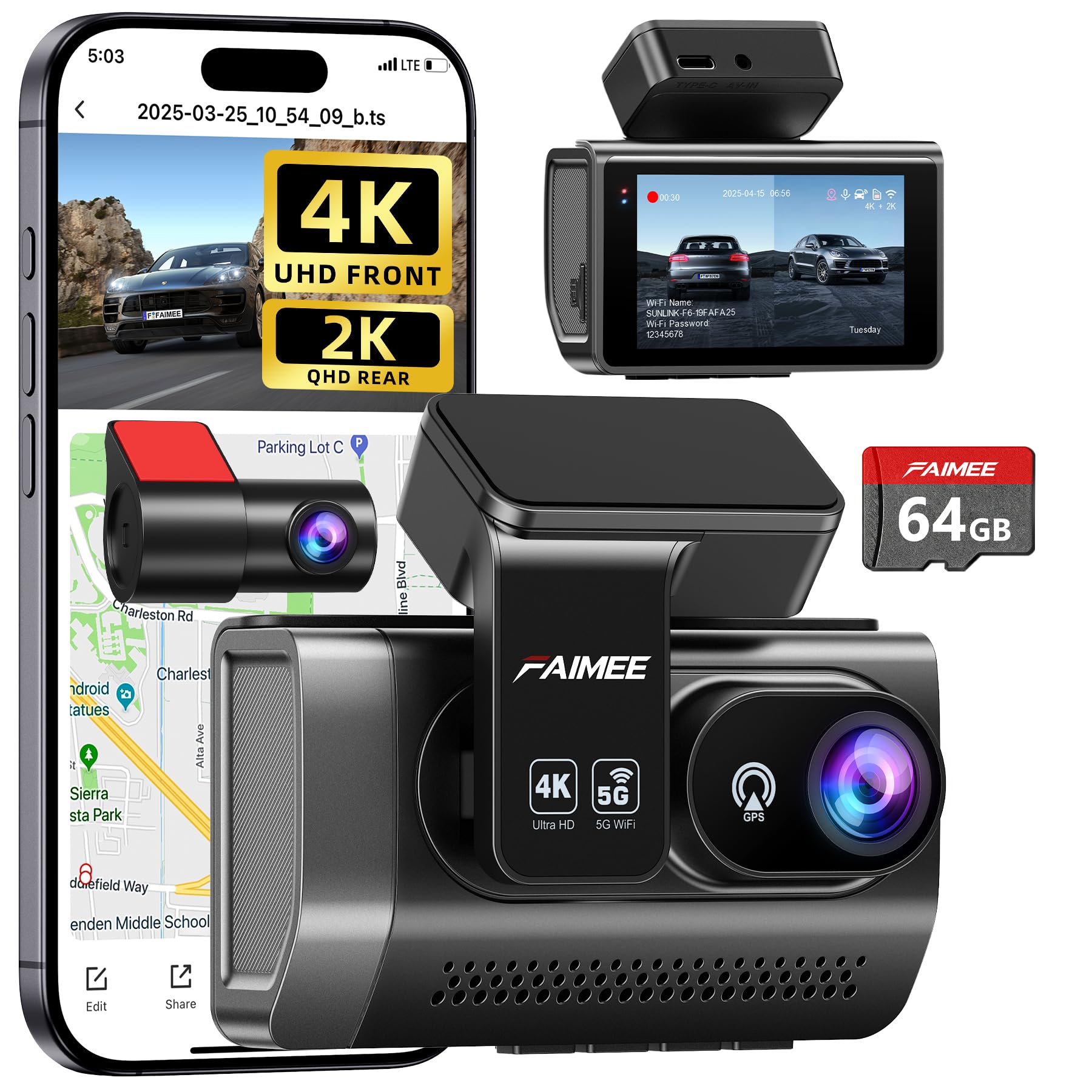
The FAIMEE F6 proves you do not need to spend top dollar for a 4K+2K dual setup with GPS. The front records crisp 4K UHD (3840×2160P) through an F1.8 aperture and 170-degree wide-angle lens, while the rear captures 2K (2304×1296P) footage. The 170-degree field of view is the widest in this lineup — matching the VIRROW X5 and covering up to six lanes of traffic. Customers note that the kit includes a 64GB high-endurance card ready to record from the start, so there is no separate purchase for day one.
Built-in GPS tracking logs your real-time speed, route history, and location coordinates directly onto the video files. That is a feature the VIRROW X5 lacks, making the FAIMEE a better pick if you want to verify incidents or tune routes. The dual-band Wi-Fi (5.8GHz/2.4GHz) connects to the FAIMEE app for live view and quick downloads.
The time-lapse parking monitor works at a low frame rate for 24-hour surveillance, auto-triggering on impact via the G-sensor. It uses a lithium-ion battery, which is less heat-tolerant than the supercapacitor in the 70mai, but the parking mode itself performs the same way. The 3-inch IPS screen and discreet design let it sit behind the rearview mirror without blocking your view.
Best Value Features
- 4K+2K (3840×2160P front / 2304×1296P rear) at a budget-friendly price
- Built-in GPS logs speed, route, and coordinates — missing from the VIRROW X5
- 170-degree front lens covers six lanes — widest view in this test
- 64GB card included, expandable to 256GB
Where It Cuts Corners
- F1.8 aperture lets in less light than the 70mai’s F1.55 or the ROVE’s F1.7
- No STARVIS 2 sensor — night footage is decent but not premium
- Lithium battery is less heat-resistant than a supercapacitor
Ideal for: budget-conscious buyers who want a 4K+2K dual-cam with GPS tracking and a wide 170-degree view.
Consider skipping if: you park in extreme heat climates (supercapacitor is safer) or need STARVIS 2-level night vision.
2. ROVE R2-4K Dual PRO
Sony’s latest STARVIS 2 sensors on both ends catch plates most cameras miss in the dark.
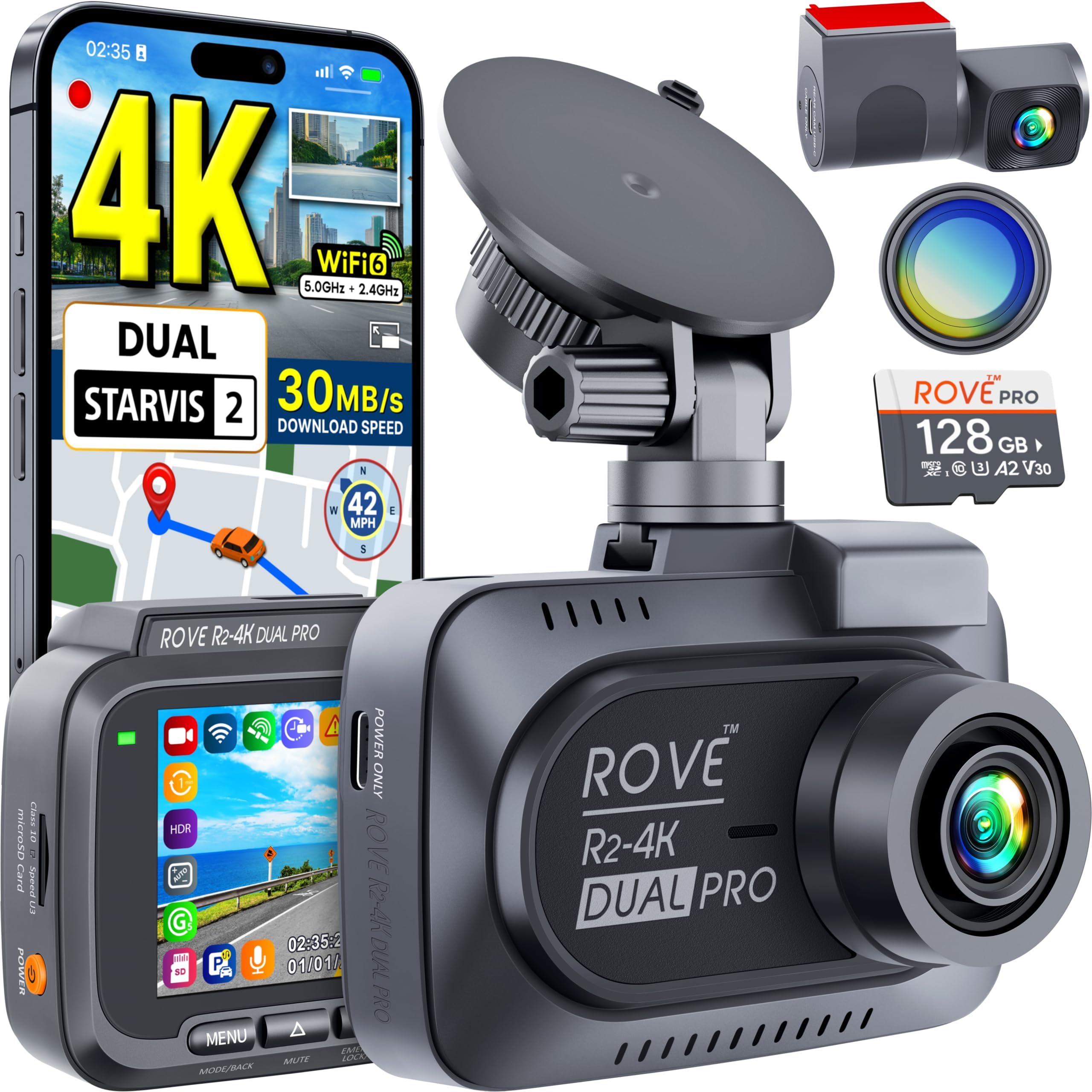
This is the pick for anyone who drives at night or parks in unlit areas. The ROVE R2-4K Dual PRO uses Sony’s dual STARVIS 2 sensors — an IMX678 (8MP) on the front and an IMX675 (5MP) on the rear — to deliver 4K (3840×2160P) front footage at 30 frames per second and 2K (2560×1440P) rear footage. The front lens has an F1.7 aperture and a 150-degree field of view; the rear has an F1.55 aperture and a 140-degree field of view. That combination gives you significantly more low-light sensitivity than the Pelsee P1 Pro, which only has STARVIS 2 on the front.
Downloading clips does not feel like a chore. The built-in dual-band Wi-Fi 6 (5GHz and 2.4GHz) reaches transfer speeds up to 30MB/s through the ROVE app, so you can pull a 4K video to your phone in seconds. The GPS is quad-mode (GPS, BEIDOU, GALILEO, GLONASS), which means it locks onto satellites faster in dense urban areas. Buyers report that the included 128GB ROVE PRO microSD card and CPL filter (which cuts windshield reflections) make this a true out-of-box setup — no extra shopping required.
The 24-hour parking monitor has three modes: time-lapse at 1 frame per second, motion detection, and collision detection. When the G-sensor detects a bump, the camera records a full 1-minute locked video and gives a voice alert when you start the car. The hardwire kit is sold separately.
What Puts It Ahead
- Dual STARVIS 2 sensors (IMX678 + IMX675) for extreme low-light clarity on both front and rear
- Wi-Fi 6 hits 30MB/s transfer speeds — fastest in this test group
- Free 128GB card and CPL filter included in the box
- Quad-mode GPS (GPS, BEIDOU, GALILEO, GLONASS) for fast satellite lock
The Trade-Offs
- Premium price reflects the dual STARVIS 2 hardware and Wi-Fi 6
- Hardwire kit for parking mode sold separately
- No interior/cabin camera — front + rear only
Your best bet if: you drive at night, park in dim garages, or want the highest sensor quality available in a dual-cam setup right now.
Look elsewhere if: you need an interior cabin camera for rideshare or a budget-first purchase.
3. Pelsee P1 Pro
Sony STARVIS 2 on the front gives you starlight-level color footage without the premium price.
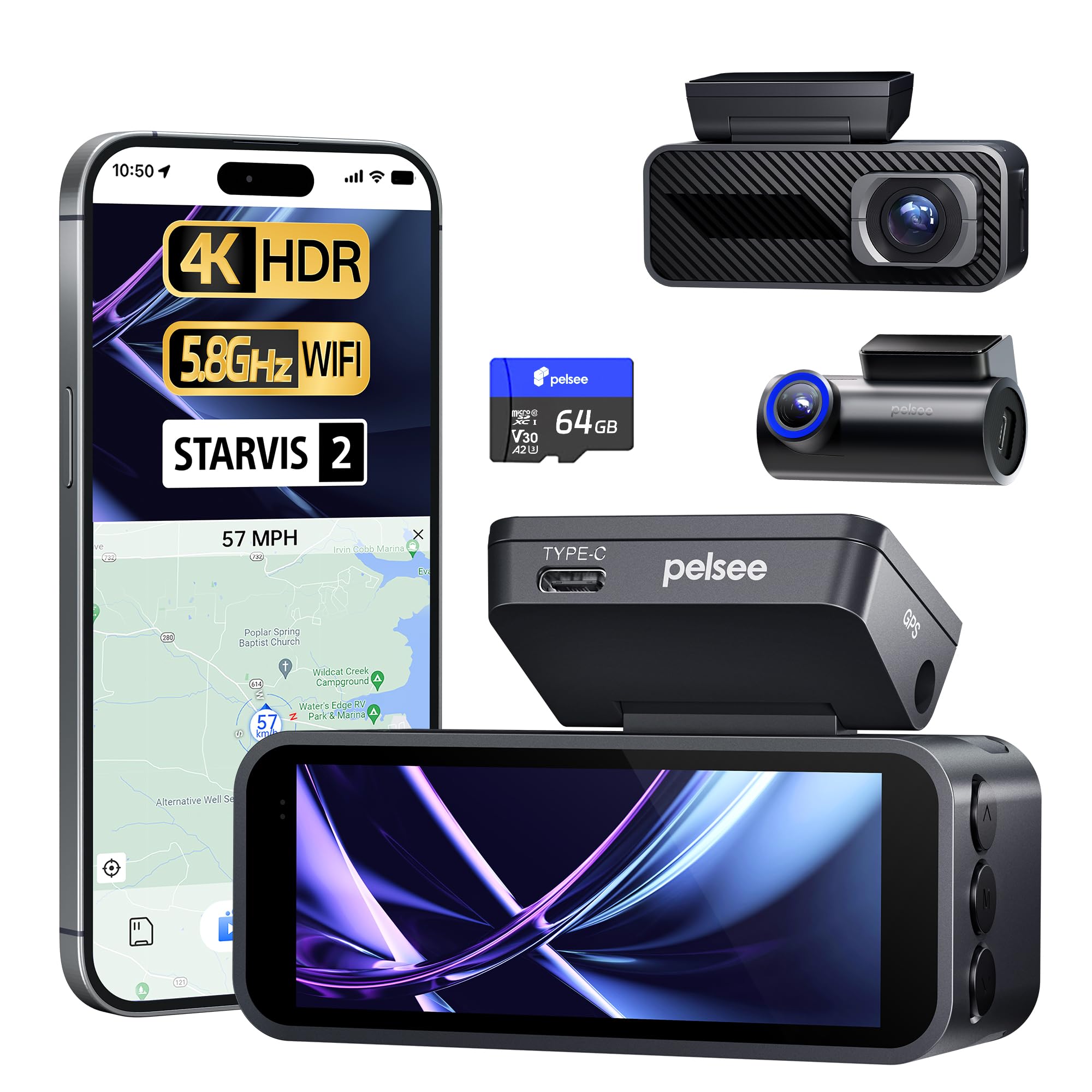
The Pelsee P1 Pro focuses its sensor budget on the front camera, where it matters most for reading plates. It uses a Sony STARVIS 2 sensor for the 4K HDR front cam, which delivers full-color night vision in starlight conditions — the same sensor technology as the ROVE, but only on one camera. The rear camera records 1080P WDR (Wide Dynamic Range), which handles backlit tunnels and fog better than a standard rear cam.
Where the Pelsee stands out is the built-in ADAS (Advanced Driver Assistance System). It gives you proactive alerts for forward collisions, pedestrian collisions, lane departure, and front vehicle start reminders, with a 0.8-to-2-second reaction time. That is a feature you do not find on the FAIMEE or the VIRROW, and it makes the P1 Pro feel like an AI co-pilot. The 3.39-inch HD IPS screen is the largest in this lineup, making menu navigation and instant playback noticeably easier than the 3-inch screens on the FAIMEE and VIRROW.
Voice control works through eight commands (including “Lock the video!”) with noise-canceling mics that filter out road noise. The 5.8GHz Wi-Fi enables real-time viewing and downloads through the Pelsee Cam app. The included 64GB card is expandable up to 512GB. The 24/7 parking mode uses G-sensor impact detection and time-lapse recording — again, a hardwire kit is needed.
Why It Stands Out
- STARVIS 2 front sensor for full-color night vision in near-darkness
- ADAS warns you of collisions and lane departures in real time
- 3.39-inch HD IPS screen — biggest display here for easy playback
- 8 voice commands with noise-canceling mics let you keep hands on the wheel
What It Sacrifices
- Rear camera is only 1080P WDR, not 2K like the ROVE or VIRROW
- STARVIS 2 is only on the front — the ROVE has it on both cams
- Hardwire kit for parking mode not included
Reach for this if: you want STARVIS 2 level night vision on a budget and appreciate ADAS warnings for daily highway commutes.
skip it if: you need a 2K or higher rear camera, or you are a rideshare driver needing an interior cabin cam.
4. 70mai 4K T800E
The front-and-interior lens setup is built specifically for Uber, Lyft, and taxi drivers.
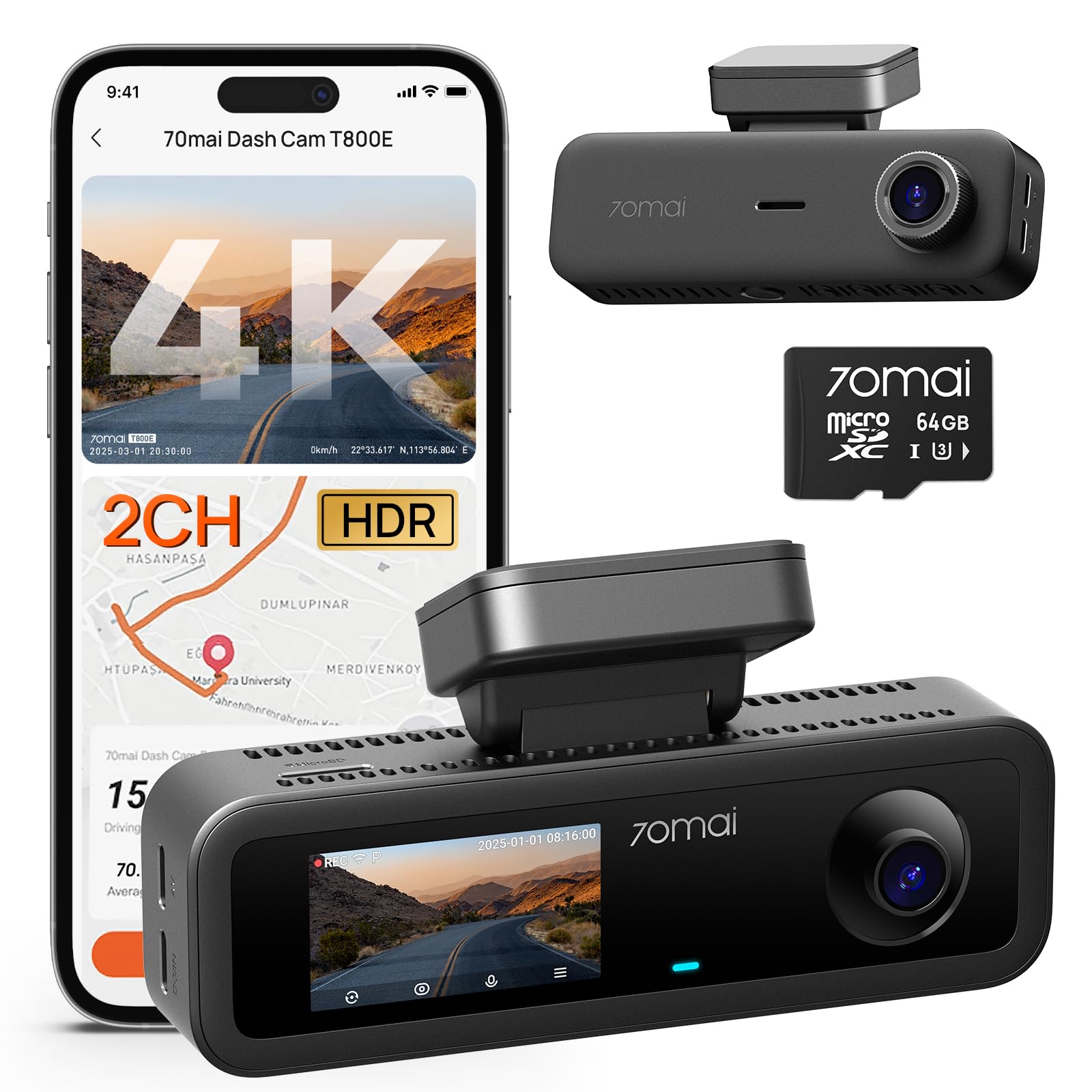
The 70mai is the only dash cam in this list that points a camera at the cabin instead of out the rear window. It records 4K HDR front footage with a large F1.55 aperture (letting in more light than the FAIMEE’s F1.8) and a built-in 1080P interior camera that captures the cabin. For a rideshare driver, that means you have video evidence of both the road ahead and what happens inside the car — tampering, disputes, or passenger behavior.
Three imaging technologies define this cam. The F1.55 aperture pulls in more light for brighter low-light footage. The MaiColor Vivid+ Solution improves color accuracy and contrast in complex lighting like tunnels or city streets. The 70mai Night Owl Vision reduces noise and preserves detail at night. Together they give you a cleaner picture than the VIRROW X5’s SC2336 sensor in dim conditions, though neither matches the STARVIS 2 low-light performance of the ROVE or Pelsee.
Built-in Wi-Fi 6 provides fast wireless transfers through the 70mai app, and voice control allows hands-free operation. The GPS records speed and location data for trip tracking. It includes a 64GB card (supporting up to 512GB) and uses a heat-resistant supercapacitor instead of a lithium battery, which is safer in hot cars. Owners mention that the 18-month warranty covers the whole unit including the SD card, and 70mai has service centers in New York and California for optional in-person installation.
Perfect For
- Front + interior recording — only cam here with dedicated cabin camera for rideshare safety
- F1.55 aperture is the widest front lens in this group for low-light intake
- Wi-Fi 6 and voice control for hands-free operation
- Supercapacitor design handles heat better than lithium batteries
The Catch
- No rear camera — you get front and interior, not front and rear
- No STARVIS 2 sensor; low-light is good but not as sharp as ROVE or Pelsee
- Price is mid-range but lacks the 2.5K rear resolution of similarly priced options
Made for: Uber, Lyft, and taxi drivers who need cabin footage for passenger disputes and accident evidence.
Not for: drivers who want rear-facing road protection — you will need a separate rear cam for that.
5. VIRROW X5
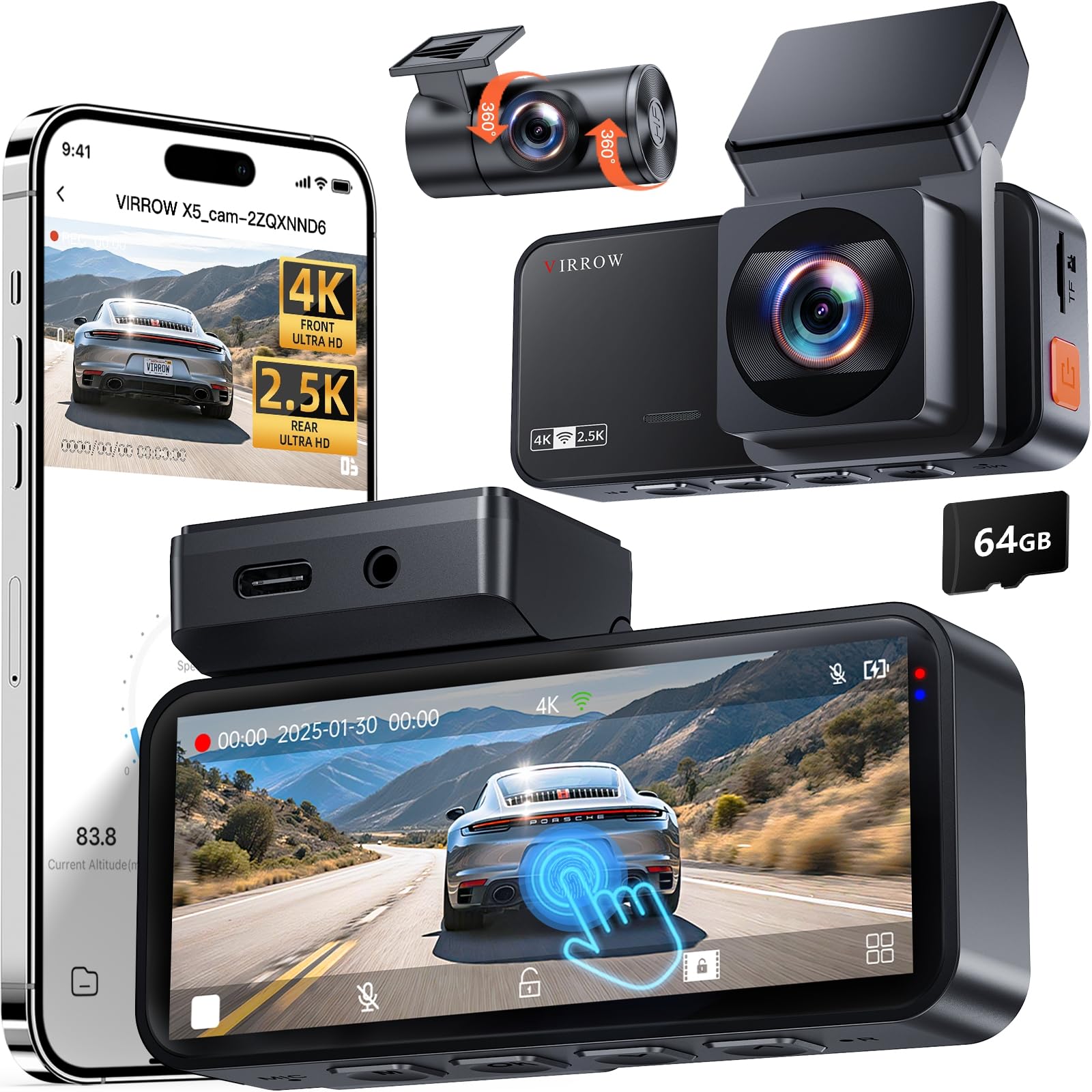
The only cam here pushing a 2.5K rear camera, and it does it at the lowest entry price.
The VIRROW X5 aims straight at the resolution enthusiast who wants the sharpest rear footage without spending for the ROVE. It records 4K on the front and 2.5K HD on the rear — a step above the 2K rear of the FAIMEE and well above the 1080P rear of the Pelsee. The front lens has a 170-degree ultra-wide view and the rear covers 165 degrees, minimizing blind spots on both ends.
The SC2336 sensor and F1.8 aperture with a 6-layer lens system do a solid job in daytime and moderate low-light, but they cannot match the Sony STARVIS 2 sensors on the ROVE or Pelsee in near-total darkness. The 3.39-inch touchscreen (same size as the Pelsee) makes navigating settings and playback intuitive — you tap directly on the screen rather than fumbling with side buttons like on the FAIMEE or 70mai.
The 24/7 parking guard uses motion sensor monitoring and time-lapse recording to condense 24 hours into minutes while parked. A 64GB memory card is included for free, and the system supports expansion up to 256GB. Reviewers point out that the installation is straightforward with the included pry tool and adhesive tape, getting both cams running in under 20 minutes. The 18-month warranty and 24/7 customer support match the FAIMEE’s policy.
Its Edge
- 4K + 2.5K (rear) is the highest rear resolution for the price
- 3.39-inch touchscreen for easy menu navigation without side buttons
- 170° front + 165° rear lens covers blind spots better than the ROVE (150° front)
- 64GB card included and ready to record from the start
Its Limits
- SC2336 sensor lacks the low-light performance of STARVIS 2 cams
- No built-in GPS — cannot log speed or route data on video files
- No Wi-Fi 6; slower transfer speeds compared to the ROVE
Grab this if: you want the highest rear resolution (2.5K) at the lowest price and like a touchscreen interface.
Consider another pick if: night-time visibility or GPS tracking are dealbreakers for you.
Understanding the Specs
STARVIS 2 Sensor — The Night Vision Champion
STARVIS 2 is Sony’s latest CMOS sensor technology designed for surveillance cameras. It delivers roughly four times the low-light sensitivity of a standard sensor (like the SC2336 found in the VIRROW X5). That means you get full-color video in starlight conditions — think a dark parking lot lit only by a distant streetlamp. A dash cam with a STARVIS 2 front sensor (like the Pelsee P1 Pro or the ROVE R2-4K DUAL PRO) will read a license plate at night where a standard sensor cam would show only a blurry shape.
G-Sensor & Parking Mode — Protection While Parked
A G-sensor (a small motion detector inside the camera) senses sudden acceleration or impact — a bump, a sideswipe, or a hit-and-run in a parking lot. When triggered, it instantly locks the current video file so it cannot be overwritten by loop recording. Parking mode takes this further by keeping the camera in a low-power monitoring state, using time-lapse recording (capturing one frame per second instead of 30) to stretch hours of surveillance into just minutes of video. A hardwiring kit (sold separately) is required for true 24-hour parking mode; without it the camera relies on its internal battery, which drains quickly.
FAQ
Will a car security camera work while my car is parked and turned off?
Do I need a hardwiring kit for 24-hour parking mode?
What is the difference between a STARVIS 2 sensor and a regular sensor for night driving?
Can I use a car security camera as a rearview mirror dash cam?
How much storage do I need for 4K dash cam footage?
Does a car security camera drain my car battery when the engine is off?
What is the best camera resolution for reading license plates at night?
Can I install a dual dash cam myself, or do I need a professional?
Final Thoughts: The Verdict
Across the board, the best car security camera winner is the ROVE R2-4K Dual PRO because it pairs Sony’s dual STARVIS 2 sensors with Wi-Fi 6 transfer speeds and a free 128GB card, giving you the clearest night footage and fastest clip downloads in this lineup. If you want full-color night vision on a tighter budget, grab the Pelsee P1 Pro — it packs a STARVIS 2 front sensor and ADAS alerts without the premium price. And for rideshare drivers who need cabin footage, the standout is the 70mai 4K T800E, with its dedicated interior camera and supercapacitor design for hot car interiors.
How We Picked
We do not accept paid placement. Every pick is matched to a real buyer and a real use-case; we do not hands-on test units.
Sources & Methodology
Specifications: manufacturer listings and product documentation. Review insights: verified customer reviews, as of July 2026. Pricing: not shown on this page (it changes often); check the current price via the retailer link.
As an Amazon Associate, Gadgets Feed earns from qualifying purchases. This does not affect which products we feature.
Related Guides
Product prices and availability are accurate as of the date/time indicated and are subject to change. Any price and availability information displayed on Amazon at the time of purchase will apply to the purchase of this product. As an Amazon Associate I earn from qualifying purchases.
CERTAIN CONTENT THAT APPEARS ON THIS SITE COMES FROM AMAZON. THIS CONTENT IS PROVIDED "AS IS" AND IS SUBJECT TO CHANGE OR REMOVAL AT ANY TIME.
Amazon and the Amazon logo are trademarks of Amazon.com, Inc. or its affiliates.