
Our readers keep the lights on and my morning glass full of iced black tea. As an Amazon Associate, I earn from qualifying purchases.
Specs are compiled from manufacturer listings and verified buyer reviews and can change over time — please confirm the key details on the product page before buying.
That constant hum from the tires, the drumming of the doors over every bump, the drone of the engine at highway speed — the difference between a car that feels tired and one that feels tight depends on what is between the metal and your ears. The right material kills that noise at its source, and this guide compares the top contenders by real-world results and build quality.
I’m Min — the founder and writer behind Gadgets Feed. This guide is built by comparing the manufacturers’ published specifications and the patterns across verified customer reviews, so you get each pick’s real strengths and trade-offs instead of marketing spin.
Whether you are chasing a cleaner stereo stage or just want a quieter commute, the best car sound deadening material is the one that matches your vehicle’s needs and your patience for installation — and this breakdown makes that choice straightforward.
Our Picks at a Glance


How To Choose The Best Car Sound Deadening Material
Sound deadening is a material science puzzle more than a simple shopping list. You are not just buying insulation — you are adding mass to a vibrating panel. The right material converts that buzzing metal energy into silent heat through constrained-layer damping. Here are the three decisions that matter most.
Butyl vs. Asphalt vs. Foam
The base material determines lifespan and smell. Pure butyl rubber (like the KILMAT and Siless offerings) stays flexible in cold weather and does not emit that tar-like odor when the cabin heats up. Asphalt-based sheets are cheaper but can drip or smell in summer sun. Closed-cell PE foam (like the 200mil roll) adds thermal blocking but is lighter, so it damps vibration less effectively by itself — it works best as a second layer over a butyl mat.
Thickness and Mass (the Mil Number)
Thickness is measured in mils (thousandths of an inch) or millimeters. A standard 80-mil sheet adds roughly half a pound per square foot of mass. That weight is what stops panel resonance. Jumping to 120 mil or 200 mil adds significantly more damping per square foot but also adds weight and can be harder to mold into tight curves. For doors and roof panels, 80 mil is the proven balance. For floors and large flat areas, thicker layers deliver a faster result.
Coverage Area vs. Install Plan
Makers advertise big square-foot numbers, but you will get the best noise reduction by covering only 25% to 50% of a panel surface in strategic strips (cut to match the natural triangles and rectangles of the metal). Full coverage is wasteful. A 36-sqft kit can easily do four doors plus the trunk floor if you apply it smartly. The adhesive tack and the ease of cutting (scissors vs. utility knife) matter more day-of than total sheet count.
Quick Comparison
| Model | Best For | Thickness | Coverage | Material | Amazon |
|---|---|---|---|---|---|
| KILMAT 80 Mil★ Best Overall | Best Overall | 80 mil (2 mm) | 36 sqft | Butyl + Foil | Amazon |
| GOSCHE 394 milTop Performer | Best Sound + Heat | 10 mm (394 mil) | 16 sqft | Closed-Cell Foam | Amazon |
| 200mil PE Foam Roll | Best Blanket Coverage | 5 mm (200 mil) | 36.16 sqft | PE Foam + Foil | Amazon |
| ZARBRE 80 Mil | Best Pure Butyl Value | 80 mil (2 mm) | 36 sqft | Butyl + Foil | Amazon |
| Siless Max 120 mil | Best Thick Butyl | 0.12 in (3 mm) | 30 sqft | Butyl Bmastic | Amazon |
| Siless Hybrid 3in1 | Best Multi-Layer | 0.2 in (5 mm) | 25 sqft | Butyl + PE + Mass Loaded | Amazon |
| Dynamat Xtreme Door Kit | Best Pre-Cut Door Kit | 1.8 mm (70 mil) | 12 sqft | Butyl Rubber | Amazon |
In‑Depth Reviews
1. KILMAT 80 Mil (2 mm) 36 Sqft Car Sound Deadening Mat
Our pick — over 4.5★ from 26,000+ verified ratings; the strongest balance of quality and price.
The crowd-sized roll that turns a hollow door into a bank-vault thud.
Each square foot sits at 0.5 lbs — enough mass to kill panel resonance without bogging down door hinges. The butyl core stays pliable in cooler weather, and the embossed foil acts as a success indicator: once rolled flat and smooth, the bond is 100% solid. One owner layered it on a 71 Barracuda and measured a drop from 71 dB to about 66 dB with two layers — a concrete 5 dB reduction.
Across thousands of installs, quality and noise-level improvements are the most-praised attributes. Buyers report that a single box covers the main panels of a sedan or light truck, and the adhesive sticks aggressively to clean painted metal. The sheets are lighter than thicker mats, making them easier to maneuver into tight cavities behind door cards. A common tip from the community is to use a seam roller for flattening overlaps — it prevents the foil edges from cutting fingers and ensures full contact.
Versus the thicker Siless options, the KILMAT is the smarter starting point for a first-time installer because it is forgiving to cut and reposition, yet delivers results that rival mats costing substantially more. The one caveat: budget-grade butyl can get messy in extreme heat, but the feedback on this specific formulation shows no complaints about dripping or odor, even when applied to roof panels under direct sun. For the combination of proven noise reduction, easier handling, and the sheer volume of satisfied owners, this is the one to beat.
Why It Wins Owners Over
- Proven 5 dB noise reduction with a two-layer install on a classic car — real data, not guesswork
- Self-adhesive butyl with an embossed foil indicator that confirms a perfect bond after rolling
- Light enough (0.5 lb per sqft) for door panels yet dense enough to stop vibration
Real-World Fit Notes
- The foil edge can be sharp — wear gloves or use a roller to push overlaps flat
- Thinner than premium 120-mil mats, so you may want two layers for maximum road-noise kill on large floor pans
Grab it if: you want the proven balance of affordability, stickiness, and sound drop that tens of thousands of owners have verified — a true one-box solution for a sedan or small SUV.
Think twice if: you are covering a large van or truck floor with massive panels and want a single-layer heavy hitter; the 120-mil Siless below may serve you better in one pass.
2. GOSCHE 394 mil 16 sqft Sound Deadener, 10mm Thick
The thickest closed-cell foam in the list — think of it as a thermal sleeping bag for your car’s metal.
At 10 millimeters thick (394 mil), this is the heavyweight champion of pure insulation in the lineup — at 10 mm thick versus the 200mil PE foam roll’s 5 mm thickness and standard 80-mil butyl mats at roughly 2 mm. The closed-cell structure does two jobs at once: it absorbs road and engine noise through its dense foam matrix, and it blocks heat transfer so effectively that owners mention a noticeably cooler cabin in summer and warmer interior in winter. The peel-and-stick backing makes installation straightforward, and owners confirm the adhesive holds strong after 9 months through heat, cold, mud, and car washes.
The crowd consensus lands on noise deduction and functionality as the standout traits — it eliminates subwoofer rattle in trucks, seals against firewall heat, and the aluminized paper layer protects RCA cables from interference. It is also the most budget-friendly option on this list, offering 16 square feet across 15 pre-cut pieces. One owner used it around car doors and speakers and found it easy to cut with scissors, with a backing that is pre-marked for quick measurements. The trade-off is that, being a foam product, it is lighter per square foot than butyl, so it is best paired with a butyl mat for maximum vibration damping — think of it as the second layer in a two-step system rather than a standalone cure for panel drumming.
Versus the 200mil PE foam roll, the GOSCHE is thicker at 10 mm vs. 5 mm, which gives it a clear edge in heat insulation and noise blocking for the same price tier. It is the right pick for someone who wants maximum acoustic and thermal improvement from a single material and is working on a smaller area like a cabin firewall, a pair of doors, or a trunk floor. The only durability concern flagged in a few longer-term reviews is that the foam can degrade if exposed to constant moisture, so sealing edges with tape is a smart precaution.
Best bang for your insulation buck: the thickest foam panel here, pre-cut in 15 pieces, with adhesive that survives 9 months of weather extremes — a genuine two-in-one noise and heat solution for under.
One honest caveat: it is foam, not butyl, so panel vibration damping is less aggressive than a 120-mil butyl mat alone; layer it over a butyl sheet for a pro-grade finish.
Reach for this if: heat blocking is as important as sound dampening — the 10 mm foam stops engine bay warmth like nothing else here.
Look elsewhere if: you want a single-product solution for rattling door panels and road noise; a butyl mat hits harder for vibration.
3. 200mil 36.16 Sqft Car Sound Deadener, 5mm PE Foam Roll

A single continuous roll that covers almost 37 square feet — one unbroken sheet for van floors and truck walls.
This roll ships as a single 315-inch long by 16.5-inch wide mat, which means you can lay it across large flat surfaces without seams — a major advantage for cargo vans, SUV cargo areas, and truck floorboards where multiple small sheets would create gaps. The closed-cell PE foam core is finished with a 5A-grade aluminum foil that resists oil, water, and UV radiation, and the working temperature range of -40°C to +149°C means it will not degrade in extreme climates. Owners confirm that a single pass on a 2024 cargo van reduced road noise from wheel wells and side walls noticeably, and the material keeps heat out in summer while holding warmth in winter.
The most-discussed aspect is adhesion — it is rated as MIXED by the customer consensus, meaning the adhesive is strong enough for a permanent install on clean dry metal but is not as aggressively tacky as the butyl mats. A few owners note that the foam is somewhat fragile and can tear if you try to reposition it, so careful first placement is essential. On the plus side, the material cuts easily with a carpet knife and the wide 16.5-inch width lets you cover door inner panels in one strip. At 36.16 square feet, it offers the second-largest coverage area in the list (matching the KILMAT but in a different format), yet it is one of the lighter options due to the foam construction.
Versus the GOSCHE foam above, this roll has a thickness of 5 mm versus 10 mm and coverage of 36.16 sqft versus 16 sqft — making it the smarter choice for large-area projects where weight and budget are concerns. It works beautifully as a second-layer thermal barrier over a butyl mat, but if you want a single-material solution for both vibration damping and heat blocking, a butyl-foam hybrid like the Siless 3in1 below will outperform it. Keep the fragile foam and moderate stickiness in mind — treat it gently during install and it performs well.
Best for big blank canvases: the continuous 26-foot roll eliminates seam gaps on van walls and truck floors, and the foil face reflects heat efficiently all year round.
An honest trade-off: the adhesive is less grabby than butyl mats, and the foam can tear if you pull it back — measure twice, stick once.
Suits you if: you are soundproofing a cargo van, a large SUV trunk, or any big metal surface where uninterrupted coverage saves hours of cutting and patching.
Not your best bet if: you need maximum vibration damping per square inch; a butyl mat delivers more mass for killing panel resonance.
4. ZARBRE 80 Mil 36 sqft Car Sound Deadening Mat, 33 Sheets
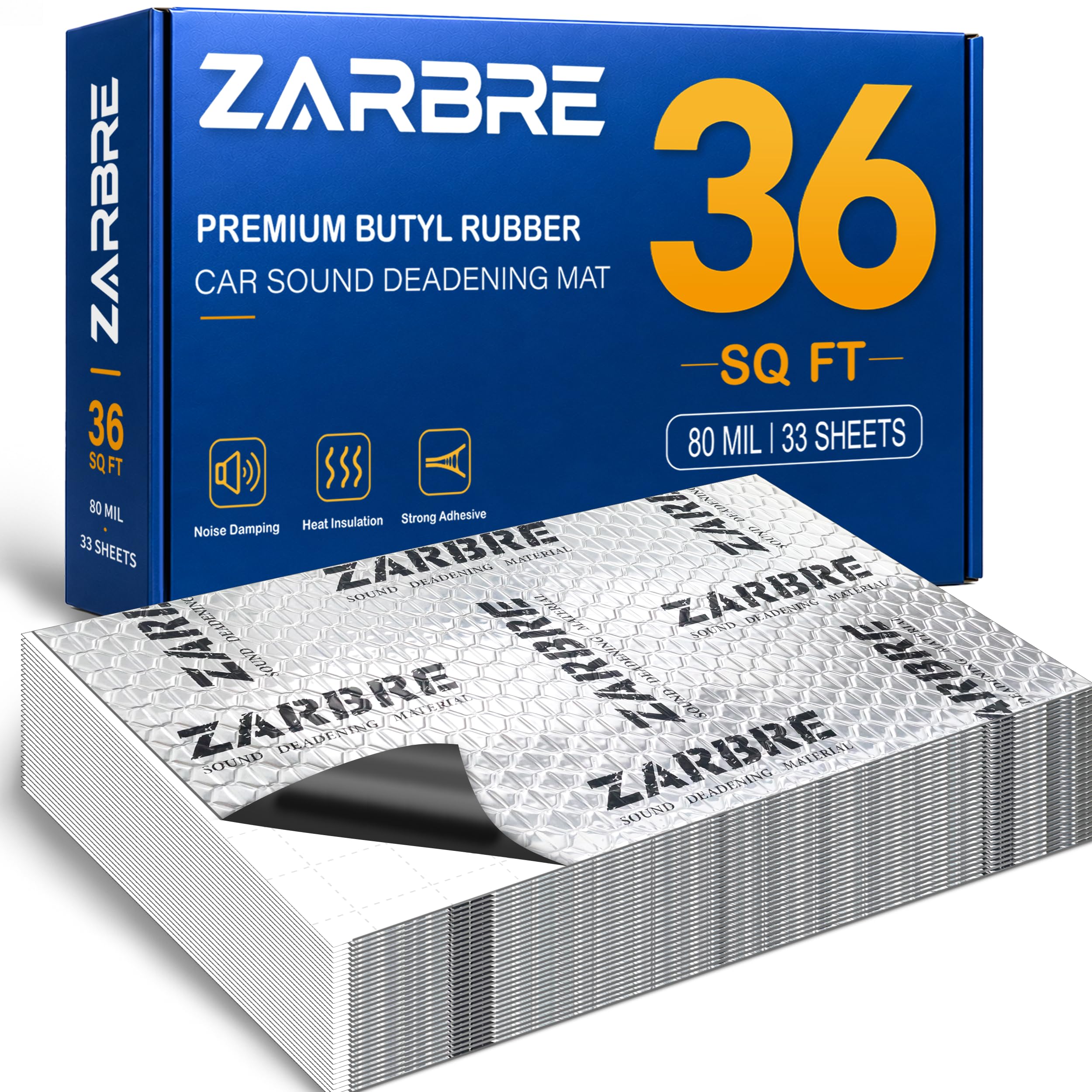
Pure butyl with no asphalt fillers — the odor-free option for hot-climate drivers.
The headline here is the material honesty: high-purity natural butyl rubber without asphalt fillers, which means zero unpleasant odor even when the cabin temperature spikes in summer. The 80-mil triple-layer composite combines a pure butyl core (for vibration absorption), a reinforced foil layer (reflecting 90% of heat), and a high-tack adhesive that forms a permanent melt-proof bond. The kit comes with 33 dense sheets totaling 36 square feet, which is enough to cover four doors plus a trunk floor on a typical sedan or SUV — no guesswork on quantity.
Owner feedback highlights noise cancellation and value for money as the strongest aspects — the mat “heavily reduces resonance and drum-like sound on large panels” according to one report, and a 50% coverage pattern on fenders and doors yielded noticeable improvement. The foil features a special embossed diamond pattern that serves as a visual installation guide: once you roll it flat and smooth, the bond is correct and professional. One owner installed it under and behind the back seat of a 1965 Mustang, confirming it conforms easily to complex curves and cuts cleanly with a blade or scissors.
Where it differs from the KILMAT is in the sheet count and the adhesive feel. The ZARBRE provides 33 sheets vs KILMAT’s fewer large pieces, which some users find easier to handle for spot-treatment of small panels. The recurring minor complaint is that the diamond pattern does not fully flatten after rolling, making it slightly harder to visually confirm full adhesion compared to KILMAT’s smoother foil. Performance-wise, owners describe it as identical to brands like Noico and Dynamat but at a friendlier price point. The waterproof construction ensures reliable performance in wet conditions, and the lack of smell makes it a standout for daily drivers parked in the sun.
What Owners Appreciate Most
- Zero odor — pure butyl without asphalt means no chemical smell in hot weather
- 33 pre-cut sheets for easy spot-treatment of doors, floors, and trunk panels without waste
- Triple-layer design that reflects 90% of heat while absorbing panel vibrations
A Practical Consideration
- The embossed diamond pattern doesn’t flatten completely, so you rely on feel rather than sight to confirm a full roll-down
- A few owners wish the adhesive was tackier for instant grab on vertical panels
Best if: you or your passengers are sensitive to chemical odors — this is the cleanest-smelling butyl mat in the lineup, even under direct summer sun.
skip it if: you want the smooth foil finish of the KILMAT for easier visual inspection of the bond; the ZARBRE’s diamond texture is a minor visual trade-off for the same performance.
5. Siless Max 120 mil (3mm) 30 sqft Car Sound Deadening Mat

At 120 mil (3mm), thicker than standard 80-mil mats — the butyl blanket that turns a 10-year-old Civic into a near-Lexus experience.
Siless uses a proprietary Bmastic formulation that is noticeably denser than basic butyl. At 120 mil (0.12 inches or 3mm), this mat adds significant mass per square foot, which translates directly into stronger vibration damping on large panels like floorpans, roof skins, and hoods. Customers note that a partial installation covering the hood, hatchback, trunk, and doors of a Toyota Yaris drastically reduced road noise — one described the transformation as making a decade-old base Civic “feel like a Lexus.” The aluminum coating aids heat dissipation, and the surface has a subtle indent pattern that makes rolling and cutting easier than plain butyl, especially in warmer weather when the material softens.
The quality and ease of installation are the most-praised attributes, with over 70 positive mentions each. The peel-and-place application is straightforward: trim to fit, peel the backing, and hand-roll for full adhesion. No spray adhesives or special tools are required, though a roller is recommended for tight corners. Owners of F-150s and Civics both confirm it significantly reduces exhaust noise and tightens the sound system’s bass response.
The main discussion point is thickness — some owners find it thicker than expected, which can make molding into complex curves slightly more effort than 80-mil sheets. The included instructions are clear, but a roller is not provided, so you will need to pick one up separately or use a makeshift tool like a wooden dowel. There are no complaints about smell or off-gassing, and the butyl stays pliable in cold weather. For anyone looking to step up from entry-level 80-mil without jumping to a multi-layer composite, the Siless Max delivers the densest single-layer performance in this guide. It beats the KILMAT on pure mass-per-sheet, so it hits harder on floor and firewall drone.
The densest butyl sheet here: 120 mil of Bmastic compound that delivers Lexus-level cabin quiet on a reasonable budget, with easier cutting than standard butyl thanks to the indent pattern.
One thing to know: you will need a roller for proper adhesion — it is not included in the box, so add one to your cart before the mat arrives.
Pick this if: you want a single-layer heavy hitter that handles floor pans and large panels without needing a second pass — the 120 mil mass is the real deal.
Consider other options if: you are working on tight door internals with complex curves; 80-mil mat is easier to mold into every crevice.
6. Siless Hybrid 3in1 200 mil 25 sqft Car Sound Deadening Mat

A three-layer composite — butyl mastic, PE foam, and mass-loaded membrane — that attacks vibration, heat, and low-frequency noise in one sheet.
This is the only true multi-layer composite in the roundup, combining a butyl mastic damping layer, a closed-cell PE foam thermal barrier, and a mass-loaded butyl membrane for blocking low-frequency exhaust drone and road rumble. At 200 mil (0.2 inches or 5mm) thick, it is twice the thickness of the 80-mil standard mats and the same thickness as the 200mil PE foam roll, but with the critical difference of having a dense butyl core for vibration killing. The three layers solve three distinct problems — panel resonance, heat transfer, and low-frequency noise — in a single peel-and-stick application. Owners have used it on four different vehicles and report that it dramatically reduces cabin noise, making aggressive exhaust systems barely audible inside.
Noise level and quality are the two most-praised aspects, with each attracting over 85 positive mentions. The mat is soft and flexible, cutting easily with scissors (no hand cuts from foil edges), and it molds into complex shapes without fighting back. One owner covered an entire exterior and interior panel set on a truck and described the result as “incredibly quiet” for a total material cost far less than premium brands. The adhesive is very aggressive — some owners find it almost too tacky in hot weather, recommending you keep the material cool before application to prevent it from grabbing prematurely. Sealing the seams with aluminum tape is a common tip for maximizing the thermal barrier effect.
Versus the Siless Max 120 mil above, the Hybrid is the more complete solution if you are tackling both temperature and sound issues because the foam layer adds insulation that a pure butyl sheet cannot provide. At 25 square feet, the coverage is smaller than the Max’s 30 sqft, but the Hybrid handles three jobs at once, so you may need less total material to achieve your goal. The single trade-off mentioned by owners is that the extra thickness (5mm) can make it slightly harder to fit into very tight door cavities compared to a flexible 80-mil mat. It also carries a higher price per square foot, but the all-in-one convenience reduces the need for a separate heat barrier layer.
Three Jobs, One Sheet
- Multi-layer design dampens vibration, blocks heat, and absorbs low-frequency exhaust drone simultaneously
- Soft and flexible — cuts with standard scissors and molds into tight curves without resistance
- Aggressive adhesive that stays put in extreme temperatures when installed correctly
Installation Notes
- The adhesive can be too grabby in hot weather — chill the material before applying for easier positioning
- At 5mm thick, it is bulkier than 80-mil mats for deep door cavities; measure your panel gaps first
Choose this if: you want a single-product solution for sound, vibration, and heat — the three-layer design eliminates the need to buy separate butyl and foam rolls.
Maybe not if: you are working on small door panels with minimal clearance; the 5mm thickness can be a squeeze where a thinner 80-mil mat slides in easily.
7. Dynamat Xtreme Sound Deadening Door Kit 10435

The name that started the category — a pre-cut door kit from the brand that has been made in Ohio since 1989.
Dynamat is the original sound deadening brand, and this Xtreme door kit is tailored specifically for standard car doors — four sheets measuring 12″x36″ each, totaling 12 square feet, enough for two doors. The butyl rubber proprietary blend is extra sticky and stays put, but it is also forgiving enough to allow repositioning before you roll it down — a rare combination that makes it easier to get right on the first try. The material is only 1.8mm thick (roughly 70 mil), making it the thinnest option here, but the formulation is dense enough that a single layer eliminates metal rattling and solidifies the door-close sound immediately.
Noise level and quality lead the feedback with over 120 and 80 mentions respectively, both rated positive. Reviewers point out that one box completely eliminates door rattling at high stereo volumes and improves bass and mid-range punchiness by roughly 20%. The material cuts easily with scissors or a utility knife, and the adhesion is described as strong but repositionable — a few owners used a tennis ball as a makeshift roller to press it into corners. A single kit covers two standard front doors, so you will need two boxes for a four-door vehicle. The instruction tip that surfaces repeatedly is to heat the material gently to soften it for tight curves, but avoid overheating or it becomes too soft to handle.
The value-for-money aspect is where opinions split — some owners find it expensive compared to the alternatives like KILMAT or Siless, which offer more square footage for a lower price. However, the counterpoint is that Dynamat’s reputation and consistency make it the default recommendation for professional installers and custom builders who cannot afford a material failure. The material has no lingering odors and has proven adhesion in hot South Texas climates without degrading. If you are upgrading a premium sound system in a specific car and want the confidence that the original formula provides, the extra cost is an insurance policy against redoing the job. For most DIYers, the alternatives above deliver similar performance at a lower per-square-foot cost, but Dynamat remains the gold standard for those who value brand consistency above all else.
The benchmark brand: four pre-cut sheets sized for standard car doors, with repositionable adhesion that forgives first-time mistakes — the safest bet for a flawless first install.
An honest value read: the cost per square foot sits well above the butyl alternatives here, but the adhesive formulation and USA-made consistency win over professionals who bill by the job, not by the sheet.
Ideal if: you are upgrading a high-end car audio system and want the proven standard that professional builders trust — the repositionable adhesion is a real time-saver.
Consider other options if: you are covering a whole vehicle floor-to-roof; the cost adds up fast, and the 80-mil alternatives give you more square footage for the same budget.
Understanding the Specs
Mils and Millimeters — What Thickness Really Does
A spec like “80 mil” or “200 mil” refers to the material’s thickness in thousandths of an inch. 80 mil (roughly 2 mm) is the standard for door panels and roof skins — it adds enough mass to stop vibrations without making the panel sag. Jumping from 80 mil (2 mm) to 120 mil (3 mm) gives you more damping per square foot, which hits harder on floor pans and firewalls where engine drone lives. The thickest options like 200 mil (5 mm) or 394 mil (10 mm) are typically composite or foam materials that trade some vibration-stopping power for superior heat insulation.
Butyl vs. Asphalt vs. Foam — The Material Choice
Butyl rubber is the gold standard because it stays flexible across temperature extremes, adheres aggressively to metal, and does not emit odor when hot. Asphalt-based mats work but can smell or drip in direct sun — avoid them for roof and firewall applications. Closed-cell PE foam is excellent for heat blocking and airborne noise absorption but adds less mass, so it works best as a second layer over butyl rather than a standalone solution. The three-in-one composites layer butyl, foam, and a mass-loaded barrier to attack all three problems (vibration, heat, low-frequency noise) in one sheet, saving install time at a higher material cost.
FAQ
How much sound deadening material do I need for a standard sedan?
Can I install sound deadening material myself without special tools?
Does sound deadening material also reduce heat in the cabin?
Will car sound deadening material make my stereo sound better?
What is the difference between 80 mil and 120 mil material?
Can I use sound deadening material on the roof of my car?
Is there a risk of the material melting or dripping in summer heat?
How long does the installation process take for a set of four doors?
Should I cover the entire panel or just part of it?
Can I stack two layers of sound deadening material for better results?
Final Thoughts: The Verdict
For most buyers, the best car sound deadening material winner is the KILMAT 80 Mil because it delivers proven 5 dB noise reduction at a weight and price that makes sense for an entire sedan or small SUV, backed by a consistent quality reputation across tens of thousands of owners. If you want maximum heat insulation and noise blocking from a single thick material, grab the GOSCHE 394 mil 10mm foam. And for a premium all-in-one solution that handles vibration, heat, and low-frequency drone in one sheet, the Siless Hybrid 3in1 is the one to reach for — just be ready for its aggressive adhesive in warm weather.
How We Picked
We do not accept paid placement. Every pick is matched to a real buyer and a real use-case; we do not hands-on test units.
Sources & Methodology
Specifications: manufacturer listings and product documentation. Review insights: verified customer reviews, as of July 2026. Pricing: not shown on this page (it changes often); check the current price via the retailer link.
As an Amazon Associate, Gadgets Feed earns from qualifying purchases. This does not affect which products we feature.