
Our readers keep the lights on and my morning glass full of iced black tea. As an Amazon Associate, I earn from qualifying purchases.
Specs are compiled from manufacturer listings and verified buyer reviews and can change over time — please confirm the key details on the product page before buying.
That tinny rattle at highway speed is not a badge of ownership — it’s a signal that your car’s paper cone speakers have given up. A good car speaker set restores the bass and clarity that factory paper cones cannot deliver. This guide walks you through seven proven upgrades, from plug-and-play coaxials to component systems that stage the sound like a live show.
I’m Min — the founder and writer behind Gadgets Feed. This guide is built by comparing the manufacturers’ published specifications and the patterns across verified customer reviews, so you get each pick’s real strengths and trade-offs instead of marketing spin.
if you want louder vocals, deeper lows, or cleaner highs at highway speed, the right best car speaker set depends entirely on your vehicle’s stock setup and whether you plan to run an external amplifier.
Our Picks at a Glance


How To Choose The Best Car Speaker Set
Picking a speaker upgrade starts with a single question: are you keeping your factory stereo, or adding an external amplifier? The answer dictates if you need a high-sensitivity coaxial or a more power-hungry component system. Here are the three specs that make or break the swap.
Sensitivity — the loudness you get without an amp
Measured in decibels (dB), sensitivity tells you how loud a speaker gets from a given amount of power. A rating of 91 dB or higher means the speaker will sound punchy straight from your stock radio. Lower sensitivity, like 88 dB, usually needs an external amplifier to sound lively.
RMS power handling — the continuous wattage you should feed it
RMS (root mean square) is the steady power a speaker can handle without distorting or damaging the voice coil. Peak wattage is a flash-in-the-pan number. Match the speaker’s RMS to what your head unit or amp actually delivers — a 40-watt RMS speaker is a sensible target for most factory replacements.
Coaxial vs component — one is a direct swap, the other demands more work
Coaxial speakers pack the tweeter onto the same frame as the woofer, making them a direct bolt-in replacement. Component systems split the tweeter away from the woofer and add an external crossover (a box that sends the right frequencies to the right driver), which lets you mount the tweeter higher for better stereo imaging. That separation comes with more wiring and cutting.
Quick Comparison
| Model | Best For | Speaker Type | Max Power | Sensitivity | Amazon |
|---|---|---|---|---|---|
| KICKER CSC65 2-Pair★ Best Overall | Complete four-speaker swap | Coaxial | — | — | Amazon |
| Pioneer TS-A1671FBudget Champion | Budget-friendly factory upgrade | Coaxial 3-Way | 320 W | 91 dB | Amazon |
| MB Quart FSB216 | Component clarity on a budget | Component 2-Way | 150 W Peak | — | Amazon |
| Pioneer TS-A1681F | Bass-heavy daily driver upgrade | Coaxial 4-Way | 350 W | 91 dB | Amazon |
| Rockford Fosgate R165-S | Component sound from a trusted brand | Component 2-Way | 80 W Peak | — | Amazon |
| HERTZ UNO K-165 | High-quality natural sound | Component 2-Way | — | — | Amazon |
| JBL GTO629 | Rich bass with a unique tweeter | Coaxial 2-Way | — | — | Amazon |
In-Depth Reviews
1. KICKER 46CSC654 – Two Pairs of CS-Series CSC65 6.5-Inch Coaxial Speakers
Our pick — over 4.5★ from 300+ verified ratings; the strongest balance of quality and price.
Four speakers in one box for a full-cabin overhaul in a single afternoon.
Sound quality is the most praised feature, and the improvement is immediate after installation. The CS-Series uses a heavy-duty motor and magnet structure with an Extended Voice Coil (EVC, a design that pushes the coil deeper into the magnetic gap for more low-end authority) to dig deeper into the bass without distorting. A UV-treated poly-foam surround keeps the cone from cracking when the sun bakes your door panel.
Installation is where this pair separates from the competition. The mounting depth is aggressively shallow, which means these 6.5-inch coaxials fit in nearly every car and truck door without a spacer or modification. Buyers report having them installed for over eight months with “still great quality” sound, and multiple owners confirm that they work as a direct plug-and-play replacement — no brackets needed — in late-model vehicles like the 2024 Toyota RAV4. The stamped-steel frame and zero-protrusion PEI tweeters (polyetherimide, a heat-resistant plastic that delivers smooth highs from the same axis as the woofer) mean nothing pokes into your factory grille.
The trade-off is you get two pairs — four speakers total — which is exactly what you need for front and rear doors, but if your car only needs two, you are left with spares. The KICKER is also a crowd favorite at well over 300 ratings, making it the most confidence-inspiring pick on this list for someone who just wants the job done once.
Why it wins
- Includes two full pairs for a four-speaker swap with zero extras to buy
- Ultra-shallow mounting depth clears tight factory doors in almost any make
- UV-treated foam surround handles direct sunlight without turning brittle
Who should think twice
- If your car only uses two speakers, the second pair sits unused
- Buyers seeking subwoofer-level bass will still need a dedicated enclosure
Reach for this if: you want to refresh all four doors in one order and value proven fit over boutique brand names.
Look elsewhere if: you need a component system with separate tweeters for custom staging or you only drive a two-seater.
2. Pioneer A-Series Standard TS-A1671F 6.5” 3-Way Speakers
91 dB sensitivity means real volume from a stock radio without plugging in an amplifier.
If you are upgrading a factory system on a tight budget, this Pioneer pair delivers dynamic and clear sound for less than you would expect. The three-way design uses separate drivers for bass, midrange, and treble, which keeps vocals distinct from the guitar and kick drum. The frequency response range of 37 Hz to 31 kHz covers deep lows (way below what most people can hear) all the way up to sparkling highs, so older compressed MP3s still sound open rather than muffled.
Sound quality is the top praise by a wide margin — 57 owners single it out — and the included multi-fit mounting adapters fit common vehicles like the Toyota RAV4 or first-generation Tacoma without extra brackets. The sensitivity rating of 91 dB is what makes this Pioneer stand out from cheaper coaxials: it produces clear, loud sound even when fed by a low-wattage head unit. As the review pages sum it up: “clear mids/highs,” though some note the bass is modest unless you add an amplifier later. The set handles 320 watts peak and 70 watts continuous, giving you room to grow.
The honest catch is build materials. A few owners felt the quality was slightly disappointing compared to premium brands, and fit can be snug in certain door panels. Still, for a 6.5-inch coaxial that includes adapters, speaker wire, and mounting screws right in the box, this Pioneer is the most cost-conscious route to noticeably better sound.
What makes it a smart buy
- 91 dB sensitivity delivers highway-volume sound from a factory stereo
- Comes with multi-fit mounting adapters and all hardware in the package
- Three-way design keeps vocals, mids, and highs from blending into mud
What to know before you buy
- Low-end bass is lightweight until you pair with an external amplifier
- Build quality reported as merely decent rather than premium-feeling
Best for: first-time upgraders who want immediate volume and clarity without spending on an amp.
Think twice if: you demand deep subwoofer-like bass or prefer the separate tweeter placement of a component system.
3. Pioneer A-Series Plus TS-A1681F 6.5” 4-Way Speakers

A fourth driver for smoother highs and a frequency response that dips to 35 Hz.
This Pioneer upgrade takes the 3-way formula and adds a fourth driver to split the treble range even finer, which can reduce harshness at louder volumes. The result is a richer, more balanced sound reproduction across different music genres, and the response range of 35 Hz to 29 kHz captures low organ notes that single-woofer designs simply cannot reach. Maximum power handling hits 350 watts with 80 watts continuous, giving you headroom if you ever add an amplifier down the road.
Sound quality is the overwhelming praise — 65 owners highlight it as the standout feature. Buyers describe the audio as “crisp” and “very loud compared to stock,” with one owner noting that these speakers sounded better than a much more expensive pair of Morels they had installed in the front doors. The 91 dB sensitivity makes them loud straight from a factory radio, and the included 6.5-inch multi-fit installation adapters remove the guesswork from the swap. Several owners confirmed a roughly 30-minute install.
The one asterisk is that a small number of listeners detect slight midrange distortion when the volume is pushed very high. That same owner, however, still called it a “MASSIVE upgrade over Toyota OEM speakers.” At 1.8 pounds per pair, these are light enough to ship easily without adding unsprung weight to your door panel.
Its strongest points
- 4-way driver layout smooths high-frequency response for fatigue-free listening
- 91 dB sensitivity means strong output without an amp
- Complete installation adapters included right in the box
A note to consider
- A minority of owners mention slight midrange breakup at extreme volume levels
Ideal for: daily drivers who want a clear, loud upgrade that beats factory speakers by a wide margin.
Pass if: you plan to listen at concert-level volumes regularly and need flawless midrange linearity.
4. JBL GTO629 Premium 6.5-Inch Co-Axial Speaker – Set of 2

Aim the tweeter at your ears even when the speaker sits low in the door.
JBL’s patented UniPivot tweeter is the reason to pick this set. Unlike fixed coaxials where the tweeter fires straight up, this one swivels so you can point the treble toward your head — a real help when the speakers are mounted down near your knees. The carbon-injected Plus One cones are physically larger than competing 6.5-inch cones in the same size class, so they push more air and produce noticeably more bass. With a mounting cutout diameter of 5-1/16 inches and a mounting depth of only 2 inches, these fit relatively shallow doors without serious modification.
Sound quality earns the most positive feedback here. Customers note “crisp sound” and call them a “great upgrade from factory ones.” The dual-level tweeter volume adjustment lets you dial back the highs if the mounting position makes them too bright — a feature you will not find on most coaxials at this level. The 3-ohm impedance is lower than standard 4-ohm speakers, which compensates for the thin wires in modern cars and gets more usable volume from the same wattage.
Fit is the mixed point. Several owners note these are not a perfect drop-in for every vehicle; a Honda Element install required a slight trim on the cover. The outer diameter is 6-1/4 inches measured externally, so check your factory opening carefully. A small number of review mentions report tweeter intermittency, but the overwhelming sentiment is that the clarity makes the effort worthwhile.
Why it stands out
- UniPivot swiveling tweeter lets you aim high-frequency sound at the listening position
- Plus One cone moves more air for deeper bass than standard 6.5-inch cones
- Dual-level tweeter adjustment tailors treble to your car’s acoustics
What to watch for
- Not a perfect fit for all vehicles — some door trim trimming may be needed
- Rare reports of tweeter failure, though far from a pattern
Grab these if: door tweeter placement in your car forces the highs to fire past your ears at an awkward angle.
Skip if: you prefer a guaranteed no-mod drop-in for an older or unusual vehicle.
5. MB Quart FSB216 Formula Component Speaker System
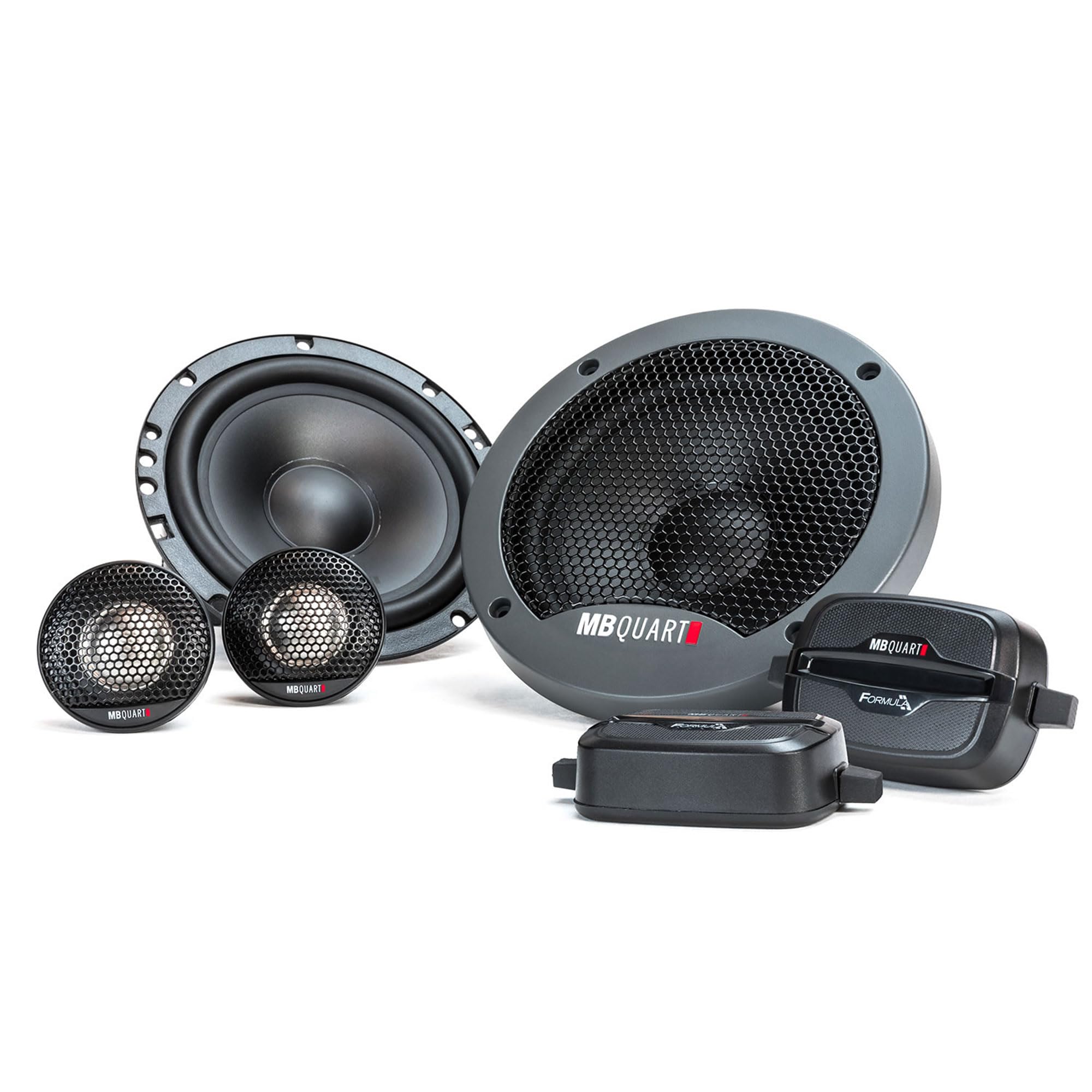
A pair of crossovers and a titanium dome tweeter for audiophile staging on a parts-store budget.
Component systems usually cost a premium, but MB Quart packs the key components — separate woofer, separate tweeter, and an outboard crossover (a box that sends the correct frequencies to each driver) — into a package that competes directly with coaxials at the same price. The 6.5-inch polypropylene cone handles the midrange and bass, while the 19mm titanium dome tweeter reproduces high frequencies with a crisp detail that soft-dome tweeters can miss. Peak power is 150 watts, and the RMS rating sits at 40 watts at 4 ohms, so this system partners well with a modest amplifier.
Value for money is the top positive aspect by a clear margin. Owners running 60 watts per channel from a head unit report “decent, clear sound,” while those feeding 100 watts from a dedicated amp say the system gets “much louder” and stays balanced. The external crossover gives you the ability to fine-tune which frequencies go to the woofer and which go to the tweeter — the main reason component systems can sound cleaner than coaxials. One owner described the sound as “amazing” paired with a CT Sounds amplifier.
Sound quality itself draws mixed feedback though: some find it crisp, while others say they had to “defeat almost all bass” to make it listenable. This is not a speaker for bass-heads — the polypropylene cone and shallow basket design trade low-end extension for midrange clarity. Size (6 inches, not the usual 6.5) also requires checking your mounting depth compared to a drop-in coaxial like the KICKER CSC65.
What sells it
- Full component system with separate crossover at a coaxial price point
- 19mm titanium dome tweeter for exceptionally clear, crisp highs
- Strong value reputation — owners consistently praise the cost-to-performance ratio
Where you compromise
- Bass output is limited — this system emphasizes mids and highs
- Sound quality opinions are split; some find it bright, others balanced
Pick these if: you want the staging and clarity of separate tweeters without jumping past the mid-range budget.
Consider something else if: your listening priorities are thumping bass or completely drama-free installation.
6. Rockford Fosgate Prime R165-S 6.5″ 2-Way Component Speaker System

A classic brand’s entry-level component kit that punches well above its power rating.
Rockford Fosgate’s Prime series is where many car audio enthusiasts started, and the R165-S shows why. This 6.5-inch 2-way component system delivers 40 watts RMS and 80 watts peak, using a mica-injected polypropylene cone that extends the frequency response beyond what plain polypropylene can manage. The kit includes two woofers with grilles, two 1-inch Mylar balanced-dome tweeters, and integrated crossovers that simplify wiring compared to bulky external boxes.
Sound quality is the undisputed champion here — over 120 owners single it out, more than any other aspect in this guide. The feedback is remarkably consistent: “clear mids and highs,” “great crisp sound,” and “you just can not beat a good quality brand like Rockford Fosgate.” The tweeter can mount flush, on the surface, or at an angle, giving you flexibility for A-pillar or dash placement. One owner replaced eight speakers in a 2004 Monaro/GTO and found that the R165S fit without modifications to the main speaker opening.
The recurring honest note is bass output — or the lack of it. Buyers describe it as “adequate for reference sound” but “lacking for bass enthusiasts.” An amplifier improves the sound dramatically, as the 40-watt RMS rating benefits from clean power. The kit is also a true component system, so you are running separate wires from the crossover to the woofer and tweeter, which adds a step compared to plug-and-play coaxials.
Why it is a legend
- Mica-injected cone extends high-frequency response for detailed, open sound
- Easy tweeter mounting options — flush, surface, or angled — for custom installation
- Rockford Fosgate build quality backed by a full 1-year warranty
What it is not
- Not a high-bass speaker — thick lows require a separate subwoofer
- Component wiring is more involved than a coaxial swap
Choose this for: accurate vocal and instrument reproduction with a brand name that carries strong owner loyalty.
Not for: anyone expecting chest-thumping bass from a door speaker alone.
7. HERTZ UNO Series K-165 6.5″ Two-Way Component Speaker System

An Italian audio house applying speaker science to wet, noisy door cavities.
HERTZ enters the list with a 2-way component system that prioritizes natural, uncolored sound. The woofer uses a water-repellent pressed paper cone — an unusual material in the car world — that resists moisture splashing through the door’s inner skin while maintaining the warm, lively character paper cones are known for. The tweeter uses a neodymium magnet (a compact, strong rare-earth magnet) and a PEI (polyetherimide) dome, which reproduces highs without the sharp edge some metal tweeters introduce.
Sound quality and build quality lead the praise. Owners describe the sound as “natural and clean,” with one noting they can play “louder at any given wattage” than the Alpine and Kenwood sets they replaced. The system produces full, articulate bass that blends well when the tweeter is mounted near the A-pillar (the vertical frame between the windshield and the front door). A 2019 Honda Accord Hybrid owner reported an immediate increase in volume and bass satisfaction after swapping out the factory speakers, with the caveat that Honda’s 10-speaker system’s pre-filtered signal means you should remove the included crossovers on the tweeter wires.
These speakers need power to shine. A few owners found them slightly bright with a factory head unit and noted they really come alive with an amplifier. The 2-way component wiring also demands more installation effort than a single coaxial. But for clarity and build quality at a premium-tier price, the HERTZ K-165 is tough to beat.
What makes it special
- Water-repellent pressed paper cone resists door moisture without sacrificing tonal warmth
- Neodymium tweeter magnet enables a compact, unobtrusive tweeter housing
- Impressive volume output per watt — plays louder than expected from modest power
One consideration
- Performs best with an aftermarket amplifier; a stock radio may leave performance on the table
Ideal for: the listener who values natural midrange and is willing to install a small amp to open up full potential.
Not ideal if: you want maximum loudness from the factory radio alone or prefer a simple coaxial drop-in.
Understanding the Specs
Sensitivity (dB)
This is the number that tells you how loud a speaker will play on the power your car radio already delivers. A rating of 91 dB means the speaker produces a high volume from just one watt of power. Speakers below 89 dB tend to sound quiet unless you add an external amplifier. If you plan to keep your stock stereo, aim for a sensitivity of 91 dB or higher — that is why the Pioneer TS-A1671F and TS-A1681F work so well as direct upgrades.
RMS vs Peak Power
Peak wattage is the brief maximum the speaker can survive before the voice coil burns, like a bass kick that lasts a split second. RMS (root mean square) is the continuous power the speaker can handle all day. A speaker rated 80 watts RMS paired with an amp delivering 80 watts per channel will sound clean at any volume. Most factory radios put out around 15 to 20 watts RMS per channel, so a high-sensitivity speaker often matters more than a high power rating if you are not adding an amp.
FAQ
Can I install 6.5-inch speakers in any car?
What is the difference between coaxial and component speakers?
Do I need an amplifier for aftermarket car speakers?
Will these speakers fit my 2024 RAV4?
Does a higher wattage rating mean louder sound?
What does 4-ohm impedance mean for my car stereo?
How long do aftermarket car speakers typically last?
Can I mix component speakers in the front with coaxials in the rear?
Is it worth replacing the factory tweeters separately?
How do I know my speaker size without removing the old one?
Final Thoughts: The Verdict
If you want one dependable pick, the best car speaker set winner is the KICKER 46CSC654 because it delivers two pairs of proven, shallow-mount coaxials that fit nearly every car and earn consistently outstanding feedback from thousands of owners. If you are on a tighter budget, the Pioneer TS-A1671F gives you 91 dB sensitivity and included adapters for under fifty dollars. And for component-system clarity without the component-system price, the Rockford Fosgate R165-S is the one to reach for.
How We Picked
We do not accept paid placement. Every pick is matched to a real buyer and a real use-case; we do not hands-on test units.
Sources & Methodology
Specifications: manufacturer listings and product documentation. Review insights: verified customer reviews, as of July 2026. Pricing: not shown on this page (it changes often); check the current price via the retailer link.
As an Amazon Associate, Gadgets Feed earns from qualifying purchases. This does not affect which products we feature.