
Choosing the right amplifier for your subwoofer isn’t just about picking the biggest wattage number. The real difference between a system that thumps cleanly and one that distorts or overheats comes down to how well the amp matches your sub’s impedance and voice coil configuration, the efficiency of its Class D topology, and the quality of its internal power supply. Get those wrong, and you’ll be chasing clipping and thermal shutdown instead of enjoying deep bass.
I’m Min — the co-founder and writer behind Gadgets Feed. I’ve spent countless hours dissecting the real-world RMS ratings, protection circuits, and thermal performance of dozens of mono subwoofer amplifiers across every price tier to separate the ones that deliver honest power from those that inflate their numbers.
Whether you’re upgrading a factory system or building a competition-grade setup, this guide to the best car subwoofer amplifier will help you find the right match for your subs and your budget.
How To Choose The Best Car Subwoofer Amplifier
Picking the right mono-block amplifier for your subwoofer comes down to three interconnected specs: RMS power, impedance stability, and the crossover flexibility you need for your specific enclosure type. Ignore these, and you risk either under-powering your sub (weak bass) or cooking it with a clipped signal.
RMS Rating vs. Peak Power
Peak power numbers (like “4000W”) are marketing figures that last a fraction of a second. RMS is the continuous power the amp can deliver cleanly. Your subwoofer’s RMS rating should be within 75-150% of the amp’s RMS rating at your target impedance. A 600W RMS sub paired with a 600W RMS amp at 2 ohms is a perfect match — anything less starves the sub, anything significantly more risks blowing it.
Impedance and Mono Block Topology
Most mono subwoofer amplifiers are stable down to 1 ohm or 2 ohms. Your subwoofer’s voice coils (single or dual, 2-ohm or 4-ohm) determine the final load the amp sees. Wiring a dual 4-ohm voice coil sub in parallel gives a 2-ohm load; wiring it in series gives 8 ohms. Choose an amp whose stable impedance range matches your wiring plan, or you’ll either lose power or trigger protection mode.
Crossovers and Subsonic Filters
A low-pass filter (LPF) blocks frequencies above a set point (typically 80-120Hz) so your sub only handles bass. A subsonic filter (infrasonic filter) cuts ultra-low frequencies (below 20-30Hz) that waste power and can mechanically over-drive the sub, especially in a ported enclosure. Amplifiers that lack a subsonic filter push your sub toward mechanical failure at high volumes with low-frequency content.
Quick Comparison
On smaller screens, swipe sideways to see the full table.
| Model | Category | Best For | Key Spec | Amazon |
|---|---|---|---|---|
| Rockville dB14 | Premium | High-power SPL builds | 1000W RMS @ 2 ohms (dyno-certified) | Amazon |
| Taramps Smart 3 Bass | Premium | Multi-impedance competition setups | 3000W RMS @ 0.5-2 ohms | Amazon |
| Alpine S-A60M | Premium | Reliable daily-driver bass | 600W RMS @ 2 ohms, CEA-2006 rated | Amazon |
| CT Sounds CT-1000.1D | Mid-Range | Compact 1-ohm power | 1000W RMS @ 1 ohm | Amazon |
| Recoil RED600-1 | Mid-Range | Budget builds with clip light | 660W RMS @ 1 ohm | Amazon |
| AUDIOZERONE ZE1000.1 | Budget | Harsh environment survival | 1000W RMS @ 1 ohm | Amazon |
| Timpano TPT-BASS400 | Budget | Tight-space installations | 400W RMS @ 2 ohms | Amazon |
In‑Depth Reviews
1. Rockville dB14

The Rockville dB14 is a serious contender for anyone building a high-power SPL system. Its dyno-certified rating of 1000W RMS at 2 ohms means you get honest, repeatable power, and the included birth certificate confirms the unit’s output — a level of transparency rare at this tier. The Optical Coupler Class-D design paired with a high-speed MOSFET power supply delivers clean energy to your sub without excessive heat buildup, even during extended listening sessions.
Beyond raw power, the dB14 packs genuinely useful tuning tools. The adjustable subsonic filter ranges from 15Hz to 55Hz, letting you protect your sub in a ported enclosure without sacrificing deep extension. The 12dB/octave crossover and phase control give you fine-grained control over how the sub blends with your main speakers. The included remote bass knob lets you dial the level up or down from the driver’s seat without touching the amp.
Setup is straightforward, though the 9-pound chassis and large footprint require a solid mounting surface. The 100-amp Maxi fuse and IC-controlled protection circuitry guard against voltage spikes and thermal overload. Just be aware that the amplifier draws a noticeable parasitic current (around 0.4A) when the car is off, so if you don’t drive daily, a battery tender is a smart precaution.
Why it’s great
- Dyno-certified RMS output with birth certificate
- Adjustable subsonic filter down to 15Hz protects ported subs
- Included remote bass knob for real-time level control
Good to know
- Large chassis (15.5 x 9 x 2.4 inches) needs ample space
- Parasitic battery drain when vehicle is off
2. Taramps Smart 3 Bass

The Taramps Smart 3 Bass is engineered for users who push their systems to the edge. Its Multi-Impedance technology automatically adapts to loads between 0.5 and 2 ohms, meaning you can swap subs with different voice coil configurations without rewiring the amp. That 3000W RMS output at ultra-low impedance is genuine — real-world tests confirm it delivers rated power and then some, making it a favorite for competition-style builds where every decibel counts.
What sets this amplifier apart is its ability to produce extremely deep bass, reaching down to 20Hz with authority. The Class D MOSFET monoblock design stays remarkably cool even under sustained abuse, thanks to its extruded aluminum heatsink and efficient circuitry. The integrated LED monitor system gives you visual feedback on clipping and protection status, helping you tune the gain without a separate oscilloscope.
There are trade-offs for this performance. The amp’s fan is audible at high output, and the bass character leans toward deep, boomy lows rather than tight, punchy mid-bass — excellent for rap and EDM, but less ideal for rock or metal. You will also need a significant electrical upgrade (at least a 200A alternator and 1/0 AWG power wire) to feed this beast. The included M1 LED monitor is a welcome addition for precise tuning.
Why it’s great
- Multi-Impedance operation (0.5-2 ohms) eliminates rewiring
- Genuine 3000W RMS with excellent thermal stability
- Clip indicator and LED monitor for precise gain setting
Good to know
- Demands heavy electrical upgrades (200A alternator, 1/0 AWG power wire)
- Audible cooling fan at high output levels
3. Alpine S-A60M

Alpine has a reputation for building gear that lasts, and the S-A60M continues that tradition. This mono-block is CEA-2006 compliant (confirmed by its birth sheet showing 667W RMS), meaning you get honest, clean power without inflated marketing claims. Its 600W RMS at 2 ohms is more than enough to drive a single 12-inch or a pair of 10-inch subs with authority, all in a chassis that’s small enough to fit under most seats.
The sound quality here is where Alpine separates itself from budget competition. The variable bass boost is centered at 50Hz, and the gain control features a center detent that helps you find the optimal setting without an oscilloscope — verified by users with picoscope measurements. The preamp and speaker-level inputs make it compatible with factory radios, and the included remote bass knob gives you convenient control from the driver’s seat.
Reliability is this amp’s strongest suit. Multiple long-term owners report zero issues over years of daily use, even in harsh environments like Jeeps with the top down. It runs exceptionally cool thanks to its efficient Class D topology, and the thermal protection circuitry never engages prematurely. The only minor complaint is that the bass boost could ideally start a bit lower than 50Hz for users running ported enclosures tuned to around 35Hz.
Why it’s great
- CEA-2006 certified with birth sheet confirming output
- Gain control with center detent prevents clipping
- Compact footprint fits under most vehicle seats
Good to know
- Bass boost fixed at 50Hz — not ideal for low-tuned ported enclosures
- Limited to 600W RMS, may not satisfy SPL competitors
4. CT Sounds CT-1000.1D

The CT Sounds CT-1000.1D proves that a small chassis doesn’t mean small output. This amplifier delivers 1000W RMS at 1 ohm with a footprint of just 11.68 x 5.62 x 2.18 inches, making it one of the most space-efficient 1000W mono blocks on the market. The MOSFET pulse-width modulated power supply and proprietary heat dissipation design keep the amp running cool even during extended high-volume sessions, a claim backed by users who report no clipping or protection mode activation under heavy use.
Tuning controls are straightforward and effective. The low-pass filter and subsonic filter are both variable, and the gain knob has a useful range for fine adjustment. The CT-1000.1D pairs exceptionally well with a single 12-inch subwoofer wired to a 1-ohm load, delivering tight, controlled bass that surprises given the amp’s size. The 4-way protection circuitry (high voltage, low voltage, overcurrent, high temperature) provides peace of mind for daily driving.
Installation is a breeze thanks to the compact form factor — it fits under seats, in glove boxes, or mounted to the back of a seat. The bass knob is included and features a clean, simple design. While the amp is 1-ohm stable, its 4-ohm RMS rating drops to 350W, so you’ll want to wire your sub for the lowest stable impedance to get the most out of it. A few users wish it came with a clip light for even easier tuning.
Why it’s great
- 1000W RMS in a very compact chassis
- Runs cool even at high output levels
- Included bass knob with useful adjustment range
Good to know
- No clip light for precise gain tuning
- Power drops significantly at 4-ohm loads
5. Recoil RED600-1
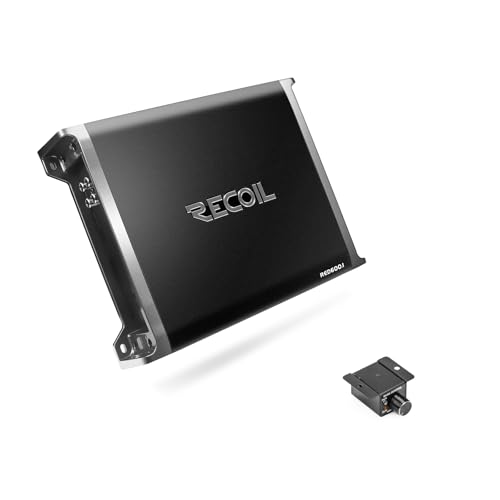
The Recoil RED600-1 occupies a sweet spot for budget-conscious builders who refuse to sacrifice features. Its 660W RMS at 1 ohm is genuine — oscilloscope tests confirm the clip light is accurate and the amp delivers its rated power without distortion. The inclusion of a subsonic filter and a clip light at this price point is rare and valuable, allowing you to tune the gain properly without external gear, protecting both the amp and your subwoofer from damage.
Thermal performance is impressive for its class. Users report the amp barely gets warm at 2-ohm loads and runs cool even at 1 ohm, thanks to the high-speed MOSFET power supply and efficient heatsink design. The variable low-pass filter and bass EQ give you enough control to dial in the sound you want. The included remote bass knob has an accurate clip indicator that lights up before audible distortion sets in — a feature usually found on amps costing twice as much.
Build quality is solid for the price point, with metal construction and clean internals. The compact dimensions (9.84 x 7.6 x 2.2 inches) make it easy to mount in tight spaces. The main limitation is damping factor — the RED600-1 doesn’t control the subwoofer’s voice coil as tightly as premium competitors, resulting in slightly looser bass compared to a Kicker or Alpine amp. For most users running a single 10 or 12-inch sub in a sealed box, this difference is negligible.
Why it’s great
- Accurate clip light for distortion-free gain tuning
- Includes subsonic filter and remote bass knob
- Runs cool at both 1 and 2-ohm loads
Good to know
- Lower damping factor than premium competitors
- Power LED is excessively bright at night
6. AUDIOZERONE ZE1000.1

The AUDIOZERONE ZE1000.1 delivers 1000W RMS at 1 ohm in a rugged chassis that’s surprisingly forgiving of harsh conditions. Users who have killed multiple Taramps and Stinger amps on demanding 1-ohm loads report that the ZE1000.1 survives with no overheating or protection mode issues, thanks to its robust thermal, overload, and short-circuit protection circuitry. The Class D MOSFET design keeps power loss low, with excess energy stored instead of converted to heat.
Sound quality is clean and punchy, with several users noting it sounds better than more expensive alternatives like the Stinger 1500W. The amplifier handles 2-ohm and 4-ohm loads gracefully as well, with RMS ratings of 650W and 400W respectively. The adjustment controls for gain, low-pass filter, and bass boost are well-labeled and stay put once set. The chassis measures 11 x 6.9 x 2 inches, fitting into most standard mounting locations.
Long-term reliability is where this amp shines. Multiple two-year owners confirm it still delivers full power without degradation, running two 12-inch subs or a single 10-inch sub cleanly. The speaker wire terminals are the only weak point — they can pull out if not tightened firmly, so use quality ring terminals or spade connectors. The included remote bass knob is basic but functional. This amp is an excellent choice for daily drivers running a moderate sub setup at 1 ohm.
Why it’s great
- Survives demanding 1-ohm loads without overheating
- Clean sound rivaling more expensive brands
- Robust protection circuitry for long-term reliability
Good to know
- Speaker wire terminals can loosen if not tightened well
- Fans are not actively cooled — relies on chassis ventilation
7. Timpano TPT-BASS400
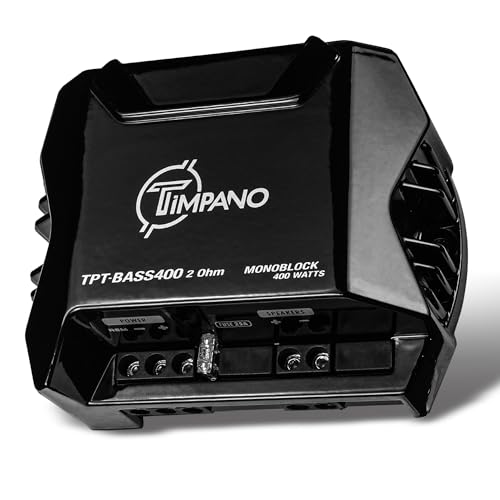
The Timpano TPT-BASS400 redefines what “compact” means for a subwoofer amplifier. At just 3.93 x 5.02 x 2 inches and weighing only 1.12 pounds, it’s small enough to mount almost anywhere — under a dash, in a glove box, or directly to the side of a subwoofer enclosure. Its Brazilian full-bridge Class D technology delivers 400W RMS at 2 ohms, which is genuinely impressive for a chassis this tiny. Users consistently report it powers a single 12-inch sub with authority, defying its toy-like appearance.
Tuning controls are remarkably complete for such a small package. The amplifier includes a variable subsonic filter (5-35Hz) and a variable low-pass filter (35-250Hz), plus a bass boost up to +15dB at a selectable frequency. This level of crossover flexibility is more common on full-size amps. The high-level inputs with signal auto turn-on eliminate the need for a remote turn-on wire, making it perfect for upgrading factory radio systems without running additional wiring.
Build quality is solid with heavy-duty power and speaker terminals despite the size. The MOSFET power supply and top-line transistors keep noise low and efficiency high. The main trade-off is heat management — at 1 ohm (unrated), the amp runs hot, and the subsonic filter is absent at that impedance. Stick to a 2-ohm or 4-ohm load within its rated spec, and this little amp will surprise you with reliable, clean bass. It’s the ultimate option for space-constrained installations.
Why it’s great
- Unbelievably compact chassis (3.93 x 5.02 x 2 inches)
- Full crossover suite with subsonic and LPF filters
- Signal-sensing auto turn-on simplifies factory radio upgrades
Good to know
- Runs hot at unrated 1-ohm loads
- Subsonic filter drops out when used below rated impedance
FAQ
What size amplifier do I need for my subwoofer?
Can I run a 1-ohm stable amplifier at 2 ohms?
Final Thoughts: The Verdict
For most users, the best car subwoofer amplifier winner is the CT Sounds CT-1000.1D because it packs 1000W RMS into a compact chassis that fits almost anywhere, runs cool, and includes the essential tuning controls without breaking the bank. If you want dyno-certified power and a subsonic filter for ported enclosures, grab the Rockville dB14. And for competition-grade multi-impedance flexibility that reaches deep into the 20Hz range, nothing beats the Taramps Smart 3 Bass.