
Our readers keep the lights on and my morning glass full of iced black tea. As an Amazon Associate, I earn from qualifying purchases.
Specs are compiled from manufacturer listings and verified buyer reviews and can change over time — please confirm the key details on the product page before buying.
You have a broken bolt, a hardened steel bracket, or a spring-steel part that needs a hole — and every bit in your box just spins, smokes, or dulls after one pass. A solid carbide bit can scratch that surface, but it is brittle, expensive, and easy to snap if you pick the wrong one. This guide walks through five solid carbide bits that actually cut hardened metals, comparing cutting diameters, coatings, and real buyer experiences so you know which one survives your job.
I’m Min — the founder and writer behind Gadgets Feed. This guide is built by comparing the manufacturers’ published specifications and the patterns across verified customer reviews, so you get each pick’s real strengths and trade-offs instead of marketing spin.
If you have ever watched a high-speed steel bit glow red while refusing to cut, you already know why swapping to a solid carbide bit is the fix — and these are the best carbide drill bits for that exact fight.
Quick Picks
- Drill America DMOD1/8 1/8″ Solid Carbide Drill Bit — Best Value
- Drill America DMOD5/32 5/32″ Solid Carbide Drill Bit — Pro Pick
- LU&MN 1/8″ Solid Carbide Jobber Drill Bits, 2-Piece — Deep Hole Specialist
- Chicago Latrobe 780 3/16″ Solid Carbide Spade Drill Bit — Thin Sheet King
- HOYUSK 4-Piece Solid Carbide Drill Bit Set (1/8″, 3/16″, 1/16″, 1/4″) — Best Overall
How To Choose The Best Carbide Drill Bits
Solid carbide is far harder than high-speed steel or cobalt, which means it cuts through tough materials without dulling quickly. But that hardness comes with brittleness — the bit can snap if your setup is not rigid or you wobble. Here is what to check before you buy.
Cutting Diameter and Your Target Material
The cutting diameter is the actual hole size the bit makes. A 0.13-inch (1/8″) bit is a common starting point for bolts and extractors, while a 0.19-inch (3/16″) bit opens up larger holes in thin sheet metal. Thicker bits are slightly less prone to breakage than very small ones, so match the diameter closely to your job — oversizing puts extra torque on a brittle tool.
Coating: Uncoated vs. TISIN (Titanium Silicon Nitride)
Most solid carbide bits come uncoated — just the bare carbide substrate, which works well for cast iron, bronze, plastics, and hardened steel if you use cutting fluid. A TISIN coating adds a heat-resistant layer that lets you run faster speeds and reduces friction, especially in stainless steel and alloy steels. The trade-off is cost; coated bits run higher than uncoated bits of the same size.
Point Style and Flute Design
A 118-degree conventional point is the standard general-purpose grind for hardened metals. Spade bits (like the Chicago Latrobe) are ground flat on top and meant for shallow holes and thin sheets — they cut fast but wander more in deep holes. Jobber-length bits have spiral flutes that pull chips upward, which helps in deeper drilling but requires you to retract often to clear chips. If you see a “center point” style, it helps the bit start on target without skating across the surface.
Quick Comparison
On smaller screens, swipe sideways to see the full table.
| Model | Best For | Cutting Diameter | Coating | Number of Pieces | Amazon |
|---|---|---|---|---|---|
| Drill America DMOD1/8 1/8″ | Hardened steel bolts | 0.13 Inches | Uncoated | 1 | $18.68$20.94Amazon |
| Drill America DMOD5/32 5/32″ | Extractor holes in tough steel | 0.16 Inches | Uncoated | 1 | $19.80Amazon |
| LU&MN 1/8″ Jobber 2-Piece | Deep holes in stainless steel | 0.13 Inches | Uncoated | 2 | $19.99Amazon |
| Chicago Latrobe 780 3/16″ | Shallow holes in thin sheets / spring steel | 0.19 Inches | Uncoated | 1 | $20.66Amazon |
| HOYUSK 4-Piece Set (1/8″ 1/4″ 3/16″ 1/16″) | Multi-size jobs on hardened steel | 0.13–0.25 Inches | Titanium Silicon Nitride | 4 | $48.99Amazon |
In‑Depth Reviews
1. Drill America DMOD1/8 1/8″ Solid Carbide Drill Bit
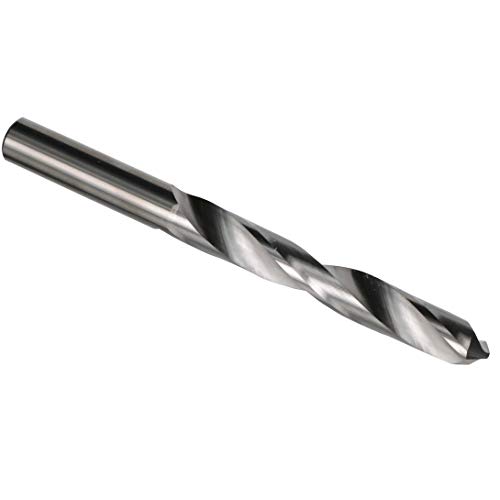
You get the single 1/8″ bit that homeowners and mechanics reach for after HSS and cobalt bits fail on hardened bolts.
This bit saves you when several HSS and cobalt bits have already broken — one reviewer noted they “broke several HSS and cobalt bits before I switched to this carbide bit.” It cuts a 0.13-inch diameter hole with a 118-degree point, which creates a precise starter for a screw extractor (a tool that grips the broken fastener) to bite into a broken bolt. The uncoated finish keeps the cost low, and you get just one piece — you pay for exactly what you need: a sharp 1/8″ bit that cuts hard material.
Solid carbide is brittle. Some buyers snapped it immediately even with cutting fluid and a light touch. This bit demands a rigid setup — a drill press or a mill-drill works best, and you must avoid any side load. For someone drilling a case-hardened bolt in a tractor, it is a lifesaver; for a beginner who wobbles, it may snap on the first contact. Compared to the Chicago Latrobe spade bit (which has a wider 0.19-inch diameter), this Drill America offers the common 1/8″ size that works with most extractor kits.
Why it earns its spot
- Cuts through hardened steel and case-hardened bolts that HSS bits cannot touch
- Small 0.13-inch diameter creates a precise starter hole for extractors
- Unaffected by high temperature drilling — stays sharp
The brittleness you must accept
- Some buyers snapped it within seconds despite careful technique
- Only one bit included — you get no backup if it breaks
- Needs a rigid tool-holding system; a hand drill adds risk
Reach for this if: you need one reliable 1/8″ carbide bit for drilling into hardened bolts, extractors, or case-hardened steel in a drill press.
Look elsewhere if: you plan to drill multiple different-sized holes or you do not have a rigid drilling setup that prevents side-loading.
2. Drill America DMOD5/32 5/32″ Solid Carbide Drill Bit
A 5/32″ bit built for when an extractor kit fails on a tractor blade bolt — one buyer says it drilled a broken bolt in 5-10 minutes.
One buyer described this bit as the tool that “successfully drilled into a broken blade bolt on a John Deere after extractor kit failed; took 5-10 minutes.” At 0.16 inches, the cutting diameter is slightly larger than the 1/8″ version, giving you a wider pilot hole (the starter hole) that a larger extractor can bite into. It uses the same 118-degree taper point and uncoated finish, so it behaves identically — extremely hard, very sharp, and demanding of a rigid mount.
The 5/32″ size sits between the 1/8″ and 3/16″ bits. It is wide enough to survive a few seconds of off-center load but still narrow enough to start on a small broken stud. Like all uncoated carbide, it works on cast iron, non-ferrous alloys (metals without iron), high-silicon aluminum, and bronze. But it remains brittle — the same “snapped immediately” pattern appears in reviews. If you are drilling into a broken bolt flush with a surface, this bit gives you a slightly thicker shank than the 1/8″, which helps reduce the chance of a snap.
Where it wins
- Larger 0.16-inch cutting diameter than the 1/8″ version — better for extractor-size holes
- Buyers confirm it cuts through extractor-hardened bolts successfully
- Manufactured to National Aerospace Standard 907 for quality control
The known risk
- Reports of snapping within seconds on first contact
- No coating for heat management — requires cutting fluid and low speed
- Single bit only, so a break means buying another
Grab this when: you have a broken bolt that needs a 5/32″ pilot hole and you already failed with an extractor kit.
skip it if: you need a bit for deeper holes — the taper point and flat flute design work best for shallow piloting.
3. LU&MN 1/8″ Solid Carbide Jobber Drill Bits, 2-Piece

You get two jobber-length bits that cut deeper in a single pass — but only if you clear chips carefully.
These bits have a 0.98-inch flute length (the spiral groove that clears chips) and a 1.69-inch overall length, which means they can cut deeper than the Drill America spade bits before you need to retract. The 118-degree center point helps the bit start on target without skating. One buyer mentioned the drawbacks: “bit broke on 4th deep hole in 304 SS due to chip clogging” — so you must retract frequently to clear chips, especially in stainless steel. But another reviewer drilled through two hardened 12mm bolts in two minutes with a hand drill and no lubricant, calling the bits “very sharp.”
You get two bits for roughly the same price as one Drill America bit, which gives you a backup if one snaps. The uncoated carbide is suitable for stainless steel, alloy steel, die steel (steel used for molds), and copper. The sharp spiral flutes produce smooth cuts with no burrs, but the lack of coating means you should use cutting fluid on deeper holes to keep heat down. Compared to the single-bit Chicago Latrobe spade bit that is limited to about twice its diameter in depth, these jobber bits let you go deeper — just do not let the chips pack up.
What you get
- Two bits in the pack — a spare if one breaks
- 0.98-inch flute length cuts deeper than spade-style bits
- Center point design reduces walking on the start
What you must watch for
- Prone to breaking on deep holes if chips clog the flutes
- Uncoated — requires cutting oil for stainless and deep holes
- Very brittle; one owner reported a snap on the 6th hole
Best suited for: jobs where you need to drill deeper than 1/4 inch in stainless or hardened steel and want a spare bit on hand.
Not for: quick pilot holes where a shorter spade bit would do — the extra length adds flex and break risk if you wobble.
4. Chicago Latrobe 780 3/16″ Solid Carbide Spade Drill Bit
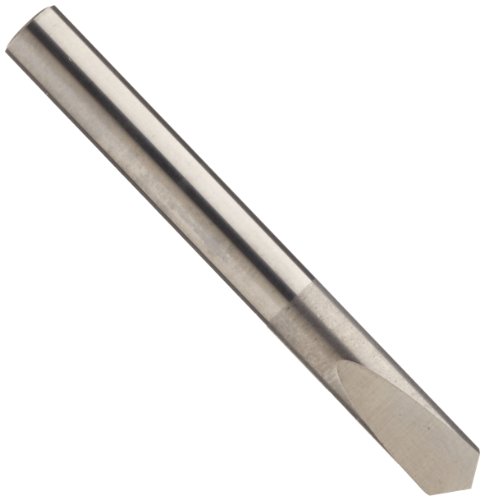
A USA-made spade bit that drilled 32 holes in high-carbon spring steel without cutting oil or going dull — buyers confirm it.
This bit has the widest cutting diameter in the lineup at 0.19 Inches, versus the Drill America DMOD1/8 at 0.13 inches. It is a spade drill bit, designed for shallow holes and thin-sheet applications up to about 2x its diameter deep. One buyer confirmed its toughness: “drilled 32 holes with no problem, no cutting oil or lube used with no sign of going dull” in high-carbon spring steel 0.128 inches thick. Made in the USA by Chicago-Latrobe, it is the choice for anyone who drills a lot of thin hardened sheet metal.
The spade geometry makes it ideal for carbon fiber too — one reviewer drilled 12 carbon-fiber holes quickly with no wear, where a standard bit dulled instantly. But the spade design causes some tear-out on the exit side, especially in composites, so it is best for non-cosmetic holes. Because it is limited to shallow cuts, it is not the right pick for a deep bolt-extraction job. For thin, hard materials where you need a 3/16″ hole fast and clean, this is the strongest option in the list.
Why this stands out
- 0.19-inch cutting diameter is the widest in this roundup, versus 0.13-inch 1/8" bits
- Buyers report 32 holes in spring steel with no dulling and no lubricant
- Excellent on carbon fiber — 12 holes without wear vs. standard bits that dull instantly
Where it falls short
- Spade design limits depth to about 2x diameter — not for deep drilling
- Tear-out on exit in composites and thin sheets
- Short length after chucking can make it hard to reach recessed bolts
Pick this for: drilling many holes in thin hardened sheet metal, carbon fiber, or spring steel where depth is less than 3/8 inch.
Skip this if: you need to drill deep pilot holes for extractors — the spade shape bottoms out too quickly.
5. HOYUSK 4-Piece Solid Carbide Drill Bit Set (1/8″, 3/16″, 1/16″, 1/4″)
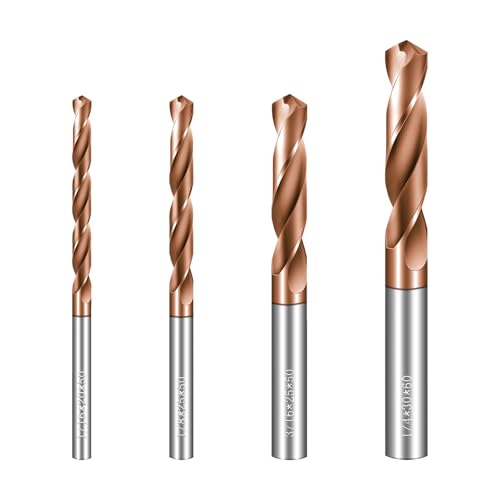
A four-bit set with a titanium silicon nitride coating that, according to one buyer, survived 100 holes in hardened steel before chipping.
This set includes the four most common sizes: 1/8″, 3/16″, 1/16″, and 1/4 inch — covering everything from a tiny pilot to a larger 1/4″ hole. It is the only product in this roundup with a TISIN (Titanium Silicon Nitride) coating, which adds heat resistance and reduces friction compared to uncoated bits. One customer observed drilling 100 holes in hardened steel u-posts before the first bit chipped — and noted that it still drilled after chipping. That is an extraordinary lifespan for a set in this price tier, and it shows the coating plus sharp spiral flutes work well together.
You get four bits for the same cost as two single Drill America bits, making this the best overall value for someone who needs multiple sizes. The spiral flutes clear chips efficiently, and the round shank design provides stable clamping to reduce wobble. But some buyers wish the shank had a 1/4″ hex base to prevent slipping in a drill chuck. If you plan to drill a range of hole sizes in hardened steel, stainless steel, or cast iron, this set gives you the widest capability in a single purchase. Its 4-piece count gives you four bits, versus the single Drill America DMOD1/8 with one bit.
What makes it the best overall
- Four sizes — 1/8″, 3/16″, 1/16″, 1/4″ — cover most drilling needs in one set
- TISIN coating adds heat resistance for higher speeds on stainless and alloy steels
- Buyers confirm 100 holes in hardened steel before chipping
The trade-offs
- Round shank can slip in a standard drill chuck — no hex base
- Still carbide-brittle; a hard wobble will snap a bit
- 1/16″ bit is very thin and prone to breakage on the first hard contact
The smart choice if: you often drill different-sized holes in hardened steel and want one set that handles 1/16″ through 1/4″ with a heat-resistant coating.
Not the pick if: you only need a single 1/8″ bit for extractors — the coated set costs more and the smallest bits may be unnecessary.
Understanding the Specs
Cutting Diameter (Inches)
This is the exact width of the hole the bit makes. A 0.13-inch (1/8″) bit fits most standard extractor kits, while a 0.19-inch (3/16″) bit makes a wider hole for larger extractors or fasteners. The bigger the diameter, the thicker the bit body, which gives it slightly more resistance to snapping — but it also requires more torque from your drill. Match the bit diameter to the job: too large and you might crack the workpiece, too small and the extractor may not grip.
TISIN Coating (Titanium Silicon Nitride)
A TISIN coating is a thin ceramic layer applied to the carbide surface. It reduces friction between the bit and the metal, which keeps the cutting edge cooler at higher RPMs. This matters most when drilling stainless steel (304 SS, for example) because stainless work-hardens (gets tougher as it heats up) as it heats up — a coated bit pushes through without making the metal harder. Uncoated bits work fine for cast iron and bronze, but for long runs in tough steels, a TISIN coating extends the bit’s life significantly.
Point Angle (118 Degrees)
The 118-degree point angle is the industry standard for general-purpose drilling in metals. It creates a moderately sharp tip that starts well on flat surfaces without excessive walking. A steeper 135-degree point is better for sheet metal and thin stock, but for hardened steel, cast iron, and bolt extraction, the 118-degree grind offers the best balance of sharpness and edge strength. Bits with a center point (like the LU&MN jobber) add a small spur that helps the bit stay on target as it starts.
Spade vs. Jobber Geometry
A spade bit has a flat, paddle-like tip with no spiral flutes. It cuts fast in shallow holes and thin sheets but cannot plunge deeper than about twice its diameter because chips have nowhere to go. A jobber bit has spiral flutes that carry chips upward as you drill, allowing depths up to 10x the diameter in a single pass. The trade-off is that jobber bits are longer and more flexible, so they can snap more easily if you apply side load. For bolt extraction (shallow holes), a spade bit is usually stiffer and safer.
FAQ
Will a carbide drill bit cut through hardened steel bolts?
How many holes can a carbide drill bit make before dulling?
Can I use a carbide drill bit in a handheld drill?
What is the difference between solid carbide and carbide-tipped drill bits?
Do I need cutting oil with carbide drill bits?
What speed should I run a carbide drill bit at?
Why do some carbide bits snap on the first use?
Can I use a carbide drill bit on stainless steel?
What size carbide drill bit should I use for a broken bolt extractor?
Why is my carbide bit smoking even though it is sharp?
Final Thoughts: The Verdict
For the majority of shoppers, the best carbide drill bits winner is the HOYUSK 4-Piece Set because it covers four common sizes with a heat-resistant TISIN coating at a price that beats buying singles. If you need a single 1/8″ bit for bolt extraction, grab the Drill America DMOD1/8. And for drilling thin hardened sheet metal or carbon fiber all day, the standout is the Chicago Latrobe 780 spade bit.
How We Picked
We do not accept paid placement, and we did not hands-on test every unit. Instead, we match each pick to a real buyer and use-case by comparing the manufacturers’ published specifications against the patterns in verified customer reviews — so you get each pick’s real strengths and trade-offs instead of marketing copy.
Sources & Methodology
Specifications: manufacturer listings and product documentation. Review insights: verified customer reviews, as of July 2026. Pricing: not shown on this page (it changes often); check the current price via the retailer link.
As an Amazon Associate, Gadgets Feed earns from qualifying purchases. This does not affect which products we feature.
Product prices and availability are accurate as of the date/time indicated and are subject to change. Any price and availability information displayed on Amazon at the time of purchase will apply to the purchase of this product. As an Amazon Associate I earn from qualifying purchases.
CERTAIN CONTENT THAT APPEARS ON THIS SITE COMES FROM AMAZON. THIS CONTENT IS PROVIDED "AS IS" AND IS SUBJECT TO CHANGE OR REMOVAL AT ANY TIME.
Amazon and the Amazon logo are trademarks of Amazon.com, Inc. or its affiliates.