
Our readers keep the lights on and my morning glass full of iced black tea. As an Amazon Associate, I earn from qualifying purchases.
Specs are compiled from manufacturer listings and verified buyer reviews and can change over time — please confirm the key details on the product page before buying.
Here is the short answer before any spec talk: if you want the strongest carbon fiber filament in this group, get the Creality PPA-CF. It holds 220°C without sagging, stays stable in humid and underwater use, and carries the highest rating here at 4.5+ stars. If your budget is tighter, the Flashforge PLA-CF is the one most people should actually buy — cheaper per spool, easy to print, and still noticeably stiffer than plain PLA.
I’m Min — the founder and writer behind Gadgets Feed. This guide is built by comparing the manufacturers’ published specifications and the patterns across verified customer reviews, so you get each pick’s real strengths and trade-offs instead of marketing spin.
Below is what each filament is made of and the printer setup it demands. By the end you will know exactly which spool belongs on your machine, and that makes narrowing down the carbon fiber filament field a whole lot simpler.
Our Picks at a Glance


How To Choose The Best Carbon Fiber Filament
Carbon fiber filament is ordinary plastic with tiny chopped fibers mixed in. Those fibers do two things: they make the printed part stiffer, and they grind away at anything soft in your printer’s hot path. Picking the right spool means matching the base plastic to your job and accepting the hardware tax that comes with the fibers.
Start with the base plastic, not the carbon
PLA-CF is the friendly one. It prints at normal PLA temperatures, warps very little, and suits brackets, models, and jigs that never see real heat. PETG-CF sits one step up — tougher and slightly more heat-tolerant, still forgiving on most machines. Nylon-based options (PA6-CF, PA612-CF, PA12-CF) and PPA-CF are the engineering tier: far stronger and heat-resistant, but they demand drying, high nozzle temperatures, and usually an enclosure.
Check the fiber percentage honestly
More fiber means more stiffness, but also more brittleness and more nozzle wear. A 15% blend tends to keep some toughness; a 20% blend pushes toward maximum rigidity. Neither is automatically better — a moving part that needs to flex wants the lower figure, while a static jig wants the higher one.
Budget for a hardened nozzle
Every carbon fiber spool on this list will chew through a standard brass nozzle. Fit a hardened steel or ruby nozzle before the first spool goes on. Several of these filaments also specify a sealed or enclosed print space to hold heat and keep warping down.
Plan for moisture before you print
Nylon-based carbon fiber soaks up water from the air. Wet filament prints with bubbles, stringing, and rough surfaces. Buy a dryer or have a dry box ready, and dry the spool before the first print — not after you notice problems.
Quick Comparison
| Model | Best For | Material | Carbon Fiber | Spool Weight | Amazon |
|---|---|---|---|---|---|
| Creality PPA-CF★ Best Overall | Engineering-grade strength | PPA-CF | 15% | 1 kg | Amazon |
| Flashforge Carbon Fiber PLABest Value | Easy, affordable prints | PLA-CF | Carbon fiber reinforced | 1 kg | Amazon |
| Creality Hyper PLA-CFFastest Print | Fast matte-finish printing | PLA-CF | Carbon fiber reinforced | 1 kg | Amazon |
| Polymaker Fiberon PA612-CF15 | Humidity-tolerant functional parts | PA612 nylon | 15 wt% | 0.5 kg | Amazon |
| TINMORRY PETG-CF | High-speed functional parts | PETG-CF | 15% | 1 kg x 2 | Amazon |
| Polymaker Fiberon PA6-CF20 | Heat-resistant rigid parts | PA6 nylon | 20% | 0.5 kg | Amazon |
| SUNLU PA12-CF | Oil and wear resistance | PA12-CF | 20% | 1 kg | Amazon |
| SainSmart ePA-CF | Strong, semi-flexible parts | Nylon + CF | 20% | 1 kg | Amazon |
| Siraya Tech Fibreheart PPA-CF | High-heat industrial parts | PPA-CF | 15% | 1 kg | Amazon |
In‑Depth Reviews
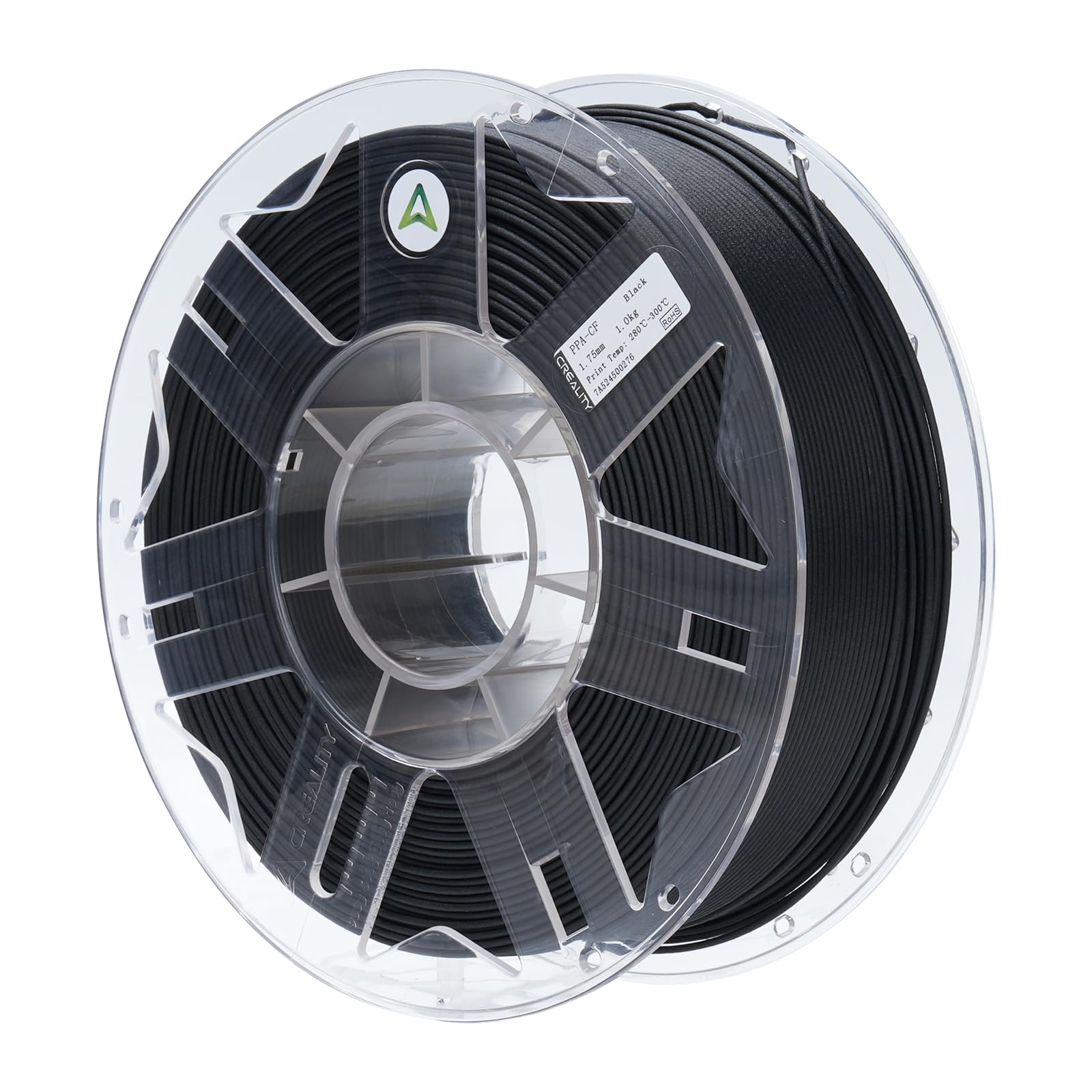
1. Creality PPA-CF 1.75mm Filament, 15% Carbon Fiber, Black, 1kg
Our pick — 4.5+★ from 500+ verified ratings; the strongest balance of quality and price.
A 15% PPA-CF spool with metal-like stiffness and 220°C heat resistance, no machining required.
Start with the number that actually decides engineering jobs: it holds structural integrity at 220°C for long stretches. That means a bracket bolted near an engine bay or a part sitting in direct sun does not sag or soften the way PLA would.
Its 15% carbon fiber blend is engineered for quasi-metallic strength. It also resists warping on large parts, which is exactly where nylon blends normally fail — a tall print that curls off the bed at hour nine.
The moisture story is the real differentiator. Creality states the printed parts stay stable in humid conditions or even underwater, keeping their stiffness and thermal properties over time. That is unusual for a fiber-filled polymer, and it makes this spool a fit for propellers, custom surfboard fins, and anything that lives wet.
Where it pulls ahead
- Holds its shape at 220°C, so hot-location parts stay rigid instead of drooping
- 15% fiber reinforcement gives metal-like stiffness for repair parts and tooling
- Declared stable in humid and underwater use — rare for a carbon-filled nylon
- Runs from 30 to 600mm/s with ±0.02mm diameter accuracy and RFID recognition
The honest friction
- A sealed print space and hardened steel nozzle are required, not suggested
- It runs 2.6 pounds against the Flashforge PLA-CF at 2.2 pounds — a heavier spool to hang
- Some owners flag the cost as steep next to basic PLA-CF spools
At 4.5+ stars it is the top-rated spool here, and the quality of the finished print is what people keep coming back to. Reviewers keep returning to it because the print quality holds steady from one spool to the next.
Built for: anyone printing functional parts that face heat, moisture, or load — automotive repair pieces, tooling, waterproof models.
Think twice if: your printer has no enclosure or you have not bought a hardened steel nozzle yet, because this filament needs both.
2. FLASHFORGE Carbon Fiber PLA Filament 1.75mm Marsala, 1kg
A PLA-CF spool that prints at familiar PLA temperatures on a stock machine and comes out stiffer than plain PLA.
If you have never run a fiber-filled spool, this is the sensible first step. The base is PLA, so it prints at familiar temperatures on a stock machine, and the carbon fiber reinforcement adds stiffness without turning the process into a science project.
What buyers consistently describe is durability without the usual headache: functional prints that do not warp or lift off the bed. The matte finish reads like a machined component rather than glossy plastic, and the Marsala shade is a deep wine-purple.
At 4.5+ stars, quality is the thing people single out most, well ahead of anything else. The one recurring note is the occasional tangle on the spool, so keep an eye on the feed path during longer jobs.
Value read: this is the spool to buy if you want the carbon fiber look and stiffness on a modest budget and do not need heat or chemical resistance.
The catch worth knowing: PLA-CF still softens with heat, so do not trust it near an engine or in a hot car — that job belongs to a nylon or PPA spool.
Pick this one: first-time carbon fiber users, and anyone printing decorative or lightly loaded parts who wants a clean matte surface.
Step up instead if: your part has to survive heat or repeated load, which pushes you toward the PPA-CF or PA6-CF picks.
3. Creality Hyper PLA-CF 1.75mm Filament, Black, 1kg
Built for speed: 50 to 300mm/s without the surface turning chalky or the layers letting go.
Creality built this one around flow. The diameter is measured by two-way laser during production to 1.75±0.03mm, so the filament feeds evenly and the extruder is not fighting a thick spot mid-print. On a fast machine, that consistency is what keeps the walls smooth.
Compared with plain PLA, Creality states 30% higher mechanical properties across flexural strength, flexural modulus, and impact strength. It also claims higher tensile strength than ABS and more toughness than traditional PLA, which is the combination that makes it useful for brackets instead of just models.
The matte black finish hides layer lines better than glossy PLA, and the filament is compatible with a wide span of machines — MK3, Ender 3 family, K1 and K1 Max are all named. The honest snag is clogging: a portion of the review set runs into it, so keep your nozzle clean and your retraction tuned.
Suits: anyone running a high-speed printer who wants carbon stiffness with a matte finish and does not want to slow the machine down.
Not the one for: anyone who leaves their printer unattended and cannot babysit a possible clog on the first few prints.
4. Polymaker Fiberon PA612-CF15 Carbon Fiber Nylon, 0.5kg

Long-chain nylon with 15 wt% fiber — the spool for fixtures that see changing weather.
Here is the spec that explains the whole product: a tensile strength of 91.9 MPa dry, and 83.1 MPa after annealing and moisture conditioning. Most of that strength survives getting wet, which is why this is the pick for jigs and fixtures living in a workshop with shifting humidity.
Heat-wise, the deflection temperature reaches 175°C at 0.45 MPa once you anneal at 100°C for 16 hours. That is a test value, not a continuous working temperature, so treat it as a relative ranking rather than a promise for every geometry.
This is a smaller 0.5kg spool next to the 1kg Creality PLA-CF, so you get half the material — worth knowing if you are planning a long production run. It still requires an all-metal hotend at 250–300°C, a 40–50°C bed, and a hardened steel or ruby nozzle with the fan off.
Print experience: buyers describe it as close to flawless, with virtually no visible layer lines and no warping or lifting.
Watch the moisture: PA612 is less thirsty than PA6 but still hygroscopic — keep it below 20% relative humidity and dry at 100°C for 10 hours if it has been sitting out.
Best matched to: rigid functional parts, tooling, and engineering prototypes that have to hold tolerance through humidity swings.
Look elsewhere if: you want a big spool for volume printing — at 0.5kg this one runs out faster than the 1kg options.
5. TINMORRY PETG-CF Carbon Fiber Filament, 1kg x 2, Black
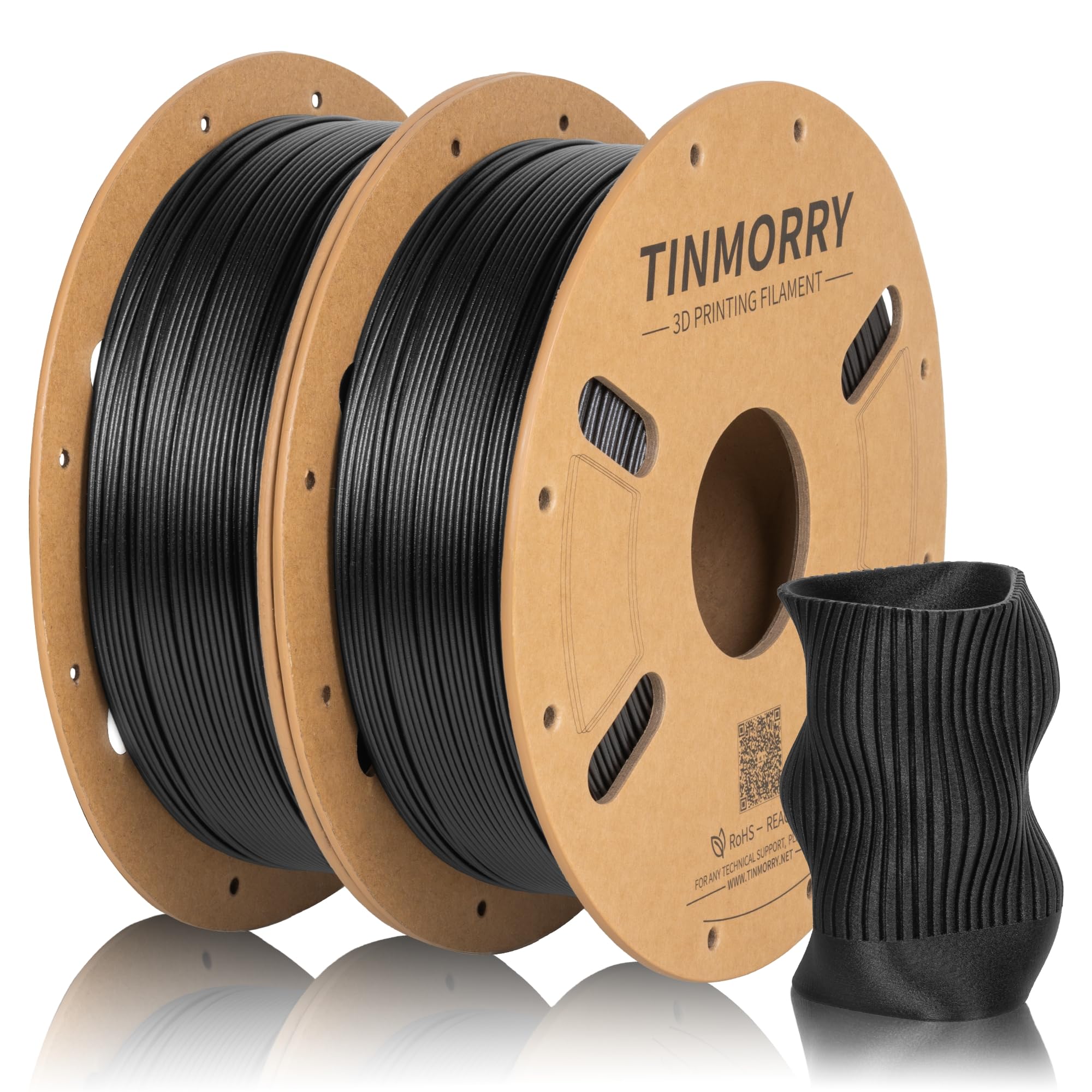
Two full spools of fiber-filled PETG that holds together under torsion and impact.
PETG-CF is the middle child of this category, and this pair makes the most of it. The blend is PETG plus 15% processed short-cut carbon fiber, with a formula aimed at cutting the clogging and clumping that traditional PETG-CF is known for.
Speed is the headline: it prints up to 300mm/s, and TINMORRY positions that as several times faster than other PETG-CF brands. The Z-adhesion is also called out specifically, which is the weak point on fast PETG prints — layers that cool too hard and peel.
Recommended settings are a 240–270°C nozzle and a 75–90°C bed, fan off for the first three layers. Do not run a brass nozzle here; the real carbon fibers demand wear-resistant steel at 0.4mm minimum, with 0.6mm preferred.
The pair format is the practical win — two 1kg spools means you are not reordering halfway through a project. Dry both before use at 65°C for 8 hours and keep them sealed with desiccant.
Go for it when: you print functional parts like drone pieces or racing models and want two spools of tough, fast-printing PETG-CF on hand.
Hold off if: your machine is an AMS-style multi-color setup or you cannot commit to a steel nozzle, since this material needs a wear-resistant feed path.
6. Polymaker Fiberon PA6-CF20 Carbon Fiber Nylon, 0.5kg
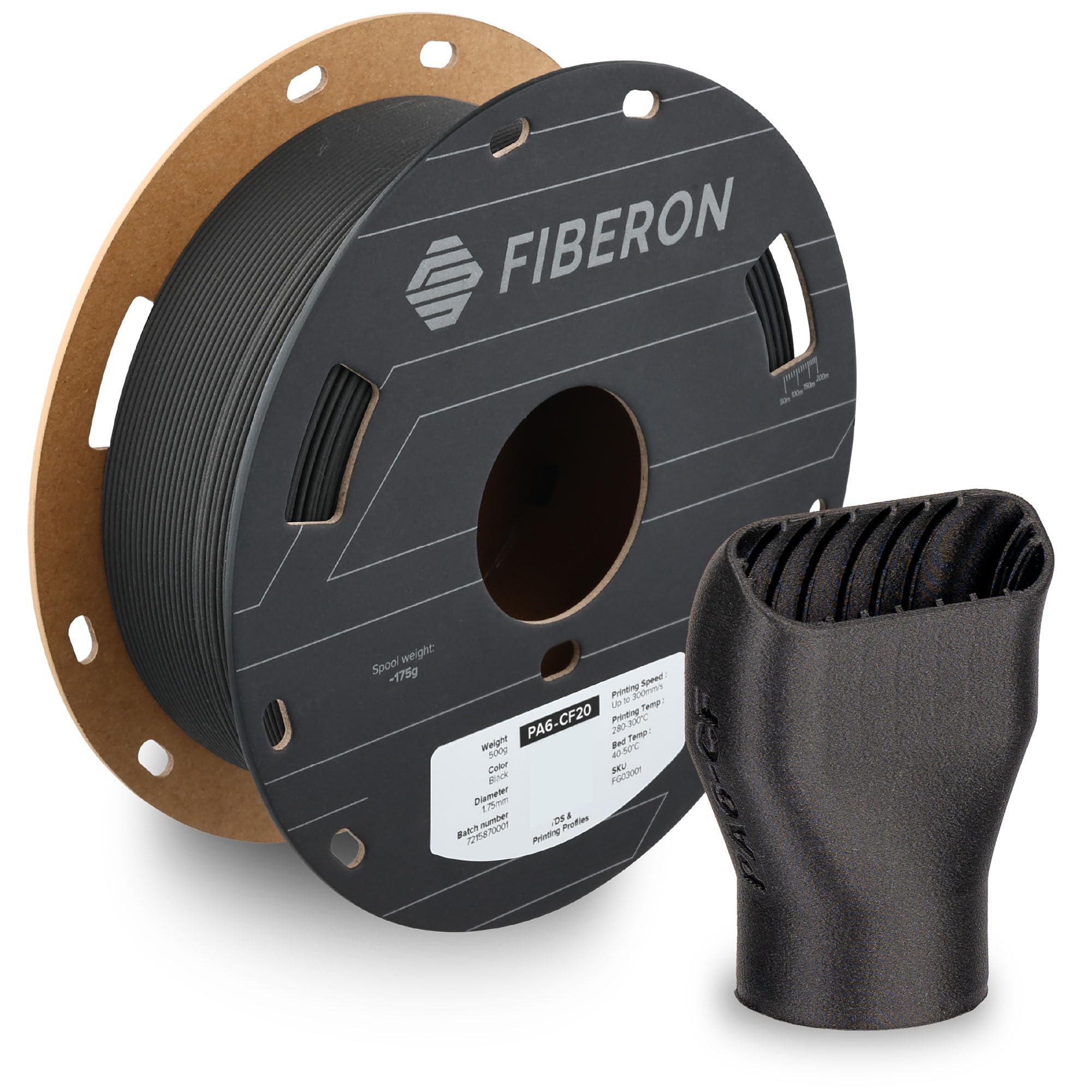
Twenty percent fiber and a 215°C deflection temperature — this is the one for genuinely hot parts.
Nylon 6 loaded with 20% carbon fiber gives the highest stiffness figure in this group, at a Young’s modulus of 8.64 GPa and a dry X-Y tensile strength of 109.3 MPa. Those numbers are why it holds shape on rigid functional parts and automotive prototypes.
After annealing at 100°C for 16 hours, the heat deflection temperature reaches 215°C at 0.45 MPa. Compare that to the PA612-CF15 at 175°C and the gap is clear: the PA6-CF20 leads on heat performance when the part must not move under load.
The recurring gripe is moisture and brittleness — it wants to be dry, at 100°C for 10 hours before printing and stored below 20% relative humidity afterward. Run it at 280–300°C through an all-metal hotend with a hardened steel or ruby nozzle and the fan off.
What the surface gives you: a flat matte black look that reads industrial, with strong layer adhesion and dimensional stability.
Size reality: this is a 0.5kg spool, so plan your annealing batches around a shorter material supply than the 1kg picks.
Reach for this if: your part has to sit near heat or carry real load and you have a printer that can hit 300°C with a hardened nozzle.
Skip the anneal at your peril: printed parts only reach their rated heat resistance after the 16-hour bake at 100°C.
7. SUNLU PA12-CF 20% Carbon Fiber Nylon, 1kg

Nylon 12 that shrugs off grease, gasoline, and sliding contact — made for moving parts.
Most carbon fiber spools are about strength. This one is about survival in a dirty environment. PA12-CF resists grease, gasoline, and solvents, so fuel caps and workshop tool handles come out functional instead of degrading after a few weeks of contact.
The fiber creates a smooth, low-friction surface, and SUNLU positions PA12-CF as outlasting PETG and ABS in high-wear settings. Gears, bearings, and sliding mechanisms are the intended targets.
Heat resistance is listed up to 347°F (175°C), keeping shape in engine compartments, direct sun, or hot workshops. Density sits at 1.04 g/cm³, which is on the light side for a fiber-reinforced nylon — useful for drone frames and bike helmet shells where weight matters.
It has the lowest water absorption of the nylons here, so it holds up in rain and humidity without the swelling you get from standard nylon. Recommended settings are 260–280°C nozzle, 50–70°C bed, and 60–150mm/s. Note that SUNLU explicitly advises against AMS or multi-color systems with this filament.
Ideal for: mechanical parts that touch oil or move against other surfaces — gears, sliding mechanisms, fuel-adjacent pieces.
Check first: if your printer feeds through a multi-color system, this spool is not recommended there — single-spool feeding is the way.
8. SainSmart ePA-CF Carbon Fiber Filled Nylon, 1kg

An 80/20 nylon and carbon blend aimed at parts that flex instead of snap.
The formula here is 80% nylon with 20% carbon fiber, and SainSmart leans on that ratio to keep some flexibility in the finished piece. That matters for parts that take a knock — a rigid carbon bracket can crack where a slightly flexing one absorbs the hit.
It is designed with a lower shrink rate than traditional nylon, so warping and lifting are reduced and the surface comes out smoother. Print temperatures land at 260–290°C with a build surface at 45–80°C.
This is the most divisive spool on the list, and it is worth being straight about that. Feedback splits fairly evenly, with some owners getting clean prints and strong layer bonding, and others hitting layer separation or rough output. Much of that split tracks back to moisture and enclosure discipline — SainSmart recommends a constant ambient temperature in an enclosed printer for best results.
Where it shines: strong yet slightly forgiving parts, industrial prototypes, and complex cosplay pieces that need to take a bump without shattering.
The real caveat: results depend heavily on your setup — dry filament and an enclosure are not optional here if you want repeatable prints.
Good fit for: makers with an enclosed printer who want semi-flexible, strong functional parts and are comfortable tuning a nylon profile.
Not for you if: you print in an open frame with humid air and no dryer — this is the fussiest spool of the batch.
9. Siraya Tech Fibreheart PPA-CF, 1kg
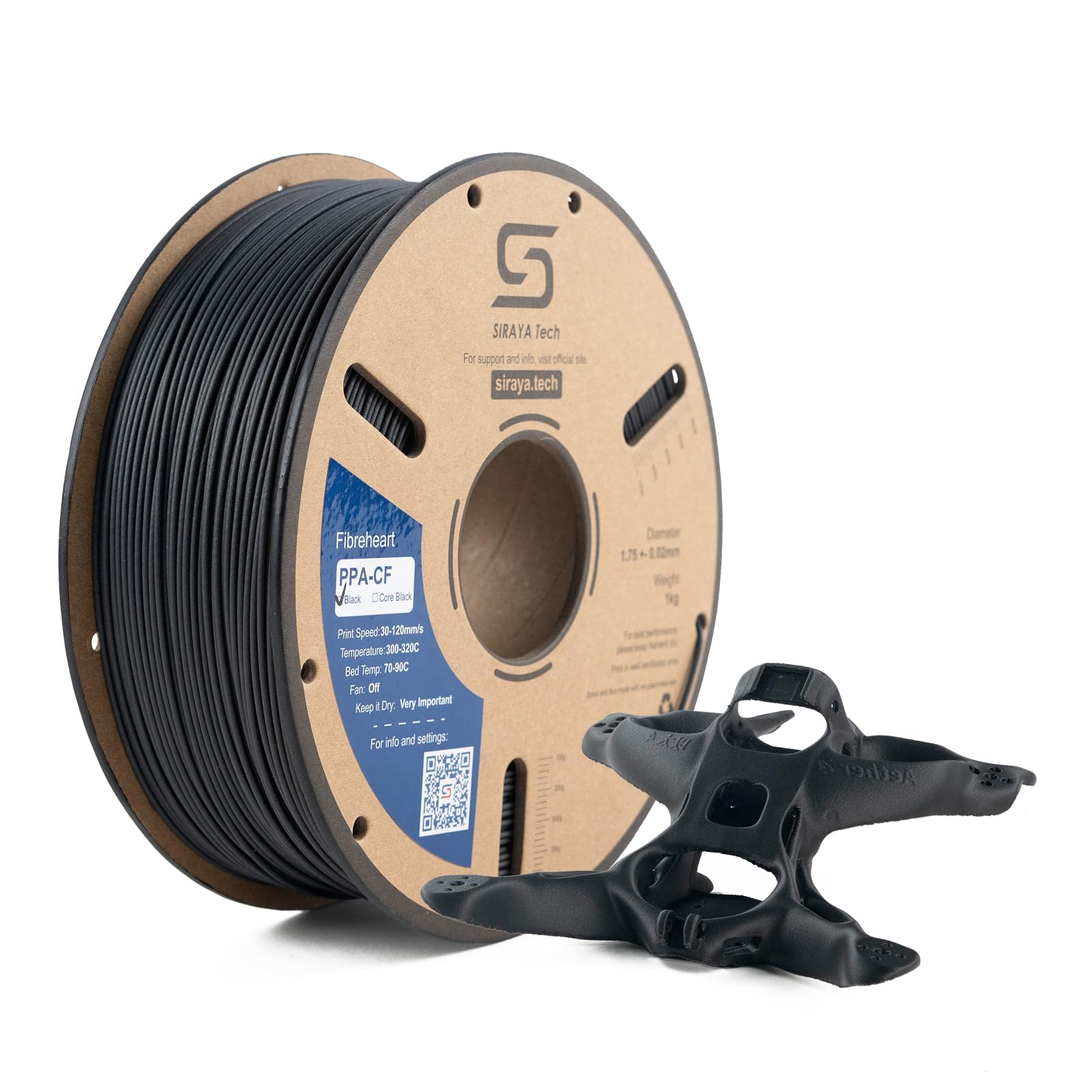
Industrial-grade PPA-PF built to hold 195°C without losing its shape or its tolerances.
PPA is a step above nylon for heat and chemical resistance, and Siraya Tech infuses it with 15% chopped carbon fiber for stiffness and impact strength. It is aimed squarely at automotive components and industrial machinery where the part is not coming off the machine.
The heat figure of 195°C puts it above the PA612-CF15 at 175°C, so it leads on sustained thermal load among the mid-tier spools. Moisture absorption is described as remarkably low, which keeps prints dimensionally accurate even when the air is damp.
What buyers praise is the material arriving ready to print straight from the factory-sealed pouch. What tempers that is brittleness — the filament itself can snap during a long job and occasionally snags on the spool, so route it with slack and check the feed between prints.
The engineering case: a 1kg spool of PPA-CF with strong stiffness and dimensional stability, aimed at parts that live in heat.
The thing to manage: keep the filament path loose and dry — brittleness and spool snags are the recurring friction point, not print quality.
Buy it for: automotive and industrial parts that need PPA-level heat and chemical resistance with real stiffness.
Consider softer handling: if your printer’s filament path has tight bends, a brittle PPA-CF spool needs extra slack to avoid mid-print breaks.
Understanding the Specs
Carbon Fiber Percentage
The figure (15%, 20 wt%) tells you how much chopped fiber is mixed into the plastic. More fiber means a stiffer, more rigid part, but also more brittleness and more wear on your nozzle. A 15% blend keeps a little give; a 20% blend pushes toward maximum stiffness. Match it to the job: flexing parts want less, static fixtures want more.
Heat Deflection Temperature (HDT)
This is the temperature at which a printed part starts to soften under a set load. On these spools it ranges from around 175°C on the PA612-CF15 up to 215°C on the PA6-CF20, measured after annealing. Higher HDT means the part keeps its shape in hot environments. Treat HDT as a standardized test figure, not a continuous working temperature for every geometry.
Tensile Strength and Modulus
Tensile strength (in MPa) measures how much pull a part takes before it fails; modulus (in GPa) measures stiffness. The PA6-CF20 lists 109.3 MPa and 8.64 GPa, while the PA612-CF15 lists 91.9 MPa dry. Higher numbers mean a more rigid part, which is ideal for jigs and fixtures but less ideal for anything that needs to absorb impact.
Moisture Absorption and Drying
Nylon-based carbon fiber absorbs water from the air, and wet filament prints with bubbles, stringing, and weak layers. The spools here specify drying at 100°C for 10 hours (the nylons) or 65°C for 8 hours (the PETG-CF) before use, and storage below 20% relative humidity. A dryer or dry box is part of the setup cost, not an accessory.
FAQ
Do I really need a hardened nozzle for carbon fiber filament?
Can I print carbon fiber filament on a stock Ender 3 or similar printer?
How is carbon fiber filament different from plain PLA or PETG?
Do I have to dry carbon fiber filament before printing?
Is 20% carbon fiber better than 15%?
Can carbon fiber filament parts go in a hot car or near an engine?
Why did my carbon fiber print snap or break in the printer?
Can I use carbon fiber filament in an AMS or multi-color system?
Does annealing really change the strength of a carbon fiber part?
Final Thoughts: The Verdict
For most buyers, the carbon fiber filament winner is the Creality PPA-CF because it holds 220°C, stays stable in humidity and underwater use, and lands at 4.5+ stars — the highest score in this group. If you want easy, affordable carbon printing for models and light brackets, grab the Flashforge Carbon Fiber PLA. And for parts that must survive real heat under load, the Polymaker Fiberon PA6-CF20 is the one to reach for, with its 215°C deflection temperature and 20% fiber load.
One last honest nudge: whichever spool you pick, buy the hardened nozzle and the dryer first. Budget for the hardened nozzle and the dryer alongside the spool.
How We Picked
We do not accept paid placement. Every pick is matched to a real buyer and a real use-case; we do not hands-on test units.
Sources & Methodology
Specifications: manufacturer listings and product documentation. Review insights: verified customer reviews, as of November 2026. Pricing: not shown on this page (it changes often); check the current price via the retailer link.
As an Amazon Associate, Gadgets Feed earns from qualifying purchases. This does not affect which products we feature.