
A kayak paddle that feels like a limp noodle after a few miles or leaves your shoulders burning is a direct hit to your time on the water. The difference between a slog and a sublime day out often comes down to one material choice: the shaft and blade construction. Getting the right blend of stiffness, weight, and blade catch transforms your stroke from a chore into an extension of your intent.
I’m Min — the co-founder and writer behind Gadgets Feed. I’ve spent countless hours cross-referencing shaft layups, blade surface areas, ferrule tolerances, and real-world customer feedback to isolate the specific design choices that separate a transformative paddle from a regrettable purchase.
Whether you are fighting current on a river run or silently gliding across a glassy lake, the right carbon fiber kayak paddle dictates your endurance and maneuverability more than any other single piece of gear you will buy.
How To Choose The Best Carbon Fiber Kayak Paddle
Selecting a paddle in this category comes down to balancing three opposing forces: weight versus durability, blade catch versus smooth exit, and adjustability versus a rigid, one-piece feel. Understanding your primary paddling environment — open water touring, winding creeks, or fishing from a wide platform — will dictate which compromise is worth making.
Shaft Construction: Full Carbon vs. Hybrid vs. Carbon-Reinforced
A full carbon fiber shaft offers the highest stiffness-to-weight ratio, directly translating your effort into forward motion with zero torsional flex. Hybrid shafts blend carbon with fiberglass or nylon to lower cost and increase impact resistance, often adding 50–100 grams but surviving rock strikes far better. A true premium paddle uses a unidirectional carbon layup with a specific weave pattern (like a diamond or twill) that indicates the quality of the resin bond.
Blade Shape and Surface Area
A high-surface-area dihedral blade (common on models like the Aqua-Bound Sting Ray) provides a powerful catch and slices through chop with minimal flutter, ideal for loaded touring kayaks. A narrow Greenland-style blade, on the other hand, reduces frontal resistance and is easier on the shoulders over long distances, but requires a more precise stroke technique. Fishing-oriented paddles often add a hook retrieval slot and serrated edge, sacrificing a small amount of hydrodynamic efficiency for utility.
Ferrule System: The Locking Mechanism
The ferrule is the joint connecting the two halves of a 2-piece paddle. A snap-button design is simple and reliable but offers limited feather angle options (usually 0° or 60°). A Posi-Lok or clamp-style lever system allows infinite or multi-angle feather adjustment, letting you dial in the perfect blade offset for wind conditions and paddling style. The tolerance of the fit — how much play exists between the two halves — is a direct indicator of manufacturing quality.
Quick Comparison
On smaller screens, swipe sideways to see the full table.
| Model | Category | Best For | Key Spec | Amazon |
|---|---|---|---|---|
| Aqua-Bound Sting Ray Carbon | Premium | All-around touring & rec | 230cm, 100% carbon shaft, Posi-Lok infinite feather | Amazon |
| Bending Branches Angler Ace | Premium | Fishing & touring | 240cm, carbon shaft, carbon-reinforced nylon blades | Amazon |
| Apex Carbon Rec/Touring | High-End | Ultra-light touring | 205-225cm, 27 oz, full carbon foam core blade | Amazon |
| Wilderness Systems Alpha Angler | High-End | Wide fishing kayaks | 240-260cm, carbon blade, low-profile lever lock | Amazon |
| Wilderness Systems Pungo Glass | Premium | Recreational paddling | 220-240cm, 50/50 carbon/fiberglass shaft | Amazon |
| Greenland Paddle Full Carbon | Specialty | Rolling & low-angle touring | 220cm, 1.3 lb, one-piece full carbon | Amazon |
| WONITAGO Carbon Shaft w/ Fiberglass Blade | Mid-Range | Budget-friendly upgrade | 230-240cm, quick cam lock, includes carry bag | Amazon |
| Backwater Assassin Carbon Hybrid | Mid-Range | Fishing with utility features | 98.5″-102.5″, ABS nylon blade, serrated edge | Amazon |
| Pelican The Catch | Entry-Level | Fishing with integrated tape measure | 250cm, fiberglass shaft, nylon blade, 65° angle adjust | Amazon |
In‑Depth Reviews
1. Aqua-Bound Sting Ray Carbon 2-Piece

The Sting Ray Carbon is hand-built in Osceola, Wisconsin, and the quality of its resin infusion and carbon layup is immediately apparent in the hand. The 100% carbon shaft is rigid enough to eliminate any torsional flex during a hard catch, yet the paddle tips the scales light enough that you forget it’s in your hand after an hour of continuous paddling. The mid-sized dihedral blade shape is the brand’s most popular for a reason — it provides a powerful, flutter-free stroke across a wide range of paddler strength and technique levels.
The Posi-Lok ferrule system uses a dual-button release mechanism that allows infinite feather angle adjustment without the slop or side-to-side play common in cheaper snap-button designs. You can dial in the perfect offset for wind conditions in seconds, and the composite construction of the ferrule eliminates the risk of galvanic corrosion. Owners consistently report that the locking mechanism stays tight even after years of saltwater exposure, and the carbon-reinforced blade edges show minimal chipping on rocky landings.
The only trade-off is the lack of a built-in hook retrieval system or measuring tape, features that fishing-focused paddles prioritize. For the touring kayaker or recreational paddler who values stiffness, weight reduction, and a foolproof adjustment system above all else, this paddle sets the standard. The 230 cm length is ideal for paddlers in the average height range using kayaks up to about 34 inches wide.
Why it’s great
- Full carbon shaft and reinforced blades deliver exceptional stiffness
- Posi-Lok ferrule offers infinite, wobble-free feather adjustment
- Mid-sized dihedral blade eliminates flutter across stroke cadences
- Hand-built in the USA with quality resin infusion
Good to know
- No integrated fishing features like a hook retrieval slot
- 230 cm length may be too short for very wide fishing kayaks
- Black shaft absorbs heat quickly in direct sun; gloves help
2. Bending Branches Angler Ace Snap-Button
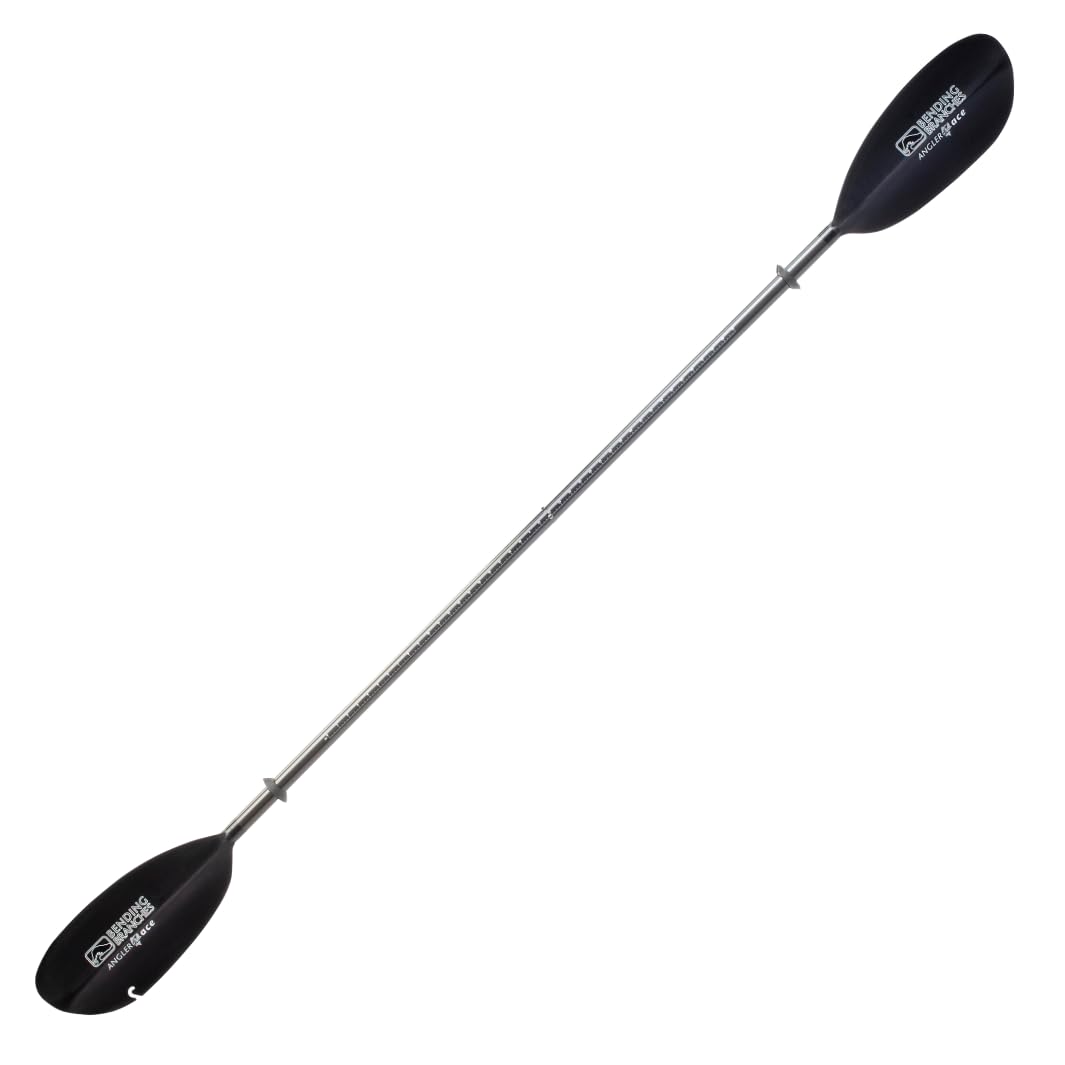
The Angler Ace specifically targets the kayak angler who needs a paddle that can handle the extra mass of a fully loaded fishing platform without flexing or fluttering on every stroke. The carbon shaft is paired with carbon-reinforced nylon blades rather than pure fiberglass, giving the blade edges a higher impact threshold when you inadvertently smack a rock or the side of the boat. The ovalized shaft section on the grip reduces hand fatigue during long days of maneuvering into tight fishing spots.
The snap-button ferrule is a two-position design (0° and 60° feather) that is simpler than the Posi-Lok but also less prone to mechanical failure in muddy or sandy conditions. Owners praise the paddle for its stiffness — the blade bites hard with no perceptible flex, even for heavier paddlers generating significant torque. The 240 cm length is well-suited for fishing kayaks in the 32-to-36-inch width range, providing enough clearance for a comfortable stroke without excessive reach.
The primary critique from users is the packaging, which sometimes arrives in a thin cardboard box with insufficient padding, leading to potential cosmetic damage in transit. Additionally, several taller paddlers using wide tandem kayaks wish for a 260 cm or 280 cm variant. Despite this, for the angler who wants a lightweight upgrade from a stock aluminum paddle that prioritizes durability and a secure bite, the Angler Ace delivers proven reliability.
Why it’s great
- Carbon-reinforced nylon blades handle rock strikes better than pure fiberglass
- Ovalized shaft reduces hot spots and improves grip control
- Impressive stiffness for efficient power transfer on heavy fishing kayaks
- At 240 cm, it clears most wide fishing boats comfortably
Good to know
- Snap-button ferrule limits feather to 0° or 60° only
- Packaging can expose the paddle to shipping damage
- Not available in extra-long lengths for very wide tandems
3. Apex Carbon Recreation/Touring

The Apex Carbon is built around a foam-core blade design that removes excess weight without sacrificing the structural rigidity needed for a clean, flutter-free stroke. Weighing just 27 ounces, it is one of the lightest production paddles in its class, making it a strong choice for paddlers who suffer from shoulder issues or plan to cover long distances. The blade shape is a mid-size dihedral that provides a smooth entry and clean exit, reducing the water noise and turbulence that can spook fish or disturb a serene morning paddle.
The ferrule uses a low-profile lever lock that allows quick length adjustment (205 cm to 225 cm) and infinite feather angles, making it exceptionally versatile for swapping between different kayaks or adapting to wind shifts mid-trip. The locking mechanism is reported to be strong and free of the wobble that plagues some clamp-style designs. Owners specifically note that the stiffness of the full carbon layup means the blade does not twist or deflect even when applying maximum force during a brace or sprint.
The main concern is a report of carbon delamination after several months of use in one instance, though this appears to be an outlier given the generally excellent feedback. The 205-225 cm length range is best suited for narrower touring kayaks and paddlers of average height — it will feel short on a wide fishing platform. For the touring purist prioritizing weight savings and a crisp, efficient blade, the Apex is a strong contender.
Why it’s great
- 27 oz total weight significantly reduces arm and shoulder fatigue
- Foam-core carbon blade provides stiffness without added mass
- Low-profile lever lock offers infinite feather and quick length changes
- Clean, quiet water entry ideal for touring and photography
Good to know
- 205-225 cm length is short for wide fishing kayaks
- One report of carbon delamination after extended use
- Premium pricing reflects the ultra-light construction
4. Wilderness Systems Alpha Angler Carbon

The Alpha Angler is purpose-built for the hardcore kayak fisherman who needs a paddle that can generate torque for pushing a heavy, gear-laden boat quickly across open water. Its aggressive, mid-size foam-core blade provides a powerful catch that translates into real speed, and the 240-260 cm adjustable length range accommodates the wide beam of modern fishing kayaks. The low-profile lever lock on the ferrule is easy to operate even with cold or wet hands, allowing on-the-fly adjustments to feather angle.
Paddlers consistently describe the blade as having a strong bite with no flutter, even at the high cadences needed when crossing a channel against a current. The carbon construction keeps the overall weight manageable given the larger blade surface area. Multiple users note that upgrading to the Alpha Angler from a stock paddle felt like adding a power steering system to their boat, with noticeably less effort required to maintain cruising speed.
The main drawbacks are the manufacturing origin — some buyers express disappointment that a paddle at this price point is made in China, and there have been isolated reports of a defective lock mechanism requiring a return. Despite these concerns, the consensus among the fishing community is that the Alpha Angler delivers top-tier performance for wide kayaks and demanding conditions. If you paddle a 36-inch or wider boat, this is one of the most capable options available.
Why it’s great
- 240-260 cm range perfectly fits wide fishing kayaks
- Aggressive blade geometry provides powerful, flutter-free strokes
- Low-profile lever lock is easy to adjust on the water
- Foam-core blade balances weight savings with stiffness
Good to know
- Manufactured in China, which concerns some buyers
- Isolated reports of lock mechanism defects
- Premium price point reflects the specialized angler design
5. Wilderness Systems Pungo Glass

The Pungo Glass strikes a deliberate balance between weight reduction and impact resilience by using a shaft that is 50% carbon and 50% fiberglass. This hybrid construction keeps the paddle noticeably lighter than a full-fiberglass or aluminum option while providing a bit more flex and shock absorption than a rigid full-carbon shaft — a feature that some recreational paddlers actually prefer for reducing joint strain. The fiberglass composite blade is durable enough to handle accidental bumps against docks and rocky shorelines without chipping.
The adjustable ferrule system uses clear indexing marks for both length (220 cm base, expandable to 240 cm) and feather angle, making setup straightforward for new paddlers. Owners frequently mention that the paddle looks and feels well-constructed, with a smooth finish and a secure joint that does not separate mid-stroke. It is explicitly designed to complement Wilderness Systems Pungo kayaks, but the dimensions and blade shape work well with any recreational or light touring boat.
The main criticism is the price, which sits in a range where some competitors offer a full carbon construction for a similar investment. Additionally, the ferrule mechanism is exposed when the paddle is disassembled, raising a minor concern about dirt or sand ingress during transport. For the recreational paddler who values a smooth, comfortable stroke and a visually appealing paddle that matches their boat, the Pungo Glass delivers a refined experience.
Why it’s great
- Hybrid carbon/fiberglass shaft offers a balanced blend of lightness and durability
- Fiberglass blade is resilient against rock and dock strikes
- Clear indexing marks make length and feather adjustment simple
- Color-matched finish integrates well with Pungo and Tsunami kayaks
Good to know
- Not a full carbon paddle; heavier than pure carbon competitors
- Ferrule mechanism is exposed when disassembled, potentially vulnerable to debris
- Premium pricing for a hybrid construction paddle
6. Greenland Paddle Full Carbon 220cm
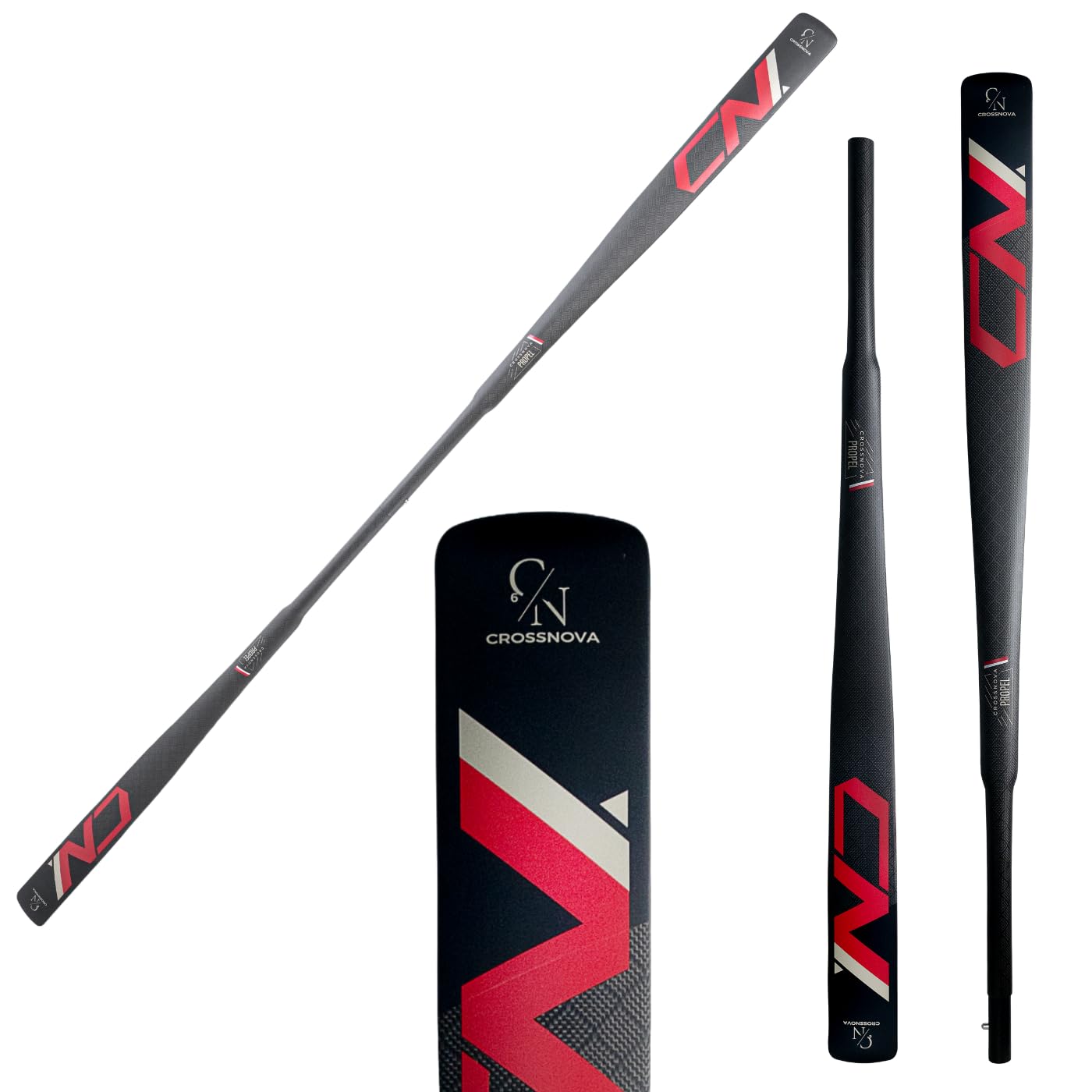
This Greenland-style paddle takes a fundamentally different approach to propulsion. Instead of the broad, cupped blade of a Euro paddle, it uses a long, narrow blade profile that slices through the water with minimal resistance and places less torque on the shoulders. The full carbon fiber construction brings the weight down to just 1.3 pounds, making it an exceptional choice for paddlers who prioritize joint health, roll performance, and all-day endurance over raw sprint power. The diamond weave finish is visually striking and provides a naturally grippy texture.
The peaked blade design creates a subtle shoulder that helps the paddler feel the blade orientation without looking, which is useful during rolling or bracing maneuvers. Owners consistently report a dramatic reduction in shoulder strain compared to a Euro paddle, and the narrow blade performs well in windy conditions where a wider blade would catch the air. The carbon layup is impressively stiff, with no perceptible flex even during aggressive strokes.
The main downside is the learning curve — the Greenland stroke is different from a standard Euro stroke, and the paddle will drip water onto your hands and lap in an open cockpit kayak if you do not master the technique. There is no included storage bag or replaceable blade tips, and the push-pin joint can be stiff to separate initially. This paddle is a specialized tool for the paddler who values efficiency and ergonomics over brute force power.
Why it’s great
- Extremely light at 1.3 lb, reducing shoulder and wrist fatigue
- Narrow blade excels in wind and provides smooth, quiet strokes
- Full carbon construction is stiff and beautifully finished
- Peaked blade design aids in orientation sensing for rolling
Good to know
- Requires learning a different stroke technique than a Euro paddle
- Narrow blade produces less power per stroke than a wide dihedral blade
- No included storage bag or replaceable tip
- Drips water in open cockpit kayaks without proper technique
7. WONITAGO Carbon Shaft w/ Fiberglass Blade
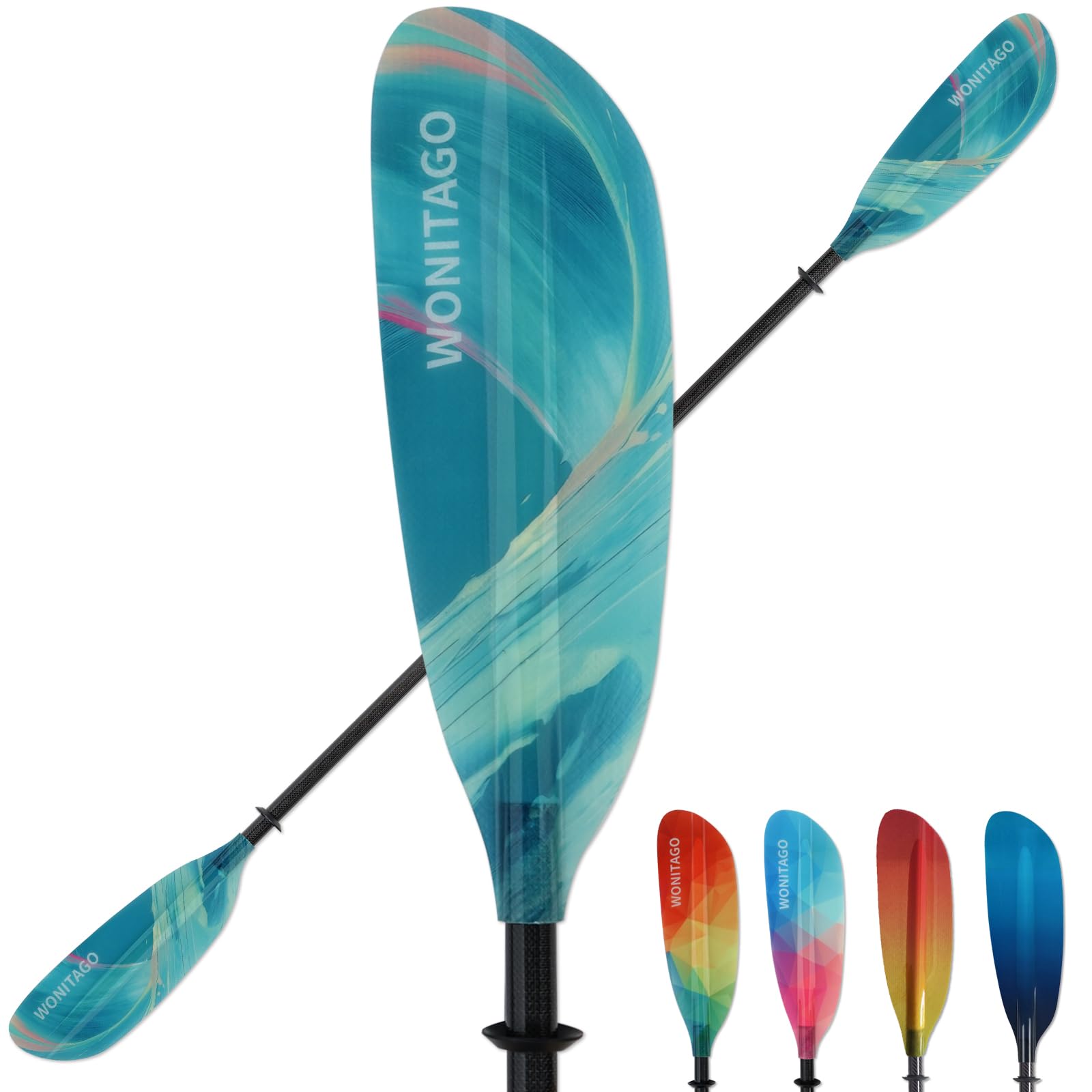
The WONITAGO offers a compelling entry point into carbon-fiber paddle ownership by using a full carbon shaft paired with gradient fiberglass blades. This hybrid approach delivers the primary benefit of carbon — a stiff, lightweight feel in the hand — while keeping the cost accessible by using fiberglass for the blade, which is also more impact-resistant than pure carbon in that area. The quick cam lock ferrule allows easy feather angle and length adjustment (230-240 cm), making it a practical travel companion.
Owners generally describe the paddle as a significant upgrade over stock aluminum or nylon-blade paddles, noting the noticeable weight reduction and improved stiffness. The included carry bag adds convenience for storage and transport. The streamlined fiberglass blade shape reduces water resistance during the stroke, and the paddle has held up well on rocky rivers with only minor cosmetic scratches after multiple trips, according to user reports.
Some users note that the shaft has a slightly rough raw carbon finish that can feel abrasive during long paddling sessions, and the blade lacks the aggressive bite of a high-surface-area dihedral design, feeling a bit less powerful at full immersion. The quick cam lock, while convenient, is not as robust as a snap-button or Posi-Lok system. For the budget-conscious paddler looking to get the weight and stiffness benefits of a carbon shaft without the premium price, the WONITAGO is a solid value choice.
Why it’s great
- Full carbon shaft provides excellent stiffness at an accessible price
- Fiberglass blades offer good durability and corrosion resistance
- Quick cam lock ferrule is easy to adjust
- Includes a carry bag for convenient transport
Good to know
- Raw carbon shaft finish can feel rough on hands during long trips
- Blade lacks the aggressive power of premium dihedral designs
- Cam lock is less robust than premium ferrule systems
8. Backwater Assassin Carbon Hybrid

The Backwater Assassin is designed with a clear mission: provide a durable, feature-packed paddle for the angler who operates in thick vegetation or tight quarters. The carbon hybrid shaft keeps the weight manageable, while the ABS-injected nylon blade is significantly tougher than fiberglass or pure carbon when striking submerged logs or pushing off rocky banks. The serrated edge on one side allows the paddler to launch themselves off solid surfaces, and the built-in hook retrieval slot can snag a fishing line, decoy, or tree branch.
Owners consistently praise the paddle for its durability and the utility of the hook feature, noting that it has saved them from losing lures and helped them navigate through dense cover. The adjustable length range (230-260 cm depending on model) is generous, accommodating a wide variety of kayak widths and paddler heights. The feathering is adjustable, though the mechanism is simpler than the premium locks found on more expensive models.
The main complaint is a risk of quality control issues with the ferrule joint, with one user reporting difficulty keeping the two halves securely connected. The hook feature, while useful for retrieving gear, can also snag on kelp or vegetation during a stroke in certain conditions. For the angler who values ruggedness and practical fishing features over the feather-light weight of a pure carbon blade, the Assassin provides a tough, versatile tool at a reasonable price point.
Why it’s great
- ABS-injected nylon blade is very impact-resistant
- Serrated edge and hook slot provide real utility for anglers
- Carbon hybrid shaft offers a good weight-to-strength ratio
- Generous adjustable length range fits various boats and heights
Good to know
- Isolated quality control issues with the ferrule locking screws
- Hook feature can catch on kelp during ocean paddling
- Heavier than a full carbon paddle due to the nylon blade
9. Pelican The Catch
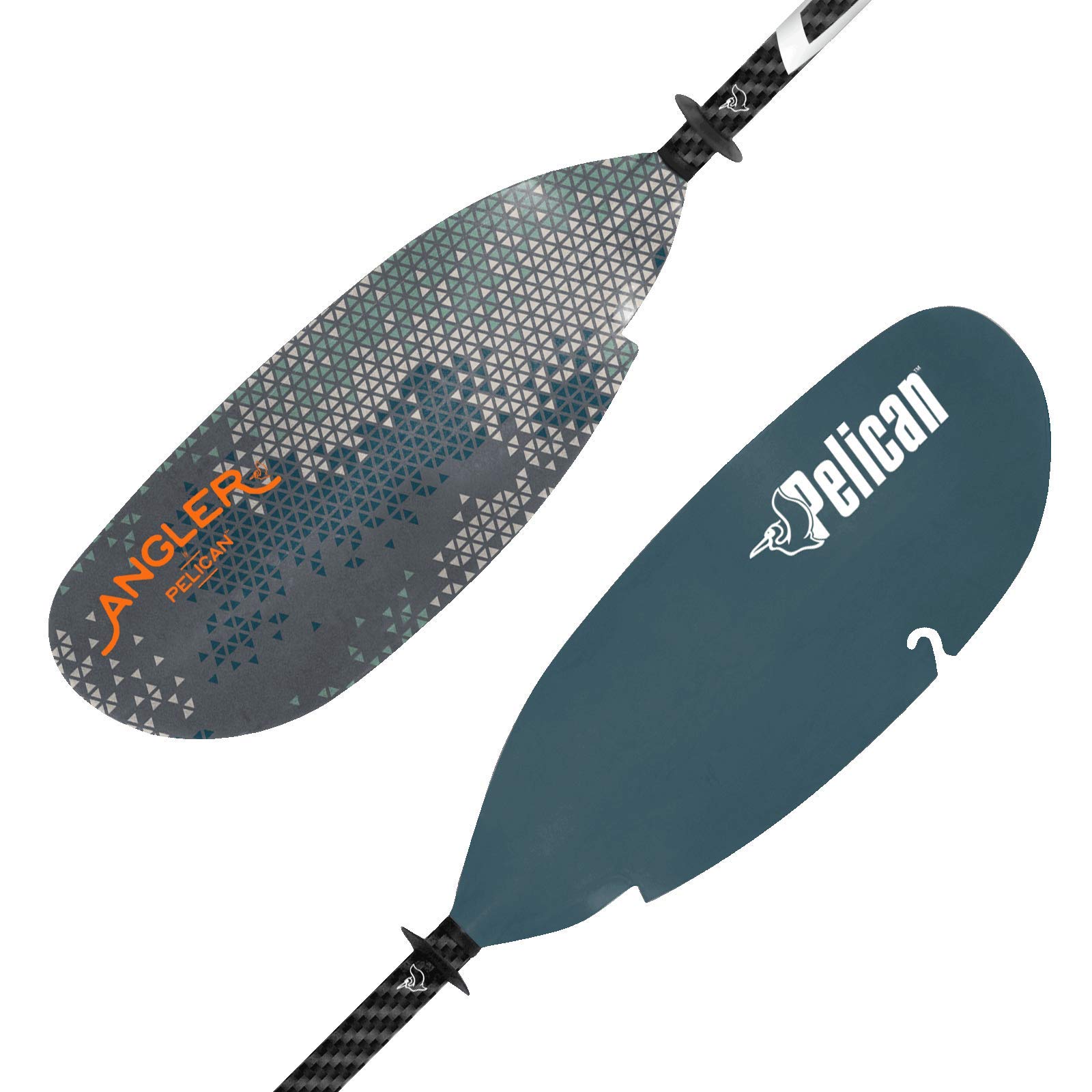
The fiberglass shaft and impact-resistant fiberglass-reinforced nylon blade prioritize durability over grams. Unique selling points include an integrated hook retrieval system built into the blade, a tape measure printed along the shaft for measuring your catch, and adjustable drip rings that help keep your hands dry during a long day on the water.
Owners report that the paddle is noticeably lighter than a standard aluminum/nylon combo, making it a worthwhile upgrade that reduces fatigue on longer trips. The 0 to 65-degree blade angle adjustment allows you to dial in the feather, and the ovalized indexing on the shaft helps you maintain the correct hand position without looking. The 250 cm length is generous, making it suitable for wide fishing kayaks up to 34 inches or more.
The trade-off is that the fiberglass shaft is not as stiff as a true carbon fiber shaft, meaning you will feel more torsional flex during hard, aggressive strokes. The blade is also not as efficient as a high-end dihedral design, with some flutter at higher cadences. For the beginner or cost-conscious angler who wants a lightweight, feature-packed paddle that is tough enough to handle accidental beach landings and scrapes, The Catch delivers exceptional value.
Why it’s great
- Integrated hook retrieval and tape measure are genuinely useful fishing features
- Fiberglass construction is tougher and more durable than budget aluminum
- 250 cm length provides excellent clearance for wide kayaks
- Adjustable drip rings and 65° feather range improve comfort
Good to know
- Fiberglass shaft has more torsional flex than carbon fiber
- Blade design can flutter at higher stroke cadences
- Heavier than a mid-range or premium carbon paddle
FAQ
How much feather angle should I use for a carbon fiber kayak paddle?
How do I choose the right length for my carbon fiber kayak paddle?
Can a full carbon fiber paddle handle rock strikes and beach landings?
Final Thoughts: The Verdict
For most users, the carbon fiber kayak paddle winner is the Aqua-Bound Sting Ray Carbon because it offers the best balance of all-carbon stiffness, a reliable infinite-feather ferrule, and a proven dihedral blade shape that works across touring and recreational paddling without fluttering. If you want integrated fishing features and extra blade durability, grab the Bending Branches Angler Ace. And for the weight-obsessed touring purist who counts every gram, nothing beats the Apex Carbon at just 27 ounces.