
Our readers keep the lights on and my morning glass full of iced black tea. As an Amazon Associate, I earn from qualifying purchases.
Specs are compiled from manufacturer listings and verified buyer reviews and can change over time — please confirm the key details on the product page before buying.
Well water brings its own set of challenges—rust stains, a rotten egg smell, and that metallic taste that makes you reach for a bottle instead of the tap. The right carbon filter eliminates taste and odor issues, but the wrong pick wastes money and causes ongoing frustration. This guide reviews top whole-house systems, focusing on iron and manganese reduction, flow rate, and cartridge replacement frequency.
I’m Min — the founder and writer behind Gadgets Feed. This guide is built by comparing the manufacturers’ published specifications and the patterns across verified customer reviews, so you get each pick’s real strengths and trade-offs instead of marketing spin.
Whether you’re fighting sulfur smells or just want better-tasting water from every tap, this breakdown of the best carbon filter for well water systems will help you match the right system to your home’s specific needs.
Our Picks at a Glance

How To Choose The Best Carbon Filter For Well Water
Your well water can smell like sulfur while your neighbor’s is full of iron—so before you buy anything, get a recent water test to see exactly what’s in yours. That test tells you if a basic carbon block filter will do the job or if you need a system with specialized iron and manganese removal media.
Match the media to your contaminant
Standard activated carbon is excellent at removing chlorine, bad tastes, and odors, but it does little for dissolved iron. If your well water leaves orange stains on fixtures, look for a system that includes KDF media or a dedicated iron and manganese removal cartridge. For sulfur (that rotten egg smell), catalytic carbon is the better choice—it’s more effective at treating hydrogen sulfide gas than regular carbon.
Balance flow rate against household demand
Every filter creates some restriction, and the more filtration stages you add, the more pressure you lose. A system rated for 7 GPM might be plenty for a small house, but if you’re running a shower and washing machine at the same time, you’ll notice a drop. Look at the maximum flow rate and match it to your household’s peak water usage—typically 5-10 GPM for a family home.
Understand the true cost of ownership
The upfront price of the system is only half the story. Check the filter life cycle—some cartridges need replacing every 6 months, while others stretch to a year or more. Standard 20″ x 4.5″ filters are cheaper and widely available; proprietary cartridges cost more but may offer better contaminant reduction. Factor in replacement costs over a few years to see what a system really costs.
Quick Comparison
| Model | Best For | Capacity | Max Flow | Filter Stage | Amazon |
|---|---|---|---|---|---|
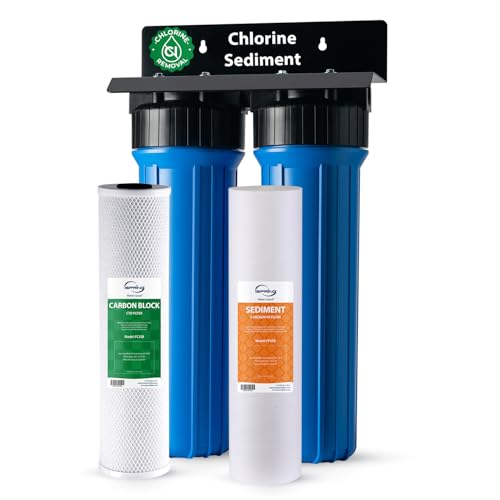
| iSpring WGB22B★ Best Overall | Balanced all-around performance | 100,000 gallons | 15 GPM | 2-Stage | Amazon |
| PUREPLUS 1-StageBudget Champion | Budget entry-level well water | — | — | 1-Stage | Amazon |
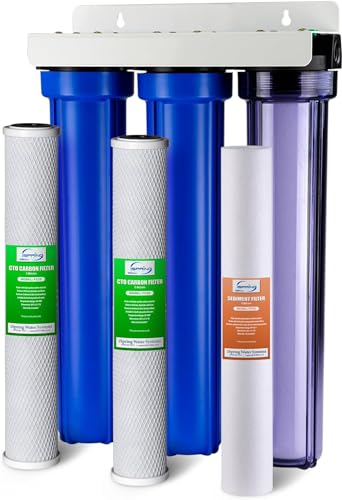
| iSpring WCB32CSmart Monitor | Budget 3-stage with visual monitoring | 30,000 gallons | 12 GPM | 3-Stage | Amazon |
| XINSHUO 9-Filter | Buy-it-once filter supply | 10,000 gallons | 15 GPM | 3-Stage | Amazon |
| H&G Lifestyles | Iron and sulfur removal on a budget | 700,000 gallons | 7 GPM | Media Tank | Amazon |
| Waterdrop WHF3T-FG | Serious iron and manganese problems | 100,000 gallons | 15 GPM | 3-Stage | Amazon |
| Healthy Spring HSCH8IO | Long-lasting chlorine reduction | 600,000 gallons | 7 GPM | Media Tank | Amazon |
| PRO+AQUA PRO-100-E | Pro-grade installation with gauges | 100,000 gallons | — | 3-Stage | Amazon |
| Aquasana EQ-Well-UV-PRO | Complete well water treatment with UV | 500,000 gallons | — | Multi-Stage + UV | Amazon |
In‑Depth Reviews
1. iSpring WGB22B 2-Stage Whole House Water Filtration System
Our pick — over 4.5★ from 800+ verified ratings; the strongest balance of quality and price.
A crowd-tested all-rounder that cleans your whole house affordably.
The iSpring WGB22B takes the top spot because it removes chlorine, rust, odors, and bad tastes in one pass, using a 5-micron sediment filter followed by a coconut shell carbon block stage. It treats up to 100,000 gallons—about a year of water for a family—and its 15 GPM (gallons per minute) flow rate keeps your shower and washing machine running together without a pressure drop. At 36 pounds, this is a permanent installation, not a quick weekend project.
The smart design choice here is the use of industry-standard 20″ x 4.5″ filters. Instead of being locked into expensive proprietary cartridges, you can shop around for replacements from any brand, which keeps long-term costs down. Buyers report the real-world experience matches the spec sheet: chlorine taste and iron smell disappear, and the included heavy-duty wrench and double O-ring seals make filter swaps straightforward.
Quality is the thing that wins people over here, with far more owners praising the build and results than anything else. That said, the honest trade-off is durability—a handful of owners mention hairline cracks in the filter housing, especially after pressure surges from utility work. The company’s response is telling: when a housing cracked after a utility upgrade, iSpring overnighted a redesigned unit free under warranty, and other owners note support remains responsive even six-plus years after purchase.
Why Owners Stick With It
- Removes up to 99% of chlorine and filters sediment down to 5 microns
- Universal 20″ x 4.5″ filters keep replacement costs low
- Retains healthy minerals while improving taste and odor
- Rated for 100,000 gallons with a 15 GPM flow rate
The Honest Trade-Off
- Housing durability has drawn occasional crack reports
- At 16″L x 8″W x 28″H, it needs a decent amount of wall space
The one to beat: if you want a proven, well-supported system that filters the whole house for about a year per set of filters, this is where to start.
Who might pass: homes with heavy iron contamination need a system with dedicated iron-removal media, not just carbon.
2. PUREPLUS 1-Stage Whole House Water Filter for Well Water
A compact, low-cost entry point that targets iron and sediment for smaller homes.
At just 7.5″L x 7.5″W x 14.2″H, the PUREPLUS is a fraction of the size of the iSpring WGB22B—a 2.1x gap in footprint that makes it a realistic option for tight mechanical rooms or even a hunting cabin. It’s a single-stage system that combines food-grade polypropylene housing with iron removal media, making it one of the few budget options that at least attempts to tackle well water’s signature problem. The kit includes a steel mounting bracket, wrench, and screws, so the install is genuinely DIY-friendly.
Its flexibility is the standout feature. The housing accepts any standard 10″ x 4.5″ filter, so you can swap between a sediment cartridge, a pleated option, or a carbon block (CTO10BB) depending on what your water test reveals. That means you’re not locked into one type of filtration forever—you can adapt the system as your needs change. A licensed plumber install reported no leaks after 4 months, with the inlet and outlet seals being the trickiest part of the job.
Functionality is what owners praise most, and for basic well water with sediment and mild iron, this unit delivers. The catch is honesty around the filter: the marketing suggests a reusable inner filter, but owners note the outer sediment filter isn’t sold separately—you have to buy the full two-part replacement rather than a cheaper standalone. There’s also the recurring durability concern of thread inserts cracking, though support has stepped in to resolve those cases.
Best for: a small household or cabin with modest well water issues who wants a cheap, flexible place to start.
Think twice if: you have heavy iron or manganese—single-stage carbon won’t be enough.
3. iSpring WCB32C Whole House Water Filter System with Clear Housing
A three-stage workhorse whose transparent first housing lets you see exactly when to change filters.
The WCB32C steps up the filtration game with three stages: a 5-micron sediment filter followed by two coconut shell carbon block filters. That extra carbon stage means more contact time with the media, which translates to better removal of chlorine, herbicides, and unpleasant tastes. The system is rated for 30,000 gallons—enough for a family of four for up to 6 months—and flows at up to 12 GPM, so most households won’t notice a pressure difference.
What sets this apart is the clear first-stage housing. You can literally watch sediment build up inside, which takes the guesswork out of filter maintenance. Instead of wondering if the cartridge is exhausted, you see the color change and know it’s time to swap. Installation uses standard 3/4″ NPT connections and the company provides step-by-step YouTube videos; owners rate the difficulty at about a 3 out of 10 for a confident DIYer.
Installation is the most-praised aspect here, and value for money runs a close second—owners repeatedly note it’s cheaper than big-box store alternatives and eliminates the need for bottled water. The recurring gripe is leakage at the threaded connections; the fix, according to the collective experience, is generous Teflon tape (10-15 wraps) and pipe dope. One owner who had a head unit crack had it replaced free under warranty, and another who struggled with leaks eventually got a replacement head unit and free filter set from support.
What Wins People Over
- Clear first-stage housing shows sediment buildup at a glance
- Three stages of filtration for thorough chlorine and taste removal
- Rated for 30,000 gallons or 6 months for a family of four
- DIY installation with clear video guidance
What to Prepare For
- Threaded connections need heavy Teflon taping to stay leak-free
- Some owners reported cracked head units replaced under warranty
Reach for this if: you’re handy and want visual confirmation of when to change filters.
Look elsewhere if: you want a set-and-forget system that never demands thread maintenance.
4. XINSHUO Whole House Water Filter System with 9 Filters, 0.5 Micron
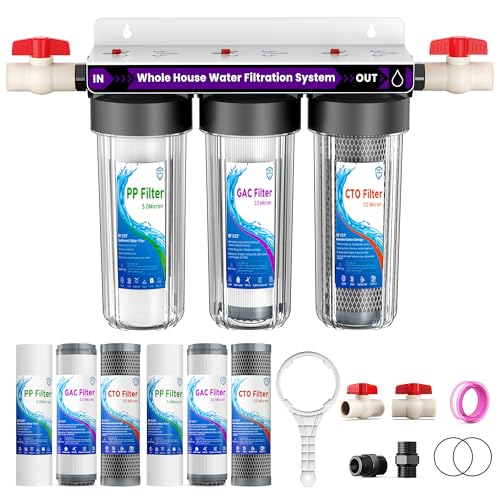
The rare system that ships with a 1.5 to 2-year supply of filters right in the box.
The headline here isn’t just the 0.5-micron filtration—it’s the sheer value of what’s included. The package comes with the housing plus 9 total filters: 3 sediment, 3 GAC carbon, and 3 CTO carbon block cartridges. That’s enough filtration for 1.5 to 2 years of continuous use, which means the hidden cost of frequent cartridge purchases is already handled. The system is rated for 10,000 gallons with a 15 GPM flow rate, so it keeps up with multiple taps running at once.
Setup is designed for someone who doesn’t want to call a plumber. The kit includes two brass 3/4″ faucet connectors, two shut-off valves, a filter wrench, and even a roll of plumber’s tape—everything you need is literally in the box. The dual valve system is a thoughtful touch: it lets you swap filters without shutting off your main water supply, turning a messy chore into a quick, clean job. The clear housing also lets you monitor sediment buildup visually.
Both installation ease and value for money get the most praise, and it’s easy to see why—few competitors throw in this many filters at this price point. The water comes out cleaner, chlorine odor disappears, and customers note better-feeling showers. The honest caveat: the included shut-off valves are the weak link, with one owner replacing them with better PVC valves before the system worked perfectly. It’s a minor fix, but worth knowing before you install.
Ideal for: a small to medium household that wants years of filter supply handled in one purchase.
Not for: anyone with high iron or manganese—this is primarily a chlorine, sediment, and taste solution.
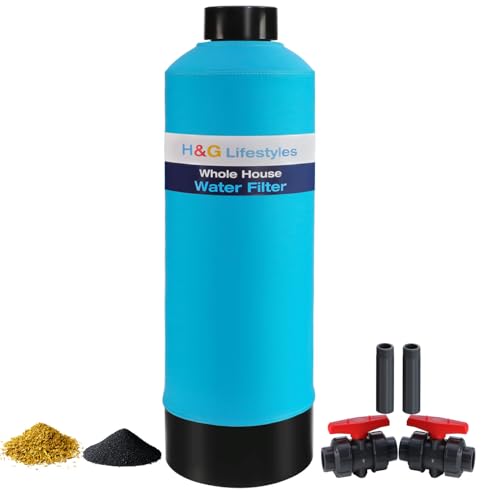
5. H&G Lifestyles Whole House Water Filter System, 700,000 Gallons
A media tank that targets the two worst well water offenders: iron and sulfur.
This system takes a different approach from the cartridge-based filters above. Instead of disposable cartridges, it’s a tank filled with NSF-certified KDF and granular activated carbon media, rated to filter an enormous 700,000 gallons over its lifetime. The KDF media is the key differentiator—it’s specifically effective at reducing heavy metals and hydrogen sulfide, the source of that rotten egg smell. The manufacturer claims 98.9% chlorine and 98.6% heavy metal reduction., with no power source required and no backwashing needed.
Owners dealing with high iron and sulfur report the most dramatic results, describing soft-water benefits like less soap scum and cleaner-feeling skin after about 6 weeks of use. The setup includes 1″ PVC piping and two control valves for a solid, leak-proof seal, plus a salt-rinse reconditioning process instead of routine flushing. At 8″L x 8″W x 27″H, it’s compact enough to fit in tight spaces despite its 700,000-gallon capacity.
Functionality is what owners praise most, and for the right water profile this is genuinely effective. The honest reality check: results are not universal. One owner running it on an irrigation system for a white vinyl fence reported zero iron reduction at all, so this is not a guaranteed iron fix for every well. It’s important to note this is not a water softener—the manufacturer is explicit that it won’t reduce TDS, sulfur in all forms, or iron in all cases.
The Big Wins
- Huge 700,000-gallon capacity with no routine flushing required
- KDF media tackles heavy metals and hydrogen sulfide odor
- No power source required for operation
- Compact tank design saves wall space
Know Before You Buy
- Iron removal is not guaranteed for every well water profile
- Not a water softener—won’t reduce hardness or TDS
Best suited to: wells with moderate iron and sulfur issues where you want a long-life media tank over disposable cartridges.
Better options exist if: your water test shows extreme iron levels that need a dedicated iron filter.
6. Waterdrop WHF3T-FG 3-Stage Whole House Water Filter System
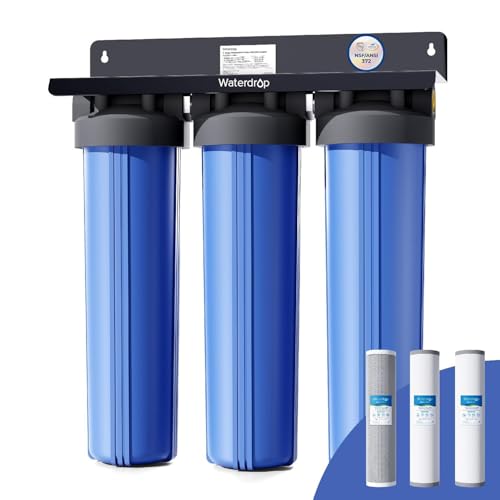
The specialist that takes on the two hardest well water contaminants: iron and manganese.
Most carbon filters quietly ignore dissolved iron, but the Waterdrop WHF3T-FG is engineered specifically for it. SGS testing shows 95.9% iron and 99.7% manganese reduction. using a double iron and manganese removal cartridge—a serious answer for wells that leave orange or black stains on fixtures. The third stage adds a carbon fiber filter for chlorine, sediment, rust, and odor, making this a complete well water solution rather than a single-purpose cartridge.
The build quality reflects the premium positioning. It’s a substantial 49-pound system that has passed 100,000+ water hammer tests to resist pressure surges, and It’s NSF/ANSI 372 certified for lead-free materials.. Owners with the worst water—one described their well water as the worst they’d dealt with—reported reduced iron staining from weekly to monthly cleaning within two months, with clearer water and better-feeling showers and laundry as a bonus.
Effectiveness is the top reason owners choose this, and the flow rate holds up at 15 GPM, so you won’t sacrifice pressure. The maintenance cycle is manageable: the iron and manganese filter lasts 6-12 months, while the GAC carbon filter is good for 12 months. The honest notes from the field: the fittings need extra Teflon tape to prevent leaks, and some owners found the housings lean slightly when full of water. A few also needed a 2″ copper nipple for proper connection—a detail not mentioned in the instructions.
Why It Wins for Wells
- Targeted reduction of iron and manganese, not just taste
- SGS tested for 95.9% iron and 99.7% manganese reduction
- NSF/ANSI 372 certified for lead-free materials
- 15 GPM flow keeps pressure strong with multiple taps
Install Notes
- Fittings need extra Teflon tape to stay leak-free
- Some setups require a 2″ copper nipple not included
- Housings may lean slightly when full
Choose this if: your water test confirms iron or manganese issues that basic carbon won’t fix.
skip it if: your well is mostly clean and you just want better taste and chlorine removal.
7. Healthy Spring Whole House Water Filter System, 600,000 Gallons
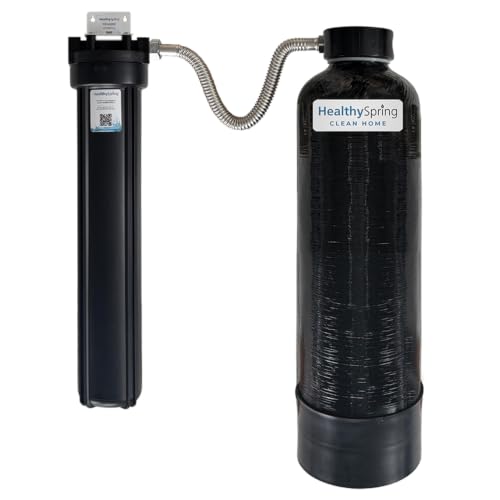
A high-capacity catalytic carbon tank that treats chlorine and chloramine for years, not months.
For homes battling municipal-style chlorine and chloramine (which is also used in some well treatments), this Healthy Spring system brings high-capacity catalytic carbon to the fight. The key word is catalytic—this form of carbon is more effective than standard GAC at breaking down chloramines and hydrogen sulfide, so it’s a strong choice for both taste and that rotten egg smell. It’s rated for up to 600,000 gallons under typical conditions, making it one of the longest-lasting systems in this lineup.
You get everything in the box: a 20-inch pre-filter with 27-micron filtration to catch sediment, dirt, and sand before they hit the carbon, plus a spare filter so you don’t need to buy one right away. The fiberglass tank lets you replace the media when it’s used up, so you keep the system instead of tossing it. With a 7 GPM flow rate—lower than the WGB22B’s 15 GPM—this suits smaller households with fewer simultaneous water demands.
Owners who waited 30 days before reviewing reported strong pressure, no clogging, and noticeably better-tasting coffee, ice, and showers. The design is praised as an excellent pre-filter for protecting water heaters, softeners, and appliances regardless of the water source. One honest note: this is not positioned as a drinking-water-only system—for that, the same owner suggests pairing it with a reverse osmosis unit for the kitchen sink. The 3/4″ plastic ports are worth handling gently during installation.
Reach for it if: you want a long-life media tank with excellent chlorine and sulfide odor reduction.
Consider alternatives if: you need high simultaneous flow for a large family or iron-specific removal.
8. PRO+AQUA Elite Series GEN2 PRO-100-E 3-Stage Whole House System
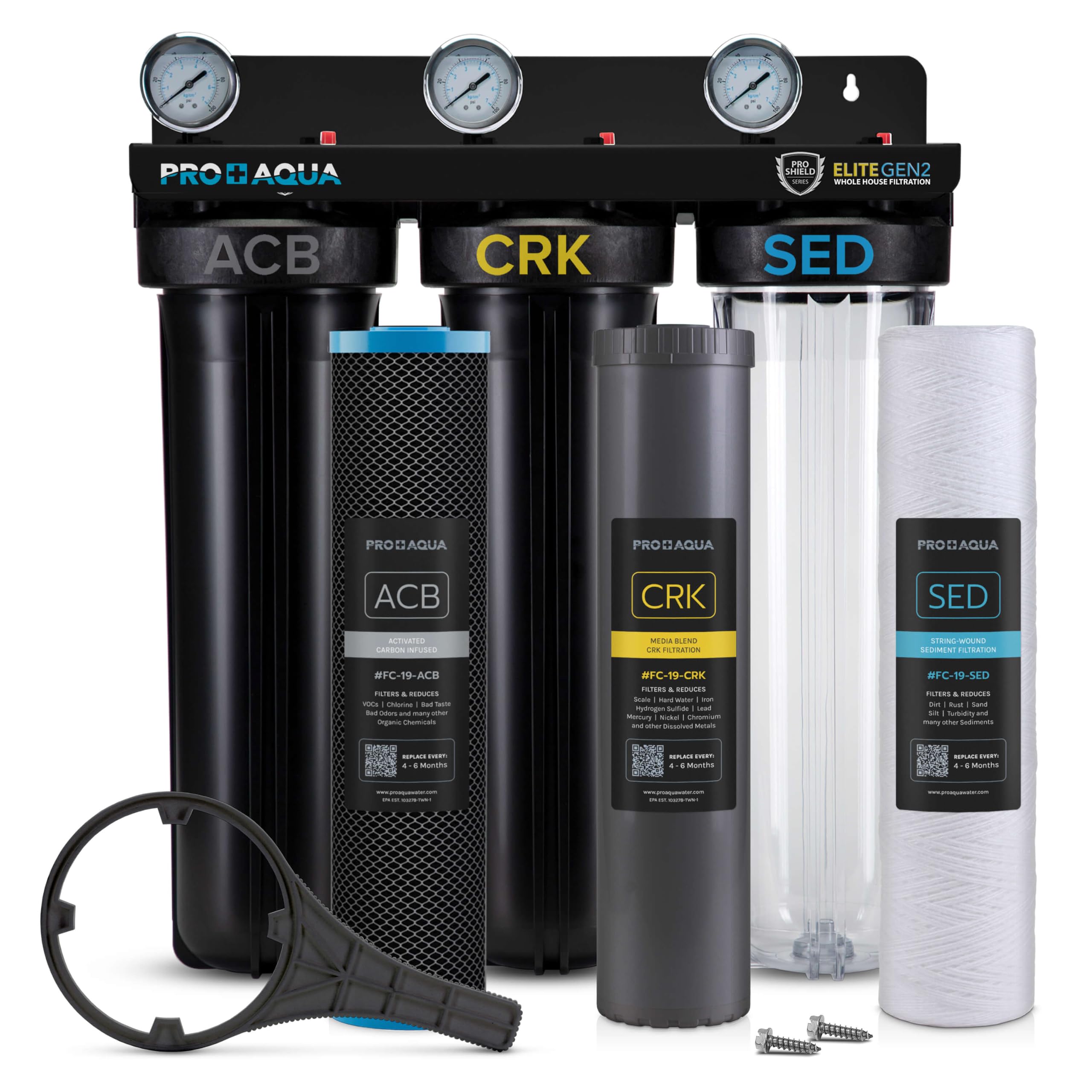
A professional-grade three-stage system with stainless steel pressure gauges for a well water home.
For small to medium households with 1-3 bathrooms, the PRO+AQUA Elite uses three stages: a sediment filter in a clear housing, a CRK filter (a combined media that reduces heavy metals like lead and iron plus hydrogen sulfide odor), and a coconut shell carbon block filter rated down to 5 microns for chlorine, VOCs (volatile organic compounds), and pesticides. It needs no regeneration, backwashing, or electricity, so maintenance stays simple.
The defining feature here is the stainless steel pressure gauges on each stage. They let you see at a glance when a filter is getting clogged, measured by the pressure difference between stages, so you replace cartridges on data rather than guesswork. The kit includes both 1″ and 3/4″ adapters, which owners say makes the install remarkably complete—the box literally has everything needed for installation. PRO+AQUA backs it with an extended 5-year warranty and lifetime US tech support after online registration.
Value and performance meet here. A Florida owner with iron and sulfur-heavy well water reported the unit removes all of it, beating other filters in side-by-side tests. Buyers repeatedly praise the sturdy gauges and included adapters. But be honest about the trade-offs: this is a heavy system—one owner’s wall bracket bent under the filled weight and needed a custom stand—and the spec sheet requires professional installation, so budget for that. Another owner noted a slight drop in water pressure that weakened showers, though the filtration itself was worth the trade.
Pro-Grade Strengths
- Stainless steel pressure gauges show when filters need replacing
- Three stages target sediment, heavy metals, and chemicals
- Includes 1″ and 3/4″ adapters for flexible installation
- Extended 5-year manufacturer warranty with lifetime support
Heavy Considerations
- System is heavy when filled—wall mounting needs reinforcement
- Professional installation recommended
- May slightly reduce water pressure in some homes
The professional’s pick: if you want data-driven filter changes and commercial-grade build for a well water household.
Who should pass: renters or anyone who can’t handle a heavy, professionally-installed permanent system.
9. Aquasana Whole House Well Water Filter with UV
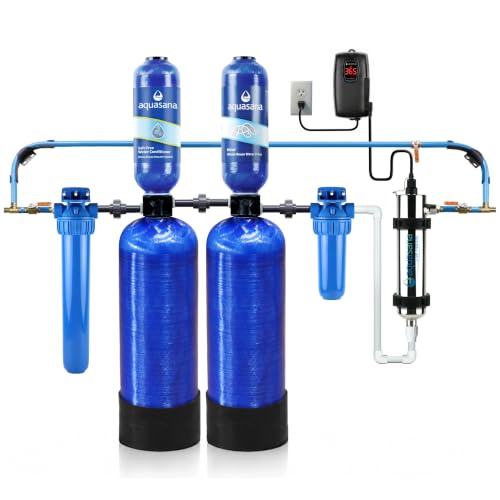
The full well water treatment suite, adding UV purification to carbon and KDF filtration.
This is the most comprehensive system here, designed from the ground up for well water. It combines pre- and post-filters with carbon, KDF, and UV—a combination that tackles chlorine (reducing chlorine by 97%), plus bacteria, viruses, and cysts that can be a real concern in private wells. The salt-free Scale Control Media prevents scale buildup in pipes without the hassle of salt bags or backwashing, addressing the hard water issues common in wells.
This system is built for the long haul: up to 500,000 gallons or 5 years of use, backed by a 5-year limited warranty. It ships as a complete kit with the pre-filter, filter tank, salt-free conditioner, post-filter, and UV filter. At 116 pounds and 69″L x 10.5″W x 57″H, it needs a dedicated space—a plumber fit it in a small utility room, but plan the footprint before it arrives.
Owners praise installation and taste most, noting the absence of chlorine and metallic flavors, plus clearer water, cleaner clothes, and softer-feeling hair. One owner in hard-water Arizona noticed the change in taste and feel immediately. The honest fit-note: the UV and multi-stage complexity raises the cost, and a few owners reported a tank leak at a connection during setup—though Aquasana’s support replaced the part after seeing a video of the issue.
The Complete Package
- UV purification tackles bacteria and viruses, not just taste
- Salt-free scale control prevents pipe buildup without salt
- 500,000-gallon capacity with 5-year limited warranty
- Reduces 97% of chlorine while preserving minerals
Big Investment, Big Footprint
- 116-pound system requires significant space and planning
- Premium price point for the UV and multi-stage setup
- Occasional tank connection leaks reported at initial setup
The ultimate solution: if you want bacteria protection plus filtration and scale control in one system, this is the most complete answer.
Only for: homeowners committed to a major investment in their water quality who have space for a large tank.
Understanding the Specs
Flow Rate (GPM)
Gallons per minute tells you how much water the filter can process while you’re using it. A 7 GPM system might struggle if you’re running a shower, a washing machine, and someone flushing a toilet at the same time. Systems rated at 15 GPM handle simultaneous use without a noticeable pressure drop. Match the flow rate to your household’s peak demand, not your average usage.
Micron Rating
This tells you how small a particle the filter can catch. A 5-micron sediment filter catches fine sand and rust; a 0.5-micron filter catches much smaller particles, which means better clarity but potentially faster clogging if your well water is heavy with sediment. For well water, a sediment pre-filter before the carbon is smart—it protects the carbon media and extends its life.
Filter Life Cycle
The manufacturer’s estimate of how long a filter lasts before replacement, usually stated in months or gallons. A system rated for 30,000 gallons or 6 months is a periodic-cost commitment; a 600,000-gallon media tank is a set-and-forget solution for years. Factor in replacement costs when comparing systems, because a cheap system with expensive 3-month filters costs more over time.
Carbon Type: GAC vs. CTO vs. Catalytic
Granular activated carbon (GAC) is loose carbon granules good for general taste and odor. CTO is a solid carbon block that’s denser and better at removing specific chemicals and particles. Catalytic carbon is specially treated to be more effective at removing chloramine and hydrogen sulfide—worth choosing if you have that rotten egg smell.
FAQ
Will a carbon filter remove iron from my well water?
What causes the rotten egg smell in my well water?
How often do I need to replace the filters?
Can I install a whole house carbon filter myself?
Will a carbon filter reduce my water pressure?
What’s the difference between a 1-stage and 3-stage system?
Do I need a UV filter for my well water?
Will these filters remove the metallic taste from my well water?
How do I know which filter type my system needs?
Will a carbon filter make my water safe to drink?
Final Thoughts: The Verdict
Across the board, the best carbon filter for well water is the iSpring WGB22B because it delivers balanced whole-house filtration with affordable standard-size filters and strong support. If your water test shows serious iron or manganese, the Waterdrop WHF3T-FG is the specialist to grab. And for a complete well water overhaul including bacteria protection, the Aquasana system with UV is the comprehensive choice—worth the money if you need it.
How We Picked
We do not accept paid placement. Every pick is matched to a real buyer and a real use-case; we do not hands-on test units.
Sources & Methodology
Specifications: manufacturer listings and product documentation. Review insights: verified customer reviews, as of August 2026. Pricing: not shown on this page (it changes often); check the current price via the retailer link.
As an Amazon Associate, Gadgets Feed earns from qualifying purchases. This does not affect which products we feature.