
A cardiology stethoscope is not a general-purpose diagnostic tool. Its acoustic sensitivity, chestpiece mass, and tubing design are optimized for the specific challenge of detecting subtle S3 and S4 gallops, low-frequency Korotkoff sounds, and faint diastolic murmurs that a standard scope will mask entirely. Choosing the wrong model means missing critical auscultatory cues that directly affect patient management decisions in the ICU, cardiac step-down unit, or ED.
I’m Min — the co-founder and writer behind Gadgets Feed. My recommendations are based on hundreds of hours comparing acoustic frequency response curves, chestpiece construction materials, and real-world user feedback from cardiologists, intensivists, and nurse practitioners who rely on these instruments daily.
Whether you are a seasoned clinician upgrading from a general scope or a medical student investing in your first serious instrument, this guide will help you identify the best cardiology stethoscope for your specific practice environment without overspending on features you do not need.
How To Choose The Best Cardiology Stethoscope
Selecting a cardiology stethoscope requires understanding the specific acoustic challenges of your clinical setting. A scope designed for a quiet exam room may be inadequate on a noisy cardiac step-down unit. Focus on the chestpiece design, tubing architecture, and binaural construction — these components determine whether you will consistently hear subtle pathological sounds.
Chestpiece Mass and Tunable Diaphragm Technology
Cardiology chestpieces are significantly heavier and thicker than their general-purpose counterparts — typically 8.5 to 10 ounces versus 5 to 6 ounces. This added mass improves low-frequency sound transmission by providing greater inertia against the patient’s chest wall. Tunable AFD (adjustable frequency design) diaphragms allow you to selectively hear high or low frequencies by varying application pressure: light pressure for low-frequency sounds like S3 and S4 gallops, firm pressure for high-frequency sounds like aortic regurgitation. Convertible chestpieces offer a threaded pediatric diaphragm that can be removed to reveal a true open bell, which is essential for detecting the very low-frequency murmurs of mitral stenosis.
Tubing Architecture: Dual-Lumen vs. Single-Lumen
Dual-lumen tubing runs two separate sound channels inside a single external tube — one channel carries sound to the left ear, the other to the right. This design eliminates the “rubbing noise” artifact that occurs when two separate tubes rub against each other, a common issue with traditional dual-tube scopes. Dual-lumen tubing is heavier and stiffer than single-lumen, which can affect neck comfort during long shifts. The internal diameter of the lumen directly impacts sound volume — larger bore channels transmit more acoustic energy. Most premium cardiology scopes use large-bore stainless steel binaurals with 3.5 mm or larger internal diameters to maximize sound transmission.
Eartip Occlusion and Headset Ergonomics
A proper acoustic seal depends entirely on the eartip material and fit. Silicone eartips (preferred over rubber) conform to the ear canal shape and maintain occlusion over extended wear. Snap-on silicone tips such as ADC’s Adsoft Plus or MDF’s ComfortSeal provide a tighter seal than push-on designs. The binaural spring tension should be adjustable via a single central leaf spring — dual-leaf springs offer twice the durability but increase headset weight. Anatomically pre-angled binaurals (typically 15 degrees) reduce the need to tilt the head during use, which decreases neck fatigue in clinicians who wear a scope for 12-hour shifts.
Quick Comparison
On smaller screens, swipe sideways to see the full table.
| Model | Category | Best For | Key Spec | Amazon |
|---|---|---|---|---|
| Littmann Cardiology IV 6151 | Premium | Critical care & noisy environments | More than 2x louder vs. leading competitors | Amazon |
| ADC Adscope 601 Red | Mid-Range | Value-driven clinics & EMS | Convertible AFD chestpiece + lifetime refurbishment | Amazon |
| ADC Adscope 601 Caribbean | Mid-Range | Color-custom preference | Identical AFD convertible design, mirror finish | Amazon |
| Welch Allyn Harvey Elite | Premium | Cardiology & pulmonology exams | Double-head chestpiece with non-chill rim | Amazon |
| MDF ProCardial MDF797DD | Premium | Pediatric/adult dual practice | Dual-leaf spring + ergonomic 15-degree angle | Amazon |
| MDF Mermaid Kaleidoscope | Premium | Lightweight daily carry | Titanium chestpiece (lighter than stainless) | Amazon |
| Littmann Cardiology IV 27″ Green | Premium | Standard-length preference & visual ID | 27-inch tubing for neck-wear comfort | Amazon |
In‑Depth Reviews
1. 3M Littmann Cardiology IV Diagnostic Stethoscope (6151)

The 3M Littmann Cardiology IV stands as the acoustic benchmark in the cardiology stethoscope category. It produces more than twice the sound output of the next leading comparable stethoscope according to Littmann’s own tests using recorded heart sounds with the diaphragm. This gain is critical in the cardiac ICU or ED where ambient noise from ventilators, monitors, and alarms can drown out low-frequency sounds like S3 gallops and Korotkoff sounds below 120 Hz. The tunable dual-sided stainless steel chestpiece is 40% larger and the bell is 60% deeper than the Classic III, providing a larger surface area for sound collection.
The 22-inch tubing length is a deliberate design choice: shorter tubing reduces sound energy loss along the lumen walls, preserving more acoustic energy at the eartips. The trade-off is that the short tube cannot easily loop around the neck — clinicians who prefer neck-wearing should consider the 27-inch version (model 6155). The soft-sealing eartips provide excellent occlusion, isolating auscultated sounds from room noise. At 3.52 ounces, the Cardiology IV weighs less than many competing cardiology scopes, reducing neck fatigue during extended use despite the larger chestpiece.
This scope is designed and manufactured in the USA with globally-sourced materials and carries a 7-year warranty. It is the preferred choice for intensivists, cardiologists, and critical care nurses who require the highest possible acoustic gain to detect subtle pathological changes in unstable patients. The convertible open or closed bell configuration allows switching between high and low-frequency auscultation without changing chestpieces — simply rotate the stem to engage the bell or diaphragm side.
Why it’s great
- Acoustic output more than doubles that of leading competitors — essential for noisy clinical environments
- 40% larger chestpiece and 60% deeper bell compared to Littmann Classic III for superior sound collection
- Weighs only 3.52 oz despite the premium stainless steel construction
Good to know
- 22-inch tubing is short — will not comfortably loop around the neck for most users
- Higher upfront investment compared to mid-range scopes like the ADC Adscope 601
2. ADC Adscope 601 Convertible Cardiology (Metallic Raspberry)
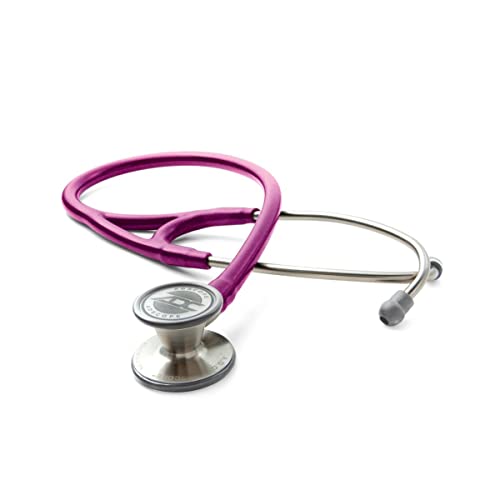
The ADC Adscope 601 delivers acoustic performance indistinguishable from the Littmann Cardiology III at roughly half the cost. Its proprietary Adjustable Frequency Design (AFD) technology uses a tunable diaphragm that shifts frequency response based on applied pressure — light pressure for low frequencies (S3, S4, mitral stenosis murmurs) and firm pressure for high-frequency sounds (aortic regurgitation, lung crackles). Each unit is individually acoustic-tested in the USA before shipment, a level of quality control usually reserved for scopes costing significantly more. The convertible stainless steel chestpiece includes a fixed adult diaphragm and a threaded pediatric diaphragm that unscrews to reveal a true open bell for capturing the lowest-frequency cardiac sounds.
The headset uses dual-channel phthalate-free tubing with large-bore stainless steel binaurals and snap-on Adsoft Plus silicone eartips. The snap-on design provides a more secure fit than push-on eartips, reducing the risk of losing a tip during a shift. The binaural spring tension is sufficient to maintain the acoustic seal without causing temporal bone discomfort. At 8.5 ounces, the chestpiece is heavy — this is intentional, as the mass improves low-frequency transmission — but some clinicians may find it fatiguing around the neck during long shifts. The 27-inch overall length provides flexibility for both neck-wearing and pocket-storage.
The lifetime warranty includes complimentary refurbishment and free parts forever. This is an extraordinary value proposition that effectively eliminates long-term ownership cost. The metallic raspberry finish is durable and resists chipping, though the color varies from the product image — several users report a darker, richer hue than the stock photo suggests. Assembled, inspected, and packaged in the USA.
Why it’s great
- Acoustic quality rivals Littmann Cardiology III and IV at a lower price point
- Lifetime warranty with free refurbishment and parts eliminates long-term costs
- Convertible chestpiece provides true open bell for low-frequency murmurs
Good to know
- 8.5 oz chestpiece is heavy — may cause neck fatigue during 12-hour shifts
- Pediatric diaphragm conversion requires unscrewing the chestpiece ring
3. ADC Adscope 601 Convertible Cardiology (Mirror Metallic Caribbean)
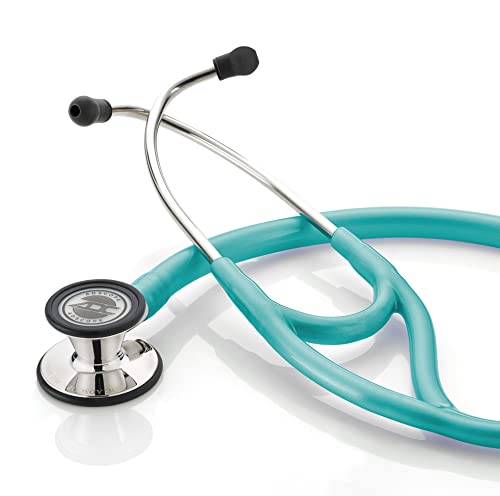
This variant of the ADC Adscope 601 shares the identical acoustic platform — the same AFD tunable diaphragm, convertible chestpiece, dual-channel phthalate-free tubing, and Adsoft Plus silicone eartips — but is offered in a distinctive Mirror Metallic Caribbean finish. The color is significantly darker than the product listing suggests, described by users as a dark teal or deep blue rather than a light mint. If you are selecting a scope primarily for aesthetic reasons, this matters because the scope will appear more subdued on the neck than the bright Caribbean image implies. Functionally, it performs identically to the Metallic Raspberry version: individually acoustic-tested, lifetime-warranted, and weighing 7.6 ounces according to the spec sheet.
The chestpiece diameter and stem rotation are identical to the other 601 models. The convertible design works well for clinicians who alternate between adult and pediatric patients, though the unscrewing process for the pediatric diaphragm is slower than a tunable dual-sided chestpiece. The large-bore stainless steel binaurals provide 3.5 mm internal diameter sound channels, and the snap-on eartips create an excellent acoustic seal. Several EMS professionals note that this scope holds up well to the rigors of field use, including exposure to weather and repeated drops.
The lifetime warranty with free parts and refurbishment applies to this model as well. The mirror metallic finish is more resistant to scratching than matte finishes because the polished surface does not show abrasions as visibly. If you are color-coordinating with a department or personal preference and want ADC’s value proposition with a unique look, this version is a direct equivalent to the raspberry model with a different visual signature. The same caveats apply: the chestpiece is heavy, and the convertible mechanism requires manual disassembly.
Why it’s great
- Same award-winning AFD acoustic technology as the standard 601 at the same price
- High-gloss mirror metallic finish resists visible scratching better than matte surfaces
- Lifetime warranty with free refurbishment and parts included
Good to know
- Actual color is much darker than the bright product photo — deep teal/blue, not light mint
- Heavier chestpiece (8.5 oz) may cause neck discomfort during extended wear
4. Welch Allyn 5079-125 Harvey Elite Adult Cardiology Stethoscope

The Welch Allyn Harvey Elite employs a traditional double-head chestpiece design with a true bell on one side and a flat diaphragm on the other, rather than a tunable combination. This matters for clinicians who prefer the tactile and acoustic certainty of switching between a dedicated bell and a dedicated diaphragm — no pressure modulation required. The bell is particularly effective for detecting low-frequency sounds like S3 gallops and mitral stenosis rumbles. The stainless steel chestpiece includes a non-chill rim, which improves patient comfort compared to bare metal contact, a thoughtful detail for cardiology exams where the scope may remain on the chest for extended periods.
The dual-lumen tubing is effective at eliminating the rubbing artifact common with separate tubes, and the rotatable stainless steel binaurals adjust to fit different ear canal angles. Users frequently report that the Harvey Elite provides superior clarity for discriminating between S3 and S4 sounds compared to the Littmann Classic III, and that lung sound exams are noticeably louder. However, the modular design has a known weakness: the non-chill rim and earpieces can loosen over time. Several long-term users report losing the diaphragm and rim during shifts because of this loosening, and replacement parts are relatively expensive. Some clinicians recommend applying a threadlocker compound to the threaded connections as a preventive measure.
At 15.8 ounces, this is one of the heaviest scopes in this comparison — nearly four times the weight of the Littmann Cardiology IV. The weight is concentrated in the chestpiece and binaurals, contributing to sound transmission quality but also to neck fatigue. The scope does not include a pediatric chestpiece as standard, though one is available separately. Users also note that the ear tips can be uncomfortable for some anatomies, and the tube tension adjustment mechanism is more difficult to manipulate compared to Littmann’s single-leaf spring design.
Why it’s great
- True bell + flat diaphragm design provides superior low-frequency sound discrimination (S3/S4)
- Non-chill rim improves patient comfort during extended cardiology exams
- Dual-lumen tubing eliminates rubbing artifact noise during single-handed use
Good to know
- At 15.8 oz, it is significantly heavier than most competing cardiology scopes
- Non-chill rim and earpieces are prone to loosening over time without threadlocker
5. MDF Instruments ProCardial Cardiology Stainless Steel Dual Head (MDF797DD)
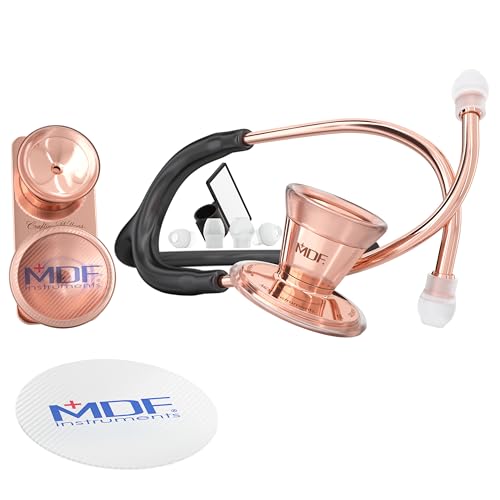
The MDF ProCardial MDF797DD competes directly with the Littmann Cardiology series at a price point that undercuts the premium brand by roughly 20 percent. The 224-gram stainless steel chestpiece is handcrafted and includes a convertible pediatric diaphragm that screws off to reveal a bell for low-frequency auscultation. The dual-lumen tubing carries sound to each ear separately, reducing phase cancellation. The Ergonomic 15-degree pre-angled binaurals reduce the head-tilt required to align with the ear canal, which minimizes neck strain over 12-hour shifts. The dual-leaf spring construction is advertised as offering twice the durability of single-leaf designs, though it adds weight to the headset.
In blind acoustic comparisons, the MDF ProCardial consistently rates 8 to 9 out of 10 for sound clarity and volume, compared to Littmann’s 6 to 7 out of 10 for the Cardiology III. The thicker stainless steel binaurals and tubing amplify sound transmission, delivering louder Korotkoff sounds and clearer breath sound differentiation. The ComfortSeal silicone eartips (three size pairs included) provide excellent occlusion, sealing out ambient noise. The scope includes MDF’s Free-Parts-for-Life program and a full lifetime warranty, though replacement parts must be requested through the warranty system rather than purchased retail.
A known issue is that the ear pieces and convertible head attachments can loosen over time, especially if the scope is carried in a messenger bag or pocket without protection. One user reported the earpiece snapping off after 18 months of daily use. The chestpiece is heavier than the Littmann Cardiology IV, and some users find it too weighty for neck-wearing during extended rounds. The rose gold/black finish is attractive but the color finish can wear off on high-contact edges after several months, revealing the underlying silver stainless steel.
Why it’s great
- Blind acoustic tests rate sound clarity 8-9/10, outperforming the Littmann Cardiology III
- 15-degree pre-angled binaurals reduce neck strain during long shifts
- Free-Parts-for-Life program eliminates long-term replacement costs
Good to know
- Earpieces and convertible head attachments can loosen over time without threadlocker
- Chestpiece is heavier than Littmann Cardiology IV — not ideal for neck-wearing
6. MDF Instruments Mermaid Kaleidoscope ProCardial Cardiology Stethoscope (Titanium)
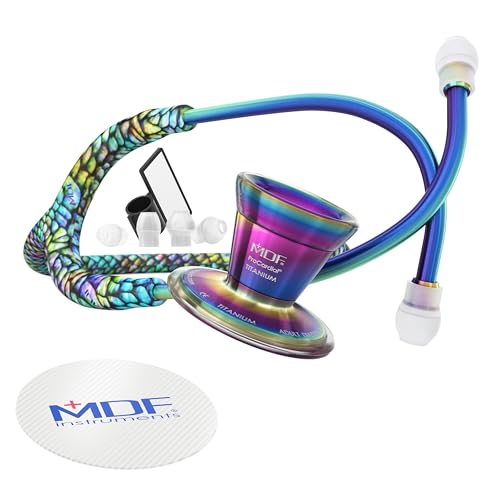
The MDF Mermaid Kaleidoscope is constructed from acoustically-superior titanium rather than stainless steel, reducing the chestpiece weight while maintaining the deep diaphragm and bell design required for true cardiology-grade auscultation. This is a meaningful engineering choice for clinicians who want the acoustic performance of a heavy cardiology chestpiece without the neck fatigue. The titanium chestpiece features deeper diaphragm and bell chambers compared to the stainless steel MDF ProCardial, providing more volume inside the sound-collection space. The GlideLock system secures the diaphragm and bell channels to prevent air leaks that degrade sound quality.
The C34 tubing has 34 individual channels etched inside the lumen wall, designed to direct sound waves without interference. This is a genuine differentiator in tubing design — most stethoscopes use a single smooth-bore lumen. The 34-channel design aims to reduce phase cancellation by keeping sound waves organized within the tube. The SafetyLock Eartip adaptors are non-invasive and use a click-locking mechanism that prevents the eartips from detaching inside the ear canal. Three pairs of ComfortSeal silicone eartips (small, medium, large) provide occlusion for different ear anatomies.
Users consistently praise the sound quality of this titanium scope, describing it as superior to the Littmann Cardiology for clarity and volume. The “Mermaid” limited edition color pattern is a fun, bright aesthetic that also serves a practical purpose — a bright, distinctive scope is harder to misplace in shared clinical spaces. The scope is slightly heavier around the neck than some users expected despite the titanium construction, likely due to the dual-leaf spring headset and C34 tubing. A pediatric/infant-neonatal convertible chestpiece is sold separately for clinicians who need that range.
Why it’s great
- Titanium construction reduces chestpiece weight while providing deeper sound-collection chambers
- C34 etched-channel tubing reduces phase cancellation compared to smooth-bore lumen designs
- SafetyLock eartip adaptors prevent detachment inside the ear canal
Good to know
- Still somewhat heavy around the neck due to dual-leaf spring and C34 tubing
- Pediatric convertible attachment is sold separately, not included
7. 3M Littmann Cardiology IV 27″ Stethoscope (Hunter Green)
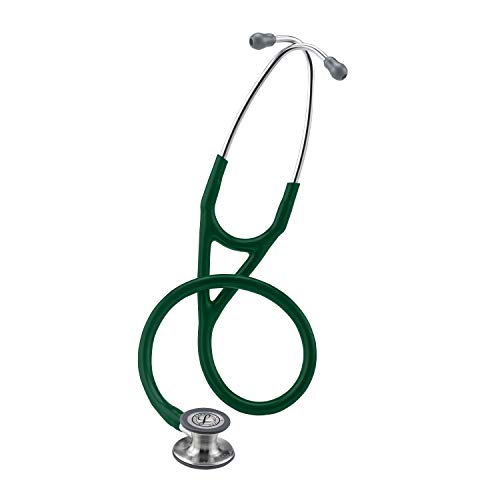
The 3M Littmann Cardiology IV in the 27-inch tubing configuration (model 6155) addresses the primary complaint about the 22-inch version — that the short tube cannot loop around the neck. This model delivers the same tunable dual-sided stainless steel chestpiece, the same >2x acoustic amplification, and the same 60% deeper bell as the 22-inch version, but with 5 additional inches of tubing that allow comfortable neck-wearing. This makes it the preferred choice for clinicians who move between patient rooms frequently and need the scope accessible without reaching into a pocket. The Hunter Green color provides a professional, subdued aesthetic that resists visible staining over time.
The acoustic performance is identical to the 22-inch model because the sound transmission loss over 5 additional inches of dual-lumen tubing is negligible at the frequencies used in cardiac auscultation. The soft-sealing eartips provide the same occlusion, and the convertible bell/diaphragm uses the same tunable diaphragm technology. The non-chill bell sleeve is available as an accessory for patient comfort. The 27-inch tubing is made from the same phthalate-free material as the shorter version, which resists stiffening and cracking over the life of the scope.
Veterinary technicians and paramedics also favor this longer version because the extra tubing length provides more flexibility when examining larger patients or working around equipment. Users with hearing loss report that the Cardiology IV’s superior amplification allows them to auscultate effectively where other scopes were borderline inadequate. The 7-year warranty applies to this model as well. The chestpiece is made from stainless steel, not titanium, so it is heavier than the MDF Kaleidoscope, but the acoustic performance is the industry standard that other scopes are measured against.
Why it’s great
- 27-inch tubing allows comfortable neck-wearing versus the 22-inch model
- Same >2x acoustic amplification as the industry-standard Littmann Cardiology IV platform
- Professional Hunter Green color resists staining and looks neutral in clinical settings
Good to know
- Heavier chestpiece than titanium alternatives from MDF
- Higher upfront investment compared to mid-range scopes from ADC
FAQ
What is the difference between a cardiology stethoscope and a general stethoscope?
Should I choose a 22-inch or 27-inch tubing length for a cardiology stethoscope?
Can a cardiology stethoscope be used for pediatric patients?
Final Thoughts: The Verdict
For most users, the best cardiology stethoscope winner is the 3M Littmann Cardiology IV (22-inch) because it provides unmatched acoustic amplification for critical care environments and sets the industry standard for frequency response. If you want a more affordable scope with lifetime warranty coverage, grab the ADC Adscope 601 Convertible. And for clinicians who prioritize lightweight carry without sacrificing sound quality, nothing beats the MDF Mermaid Kaleidoscope Titanium.