
Our readers keep the lights on and my morning glass full of iced black tea. As an Amazon Associate, I earn from qualifying purchases.
Specs are compiled from manufacturer listings and verified buyer reviews and can change over time — please confirm the key details on the product page before buying.
A hammer is the one tool you trust with every swing — the wrong one leaves you fighting bent nails, a sore elbow, and slower work all day long. This guide breaks down seven carpenter hammers built for real framing, demo, and trim work, so you know exactly which head weight, handle length, and grip type fits the way you actually swing.
I’m Min — the founder and writer behind Gadgets Feed. This guide is built by comparing the manufacturers’ published specifications and the patterns across verified customer reviews, so you get each pick’s real strengths and trade-offs instead of marketing spin.
After weighing the balance, grip, and power of each option, you will find the carpenter hammer that keeps your strikes accurate and your hands comfortable through a full day of framing.
Our Picks at a Glance


How To Choose The Best Carpenter Hammer
Picking a hammer sounds simple, but one wrong spec — too heavy, too short, wrong claw curve — turns every nail into a fight. Here is what matters most when choosing your go-to framing or carpenter hammer.
Head Weight: How Much Force You Need
Heavier heads drive larger nails with fewer swings but wear out your arm faster. A 16-oz hammer suits trim work; a 20-oz is the standard for general carpentry; 22-oz and 25-oz models deliver serious framing power at the cost of fatigue. Your pick should match the nail size you drive most often — you do not need 25 oz for finish nails.
Handle Length and Material
A longer handle gives you more leverage — 18 inches lets you sink framing nails in two hits, but a 14-inch handle keeps the swing tight and controlled in stud walls. Most carpenter hammers range between 14 and 18 inches. The handle material is also key: one-piece forged steel (like Estwing models) is nearly indestructible, while a steel head with a shock-absorbing grip (like Fiskars IsoCore) is gentler on your joints.
Claw Type: Rip vs. Curved
A rip claw (straight) gives you prying and demolition leverage — ideal for framing and pulling boards apart. A curved claw is better for pulling nails cleanly out of finished surfaces. If you are building walls and roofs, go rip claw; if you do more general repair and removal work, the curved claw is more versatile.
Face Type and Shock Reduction
A milled (textured) face grips the nail head to prevent glancing off — essential for fast, accurate strikes. A smooth face leaves a cleaner finish on the wood. Shock-reducing grips — like Estwing’s claim to reduce vibration by 70% or Fiskars’ IsoCore — protect your elbow from the sting of repeated hits, which matters on long framing days.
Quick Comparison
| Model | Best For | Head Weight | Overall Length | Weight (Pounds) | Amazon |
|---|---|---|---|---|---|
| Spec Ops Tools 20 Oz★ Best Overall | Budget-friendly all-rounder with mallet cap | 20 oz | — | 1.25 lbs (567 grams) | $30.68$35.99Amazon |
| Fiskars Pro IsoCore 20 ozAlso Great | All-day comfort with minimum vibration | 20 oz | 15.5″ | 1.25 lbs (20 oz) | $32.86Amazon |
| ESTWING Ultra 19 oz (Milled Face) | Premium one-piece USA steel for rough framing | 19 oz | 15.4″ | 2.2 lbs | $45.68$53.99Amazon |
| ESTWING Ultra 19 oz (Smooth Face) | Classic leather-grip durability with a polished look | 19 oz | — | 2.1 lbs | $48.79$52.02Amazon |
| Milwaukee 20oz Curved Claw | Lightweight curved claw for everyday use | 20 oz | 14″ | 1.7 lbs | $42.99$46.86Amazon |
| Jorgensen 22 oz Framing Hammer | Heavy hitting power at an entry-level price | 22 oz | ~14-16″ | — | $26.99Amazon |
In‑Depth Reviews
1. Spec Ops Tools Nailing Hammer 20 Oz with Mallet Cap
Our pick — over 4.5★ from 850+ verified ratings; the strongest balance of quality and price.
A 20-ounce hammer that moonlights as a rubber mallet — two tools in one for the price of one.
What sets the Spec Ops apart from every other pick here is the included Santoprene rubber mallet cap. You slip it over the smooth face, and suddenly you have a non-marring hammer for tapping trim, assembling furniture, or persuading a stubborn cabinet without denting the surface. That is a genuinely useful bonus for anyone who switches between framing and finish work. The hammer itself weighs 567 grams (about 1.25 pounds) — buyers describe it as “lighter than framing hammers but heavier than 16 oz trim hammer.”
It carries a shock-absorbing MOA grip and a magnetic nail starter for one-handed use. The rip claw is versatile for demo work, and the heat-treated alloy steel construction feels solid. Buyers rate it 4.8/5 from 899 ratings, with comments like “nicely balanced to keep any wrist injuries at bay” and “excellent magnet for starting nails.”
Compared to the Jorgensen (22 oz, one-piece forged), the Spec Ops is lighter and more versatile with the mallet cap, but the Jorgensen has a more powerful swing. The Spec Ops is also lighter than the 2.2-lb Estwing by a wide margin. The catch? The grip and build feel slightly less premium than the Fiskars or Estwing options — it is a solid budget-friendly choice, not a professional heirloom. For the price and the included mallet cap, it is an outstanding value.
Smart additions
- Includes a soft mallet cap — instantly converts from hammer to non-marring tool
- Light at 567 grams — easy on the arm for medium-duty work
- Magnetic nail starter works well, per buyers
Shortcomings
- Lighter 20 oz head with less driving force than Jorgensen (22 oz) or Estwing (19 oz but heavier build)
- Not built for heavy daily framing — better suited to trim, demo, and punch list tasks
Choose this for: a versatile, budget-friendly hammer that does double duty with the mallet cap, ideal for DIYers and trim carpenters.
Skip this for: full-time framing — the 1.25-lb weight and plastic grip won’t hold up to years of heavy daily swinging like the forged-steel Estwing.
2. Fiskars Pro IsoCore 20 oz General Use Hammer (15.5″)
The hammer that cradles your elbow while driving nails all day — no sting, no slip.
If you have ever felt the vibration from a wood-handled hammer travel straight up your arm, you will appreciate what Fiskars does here. The patented IsoCore Shock Control System transfers 4X less shock and vibration than wood handles. — and buyers confirm it: one retiree framer reported no elbow pain after full-day use. That matters when you are driving dozens of nails into studs or decking. The 20-ounce head weight (the standard for most general carpentry) gives you authority without turning your swing into a chore.
You get a 15.5-inch overall length — longer than the 14-inch Milwaukee below, so you have decent leverage, but not so long that it feels clumsy in a wall cavity. The Softgrip handle flares to keep the hammer locked in your palm, and buyers report the magnetic nail starter “works flawlessly: no slips, perfect magnet strength, accurate within 1/8″.” The steel-welded head carries a rust-resistant coating and a rip claw for quick nail pulling.
Unlike the heavier Jorgensen (22 oz) or the one-piece forged Estwing (2.2 lbs), the Fiskars weighs only 20 ounces, which keeps fatigue low on long jobs. The trade-off? A few buyers mention the clear coat on the head scratches easily — a cosmetic issue that does not affect function. For homeowners and tradespeople alike, this is the best-balanced mix of comfort, weight, and price in the lineup.
what separates it
- 4X less vibration than wood handles — arm-friendly for all-day framing
- Magnetic nail starter accurate within 1/8″, per buyers
- 15.5-inch length gives good leverage without being unwieldy
Honest limitations
- Clear coat scratches relatively easily
- 20 oz may feel light for heavy demolition compared to 22 oz or 25 oz options
Reach for this if: you want the best all-around framing and general-use hammer that protects your elbow and hits accurately, straight from the start.
One caveat: if you are a framer driving large sinkers all day, you might want the extra leverage of an 18-inch handle; for nearly everyone else, this is the pick.
3. ESTWING Ultra Series Hammer – 19 oz USA Made Rip Claw Framing Hammer (Milled Face) – EB-19SM

American steel forged as one solid piece — the kind of hammer that outlasts your tool belt.
Estwing has been making hammers in Rockford, IL since 1923, and the Ultra Series shows why their name carries weight. This 19-oz model is forged from a single piece of American steel — no welds, no joints to snap. It comes with a milled (textured) face that grips the nail head so your strike does not slide off, which is especially helpful when you are swinging at an awkward angle. At 15.4 inches long and 2.2 pounds, it is noticeably heavier than the Fiskars (which weighs 1.25 pounds) — that extra mass drives nails with fewer swings, but you will feel it by the end of the day.
Buyers consistently praise the balance and the magnetic nail starter — one reviewer who got the 19-oz smooth face version by mistake still called it “excellent… the face hits cleanly and doesn’t slide off the nail.” The polished rip claw handles prying and demolition well, and the patented grip claims to reduce vibration by 70%.
Compared to the Milwaukee 20-oz at 1.7 pounds and 14 inches, the Estwing is both longer and denser — you get 10% more length and significantly more heft for power-hitting. The catch? The 2.2-pound weight is a workout; if you are doing overhead nailing or have wrist issues, the lighter Fiskars is kinder. But for raw durability and a hammer that feels like an extension of your arm, this is tough to top.
One-piece confidence: No separate head to fly off — forged from solid steel so it will not break at the neck.
The trade-off: At 2.2 lbs it is 0.5 lbs heavier than the 20-oz Milwaukee (which owners mention “is a feather” at 1.7 lbs), so expect arm fatigue on long runs.
Reach for this if: you want a near-indestructible hammer that sinks big nails fast and you are okay with the extra heft.
Look elsewhere if: you prioritize light weight and low vibration over raw steel durability — the Fiskars is a better arm-saver.
4. ESTWING Ultra Series Hammer – 19 oz USA Made Rip Claw Framing Hammer (Smooth Face, Leather Grip) – E19S

A timeless leather-wrapped handle that looks and feels like a tool from your grandfather’s workshop.
This is essentially the same one-piece forged steel body as the EB-19SM above, but swapped: the milled face becomes a smooth face, and the synthetic shock reduction grip becomes genuine leather. The smooth face leaves a cleaner finish on the wood (no texture marks), so it is a better choice for visible trim work or projects where the hammer mark shows. The leather grip is hand-sanded and lacquered for a comfortable, non-slip hold — and it does not get sticky in heat like some rubber grips.
At 2.1 pounds, it is 0.1 lbs lighter than the milled-face version — still heavier than the Milwaukee (1.7 lbs) and the Fiskars (1.25 lbs). One reviewer who buys Estwing hammers regularly says they are “well balanced, and are very durable.” The magnetic nail starter is the same excellent design as the milled-face version, making one-handed nail setting easy.
The potential deal-breaker: a buyer warns that isopropyl alcohol easily removes the black painted finish, leaving bare metal. They applied gun oil to prevent rust. If you work in wet conditions or use solvents on site, the painted finish may not hold up as well as the raw steel of the BIG BLUE below. Still, for a handsome, rugged hammer that feels like a hand-tool heirloom — and one reviewer sums up as “fantastic hammer made in Rockford Illinois” — this is a beautiful choice.
The appeal
- Leather grip is comfortable and non-slip, ages well
- Smooth face leaves no texture marks on wood
- Same one-piece forged steel construction as the pro-grade Estwing
The catch
- Black paint is vulnerable to solvents (buyer reported it strips easily)
- Heavier than Fiskars and Milwaukee — 2.1 lbs vs 1.7 lbs
Snag this for: a classic, durable carpenter hammer that looks as good as it swings, perfect for finish work and trim where a milled face would mar the surface.
skip it if: you need maximum vibration reduction — the leather grip does not absorb shock as effectively as the IsoCore or synthetic Estwing grip.
5. Milwaukee 20oz /14″ Curved Claw Hammer (20)
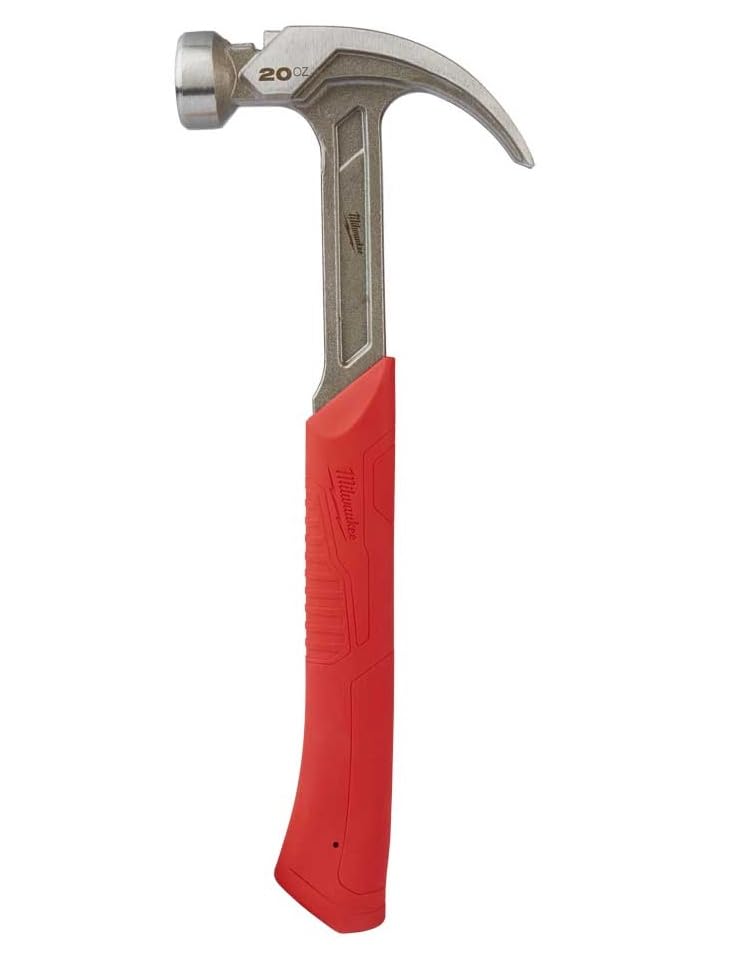
A 20-ounce hammer that somehow swings like it is 16 ounces — your arm will thank you.
Milwaukee packed a 20-ounce head into a body that weighs only 1.7 pounds — and buyers notice. One review says plainly: “For a 20 oz hammer, this thing is a feather.” That makes a real difference when you are swinging all day on a framing job. The 14-inch overall length is the shortest on this list (10% shorter than the 15.4-inch Estwing), which means you trade some leverage for a compact, controlled swing that is easier to aim in tight spots like stud bays.
The curved claw is the standout difference here from the rest of the pack — it is designed for pulling nails cleanly out of finished wood rather than prying boards apart. The anti-vibration grip and anti-ring head reduce the high-pitched “ping” that metal-handled hammers can make, and buyers comment on the “excellent balance and weight.”
Compared to the Fiskars above, the Milwaukee is a half-pound lighter (1.7 vs about 2.1 lbs for the Estwing E19S) and 1.5 inches shorter. It is a specialist for close-quarters work and lighter swinging. The downside? The shorter handle means you need to swing harder to sink a framing nail in one or two hits. And a few buyers feel it is slightly overpriced vs. competitors. For a featherweight 20-ounce curved claw, though, this is tough to top for comfort.
Standout spec: At 1.7 pounds, this is the lightest 20-oz hammer in the group — buyers call it “a feather.”
The trade-off: The 14-inch handle means less leverage than the 15.5-inch Fiskars or 15.4-inch Estwing, so be ready to swing with more velocity.
Reach for this if: you want a lightweight curved claw for general carpentry and nail pulling, especially in tight spaces.
Look elsewhere if: you do heavy framing or demolition — the curved claw cannot pry like a straight rip claw, and the short handle lacks leverage for big nails.
6. Jorgensen 22 oz Framing Hammer, Straight Claw, Milled Face
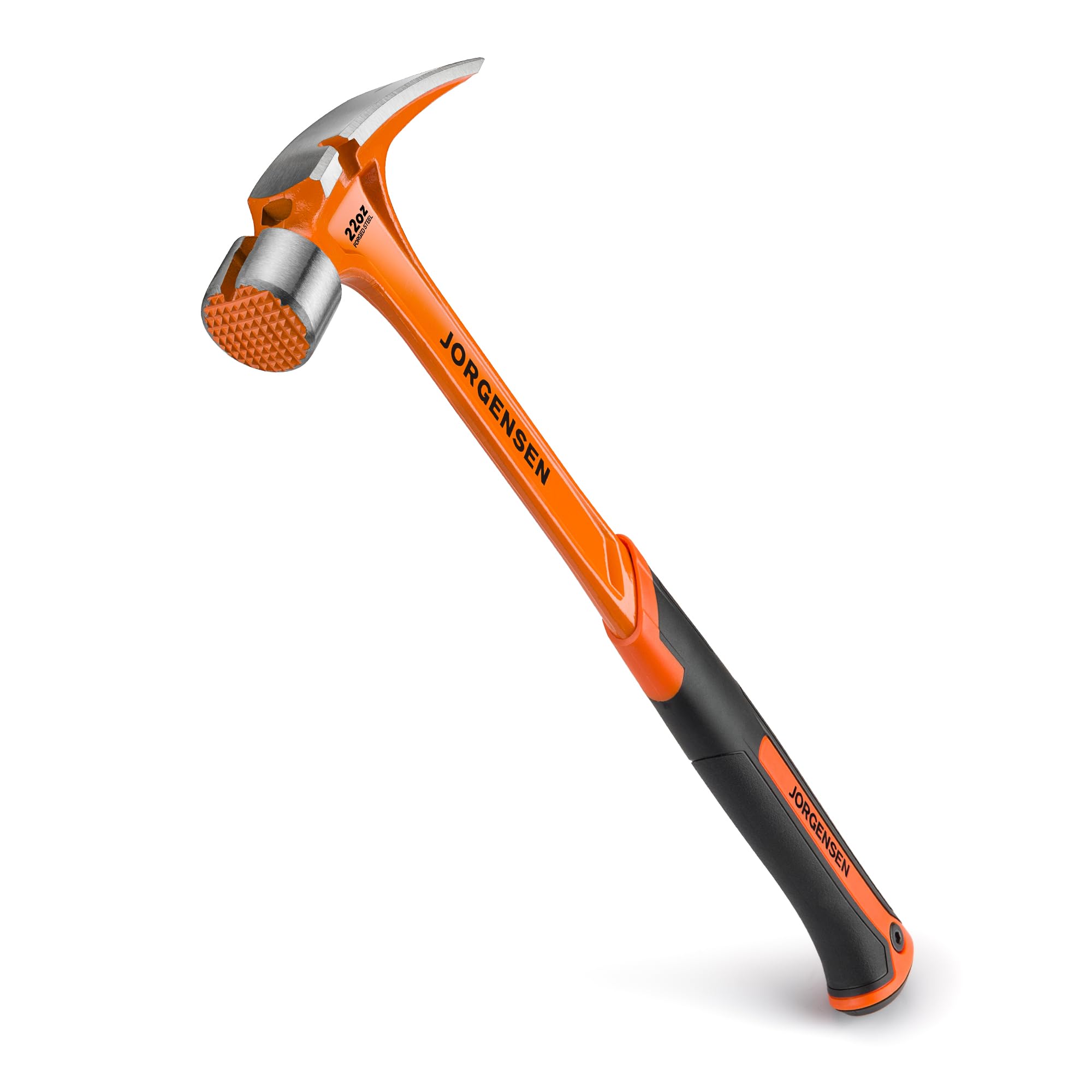
Two extra ounces over the standard 20-oz delivers noticeably more authority with every swing — without a premium price tag.
Jorgensen built this hammer around the idea that more weight equals more power for less effort — the 22-ounce head weighs 22 ounces, compared to 19 ounces for the Estwing and 20 ounces for a standard. That extra mass drives nails deeper with less arm velocity, which matters on framing jobs. The head is milled (textured) for secure strikes, and a built-in magnetic nail starter lets you set nails one-handed. The straight rip claw handles prying and demolition, and there is even a side nail puller for stubborn nails the claw cannot reach.
Buyers who have used Jorgensen for decades say “I can hammer away all day with this and my arm does not hurt” — proof of the shock-absorbing TPR grip. The one-piece forged and heat-treated carbon steel construction gives it real durability at a value price point. Another buyer notes it is “affordable. Works well. Unique side nail remover for nails claw can’t reach.”
Compared to the Fiskars (lighter, better vibration control) and the Spec Ops (lighter, includes mallet cap), the Jorgensen is heavier and more brute-force. The catch? The handle is described as about 14-16 inches, which is shorter than the Estwing (15.4″) and the Fiskars (15.5″), so you get less leverage. Still, for a buyer who wants maximum hitting power per dollar, this delivers.
Heavy hitter: The 22 oz head is the second-heaviest on this list — only the 25-oz BIG BLUE is bigger — and pumps serious force into each swing.
One issue: At roughly 14-16 inches, the handle is on the short side for a framing hammer, so you lose some leverage advantage despite the heavy head.
Reach for this if: you want the most driving power for your dollar and a milled face for anti-slip strikes.
Pass it up if: you prefer a longer handle for maximum leverage — the 15.5-inch Fiskars or 18-inch BIG BLUE give you more reach per swing.
Understanding the Specs
Head Weight (Ounces)
Head weight — measured in ounces (oz) — determines how much force each swing delivers and how quickly your arm tires. A 16-oz hammer is light and fast, ideal for finish nails. A 20-oz hammer is the carpenter’s standard: enough power for framing nails without wearing you out. Jump to 22 oz or 25 oz (like the Jorgensen or Estwing BIG BLUE), and you get deep-driving force for thick lumber but noticeably more fatigue over a full day. Pick the smallest head that drives your most common nail size in one to two hits.
Overall Length (Inches)
The handle length — from the base of the grip to the top of the head — directly affects your leverage. A 14-inch handle (like the Milwaukee) gives you a compact, controllable swing for tight spaces but requires more arm speed to match the driving power of a longer handle. A 15.5-inch handle (Fiskars) is a good middle ground. An 18-inch handle (Estwing BIG BLUE) multiplies leverage so you sink nails with less effort, but the extra length can be clumsy in a wall cavity or on a tool belt. Match the length to your most common work environment.
Claw Type: Rip vs. Curved
The claw is the forked end opposite the striking face. A rip claw (straight) is designed for prying boards apart, pulling stubborn nails, and demolition — you see it on almost every framing hammer. A curved claw is shaped to hook under nail heads and pull them out with a rolling motion, which is gentler on the wood surface. If you frame walls and roofs, get a rip claw. If you do more general repair and finish work, a curved claw is more versatile for clean nail removal.
Face Type and Shock Reduction
The striking face comes in two varieties: smooth and milled (textured). A milled face (like the Estwing EB-19SM or Fiskars) grips the nail head so your swing stays centered, which is invaluable when you are working fast or at odd angles. A smooth face leaves a clean surface on the wood, so it is preferred for finish work. Shock reduction refers to materials or designs in the handle that absorb recoil — Fiskars’ IsoCore claims 4X less vibration, Estwing’s patented grip claims 70% reduction. If you have ever felt your elbow ache after a day of hammering, a shock-reducing grip is worth every penny.
FAQ
What is the best head weight for a carpenter hammer?
Does a longer handle make hammering easier?
What is the difference between a rip claw and a curved claw?
Is a milled face better than a smooth face?
How important is a shock-reducing grip?
Can I use a 20-oz hammer for demolition?
What does “forged one-piece steel” mean?
How do I choose between a leather grip and a rubber grip?
Are magnetic nail starters worth it?
What is the warranty on these carpenter hammers?
Final Thoughts: The Verdict
For the majority of shoppers, the carpenter hammer winner is the Fiskars Pro IsoCore 20 oz because it combines excellent vibration control, a magnetic nail starter accurate within 1/8″, and a 15.5-inch length that balances leverage and control — all at a price that undercuts the forged-steel Estwing models while outperforming budget options on comfort. If you want USA-forged one-piece steel and a milled face for max grip on every swing, grab the ESTWING Ultra 19 oz Milled Face. And for driving heavy nails into thick lumber with the leverage of an 18-inch handle, nothing here beats the ESTWING BIG BLUE 25 oz.
How We Picked
We do not accept paid placement. Every pick is matched to a real buyer and a real use-case; we do not hands-on test units.
Sources & Methodology
Specifications: manufacturer listings and product documentation. Review insights: verified customer reviews, as of July 2026. Pricing: not shown on this page (it changes often); check the current price via the retailer link.
As an Amazon Associate, Gadgets Feed earns from qualifying purchases. This does not affect which products we feature.
Related Guides
Product prices and availability are accurate as of the date/time indicated and are subject to change. Any price and availability information displayed on Amazon at the time of purchase will apply to the purchase of this product. As an Amazon Associate I earn from qualifying purchases.
CERTAIN CONTENT THAT APPEARS ON THIS SITE COMES FROM AMAZON. THIS CONTENT IS PROVIDED "AS IS" AND IS SUBJECT TO CHANGE OR REMOVAL AT ANY TIME.
Amazon and the Amazon logo are trademarks of Amazon.com, Inc. or its affiliates.