
Our readers keep the lights on and my morning glass full of iced black tea. As an Amazon Associate, I earn from qualifying purchases.
Specs are compiled from manufacturer listings and verified buyer reviews and can change over time — please confirm the key details on the product page before buying.
The scariest moment in any roast dinner is the carve — a hot bird sliding sideways while a knife comes down beside your fingers. A carving fork stops that slide, and the right one grips instead of tears. The nine picks below are sorted by what they actually do at the table: some hold a whole turkey steady, some lift an eight-pound ham straight off a smoker, and several are built to stay in a drawer for a decade. Buy the one that matches how you cook.
I’m Min — the founder and writer behind Gadgets Feed. This guide is built by comparing the manufacturers’ published specifications and the patterns across verified customer reviews, so you get each pick’s real strengths and trade-offs instead of marketing spin.
Here’s what matters. Prong length decides whether you’re holding a burger or a turkey. Handle shape decides whether your hand stays dry on the fourth slice. If you carve at home more than twice a year, the best carving fork is the one piece that quietly makes the whole job steady.
Our Picks at a Glance


How To Choose The Best Carving Fork
A carving fork does one job: it pins a hot, moving piece of meat to the board so your knife can do its work. Everything about the tool — prong length, tine thickness, handle material, weight — either helps or hurts that one job. Here’s what to check before you buy.
Prong length is the number that matters
The tines are the two prongs that go into the meat. Their length, not the overall fork length, is what decides what you can hold. A shorter set of tines handles a chicken breast or a steak. A longer set gets through a whole turkey to the bone. Tine thickness matters too — thicker tines resist bending under a heavy roast, so they still pull straight out instead of sauntering sideways.
Look for one-piece forging
A forged fork is shaped from a single piece of steel, so the tines and handle are one continuous unit — nothing to loosen or wobble. Stamped forks are cut from flat steel and can feel lighter and less rigid. Neither is automatically better, but forging is the reason a fork can lift something heavy without the prongs splaying apart.
Handle material and how you’ll wash it
Handles come in brushed aluminum, ABS plastic, POM plastic, polypropylene, and G10 resin. The bigger question is cleaning: some handles are dishwasher safe, and some makers ask you to wash by hand only to keep the finish looking new. If you want to toss it in the rack after a holiday meal, confirm the handle survives that first.
Do you need a finger guard
A guard is a small shield that sits between the tines and your hand. It blocks a knife that slips off the roast from landing on your fingers. On short forks used for slicing, it’s a real safety feature. On long BBQ forks used for lifting, it usually just adds bulk.
Quick Comparison
| Model | Best For | Overall Length | Tine / Prong Detail | Handle Material | Amazon |
|---|---|---|---|---|---|
| Carving Fork, Meat Fork, 12 Inch Cooking Fork★ Best Overall | Everyday home roasting | 12 inches | 7″ prong, 4″ tine | ABS with triple rivets | Amazon |
| Rada Cutlery Carving Fork (R110)Compact Pick | Compact indoor carving | 9.5 inches | 5⅛” tines | Cast brushed aluminum | Amazon |
| Kilajojo Chef Pro 13 InchHeavyweight Pick | Lifting heavy roasts | 13 inches | One-piece forged steel | POM plastic | Amazon |
| Babish 6.5-Inch Carving Fork | Plating and oven reaching | 6.5 inches | 1.411 German carbon steel | Black ABS | Amazon |
| All-Clad T103 Stainless Steel 13.5-Inch Fork | Serving at the table | 13.5 inches | 18/10 stainless tines | Stainless steel | Amazon |
| MasterClass Stainless Steel Carving Fork with Guard | Holiday turkey safety | 11.02 inches | Integrated finger guard | POM plastic | Amazon |
| Mercer Culinary M20806 Genesis 6-Inch | Small cuts and drawers | 6-inch blade | Forged high-carbon German steel | Santoprene non-slip | Amazon |
| Victorinox Swiss Classic 6 Inch | Quick pick-up and serve | 10.6 inches | Optimally aligned prongs | Polypropylene | Amazon |
| KESSAKU Dynasty 7″ Meat Fork | Gifting and heavy brisket | 7-inch tines | Nitrogen-cooled dual prong | G10 fiber-resin | Amazon |
In‑Depth Reviews
1. Carving Fork, Meat Fork, 12 Inch Cooking Fork, Stainless Steel BBQ Fork
Our pick — over 4.5★ from 700+ verified ratings; the strongest balance of quality and price.
The everyday workhorse that pins a turkey steady and still feels right in a smaller hand.
Start with the measurements, because they explain everything else. This fork runs 12 inches overall, with a 7-inch prong section and 4-inch tines. In practice that means the tines reach through a full turkey or a standing rib roast to the bone, so the meat stops moving the second you press down. It’s a one-piece forging in stainless steel, so there’s no seam where the head meets the handle to flex or loosen over time.
The part that surprises people is the weight. Owners describe it as hefty but not heavy — enough mass that it feels planted, not so much that your wrist complains on the fourth slice. The grip is an ABS handle with a triple-rivet design, and it’s shaped so your hand doesn’t slide up toward the tines when things get greasy. Sharpness is where it earns its reputation: the taper-ground tines go into raw meat and cooked meat without needing a shove. Buyers report it speeds up cutting meat and keeps your hands at a safe distance from the blade.
What wins people over most is the build quality, and there’s a lot of it — the fork draws a deep well of praise that centers on construction and durability rather than looks. The kitchen helper description holds up too: the compact head plus sharp tines lets you pick up and serve everything from sliced brisket to a whole chicken. If your carving happens on a cutting board over a countertop, this is the length that suits it. The one practical note is travel — a fork this long and this pointed belongs in checked luggage, not a carry-on.
Where It Shines
- 12-inch body with a 7-inch prong section reaches through a whole bird to the bone
- One-piece forged stainless steel — no seam to flex or loosen
- Triple-riveted ABS handle stays grippy once your hands get greasy
- Taper-ground tines bite raw and cooked meat alike without a hard shove
Worth Knowing
- At 12 inches it’s long for small drawer storage or a compact carving board
- The pointed tines need care in travel packing
Made for: the home cook who carves a roast or a bird at the counter and wants one fork that stays planted through the whole job.
Rethink it if: your carving happens in a tight kitchen drawer or you mostly carve small cuts — a shorter fork suits you better.
2. Rada Cutlery Carving Fork (R110), Silver
Nine and a half inches of American-made steel that slips into a drawer and still holds a roast.
Compared with the 12-inch Kakamono above, this one is shorter by 2.5 inches overall — a real difference if your carving board is small or your drawer is shallow. The tines are 5⅛ inches of 300 Series high-nickel stainless steel, which is plenty for a chicken, a pork loin, or a roast you’re slicing rather than lifting. The handle is permanently cast brushed aluminum with a satin finish, hand-wash only. That finish is the whole aesthetic here: bright, plain, and built to look the same for a long time if you treat it right.
Owners who’ve used this fork for years reach for it because it simply works — one buyer puts it at “as well as expensive brands.” The handle is balanced enough that turning a sausage or a roasting chicken feels controlled, and the tines are sharp enough on arrival to go in without pressure. There’s a lifetime guarantee on materials and workmanship, and the fork is made in the United States from raw materials all the way through construction — a detail that matters to a lot of the people who buy it.
Size is the honest caveat. Among the recurring themes in the reviews, opinions on the fork’s dimensions are split — some buyers find it perfect for their hand, others genuinely want it bigger. That’s a fit question, not a quality problem, so measure your usual roasts before committing. The other thing to know is the handle finish. Multiple long-term owners mention that the aluminum handle doesn’t stay bright if it goes in the dishwasher, so if you want it looking new, wash by hand.
Pick this if: you carve mostly chickens and smaller roasts, want a fork built in the USA, and don’t mind washing it by hand.
Skip the fit if: you routinely lift whole turkeys or heavy primals — you’ll want the extra reach of a longer tined fork.
3. Kilajojo Chef Pro Stainless Steel Meat Fork 13 Inch
Thirteen inches forged in one piece — the fork that picks up a whole ham and doesn’t flinch.
If you cook outdoors, this is the one worth a hard look. At 13 inches it’s the longest of the three mid-range picks, with a one-piece forging in high-quality stainless steel that keeps the tines perfectly aligned with the handle. The POM plastic handle is shaped with a tail-arc square design that’s built for the way a hand actually closes around a fork — no slip when you’re pulling a pork butt off a smoker in the rain. The whole thing is finely polished, and the makers note it’s smooth without hurting hands and easy to clean.
What earns it a place here is sheer strength. One owner reports lifting an 8-pound ham off a smoker without the tines bending. That’s not marketing — that’s a fork doing load-bearing work. The heavy weight is the reason it holds up; lighter forks fold under a big roast, and this one refuses. Another buyer calls it heavier than other forks they’ve owned, with no bending, and finds the 13-inch length ideal for kitchen use.
The trade-off is straightforward. This is a substantial tool — the weight that makes it reliable is the same weight you’ll feel if you’re carving delicate cuts one-handed for a long stretch. It’s overkill for a single chicken breast or a quick pork chop. And if you’re looking for something ornamental for a set table, the practical balance of this fork leans more toward utility than decoration. But if your cooking involves big pieces of meat that need moving, this is the pick.
The strength story: a fully forged 13-inch body in stainless steel, with a POM handle shaped to sit correctly in the hand even when it’s slick.
The practical limit: it’s heavy. That’s the point on a smoker and it’s the annoyance on a quiet weeknight carving a small roast.
Yours if: you grill, smoke, or roast whole cuts and you want a fork that carries the weight without any give.
Not for you if: you carve mostly boneless chicken breast or fish — a lighter, shorter fork will feel better in your hand.
4. Babish 6.5-Inch Carving Fork – High-Carbon 1.411 German Steel

A short carbon-steel fork that reaches into the oven and doubles as a pasta server.
At 6.5 inches this is a different animal from the long BBQ forks above — it’s built for precision, not leverage. The blade is 1.411 German carbon steel (a hard, rust-resistant steel), the same family of steel you’d find in a serious kitchen knife, and the handle is black ABS (a tough plastic) with a polished finish. In real terms, that means it holds food in place for slicing and, in the makers’ own words, is “100% necessary for plating pasta to impress just about anyone.” It’s also a tool you can reach into a hot oven or pot with to move or turn something that’s cooking or broiling.
The feedback lands where you’d expect for a short, sharp fork: people are drawn in by how substantial it feels. One buyer’s first impression was how substantial the fork feels. Owners describe it as well designed and comfortable, with the short reach making it easy to pin food precisely where you want it — the opposite problem from a long fork that overshoots. It’s also a common gift choice, and multiple buyers mention buying more from this brand after starting with one piece.
The catch is length. If your carving involves a whole turkey or a big roast, 6.5 inches won’t give you the reach or the leverage of the 12- and 13-inch picks. That’s the trade: shorter means more control, less lifting power. For a home cook who mostly slices chicken, grills steaks, and plates pasta, the compact size is an advantage, not a limit.
Big Draw
- 1.411 German carbon steel blade takes a keen edge
- 6.5-inch reach is precise and easy to control
- Polished black ABS handle gives balance and comfort
- Doubles as a pasta server and an oven-reaching tool
The Friction Point
- Short by design — no leverage for a whole turkey or a heavy roast
- Carbon steel needs drying after washing to stay at its best
Suits: the cook who slices, plates, and grills more than they roast whole birds, and wants a fork that looks good sitting out.
Look past it if: your holiday centerpiece is the whole turkey and you need the reach — pick a 12-inch or longer fork.
5. All-Clad T103 Stainless Steel 13.5-Inch Fork / Kitchen Tool, Silver

Thirteen and a half inches of polished 18/10 steel that looks the part at the table.
The numbers here are clear: this fork is 13.5 inches overall, built from highly polished 18/10 stainless steel (a rust-resistant mix of 18% chromium and 10% nickel), with an ergonomic design the makers say achieves ideal balance, weight, and feel. It’s dishwasher safe, and there’s a laser-etched All-Clad logo on the handle. Compared with the compact Rada above, this is the opposite end of the spectrum — long enough to reach across a big roast, and finished to a mirror shine that makes it look at home on a set table.
Owners come back to it for the thickness. The tines are noticeably beefier than the thin steel on inexpensive forks, and that’s why they don’t bend when you go through a tough roast. One buyer says the thicker tines hold tough, heavy meat without flexing, unlike cheaper forks. Multiple owners describe it as weighty, sturdy, and expected to last years as a kitchen basic. Several bought it more than once — as gifts for family and friends — which tells you they trusted it enough to hand it to other people.
The handle shape is described in older reviews as slightly awkward for some hands, and the plain, all-steel look means no color or texture variety. It’s heavy, which is great for leverage and less great if you prefer a light fork. The limited lifetime warranty under normal use and following care instructions is the reassurance you’re buying once.
Tried and trusted: multiple buyers returning to buy a second one as a gift — if that’s not proof of a piece that keeps working, it’s close to it.
Worth the note: the plain steel handle won’t suit everyone’s grip, and the weight is deliberate. It’s built for durability, not delicacy.
Best match: a household that serves roasts at the table and wants a fork that looks as solid as it feels.
Consider elsewhere if: you want color and grip variety, or you prefer a lightweight carving tool.
6. MasterClass Stainless Steel Carving Fork with Guard, 28 cm (11″)

The one with a built-in guard — so a slipping knife lands on steel, not on you.
This is the safety pick, and the guard is the whole reason. It’s a hinged metal shield sitting between the tines and the handle that deflects a knife that slips off the roast before it reaches your hand. It’s roughly 11 inches overall, in polished stainless steel with a POM handle, and the makers describe the tines as precision-designed for a clean cut every time. The guard also folds down for storage and for the dishwasher — a small thing that makes it practical to actually use rather than leave in the drawer.
The people who buy it tend to be nervous about the carving moment, and they’re the ones who end up recommending it hardest. Owners describe it as easy to use with both small and large knives, sturdy enough to last a long time, and well worth the money. If you’ve ever had the knife slip and graze your knuckles during a holiday bird, this is the fork that makes you stop worrying about it. The 2-point shape of the tines is also specifically called out as better than older-style forks for holding steaks while grilling.
The one knock is the guard’s long-term hinge. It starts out perfect, but a buyer reports it doesn’t hold position as firmly as it once did — an honest note on a feature that gets used more than most. Beyond that, the fork itself holds up: quality and sturdiness are what buyers mention most, and there’s a lifetime-look feel to the steel that makes it a genuine gift candidate.
Genuine Draws
- Hinged metal guard deflects a slipping knife away from your hand
- Guard folds down for dishwasher and drawer storage
- Roughly 11 inches overall — right length for a turkey or a roast
- Sharp, precise stainless tines hold food firmly while you slice
One Thing to Note
- The guard’s hinge can loosen over time and start to slip out of position
- POM handle is solid but doesn’t have the weight feel of a full-steel handle
Right for the nervous carver: anyone who’s ever had a knife slip on a holiday bird and wants that risk engineered out.
Less critical if: you carve rarely, never lift the bird for slicing, or want a fork without the extra guard weight.
7. Mercer Culinary M20806 Genesis 6-Inch Carving Fork
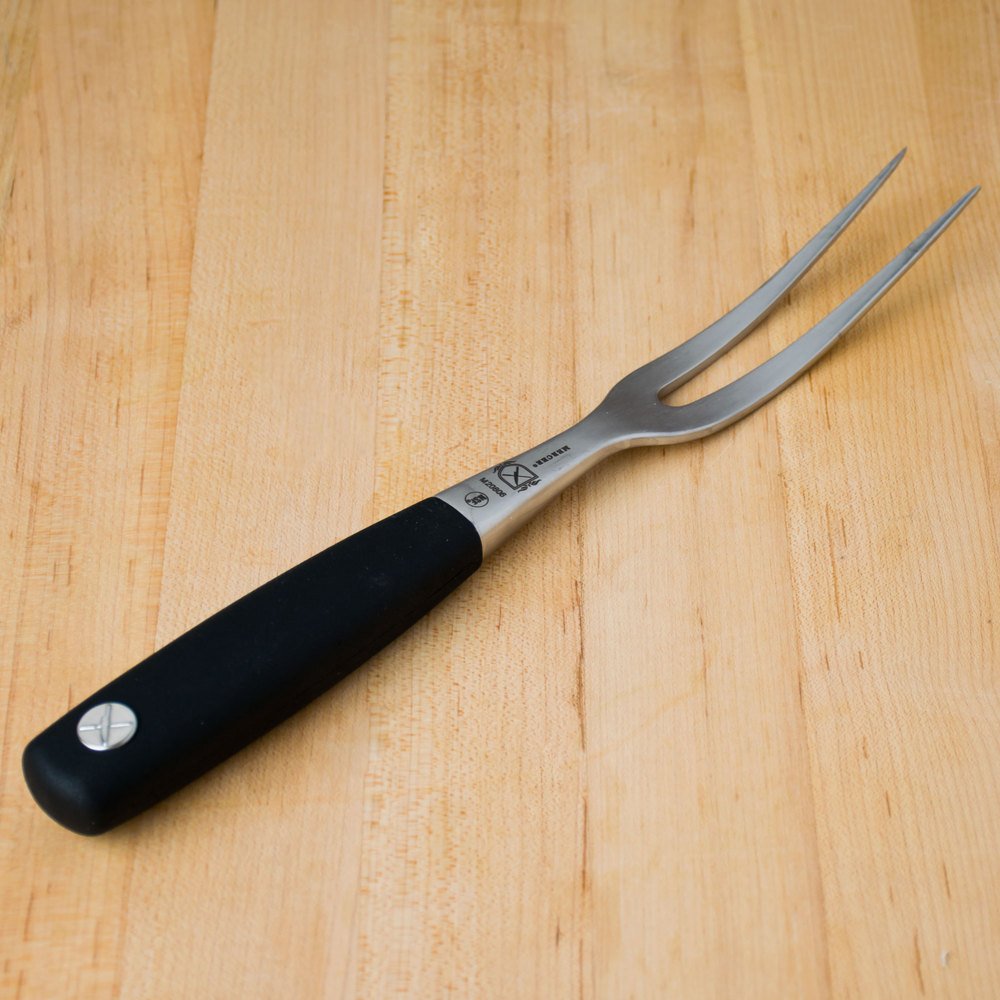
A forged six-inch fork with a wet-grip handle that stays put when the roast is slick.
The standout here is the handle. It’s Santoprene — a rubbery, non-slip material that the makers say offers comfort and grip even with wet hands, which matters when you’ve just pulled a roast out of the oven and your palms are damp. The rest of the fork is precision-forged from high-carbon German steel for strength, and it’s built to pair with Mercer’s own carving knives. It’s only six inches, so it’s a compact tool aimed at piercing and holding small cuts rather than lifting a whole bird.
What owners come back to most is how solid it feels in the hand. One buyer reports her husband stabbed a 5+ pound rib roast and lifted it with the fork without trouble. The forged construction (shaped from a single piece of metal) gives it real heft, and the black handle has a nice finish that looks more commercial-kitchen than decorative. It’s also a good value for what it is: an America’s Test Kitchen–favorite build at a price point that makes it easy to justify even if you carve only a few times a year.
Be realistic about the length. Six inches is ideal for a chicken thigh or a small roast and it’s easy to tuck into a drawer, but it won’t reach through a full holiday bird the way the 12- and 13-inch options above will. It also needs hand washing — the maker specifically asks you to rinse and dry completely with a soft towel and to keep it out of the dishwasher or any long submersion.
The grippy read: a Santoprene handle paired with a forged high-carbon steel fork that holds a five-pound rib roast without complaint.
Be honest about size: six inches is a small-cut tool. Hand-wash only, and no dishwasher shortcuts.
Strong choice if: you want commercial-kitchen feel in a compact form and the grip is your top concern.
skip it if: you mostly carve whole birds — move up to a 12-inch or longer fork for that job.
8. Victorinox Swiss Classic 6 Inch Carving Fork – Stainless Steel Meat Fork
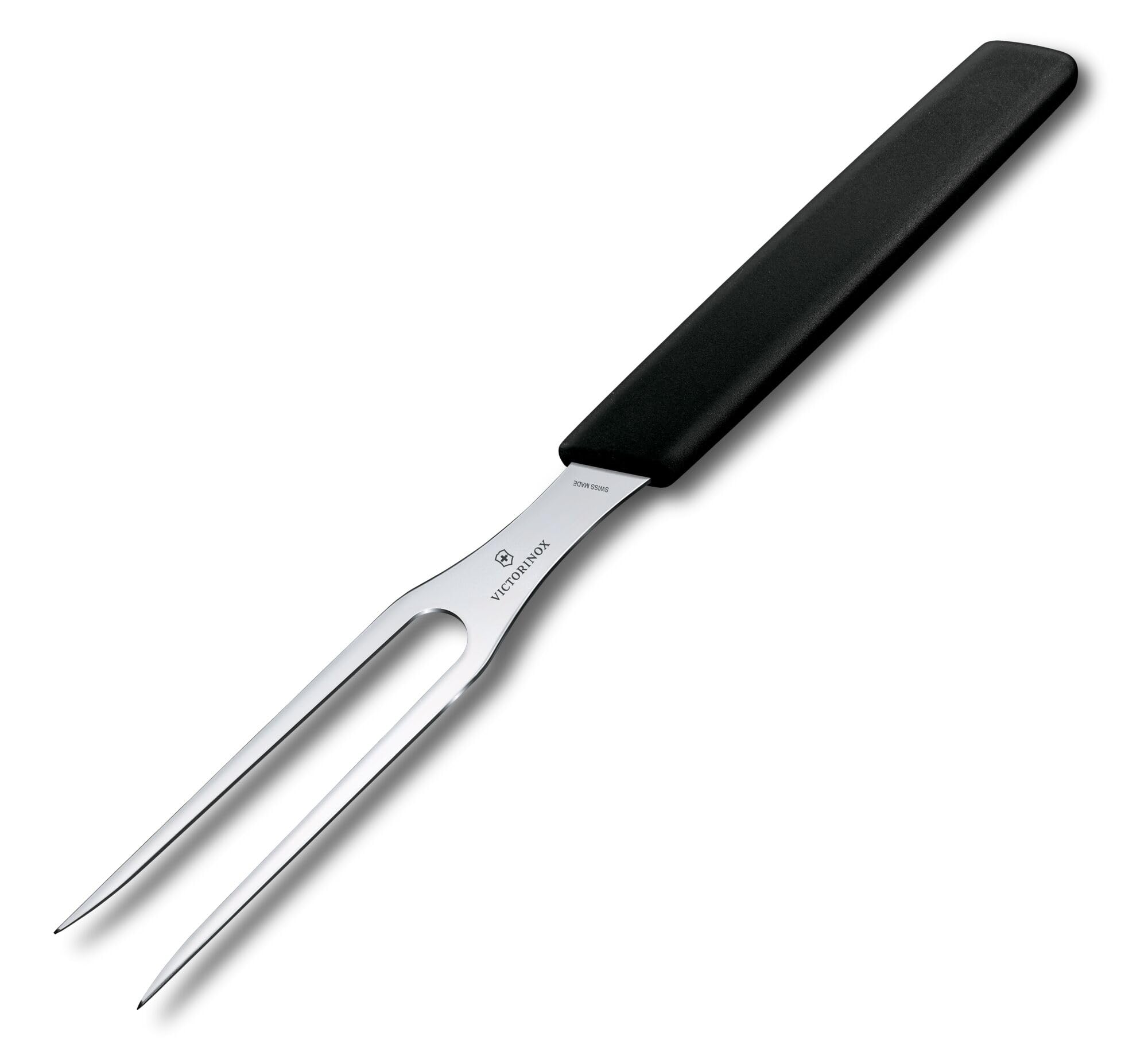
A slim Swiss classic with six-inch tines that grab anything you can stick a fork into.
This one keeps it simple. It’s a stamped stainless steel fork (cut from a sheet of metal) with a 6-inch blade and an overall length of 10.6 inches, so it sits between the compact six-inchers and the long roasting forks. The handle is sturdy black polypropylene (a hard plastic) — lightweight in the hand, and the makers note it can be sterilized for maximum cleanliness. Total weight is light, which makes it easy to handle through a whole carving session without fatigue. It’s dishwasher safe, and Victorinox describes it as professional grade for slicing and serving meat.
The prongs are aligned specifically for the job they do, and the weight is balanced for easy handling. Customers note it will pick up anything you can stick a fork into. Owners describe it as practical and well made. If you’re looking for a fork that does the everyday work without fanfare — pulls a chicken out of the pan, steadies a pork loin, lifts a carved slice — this is the one that feels right doing it.
Set expectations on reach. It’s noticeably shorter than the 12- and 13-inch options, and some buyers find the length on the shorter side of what they expected. For carving a large holiday bird at the table, the length might feel tight. For everything else, it’s an easy, uncomplicated fork that just works.
A good everyday fork: light in hand, dishwasher-friendly, and easy to use for most home carving jobs.
Think twice if: you need reach for a whole turkey — the length runs shorter than some buyers expect.
9. KESSAKU Dynasty 7″ Meat Fork – Dual-Prong Carving & BBQ Fork

The looker of the group — a dual-prong showpiece that still handles a whole brisket.
Let’s start with the sexiest part: this fork is beautiful. It’s built around a hand-crafted G10 fiber-resin handle with triple-rivet construction and a full tang, and the tines are forged from 430 chromium alloy stainless steel and nitrogen-cooled. The makers say the design gives ample knuckle clearance for control, and the whole thing has a Rockwell hardness rating the company lists for strength and tine durability. It arrives in a magnetic-closure gift box with a custom sheath and polishing cloth — clearly meant to be given as much as used.
What buyers notice first is the appearance, and it’s the thing they keep coming back to. The heft is right at roughly 215 grams, with 6-3/4-inch tine depth — enough to hold a brisket, a roast, or a pork butt through carving. Owners describe it as well balanced and comfortable, and it’s specifically cited as a great multi-tasker that can lift an entire meatloaf without breaking.
One honest caveat on size: at 7 inches of tines with the full handle, it can feel like more fork than some home cooks need for a single chicken breast, and one buyer wished for a slightly shorter version for everyday use. It’s also thicker at the tines than some knife-block slots will accept, which is worth measuring if you store your cutlery that way. For a statement piece that also works, there’s nothing here that gets in the way.
Standout Details
- G10 fiber-resin handle resists heat, cold, and moisture
- Full tang with triple-rivet construction for real strength
- Roughly 215 grams with 6-3/4-inch tine depth for large cuts
- Arrives in a magnetic-closure gift box with sheath and polishing cloth
Things to Consider
- Tines are thick — they may not fit slimmer knife-block slots
- Larger than some cooks need for everyday small-cut carving
Ideal for: someone who wants a carving fork that doubles as a standout piece — a real gift, and a real tool.
Look elsewhere if: you want a plain workhorse for a small kitchen, or you store cutlery in a tight block.
Understanding the Specs
Overall Length vs Tine Length
A carving fork is described by two different lengths, and they mean different things. The overall length — the number measured from the tip of the tines to the end of the handle — is what determines reach and storage. Tine length, sometimes called prong length, is the part that actually goes into the meat. A fork listed as 12 inches overall can have 4-inch tines, so most of its measurement is handle and prong. When you’re deciding, look at the tine length first — that’s what limits what you can hold. Then use overall length to gauge whether the fork fits your board, your drawer, and your hand.
Forged vs Stamped Construction
Forged forks are shaped from a single piece of steel, so the tines and handle are continuous — no seam, no flex, and typically more heft. Stamped forks are cut from flat steel and tend to be lighter and less rigid. Neither is automatically better, but forging is the reason a fork can lift an eight-pound ham without the tines splaying. If you’ll be lifting whole roasts or heavy cuts, forging is worth choosing. If your carving is mostly table slices and pasta plating, a lighter stamped fork can feel more precise and easier to control.
Handle Materials and Cleaning
Handle materials range from brushed aluminum and ABS plastic to POM, polypropylene, Santoprene, and G10 fiber-resin. Each has different strengths: Santoprene stays grippy with wet hands, G10 resists heat and moisture, and brushed aluminum looks bright but can dull in the dishwasher. The bigger decision is cleaning. Some forks are dishwasher safe, and some makers explicitly ask for hand washing to keep the finish looking new. Confirm which yours is before the first holiday meal — a few seconds of hand washing preserves a finish that a hot cycle can strip over time.
Finger Guards and Safety
A finger guard is a small shield mounted between the tines and the handle that intercepts a knife that slips off the roast. On shorter carving forks used for slicing, it’s a genuine safety feature — the guard blocks the blade before it reaches your hand. On longer BBQ forks used for lifting, it usually adds weight without much benefit. If you’ve ever had a knife slip during a holiday carve, a guarded fork is a reasonable choice. If your primary job is lifting a whole bird off the grill, a longer guard-free fork is the better tool.
FAQ
What is the difference between a carving fork and a regular meat fork?
What length carving fork do I need for a turkey?
Can I use a carving fork on a grill or smoker?
Are carving forks dishwasher safe?
What does forged mean on a carving fork?
Will a carving fork scratch my carving board?
Is a finger guard on a carving fork worth it?
How do I keep my carving fork from rusting?
What is the right technique for using a carving fork safely?
Final Thoughts: The Verdict
The carving fork worth your first look is the Kakamono 12-Inch Carving Fork, because a 4.8-star average across 700+ ratings backs up the combination of a 12-inch forged body, 7-inch prong section, and 4-inch tines that reaches through a whole bird.
If your carving happens on a smoker or grill with whole hams and pork butts, the Kilajojo Chef Pro 13-Inch is the one built to lift without bending.
And for a holiday turkey where safety is the priority, the MasterClass 28cm Carving Fork with Guard pairs an 11-inch polished steel body with a hinged metal shield that keeps a slipping knife off your hand.
How We Picked
We do not accept paid placement. Every pick is matched to a real buyer and a real use-case; we do not hands-on test units.
Sources & Methodology
Specifications: manufacturer listings and product documentation. Review insights: verified customer reviews, as of September 2026. Pricing: not shown on this page (it changes often); check the current price via the retailer link.
As an Amazon Associate, Gadgets Feed earns from qualifying purchases. This does not affect which products we feature.