
Our readers keep the lights on and my morning glass full of iced black tea. As an Amazon Associate, I earn from qualifying purchases.
Specs are compiled from manufacturer listings and verified buyer reviews and can change over time — please confirm the key details on the product page before buying.
If you are new to throwing a cast net, the biggest hurdle is not strength — it is getting the net to open into a wide circle instead of landing in a tangled clump, and the best beginners’ nets are built to make that happen. The key is matching a small, light radius you can throw with a mesh and sinker setup that keeps bait from escaping before you haul it in. This guide covers the nets that actually reward beginners, from a kid-friendly thrower to higher-capacity picks for saltwater and freshwater. A good beginner net opens into a full circle on the first few throws, sinks fast enough to pin baitfish against the bottom, and ships with the small accessories that make cleanup and repair painless.
I’m Min — the founder and writer behind Gadgets Feed. This guide is built by comparing the manufacturers’ published specifications and the patterns across verified customer reviews, so you get each pick’s real strengths and trade-offs instead of marketing spin.
A beginner’s net lives or dies on the throw, the mesh size, and sinker weight, and the picks below sort those trade-offs so you can grab one and get on the water. The right cast net for beginners should open clean and hold bait on the way up.
Our Picks at a Glance

How To Choose A Beginner Cast Net
A cast net is thrown over the water and drawn closed as it sinks, trapping baitfish underneath. For a first-time buyer, the wrong size or sinker weight is the difference between a clean opening and a ball of tangles every throw. These four specs drive that outcome.
Radius And Open Diameter
Radius is the distance from the center horn to the outer edge of the net, measured in feet — a 4-foot net unfolds into an 8-foot circle. For a young or new caster, a smaller radius like 3 or 4 feet is easier to load and throw accurately, while 6-8 foot nets cover more water but demand more technique. Start smaller than you think you need: a 3 or 4-foot radius you can open flat beats a 6-foot net that lands in a knot.
Sinker Material And Weight Per Foot
Sinkers are the weighted ring around the bottom that drags the net down. Lead sinkers are dense and sink fast; zinc and PVC-coated iron weigh less for the same bulk but resist rust better in saltwater. Weight per foot (listed as lb/ft) tells you how heavy the net feels in hand — around 0.75 lb/ft is a common middle ground, while lighter nets are easier for beginners to throw. Heavier nets open faster but tire your arm quicker.
Quick Comparison
| Model | Best For | Radius | Mesh Size | Weight | Amazon |
|---|---|---|---|---|---|
| Betts CH4-I-EZ Buddy Throw Net★ Best Overall | Kids and first-time throwers | 4 feet | — | 1 kg | Amazon |
| Betts Buddy Cast NetTop Performer | Young anglers learning to cast | 4 feet | 0.375 inches | 2.2 pounds | Amazon |
| Drasry Saltwater Fishing Cast NetMost Versatile | Long handline and distance casting | 3-10 feet | 3/8 inch | 3.8 pounds | Amazon |
| BASSDASH American Saltwater Cast Net | Saltwater use and rust resistance | 4-8 feet | 3/8 inch | 4.5 pounds | Amazon |
| BasicGear Cast Net, 3-14ft Radius | Versatile size range | 3-14 feet | 3/8 inch | 0.75 lb/ft | Amazon |
| XPLORZ American Cast Fishing Net | Storing and travel | 4-8 feet | 3/8 inch | 2.77 kg | Amazon |
| BasicGear Cast Net, Lead | Value and lead sinkers | 3-12 feet | 3/8 inch and 1/4 inch | 0.75 lb/ft | Amazon |
| Calamus Baitfish Cast Net | Compact size and accessories | 3-6 feet | 3/8 inch | 1.67 kg | Amazon |
| BalanZze Cast Net for Bait Trap Fish | Cheap learning net | — | 1/2 inch | 1.3 kg | Amazon |
In‑Depth Reviews
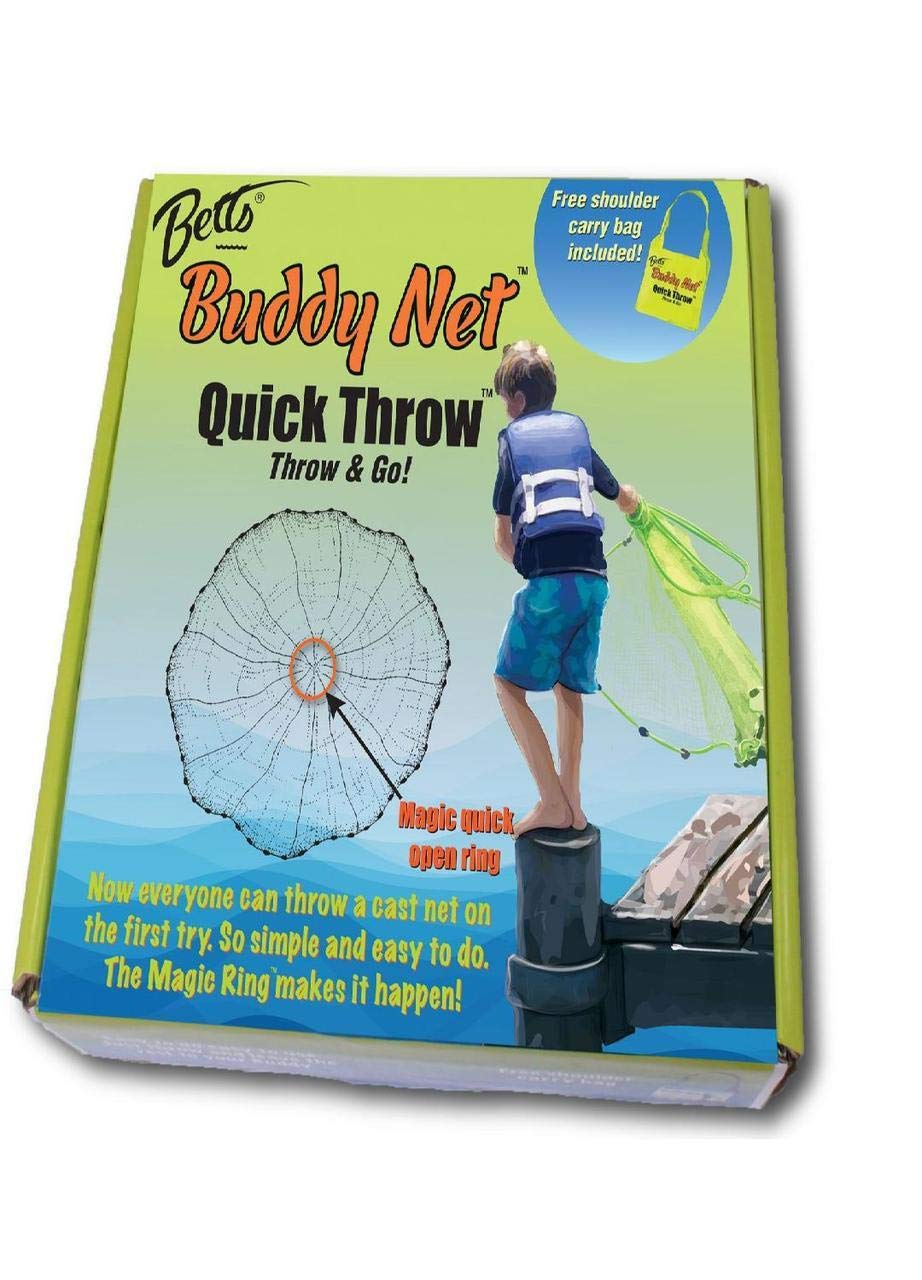
1. Betts CH4-I-EZ Buddy Throw Net, 4′, Chartreuse
Our pick — over 4.5★ from 150+ verified ratings; the strongest balance of quality and price.
The featherweight thrower that lets a young angler cast bait all afternoon without wearing out an arm.
Start here if you are buying for a kid or anyone throwing a net for the very first time. At 1 kg the Betts Buddy is light enough that a small caster can load and release it cleanly, and the 4-foot radius keeps the whole thing manageable in shallow water. Compare that to the Calamus Baitfish Cast Net at 1.67 kg and you can feel the difference in hand — the Betts is the one a beginner can whip overhand without the arm giving out after ten throws.
The reason this earns the top spot is that it does the one job beginners care about — catching bait — without a steep learning curve. New casters who had struggled with a heavier or larger net find this one a breeze, and it opens reliably enough to pull in small fish and even the occasional crab at the beach. What wins people over is the catch performance: it simply works for its intended size, and the included tote bag and instructions mean you can start throwing right away, plus a little YouTube study on technique goes a long way.
The catch to plan around is the cover you fish. Sticks and submerged brush can snag and rip the netting, so a parent should keep an eye on a young caster to avoid a hard yank. That is the nature of a lightweight beginner net, not a flaw in this one — keep it in open water and it holds up fine. This is the pick when the goal is a small, easy-to-throw net that keeps a kid busy catching and releasing all day.
What Sold Me
- 4-foot radius and 1 kg weight are ideal for small or first-time throwers
- Tangle-free enough that new casters get a good spread quickly
- Ships with a tote bag and instructions to start casting right away
Keep In Mind
- Sticks and brush can snag and rip the netting if you cast near structure
- Light build trades outright durability for beginner-friendly throwing
Reach for this if: you are outfitting a kid or a brand-new caster who needs a light, forgiving net that opens without a fight.
Look elsewhere if: you fish around heavy cover where a thicker, more abrasion-resistant net belongs.
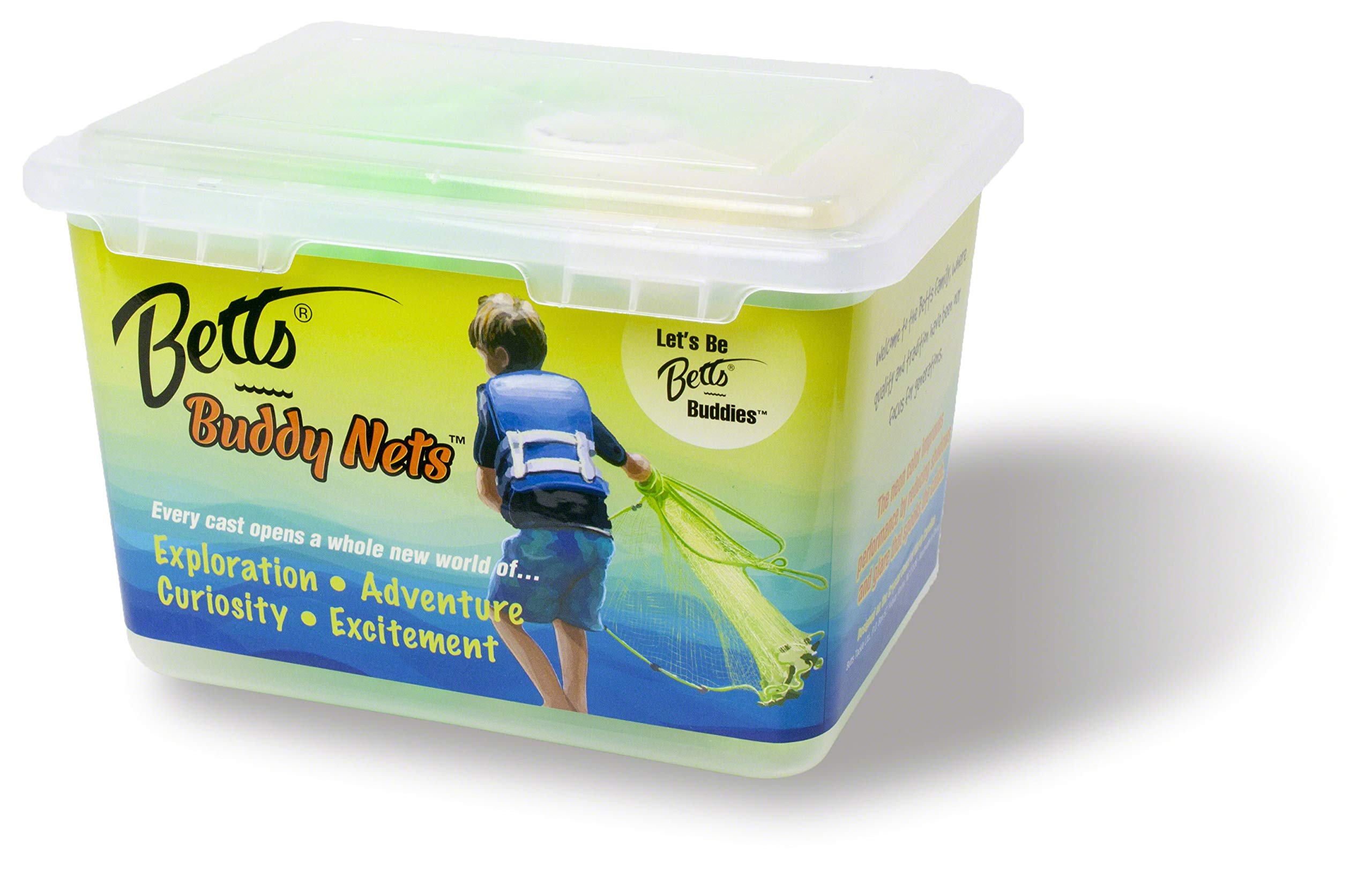
2. Betts Buddy Cast Net
A 4-foot, 0.375-inch-mesh kid-scale net that turns pond play into a proper first casting lesson.
This is the sibling to the top pick and a smart buy if your beginner is on the younger side. The 0.375-inch mesh — the openings between the netting — is sized to hold small bait without letting it slip through, and the 4-foot radius keeps the throw within reach of a 9-year-old. Owners describe it as “Perfect size for my 9 year old. Easy for him to use. Not to heavy.” That is the whole game for a first net: light in hand, correctly sized, and simple to deploy with a little practice.
Where it earns its keep is in the daily reality of a family pond trip. It is easy to maneuver, the feel in hand is good, and deploying it works well once you get the wrist motion down. Kids use it to play and catch fish in a backyard pond and stay entertained, which is exactly what you want a starter net to do. A 4-foot Betts Buddy puts a beginner in a position to succeed on the cast rather than fight the net.
The one honest knock is sinker weight on some units: the weights can run light, meaning the net does not always sink fast enough to trap fish before they scatter. If your fishing depends on a fast drop, look at a lead-sinker net instead. For kids splashing in a pond, though, this is a forgiving first net.
The verdict: A well-sized starter for a child who is ready to move past a minnow net, provided fast sinking is not the priority.
The trade-off: Light sinkers mean a slow drop on some units, so bait can escape before you close the net — fine for pond play, weaker for serious bait gathering.
Best for: families buying a first net for a young angler who fishes ponds and shallows for fun.
Think twice if: you need a net that slams down fast to hold baitfish — a lead-weighted model sinks quicker.
3. Drasry Saltwater Fishing Cast Net for Bait
A broad size range and a long handline for beginners who want room to grow into the throw.
If you want one net that suits a range of fishing spots, the Drasry stands out with radius options from 3 up to 10 feet and a 39-foot polyethylene braided handline. That long rope can be adjusted for different water, which matters when you are learning because you can shorten it for control close-in. The 3/8-inch mesh handles most bait species, and the perforated lead sinkers are built to cut splash and drop fast. One owner summed it up as “well-made, easy to throw, and sinks fast with good weight distribution.”
For a beginner who wants distance, the weight distribution here helps the net open wide and stay accurate. The lead sinkers sink quickly, and the tight bottom seal keeps bait from escaping on the way up. Tackle the learning curve with a couple of practice casts and this net rewards you with real reach — but note some casters find it a little stiff at first until the mesh breaks in.
The honest catch is durability under hard use: the wrist strap and netting are the weak points if you snag structure. The wrist strap and netting are the weak points if you snag structure, and the rope length is more than some casters want for tight spots. Treat it as a capable mid-range net that likes open water and a patient first session, and it will serve you well.
Why Beginners Like It
- Radius choices from 3 to 10 feet let you pick your size from the start
- 39-foot handline adjusts for different water depth and casting distance
- 3/8-inch mesh and perforated lead sinkers suit most baitfish
The Honest Catch
- Netting can stiffen up and needs breaking in before it casts its best
- Wrist strap and mesh can tear if you snag rocks or structure
Snag this if: you want a size-flexible net with a long handline and room to grow your casting skill.
Pass if: you prefer a smaller, lighter net for tight little spots rather than long-distance throwing.
4. BASSDASH American Saltwater Fishing Cast Net
One pound of weight per radius foot and a 316 stainless swivel built to shrug off saltwater.
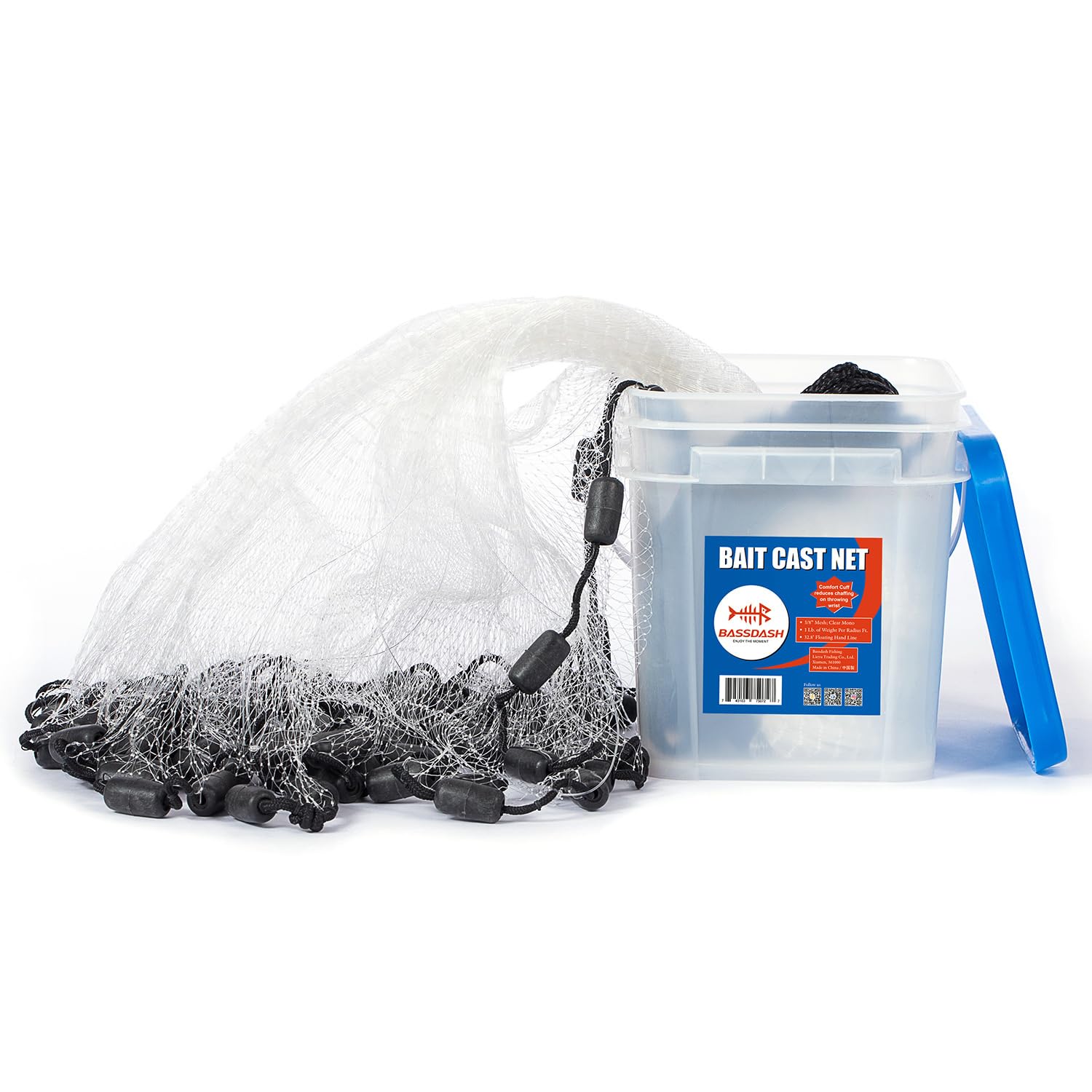
Here is the pick for a caster who fishes the coast and does not want to replace a net after a single season. The BASSDASH uses plastic-covered weights at 1 lb per radius foot, a 316 stainless steel swivel (the corrosion-resistant grade), and a durable ABS horn. The 32.8-foot floating handline and comfort cuff cut down on wrist chafing during repeated throws — a small detail that matters once you are casting dozens of times in a session. The 3/8-inch mesh is sized for small to medium baits three inches or longer.
What owners keep coming back to is durability. The wrapped weights mean it should last, and the net shows no rusting and takes a beating while staying in great shape. One caster put it plainly: “A net that survives the salt pays you back in bait you did not have to buy.” That is the real selling point for a beginner who plans to fish saltwater often — a net that survives the salt pays you back in bait you did not have to buy.
The recurring gripe is the storage box, which several describe as flimsy and worth replacing with a proper bag. A few also find it closes faster than they would like. But the net itself is the star, and it opens well enough for a newcomer. For saltwater beginners who want a net that lasts, the BASSDASH is the rust-resistant workhorse to beat.
Best suited to: coastal casters who want corrosion-resistant hardware and enough weight to open the net fast.
Worth knowing: the supplied container is the weak link — budget for a real storage bag and treat the net as the value here.
Pick this if: you fish saltwater and want sinker weight and stainless hardware that hold up across seasons.
Keep looking if: you want a feather-light net, since 1 lb per radius foot is heavier than beginner nets.
5. BasicGear Cast Net, 3-14ft Radius

A size menu that runs from 3 to 14 feet, with rust-resistant PVC-coated sinkers for the salt crowd.
What sets this BasicGear apart from the lead-sinker BasicGear further down is the hardware: PVC-coated iron sinkers that resist rust, at 0.75 lb per radius foot. The 3/8-inch mesh suits a range of bait, and the double lead line with a Japanese stainless steel swivel keeps the weight distributed as the net opens. The neoprene wrist strap keeps it comfortable on a long session, and every size from 3 to 14 feet is on the table so you can match your water.
Owners find it sturdy and easy to throw, with a tangle-free collapse that makes storage simple, and it comes with a plastic storage box. The recurring note is that the netting can tear quickly if it meets something sharp, and the build feels heavier than lighter beginner options — so a first-timer should stay at the smaller radii. Pick a lighter size and it is a friendly intro net; go big and you need solid technique.
The one small issue to expect on some units is the handle pulling off the rope, which caught at least one buyer off guard on day one. It is a simple fix, but worth checking before you fish. Choose this BasicGear for its rust-resistant sinkers and wide size choices; keep the radius modest if you are just learning.
Where It Wins
- PVC-coated iron sinkers resist rust for saltwater use
- Size range from 3 to 14 feet lets you match any water
- Neoprene wrist strap and tangle-free collapse aid comfort and storage
Worth A Check
- Netting can tear quickly if it contacts sharp structure
- The handle has detached from the rope on some units
Grab this if: you want a rust-resistant net and the freedom to choose your exact radius.
Hold off if: you are a total beginner who should stay in the smaller sizes and needs the lightest possible throw.
6. XPLORZ American Cast Fishing Net for Bait Trap Fish
A 4, 6, or 8-foot net with zinc sinkers that spreads evenly in water from ankle-deep to 20 feet down.
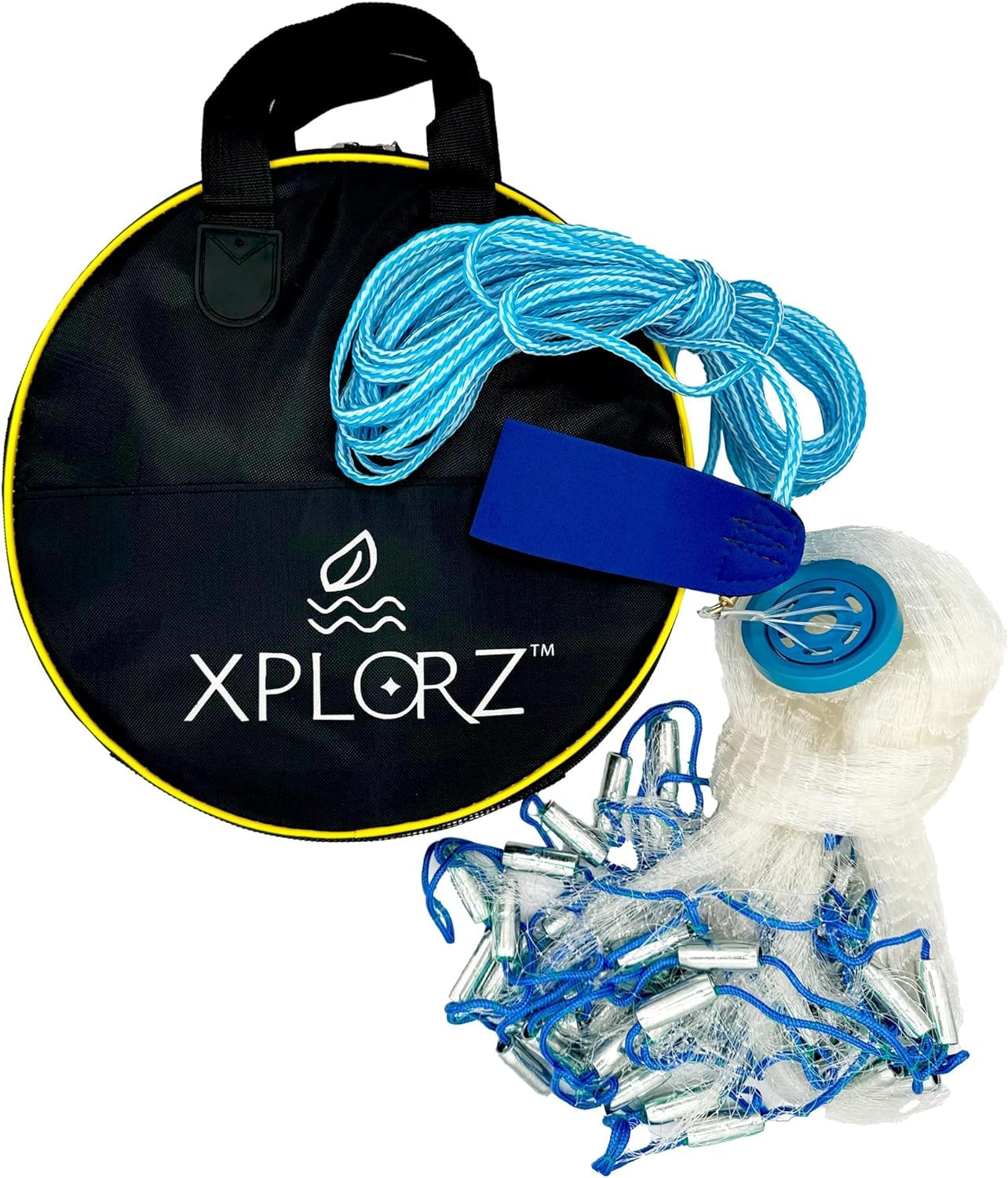
The XPLORZ leans premium and gives a beginner a net that works in more places than most. Choose a 4, 6, or 8-foot radius, all with a 3/8-inch mesh for a variety of baitfish, and heavy-duty zinc sinkers for a fast sink in both saltwater and freshwater. The telescopic handle and drawstring closure round out a build aimed at longevity. Owners find it easy to use in shallows and deep water alike, with the net spreading evenly for maximum bait-catching surface area, and the carry bag makes storage simple.
The spot this net really shines is convenience. It is easy to clean and stores compactly, so it slips into a car or boat without fuss. First casts have produced fish for some owners, and once you master the wrist motion it handles brown gobies, perch, and rock bass. The 8-foot radius size adds reach over the smaller options here, but it also asks more of your arm.
The catch — and this is real for beginners — is build consistency: some units feel cheaply made and rip easily on a cast. Some units feel cheaply made, and durability is the most-discussed concern, with the net falling apart or ripping easily on some casting. When it holds together it is a versatile tool; just go in with eyes open and pick a size you can actually throw. If you want one net that travels well and handles shallow to deep water, the XPLORZ delivers, provided you handle it with care.
Strong point: spreads evenly in water from ankle-deep to 20 feet and stores in a bag for easy transport.
The weak spot: build consistency varies — some units rip easily, so gentle handling around rocks and structure matters.
Ideal for: anglers who fish varied depths and want a portable net with zinc sinkers and a fast drop.
Skip if: you want the most durable netting and prefer a heavier, tougher build over portability.
7. BasicGear Cast Net, Lead, 3-12ft Radius

Real lead weights at 0.75 lb per foot — a fast-sinking value net for beginners who want results now.
Lead sinkers are the densest option here, and this BasicGear packs premium real lead at 0.75 lb per radius foot for a fast drop. That weight is the reason bait does not escape before you close the net, and the double lead line with a Japanese stainless steel swivel keeps the opening smooth. A neoprene wrist strap adds comfort, and it ships with a repair kit and utility box. A long-term owner who ran the 5-foot, 1/4-mesh version daily for a year found it best in shallow water up to about 5 feet.
What owners value most is the value and function: it sinks quickly, shrugs off a snag on an underwater bush, and only stretched main line that was easily repaired. The lead weights hold up over time and the small top hole keeps bait from escaping. For a beginner, the combination of a real lead sinker and a low entry point is hard to argue with.
Two things to know: it opens slowly in deeper water, and some casters report it not opening properly on occasion, so the horn design takes adjusting to. The recurring gripe is that durability varies — treat the netting with care. On balance a strong first net. If you want lead-sinker sinking performance without paying premium money, this is the value buy to start with.
The Case For It
- Pure lead weights at 0.75 lb/ft sink fast to trap bait quickly
- Double lead line and stainless swivel keep the opening smooth
- Comes with a repair kit and utility box for upkeep
The Fine Print
- Opens slowly in deeper water, so it suits shallow spots best
- Some casters find it does not always open properly on a throw
Choose this if: you want a lead-weighted net that sinks fast and keeps bait without a big spend.
Reconsider if: you mostly fish deep water where a slow open would hurt your catch.
8. Calamus Baitfish Cast Net, 3/8″ Mesh, 3ft-6ft Radius
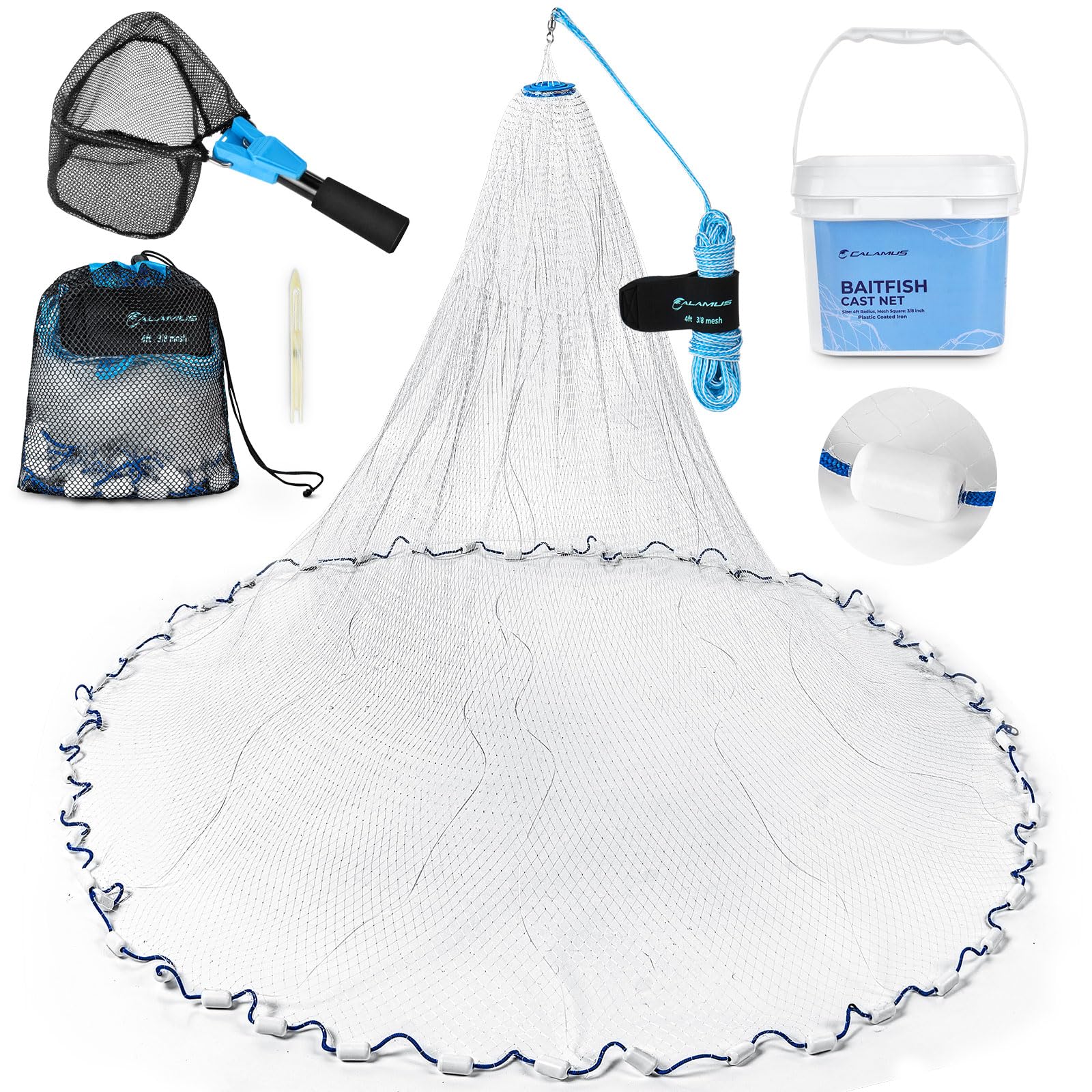
A compact net with a 6-hole sectioned horn that reduces tangles — the beginner’s best friend on the first throw.
The 6-hole sectioned horn is the headline here. A horn is the plastic or metal head at the top of the net where the lines gather, and sectioning it into six holes spreads the weight evenly and cuts tangles and knots — the single biggest frustration for a beginner. The 0.012-inch nylon mono mesh is built to resist deformation, and the 3/8-inch openings suit small baitfish, with a 33-foot braided handline and a 2.36-inch wide neoprene wrist strap for a comfortable grip.
What wins people over is the quality of the parts. Owners describe it as pro-quality without the pro price, with strong netting, a tangle-free horn, and easy throwing. It comes with accessories that cover the whole job — a foldable stainless steel bait net, a mesh storage bag, a storage bucket, and a net repair kit — so nothing extra is needed to start. The coated weights resist corrosion for both fresh and salt water.
The thing to watch is durability at the collar. The net can come loose at the slip ring after a few hard throws, and the mono can be tricky to fix, so inspect it before each trip. Also note the 6-foot size is heavier — 1.67 kg versus the 1 kg Betts Buddy — making it a touch more demanding for a small caster. For a first-timer who wants a tangle-free throw and complete kit, the Calamus is a sharp choice.
Stands out: the 6-hole sectioned horn spreads weight evenly and keeps knots down, which is exactly what a new caster needs.
Keep an eye on: the collar and slip ring, which can come loose after repeated hard casts — a quick pre-trip check saves frustration.
This suits: beginners who want a tangle-free horn and a ready-to-go kit with bait net, bag, bucket, and repair tools.
Not for: casters who want to avoid the heavier 6-foot version — stick to the smaller radii instead.
9. BalanZze Cast Net for Bait Trap Fish, 1/2 Inch Mesh

The cheap learning net you can lose on a stump without losing sleep.
This is the throwaway-priced net you learn on, which is a genuinely useful thing for a first-timer. It uses heavy-duty zinc sinkers and a double-layer sinking line to keep the weights from falling off during the cast, and the 1/2-inch mesh is transparent for concealment and sized for small fish, shrimp, mullet, and similar swimmers. The 26-foot hand rope gives you enough line to throw and retrieve comfortably, and it ships with a repair kit and storage box.
Buyers report it casts easily, untangles readily, and stows small enough to keep in a bag — one describes using it for small catfish bait. For pure practice, that low commitment is the point.
The trade-offs are real: sinkers can be too light to sink fast, and durability is a weak spot — one snag can put a hole in the net, and quality is inconsistent. This is not the net for a seasoned caster chasing fast drops. Treat the BalanZze as your practice net — learn the throw here, then move up when you are done snagging stumps.
Why It Makes Sense
- A low-commitment price makes losing it on a snag tolerable
- 1/2-inch transparent mesh suits small fish, shrimp, and mullet
- 26-foot hand rope gives enough line to throw and retrieve
The Reality Check
- Sinkers can be too light to sink quickly enough to hold bait
- Netting can tear easily on a snag, and build quality varies
Good pick for: a total beginner who wants an affordable net to practice the throw without fear of ruining it.
Move up if: you want fast sinking and durable netting, which the lead-sinker nets handle better.
Understanding the Specs
Radius And Open Diameter
Radius is the distance from the center horn to the net edge, so a 4-foot radius opens into an 8-foot circle when thrown flat. Beginners should start small — a 3 or 4-foot radius is easier to load and throw, while 6 to 8 feet covers more water but needs better technique. A 3 or 4-foot net that opens flat catches more bait than a 6 to 8-foot net that lands tangled.
Mesh Size
Mesh size measures the openings in the netting in inches. A 1/4-inch mesh holds the smallest baitfish and shrimp, 3/8-inch is the common all-rounder for small to medium bait, and 1/2-inch lets smaller fish slip through but is easy to clear. Match the mesh to your target bait — too big and your catch escapes, too small and you trap debris.
Sinker Material And Weight
Sinkers form the weighted ring that drags the net down and seals it against the bottom. Pure lead is densest and sinks fastest, zinc is lighter for the same bulk, and PVC-coated iron resists rust for saltwater. Weight per foot tells you how heavy the net feels — lighter nets are easier for beginners to throw, heavier ones open faster but tire the arm sooner.
Horn And Swivel
The horn is the head at the top where the lines gather, and its design decides how easily the net opens and how little it tangles. A sectioned horn, such as one with multiple holes, spreads weight evenly and fights knots. The swivel connects the handline to the horn and lets it spin freely; a stainless steel swivel resists corrosion, which matters most in saltwater.
FAQ
What size cast net should a beginner start with?
How do I stop the net from tangling on every cast?
What mesh size is best for catching baitfish?
Are lead sinkers better than zinc or coated weights?
Can a cast net be used in saltwater and freshwater?
How much weight per foot should a beginner handle?
Do I need a repair kit with my first cast net?
Is it normal for a new cast net to feel stiff at first?
What is the difference between a cast net and a minnow net?
Final Thoughts: The Verdict
For most beginners, the winner is the Betts CH4-I-EZ Buddy Throw Net because its 4-foot radius and 1 kg weight make the first throws easy and forgiving — exactly what a new caster needs to build confidence. If you fish saltwater and want a net that lasts across seasons, grab the BASSDASH American Saltwater Fishing Cast Net for its lead-weighted sinking and 316 stainless swivel. And for pure practice where losing a net to a snag is part of the process, the BalanZze Cast Net for Bait Trap Fish is the low-commitment one to reach for. Start with a 3 or 4-foot radius, learn the throw, and size up once the net opens flat every time.
How We Picked
We do not accept paid placement. Every pick is matched to a real buyer and a real use-case; we do not hands-on test units.
Sources & Methodology
Specifications: manufacturer listings and product documentation. Review insights: verified customer reviews, as of September 2026. Pricing: not shown on this page (it changes often); check the current price via the retailer link.
As an Amazon Associate, Gadgets Feed earns from qualifying purchases. This does not affect which products we feature.