
Our readers keep the lights on and my morning glass full of iced black tea. As an Amazon Associate, I earn from qualifying purchases.
Specs are compiled from manufacturer listings and verified buyer reviews and can change over time — please confirm the key details on the product page before buying.
Choosing the right casting reel depends on what you want at the end of the line: smooth, consistent casts or the raw power to turn a charging brute. A bad reel will backlash at the worst moment or lock up when a trophy fish makes its run. The 9 reels here span the range of drag pressures, gear speeds, and braking systems so you can match one to your specific fishing style — whether that is skipping a weightless Texas rig or muscling a catfish out of heavy cover.
I’m Min — the founder and writer behind Gadgets Feed. This guide is built by comparing the manufacturers’ published specifications and the patterns across verified customer reviews, so you get each pick’s real strengths and trade-offs instead of marketing spin.
casting reels can be a lot to sort out when gear ratios, bearing counts, and the difference between magnetic and centrifugal braking all come into play — this guide cuts through the jargon to show you exactly which reel is tough enough, smooth enough, and fast enough for how you actually fish.
Our Picks at a Glance


How To Choose The Best Casting Reel
You are shopping for a tool that has to balance spool speed against stopping power — and every brand has a different idea of how to do it. Before you look at price or color, figure out what you are fishing for. That will tell you the drag you need, the gear ratio that fits, and the braking system that saves your sanity.
Match the Drag to the Fight
Max drag is the pressure the reel exerts on the line before the spool slips. For bass and pike in open water, 11 to 15 pounds is plenty. For catfish, musky, or saltwater species that run hard, look for 20 pounds or more — the KastKing MegaTron and the Piscifun Alinox 400 both push past 28 pounds so a heavy fish cannot simply pull line until it wraps a log.
Gear Ratio: Speed or Muscle
A high gear ratio, around 7.4:1 to 8.2:1, recovers more than 30 inches of line per crank turn, which means you can catch up to a running fish fast or rip a lure out of heavy cover. A low gear ratio, like the Lew’s Laser XL at 4.2:1, recovers only 18 inches per turn but gives you leverage like a winch — ideal for deep cranking or pulling a big crankbait through current. Pick the reel whose speed matches the tempo of your retrieve.
Braking Systems That Prevent Backlash
Magnetic brakes (like the Daiwa Fuego CT uses) let you adjust the braking force with a simple dial on the side — you can tune it on the fly as wind changes. Centrifugal brakes (like the SVS Infinity on the Curado K) use spinning pins that throw outwards, and you adjust them by changing the pins themselves. Both work well; magnets are faster to dial in, centrifugal gives you more consistent feel at the end of the cast. Beginners tend to prefer the adjustability of a magnetic system.
Quick Comparison
| Model | Best For | Max Drag | Gear Ratio | Weight | Amazon |
|---|---|---|---|---|---|
| Shimano Curado K★ Best Overall | All-around tournament use | 11 lb | 7.4:1 | 7.6 oz | Amazon |
| Piscifun Alinox 400Big Fish Slayer | Musky & saltwater brute | 38 lb | 8.1:1 | — | Amazon |
| Shimano SLX XTDistance Artist | Distance casting & reliability | 11 lb | 7.2:1 | 11.46 oz | Amazon |
| KastKing MegaTron 200 | Big fish & heavy cover | 28.6 lb | 6.4:1 | 4.4 oz | Amazon |
| Lew’s Laser XL | Deep cranking & control | 15 lb | 4.2:1 | — | Amazon |
| Abu Garcia Ambassadeur SX | Catfish & medium freshwater | 12.5 lb | 5.3:1 | 11.2 oz | Amazon |
| Shimano SLX | Mid-range do-it-all | 11 lb | 8.2:1 | 6.9 oz | Amazon |
| Daiwa Fuego CT | Palmability & smooth casting | 13.2 lb | 8.1:1 | — | Amazon |
| Lew’s Tournament Pro LFS | Power fishing & tournament | 20 lb | 7.5:1 | — | Amazon |
In‑Depth Reviews
1. Shimano Curado K
Our pick — over 4.5★ from 750+ verified ratings; the strongest balance of quality and price.
The benchmark that generations of serious anglers trust with their best rod.
Shimano’s Curado K is the reel that other reels get compared to, and the reason is simple: the SVS Infinity braking system. You get easy, predictable spool control even with lighter lures, and the brake force adjusts precisely when you switch baits or fight wind. The 7.4:1 gear ratio recovers 31 inches of line per crank — fast enough to rip a frog out of lily pads yet not so twitchy that you lose feel on a steady retrieve.
The crowd favorite here earns its reputation honestly. Constructed with Micromodule gearing (teeth so precisely cut the engagement feels almost fluid) and X-Ship technology that braces the pinion gear between bearings, it produces a retrieve that is both smooth and powerful. At 7.6 oz it is light enough that you can work it for hours, and the low-profile body sits comfortably in the palm — a few long-time owners say “it’s so light it’s hard to believe” on the water. The one honest trade-off: the light spool can backlash if you get lazy with your thumb, but as the review pages sum it up, “the infinity breaking system is amazing” once you dial it in. The 11 lb max drag is modest compared to some of the heavy-duty picks below, but for bass, pike, and most freshwater applications it is perfectly adequate.
What wins people over
- Quality is the most-praised aspect — owners find the materials and finish noticeably above the crowd
- Smoothness of the retrieve leaves almost no one disappointed, and it casts with nearly no backlash when set right
- Weighs 7.6 oz, making it one of the lightest reels here for fatigue-free all-day fishing
The catch
- Max drag is 11 lb, which is fine for bass but too low if you target catfish or musky
- The light spool can overrun if you are not careful — a quick thumb is still part of the deal
Best for: The angler who wants a single reel they can trust for everything from finesse plastics to medium swimbaits, backed by Shimano’s engineering reputation.
Consider if: You need more than 11 lb of drag for heavy cover or big fish — the MegaTron or Alinox below will serve you better.
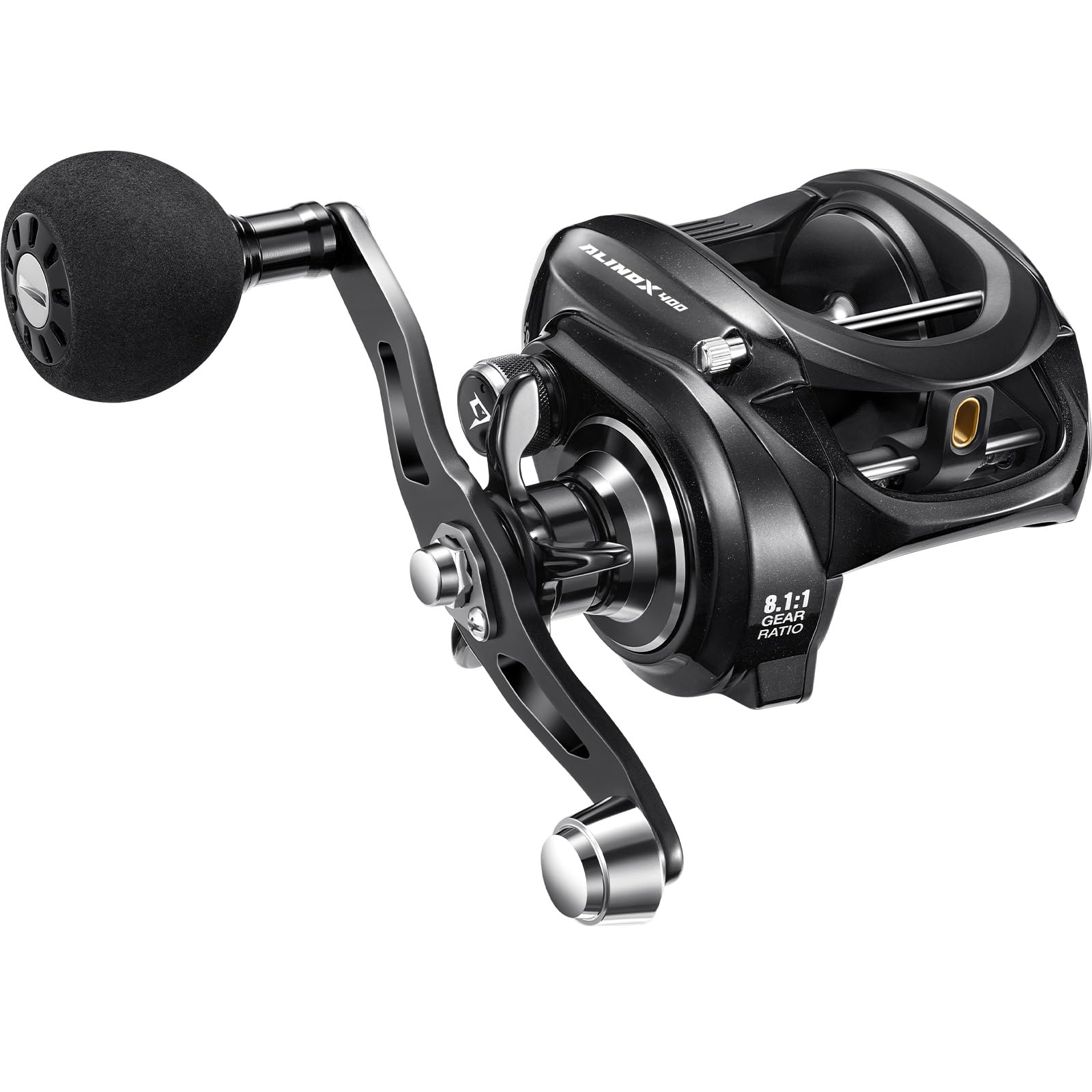
2. Piscifun Alinox 400 Baitcaster
The reel built to win the fight before the fish knows it’s hooked.
If your target species makes you worry about drag strength, this is the reel to reach for. The Alinox 400 delivers 38 pounds of max drag — that is more than double what the Curado K provides, and it is backed by the proprietary Hercules Drag System (HDS) which increases the brake pad surface area for that kind of holding force. The aluminum alloy frame and handle keep corrosion at bay, and the 8 double-shielded stainless steel bearings plus one single bearing ensure smooth retrieval even in punishing saltwater conditions.
What stands out in this crowd is the 120 mm extended counterbalance handle and the integrated line-cast alarm system, which lets you run a live bait rig and hear a strike without staring at the rod tip. The 8.1:1 gear ratio (on the tested model) recovers line fast, though owners note that version nets 35 lb of drag versus the 38 lb of the 6.6:1 ratio. Quality tops the list of what buyers appreciate most, and many call it an exceptional value compared to reels costing four to five times as much. Durability gets mixed feedback — some units have had issues after heavy use, but the consensus is that for big fish duty it punches well above its class.
Where it dominates
- A massive 38 lb of drag is class-leading in this lineup — it can stop a big musky or catfish cold
- Aluminum alloy frame and side cover resist saltwater corrosion better than graphite reels
- Line-cast clicker alarm lets you hear a take while dead-sticking a bait
Where to be cautious
- The drag can engage abruptly within the first few clicks — not a gradual ramp-up
- A small number of buyers report breakage after light use; the long-term track record is still building
Reach for if: You throw giant swimbaits, fish for musky, or venture into saltwater and need drag that will not flinch.
Look elsewhere if: You fish light line and small lures — the heavy-duty construction can feel like overkill on a 6-foot light-action rod.
3. Shimano SLX XT Series Casting Reel
Adds 100 feet to your cast without adding a cent to your stress level.
Step up from the base SLX and you land on the XT, which brings the S3D spool technology — a spool so precisely balanced it reduces vibration during the cast and lets the line peel off with less friction. The result is noticeable distance, and owners confirm that on a good day you can clear 100 feet with a 1/8 oz jig head. The SVS Infinity braking system (same family as the Curado K’s) gives you consistent spool control across the entire cast, and the Hagane body (a rigid one-piece metal frame) eliminates any flex that could cost you accuracy.
Quality leads the praise here by a wide margin, and smoothness follows. The 7.2:1 gear ratio recovers 28 inches per turn — a happy medium between cranking speed and cranking torque. One thing to be aware of: at 11.46 oz it is heavier than the Curado K, so it does not disappear into your palm the same way. The drag (11 lb) is the same moderate figure as the Curado, so this is still a freshwater-focused reel. The SLX XT is the choice for the caster who prioritizes bombing a bait into the next zip code over raw stopping power.
Dialed-in engineering: The S3D spool and Hagane body create a rigid, low-vibration platform that turns casting distance into a consistent tool, not a lucky break.
Ideal for: The angler who needs to reach distant structure or cover water efficiently — the casting distance really is a step above.
Skip if: You want a sub-10 oz reel for finesse techniques; the slightly heavier body might fatigue a light-wrist angler over a long day.
4. Daiwa Fuego CT Low Profile Baitcasting Reel

The aluminum-frame stunner that feels like it costs twice what it does.
At a price point where most competitors use graphite, the Fuego CT gives you an aluminum frame — rigid, light, and palmable. The Magforce Z magnetic braking system is the real star here: you dial the tension knob on the side and the internal magnets slow the spool as the lure loses speed, so backlashes become genuinely rare. Owners consistently report that it “casts a country mile” with rare overruns, and the 8.1:1 gear ratio recovers line fast enough to keep a running fish tight.
Quality tops the chart of what buyers appreciate, and value for money is a very close second. The one real-world note: it is slightly heavier than some low-profile competitors, but the aluminum construction is exactly why it feels sturdy in hand. If you want to spend less and get a reel that casts like a premium model, this is your pick.
What hooks buyers
- Aluminum frame at this price is a rarity — it keeps the reel rigid and corrosion-resistant
- Magforce Z brake makes it forgiving for newer baitcaster users while staying long-range capable for veterans
- 13.2 lb of carbon drag is respectable for bass and pike fishing
The honest trade-off
- A bit heavier than higher-end reels, so it does not vanish into your palm quite like the Curado K
- Not built for extreme drag needs — stick to freshwater and inshore where 13.2 lb is plenty
Best for: The angler who wants premium casting performance and a rigid frame without paying a premium price.
Think twice if: You need maximum drag for heavy cover or big fish — the frame is tough, but 13.2 lb is not going to stop a musky.
5. Shimano SLX Baitcasting Reels

Shimano’s hundred-dollar wonder that punches as high as reels twice its price.
The SLX is the reel that changed what anglers expect at the entry-to-mid level. It uses the same Variable Braking System (VBS) found in Shimano’s higher-tier reels, giving you external adjustment of 6 internal brake pins. The Hagane Body eliminates frame flex, and the Super Free Spool design reduces friction on the spool shaft during the cast — so lures drop further with less effort. Available in three gear ratios (6.3:1, 7.2:1, and the 8.2:1 tested here), it fits a huge range of techniques from crankbaits to frogs.
At just 6.9 oz it is lighter than the Curado K, and the low-profile shape makes it easy to palm. Quality and value for money are the two most-discussed strengths by a wide margin. The one area that gets honest mixed feedback is backlash — the VBS is good but not idiot-proof, and new users need to take time tuning it. The max drag is 11 lb, the same as the Curado, so it is not a big-fish reel either. But for the angler who wants Shimano build quality without the flagship price tag, the SLX is the obvious answer.
Hands-down value: The SLX gives you a Hagane body, Super Free Spool, and VBS braking at a price that leaves room for a good rod in the same budget — tough to top for a do-it-all freshwater reel.
Perfect for: The angler graduating from their first baitcaster or building a quiver of reliable reels without emptying the wallet.
Not for: Heavy-cover power fishing where 11 lb of drag will get you broken off — look at the MegaTron or Alinox for that.
6. KastKing MegaTron 200 Baitcasting Reel

The big-bait brute that still fits in a human hand.
KastKing built the MegaTron 200 around a single idea: hold more line and stop harder. The 28.6 lb max drag is nearly double the Lew’s Laser XL’s 15 lb and more than double the Curado K’s 11 lb — a 1.9x gap against the Laser XL in head-to-head numbers. The triple-disc carbon drag system is exceptionally smooth for its stopping power, and owners note it can pull in a big catfish without the reel struggling at all.
Despite the larger spool and the 28.6 lb drag, this is still a low-profile reel. The graphite frame and side covers keep weight manageable, and the 105 mm aluminum handle arm with 3A cork knobs gives you plenty of leverage. The 8-button magnetic braking system has 9 levels of adjustment and virtually eliminates overruns when you are throwing 1/2 to 3/4 oz lures. Value for money is the second most-praised aspect, and many users compare it favorably to reels costing twice as much. The honest caveat: the spool is larger and heavier than standard baitcasters, so it does not cast ultralight baits as well — this reel lives in the 1/2 oz and up zone.
Why it stands out
- 28.6 lb of smooth carbon drag is more stopping power than anything else near its class
- High line capacity — 130 yards of 17 lb mono means fewer worries about getting spooled
- Magnetic brake with 8 buttons and 9 levels is forgiving even when you skip baits
The honest trade-off
- Heavier spool makes it less ideal for sub-1/2 oz lures; this is a big-bait casting machine
- A few owners mention the thumb bar has a slightly sharp corner that can be noticeable
Reach for if: You fish for catfish, musky, or throw deep-diving crankbaits and need a reel that can handle the torque.
Pass if: You mostly fish weightless plastics or 1/4 oz finesse baits — the MegaTron’s strengths start where the weights go up.
7. Lew’s Tournament Pro LFS Speed Spool

Power-fishing precision wrapped in 11 bearings of buttery smoothness.
The Tournament Pro LFS is Lew’s flagship for a reason: it delivers 20 lb of max carbon-fiber drag with a 7.5:1 gear ratio that recovers 34 inches of line per turn — the fastest retrieve of any reel in this lineup. That combination means you can rip a big crankbait out of cover and still have the stopping power to turn a big bass at the boat. The QuietCast externally adjustable centrifugal braking system lets you tune the brake without opening the side plate, a time-saver when conditions change.
The 1-piece aluminum frame and C45 carbon sideplates keep the weight down while maintaining rigidity, and the 11-bearing system with a Zero Reverse one-way clutch bearing delivers a retrieve owners describe simply as “butter”. The titanium-coated zirconia line guide resists wear from braid, and the external lube port means you can oil the gears without disassembly. The downsides are minor: the 120-yard line capacity on 12 lb mono is slightly lower than some competitors, so heavy-cover power fishing requires a bit more attention to line level. But for an angler who wants a no-compromise casting reel for tournament-level work, this is the one.
Speed + power: 34 inches of retrieve per crank at 7.5:1 with 20 lb of drag is a rare combination — fast enough to catch a running fish, strong enough to stop one.
Best for: The tournament angler who needs a reel that casts far, retrieves fast, and stops hard — all without sacrificing smoothness.
Consider if: You fish heavy cover or big swimbaits but want a reel that still feels refined in hand — the 11 bearings give it an edge in smoothness over heavier-duty reels.
8. Lew’s Laser XL Baitcast Fishing Reel

The low-gear, high-torque winch for deep divers and heavy current.
Most baitcasters chase speed, but the Laser XL leans in the opposite direction — a 4.2:1 gear ratio that recovers only 18 inches of line per turn but delivers immense cranking torque. That is the right tool when you are dragging a deep-diving crankbait through a rock pile or fishing a big spinnerbait in current. The round-style body (a 60-size reel) is a nod to classic design, and the rugged aluminum frame and sideplates give it a tank-like feel that inspires confidence.
The centrifugal brake system throws four pins outward to control spool speed, and paired with the brass main gear and crankshaft it produces a smooth, powerful crank. Line capacity is generous: 330 yards of 20 lb test mono or 80 lb test braid, so you can chase fish that run deep. The carbon fiber drag delivers 15 lb of max pressure, which is solid for its class. The clicker gets mixed reactions — some find it satisfying, others wish it were quieter. Durability and quality are the aspects owners praise most, and many use this reel specifically for catfishing and heavy freshwater work.
The strength
- 4.2:1 gear ratio gives you serious winching power for deep cranks and heavy baits
- 330 yards of 20 lb mono capacity means you can fish heavy line without worrying about running out
- Aluminum frame and sideplates are built to last
The honest limits
- Slow retrieve means it is not ideal for fast-moving reaction baits like a buzzbait
- Clicker is loud — if you fish quiet waters, that sound travels
Best for: The angler who spends time deep-cranking or fishing heavy current and wants control over speed.
Skip if: You fish fast-moving baits like topwater frogs or need a reel that can keep up with a sprinting bass — look for a 7:1 ratio or higher.
9. Abu Garcia Ambassadeur SX Baitcast Fishing Reel

The round-body that refuses to quit, even after years of hard use.
The Ambassadeur name has been on the water for decades, and the SX carries that legacy with an honest mid-range build. The machined aluminum spool keeps weight down while maintaining strength, and the synchronized level wind system lays line evenly across the spool for consistent casts. The 6-pin centrifugal brake gives you steady braking throughout the cast, and the 5.3:1 gear ratio recovers 26 inches per turn — a solid middle ground that works for both cranking and standard retrieves.
The multi-disc drag system delivers 12.5 lb of max pressure, which owners find adequate for catfish up to 30 lb. The ergonomically designed compact bent handle and star make long days on the water comfortable. With 255 yards of 17 lb mono capacity (or 350 yards of 30 lb braid), it spools up high enough for most freshwater scenarios. The 4-bearing system (3 stainless steel ball bearings plus 1 instant anti-reverse bearing) keeps things smooth, though it is less refined than higher-bearing-count reels. Quality is the top aspect praised, and for someone who wants a proven round-body workhorse without overpaying, the Ambassadeur SX delivers.
Proven and simple: The synchronized level wind and 6-pin brake give you reliable casting and retrieval — no frills, no fuss, just consistent performance a loyal user base trusts.
Ideal for: Catfish anglers, bank fishermen, and anyone who appreciates the durability of a round-body reel from a brand that has been doing it longest.
Consider if: You want more bearings or a lower profile — the round-body Ambassadeur is a classic shape, but it does not palm quite as naturally as the low-profile competition.
Understanding the Specs
Max Drag (Measured in Pounds)
This is the amount of force the drag system can apply before the spool slips and lets line out. A higher max drag — 20 lb, 28.6 lb, or 38 lb — means you can apply more pressure to stop a heavy fish or turn its head away from cover. A moderate drag of 11 to 13 lb is plenty for bass, pike, and walleye where you rely more on rod action to tire the fish. The range in this guide spans 11 lb to 38 lb, so match the number to the species you chase.
Gear Ratio (e.g. 7.4:1)
The gear ratio tells you how many times the spool rotates for each turn of the handle. A high ratio like 7.4:1 or 8.2:1 recovers 30 inches or more of line per crank — ideal for fast retrieves, burning a buzzbait, or catching up to a running fish. A low ratio like 4.2:1 recovers just 18 inches per turn but multiplies your cranking power, so you can pull a heavy crankbait through deep water or fight a fish that wants to stay deep. There is no right answer — only what matches your preferred technique.
Bearing Count (e.g. 7+1, 11)
Bearings are the small steel (or sometimes stainless steel) balls that let the spool and gears spin with less friction. More bearings generally mean a smoother retrieve and longer life under load, but the quality of the bearings matters more than the number. A reel with 11 high-quality stainless bearings (like the Lew’s Tournament Pro) will feel smoother than one with 7 cheap bearings. Stainless steel bearings resist corrosion much better in saltwater than standard chrome steel.
Braking System (Magnetic vs Centrifugal)
Both systems use the same job — slow the spool at the beginning and end of the cast to prevent backlash (that tangle of line called a birds nest). Magnetic brakes (Daiwa Fuego CT, KastKing MegaTron) use a dial that moves magnets closer to or further from the spool, giving you on-the-fly adjustment. Centrifugal brakes (Shimano Curado, Lew’s Laser XL) use weighted pins that fling outward against a brake ring; you adjust by changing the pin configuration. Magnetic is faster to tune, centrifugal often feels more consistent once set. Both work well — pick the style you find easier to manage.
FAQ
What is the best gear ratio for a beginner with a casting reel?
How much drag do I really need for bass fishing?
Can I use a casting reel in saltwater?
What does “line retrieve” in inches mean?
How do I stop a casting reel from backlashing?
Is a round baitcaster or a low-profile baitcaster better?
What line should I use on a casting reel?
How many bearings do I need in a casting reel?
Can I cast lightweight lures with a baitcaster?
Final Thoughts: The Verdict
If you want one dependable pick, the best casting reels winner is the Shimano Curado K because it combines a legendary braking system, a smooth retrieve at just 7.6 oz, and the trust of tens of thousands of owners who keep coming back to it. If you need raw stopping power for big fish, grab the Piscifun Alinox 400 with its 38 lb of drag. And for the budget-conscious angler who still wants premium casting performance, the Daiwa Fuego CT is the one to reach for: an aluminum frame and Magforce Z braking at a price that leaves room for good line and a better rod.
How We Picked
We do not accept paid placement. Every pick is matched to a real buyer and a real use-case; we do not hands-on test units.
Sources & Methodology
Specifications: manufacturer listings and product documentation. Review insights: verified customer reviews, as of July 2026. Pricing: not shown on this page (it changes often); check the current price via the retailer link.
As an Amazon Associate, Gadgets Feed earns from qualifying purchases. This does not affect which products we feature.