
Our readers keep the lights on and my morning glass full of iced black tea. As an Amazon Associate, I earn from qualifying purchases.
Specs are compiled from manufacturer listings and verified buyer reviews and can change over time — please confirm the key details on the product page before buying.
Brushing your cat’s teeth is a losing battle for most people, and that is exactly why dental treats exist. The right ones are crunchy enough that your cat actually chews rather than swallows, because the scraping action of a tooth cracking through a hard biscuit is what wipes tartar off the gumline. This guide sorts the popular dental treats by what really matters: whether your cat will eat them, whether they hold up as a daily habit, and which textures suit a senior cat with weak teeth versus a youngster who inhales everything.
I’m Min — the founder and writer behind Gadgets Feed. This guide is built by comparing the manufacturers’ published specifications and the patterns across verified customer reviews, so you get each pick’s real strengths and trade-offs instead of marketing spin.
Texture, portion size, and whether your cat actually chews all decide if these work, so the picks below are ranked on real owner experience with cat dental treats.
Our Picks at a Glance
How To Choose The Best Cat Dental Treats
The single biggest mistake cat owners make is buying a dental treat for the flavor and ignoring the texture. A soft, chewy treat does nothing for tartar no matter what the bag promises. What cleans teeth is the moment of resistance — the crunch — because that is when the biscuit scrapes the surface of the tooth. Everything else, from flavor to pouch size, is secondary to whether your cat will actually bite down.
Texture decides whether the treat does anything at all
Look for words like crunchy, porous, or hard on the label. A porous texture is designed so the tooth sinks into the treat as it bites, which is how it reaches the sides of each tooth. If your cat is a gulper who swallows treats whole, a larger piece forces more chewing. Conversely, a cat with few teeth left needs a treat soft enough to manage without pain, so size and hardness are a trade-off you have to weigh against your own cat.
Match the treat to your cat’s age and mouth
Kittens and seniors have very different mouths. A younger cat with a full set of teeth can handle a hard, substantial biscuit that demands real chewing. An older cat, or one who has had teeth removed, does better with a smaller, easier-to-manage piece — and often needs the treat broken or softened slightly. Gums that are already inflamed will not tolerate a rock-hard chew, so if your cat flinches, size down.
Think about the daily portion, not the bag
Dental treats only work as a daily habit, so the real question is how many pieces a day your cat needs and how many calories that. A treat that costs less per bag but demands a big daily handful can end up costing more across a month than a denser treat with a smaller daily serving. Watch the calorie count per piece too, especially if your cat is indoor and prone to weight gain.
Read the label for what is actually added
Beyond the crunch, look at what is inside. Some treats carry added vitamins, minerals, taurine, or probiotics, while others lean on chlorophyll or kelp to neutralize odor. Grain-free and limited-ingredient options suit cats with sensitive stomachs or skin conditions. None of these replace a professional cleaning, but a thoughtful formula gives you more than empty calories between vet visits.
Quick Comparison
| Model | Best For | Flavor | Item Weight | Calories Per Treat | Amazon |
|---|---|---|---|---|---|
| Greenies Feline Natural Dental Cat Treats★ Best Overall | Daily tartar control | Roasted Chicken | 1.3 pounds | Less than two calories | Amazon |
| Pro Plan Veterinary Diets Purina Dental BitesVet Formulated | Vet-formulated tartar control | Natural chicken & liver | 3.6 ounces | Less than two kcals | Amazon |
| Tartar Shield Daily Dental Cat TreatsBest Value | Low-calorie daily treating | Chicken | 4.7 ounces | One calorie per treat | Amazon |
| Pet Honesty Cat Teeth Cleaning Bites | Dual-texture breath freshening | Parsley & green tea | 3.84 ounces | — | Amazon |
| Dentalife Purina Dental Cat Treats | Big-bag value | Tasty Chicken | 1.2 pounds | — | Amazon |
| Emerald Pet Grain-Free Cat Dental Treats | Sensitive stomachs | Salmon | 11 oz Tub | 2 calories per piece | Amazon |
| Wellix Cat Grass Treats with Catnip | Hairball and digestive support | Cat Grass | 13.05 oz | 1.3 calories | Amazon |
| FELINE GREENIES Dental Treats Catnip Flavor | Picky cats and small bags | Catnip | 2.5 oz | Low calorie | Amazon |
| Purina DentaLife Savory Salmon Canister | Large households and seniors | Savory Salmon | 13.6 ounces | — | Amazon |
In‑Depth Reviews
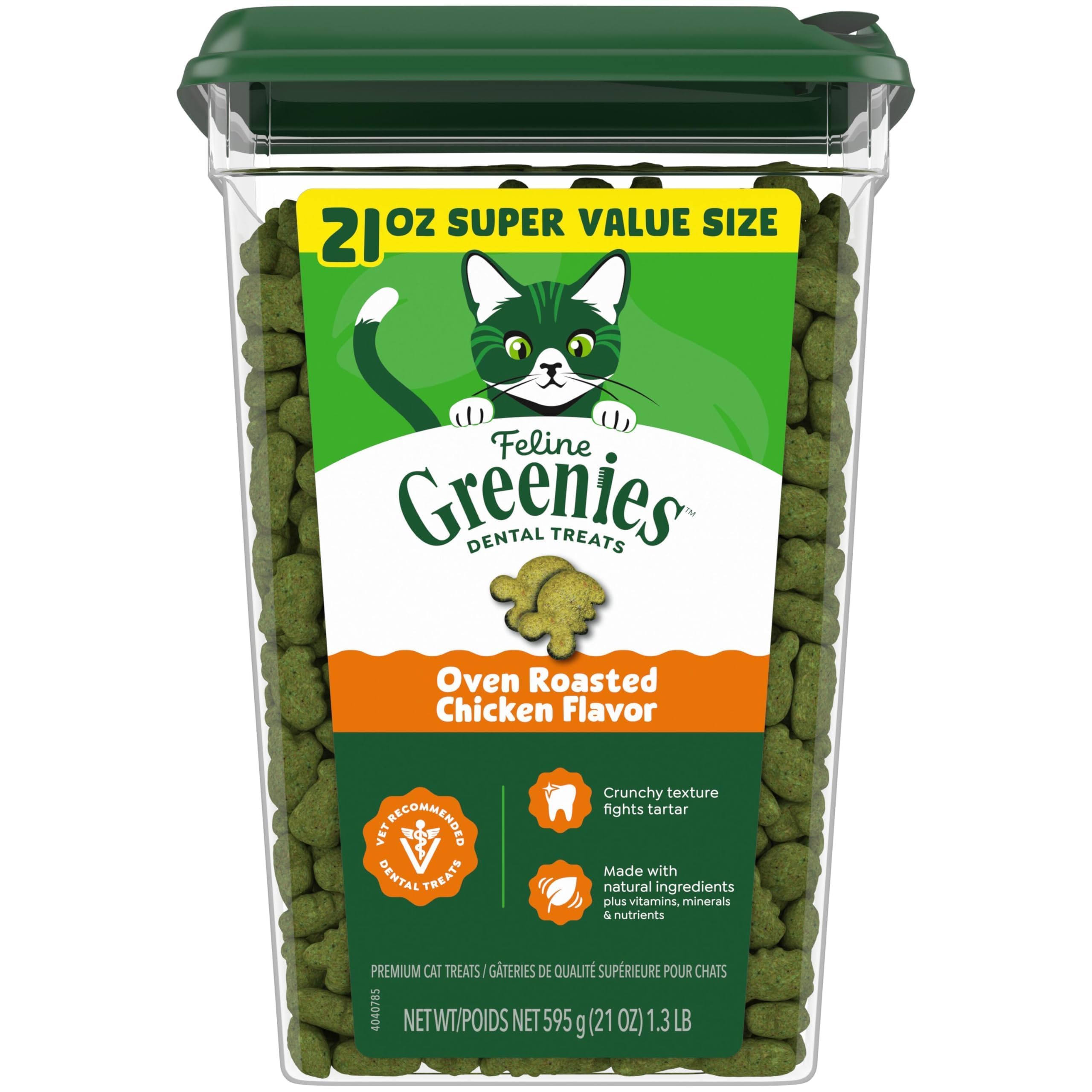
1. Greenies Feline Natural Dental Cat Treats, Roasted Chicken Flavor, 21 oz
Our pick — over 4.5★ from 44,000+ verified ratings; the strongest balance of quality and price.
The tub that turns treat time into tooth time, and the treat picky cats actually beg for
What wins people over here is simple: cats race to the container the second they hear it open, and the crunchy wafer texture does the cleaning work while they eat. It is the #1 veterinarian-recommended dental treat for cats, and the maker’s own data puts it at 36% less tartar accumulation in 28 days. The piece is a wafer form rather than a nugget, which gives a cat that satisfying crack without being a rock. At 1.3 pounds in a tub, this is the large-format buy that keeps a multi-cat household stocked for a while, and every piece lands under two calories, so you can hand them out daily without wrecking your cat’s waistline.
For context on sizing, this 1.3-pound tub is the heavyweight of the practical daily feeders here — the Pro Plan Veterinary Diets Dental Bites pouch sits at 3.6 ounces. That is the difference between a treat you restock every couple of weeks and one that lingers in the cupboard. If storage space is tight or you want to test whether your cat will accept a dental treat at all before committing to a big container, a smaller format makes more sense to start.
The interesting wrinkle in the owner feedback is that not every cat takes to them. Some cats, including senior cats well into their double digits, have been on these for years and now refuse every other brand. Others turn their nose up entirely — that is a cat-preference thing, not a formula flaw, and it is the one real gamble you take with any dental treat. The chunkier crumb does occasionally leave residue in the bowl, and a few owners wish the brand sold an even larger bulk size for multi-cat homes. None of that dents a 4.8-star reputation built on a long-running crowd of repeat buyers.
Where it earns its keep
- Crunchy wafer texture scrapes the gumline as your cat chews, backed by a documented tartar reduction
- Under two calories per treat, so a daily habit does not blow up your cat’s weight
- The 21 oz tub stretches far in a multi-cat home and stores easily
- Long-running favorite — owners of senior cats report years of daily use
What to weigh first
- Cats are either all in or totally indifferent; the formula itself is not the issue, individual taste is
- Owners wanting an even bigger bulk format will not find one here
- Chicken is the flavor here, so cats with a chicken sensitivity need a different pick
Best for: the household that wants one reliable daily dental treat and does not mind buying in a larger tub.
Look elsewhere if: your cat has a chicken sensitivity, or you want to trial a tiny bag before committing.
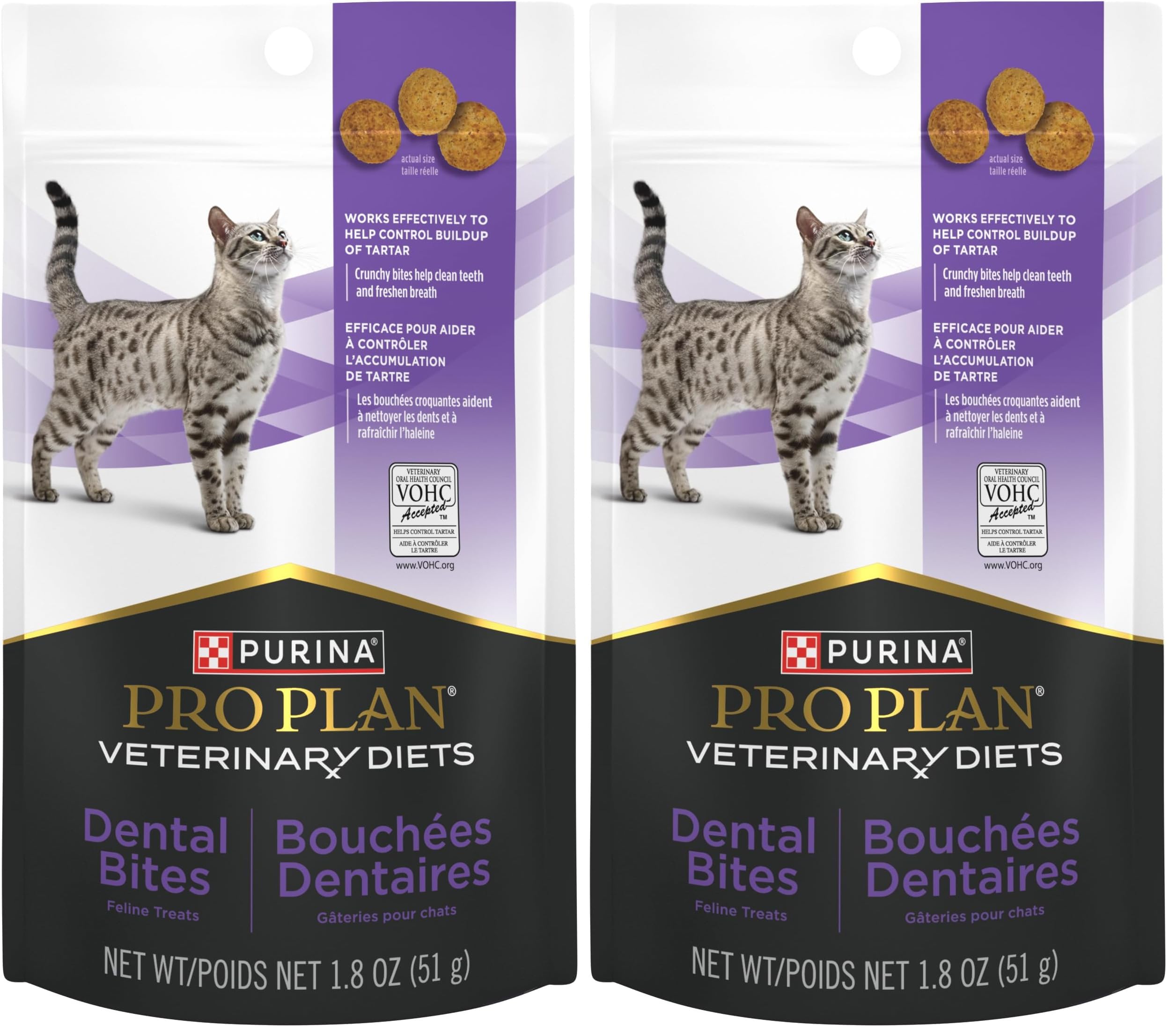
2. Pro Plan Veterinary Diets Purina Dental Bites Cat Treats – 1.8 oz. Pouch (Pack of 2)
Veterinary-diet formula with the VOHC seal — built for cats whose teeth need more than a snack
The headline here is the VOHC Seal of Acceptance, a Veterinary Oral Health Council stamp for treats shown to help control tartar. That puts it in slightly different territory to a plain treat. The crunchy bite is designed to be hard so it forces real chewing, and each piece runs under two kcals. The flavor blend is natural chicken and liver, and the Pack of 2 means two 1.8 oz pouches. One cat who made the switch from a prescription metabolic diet — a 16-year-old, no less — reportedly took to it easily, with the small bites and ease of chewing being the winning detail.
Here is the practical catch worth knowing before you buy. The company’s own packaging marks these as hard, and the crunch that does the cleaning is the same hardness that some cats with sensitive mouths will balk at. That is the intended design, not a defect — a soft treat would not remove plaque. One owner’s honest note was that the cat chews some and swallows some, which is the classic gulping problem with any dental treat. The other recurring frustration is the bag size: multiple owners have asked the brand for larger packaging, and at 1.8 oz per pouch these do not go far in a multi-cat house.
For a cat with a mouth that needs genuine help — a stomatitis case, a history of trouble — the vet-diet positioning and the VOHC seal make this the more clinical choice versus a mainstream treat. It is not a standalone fix, and one owner’s take was that it works best alongside other methods like toothpaste or wipes. If your cat is a hard-treat veteran and eats them easily, this is a serious contender. If your cat has never handled a hard crunchy treat, start with a softer or smaller option and work up.
The veterinary angle: the VOHC seal and vet-diet formulation give this more clinical weight than most treats on this list, and the under-two-kcal bite means it slots into a managed diet without much fuss.
Reach for this if: your vet has flagged tartar and you want a crunchy, professionally-stamped treat to work alongside your existing routine.
Think twice if: you need a big supply — the small pouches run out quickly.
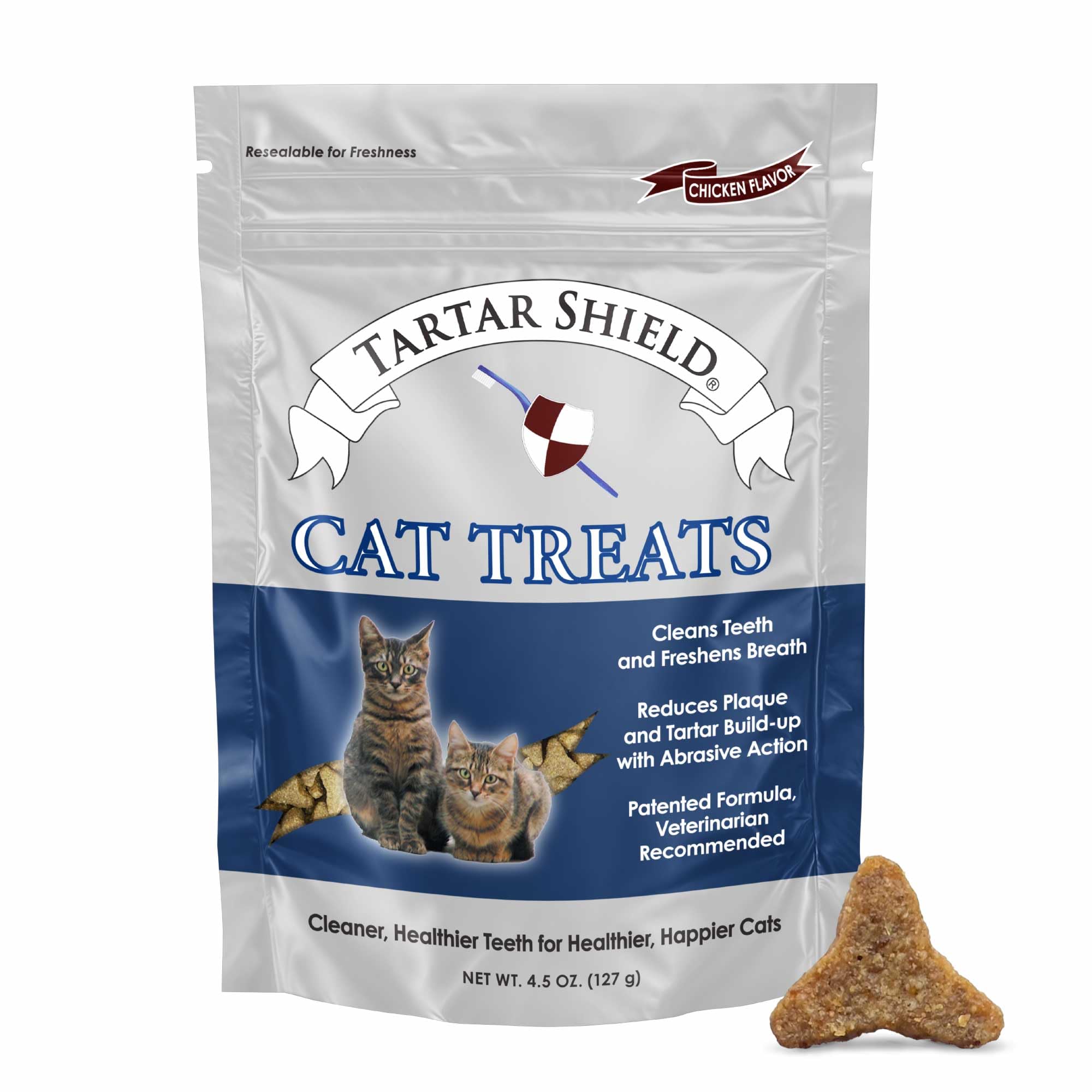
3. Tartar Shield® Daily Dental Cat Treats, Chicken Flavor, 4.5 oz
The one-calorie daily treat — light on the waistline and generous on the cleaning claim
If your cat is a treat-shaped balloon and you still want to hand something out every day, this is the one built for that. Each piece is a single calorie, and the chicken-flavored biscuit is made with no artificial preservatives, colors, or flavors. The company claims more than 42% less tartar buildup plus lower plaque and gingivitis, and the formula adds vitamins and minerals. Interesting detail on weight: this 4.7-ounce bag is heavier than the Pro Plan Veterinary Diets pouch at 3.6 ounces, so despite the smaller-looking format you are getting more physical product in the bag.
The thing to be honest about is that not every owner can confirm the dental result themselves. Several report their cat loves the taste and happily eats them, but add that it is too early to say whether the teeth are actually cleaner. That is a fair limitation — dental changes take time and are hard to eyeball without a vet comparison. The recurring gripe is the piece size, with some cats seeming to want something more substantial, and a few owners felt the price did not match the size of the bag for what they got.
Where this earns its spot is as a daily low-calorie habit, particularly for a cat on a managed weight plan. Owners of cats in the middle years have reported bright white teeth after consistent daily feeding, and the package directs a generous daily portion to get the benefit. If your cat is a determined gulper, the small piece may not force enough crunch — that is the trade-off you accept for the calorie count.
The calorie math angle: one calorie per treat is the lowest here, which makes this the pick for anyone who hands out treats all day and cannot afford the extra weight. The size question: the small biscuit suits a lighter-framed or older cat, but may get swallowed whole by a vigorous chewer who needs a bigger piece to slow down.
Suits: a weight-managed cat who gets treated daily and needs the calorie budget to stay intact.
skip it if: your cat crunches through small treats without really working at them.
4. Pet Honesty Vet Approved Cat Teeth Cleaning Bites for Fresh Breath, 30 Day
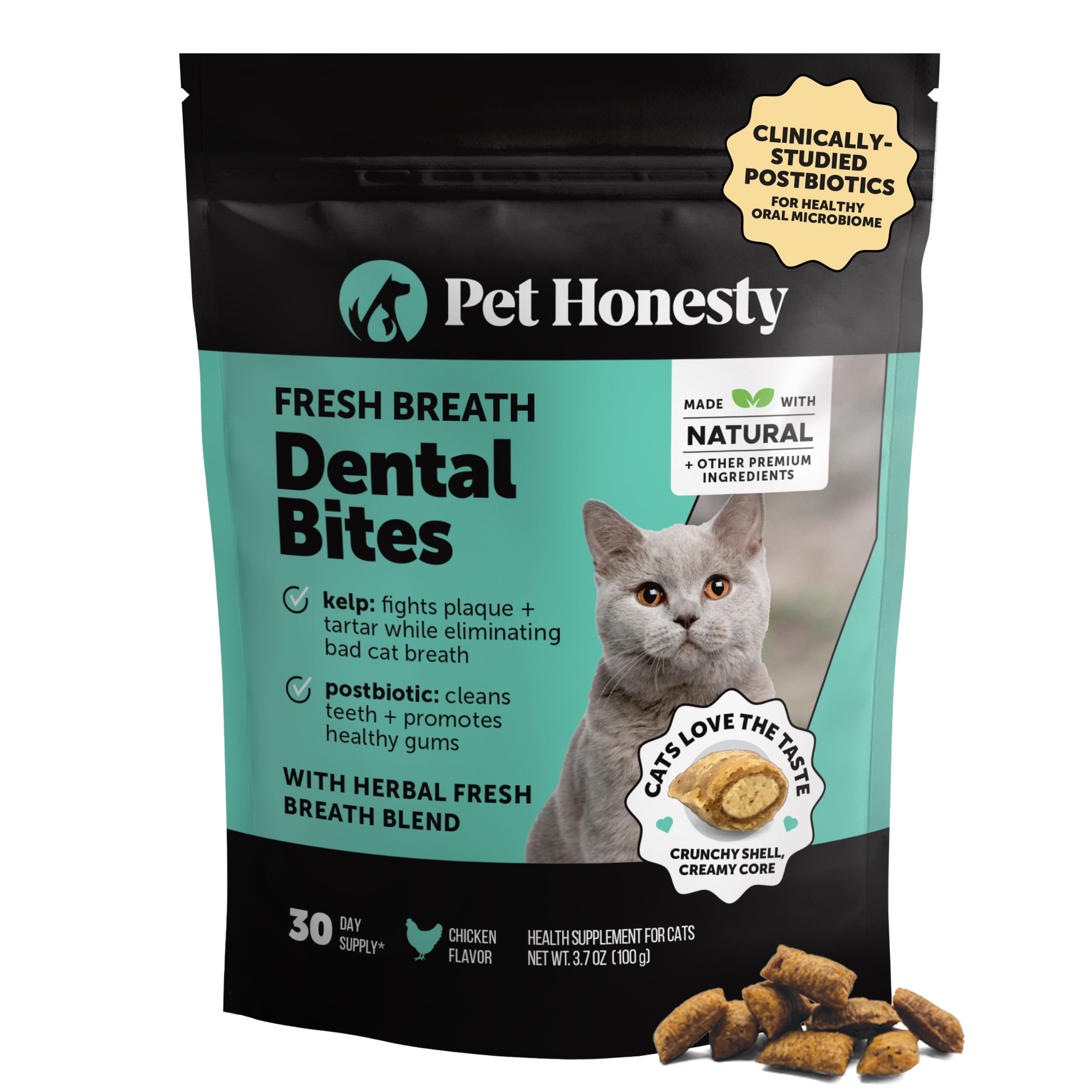
Crunchy shell, creamy center — the treat that works on breath from two directions at once
Most dental treats pick one texture and commit. This one splits the difference with a crunchy outer shell and a creamy inside, so your cat gets the satisfying crack and a soft center in the same bite. That is the delivery mechanism for a formula built on postbiotics, kelp, and parsley. Kelp is included as a natural tartar remover, parsley as the breath freshener, and the postbiotics are aimed at the oral microbiome. It is made without palm oil, cellulose, corn, wheat, or soy, packaged in 36% recycled plastic, and carries NASC certification.
The brand notes 70% of cats over age 2 show signs of poor dental health — the case for daily, not occasional, treating. The packaging is sized as a 30-day supply, and the creamy center is the reason a lot of buyers report easy acceptance — even a cat described as very picky went for these. On breath, the honest picture from the owner reviews is that the improvement shows up, but not instantly: one buyer noticed better breath just starting out, and another described the effect as temporary. This is a daily-buildup formula, not a one-off fix.
The main thing to watch is how your cat digests them. A handful of owners mention changes in tolerance, and the softer center means this is not going to force the hard scraping a rock-hard biscuit does. If your cat has a sensitive stomach, work these in slowly rather than loading up on day one. For a cat with inflamed gums or a diagnosed condition, this is a maintenance aid, not a replacement for a vet’s treatment plan.
The formula angle: postbiotics plus kelp and parsley is a genuinely different flavor of dental care to a plain crunchy biscuit, and the clean-label rule-out of palm oil, corn, wheat, and soy suits ingredient-conscious owners.
Pick this if: you want a breath-focused daily bite with a soft center that suits cats who dislike rock-hard treats.
Know that: the creamy texture and postbiotic blend will not work for every digestion, so introduce it gradually.
5. Dentalife Purina Dental Cat Treats, Tasty Chicken Flavor, 19 oz Pouch

The bulk buy that keeps working — sticky-shaped sticks with a porous texture built to trap the tooth
Here is what is different about this one: it is shaped as a stick rather than a wafer, and the texture is porous rather than solid. That porosity is the point — it is designed so the tooth sinks into the treat as your cat bites, scraping as it goes, and it is scientifically tested for tartar reduction. It carries the VOHC stamp for tartar reduction and adds calcium, taurine, and probiotics for digestive support. The chicken flavor comes in a reclosable 19 oz pouch, which is the big-daily-habit format for a household that goes through treats fast.
Owners who made the switch from failed dental treats describe this clearing a cat’s bad breath within a couple of weeks, and the vet-compliment effect — teeth still look good, no cleaning yet — shows up more than once in the feedback. Rotation into a treat dispenser works too, since the stick shape feeds cleanly. The honest variable is size and hardness: the sticks are on the larger side, and a smaller cat or one with a sensitive mouth may struggle to chew them. One owner noted a single cat in a six-cat household needing a different, smaller treat instead. That is a fit issue, not a formula issue, but worth flagging if your cat is small or toothless.
For a multi-cat home or a big-bag shopper, the 19 oz pouch plus the added probiotics makes this a strong daily driver. If your cat is a delicate chewer or a senior with few teeth, look at a smaller, softer format instead — the cleaning action here depends on your cat being able to bite into the porous stick.
The bulk angle: 19 ounces of VOHC-endorsed tartar control in a reclosable pouch, with probiotics layered in, is the volume-per-treat standout for households treating several cats. The chew angle: the larger stick demands real chewing, which is great for a sturdy cat and a genuine hurdle for a small or delicate one.
Best fit: big households or big-bag buyers who want VOHC-endorsed tartar control and can keep a full pouch fresh.
Who should pass: the cat who struggles to crunch a larger, harder stick.
6. Emerald Pet Grain-Free Cat Dental Treats with Salmon – Crunchy Natural Dental Treats, 11 oz Tub

For the cat with a sensitive gut — fish-shaped, grain-free, and built to force a real bite
The design logic here is deliberate: these are fish-shaped pellets sized large enough that your cat has to chew rather than swallow, and chewing breaks the treat into pieces that scrape the teeth. They are grain-free, gluten-free, soy-free, and dairy-free, which is the whole point for a cat with food sensitivities or a skin condition. There are six recipes in the line — Chicken, Salmon, Tuna, Ocean Fish, Turducky, and Catnip — and this is the Salmon. Each piece is 2 calories, and they carry chlorophyll, which neutralizes odor at the source for breath. No sugars, salt, or by-products.
Owners with a sensitive cat tend to be the loudest fans of the formula, and one thing that shows up repeatedly is that the daily dose is far lower than other dental chews — some brands want a large handful a day, this one needs less, so the cost per day is friendlier than the bag tag suggests. The tub is easy to open and close, and the lack of a strong odor is a common point of appreciation. The honest flip side: not every cat likes the flavor, and a few owners found it expensive for what they got. That is the gamble with a grain-free fish treat — some cats turn their noses up at the salmon.
The bigger limitation is expectations. Owners who have used these for years often say they still can’t confirm the teeth are actually cleaner, and the soundest advice in the feedback is that a dental treat is never a substitute for an annual professional cleaning. So treat this as a daily maintenance habit for a sensitive cat, not a replacement for the vet. If your cat handles salmon and the daily dose is small in your household, the tub will last.
For the sensitive cat: grain-free, gluten-free, soy-free, and dairy-free in one formula, with a small daily dose that keeps cost-per-day reasonable and a fish shape that encourages chewing.
The right call for: cats with grain, gluten, soy, or dairy sensitivities who need a crunchy daily treat.
The caveat: salmon is a love-it-or-leave-it flavor, and a dental treat will never replace a vet cleaning.
7. Wellix Cat Grass Treats with Catnip, Hairball & Digestive Support, 13.05 oz
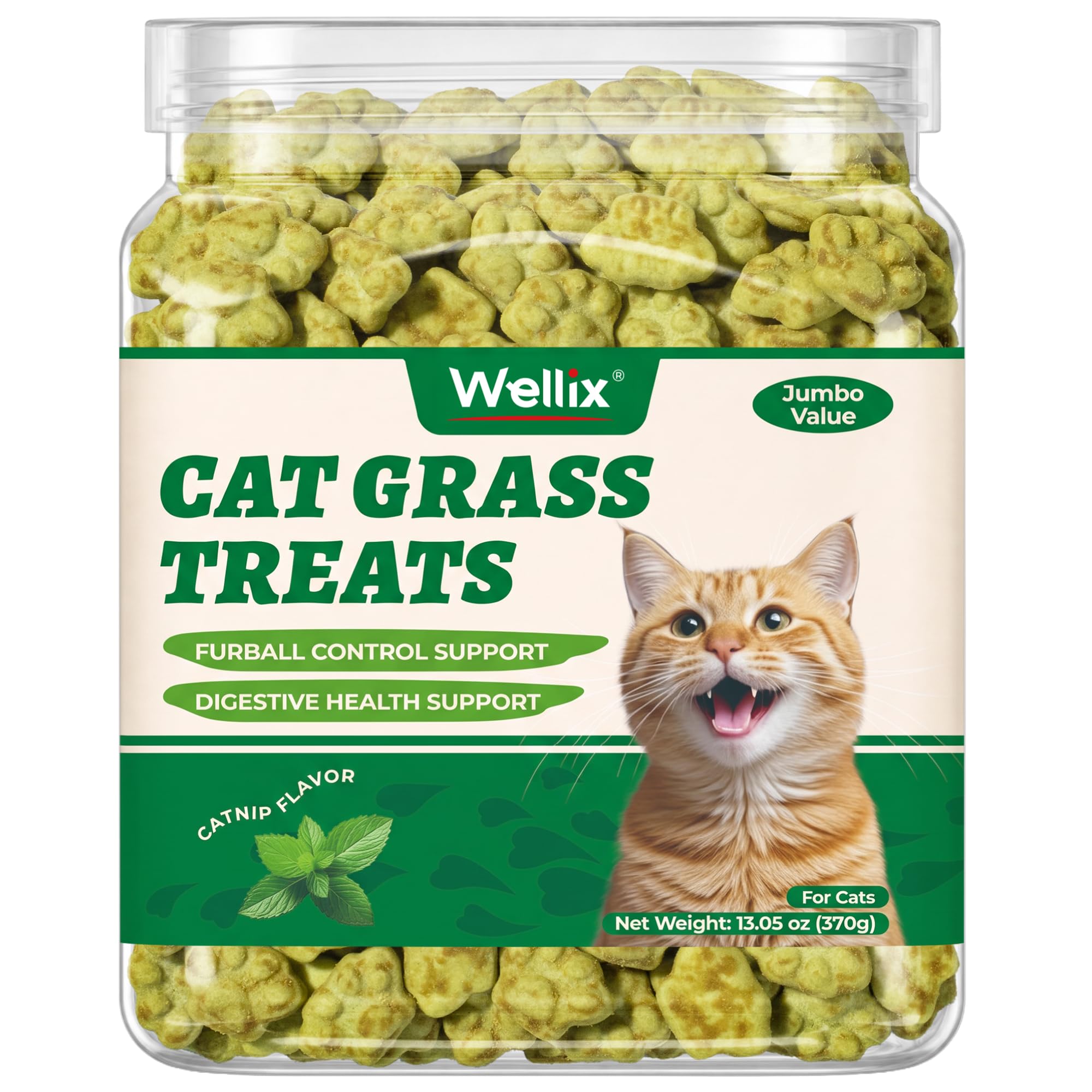
Two jobs in one biscuit — hairball control and dental care from the same crunchy bite
This one solves a problem the other treats here ignore: hairballs. The formula is built on natural fibers from cat grass — barley seedling powder — plus catnip powder, aimed at helping hair pass through and reduce the formation of new hairballs. The same crunchy biscuit texture is doing the dental work, cleaning teeth and controlling tartar while your cat enjoys the cat-grass flavor and catnip. Each treat is 1.3 calories, and the tin holds 13.05 ounces with a resealable lid to keep the pieces crisp and fresh. It is sugar-free, with no artificial flavors or colorings, and the salmon-plus-catnip flavor combo is aimed at picky cats.
The owner pattern with hairball treats is usually a slow reveal — the change in the hairball schedule shows up over weeks, not days. Owners who gave a few treats a couple of times a week report the vomiting easing off after an initial pass of hair, with the cat seeming happier and more energetic once the fur cleared. Others were cautiously hopeful, noting it was still early but the gap since the last hairball had stretched longer than usual. The four-cat household record — all four running for them — is the kind of acceptance that is hard to fake with a cat product.
The honest limit is that some indoor-outdoor cats, used to real grass outside, simply will not touch these. The cat-grass biscuit flavor is a specific taste, not a universal one, and the value question is a live debate — some owners found the tin fairly priced for the volume, others found it on the pricey side for what is essentially a digestive aid. For the cat who already loves grass and suffers hairballs, this folds two routines into one treat instead of two separate products.
The two-for-one angle: hairball support from barley seedling powder and catnip, plus a crunchy texture doing dental work, at 1.3 calories a piece — a rare dual-purpose pick. The flavor caveat: the cat-grass and catnip profile is a specific taste, so a house cat used to grass from the yard may pass.
Made for: the hairball-prone cat who will accept a cat-grass and catnip biscuit and needs both digestive and dental help.
Not for: the cat with no hairball problem, or one that already has all the grass it wants outside.
8. FELINE GREENIES Dental Treats for Cats Catnip Flavor 2.5 oz.
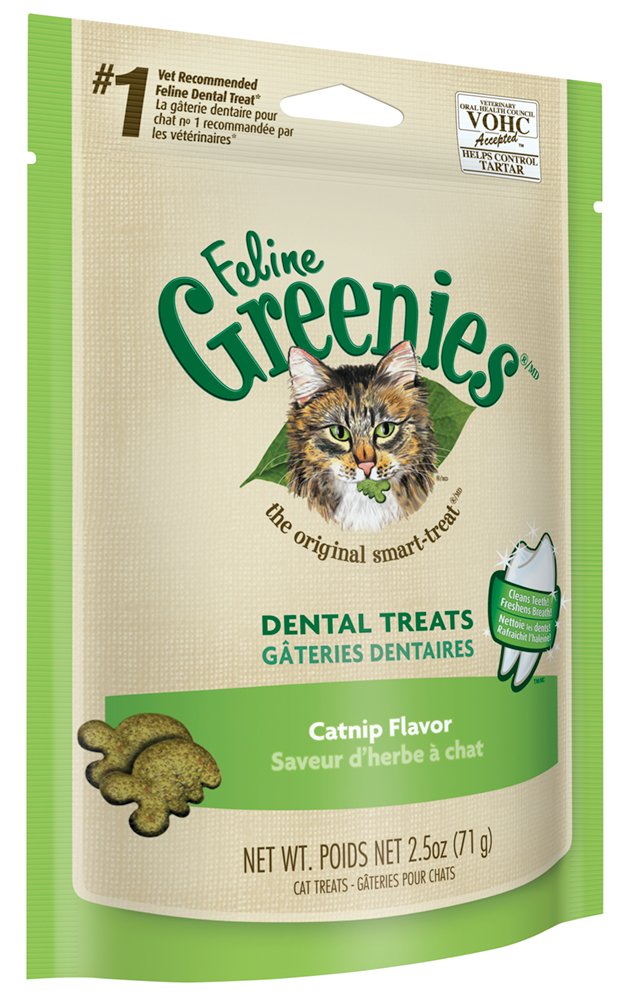
The catnip-flavored trial size — a small bag to test a fussy cat before you buy big
If you have a cat that has rejected every treat you have tried, starting with a small bag makes sense, and this is the one. It is the only catnip-flavored pick here, a crispy pellet form from the same family as the crowd-favorite brand, designed to reduce tartar and freshen breath. The 2.5 oz bag is the trial format — small enough to learn whether your cat accepts the texture without committing to a tub. The brand describes the shape as specially selected for dental health, and the treat is 100% nutritionally complete and balanced, which is unusual for a treat.
What makes this one stand out in the owner reports is that fussy cats come around to it. One owner with a notably picky cat confirmed the acceptance directly, and a long-term pair of owners have used it long enough to have a routine — a handful twice a day, which the directions support. The catnip angle is the differentiator for a cat that ignores chicken and salmon flavors. The 2.5 oz sizing means it is genuinely a trial, though: if your cat takes to it, you will be reordering constantly. Value is the other mixed signal — some owners felt the small bag was a lot of money for a little product.
Two things worth knowing before you buy. First, the pellet is on the larger side, and a gulper may swallow them whole — one owner reported exactly that, the treat being too big to force a proper chew. Second, and more reassuring, the brand markets it as low calorie, and one reviewer with a toothless cat confirmed the softened treat still worked for a cat with no teeth to chew with. So for a senior cat with a limited mouth, this can still work even though the tooth count is low.
The trial-bag logic: a small catnip-flavored bag is the low-risk way to find out if your fussy cat will accept a dental treat at all. The honesty note: the pellet is substantial, so a gulper may swallow rather than chew — the size is the trade-off for the crunch.
Go for this if: you are testing a picky cat and want a small bag before committing to a larger tub.
Consider a different size if: your cat already accepts dental treats and you need a long-lasting bag.
9. Purina DentaLife Made in USA Facilities Cat Dental Treats, Savory Salmon Flavor – 13.5 oz. Canister

The senior-cat favorite with a porous bite the tooth sinks into for a thorough clean
What makes this one interesting is the texture design. The treat is more porous than a standard cat biscuit, so when your cat bites, the tooth penetrates the treat and the surface scrapes all the way around — all sides of the tooth, not just one edge. That porous bite is the mechanical trick behind the tartar reduction, and it carries the VOHC endorsement. It comes in a 13.5-ounce canister in savory salmon, with no artificial flavors or colors, and it is designed to be fed as a treat to an adult cat.
Seniors respond especially well to it. Multiple owners with older cats have reported the vet commenting on how little tartar they have, and a finicky 16-year-old was among a large cat group that took to it. The round shape also rolls, which some cats chase down before eating — a small play bonus baked into the design. The canister format means a long supply, and at this size it is genuinely economical for a daily habit, which is why value is such a strong signal in the owner feedback here.
The one packaging note worth flagging: at least one owner received the treats in a bag rather than the canister pictured, and transferred the product to their own jar to keep it fresh. That is a fulfillment mismatch, not a product flaw, but it is worth knowing the container shown is not guaranteed. On the flavor front, salmon is a polarizing choice — some cats dive in and others ignore it, and there have been reports of reactions in a few sensitivity-prone cats. For a senior with a full mouth and a taste for fish, this is the low-fuss daily driver.
Why seniors love it: the porous texture lets the tooth sink in for all-sides cleaning, the salmon flavor appeals to older cats, and the big canister keeps the daily cost down. One thing to know: the container shown in the listing is not always what arrives, so freshness depends on how you store it if it comes bagged.
Ideal for: senior cats with a full set of teeth who need a thorough, all-sides cleaning and will take to salmon.
Skip this one if: your cat has known fish or food sensitivities, or refuses salmon outright.
Understanding the Specs
Calories per Treat
This is the number that decides whether a dental treat is a daily habit or an occasional indulgence. A treat at one or two calories per piece can be handed out freely without tipping your cat’s weight, while a denser treat means fewer pieces a day. The picks here range from one calorie per treat up to two, and the piece weight matters as much as the count — a heavier biscuit with the same calorie tag means more chewing per calorie. Check the calories first if your cat is indoor, spayed or neutered, or prone to weight gain, because the daily handful adds up over a month.
Texture and Piece Size
Texture is what does the cleaning, so it is the spec most worth understanding. A porous texture lets the tooth sink into the treat as your cat bites, which is how the surface scrapes the sides of each tooth. A crunchy wafer or stick works by forcing a hard, satisfying crack. The piece size is the second half of the equation — a bigger piece forces more chewing and discourages gulping, while a smaller piece is easier for a senior or a cat with a light jaw to manage. If your cat swallows treats whole, a larger piece is doing the work; if your cat struggles to crunch, a smaller or softer piece is the right call.
Flavor and Ingredient Claims
Flavor is the make-or-break variable for acceptance, and it is genuinely individual — a cat that ignores salmon may race for chicken or catnip. Beyond flavor, the label claims matter for a cat with sensitivities. Grain-free, gluten-free, soy-free, and dairy-free are the common allergen-friendly markers, and a limited-ingredient formula suits a cat with a known food reaction. Look for added vitamins, minerals, taurine, or probiotics if you want the treat to contribute nutritionally rather than just clean teeth.
The VOHC Seal of Acceptance
The Veterinary Oral Health Council runs a seal program for pet dental products, and a treat carrying the VOHC Seal of Acceptance has been reviewed for tartar control. The seal is a useful shortcut when you are scanning labels in a store, but it is not a guarantee of overnight results or a replacement for professional cleaning. Treat it as one signal among several, alongside the texture, the calorie count, and whether your cat will actually eat the thing. A treat your cat refuses does nothing regardless of what seal it carries.
FAQ
Do dental treats actually clean a cat’s teeth or just freshen breath?
How many dental treats should I give my cat each day?
My cat swallows treats whole — will dental treats still help?
Are dental treats safe for a senior cat or one with missing teeth?
Can a cat dental treat replace a professional teeth cleaning?
What does the VOHC Seal of Acceptance mean on a cat treat?
Are grain-free cat dental treats better for cats with allergies?
How long does a bag or tub of cat dental treats last?
Which flavor do most cats prefer — chicken, salmon, or catnip?
Can I give dental treats to a kitten?
Are dental treats with added probiotics worth choosing over plain ones?
Final Thoughts: The Verdict
For most people, the cat dental treats winner is the Greenies Feline Natural Dental Cat Treats because it does the crunch and the tartar control with a track record no other pick here matches — the vet-recommended formula, the under-two-calorie piece, and a tub that keeps a household stocked. If you want the veterinary-diet angle with the VOHC seal and a harder, deliberately chewy bite, grab the Pro Plan Veterinary Diets Purina Dental Bites. And for the senior cat with a full mouth and a taste for fish, the Purina DentaLife Savory Salmon Canister is the one to reach for, with its porous texture that lets the tooth sink in for a thorough clean.
How We Picked
We do not accept paid placement. Every pick is matched to a real buyer and a real use-case; we do not hands-on test units.
Sources & Methodology
Specifications: manufacturer listings and product documentation. Review insights: verified customer reviews, as of September 2026. Pricing: not shown on this page (it changes often); check the current price via the retailer link.
As an Amazon Associate, Gadgets Feed earns from qualifying purchases. This does not affect which products we feature.