
Our readers keep the lights on and my morning glass full of iced black tea. As an Amazon Associate, I earn from qualifying purchases.
Specs are compiled from manufacturer listings and verified buyer reviews and can change over time — please confirm the key details on the product page before buying.
If your cat is straining in the litter box, the fix is rarely “more fiber” dumped on top of the same bowl. It is usually moisture plus a gentle, fermentable fiber source your cat will actually finish. The picks below are all built around that idea, and one of them, Purina ONE Tender Selects, is the crowd favorite at 4.5+ stars across 27,000+ ratings.
I’m Min — the founder and writer behind Gadgets Feed. This guide is built by comparing the manufacturers’ published specifications and the patterns across verified customer reviews, so you get each pick’s real strengths and trade-offs instead of marketing spin.
You will see dry formulas with prebiotic fiber, wet foods that quietly top up water intake, and veterinary-style diets for stubborn cases. Every pick here is chosen for digestive support first, taste second, because a high-fiber food your cat refuses is worth nothing at all, and this rundown of the best cat food for constipation keeps that reality front and center.
Our Picks at a Glance

How To Choose The Best Cat Food For Constipation
Hard, dry stools usually mean two things at once: too little water in the gut and too little fermentable fiber to hold that water in the stool. A food that covers both — water and fermentable fiber — removes the guesswork. Here is what actually separates one bag or can from the next.
Moisture first, then fiber
A wet food is the simplest way to raise your cat’s water intake without a fight. Cats are famously poor drinkers, so a can with a high moisture content does work a bowl of kibble cannot. Tiki Cat Friends, for example, is built with real tuna broth as the first ingredient, which is a hydrating base rather than a dry one.
Dry formulas can still help, but only when the fiber is the gentle, fermentable kind. Look for prebiotic fiber, pumpkin, lentils, or Miscanthus grass named on the label. Those feed gut bacteria and soften stool rather than simply bulking it.
Read the fiber type, not just the number
Soluble fiber dissolves and ferments in the gut, which is the softening, stool-regulating kind. Insoluble fiber adds bulk and moves things along. A digestive formula often lists both. Tiki Cat Solutions states it is a source of soluble and insoluble fibers and calls its fiber “gentle” — that is the exact wording worth scanning for.
Match the food to how stubborn the problem is
An occasional hard stool responds well to an everyday digestive food with prebiotics. A cat with a long history of straining, or one your vet has already examined, may need a therapeutic diet. Hill’s Prescription Diet GI Biome and Royal Canin Digestive Care are both built for that heavier job, and both are worth raising with your vet before you switch.
Quick Comparison
| Model | Best For | Form | Primary Protein | Digestive Feature | Amazon |
|---|---|---|---|---|---|
| Purina ONE Tender Selects Salmon★ Best Overall | Everyday value feeding | Dry, 22 lb bag | Salmon | Natural prebiotic fiber | Amazon |
| Tiki Cat Friends Tuna & PumpkinBest Wet Pick | Hydration in a can | Wet, 12 x 2.8 oz | Tuna | Pumpkin fiber, tuna broth | Amazon |
| Solid Gold Indoor SalmonBest For Indoor Cats | Indoor cats with hairballs | Dry, 3 lb bag | Salmon | Probiotics, prebiotics, pumpkin | Amazon |
| Nulo Digestive Health Chicken & Whitefish | High-protein, grain-free feeding | Dry, 4.5 lb bag | Chicken & whitefish | BC30 probiotic, Miscanthus grass | Amazon |
| Wellness CORE+ Digestive Health Pate | Pate lovers, sensitive stomachs | Wet, 12 x 3 oz | Chicken & turkey | Prebiotic fiber, omega-3 | Amazon |
| Tiki Cat Solutions Digestion | Gentle fiber in dry form | Dry, 2.8 lb bag | Lamb & egg | Prebiotic fiber, soluble + insoluble | Amazon |
| Royal Canin Digestive Care Loaf | Small-cat households | Wet, 24 x 3 oz | Chicken | Highly digestible proteins | Amazon |
| Royal Canin Digestive Care Thin Slices | Gravy-texture cats | Wet, 24 x 5.1 oz | Salmon | Highly digestible proteins | Amazon |
| Hill’s Prescription Diet GI Biome Stress | Vet-directed stubborn cases | Dry, 8.5 lb bag | Chicken | ActivBiome+ prebiotic blend | Amazon |
In‑Depth Reviews
1. Purina ONE Digestive, Natural Dry Cat Food, Tender Selects, Salmon, 22 lb
Our pick — 4.5+★ from 27,000+ verified ratings; the strongest balance of quality and price.
A 22-pound bag that quietly takes the top spot by doing the boring thing well: gentle fiber your cat actually eats.
The headline is scale. At 22 pounds it is far and away the biggest bag here — versus the 12 cans of 2.8 oz Tiki Cat Friends next to it. For a multi-cat home or a cat that eats a bowl a day, that means fewer reorders and steadier feeding.
What earns it first place is acceptance. Real salmon leads the ingredient list, and the bowl mixes crunchy kibble with tender pieces so a picky cat stays interested long enough to finish. Natural prebiotic fiber supports the gut, while omega-6 fatty acids handle skin and coat. Four antioxidant sources back the immune system. It is complete and balanced for adult cats with no artificial flavors or preservatives.
The honest caveat is that “digestive” here means gentle daily support, not a therapeutic fix. It is not a vet diet, and a cat with a long-standing straining problem may need something stronger. Some cats also simply turn their nose up at the texture, which is true of any food in this category. But what stands out across the crowd is how many cats take to it with no fuss at all.
What earns it the top slot
- 22 lb bag feeds a multi-cat home for a long stretch
- Real salmon is the first ingredient, with prebiotic fiber for gut balance
- Crunchy-plus-tender texture keeps picky eaters coming back
- Complete and balanced for adults, no artificial flavors or preservatives
Where it tops out
- Gentle daily support, not a veterinary-strength formula
- Texture does not suit every cat’s preference
Made for: the household that wants one big bag of everyday digestive dry food and a cat that reliably clears the bowl.
Think twice if: your vet has already flagged a stubborn gastrointestinal issue that calls for a prescription diet.
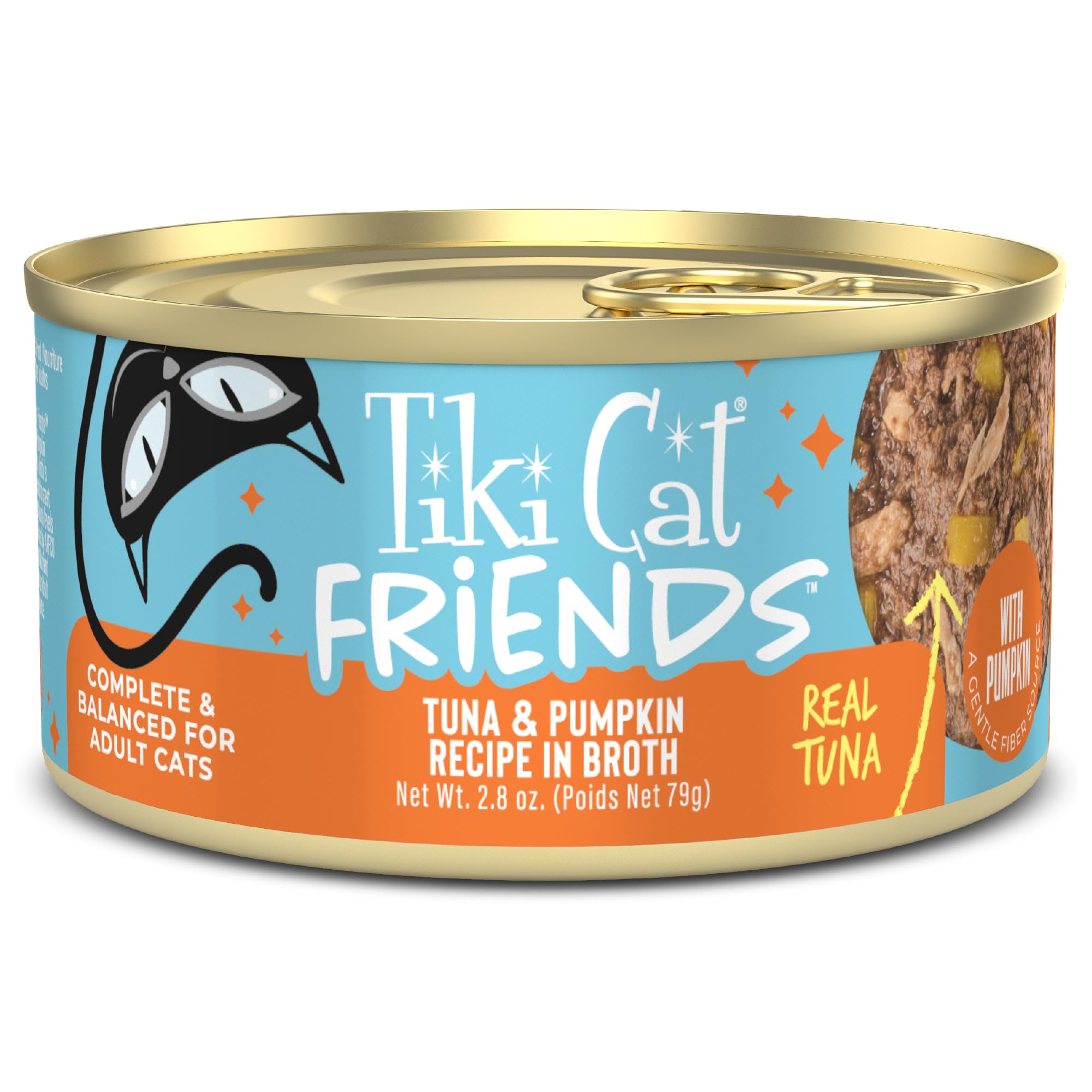
2. Tiki Cat Friends Wet Cat Food, Tuna & Pumpkin, 2.8 oz Can (12)
The quiet fix for a cat that barely drinks: a broth-first can that adds water and pumpkin fiber in one spoonful.
Real tuna broth is the first ingredient, which makes this less a chunk of meat in jelly and more a hydrating base your cat laps up. Pumpkin is the fiber source, and it is an easy-to-digest one — the kind that softens stool rather than bulking it. The formula is grain-free and complete and balanced for adult cats.
Where it fits is a cat on dry food whose stools run hard. Swapping even one meal a day for a moist can raises water intake without a fight, and the tuna flavor keeps most cats interested. Squeeze this into a mixed feeding routine rather than treating it as a standalone cure.
The catch is value. Twelve small 2.8-ounce cans go fast in a multi-cat home, and a wet-only diet on this gets costly. Some cats also reject the texture, and the tuna-forward smell is stronger than a pate. That smell is the trade-off for the broth content that does the actual work.
Where it wins: the moisture-plus-pumpkin combination targets both halves of a constipation problem at once — water to soften, gentle fiber to regulate.
Worth knowing: it is a supplemental hydration tool, and the can count disappears quickly if you feed it as the main meal.
Reach for this if: your cat eats dry food and needs a tasty, broth-heavy way to drink more.
Look elsewhere if: you want one wet food to cover every meal for several cats without constant restocking.
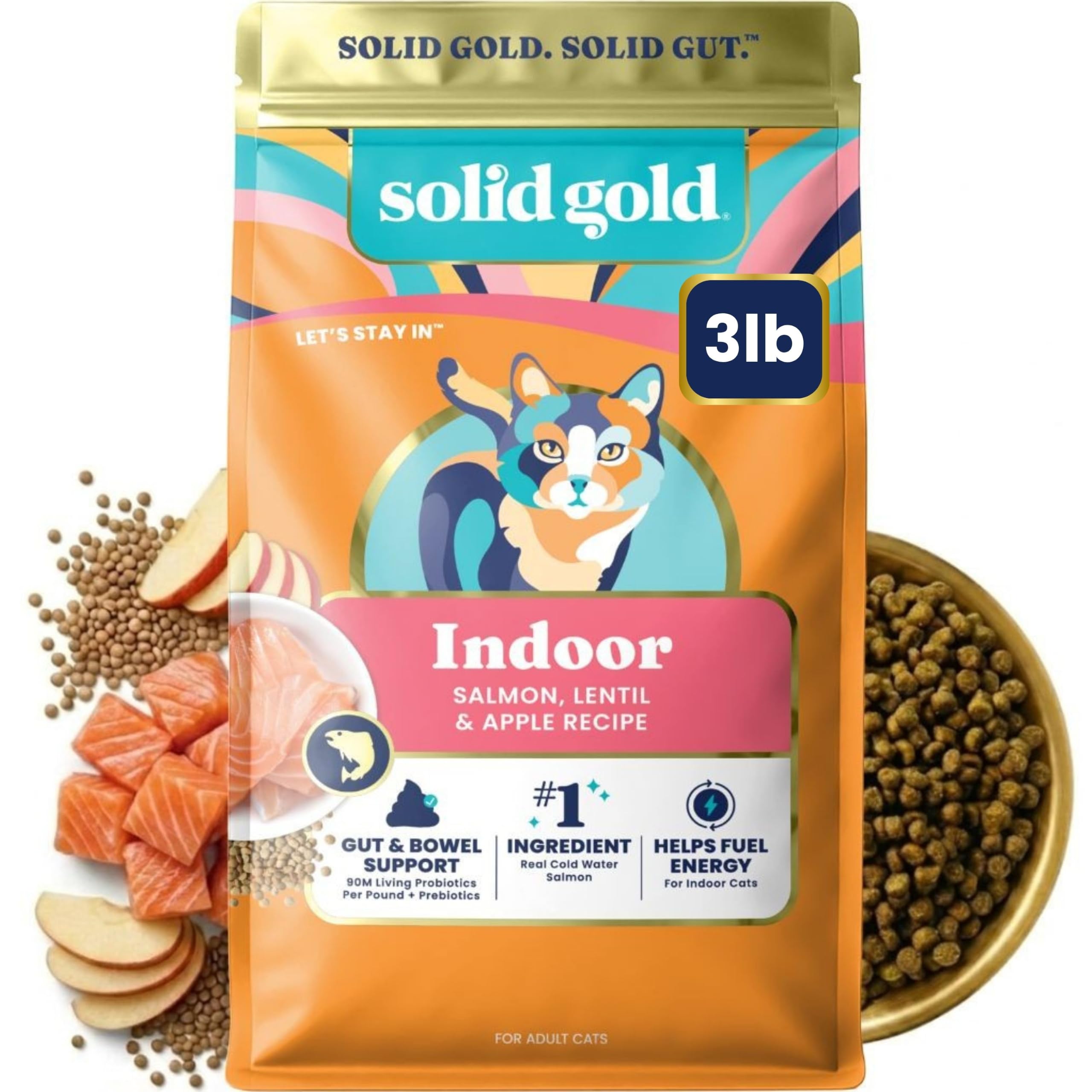
3. Solid Gold Indoor Salmon Dry Cat Food, High Fiber, Adult & Senior Cats, 3LB
Built for the indoor cat that spends half its life grooming and the other half dealing with the hairballs that follow.
Indoor cats swallow a lot of fur, and slow gut transit is how that fur turns into a problem. This formula leans on lentils and high-fiber superfoods like pumpkin and broccoli to keep things moving, and it is labeled as hairball control food as well as digestive support. For an indoor adult or senior cat, hairball control and digestive support are largely the same job.
It also stacks live probiotics with prebiotics for gut flora — both the beneficial bacteria and the fiber that feeds them. Real cold-water salmon carries the flavor, which matters because a high-fiber food a picky cat rejects helps no one. Antioxidants, omega fatty acids, and superfoods round it out for immune, skin, and coat support.
The honest split is acceptance. The ingredients earn consistent praise and the quality reads high, but cats are famously divided — some dig in, others walk away. The 3-pound bag is also a starter size, so a cat that loves it means frequent reorders. Buy small first, confirm the cat agrees, then size up.
Why indoor cats benefit
- Combines hairball control with high-fiber digestive support in one kibble
- Live probiotics plus prebiotics for gut flora balance
- Real cold-water salmon leads the recipe
- Wheat-free, with salmon, lentils, and apples
What to expect
- Acceptance varies sharply from cat to cat
- 3 lb bag is small for a daily-feeding household
Worth it for: strictly indoor adults and seniors fighting both hairballs and slow digestion.
Hold off if: your cat is a notorious food snob — trial the small bag before committing to a routine.
4. Nulo Digestive Health High Protein Dry Cat Food, Chicken & Whitefish, 4.5lb

Animal protein makes up 90% of the protein here, and a BC30 probiotic does the gut work alongside it.
Most digestive dry foods ask you to accept a lower-protein recipe in exchange for fiber. This one refuses that trade. Ninety percent of the protein comes from animal sources, which supports lean muscle and a healthy heart while the gut is being looked after.
The fiber comes from Miscanthus grass — a natural, plant-based source paired with the BC30 probiotic. The recipe skips grains, corn, soy, and artificial ingredients, and it carries a full spread of vitamins, minerals, and antioxidants for the immune system. It is developed in Austin, Texas, and manufactured in the USA.
What appeals to owners is the kibble size — small, kitten-sized pieces that even a delicate eater handles easily. The trade-off is taste: not every cat takes to it straight away, and the protein-forward recipe has a distinct smell. Small kibble helps a picky senior finish a bowl, though a cat that turns away from the flavor will not be won over by shape alone.
The real draw: it pairs genuine high animal-protein content with a named probiotic, so you are not choosing between muscle support and digestive support.
The small print: it is a 4.5-pound bag, so start here to test acceptance before stocking up.
Best suited to: owners who want grain-free, high-protein feeding without giving up digestive support.
Not the first choice if: your cat is a committed fish-only or pate-only eater.
5. Wellness CORE+ Digestive Health Pate Variety Pack, Chicken and Turkey, 3 oz, 12 Cans

Two smooth pates, real chicken and turkey first, and prebiotic fiber folded in for cats with touchy stomachs.
If your cat turns its nose up at chunks and gravy but laps up a smooth pate, this is the digestive formula that fits that preference. The 12-can pack splits between Chicken Pate and Turkey Pate, both with real protein as the first ingredient. The texture is completely smooth, which is often easier on a sensitive stomach than chunky wet food.
The digestive side is handled by prebiotic fiber for gut health, omega-3 fatty acids for skin and coat, and a vitamin and mineral blend. There is no added carrageenan, wheat, corn, soy, artificial colors, or preservatives. As a wet food, it also boosts daily moisture intake, and the brand suggests serving at room temperature and refrigerating the unused portion.
The clear tension is flavor preference. Some cats devour both recipes, others flatly refuse one or both, and the variety pack removes your ability to buy only the one your cat likes. Value is the other watch point — twelve 3-ounce cans is a short runway if you feed wet daily. Trial the pack, then reorder single-flavor cases once you know the winner.
Pick this for: a pate-only cat whose stomach needs prebiotic fiber and extra moisture.
Second-guess it if: your cat has strong flavor opinions — a variety pack can leave half the cans untouched.
6. Tiki Cat Solutions Dry Cat Food, Digestion, Lamb & Egg, 2.8 lbs. Bag

Oven-baked, minimally processed, and deliberately gentle on the gut — this is the careful dry option of the group.
Where most dry foods are extruded at high heat, this one is oven-baked and described as minimally processed. The fiber is a deliberate blend of both soluble and insoluble types, which is the combination that softens stool while keeping things moving. Prebiotic supplementation handles the gut bacteria side, and the recipe is formulated by veterinarians and animal nutritionists.
Protein sits at a guaranteed 40%, carried by lamb and egg. The formula is complete and balanced with gentle fiber and labeled easy to digest. For a cat that needs digestive support but refuses wet food entirely, that dry kibble with a real fiber strategy is exactly the gap this fills.
The one recurring note is smell. The lamb-and-egg recipe carries a stronger odor than many owners expect when they open the bag. That is a sensory trade-off rather than a functional one — the food still does its job. The 2.8-pound bag is also modest, so a one-cat household will go through it steadily.
What makes it different: baking instead of extrusion and a mixed soluble-insoluble fiber blend put it a step apart from standard digestive kibble.
The honest downside: the bag has a stronger smell than most dry foods when opened.
Go with this if: your cat eats only dry food and you want a gently processed formula with a two-part fiber strategy.
skip it if: you are sensitive to strong food odors in the bin.
7. Royal Canin Digestive Care Adult Wet Cat Food, 3 oz (Pack of 24)

The efficiency play: highly digestible proteins help your cat absorb more and leave less behind in the box.
This formula is aimed at cats one year and older with sensitive stomachs, and its core idea is absorption. Highly digestible proteins are easier for the gut to break down, so more nutrients are absorbed and, per the label, less undigested material reaches the lower gut to produce stool odor. A cat that struggles with soft or irregular stools often does better when less undigested food reaches the lower gut.
The loaf in sauce texture is soft and manageable, and the formula also carries weight-management support plus a balanced vitamin and mineral blend. It is complete and balanced on its own and designed to pair with Royal Canin Digestive Care Dry food if you feed both. The 24-can pack gives a steady supply.
The friction here is the can size and the flavor. Three ounces is a small serving, so a bigger cat may need more than one can a meal, and the chicken flavor does not win every cat over. It is a premium-tier food, which puts it among the pricier wet options. But for a cat whose stools have been inconsistent, that digestibility focus is the whole point.
Where the value sits
- Highly digestible proteins target absorption directly
- Stool-odor reduction is built into the formula
- Includes weight-management support and balanced vitamins and minerals
- 24-can pack covers a long stretch of daily feeding
The fine print
- 3 oz cans are small for a larger cat’s portion
- Chicken flavor is not universal
Ideal for: a sensitive-stomach adult cat whose vet-free routine needs easier-to-absorb protein.
Pass if: your cat eats large portions per meal and you want bigger cans per serving.
8. ROYAL CANIN Digestive Care Cat Food, 5.1 oz (Pack of 24)

Same digestive playbook as the loaf, but in thin slices and gravy — and in a bigger 5.1-ounce can.
This is the salmon version of the Royal Canin Digestive Care wet line, and the format is what separates it. Thin slices in gravy suit cats that will not touch a pate, while the extra gravy adds moisture on top of the food itself. The formula is for cats one year and older with sensitive stomachs, built on highly digestible proteins for better nutrient absorption and reduced stool odor.
It includes weight-management support and a balanced vitamin and mineral blend, and it is complete and balanced as a meal. The 5.1-ounce can is a bigger serving than the 3-ounce loaf can, so a larger cat gets a full meal from one can. That cuts down on the number of cans you open per day.
The main consideration is texture and flavor loyalty. A cat that likes pate may not take to slices and gravy, and salmon is a different flavor profile from the chicken loaf. It is also premium-priced, especially across a 24-can pack. What it does well is repeatability — the gravy texture and salmon flavor appeal to cats that reject everything else, which matters when a sensitive stomach needs consistency.
Why it earns a spot: the 5.1-ounce can and gravy texture solve two problems the smaller loaf can leaves open — bigger portions and more moisture per serving.
Watch for: switching from a pate to slices and gravy can trigger a fresh bout of pickiness.
Right for you if: your cat loves gravy and needs larger wet portions from a sensitive-stomach formula.
Better to wait if: your cat is a confirmed pate eater who dislikes shredded textures.
9. Hill’s Prescription Diet GI Biome Stress Digestive/Fiber Care Dry Cat Food
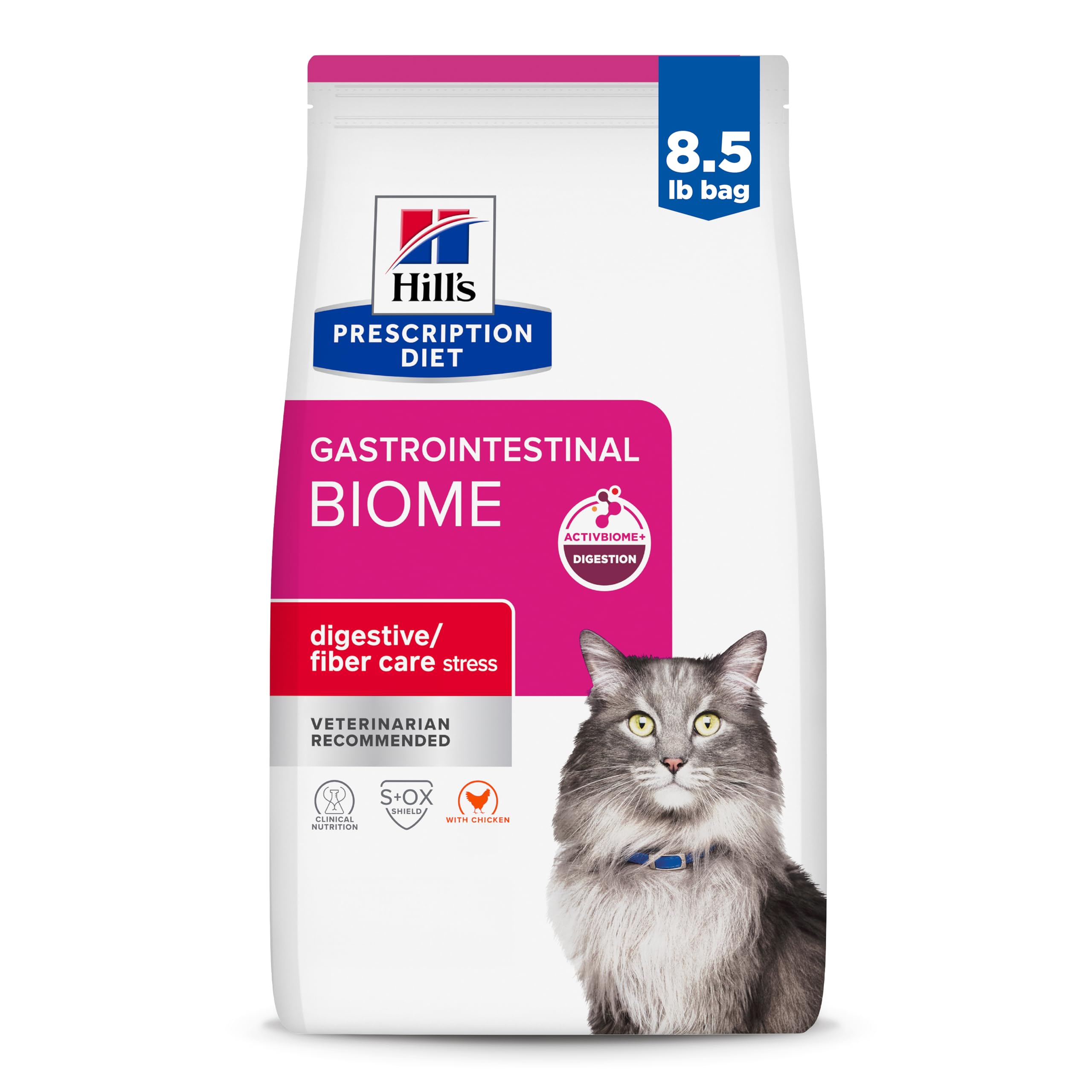
For the cat that has already tried everyday gentle fiber and still struggles — this is the therapeutic tier.
This is a prescription diet, and that label matters. It is formulated for cats with gastrointestinal issues, pairing proprietary ActivBiome+ technology with a prebiotic fiber blend aimed at regular bowel movements and balanced digestive function. It also targets stress directly, with hydrolyzed casein and L-tryptophan included to help reduce it. Stress and gut problems in cats often travel together, which is why this formula addresses both.
The protein is chicken, and the formula carries high levels of omega-3 fatty acids (DHA and EPA). As a dry food, it is an 8.5-pound bag. Hill’s states it is formulated by nutritionists and veterinarians and is the top vet-recommended therapeutic pet food brand in the US, a maker’s claim to weigh with your vet. That claim belongs to the maker, and it is the kind of decision you make with your vet’s guidance rather than on your own.
Two things set expectations. First, this is not for every cat — it is meant for cats already identified with a GI problem, so it is not a first-switch food. Second, it is premium-tier, which reflects the therapeutic formulation. Most owners who land here after a vet visit report it does the job their everyday food could not.
Where it goes beyond everyday food
- ActivBiome+ technology with a multi-fiber prebiotic blend for bowel regularity
- Hydrolyzed casein and L-tryptophan address stress alongside digestion
- High levels of omega-3 fatty acids DHA and EPA
- 8.5 lb bag built for extended feeding
Who should not start here
- Prescription diet — needs a vet’s input before switching
- Premium-tier cost for a therapeutic formula
Made for: a cat whose GI problem has been flagged by a vet and needs a therapeutic fiber-and-stress formula.
Not for: a healthy cat or a mild case where an everyday digestive food still has room to work.
Understanding the Specs
Soluble vs Insoluble Fiber
Soluble fiber dissolves in the gut and ferments, which draws water into the stool and softens it — the effect you want for hard, dry stools. Insoluble fiber adds bulk and helps movement. A digestive formula often uses both together, which is why Tiki Cat Solutions lists a mix of soluble and insoluble fibers rather than one type. When you read a label, the word “gentle” next to fiber usually signals a softer, fermentable source rather than a coarse bulking one.
Prebiotics and Probiotics
Probiotics are live beneficial bacteria; prebiotics are the fiber that feeds them. A strong digestive food often includes both. Nulo pairs its BC30 probiotic with Miscanthus grass fiber, and Solid Gold stacks live probiotics with prebiotics in its indoor recipe. The difference in practice: prebiotics feed the bacteria already in the gut, while probiotics add more of them. Both support the gut environment that keeps stool regular.
Moisture Content in Wet Food
Cats evolved to get much of their water from prey, and many barely drink from a bowl. That is why wet food is a constipation tool, not just a flavor choice. A broth-based can like Tiki Cat Friends puts hydrating liquid at the front of the meal. Higher water intake softens stool directly, so for a cat on mostly dry food, swapping in even one wet meal a day moves the needle.
Highly Digestible Proteins
Digestibility is about how much of the food your cat actually absorbs versus how much passes through. Highly digestible proteins are easier to break down, so more nutrients get taken in and less undigested material reaches the lower gut — which is why the Royal Canin Digestive Care formulas link digestible proteins to reduced stool odor. For a sensitive stomach, that efficiency can mean firmer, more regular stools.
FAQ
Is wet or dry food better for a constipated cat?
How much fiber should a constipated cat get?
Can pumpkin really help a cat with constipation?
How long does it take for a new food to help digestion?
Should I use a prescription diet for my constipated cat?
Are grain-free foods better for a cat with digestive issues?
How do I switch my cat to a new digestive food without upset?
What is the difference between prebiotic fiber and a probiotic supplement?
Can a wet food cause constipation?
How much water should I add if I feed dry food?
Final Thoughts: The Verdict
For most households, the everyday winner is the Purina ONE Tender Selects Salmon — a 22-pound bag of complete adult food with natural prebiotic fiber that most cats finish without a fight. If you would rather add moisture than fiber, the Tiki Cat Friends Tuna & Pumpkin brings broth and gentle pumpkin fiber in every can. And for a stubborn case your vet has already flagged, the Hill’s Prescription Diet GI Biome Stress is the therapeutic step up, with its ActivBiome+ blend and stress-targeting formula.
Start with a food your cat will actually eat, then add moisture alongside it — a refused bowl helps no gut.
How We Picked
We do not accept paid placement. Every pick is matched to a real buyer and a real use-case; we do not hands-on test units.
Sources & Methodology
Specifications: manufacturer listings and product documentation. Review insights: verified customer reviews, as of November 2026. Pricing: not shown on this page (it changes often); check the current price via the retailer link.
As an Amazon Associate, Gadgets Feed earns from qualifying purchases. This does not affect which products we feature.