
That sound of your cat inhaling kibble followed by the inevitable wet cough on the rug is a distress signal, not a personality quirk. Cats evolved to hunt small prey across multiple short bursts, not to Hoover a bowl of dry nuggets in twelve seconds. A food puzzle reintroduces the chase, forcing your cat to work, spin, paw, and problem-solve for every piece—transforming a gulping disaster into a calm, species-appropriate feeding ritual.
I’m Min — the co-founder and writer behind Gadgets Feed. I’ve spent hundreds of hours analyzing pet enrichment products, dissecting design patterns, and cross-referencing real owner experiences to find the puzzle feeders that actually solve the scarf-and-barf cycle without turning your kitchen into a frustration zone.
Whether your cat bolts food and vomits daily, needs mental stimulation to curb destructive behavior, or is simply bored with a standard bowl, the right interactive feeder changes everything. This guide breaks down the best cat food puzzles by design, durability, and how effectively they slow down a determined eater.
How To Choose The Best Cat Food Puzzles
Not every puzzle feeder is built for the same cat. A high-energy Bengal needs more complexity than a senior Persian, and a cat that vomits daily needs a different approach than one that just eats too fast out of boredom. Here’s what separates a useful puzzle from a dust collector.
Material Matters: Ceramic vs Plastic vs Cardboard
Ceramic is the gold standard for slow-feeder bowls because it’s heavy, non-porous, and dishwasher-safe. Plastic bowls can cause feline acne (black chin) and absorb odors over time. Cardboard puzzle boxes like the Cat Amazing MEGA are excellent for dry treats and supervised play, but they won’t survive wet food or a determined chewer. For daily meals, prioritize ceramic or BPA-free hard plastic with a non-slip base.
Difficulty Curve: Matching the Puzzle to Your Cat’s Personality
A puzzle that’s too easy becomes a regular bowl; one that’s too hard causes frustration and food refusal. Spinning-layer puzzles with 80+ compartments (like the Catstages Lickin’ Layers) work well for most cats because they offer incremental reward. Maze bowls with raised fishbone or flower obstacles are better for slow feeding because they physically block rapid gulping. For highly intelligent breeds, a multi-compartment treat box with sliding doors or hidden chambers provides the mental workout they need.
Height and Stability: The Anti-Vomit Design Factor
Elevated bowls (3 to 5 inches tall) reduce neck strain and help food travel down the esophagus more naturally, which directly reduces regurgitation. A heavy ceramic base or rubber non-slip feet prevent the bowl from sliding across the floor during aggressive eating. The best anti-vomit designs combine a raised stand with internal obstacles that force the cat to eat one or two pieces at a time.
Quick Comparison
On smaller screens, swipe sideways to see the full table.
| Model | Category | Best For | Key Spec | Amazon |
|---|---|---|---|---|
| Catstages Lickin’ Layers | Interactive Puzzle | Cats that need mental stimulation | 80+ treat compartments | Amazon |
| S&Q’s CERAMICS Raised Flower Bowl | Slow Feeder Bowl | Anti-vomit and whisker comfort | 5.8″ wide, 2.1 lb ceramic | Amazon |
| PETTOM Slow Feeder with Stand | Elevated Slow Feeder | Fast eaters with neck strain | 6.3″ wide, 3″ elevated stand | Amazon |
| Y YHY Fishbone Slow Feeder | Ceramic Slow Feeder | 12x slower eating with stability | 5.7″ tall, one-piece ceramic | Amazon |
| PTOBER Flower Maze Bowl | Premium Aesthetic | Design lovers and whisker-sensitive cats | 6.3″ dia, bamboo stand | Amazon |
| TRUNDISAN 2PCS Elevated Set | Multi-Cat Set | Multi-cat homes with wet food | 2 bowls, 7 oz capacity each | Amazon |
| Cat Amazing MEGA Puzzle Box | Cardboard Puzzle | Indoor enrichment and treat dispensing | 27 sections, 15.5″ box | Amazon |
In‑Depth Reviews
1. PTOBER Elevated Flower Maze Bowl

The PTOBER maze bowl is the rare puzzle feeder that nails both form and function for the anti-vomit crowd. Its 6.3-inch diameter is wide enough to prevent whisker fatigue, while the raised flower obstacles create a genuine feeding challenge — cats must work around each petal-shaped ridge to reach the kibble, which naturally extends eating time from seconds to several minutes. The flat, shallow profile (1.2 inches deep) means no food gets trapped in dark corners, and the ceramic construction at 6 ounces is dense enough to stay planted on the floor with its rubber non-slip feet.
What elevates this beyond a simple slow feeder is the bamboo stand. At 3.5 inches total height, it reduces neck and joint pressure for cats that tend to hunch over low bowls — a direct contributor to regurgitation. Owners consistently report that this bowl stopped their cat’s vomiting on the first or second use, and that the flower design avoids the nose-pinching common with other maze feeders. The ceramic is dishwasher and microwave safe, which makes switching between wet and dry food effortless without flavor crossover.
The only trade-off is that extremely determined eaters may still bulldoze through the obstacles. The flower ridges are effective but not impossible — a cat that is truly desperate may flip kibble out of the bowl entirely. That said, for the vast majority of households dealing with fast eating, whisker stress, and neck strain, this is the most complete solution available.
Why it’s great
- Ceramic + bamboo stand prevents tipping and slip
- Wide shallow design respects whisker comfort
- Dishwasher and microwave safe for easy cleaning
- Flower obstacles slow eating without frustrating cat
Good to know
- Very determined cats may still flip kibble
- Bamboo stand should be wiped dry only
2. Catstages Kitty Lickin’ Layers
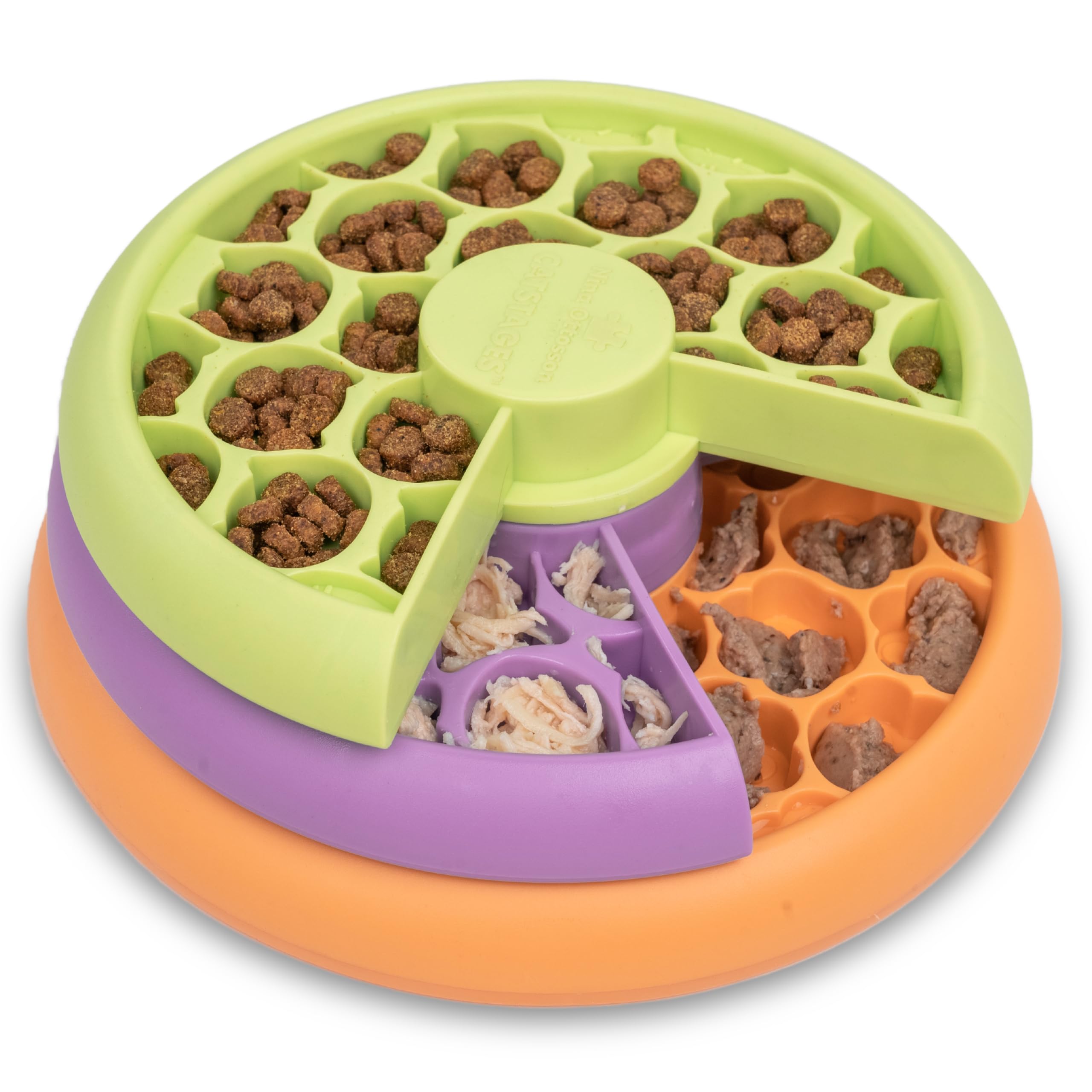
The Catstages Lickin’ Layers takes a fundamentally different approach from maze bowls — instead of passive obstacles, it requires active manipulation. The three-tier spinning disc design means your cat must paw, nudge, and spin each layer to expose the hidden compartments below. With over 80 treat compartments and a 6.61-inch diameter, this is essentially a foraging wheel scaled for domestic cats. The base layer holds up to half a cup of dry food or one cup of wet food, making it suitable for full meals, not just treats.
The real-world impact is immediate for high-energy or food-obsessed cats. Owners of Bengal mixes and similarly driven breeds report that the Lickin’ Layers keeps cats occupied for 15–20 minutes per meal, compared to the 30-second scarf-and-barf cycle from a standard bowl. The multi-level design taps into natural foraging instincts — cats work harder for the treats hidden in the small edge compartments, while the larger central slots offer easier access. This graduated difficulty keeps cats engaged across multiple meals without frustration.
Cleaning is straightforward: the three layers pop apart for dishwasher access, and the BPA-free plastic is lightweight enough to carry to the sink. Some users note that filling all 80+ compartments can be tedious, but the payoff in slower eating and mental stimulation makes the two-minute prep worthwhile. For cats that need more than just a physical eating barrier, this is the best interactive option on the market.
Why it’s great
- Spinning layers require paw manipulation for food
- 80+ compartments extend meal duration significantly
- Dishwasher-safe and easy to disassemble
- Suitable for both dry and wet food
Good to know
- Filling every compartment takes 2 minutes
- Lightweight plastic may slide on smooth floors
3. TRUNDISAN 2PCS Elevated Set
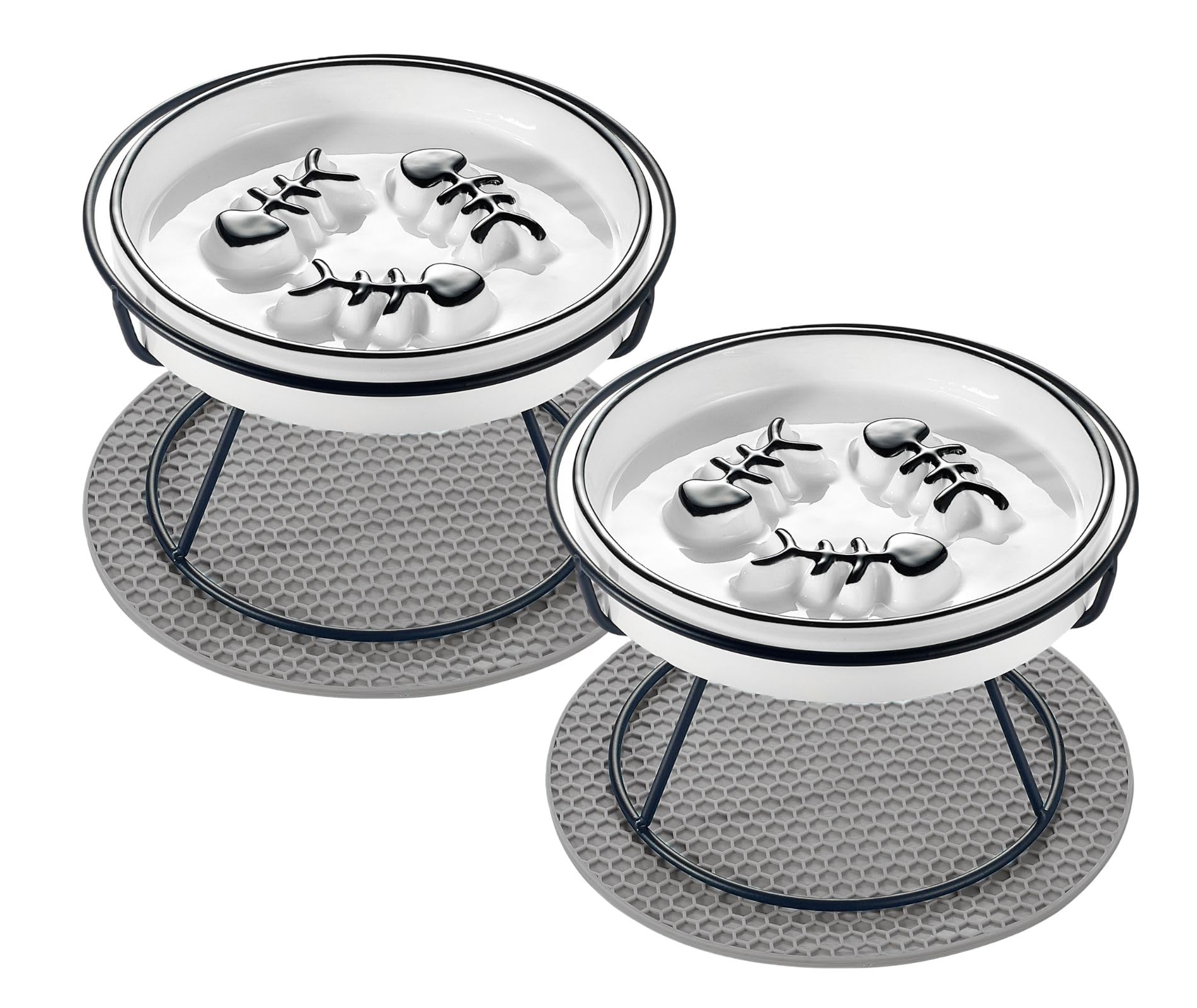
The TRUNDISAN set is built for households where more than one cat needs a slow feeder. Each 5.9-inch ceramic bowl sits on a sturdy metal stand with a 4.13-inch total height, featuring a fishbone raised pattern that forces cats to eat around the ridges. The 7-ounce capacity is ample for a standard cat meal, and the elevated design with a 15-degree tilt aligns the bowl with the cat’s natural eating posture — directly reducing the neck strain that contributes to regurgitation.
What sets this apart from single-bowl solutions is the included non-slip mat and cleaning brush. The mat prevents both bowls from sliding during feeding, which is critical when two cats are eating simultaneously. Owners report that the fishbone pattern slows eating from under 5 minutes to around 19 minutes for fast eaters, and the wide gaps between ridges allow easy access for flat-faced breeds. The ceramic is dishwasher and microwave safe, and the metal stand is easy to wipe down.
The main caveat is quality control on the stands — some units arrive with paint chips or debris, though the ceramic bowls themselves are consistently well-made. The cleaning brush with built-in soap dispenser is a nice touch, but the soap compartment tends to leak over time. For multi-cat owners who want elevated, slow-feeding bowls without buying two separate units, this set delivers solid value.
Why it’s great
- Two bowls with metal stands for multi-cat feeding
- Fishbone pattern slows eating significantly
- Non-slip mat keeps both bowls stable
- Dishwasher-safe ceramic is easy to clean
Good to know
- Stand quality control can be inconsistent
- Soap dispenser in brush may leak
4. Y YHY Fishbone Slow Feeder

The Y YHY slow feeder is a no-nonsense ceramic solution for cats that vomit after every meal. The one-piece construction means there’s no separate stand to wobble or detach — the entire unit is molded from a single block of ceramic that weighs 1.85 pounds, making it nearly impossible for even a determined cat to tip over. The 5.5-inch width is slightly narrower than some competitors, but the 5.7-inch height is among the tallest in this category, providing excellent elevation for neck and spine alignment.
The fishbone ridge pattern is arranged in columns with gaps that allow cats to access food one or two pieces at a time. Owners report that this design slows eating by a factor of 12 compared to a standard bowl, and the raised obstacles prevent the food bolting that triggers regurgitation. The glazed ceramic surface is smooth enough to prevent tongue scratches, and the one-piece design means no food gets trapped in crevices between bowl and stand. Both dry and wet food work well, though wet food may dry onto the fishbone ridges and require a brief soak before cleaning.
The trade-off is that the fishbone spacing may be too narrow for some cats. A few owners noted that their cats struggled to chomp the kibble between the ridges, leading to frustration. The bowl is also slightly more expensive per ounce than simpler designs. However, for cats with chronic vomiting issues, the sturdy ceramic build and effective slow-feeding geometry make this a worthwhile investment.
Why it’s great
- One-piece ceramic prevents tipping and wobble
- 5.7-inch height reduces neck and spine strain
- Fishbone pattern effectively slows eating by 12x
- Smooth glazed surface protects tongue
Good to know
- Fishbone spacing may frustrate some cats
- Wet food can dry onto ridges
5. PETTOM Slow Feeder with Bamboo Stand
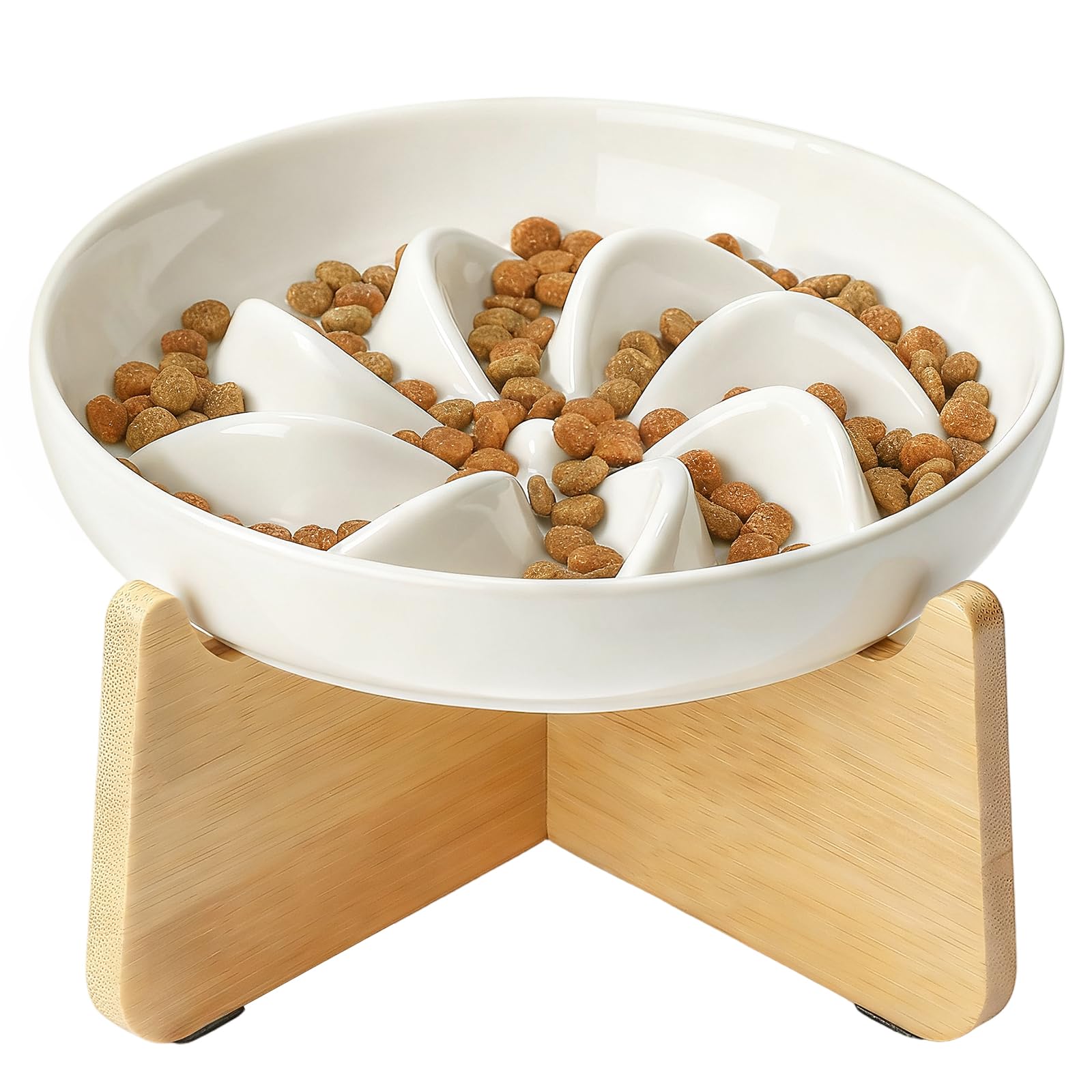
The PETTOM slow feeder pairs a 6.3-inch ceramic bowl with a natural bamboo stand that elevates the bowl by 3 inches. The fish-shaped obstacle pattern inside the bowl forces cats to navigate around the raised ridges, extending eating time and reducing the food bolting that leads to vomiting. The 1.5-cup capacity is generous enough for larger breeds like Maine Coons or Persians, and the 2.8 cm raised rim prevents kibble from scattering across the floor during enthusiastic eating.
What makes this stand out is the attention to detail in the bamboo stand design. The stand has non-slip feet that grip tile and hardwood flooring, and the bowl sits securely in a recessed ring that prevents lateral movement. Owners of arthritic cats report that the 3-inch elevation significantly improves eating posture, reducing the need for the cat to hunch down. The ceramic is food-grade, fired at high temperature, and certified free of lead and cadmium. Both the bowl and stand are easy to clean — the bowl is dishwasher and microwave safe, while the stand requires only a dry cloth wipe.
The only consistent complaint is that the bamboo stand may require light sanding on the assembly slots before it fits together smoothly. Additionally, the fish pattern is better suited for dry food — wet food tends to get pushed into the ridges and requires more effort to clean. For owners who prefer a natural aesthetic and need an elevated slow feeder for a fast-eating cat, this is a strong mid-range choice.
Why it’s great
- Bamboo stand with non-slip feet for stability
- 6.3-inch wide bowl prevents whisker fatigue
- Dishwasher-safe ceramic with raised rim
- Generous 1.5-cup capacity for large breeds
Good to know
- Bamboo stand may need sanding for assembly
- Wet food is harder to clean from ridges
6. S&Q’s CERAMICS Raised Flower Bowl

The S&Q’s CERAMICS flower bowl proves that an effective slow feeder doesn’t need to be expensive. The 5.8-inch ceramic bowl features a plum blossom petal pattern with raised ridges that create a maze-like structure, forcing cats to eat around the petals rather than Hoovering from the center. At 2.1 pounds, the bowl is heavy enough to resist sliding across the floor, and the 4.2-inch elevated design with a 15-degree tilt aligns food access with the cat’s natural eating angle.
The key advantage here is the whisker-friendly shallow profile. Unlike deeper bowls that compress whiskers against the sides, this flower-shaped dish allows cats to eat without sensory stress — a major factor for cats that refuse to eat from standard bowls. Owners consistently report that this bowl stopped their cat’s vomiting on the first use, and that the slower eating pace reduced bloating and gas. The ceramic is dishwasher safe and the glaze resists odor absorption, even after months of daily wet food use.
The main drawback is cleaning difficulty. The petal crevices between raised sections trap food particles, and the bowl requires thorough scrubbing by hand to remove residue. Some owners note that a rinse alone isn’t enough — a brush is necessary to reach all the nooks. For the price, however, this is an excellent entry point for owners trying a slow feeder for the first time, especially if their primary concern is vomiting and whisker fatigue.
Why it’s great
- Heavy ceramic prevents sliding and tipping
- Shallow design prevents whisker compression
- Elevated tilt reduces neck and spine strain
- Diswasher-safe with odor-resistant glaze
Good to know
- Petal crevices require thorough hand scrubbing
- Food particles get trapped in raised ridges
7. Cat Amazing MEGA Puzzle Box

The Cat Amazing MEGA is not a slow feeder in the traditional sense — it’s a fully interactive cardboard puzzle box designed for treat dispensing and enrichment. With 27 strategically positioned holes of varying shapes and sizes, this 15.5-inch box forces cats to paw, scoop, and methodically extract treats from multiple chambers. It’s built from industrial-grade plant-based materials that are 100% biodegradable, yet strong enough to withstand repeated clawing and biting. Veterinarians recommend it as a form of mental exercise that taps into natural foraging instincts.
The impact on high-energy cats is remarkable. Owners of Bengal, Siamese, and mixed rescue cats report that the MEGA keeps their pets occupied for 30–45 minutes per session — far longer than any bowl-based puzzle. The irregular hole pattern means cats can’t simply tip the box over to access all treats; they must work sequentially through each compartment. The box has been featured on Shark Tank and is widely used in shelter enrichment programs, where it reduces stress and destructive behavior in confined cats.
The limitations are clear: this is strictly for dry treats, not meals. The cardboard construction won’t survive wet food or excessive moisture, and assembly requires about 10 minutes of folding tabs into slots. Some cats may need a few sessions to understand the mechanism, and freeze-dried treats can be particularly hard to extract. For owners who want to provide daily mental stimulation, reduce boredom, and help overweight cats lose weight through puzzle-based feeding, this is the premier option.
Why it’s great
- 27 chambers with varied hole sizes for complex challenge
- Keeps active cats engaged for 30+ minutes
- Veterinarian recommended for enrichment
- Biodegradable cardboard is eco-friendly
Good to know
- Not suitable for wet food or daily meals
- Assembly takes 10 minutes of folding
- Freeze-dried treats are hard to extract
FAQ
Will a ceramic slow feeder bowl actually stop my cat from vomiting?
Can I use wet food in a cardboard puzzle box like the Cat Amazing MEGA?
How often should I replace a cardboard cat puzzle box?
What size slow feeder is best for a Maine Coon or large breed cat?
Final Thoughts: The Verdict
For most users, the cat food puzzles winner is the PTOBER Elevated Flower Maze Bowl because it combines effective slow-feeding obstacles with a comfortable elevated stand and dishwasher-safe ceramic that addresses both speed eating and whisker fatigue. If you want maximum mental stimulation through active play, grab the Catstages Lickin’ Layers. And for multi-cat households that need two elevated feeders with non-slip stability, nothing beats the TRUNDISAN 2PCS Set.