
Our readers keep the lights on and my morning glass full of iced black tea. As an Amazon Associate, I earn from qualifying purchases.
Watching your cat inhale a full bowl of kibble in under twenty seconds is a specific kind of household stress. The frantic gulping, the inevitable regurgitation on your rug, the vet bills for digestive distress — it’s a cycle that a standard bowl simply cannot break. That’s where purpose-built enrichment feeders come in, designed to engage your cat’s natural foraging instincts and pace their eating through physical and mental effort.
I’m Min — the co-founder and writer behind Gadgets Feed. I’ve spent years analyzing the engineering and behavioral science behind cat enrichment products, studying how puzzle geometry, material density, and kibble-dispensing mechanics directly affect eating speed and mental stimulation.
Whether you’re managing a fast eater who vomits daily or a bored indoor cat who needs a job to do, the right piece of hardware can transform mealtime. After sifting through dozens of designs, material types, and difficulty levels, I’ve compiled the definitive list of the best cat puzzle feeder options available right now.
How To Choose The Best Cat Puzzle Feeder
Not every puzzle feeder works for every cat. Your selection should be driven by a single factor: your cat’s current eating behavior. A cat who bolts down food needs a physical slow-feeder bowl with obstacles. A bored indoor cat who eats at a normal pace needs a multi-step puzzle box that dispenses treats. A senior cat with arthritis needs a low-profile, easy-access tray. Below are the three most critical specs to evaluate.
Material and Hygiene
The feeder’s material directly impacts your cat’s health and your cleaning routine. Food-grade ceramic is the gold standard — it’s non-porous, resists bacterial growth, won’t absorb odors, and is heavy enough to resist sliding. Wooden feeders are aesthetic and durable but require careful hand-washing to avoid warping. BPA-free plastics are lightweight and budget-friendly but can develop micro-scratches that harbor bacteria over time. Avoid glazed ceramics with unknown lead content and always verify dishwasher-safe labeling if convenience matters to you.
Difficulty Level and Adjustability
Puzzle feeders range from single-obstacle bowls to multi-module strategy games. A cat new to enrichment will become frustrated and lose interest if you start with a complex box that requires sliding drawers and flipping lids. Look for feeders with adjustable opening sizes or modular sections that you can rearrange to increase difficulty gradually. The best puzzle feeders grow with your cat’s skills, offering a light challenge at first and a progressively harder configuration as your cat masters each tier.
Stability and Safety
A feeder that tips, slides, or has small removable parts is a hazard. The base should be weighted or have non-slip rubber feet to prevent the unit from skidding across the floor during aggressive pawing. Inspect the gap sizes — holes should be large enough to let kibble fall through but small enough to prevent a paw or whisker from getting pinched. For wooden or cardboard feeders, check that all screws or tabs are flush with the surface. No feeder should have sharp edges, exposed springs, or loose components that a determined cat could pull off and ingest.
Quick Comparison
On smaller screens, swipe sideways to see the full table.
| Model | Category | Best For | Key Spec | Amazon |
|---|---|---|---|---|
| TRIXIE Poker Box | Strategy Game | Smart cats needing a challenge | 4 puzzle modules, 12.2 x 12.2 in | Amazon |
| Cat Amazing MEGA | Treat Maze | Multi-cat households | 27 sections, 3.4 lbs cardboard | Amazon |
| PetPals Campfire Feeder | Treat Dispenser | Active, playful cats | Adjustable opening, 11 x 11 x 11 in | Amazon |
| PTOBER Elevated Bowl | Slow Feeder Bowl | Vomiting fast eaters | Ceramic, 6.3 in diameter, bamboo stand | Amazon |
| Y YHY Slow Feeder | Slow Feeder Bowl | Budget-conscious owners | Ceramic, 5.7 in tall, fishbone maze | Amazon |
| S&Q’S CERAMICS Bowl | Slow Feeder Bowl | Whisker-sensitive cats | Ceramic, 5.8 in, tilted 15% | Amazon |
| Marchul 3-in-1 Toy | Puzzle + Play Toy | Kittens and small cats | Wooden track ball, 7.5 x 7.5 x 12.7 in | Amazon |
In‑Depth Reviews
1. TRIXIE Cat Activity Poker Box

The TRIXIE Poker Box is the benchmark for modular cat enrichment in the mid-range tier. It measures 12.2 inches square and contains four distinct puzzle modules — a flip lid, a sliding drawer, a pull-out compartment, and a removable cover — each requiring a different fine-motor skill. The 2.5-inch profile keeps treats accessible without frustrating your cat, and the BPA-free plastic construction is dishwasher-safe for easy sanitation.
What sets this feeder apart is its progressive difficulty. You can start with the simplest module (the open depression) and gradually introduce the more complex actions as your cat learns. The bottom tray collects crumbs, and the entire unit weighs a full kilogram, giving it enough mass to resist sliding during aggressive pawing. Customer feedback consistently reports that food-motivated cats master all four compartments within one to two weeks, after which you can rearrange the layout to renew the challenge.
The trade-off is that very smart cats can solve all compartments in under ten minutes, making it a relatively short single-session engagement. It’s also predominantly white plastic, which shows scratches and kibble dust more readily than darker materials. For cat parents who want a durable, veterinarian-recommended entry point into interactive feeding that will last for years, the Poker Box is the goldilocks option.
Why it’s great
- Four distinct puzzle actions for varied mental stimulation
- Modular design lets you adjust difficulty over time
- Dishwasher-safe, BPA-free plastic is easy to clean
Good to know
- Too easy for extremely clever cats — they can solve it in minutes
- Light-colored plastic shows wear and dirt quickly
2. Cat Amazing MEGA

The Cat Amazing MEGA is a cardboard-based puzzle box that gained national attention after appearing on Shark Tank, and its design philosophy is refreshingly simple: create a large, destructible maze that forces cats to forage across a wide area. At 15.5 x 11 x 11 inches with 27 distinct compartments, it spreads treats across multiple layers and irregular hole shapes, requiring your cat to paw, nudge, and reach through openings to extract rewards.
The key structural feature is its fixed internal maze — unlike modular puzzles where you rearrange pieces, the MEGA relies on a pre-cut cardboard lattice. Cats can rock the entire box to shift treats between chambers, and the robust corrugated material supports a cat’s full body weight without collapsing. The holes are sized to prevent paws from getting stuck while allowing kibble, crinkle balls, and small mice toys to pass through. It’s particularly effective in multi-cat homes because the large surface area prevents resource guarding — each cat can work a different side of the box simultaneously.
The downside is that cardboard is not impervious to moisture or bacterial growth. Wet food or damp treats will degrade the box, so it’s strictly a dry-kibble and treat dispenser. Assembly is required, and the box’s 3.4-pound weight means it won’t slide but isn’t easily portable. For cat owners who want a durable, engaging hardware that turns snack time into a 30-minute hunting session, this is a premium pick that justifies its price through sheer replay value.
Why it’s great
- 27 compartments keep multiple cats occupied for over 30 minutes
- Irregular hole shapes and layers create genuine foraging difficulty
- Industrial-grade cardboard is surprisingly durable and cat-safe
Good to know
- Cardboard cannot handle wet food or moisture
- Assembly required and the box is not portable
3. PetPals Campfire Treat Dispenser

The PetPals Campfire Feeder combines two enrichment mechanisms in a single 11-inch cylindrical unit: a tumbling fish that dispenses treats as it rolls, and a rotating fire pit on top with an adjustable opening. The core innovation is the resistance-based rotation — the fire pit spins with enough friction to prevent over-dispensing, forcing your cat to work for each kernel. The adjustable opening lets you control the challenge level, accommodating everything from tiny kibble to larger freeze-dried treats.
Customer feedback highlights its appeal to active, food-driven cats, particularly larger breeds like Maine Coons who need more physical engagement. The unit weighs 1.4 pounds and has a wide, stable base that doesn’t tip over during enthusiastic batting. The two-stage design (rolling ball + spinning top) gives cats two distinct ways to access food, which reduces boredom and encourages longer play sessions. Owners report that most cats figure out the rolling fish within a few days, while the fire pit mechanic provides a secondary, more difficult challenge.
The primary complaint is the integrated bell inside the fish component — it’s non-removable and produces a constant jingle that some cats (and owners) find annoying. The rotating mechanism can become squeaky after a month of heavy use, and the treat holes sit slightly high, requiring a paw lift that smaller cats may struggle with. For the mid-range price point, however, this is the most versatile combination of a slow feeder and a play toy you can buy.
Why it’s great
- Two separate enrichment mechanisms in one compact unit
- Adjustable opening fits various kibble and treat sizes
- Sturdy, non-tip base works well for large, active cats
Good to know
- Integrated bell in the fish cannot be removed
- Rotating fire pit can become squeaky after extended use
4. PTOBER Elevated Slow Feeder Flower Bowl

The PTOBER Elevated Slow Feeder marries a wide, 6.3-inch ceramic bowl with a natural bamboo stand, creating a 3.5-inch elevated eating platform that reduces neck strain while using raised flower-shaped obstacles to slow gulping. The ceramic construction is free of lead and cadmium, weighs enough to resist tipping, and features a smooth, dishwasher-safe glaze that resists bacterial growth. The bamboo stand has anti-slip stickers on each leg to prevent sliding on tile or hardwood floors.
What makes this the top-performing slow-feeder bowl is the specific geometry of the obstacles. The raised flower petals are tall and densely packed, forcing your cat to weave its tongue and nose around each barrier to reach food. Unlike flat maze bowls where fast eaters can simply lap around the pattern, this design genuinely paces intake. The 6-ounce capacity is ideal for portion-controlled feeding, and the 1.2-inch depth prevents whisker fatigue by giving the cat’s face ample clearance from the food surface.
The primary limitation is the bamboo stand — while attractive, it must be wiped with a dry cloth only, and moisture from splashing can cause warping over time. The bowl itself is heavy at 6 ounces, but the stand is lightweight, so the combined unit can be pushed by a determined large cat. For cat owners whose primary goal is stopping regurgitation from fast eating, this is the most effective ceramic slow feeder on the market, and its floral aesthetic is genuinely charming.
Why it’s great
- Dense flower-petal obstacles effectively slow even the fastest eaters
- Lead-free ceramic is dishwasher and microwave safe
- Elevated bamboo stand improves neck and joint posture
Good to know
- Bamboo stand must be dry-wiped only — moisture can warp it
- Lightweight stand may slide on smooth floors if stickers lose grip
5. Y YHY Slow Feeder Fishbone Bowl

The Y YHY Slow Feeder Bowl uses a raised fishbone pattern at the bottom of a shallow 6-inch ceramic dish, paired with a 5.7-inch elevated stand to combat fast eating at an entry-level price. The one-piece ceramic construction is notably heavy at 1.8 pounds, giving it superior stability against sliding, and the glaze is smooth enough for easy daily rinsing. The elevated height is purpose-built for male cats with longer necks, reducing the strain that low bowls place on their cervical spine.
Customer reports confirm that the fishbone columns, which form narrow gaps between raised ridges, force cats to eat significantly slower — owners of 20-pound fast eaters who routinely vomited after meals report a complete stop to regurgitation after switching to this bowl. The design works for both dry kibble and wet food, and dishwasher-safe labeling ensures hygiene maintenance. The white ceramic also resists odor retention, a common problem with plastic feeders after months of use.
The catch is that the column spacing is somewhat arbitrary — some cat owners find their pets can still lap food quickly by approaching from the sides, and the ceramic-on-ceramic contact produces an unpleasant scraping sound that sensitive cats may avoid. The single-piece base means the bowl cannot be disassembled for deep cleaning of the maze crevices. For a budget-conscious owner who needs a simple, effective mechanical solution to gulping, this bowl delivers the functional result without aesthetic frills.
Why it’s great
- Heavy 1.8-pound ceramic base prevents tipping and sliding
- 5.7-inch elevation significantly reduces neck strain for larger cats
- Dishwasher-safe and does not retain odors or bacteria
Good to know
- Ceramic-on-ceramic scraping sound may deter sensitive cats
- Column spacing allows determined fast eaters to cheat from the edges
6. S&Q’s CERAMICS Raised Flower Bowl

The S&Q’s CERAMICS bowl addresses two common feline feeding issues simultaneously: gulping and whisker fatigue. The 5.8-inch wide bowl is significantly wider than standard feeders, giving a cat’s whiskers ample clearance from the walls — a critical feature for cats who flatten their ears while eating. The bowl sits on a 4.2-inch elevated base with a 15-degree tilt, which gravity-feeds kibble toward the front edge while slowing the eating motion and reducing the need for neck extension.
The plum-blossom petal design creates a maze-like pattern that forces the cat to navigate around raised obstacles, but it’s more gentle than the dense fishbone patterns — cats who get frustrated by aggressive mazes adapt quickly here. The 2.1-pound ceramic weight provides exceptional stability, and the non-slip silicone ring on the base prevents any lateral movement during meals. Multiple customer reviews specifically highlight that this bowl stopped daily vomiting in cats who had regurgitated for months, making it a first-choice recommendation for cats with sensitive digestive systems.
The trade-off is that the maze crevices are both a feature and a maintenance burden — food particles get lodged deeply in the petal gaps, requiring thorough scrubbing even in the dishwasher. The aesthetic color options (pink, blue, white) are charming but the painted finish can develop micro-crazing over time in high-use homes. For cat owners who prioritize whisker comfort and digesion health over extreme difficulty, this is the most thoughtful ergonomic slow feeder available.
Why it’s great
- Wide 5.8-inch bowl and 15-degree tilt reduce whisker fatigue and neck strain
- Heavy 2.1-pound ceramic with non-slip base stays rock-solid
- Gentle maze pattern is effective without frustrating timid eaters
Good to know
- Deep maze crevices require thorough cleaning to remove stuck food
- Painted finish may craze over extended daily use
7. Marchul 3-in-1 Wooden Puzzle Feeder
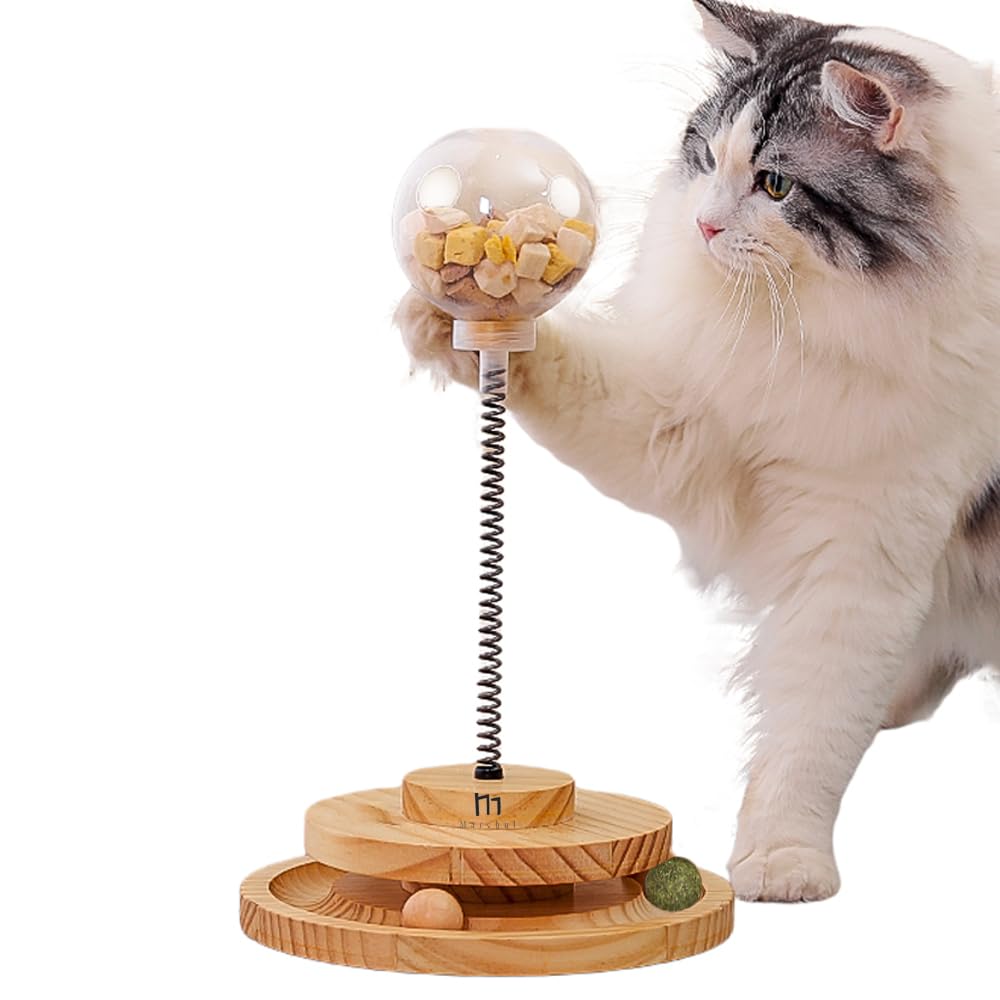
The Marchul 3-in-1 Feeder combines a slow-feed ball, a built-in rolling track, and a rotating bottom sphere into a single 7.5 x 7.5 x 12.7-inch wooden unit. The construction uses natural wood rather than plastic, offering a non-toxic surface that resists scratching and won’t leach chemicals. The top slow-feed ball contains a spring-loaded opening that dispenses kibble as the ball rolls, while the embedded track below prevents the ball from flying off the unit during vigorous play — a feature specifically designed for the high-energy batting of kittens.
The design philosophy here is low-difficulty, high-engagement. Unlike the TRIXIE Poker Box which requires problem-solving, the Marchul feeder relies on simple physics: roll the ball, get food. This makes it ideal for kittens under six months old who lack the fine motor control for sliding drawers or the patience for multi-step puzzles. The rotating sphere at the base satisfies innate hunting instincts by mimicking the movement of prey, encouraging swatting and chasing without requiring any cognitive puzzle-solving.
Build quality is the main concern — customer reports note occasional missing screws and a cheap feel in the spring mechanism. The 0.54-kilogram weight is light enough that determined adult cats can knock the unit over, and the wooden surface can’t be cleaned in a dishwasher. For a household with a young kitten who needs basic food-dispensing enrichment that doesn’t overwhelm, this is a charming entry point, but adult cat owners should consider upgrading to a more durable mid-range option after the kitten phase ends.
Why it’s great
- Simple rolling mechanics are perfect for kittens and less dexterous cats
- Wooden construction is non-toxic and resistant to scratching
- Built-in track prevents the ball from escaping during vigorous play
Good to know
- Lightweight base can be tipped over by larger adult cats
- Some units arrive with missing screws or loose plastic components
FAQ
Will a puzzle feeder stop my cat from vomiting after meals?
How do I introduce a puzzle feeder to a cat who has never used one?
Can I use wet food in a puzzle feeder bowl?
Final Thoughts: The Verdict
For most users, the best cat puzzle feeder winner is the TRIXIE Cat Activity Poker Box because it offers the perfect balance of progressive difficulty, durable construction, and dishwasher-safe convenience for the vast majority of domestic cats. If your primary goal is ending vomiting from fast eating, grab the PTOBER Elevated Slow Feeder Flower Bowl — its dense ceramic obstacles are unmatched at pacing intake. And for a multi-cat household where boredom and resource guarding are the real challenges, nothing beats the Cat Amazing MEGA for its sheer 27-compartment foraging span that keeps every cat in the room occupied.