
If you have a fastpitch player settling in behind home plate, you already know the hard truth: one bad hop off a 50-mph riseball can rattle a young catcher for weeks, and the wrong gear makes that fear worse. That hollow thud of a ball hitting a thin chest protector is the sound of a kid losing confidence in the position. This guide breaks down the five best complete sets that actually fit girls and young women properly — no baseball hand-me-downs, no gear that gaps at the collarbone, just real protection built for the fastpitch motion.
You want a set that keeps your daughter safe from a 45 to 60 mph ball without weighing her down through seven innings. The best overall pick is the Champro Fastpitch Softball Catcher’s Set — at just 5.82 pounds total, it is the lightest full set here, so a 10U or 12U player can squat for 90 pitches without her shoulders giving out. The hockey-style headgear (a helmet that wraps around the back of the head and temples like a hockey player wears) uses AirTech ventilation channels to let hot air escape, which buyers report keeps players cooler during back-to-back weekend games.
How To Choose The Best Catchers Gear For Fastpitch Softball
Buying a complete catcher’s set for fastpitch softball is not the same as picking out a baseball set off the shelf. Girls’ frames are typically narrower through the shoulders and shorter in the torso, so a chest protector designed for a baseball player often rides up or leaves the collarbone exposed. Beyond the fit, you want gear that absorbs hard contact from an 11- to 15-inch ball moving at 45 to 60 mph while keeping the player cool enough to focus for seven innings. Here are the three things that matter most when you start comparing sets.
NOCSAE Certification and Impact Protection
NOCSAE (the National Operating Committee on Standards for Athletic Equipment) sets the safety standard for softball and baseball protective gear. A NOCSAE-certified helmet has passed drop tests and ball-impact tests that measure how much force reaches the head. For the chest protector, NOCSAE certification is becoming common even though it’s not yet mandatory for all levels — it means the padding absorbs high-speed impact rather than just softening it. If your player faces pitchers throwing 50 mph or higher (common from 12U onward), look for sets that explicitly mention NOCSAE compliance on both the headgear and the chest protector. A non-certified set might feel padded but can transfer dangerous energy through to the ribs or sternum.
Hockey-Style Helmet Versus Traditional Mask
Hockey-style headgear wraps around the back of the head and the temples, offering more coverage than a traditional two-ear catcher’s mask. For fastpitch catchers, who often take foul tips to the side of the head while blocking low pitches, the hockey-style shell adds protection where a cage mask can leave gaps. The catch is that hockey-style helmets are heavier and trap more heat — look for AirTech ventilation channels or mesh brow-line inserts that let hot air escape. If your player runs hot or plays in humid climates, a traditional mask with open airflow might be more comfortable, but it does leave more of the skull exposed.
Weight and Ventilation for Extended Play
A full catcher’s set typically weighs between 5.8 pounds and 9.7 pounds. That may not sound like much, but a 14-year-old catcher might squat for 90 pitches in a single game while wearing it. Every extra pound pulls on the shoulders and increases fatigue in the legs. Lighter sets (under 7 pounds total) are ideal for younger or smaller players still building strength. But lighter often means thinner padding, so you want to check if the manufacturer uses compression-molded foam (like the Champro Optimus Pro) or a multi-density pad system (like the Easton Fundamental) to keep weight down without sacrificing impact absorption. Ventilation features like moisture-wicking liners and mesh back panels help prevent overheating, which is the second most common complaint from catchers behind the mask.
Quick Comparison
On smaller screens, swipe sideways to see the full table.
| Model | Category | Best For | Key Spec | Amazon |
|---|---|---|---|---|
| Champro Champro Set | Best Overall | Young players ages 6-12 | 5.82 lbs total weight | Amazon |
| Champro Optimus Pro Kit | Top Performer | Improved ventilation and fit | Two-piece ABS shell helmet | Amazon |
| Easton Fundamental Set | Premium Pick | Older youth and teen catchers | 9.7 lbs; NOCSAE certified | Amazon |
| All-Star Heiress Kit | Best for Travel Ball | Travel ball and competitive play | StinkStop antimicrobial treatment | Amazon |
| Rawlings Velo Set | Best Durability | High-impact protection | Arc Reactor Core chest technology | Amazon |
In‑Depth Reviews
1. Champro Fastpitch Softball Catcher’s Set
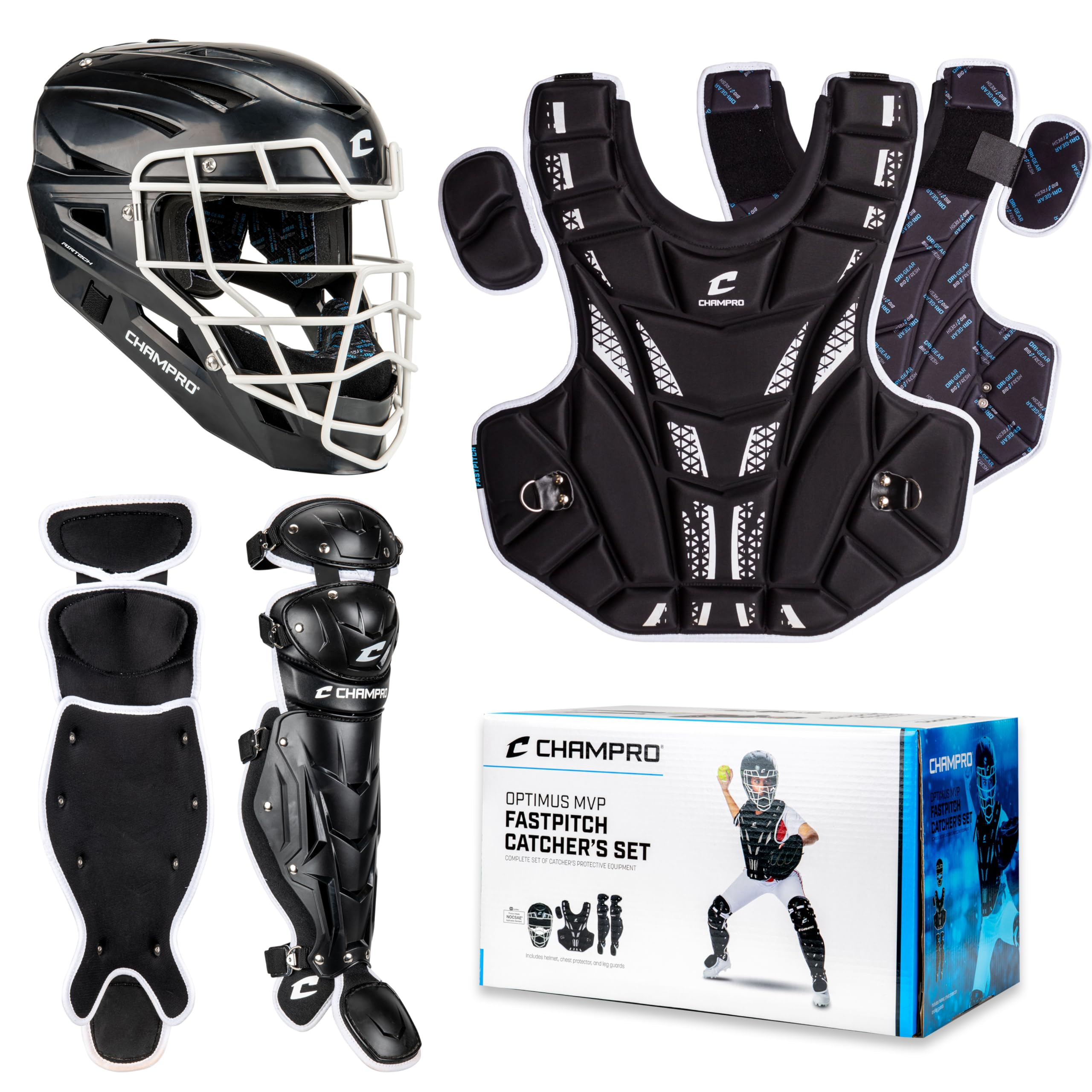
At 5.82 pounds total, this set is a full 3.7+ pounds lighter than the Easton Fundamental. That means a 10U or 12U player can squat for 90 pitches without her shoulders giving out. The hockey-style headgear (a helmet that wraps around the back of the head and temples) has AirTech ventilation channels that let hot air escape the top, so your catcher stays cooler during back-to-back weekend games, as buyers confirm. This set is designed for young fastpitch catchers ages 6 to 12. The 9-12 size comes with double-knee shin guards (leg pads that hinge at the knee for better flexibility) that make squatting easier.
The chest protector uses compression-molded foam (padding formed under pressure to absorb impact) with Dri-Gear moisture-wicking lining and BioFresh technology, which helps kill bacteria that cause odor. One reviewer noted a 12U player facing 50 mph pitchers “felt no pain included she said must buy” — a real-world sign that the padding handles hard contact without bulk. The hook-and-loop straps adjust fully, so a team of girls ages 7 to 10 can share one set by cinching the straps individually. This is the set for a family with a younger catcher aged 7 to 11 who wants the best value-to-protection balance. skip it if your 12-year-old is above a size 14 in kids clothing — the 9-12 size runs small for taller kids.
For a young fastpitch catcher ages 6 to 12, this is the lightest, most ventilated set that delivers proven protection without the weight.
Why it’s great
- Lightest set at 5.82 lbs reduces fatigue for young catchers
- AirTech ventilation and Dri-Gear moisture-wicking keep players cool
- Double-knee leg guards on the 9-12 size improve flexibility in the squat
Good to know
- No throat guard included — buy separately if required by your league
- 9-12 sizing may be too small for a tall 12-year-old above a size 14 in kids clothes
2. Champro Optimus Pro Fastpitch Catcher’s Kit
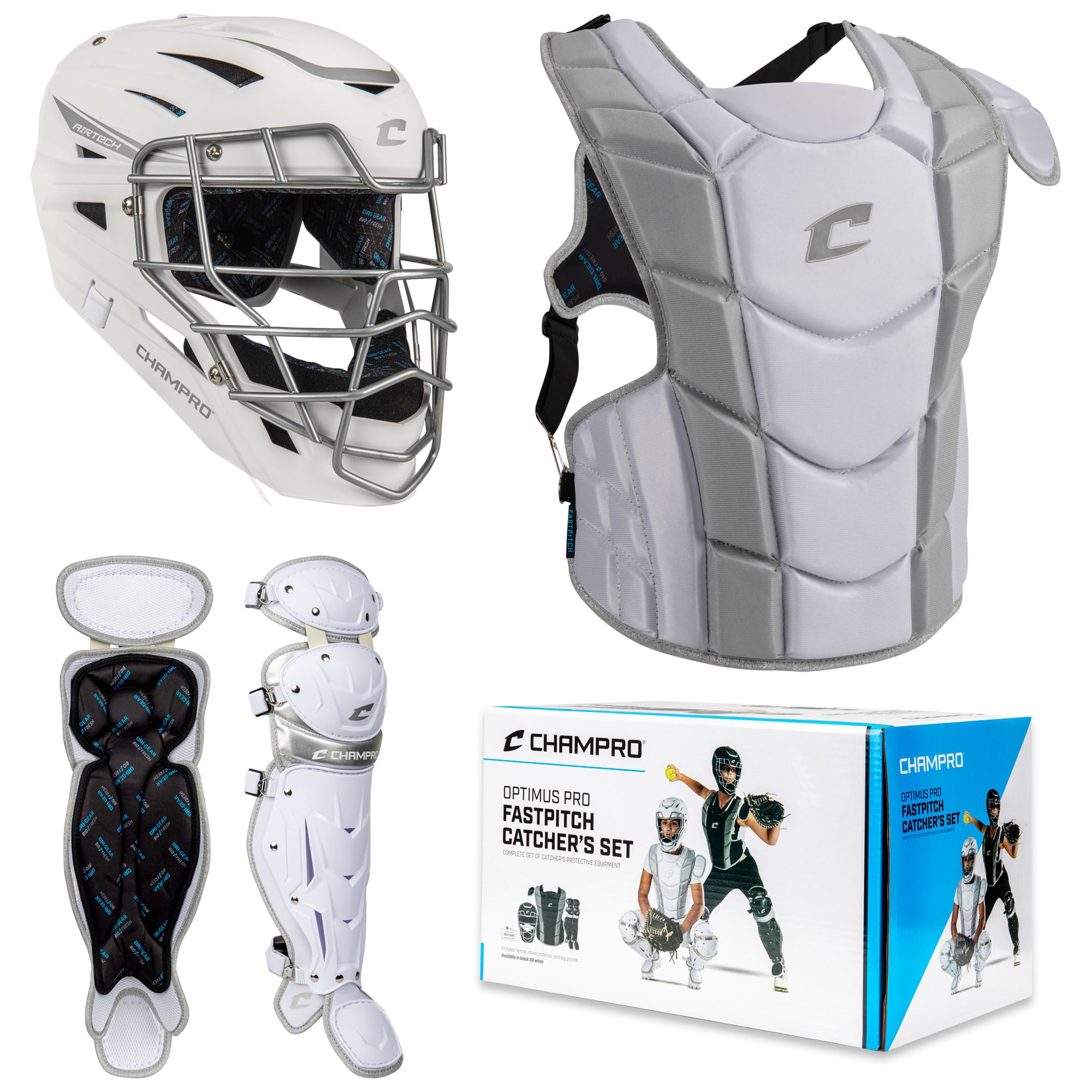
Compared to the top pick, this kit adds a hockey-style helmet with a two-piece ABS shell that splits impact zones so a hit to the temple does not transfer energy to the top of the skull, and a winged chest protector shaped for fastpitch catchers that closes the armpit gap baseball chest protectors leave open. The helmet padding runs slightly large on purpose for growth space — one buyer mentioned her 8-year-old daughter found the “helmet a little big but loved the leg guards that extend over the knee.”
The kit uses a multi-density pad system in the chest protector that layers soft foam near the body with a harder outer shell near the surface, so a 50-plus mph pitch gets absorbed gradually, not slapped. The harness adjusts across both shoulders and the waist, so you can cinch it tight enough that the protector does not ride up during a blocking stance. The shin guards on the 9-12 size are double-knee guards that wrap around the side of the leg, protecting better against foul tips that deflect off the inside knee.
This is the pick for a catcher who plays multiple games per week and wants better padding architecture than the standard Champro set. Choose this over the top pick if your player is in the 9-12 age bracket and needs the helmet’s impact-splitting shell and the chest protector’s fastpitch-specific armpit closure, but pass on it if your player is past that age bracket — it does not come in a larger youth size.
Where it shines
- Two-piece ABS shell helmet separates impact zones for better protection
- Winged chest protector design fits the fastpitch body shape
- Multi-density pads absorb hard contact gradually without feeling heavy
Worth noting
- No larger size available beyond 9-12 for taller older players
- Throat guard sold separately — not included in the kit
3. Easton The Fundamental by Jen Schro Fastpitch Softball Catcher’s Set

You are a parent whose 13-year-old daughter has outgrown her starter gear and now needs a set built for the low squat and quick pop-up throw of competitive fastpitch. Co-developed with Jen Schro (former All-American catcher at Arizona and a fastpitch instructor), this set is made for the low squat, quick pop-up throw, and sidesaddle block that fastpitch catchers actually use. At 9.7 pounds, it is heavier than the Champro sets by nearly 4 pounds, but that weight comes from thicker padding and a larger frame that fits older youth players and teens. Owners mention it fits a 13-year-old daughter well, with knee padding comfortable enough for a full tournament day.
The chest protector has an improved collarbone guard that extends higher than most competitors, so a foul tip riding up the bat handle does not hit bare bone. NOCSAE certification (meaning it passed independent lab impact tests) covers the full set. The leg guards use a redesigned shell that contours to the shin and knee for better blocking — your catcher can slide laterally without the guard shifting. The helmet padding is treated with Clear Dri and Aegis antimicrobial agents that fight sweat bacteria, which several customers note keeps it smelling fresher than old gear after a season. One parent noted the chest guard “covers all needed areas when squatting” but sits higher than some expect. This is the set for a 13-year-old moving into competitive fastpitch or high school. it’s not for you if your player is small or younger — at 9.7 pounds, it is heavier than budget sets and the chest guard may ride too high for shorter catchers.
At 9.7 pounds, it is the heaviest set in this guide — and that weight is the price of NOCSEA-certified protection built for the fastpitch frame.
What stands out
- Co-developed with Jen Schro for fastpitch-specific body mechanics
- Extended collarbone guard on the chest protector for high-impact protection
- Clear Dri and Aegis treated pads fight bacteria and sweat odor
The trade-offs
- At 9.7 lbs, it is heavier than budget sets — not ideal for younger or smaller players
- Chest guard sits higher on the torso, which may not suit players who prefer full coverage
4. All-Star Heiress Fastpitch Catcher’s Kit (12-16)
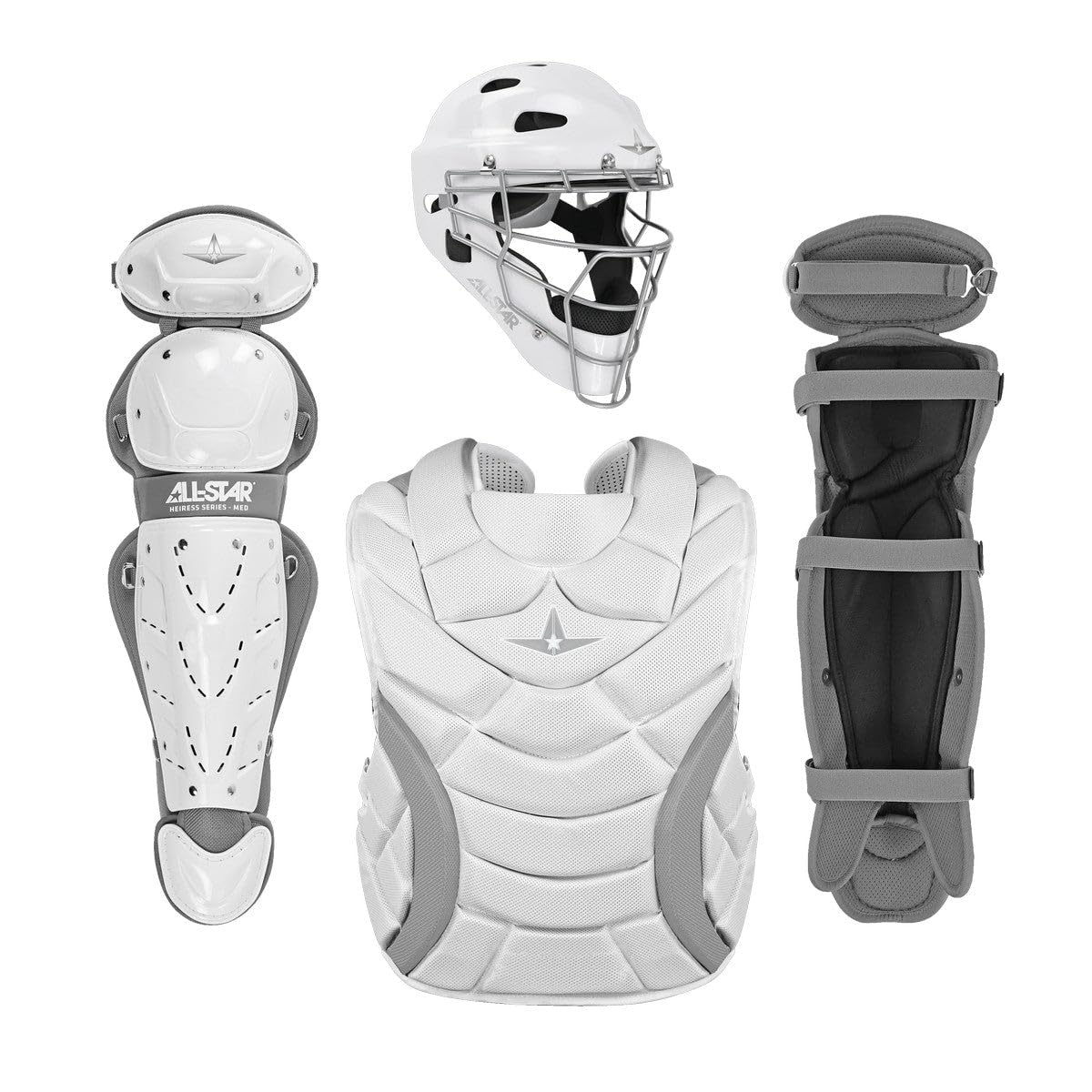
The single number that matters most in this category is the 12-16 size range — it is the only kit on the list designed explicitly for older youth, high school, and even smaller adult catchers. Reviewers point out it fits a 5’3″, 115-pound 13-year-old well, and the longer leg guards accommodate taller players who struggle with standard youth sets riding up above the knee. The chest protector uses premium mesh fabric (a woven, breathable material), which is significantly more breathable than closed-foam designs — critical for travel ball tournaments with three games in one day in August heat.
Both the chest protector and leg guards are treated with StinkStop antimicrobial agent. That prevents bacteria from bonding to the fabric and causing sour odor, a meaningful upgrade if gear gets left in a hot car after a doubleheader. The hook-and-loop straps on the leg guards have “good grip,” per one reviewer, and hold firm through slides and aggressive blocking drills. The hockey-style helmet fits well for a 5’5″, 120-pound teen, with adjustable straps to dial in the crown pressure. The downside: the chest guard runs proportionally large even within the 12-16 bracket. A buyer noted that for a tall 11-year-old, the leg guards and helmet fit but the chest guard was “obviously bigger” and loose on the tightest straps. This set shines for older youth catchers who are at least 5’2″ or in the 12U-to-varsity range. look elsewhere if your player is under 5’2″ or slim — the chest protector may swim on a smaller frame.
For a family buying for a growing teen, the StinkStop treatment and breathable mesh add durability that justifies the price-to-value read: you are paying for features that keep the gear fresh and functional through multiple seasons of travel ball, not just a single summer.
The upsides
- 12-16 size range fits taller youth and teen catchers better than standard youth sets
- StinkStop antimicrobial treatment keeps gear odor-free through heavy use
- Premium mesh chest protector offers best-in-class breathability for hot-day tournaments
Keep in mind
- Chest protector runs large and may fit loosely on slim or shorter players
- Premium tier pricing — best value for older catchers already committed to the position
5. Rawlings Velo Fastpitch Softball Catcher’s Set

With the Rawlings Velo you get a chest protector using Arc Reactor Core technology — a layer blending impact-absorbing polyurethane with an arch-engineered polymer plate that disperses forceful impact across a wider area — plus a helmet with a high-visibility cage offering increased impact resistance over standard steel masks, leg guards with Heat Exchange foam on the side flaps that pulls heat away from the skin, and a Dynamic Fit System with a four-point shoulder and back harness. The entire set is NOCSAE certified and weighs 9 pounds, slightly lighter than the Easton set despite accommodating a wider range of player sizes. One owner reported the gear lasted three full seasons for an 8-year-old who slides aggressively and takes direct pitches to the chest.
The chest protector’s Arc Reactor Core blends impact-absorbing polyurethane with an arch-engineered polymer plate that disperses forceful impact across a wider area instead of concentrating it on one rib. The leg guards use Heat Exchange foam on the side flaps — a foam formulation that pulls heat away from the skin and releases it through the shell. The Dynamic Fit System on the chest protector uses a four-point shoulder and back harness that distributes weight evenly across the shoulders and prevents shifting during lateral movement. Shoppers say the socks wear out at the ankles before any part of the protective equipment fails, and the gear feels “like a second skin” once adjusted.
For a parent who wants to buy catcher’s gear once and avoid replacement every season, the Rawlings Velo justifies its higher price through sheer survivability. This set is perfect for the budget buyer who prioritizes long-term durability over upfront cost — a parent willing to pay a premium for gear that lasts from 10U through middle school, but who should steer clear if their player is a casual or beginner catcher.
Why we’d pick it
- Arc Reactor Core technology in the chest protector disperses high-speed impact across a wider area
- Heat Exchange foam on leg guard side flaps keeps the knees cool during extended play
- Durable enough to last three seasons for an active 8-year-old, per buyer reports
A few caveats
- Premium tier pricing puts it out of reach for casual or beginner players
- Socks are the weak point — they may wear out at the ankle before the gear itself
Understanding the Specs
NOCSAE Certification vs Non-Certified
NOCSAE (National Operating Committee on Standards for Athletic Equipment) runs a drop test and a ball-impact test on helmets and chest protectors. A certified helmet must withstand a 60 mph baseball strike without transferring more than a set amount of g-force to the head. For fastpitch softball, where balls are slightly larger and softer but still hit hard, NOCSAE certification is the gold standard because it means the manufacturer has paid for independent lab testing rather than just using off-the-shelf foam padding. If the product page does not mention NOCSAE, the set likely uses generic padding that may not disperse energy as effectively.
Hockey-Style Helmet vs Traditional Catcher’s Mask
A hockey-style helmet wraps around the back of the skull and the temples, protecting areas a cage mask leaves exposed. It also integrates the face guard into the shell so a direct hit to the cage does not break your catcher’s nose on the crossbar. The trade-off is weight and heat — hockey-style helmets are 15 to 30 percent heavier than a traditional mask and trap body heat against the head. If your catcher runs hot or plays outdoors in humid climates, look for helmets with vent channels (often called “AirTech” or “Flow-through” vents) that let warm air escape out the top rather than trapping it inside the shell.
FAQ
Does my daughter need NOCSAE certified gear for a rec league?
What size catchers gear should I buy for a 10-year-old girl?
How do I clean and maintain catchers gear through a season?
Final Thoughts: The Verdict
For most families, the catchers gear for fastpitch softball winner is the Champro Fastpitch Softball Catcher’s Set because it balances lightweight protection at 5.82 pounds with real-world ventilation and a price that makes it accessible for new catchers. If you want the best cooling and advanced padding architecture for regular use, grab the Champro Optimus Pro Kit. And for high-school-level durability that survives three seasons without replacement, the standout is the Rawlings Velo Set.