
Our readers keep the lights on and my morning glass full of iced black tea. As an Amazon Associate, I earn from qualifying purchases.
Specs are compiled from manufacturer listings and verified buyer reviews and can change over time — please confirm the key details on the product page before buying.
Stuck with a CB radio that can barely hear the truck in front of you? The difference between shouting into the void and actually reaching the next rest stop is the antenna bolted to your mirror bracket. The right one makes your signal clear and loud for miles, while the wrong one turns your radio into an expensive paperweight. We have lined up the options that actually get the job done for serious drivers.
I’m Min — the founder and writer behind Gadgets Feed. This guide is built by comparing the manufacturers’ published specifications and the patterns across verified customer reviews, so you get each pick’s real strengths and trade-offs instead of marketing spin.
Whether you are hauling coast-to-coast or running a local route, swapping to a properly matched antenna is the single biggest upgrade you can make to your cab. This is our researched shortlist for the best cb antenna for truckers you can buy right now.
Our Picks at a Glance


How To Choose The Best CB Antenna For Truckers
Picking the right antenna for a semi-truck is different than slapping one on a pickup. Your mirror mount, the metal mass of the cab, and highway wind load all play a huge role. Here are the three things you need to get right before you buy.
Wattage Rating vs Your Radio
Every antenna has a maximum power rating in watts. If you push a 300-watt antenna with a high-power 1,000-watt amp, you will melt the coil. Match the antenna’s rating to your radio’s output. Most stock CBs run 4 watts, so even a 300-watt antenna leaves huge headroom. If you run a linear amplifier, look for 1,000-watt or 15,000-watt options.
Height and Clearance
A taller antenna typically gives you more range, but a semi-truck already stands around 13 feet tall. A 102-inch whip (about 8.5 feet) on top of that will smack every low bridge, tree branch, and warehouse door you pass under. Many truckers prefer shorter models around 2 to 4 feet to avoid constant snagging, but you trade some distance. Smaller antennas use loading coils to make up for the lost length in a compact package.
SWR Tuning Is Not Optional
Standing Wave Ratio (SWR) measures how much of your radio’s power actually leaves the antenna versus reflecting back into the transmitter. A high SWR can burn out your radio’s final transistors in minutes. Most antennas need a little trimming or tuning from the start. Look for models with a tunable tip or an adjustable stud. You will also need an SWR meter or an antenna analyzer (like a NanoVNA) to set it up properly.
Quick Comparison
| Model | Best For | Height | Power Rating | Weight | Amazon |
|---|---|---|---|---|---|
| Firestik II FS-2BK★ Best Overall | Overhead clearance + solid range | 2 ft | 300 W | 8 oz | Amazon |
| Prostick 4-FootBudget Champion | Budget 4-foot fiberglass | 4 ft | 1000 W | — | Amazon |
| Tram NighthawkBest Steel Whip | Low-clearance steel whip | 43 in | 400 W | 4 oz | Amazon |
| Tram TramCat TCT-9 | Pro twin-coil performance | ~4 ft | 15000 W | 13 oz | Amazon |
| Wilson T2000 | Drop-in upgrade for big rigs | ~5 ft | 3500 W | 1.2 lb | Amazon |
| Browning BR-78 | High-power flat-coil DX | 63 in | 15000 W | — | Amazon |
| Hustler 102-Inch Redman | Full quarter-wave range | 102 in | — | — | Amazon |
| Pro Trucker 102-Inch | Sturdy full-length steel | 102 in | — | — | Amazon |
| Wilson T5000 | Maximum output serious build | ~5 ft | 5000 W AM / 20000 W SSB | — | Amazon |
In‑Depth Reviews
1. Firestik II FS-2BK 2-Foot CB Antenna
Our pick — over 4.5★ from 650+ verified ratings; the strongest balance of quality and price.
The 2-foot tunable stick that slips under every garage door.
You can pull into a warehouse or residential garage without worrying about hitting an overhang, thanks to the 2-foot height. Yet it still gets out: the 5/8-wave design (a type of antenna that is longer than a quarter-wave but shorter than a full-wave, giving better range) with a top-load coil (a coil near the top that helps the short antenna work on CB frequencies) pulls in solid reception. Buyers report verified strong transmit at 2.5 miles while hearing traffic at around 15 miles — a seriously impressive return for such a short stick. This is the antenna most recommended for drivers who cannot afford to smack a long whip into every overhang.
It is made in the USA with a custom-blended fiberglass shaft that is thick and sturdy. The heavy insulated copper winding prevents oxidation, which matters when you are running the antenna through rain, snow, and road salt year after year. Tuning is straightforward: you recap the tip and check your SWR. The small trade-off is that with such a short antenna, highway wind noise is a little more audible inside the cab compared to something taller and stiffer.
Best for tight fits: If you absolutely cannot run a 4-foot or taller antenna, this is the one that sacrifices the least range. It is 2 feet, while the Prostick is 4 feet, but the smart coil design keeps it communicating.
Grab this if: clearance is your #1 headache and you want an antenna that tunes easily right from the start.
Look elsewhere if: you need maximum range for barefoot radios — a taller whip will always reach farther than a load coil.
2. Prostick 4-Foot Fiberglass 1000W CB Antenna
A 4-foot fiberglass whip that handles serious power on a budget.
It works right from the start for many drivers, which is why it is among the most popular antennas on the road. The 4-foot height is a balance — tall enough to get good range but short enough to dodge most tree limbs. It is rated to handle 1000 watts of input (the maximum power the antenna can safely take), giving you room to grow into a linear amplifier (a device that boosts your radio’s transmit power) later without swapping antennas.
The “VibraSorb” anti-breakage design is a smart touch for life on the road. It improves the product’s lifespan by absorbing some of the shock from low-hanging branches. Performance is the top thing owners praise about this one. The catch is that tuning experience varies. Many owners screw it on and report SWR at 90% perfect with no further action needed. Others find it ships electrically long and needs trimming. As one reviewer noted: requires cutting the copper wire roughly 1.5 inches and tuning to bring SWR to around 1.3. Plan on having a NanoVNA or SWR meter on hand.
Best bang for the buck: A 4-foot fiberglass stick with a 1000-watt ceiling at an entry-level price. It beats the shorter Firestik on height, but the Firestik is lighter by 8 ounces and has a more consistent tune from unit to unit.
Reach for this if: you want a cheap 4-footer that can handle an amplifier later.
Think twice if: you are not comfortable trimming a whip or using an SWR analyzer — some units ship long and need work before they are safe to use.
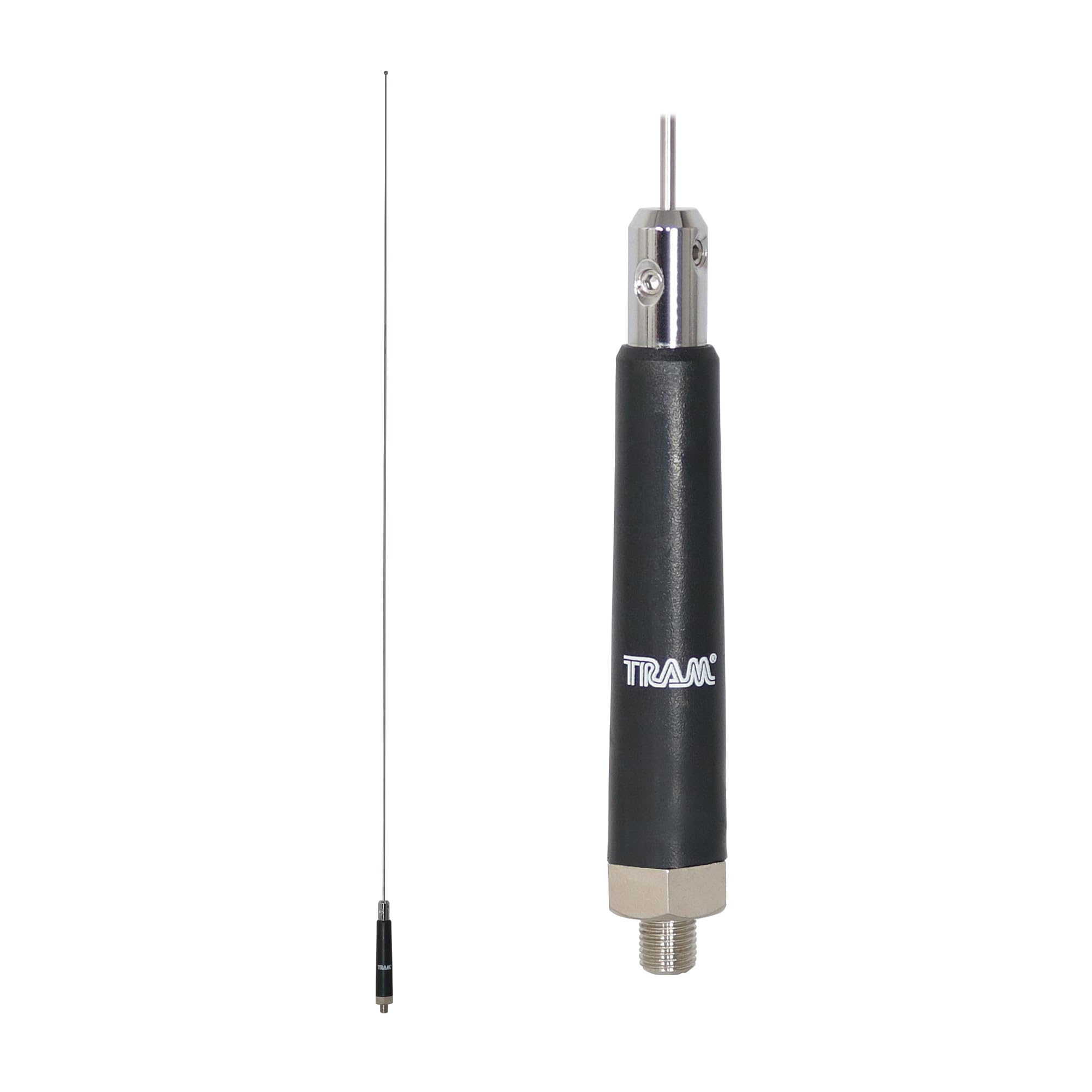
3. Tram Nighthawk 43-Inch Stainless Steel CB Antenna
A 43-inch steel whip that bends but does not break.
For truckers who hate fiberglass sticks, this is a solid alternative. The heavy-duty 4.5-inch bottom-loading coil feeds a 43-inch stainless steel 17-7 PH tempered whip that is only 2.5 mm thick. It weighs just 4 ounces, while the Firestik weighs 8 ounces, so it puts less stress on your mirror mount bracket. Owners mention SWR is good right from the start, and you can fine-tune it by trimming the steel whip with the included Allen wrench.
The build quality is excellent. Several owners note it has swatted many tree limbs without breaking, and the flexible design handles low-clearance garages easily — one driver measured it at only 4 inches above the roofline. A few note that the whip does bend back a lot going down the highway because of wind pressure. It is also important to check the set screws before you drive off; a handful of owners found they fell out during the first trip.
Top performer for low weight: The Nighthawk weighs 4 ounces, while the Firestik weighs 8 ounces. That makes a real difference if you are running a passenger-side mirror bracket that already vibrates.
Get this for: a flexible steel whip that tunes easily and handles branch slaps without cracking.
Avoid if: you need absolute stiffness at highway speed — the thin whip will lean back noticeably.
4. Tram TramCat TCT-9 Twin-Coil CB Antenna

The professional trucker’s choice for massive power handling.
This is the antenna of choice for professional drivers who run high-power setups. The twin-coil design with a 42.25-inch stainless steel whip and a 9-inch shaft is built for range and durability. It handles an incredible 15,000 watts, so it is basically future-proof if you ever decide to run a big amplifier. The high-performance aluminum body and stainless steel 3/8-inch x 24 all-thread mount mean it mates perfectly to standard mirror brackets.
The thing everyone raves about is the SWR. Multiple customers note getting SWR readings of 1.1 across all 40 channels straight from the start — that is as close to perfect as you get in the real world. Installation is simple, and the range is described as amazing. The honest downside: the whip is vulnerable to branches and other obstacles. One owner reported the whip snapped at the plastic middle section when it caught a branch. Others say it bounces off silos without damage.
Perfect SWR from the start: while the Prostick and Firestik often need cutting or tuning, this TramCat puts up 1.1 across the band for many owners. That is a huge time saver when you want to install and go.
This fits if: you run a modified radio or amp and want a 15,000-watt antenna that tunes instantly.
Not ideal if: you regularly drive under heavy tree cover — the whip can snap at the plastic joint if it catches something solid.
5. Wilson T2000 3500W Trucker Antenna

A Wilson classic that drops right onto a standard mirror bracket.
Wilson has been a known name in trucking CBs for years, and the T2000 is a solid reason why. The larger coil housing increases power handling to 3500 watts, with a 49-inch stainless steel whip and a 10-inch shaft. The standard 0.38-inch x 24 thread means it screws onto almost any mirror mount without adapters. The build quality is the thing owners praise most — this antenna feels solid in hand.
Installation takes minutes, and many reviewers point out no tuning needed with an out-of-box SWR of 1.5. Reception is excellent, with one owner noting clear sound at construction sites with no problem. The 3500-watt limit gives you headroom for a moderate amplifier. An honest trade-off: a few shoppers say the antenna snapping off at the base after hitting something. This is not unique to Wilson (all whips can fail on hard impacts), but it is worth keeping in mind for tight yards.
Drop-in and go: compared to the Prostick, which often needs trimming, the T2000 typically hits a usable SWR straight from the start. That saves roadside fiddling time.
Buy this for: a well-built, medium-power antenna with a big coil housing that does not require immediate tuning.
Pass if: you need the ultra-high 15,000-watt ceiling of the TramCat above.
6. Browning BR-78 15,000W Flat-Coil CB Antenna
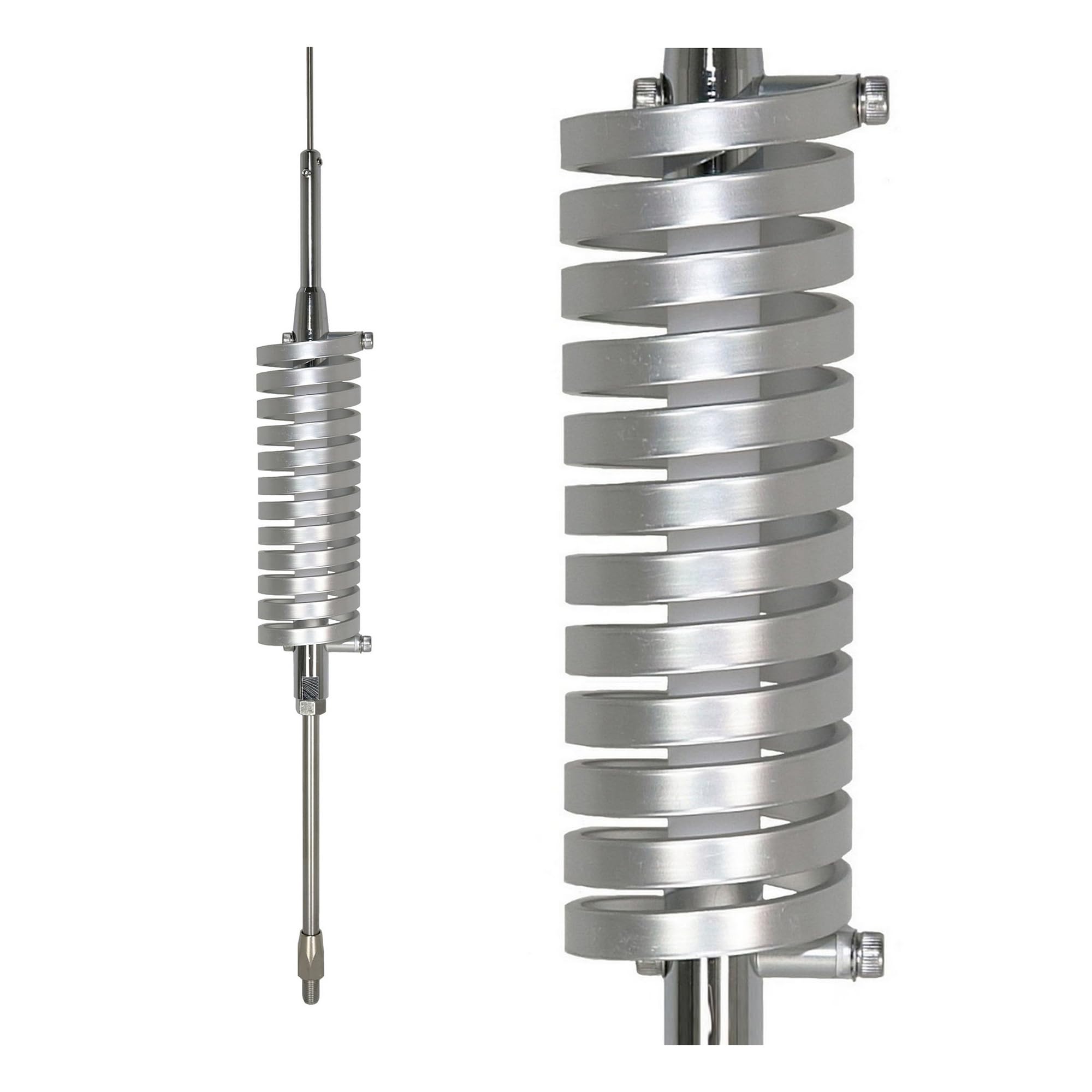
A 63-inch flat-coil giant for skip-shooters and long-haulers.
The Browning BR-78 is built for serious range. It stands 63 inches tall with a stainless steel 17-7 PH tempered 3 mm tapered whip and shaft, and it handles a full 15,000 watts. The flat-coil design is known for being broadband, meaning it performs well across the entire 25 MHz to 30 MHz range without needing a re-tune when you switch channels. One owner reported out-of-box SWR of 1.2 on the 10-meter DX band.
Several owners note a 25% increase in coverage after switching to this antenna. It is well-built and easy to install without needing to cut the whip — many get good SWR immediately. The antenna quality is the top praised aspect, with 34 positive mentions. A few owners did find the antenna required a little trimming of the whip (more than 1 inch in one case) to achieve the best SWR, so results vary depending on your specific mount and vehicle.
Flat-coil advantage: The Browning’s flat coil design gives it broader bandwidth than the round coils on the Firestik or Wilson. That matters if you regularly switch between different CB channels and want consistent performance on every one.
Choose this one for: high-power setups and long-distance “skip” communication where every dB of signal matters.
Not for: drivers who need a short, garage-friendly antenna — 63 inches puts you up there with the big whips.
7. Hustler Redman 102-Inch CB Ham Radio Antenna
The classic 102-inch whip that offers class-leading receive capability (how well it picks up weak signals).
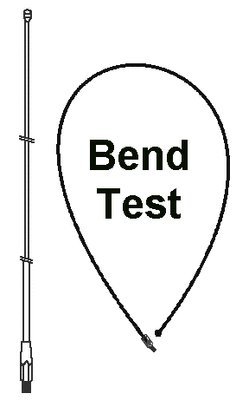
For pure, unloaded performance (no power lost to a coil), a full quarter-wave (a type of antenna that is one-quarter of the CB radio wavelength) on the CB band is tough to top. At 102 inches, this whip is a true 1/4-wavelength on 11 meters (the CB radio frequency band). It does not use a loading coil (a coil that shortens the antenna but wastes some power as heat), so all your radio’s power goes straight into the air. The 17-7 PH stainless steel (a spring-tempered alloy) is guaranteed to return to its original shape after a 180-degree bend, so it survives leaning on branches and docks.
Buyers report a greatly improved receive and transmit compared to shorter loaded antennas. The quality of the build is what stands out most to buyers. It ships in a straight PVC tube. The massive length is the main hurdle for truck use — you absolutely need an inline spring to protect the mount from stress. A few owners note the threaded base screw can come loose, so check that before installation.
Maximum receive unfiltered: The Hustler 102-inch whip receives much better than any loaded 2-foot or 4-foot antenna. If you want to hear the weak signals, this is the one — but at 102 inches versus the Firestik’s 2 feet, clearance becomes a real restriction.
Perfect for: drivers who park in open lots and want the absolute best receive performance without a coil stealing power.
Not practical if: you regularly enter low garages, tunnels, or tree-lined roads — you will be constantly snagging things.
8. Pro Trucker 102-Inch Stainless Steel CB Antenna

A durable 102-inch whip with an adjustable mounting stud.
This is another excellent take on the full-length 102-inch whip. It uses a 17-7 PH tapered stainless steel design that is extremely durable. The adjustable mounting stud gives you a little wiggle room for fine-tuning SWR, which is important because a pure quarter-wave whip needs a good ground plane to perform. The build quality is the top thing owners highlight: this is a sturdy metal whip that feels built to last.
Several owners mention very good SWR and incredible reception once properly grounded. One driver noted that it works best with a bonding wire from the mount to the frame — without a solid ground, performance suffers. The whip is bendable and has snapped back without breaking through multiple impacts. A recurring note from the data is the lack of true SWR adjustability compared to loaded antennas. You cannot trim a 102-inch whip the same way you trim a fiberglass stick.
Solid ground needed: Unlike the loaded Firestik or Tram Nighthawk, a full 102-inch whip demands an excellent ground connection. A bad ground plane kills range, but a bonding wire solves it.
Reach for this if: you want a classic full-length whip and are willing to set up a proper ground for peak performance.
Look elsewhere if: your truck has a fiberglass or plastic mirror bracket with no metal path — you will never get good SWR without a ground wire.
9. Wilson T5000 Trucker Series CB Antenna
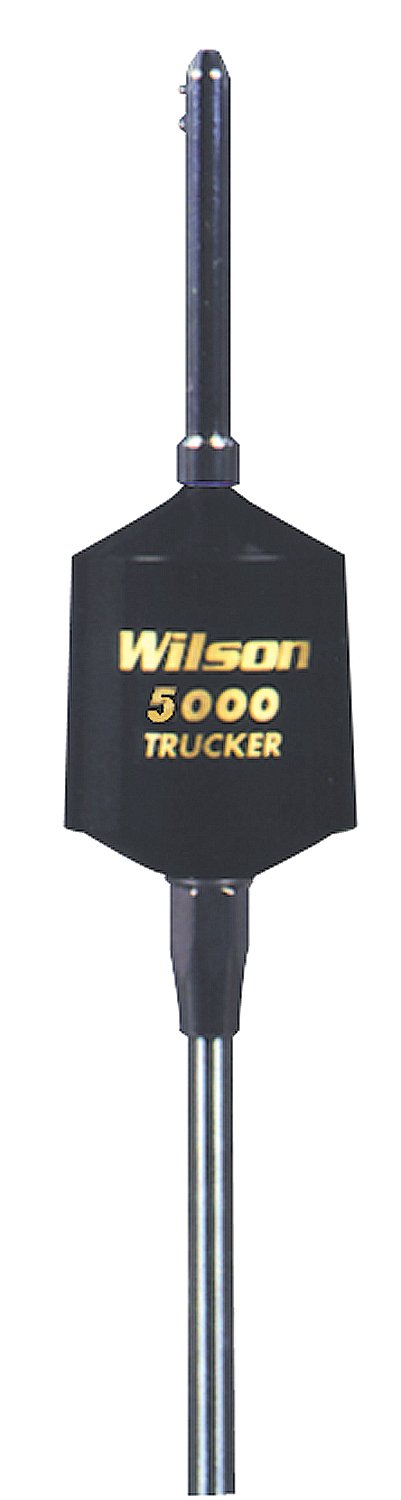
“The world’s most powerful base-loaded mobile CB antenna”.
Wilson claims this T5000 series holds the title of the most powerful base-loaded mobile CB antenna, and the specs back it up. It handles 5,000 watts AM and a staggering 20,000 watts SSB (ICAS rating). If you run a big linear amplifier, this antenna can absorb the punishment without a problem. The low-loss coil design helps more of that power actually get out of the antenna rather than being lost as heat.
Customers note that the clarity of reception is one of the first things they noticed, and the SWR is easy to dial down to 1. The Wilson line of antennas has been a long-time choice for many serious CB users. An honest caveat from one buyer: the antenna arrived slightly bent during shipping because it was not well secured in the box. This is a risk with any long antenna shipped unassembled. The base also has a 5-inch shaft, which is shorter than the 10-inch shaft of the T2000 and may sit differently on your mount.
Maximum power ceiling: The T5000 handles 20,000 watts SSB, blowing past the Tram Nighthawk’s 400W and even the Prostick’s 1000W. If you run a big amp, there is no better base-loaded choice in this list.
Get this one for: the highest power handling available in a base-loaded design, plus Wilson’s trusted build.
Skip if: you run a stock 4-watt radio — the T2000 or the Tram Nighthawk gives you everything you need at a lower entry point.
Understanding the Specs
SWR (Standing Wave Ratio)
This is the single most important number to check after installing any CB antenna. SWR measures how much radio frequency energy your antenna is actually radiating into the air versus how much is reflecting back into your radio. A perfect SWR is 1.0. Anything above 2.5 can damage your radio’s final transistor. You tune the antenna (by trimming the tip or adjusting a stud) until the SWR is as low as possible across channels 1 and 40. Without an SWR meter, you are flying blind — and risking a fried radio.
Power Handling (Watts)
Every antenna has a wattage rating. A stock CB radio puts out about 4 watts, but many truckers add a linear amplifier that pushes 100, 500, or even several thousand watts. If your antenna is rated for 300 watts and you feed it 1,000 watts, the coil will overheat and fail. Match the antenna’s power rating to your radio’s maximum output. If you are running a stock radio, even a 300-watt antenna gives you huge overhead. If you are building a “big radio” setup, look for 1,000-watt, 15,000-watt, or even 20,000-watt ratings.
Coil Type and Location
Antennas use loading coils to electrically lengthen a short physical whip so it resonates on the CB band (27 MHz). A base-loaded coil sits at the bottom of the whip. A top-loaded coil (like the Firestik) sits near the top. A center-loaded or twin-coil (like the TramCat) splits the coil. Generally, top-loaded antennas are more efficient for a given height, but base-loaded antennas are simpler to build and mount. Flat-coil designs (like the Browning) offer wider bandwidth — meaning less re-tuning when you change channels.
Mounting Thread and Ground Plane
Almost every CB antenna uses a standard 3/8-inch x 24 thread. This screws into mirror brackets, fender mounts, or mag mounts. The ground plane is the metal surface of your vehicle that the antenna uses as a “mirror” for its radio signal. A semi-truck’s metal cab is a naturally good ground plane. If you mount the antenna on a fiberglass mirror bracket, you lose that ground plane and your SWR will skyrocket. You can fix this by running a bonding strap from the antenna mount to the vehicle chassis.
FAQ
Do I need to tune a new CB antenna for my truck?
What is the best antenna height for a semi-truck?
Can I use a 102-inch whip on a semi-truck?
What is the difference between fiberglass and steel whips?
How many watts do I need my CB antenna to handle?
Will this antenna work with my standard 3/8-inch mount?
Is a ground plane required for a CB antenna on a truck?
Can I run two CB antennas (co-phased) on my truck?
What tool do I need to tune my SWR?
What is the difference between a 1/4-wave and a 5/8-wave antenna?
Final Thoughts: The Verdict
For most truckers, the best cb antenna for truckers you can buy today is the Firestik II FS-2BK. It is short enough to dodge obstacles, tunes easily to a low SWR, and still reaches out 15 miles for receive thanks to its smart 5/8-wave coil design. If you have a bit more clearance and want a 4-footer that handles a 1000-watt amp, grab the Prostick 4-Foot. And for the driver running a high-power system who needs a rock-solid 15,000-watt antenna, the Tram TramCat TCT-9 is the professional choice. Pick the one that matches your cab clearance and your radio’s power, tune your SWR before you key the mic, and you will be talking clean for the long haul.
How We Picked
We do not accept paid placement. Every pick is matched to a real buyer and a real use-case; we do not hands-on test units.
Sources & Methodology
Specifications: manufacturer listings and product documentation. Review insights: verified customer reviews, as of July 2026. Pricing: not shown on this page (it changes often); check the current price via the retailer link.
As an Amazon Associate, Gadgets Feed earns from qualifying purchases. This does not affect which products we feature.