
Our readers keep the lights on and my morning glass full of iced black tea. As an Amazon Associate, I earn from qualifying purchases.
Specs are compiled from manufacturer listings and verified buyer reviews and can change over time — please confirm the key details on the product page before buying.
If you want a home CB radio that actually reaches out when the cell towers don’t, the short answer is this: the Cobra 29 NW is the one to buy first. It nails the fundamentals — clean audio, full 40 channels, and a dimmable night display — and owners keep coming back to the same two words: clear and easy. Below, every pick is sorted by what it’s genuinely good at, so you can match one to your desk, your truck cab, or your cabin shelf.
I’m Min — the founder and writer behind Gadgets Feed. This guide is built by comparing the manufacturers’ published specifications and the patterns across verified customer reviews, so you get each pick’s real strengths and trade-offs instead of marketing spin.
You’ll see what makes a true base station (a desktop radio that plugs into wall power) different from a mobile unit, which channels and modes matter, and how to judge audio and antenna tuning before you buy a cb base station.
Our Picks at a Glance


How To Choose The Best CB Base Station
Buying a base station isn’t like buying a phone. There’s no app store, no monthly bill, and no company deciding which conversations you’re allowed to have. It’s a box, an antenna, and a power cord — and how well it works depends on a short list of specs you can check before you spend a cent. Here’s what actually matters.
Start with AC power and a permanent antenna
A genuine base station runs on household wall power (120-volt AC), not a truck’s 12-volt socket. That means it sits on a desk or shelf and stays put — which is exactly what you want for a home setup. Pair it with an outdoor CB antenna mounted as high as you can get it, and run quality coax cable down to the radio. The radio is only half the system — a weak antenna will hold back even a great unit.
AM, FM, and why SSB is a different animal
AM (amplitude modulation) is the classic CB mode — it’s what most drivers and hobbyists still use, and it reaches long distances. FM (frequency modulation) is newer to CB and sounds cleaner up close, which is why dual-mode AM/FM radios now dominate. SSB (single sideband) is a separate mode used by serious hobbyists for longer-range contacts; it’s more sensitive to tuning, so only chase it if you know you’ll use it.
The specs worth checking before you buy
Look at the channel count (40 is the legal full band), the transmit power (4 watts is the FCC limit for AM/FM), whether there’s a built-in SWR meter for antenna calibration, and how the display handles night driving. A dimmer control and illuminated faceplate matter on a long evening watch.
Quick Comparison
| Model | Best For | Channels | Modes | Display | Amazon |
|---|---|---|---|---|---|
| Cobra 29 NW★ Best Overall | Everyday home base use | 40 | AM/FM | NightWatch illuminated | Amazon |
| Uniden PC78LTXFMCompact Pick | Slim-space truck cab installs | 40 | AM/FM | Analog S/RF meter | Amazon |
| Cobra 29LX | Weather-aware operators | 40 | AM/FM | Selectable 4-color LCD | Amazon |
| Uniden Bearcat 880 | Customizable bright-cabinet setups | 40 | AM | 7-color digital backlit | Amazon |
| Galaxy DX-2547 | Sideband hobbyists who tune | 40 | AM/SSB | 6-digit frequency counter | Amazon |
In‑Depth Reviews
1. Cobra 29 NW AM/FM Classic Professional CB Radio
Our pick — over 4.5★ from 300+ verified ratings; the strongest balance of quality and price.
The classic 29 you already know, now with a dimmer that won’t cook your eyes at night
For most people building a home station, this is the one to buy. What wins people over is the sound — the audio comes through clean whether you’re talking across town or pulling in a distant operator, and it stays clear as the evening drags on. The 40 channels cover the full legal band, and 4 watts of transmit power is the legal ceiling on AM and FM anyway, so you’re not leaving anything on the table.
For a base setup, the backlighting is the real difference-maker. NightWatch illumination with a variable dimmer lets you dial the glow up or down so the face is readable in a dark room without washing out your vision. Owners also single out the built-in SWR meter — that’s the little dial that checks whether your antenna is matched to the radio, and getting it right protects the finals inside a transmitter. According to the maker, the included 9-foot microphone cable gives you reach without cluttering a desk. It’s a hair behind the 29LX on score, and it carries a lower count of ratings, but the 29 NW holds 4.6 stars across a body of owners who clearly trust it. Listen for a moment: as buyers report of a 29 unit, the audio came in “clear and easy,” though one antenna port failed shortly after receipt — a reminder to reseat your connector firmly and open a support ticket fast if anything feels loose.
What owners keep talking about
- Sound quality drives the praise more than anything else — clean, loud, and steady.
- NightWatch dimmer lets you tune the backlight to match a dark room.
- Built-in SWR meter means you can calibrate your own antenna at home.
- Instant Channel 9 puts emergency traffic one button away.
Worth knowing before you order
- Appearance is a love-it-or-not thing — the classic 29 face divides opinion.
- 3.4 pounds and a footprint around 8.6 by 7.6 inches means it needs real shelf space.
- No SSB mode, so sideband hobbyists should look further down this list.
Pick it if: you want a proven home CB that sounds good from the start and survives nightly use.
Look past it if: you need sideband mode or a slimmer chassis for a tight install.
2. Uniden PC78LTXFM Professional 40-Channel CB Radio
A slim chrome-faced workhorse that slips into tight spaces a full-size radio can’t touch
If your mounting spot is shallow — a shelf, a cubby, a console pocket where nothing big will fit — this is the tightest solution on the list. At 2.2 inches deep and about 7.8 inches wide, it’s noticeably smaller than the 29LX, which runs 9.25 inches deep and 7.25 inches wide. That’s a real difference when every inch of dash or shelf counts.
Uniden packs a lot into that width. You get an RF gain control for cutting background noise, a microphone gain, a noise blanker and automatic noise limiter, and a Hi-Cut switch for taming hiss on weak signals. FM mode gives you clean short-range audio when you’re close to another operator, and AM still handles the long haul. Built in the USA and engineered in Japan, per the maker — and the chassis is styled to match the old chrome-faced CBs, which is a nice nod if you care how your station looks.
Treat it as a fundamentals-first radio. Owners use it at the cabin, in trucks, and moved between a truck and a sedan with no complaints. And buyers do report a serious failure: in one case, output dropped below 1 watt of transmit power after about two months, past the return window. Rare, but it’s a reminder to buy from a source you can chase if the magic smoke escapes.
The fundamentals-first play: nothing fancy — a squelch that owners say knocks out the noise, a built-in tuner, and a footprint that fits anywhere. If you don’t need sideband or a color display, this is the sensible pick.
The honest catch: no SSB and a smaller owner base than the top pick, so the long-term reliability record is thinner.
Reach for this if: space is tight and you want proven AM/FM basics in a compact, tough-looking frame.
Skip ahead if: you’d rather have the larger reliability record that the Cobra 29 family carries.
3. Cobra 29LX AM/FM Professional CB Radio
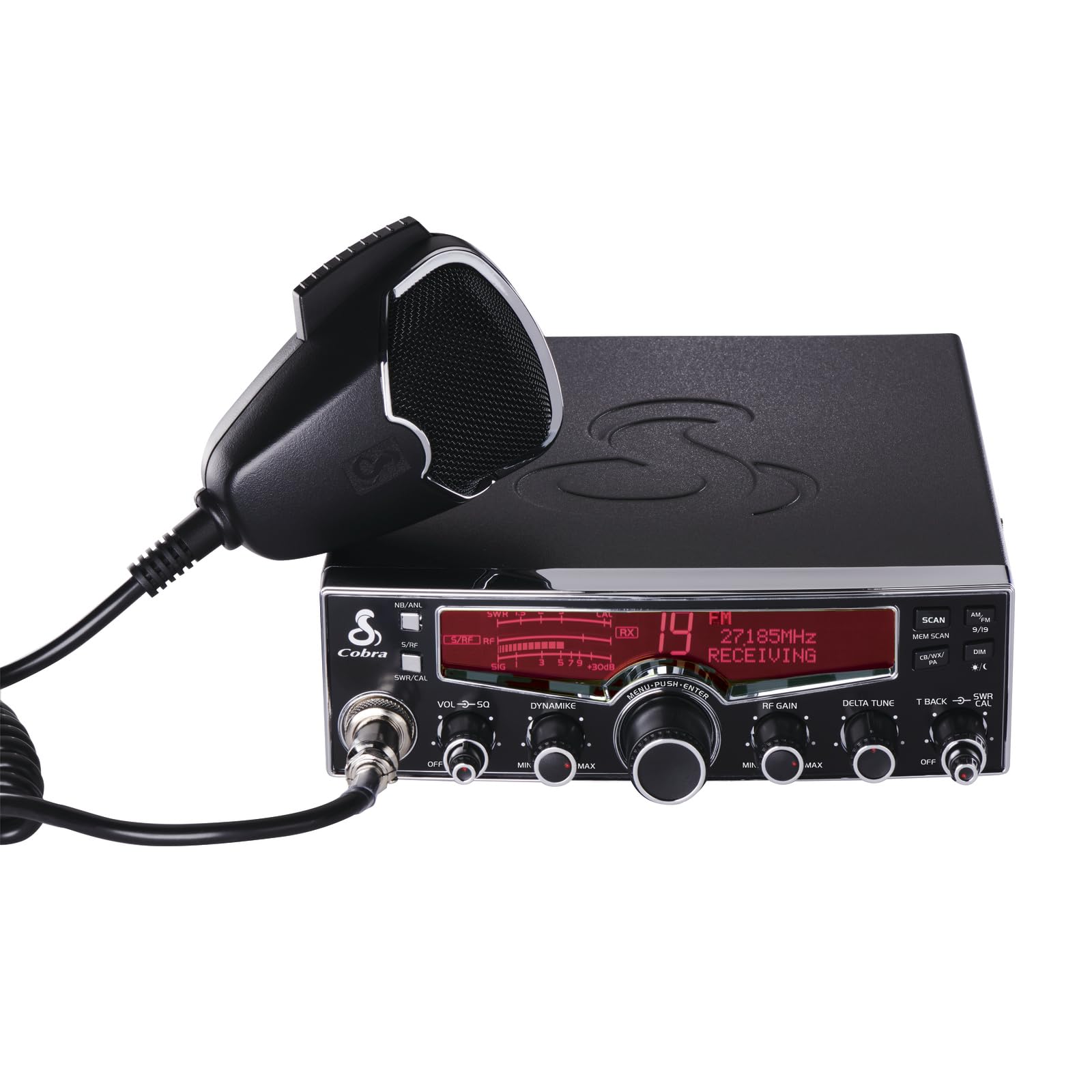
For the operator who wants the storm warning to come to them, not the other way around
What sets this pick apart from the rest of the list is the weather system. It scans NOAA weather channels automatically, locks onto the strongest one, and — according to the maker — can break in with an alert tone even when you’re parked on a regular CB channel. That’s the feature owners rave about: as one put it, “I like the way that NOAA forecasts break in and warn you about any storm situation, even when not turned to the Weather Channel frequency.”
It’s the biggest of the Cobra pair here, running 9.25 inches deep and 7.25 inches wide, and it weighs 3.5 pounds — noticeably heavier than the 29 NW at 3.4 pounds, but on the shelf that’s a rounding error. Where it earns its keep is the extras: a selectable 4-color LCD, an on-screen clock with an alarm, and a radio check that auto-runs diagnostics for voltage, RF output, and antenna matching. The 50-ohm impedance matches standard CB antennas, and the frequency range is the standard 26.965 to 27.405 MHz band. It scores 4.4 stars across roughly 70 ratings, a touch lower than the 29 NW.
Be honest about what you’re paying for: features. The 4-color LCD and the diagnostic suite are the draw, not the raw sound. On tuning, this one is fussier. There’s a real spread in owner experience, and the count of ratings is small — plus the occasional dud that “never worked,” per one account, though that’s the rare end of the bell curve. If you want weather alerts and a clock on the face, this is worth it. If you just want classic CB audio, the 29 NW does that better and cheaper.
Weather on the front line: NOAA auto-scan and alert interrupts are the headline. If you operate where storms roll in fast, that alone justifies the pick.
A feature-rich center console: 4-color LCD, clock and alarm, and automatic radio check diagnostics. Plenty to fiddle with.
The one to think twice about: value is the mixed note in reviews, and the smaller rating count means less owner data to lean on.
The right call if: weather warnings and a clock on the face are worth the premium to you.
Pass if: you want pure sound quality, which the 29 NW nails for less.
4. Uniden Bearcat 880 40-Channel CB Radio

Seven colors of backlight and a face built to read at a glance from across the cab
This is the radio you buy when you want the console to look as good as it sounds. A 7-color backlit display with large, easy-to-read type and a dimmer switch lets you shift the glow from day to night, and the controls are arranged so you can find a knob by touch without taking your eyes off the road or the water. Owners use these on boats as well as cabins and trucks, and the maker lists the channel count at 40 with NOAA weather channel access built in.
The practical features are all here: a built-in SWR meter, public address function, emergency channel access you can enable or leave off, and integrated diagnostic modes. The talking range is listed at up to 10 kilometers under ideal conditions, though real-world range depends entirely on your antenna and terrain. Beyond the looks, the recurring note from buyers is just how clean the receive sounds and how well the transmit gets out.
The catch is an honest one: ambient noise. A few operators report heavy receive noise that means leaning on the RF gain and squelch to keep things quiet, and there’s at least one account of this unit not playing nicely with a specific magnetic mount antenna after a failed transmit test. With a clean install and a properly matched antenna, that’s a non-issue. But if you’re mixing and matching parts you already own, expect to spend some time dialing it in.
The strong hand
- 7-color backlit display with dimmer — the most customizable face on this list.
- Large type that’s readable at a glance, day or night.
- Rock-solid owner sentiment on the quality of the chassis and controls.
- NOAA weather access and public address mode built in.
What to plan around
- Receive noise can run high in noisy RF environments — be ready to work the gain and squelch.
- AM only here; no FM or SSB mode aboard.
- Some antenna-and-mount combos may not pair with it cleanly.
For the operator who wants it to look the part: a bold, bright face and well-laid-out controls make this a station centerpiece.
Not for you if: you need FM or sideband modes, or you’re slotting it into a noisy RF setup without room to tune.
5. Galaxy DX-2547 AM/SSB CB Base Station

The only true base station here with a tunable, open board — and sideband to match
This is the enthusiast’s machine. It’s a dedicated 120-volt AC base station with its own built-in power supply, which means it lives on a desk and runs off the wall — no truck required. It’s also the heaviest thing on the list at 10.7 pounds, because it’s a big metal cabinet full of discrete components rather than a mobile chassis with a display jammed into it. You get AM and SSB modes, a 6-digit frequency counter, variable RF output, a talkback control, a switchable Roger beep, and a modulation meter. The 50-ohm impedance is standard, and the frequency range is the familiar 26.965 to 27.405 MHz band.
For a serious operator, the appeal is the adjustability. Owners with years on the air report the receiver hears weak signals better than comparable mobile radios, the transmit audio is clean, and the board is built with discrete parts that are simple to tweak. One account notes that the LSB mode ran off-frequency and low on power from the start, but a quick internal adjustment via the trim pots brought it right into spec — a job this radio allows and most sealed units don’t.
Set realistic expectations though. This is a tinkerer’s radio, and it rewards patience. Owners describe a warm-up drift that settles after roughly ten minutes of being on, and one operator found SSB so far off that the signal clipped to the point of being unreadable, then had it come back from service no better. The honest read: if you’re comfortable tuning an open board and you want SSB, this is the pick. If you want plug-in-and-talk, look elsewhere on this list.
The enthusiast’s choice: AM and SSB, a frequency counter, and an open board that accepts your adjustments.
Stay clear if: you want zero-tweak, plug-and-play operation with no warm-up drift to manage.
Understanding the Specs
Channels and Modes
Every radio on this list has 40 channels, which is the full legal CB band — so that’s the easy part. The harder call is modes. AM and FM are what you’ll use day to day, and a dual-mode AM/FM radio lets you talk to more people, since FM sounds cleaner up close and AM reaches farther. SSB (single sideband) is a separate mode that only a few radios here offer, and it’s meant for long-range hobby work. If you don’t need sideband, don’t pay for it — stick with the AM/FM units.
SWR and Antenna Calibration
SWR (standing wave ratio) is a measure of how well your antenna is matched to the radio. If it’s off, your signal gets reflected back into the unit and you lose range — and in the worst case, you can damage the transmitter. A built-in SWR meter means you can check and correct this yourself. All five picks here include one, so a poor antenna match is yours to fix, not the radio’s fault.
FAQ
What is the difference between a CB base station and a mobile CB radio?
Do I need an SSB radio for a home CB base station?
Will a mobile CB radio work as a base station at home?
How do I calibrate the SWR on a CB radio?
Does a CB base station need an external antenna?
Which CB base station has the best night display?
Can I use a CB radio during a cellular or power outage?
What is the difference between AM and FM on a CB radio?
How much shelf or desk space does a CB base station take up?
Should I buy a CB radio with a built-in SWR meter or a separate one?
Final Thoughts: The Verdict
For most people setting up a home CB station, the cb base station winner is the Cobra 29 NW because it does the fundamentals — clean sound, full 40 channels, and a dimmable night display — with the most owner confidence behind it. If weathering the storm matters more than pure audio, the Cobra 29LX puts NOAA alerts and a clock on your faceplate. Want to work sideband with a board you can tune? The Galaxy DX-2547 is the enthusiast’s machine.
The one honest nudge: the 29 NW carries a larger body of owner ratings than most others here — the track record you want in a radio you’ll rely on for years. Pick it, or pick the specialist above that matches how you actually use the airwaves.
How We Picked
We do not accept paid placement. Every pick is matched to a real buyer and a real use-case; we do not hands-on test units.
Sources & Methodology
Specifications: manufacturer listings and product documentation. Review insights: verified customer reviews, as of September 2026. Pricing: not shown on this page (it changes often); check the current price via the retailer link.
As an Amazon Associate, Gadgets Feed earns from qualifying purchases. This does not affect which products we feature.