
A poorly matched CB radio antenna turns your transmitter into an expensive paperweight. The difference between 2 miles of crackly static and 15 miles of solid contact comes down to one thing: the antenna system. Every watt your radio produces either launches into the air or reflects back into the circuitry, and the antenna alone decides that split.
I’m Min — the co-founder and writer behind Gadgets Feed. I’ve mapped the engineering trade-offs behind every popular mount style, whip length, and coil design to cut through the noise and find the setups that actually deliver measurable SWR stability and reliable range.
The right cb radio antenna balances impedance, power handling, and mount stability to maximize real-world transmission without cooking your radio’s final amplifier.
How To Choose The Best CB Radio Antenna
Choosing a CB antenna isn’t about picking the tallest whip or the flashiest coil. Real performance hinges on three interconnected variables: mount integrity, impedance matching, and resonance tuning. A misstep in any single area creates a system that radiates poorly and may damage your radio.
Mounting Matters: Magnetic vs. Permanent
Magnetic mounts offer convenience and easy removal for car washes or parking garages, but they introduce capacitance to ground that shifts your antenna’s resonant frequency. Permanent roof or bumper mounts provide a consistent ground plane and lower SWR, but require drilling or clamping. Truckers running mirror-mount brackets get the best of both worlds: solid electrical connection with moderate install effort.
Power Handling and Coil Design
A center-loaded coil concentrates the radiating current higher on the whip, improving efficiency over base-loaded designs of the same total height. Pay attention to the power rating: a 1000-watt coil will survive a 4-watt stock radio easily, but the inverse — a 100-watt rated coil on a 100-watt linear amplifier — creates smoke. Wilson and Sirio use heavy-gauge wire and sealed coils to prevent moisture ingress.
SWR and the Fine Art of Tuning
Standing Wave Ratio is the single metric that determines whether your antenna is working. A reading of 1.5:1 or lower means nearly all your power radiates. Anything above 2.5:1 risks damaging your radio’s output transistors. Most fiberglass whips ship intentionally long — expect to trim copper wire under the tip cap. Pre-tuned magnetic base units usually land closer to 1.2:1 without modification.
Quick Comparison
On smaller screens, swipe sideways to see the full table.
| Model | Category | Best For | Key Spec | Amazon |
|---|---|---|---|---|
| Wilson T2000 | Trucker Antenna | High-power mobile setups | 3500W max input | Amazon |
| Sirio Vector 4000 | Base Station J-Pole | Omnidirectional base use | 1400 KHz bandwidth @ SWR 2 | Amazon |
| Tram Discone | Wideband Scanner | Multi-band scanning + CB TX | 25 MHz – 1300 MHz coverage | Amazon |
| Retevis MB1 Kit | Compact All-in-One | Entry-level mobile setup | 6-mile range with included antenna | Amazon |
| Prostick 4′ Fiberglass | Fiberglass Whip | Off-road/trail survival | 1000W power handling | Amazon |
| Nagoya CB-72 | Pre-Tuned Mobile | No-tune road trips | 18 ft RG-58A/U cable | Amazon |
| Eifagur Magnetic Base | Low-Profile Starter | Budget entry and listening | BNC male connector with adapter | Amazon |
In‑Depth Reviews
1. Wilson Antenna 305-493 T2000 Series Red Mobile CB Trucker Antenna

The Wilson T2000 uses a stainless steel center-loaded coil housed in a red polycarbonate sleeve that resists UV damage and road grime. The 5-inch mounting shaft accommodates mirror-brackets on large trucks, while the 49-inch stainless whip provides the radiating length needed for solid skip propagation on 11 meters.
Owners consistently report SWR readings below 1.3:1 after a simple whip-length adjustment, and the 3500-watt power rating means it handles even the most aggressive linear amplifiers without core saturation. The spring-loaded base design absorbs vibration from rough highways without fatiguing the coil connection.
The AM/FM ready designation means you can run your CB and broadcast radio through the same coax with a splitter, simplifying roof clutter. Field reports from long-haul drivers note reliable contacts at 8–12 miles on flat terrain with a properly tuned setup.
Why it’s great
- Massive headroom for linear amplifiers up to 3500W
- Center-loaded design concentrates radiation higher for better range
- UV-stable red housing survives years of sun exposure
Good to know
- Set screws sometimes missing from packaging — check contents immediately
- Requires SWR tuning after initial installation; not plug-and-play
- 5″ shaft may be too short for some heavy-duty mirror brackets
2. Sirio Antenna New Vector 4000 Tunable Base Antenna

The Sirio Vector 4000 is a 3/4-wave coaxial J-pole base antenna tunable from 27 to 28.5 MHz via whip-length adjustment. The design delivers a natural gain advantage over traditional 1/4-wave ground planes, with a published bandwidth of 1400 KHz at SWR 2:1 — wide enough to cover the entire CB band without re-tuning when properly set.
Users report SWR dips as low as 1.1:1 on channel 20 after careful tuning with an antenna analyzer. The antenna handles up to 3000 watts, making it suitable for serious base-station operators running amplifiers. The all-aluminum construction with stainless hardware resists corrosion, though several owners note the included set screws are brittle and recommend replacing them with stainless equivalents.
Assembly instructions are minimal — expect to consult online mm-to-inch conversion charts for the tuning rod. At 21 feet elevation, the Vector 4000 delivers consistent contacts across 100 miles at night and has been reported to work Europe and South America during daytime skip conditions with as little as 3 watts.
Why it’s great
- Exceptional gain for a base antenna — outperforms 1/4-wave ground planes
- Wide tuning range allows coverage beyond CB into 10-meter ham band
- 3000W power handling suits high-power base stations
Good to know
- Instructions are sparse; tuning requires an SWR meter or antenna analyzer
- Hardware quality is adequate — consider aftermarket set screws for durability
- Large footprint requires sturdy mast support; pop-rivet reinforcement recommended for wind areas
3. Nagoya CB-72 High-Performance 28″ CB Antenna Kit

The Nagoya CB-72 uses a solid brass NMO mount with a gold-plated spring contact pin, ensuring consistent electrical contact in a magnetic-base package. The 28-inch whip is center-loaded and pre-tuned, with multiple users reporting SWR readings of 1.2:1 or lower immediately after mounting — no trimming required.
The 18-foot RG-58A/U cable provides generous routing flexibility for trucks, SUVs, and passenger cars, and the 3.5-inch magnet holds securely at highway speeds when mounted on a clean metal surface. The antenna unscrews from the base for car washes, and a threaded rubber dust cap protects the NMO threads when the whip is removed.
A small percentage of units have arrived with cold solder joints at the base connection, so testing continuity before permanent cable routing is advisable. Overall, the CB-72 delivers genuine ease of use for drivers who want functional CB communication without spending time on SWR calibration.
Why it’s great
- Genuinely no-tune — most users hit perfect SWR straight out of the box
- Brass NMO mount with gold contact pin resists corrosion
- Long 18-foot coax simplifies routing in larger vehicles
Good to know
- Soldering quality at base connector has been inconsistent in some batches
- Whip is non-adjustable — no trimming option for fine SWR tuning
- Magnet grip depends on clean, painted metal; loses hold on dirty surfaces
4. Tram 300-Watt Broad-Band Scanner Discone Base Antenna
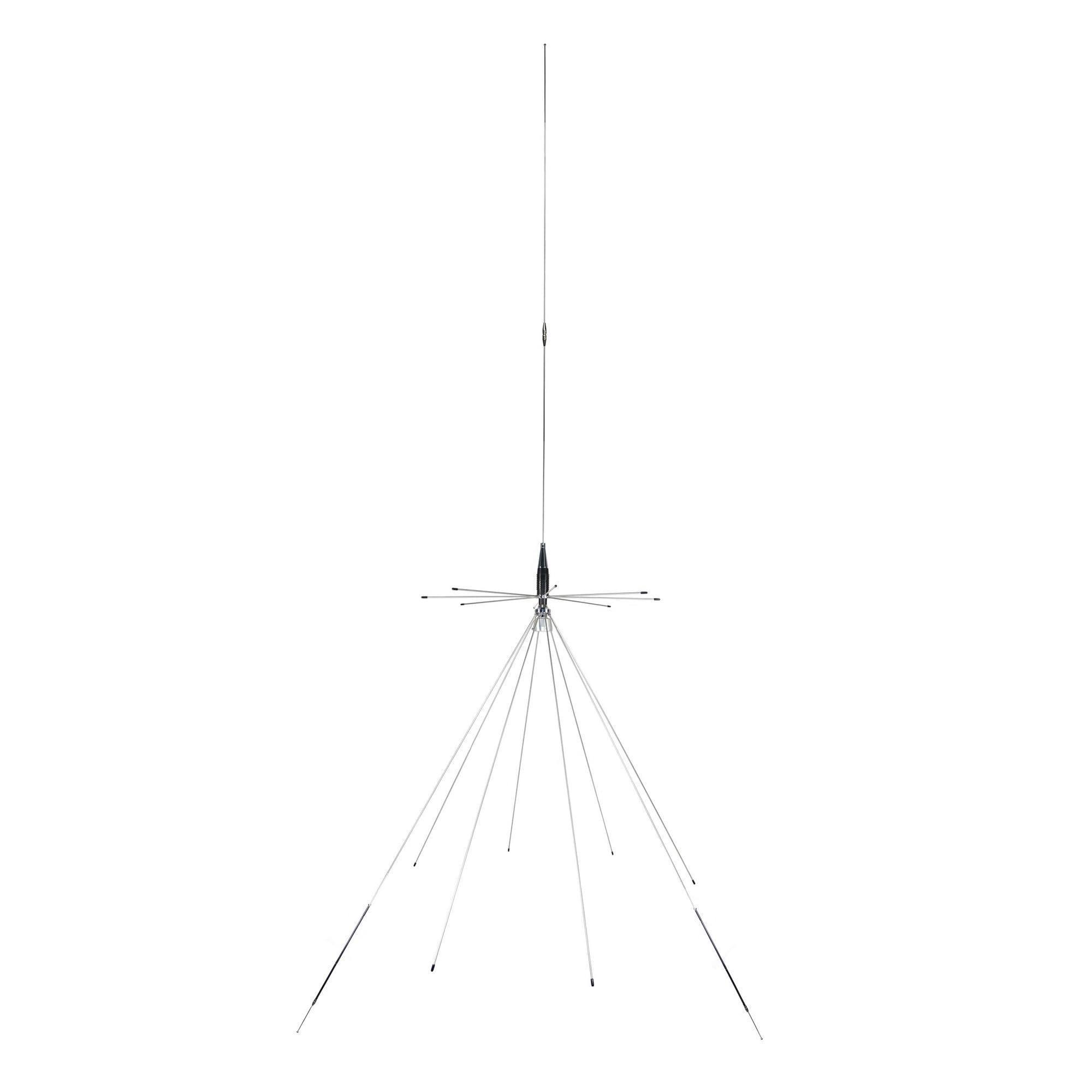
The Tram Discone covers 25 MHz to 1,300 MHz in reception and transmits on nine distinct bands including 26/27 MHz for CB, 2-meter, and 70-centimeter ham bands. The stainless steel structure uses 6 lower radials at 32 inches and 8 upper radials at 10.5 inches, creating a broadband omni pattern that doesn’t require tuning between bands.
CB SWR sits around 1.1:1 on channel 19 with careful assembly, climbing to 1.5–1.6:1 at the band edges — acceptable for 4-watt mobile use. The antenna’s wideband nature means it sacrifices some gain compared to a dedicated single-band CB vertical, but the versatility for scanner enthusiasts and amateur radio operators is unmatched in this price tier.
Assembly involves sliding radials into the cast-aluminum hub and securing with tiny set screws. Several owners report these screws are easy to lose in grass or indoor carpet, so work over a drop cloth. The SO-239 connector lacks the standard notch for PL-259 thread locks, so consider weather-sealing the connection with silicone tape.
Why it’s great
- One antenna covers CB, VHF, UHF, and scanner frequencies without switching
- Stainless steel construction resists rust in outdoor installations
- Actual SWR below 1.5:1 across most transmit bands when assembled correctly
Good to know
- SO-239 connector lacks a standard locking notch for PL-259 plugs
- Small set screws require careful handling during assembly
- Not a dedicated CB performer — gain is lower than a tuned 1/4-wave vertical
5. Retevis MB1 CB Radio Kit with Antenna
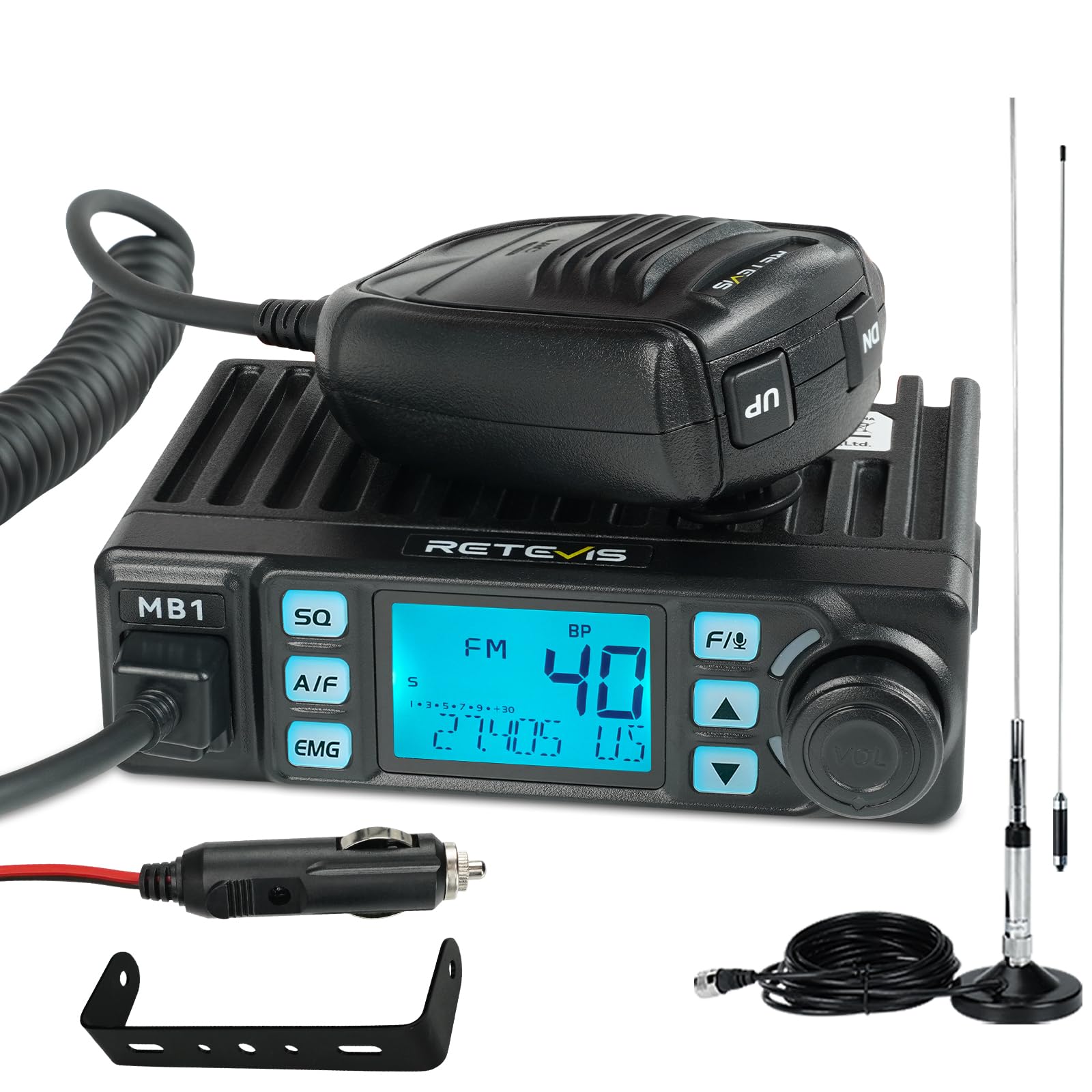
The Retevis MB1 is a complete CB ecosystem in a box: a compact 4.9×4.0x1.4-inch radio, microphone, magnetic antenna with 5-meter coax, and 12/24V cigarette lighter plug. The AM/FM capability is notable — FM mode dramatically reduces the ignition noise and alternator whine that plagues AM-only installations in modern vehicles.
The included antenna is a basic magnetic base whip sufficient for local communications up to about 6 miles under clear conditions. Users upgrading to a higher-quality external antenna report significantly better receive sensitivity, and the MB1’s ASQ, HI-CUT, and NB filters further clean up noisy channels.
The 7-color backlight screen and VOX hands-free operation add comfort for long-haul drivers. However, a small number of units have shipped with antenna sections that don’t thread together properly — test the antenna connection before mounting, as Retevis customer service has been responsive to replacement requests for that specific issue.
Why it’s great
- FM mode dramatically reduces background noise compared to standard AM CBs
- Everything needed for operation is included in one box
- Compact size fits in tight cab spaces where full-size radios won’t
Good to know
- Included antenna is entry-level — expect better range with a quality upgrade
- Antenna threading QC has been inconsistent across production batches
- Max power output is 4W per FCC limit; no internal amplifier for more range
6. Prostick 4′ Foot Fiberglass CB Radio Antenna

The Prostick 4′ fiberglass whip uses a “VibraSorb” joint between the fiberglass mast and the nickel-plated brass ferrule to absorb impacts that would shatter rigid antennas. This design makes it a favorite for off-road and trail use where low-hanging branches and brush are constant hazards.
The antenna ships electrically long — the copper wire under the red tip cap must be trimmed to achieve SWR below 2.5:1. With an SWR meter or antenna analyzer, owners report trimming about 1.5 inches of wire to land at 1.2–1.3:1 across channels 1 through 40. Running this antenna without tuning can produce SWR readings above 6:1, which will damage a transmitter’s final amplifier.
The 1000-watt power rating provides plenty of headroom for amplified setups, though the fiberglass lacks a spring base. If the whip hits a solid overhead obstacle at speed, the fiberglass absorbs the blow but may crack — treat it as a robust but not indestructible trail antenna.
Why it’s great
- VibraSorb joint reduces breakage from trail impacts and wind whipping
- 1000W rating handles amplifiers without core damage
- Made in the USA with nickel-plated brass ferrule for corrosion resistance
Good to know
- Mandatory trimming required — running untuned risks radio damage
- No spring base; tree hits at speed can still break the fiberglass mast
- No instructions included for the tuning process
7. Long Range 27MHz Heavy Duty Magnetic Base Soft Whip CB Radio Antenna Kit, Eifagur

The Eifagur kit uses a 9.9-inch soft whip on a heavy-duty magnetic base with a BNC male connector and includes a BNC-to-PL-259 adapter for compatibility with standard CB radio mounts. The RG-58U cable at 10 feet is shorter than most competitors, so plan your radio location before mounting.
The antenna is pre-tuned to the 27 MHz center frequency with a published SWR of 1.2:1, and multiple users confirm it works without adjustment for basic CB monitoring and short-range communication. The heavy magnet holds well in normal driving but may shift under extreme wind or aggressive off-camber terrain.
At only 25 cm tall, this is a low-profile option — useful for vehicles entering parking garages or automated car washes, but range is limited compared to full-length whips. It serves best as an entry-level antenna for listening to skip and local chatter, or as a backup spare tossed in the glove box for emergencies.
Why it’s great
- True no-tune operation — works immediately for receive and short-range TX
- Compact height fits under garage doors and car washes
- BNC adapter included for compatibility with handheld and mobile radios
Good to know
- 10-foot coaxial cable limits placement options in larger vehicles
- 25 cm whip provides minimal range — not suitable for serious DX work
- Magnetic hold is adequate but not as strong as premium 3.5-inch bases
FAQ
Do I need to tune a CB antenna or is it plug-and-play?
What is the best mount location on a vehicle for a CB antenna?
Why does my CB antenna need a ground plane and what happens without one?
How much does coax cable length and quality affect CB antenna performance?
Final Thoughts: The Verdict
For most users, the cb radio antenna winner is the Wilson T2000 because it delivers professional-grade power handling and proven SWR stability in a package that survives years of trucking abuse. If you want a versatile base station antenna that also covers scanner and ham bands, grab the Tram Discone. And for a completely no-tune mobile setup that works right out of the box, nothing beats the Nagoya CB-72.