
The difference between a road trip that flows and one that stalls often comes down to access. A CCS to NACS adapter bridges the plug standard gap, letting CCS1-equipped EVs plug directly into Tesla’s V3 and V4 Supercharger stalls. That means thousands of previously off-limits high-speed charging points suddenly become available, transforming the route map for Ford, Rivian, GM, Hyundai, Kia, and Volvo owners.
I’m Min — the co-founder and writer behind Gadgets Feed. I have spent countless hours analyzing the safety certifications, current ratings, connector materials, and temperature management systems across the current pool of CCS-to-NACS adapters to separate the well-engineered units from the also-rans.
This guide breaks down the eight most relevant adapters on the market right now, covering peak amperage, build quality, temperature sensor design, and real-world vehicle fit so you can find the right best ccs to nacs adapter for your specific EV and travel needs.
How To Choose The Best CCS To NACS Adapter
A CCS to NACS adapter looks simple, but the engineering inside determines whether your charge session hits full speed or gets cut short by a thermal fault. Focus on four areas: current rating, certification, temperature management, and vehicle compatibility.
Current Rating and Charging Speed
The two numbers that define an adapter’s power ceiling are its amp and voltage ratings, most commonly listed as 500A/1000V or 350A/1000V. A 500A-rated adapter can theoretically handle the peak output of V3 Superchargers that push up to 250kW. However, the actual charge rate your EV receives also depends on the vehicle’s onboard charging curve, battery pack voltage, and the Supercharger generation. An adapter with a higher rating is not automatically faster for every car, but it provides more headroom for future vehicles with higher acceptance rates.
Safety Certifications (UL 2252 and SGS)
UL 2252 is the current industry safety standard specifically for EV charging couplers and inlets. An adapter that holds UL 2252 certification has passed testing for dielectric voltage withstand, insulation resistance, temperature rise under load, and mechanical endurance. SGS certification indicates third-party verification of those same tests. Avoid adapters that list “certification in progress” or no certification at all — high DC current generates serious heat, and uncertified components carry a genuine risk of connector damage or fire.
Temperature Management and Locking Mechanisms
Heat is the primary enemy of high-current DC charging. Premium adapters embed one or more temperature sensors at the contact points. When the detected temperature exceeds a threshold, the adapter either signals the charger to reduce power (derating) or terminates the session entirely. A second cooling layer is the connector material — glass-filled nylon (PA66+GF) handles thermal expansion better than standard plastic. Mechanical interlocks on both the NACS and CCS1 sides prevent accidental disconnection during an active charge, which can arc and damage the pins or port.
Vehicle Compatibility and App Authorization
Not every CCS1 EV can talk to a Tesla Supercharger even with a physical adapter. Automakers must sign licensing agreements with Tesla to grant their vehicles Supercharger access. Currently, Ford, Rivian, GM, Volvo, Polestar, and some Hyundai/Kia models are approved. Owners of BMW, Mercedes, Lucid, and certain older CCS EVs may find that Supercharger stalls simply refuse to initiate a session. Always confirm in your vehicle’s app or with your manufacturer that Supercharger access is enabled before buying an adapter.
Quick Comparison
On smaller screens, swipe sideways to see the full table.
| Model | Category | Best For | Key Spec | Amazon |
|---|---|---|---|---|
| A2Z EV Typhoon Pro | Premium | Ford / GM / Rivian | 500A / 400A non-liquid cooled | Amazon |
| DEWALT NACS to CCS1 (500A) | Premium | Rivian & Ford road trips | 500A / IP54 weatherproof | Amazon |
| EVDANCE NACS to CCS1 | Mid-Range | Ergonomic daily use | 500A / 10k+ plug cycles | Amazon |
| LENZ NACS to CCS1 | Mid-Range | UL 2252 certified pick | 500A / SGS certified | Amazon |
| HhaadenEV NACS to CCS1 | Mid-Range | Compact travel adapter | 500A / dual temp sensor | Amazon |
| Hugener NACS to CCS1 | Mid-Range | OEM replacement option | 500A / IP67 plugged | Amazon |
| NACSTOCCS NC-01 | Value | Budget-friendly entry | 500A / 1.54 lb compact | Amazon |
| DEWALT CCS1 to NACS (350A) | Premium | Tesla at CCS chargers | 350A / 3-year warranty | Amazon |
In‑Depth Reviews
1. A2Z EV Typhoon Pro NACS to CCS1 Adapter
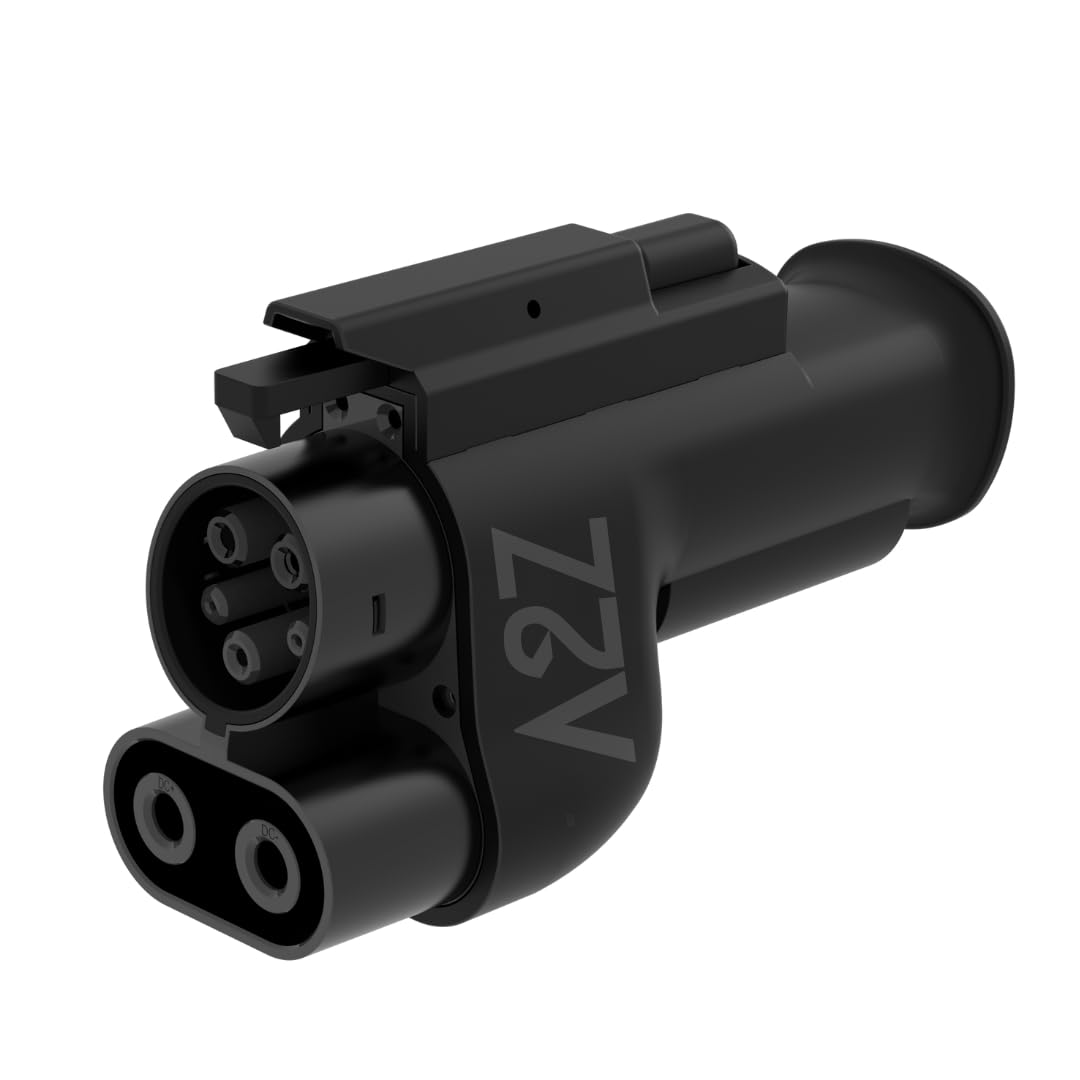
The Typhoon Pro is built around a dual-temperature-sensor architecture: the first sensor triggers power derating when it detects excessive heat at the contact interface, while the second sensor cuts the session entirely if temperatures continue climbing. That redundant safety net is rare at this tier. The enclosure uses UL-94-V0-rated PA66 with a silicon rubber sealing gasket, giving it IP67 protection on the enclosure itself and IP54 on the mating surface. It has logged more than 100 customer reviews averaging 4.6 stars, with Ford Lightning and Chevy Equinox owners reporting consistent 170kW to 180kW peak rates at V4 stalls.
Internally, silver-plated copper conductors keep contact resistance low at 5 mΩ, which translates into less resistive heating during a 30-minute high-current session. The integrated locking mechanism on both the NACS and CCS1 sides prevents accidental disconnection. Owners note the adapter runs warm — not hot — after sustained charging, and the included semi-hard travel case adds convenient storage.
The main catch is that UL2252 certification is still listed as “in progress” even though the product has passed all required tests. Tesla has not officially authorized the Typhoon Pro for its network, so users need to confirm their vehicle’s Supercharger access through their own automaker before using it. The 4.1-pound weight also makes it the heaviest adapter on this list, which some drivers find cumbersome for daily glovebox storage.
Why it’s great
- Dual temperature sensors with derating and shutdown
- Low 5 mΩ contact resistance for reduced heat buildup
- Silver-plated copper conductors inside PA66 enclosure
Good to know
- UL2252 certification not yet finalized
- 4.1-pound weight is heavy for daily carry
- Not officially authorized by Tesla for Supercharger use
2. DEWALT NACS to CCS1 Fast Charging Adapter (500A)
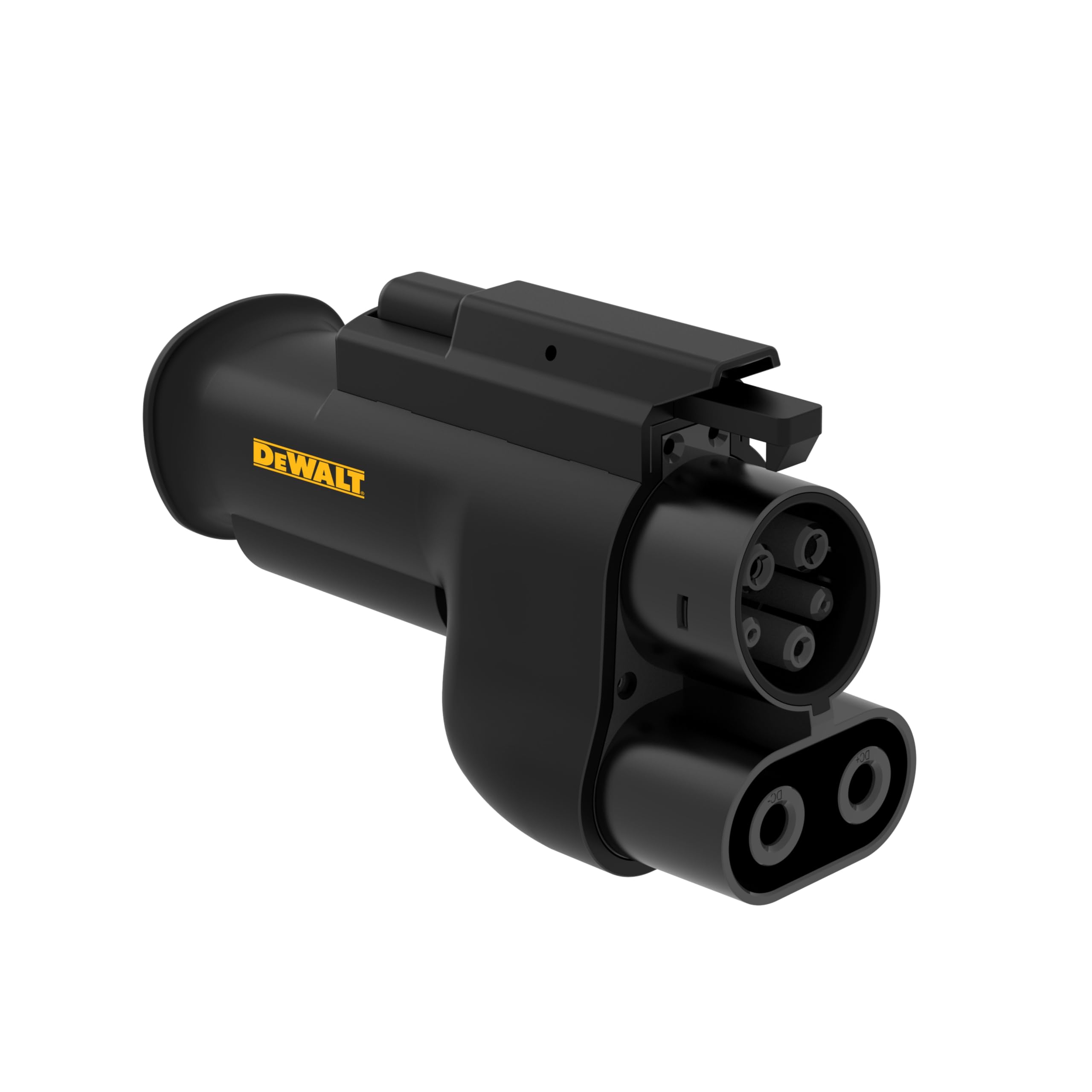
DEWALT applies its construction-tool engineering philosophy to this NACS-to-CCS1 adapter, and the result is a dense, metal-reinforced unit that feels built for years of rough handling. It is rated for 500A and 1000V, matching the full theoretical output of V3 and V4 Superchargers. The IP54-rated housing resists rain, dust, and road grime, and the operating temperature range of -22°F to 122°F covers real North American climate extremes.
Compatibility is strong: it works with Rivian R1T/R1S, Ford Mustang Mach-E and F-150 Lightning, GM EVs including the Chevy Bolt, Silverado EV, Hummer EV, Cadillac Lyriq, and Blazer EV, plus Polestar, Volvo, Nissan Ariya, Hyundai Ioniq and Kona, and Kia EVs. The adapter includes a travel bag and is backed by a 3-year limited warranty with 24/7 technical support from DEWALT — a warranty period that doubles most competitors.
The release mechanism requires some user acclimatization. Multiple owners report that disconnecting the adapter from the Tesla handle demands pressing both the Tesla cable button and the adapter release latch at the same time. The process is not documented in the packaging, which leads to initial frustration. Additionally, the 1.56-kilogram weight reflects the rugged construction, but it is heavier than compact alternatives.
Why it’s great
- 3-year limited warranty with 24/7 support
- IP54 weatherproof housing for all-season use
- 500A rating compatible with V3/V4 Superchargers
Good to know
- Disconnect process is not intuitive at first
- Heavier than most compact alternatives
- Does not support Audi, BMW, Mercedes or Lucid
3. EVDANCE NACS to CCS1 Adapter with Interlock
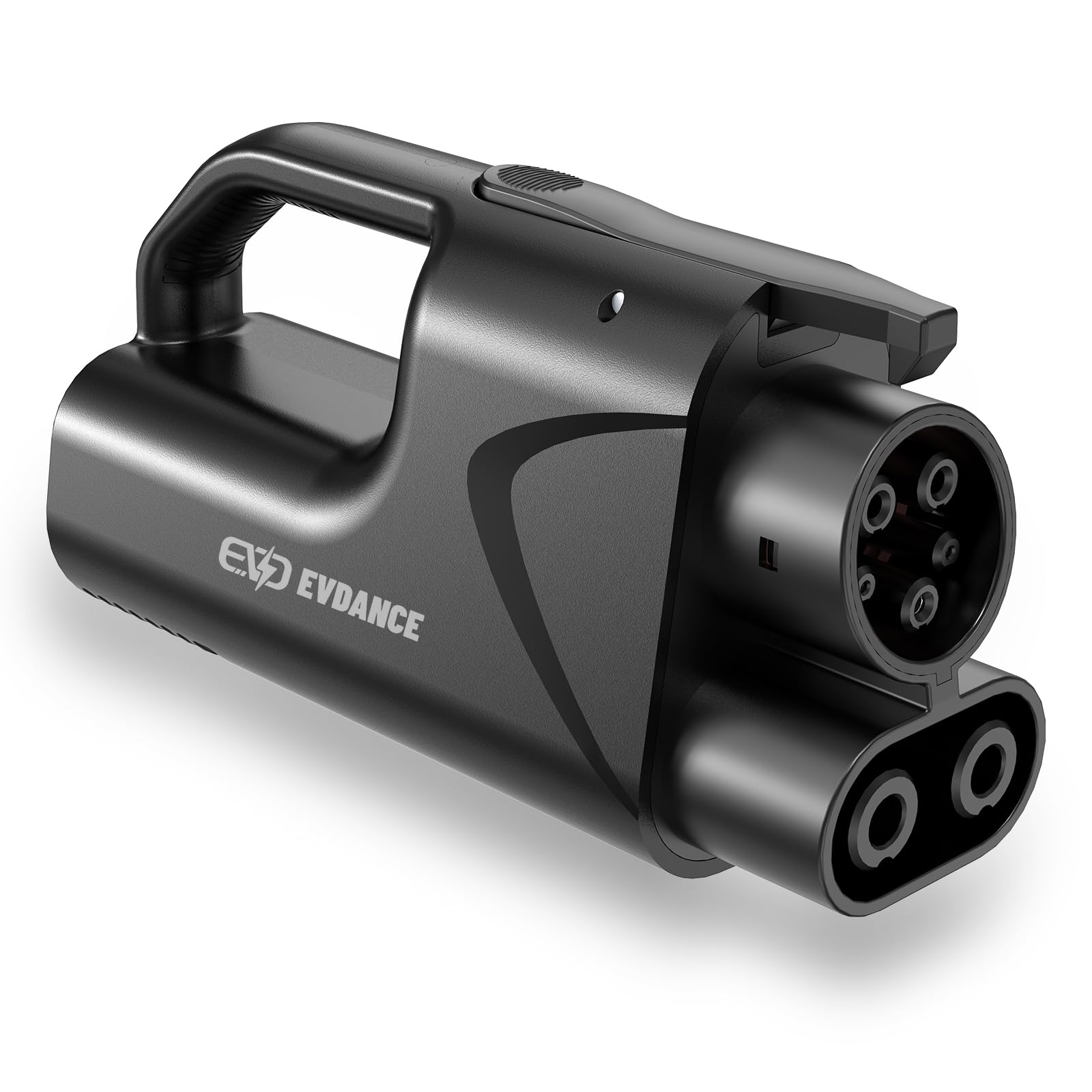
EVDANCE focused on the physical interaction between driver and adapter. The patented slip-resistant handle is contoured for a secure grip, even with wet or gloved hands, and the unit has been tested for over 10,000 insertion and extraction cycles. The PA66+25%GF glass-reinforced enclosure provides structural rigidity that resists flexing under the force of plugging into a stiff Tesla cable at a V3 stall.
The adapter carries a 500A current rating and 1000V voltage rating, and the IP65 seal protects against low-pressure water jets and dust ingress. Compatible vehicles include Ford (Mustang Mach-E, F-150 Lightning, E-Transit), Rivian R1T/R1S/R2/R3, GM models, Volvo, Polestar, Nissan, Mercedes, Lucid, Kia EV6, and Hyundai Kona. The package includes a rugged travel case with internal padding.
Owners with a 2026 Chevy Equinox and 2025 Kia Nero report seamless charging initiation and stable current flow. The interlock mechanism makes disconnection less fiddly than some competition, but the adapter is not compatible with Ford PHEVs, the 2012–2016 Ford Focus Electric, or the 2013–2016 Chevy Spark EV. It also does not support AC Level 1 or Level 2 home charging.
Why it’s great
- Slip-resistant ergonomic handle design
- 10,000+ plug cycle durability testing
- IP65 dust and water jet protection
Good to know
- Not compatible with certain older EVs or PHEVs
- Does not support AC Level 2 home charging
- Limited user reviews available at launch
4. LENZ NACS to CCS Electric Vehicle Adapter
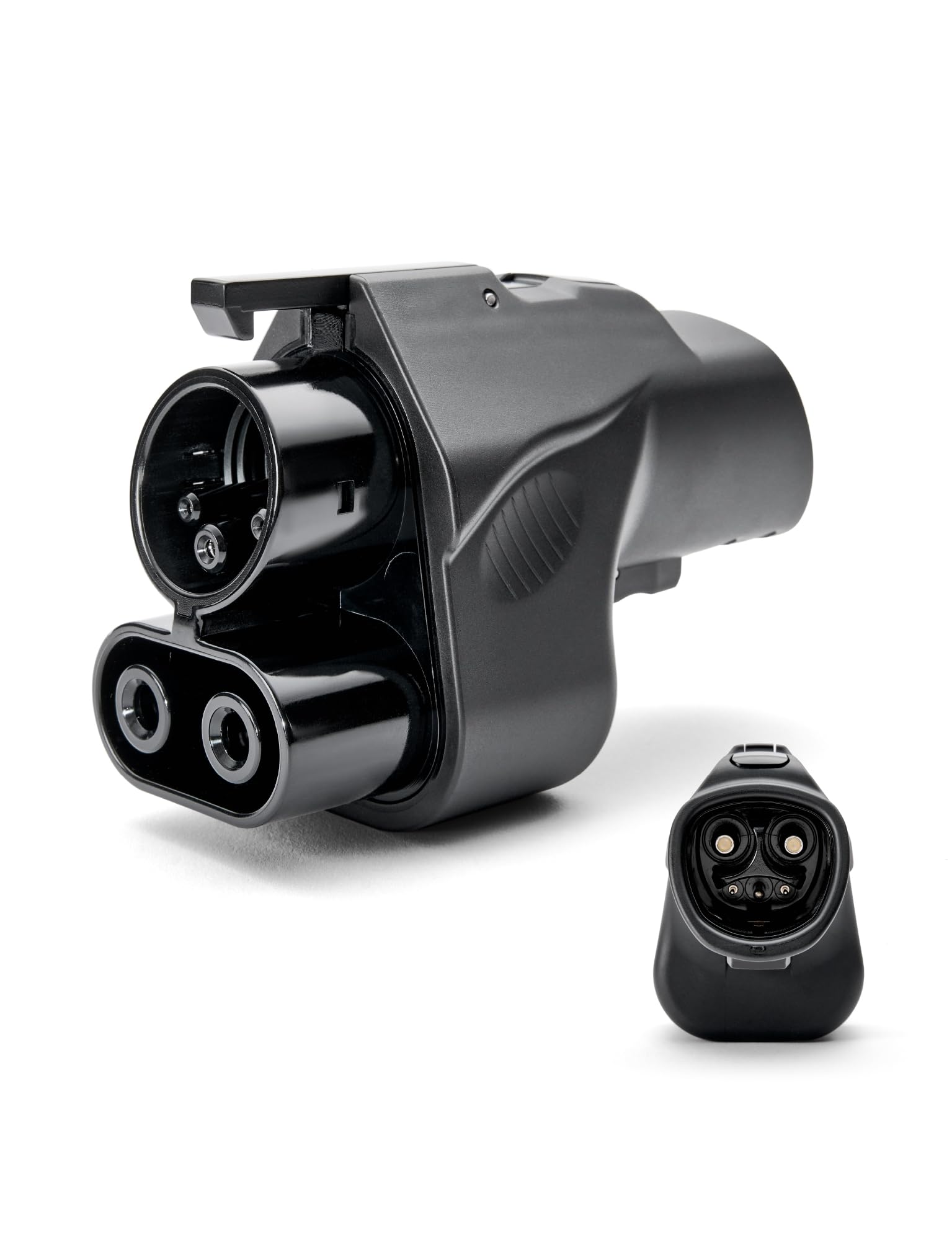
LENZ is one of the few brands in this comparison that can claim SGS certification for ANSI/CAN/UL 2252 compliance. That third-party verification covers dielectric withstand, insulation resistance, temperature rise under rated current, and mechanical endurance. For buyers who prioritize safety certification above all else, the LENZ adapter offers verified peace of mind at a mid-range price.
The physical design includes functional latches on both the NACS and CCS1 sides, precision-molded connectors, and a compact profile that measures 6 x 4.75 x 2.8 inches. It weighs just 1.63 pounds, making it one of the lighter 500A-rated adapters available. The included semi-hard zippered carrying case is well-padded and sized to fit in a door bin or under a seat.
Owners using the adapter with a Volkswagen ID.4 and Chevy Blazer EV report zero overheating issues after months of regular use. The main limitation is that LENZ specifically warns the adapter works only with CCS1 EVs that have been granted Supercharger access by Tesla. It is not compatible with all CCS1 vehicles, and buyers must verify eligibility through their automaker’s app before purchase.
Why it’s great
- SGS certified for UL 2252 compliance
- Lightweight at 1.63 pounds
- Functional latches on both connector sides
Good to know
- Vehicle Supercharger eligibility must be pre-verified
- Not compatible with Level 1 or Level 2 chargers
- Limited to CCS1 EVs with Tesla network access
5. HhaadenEV NACS to CCS1 Adapter
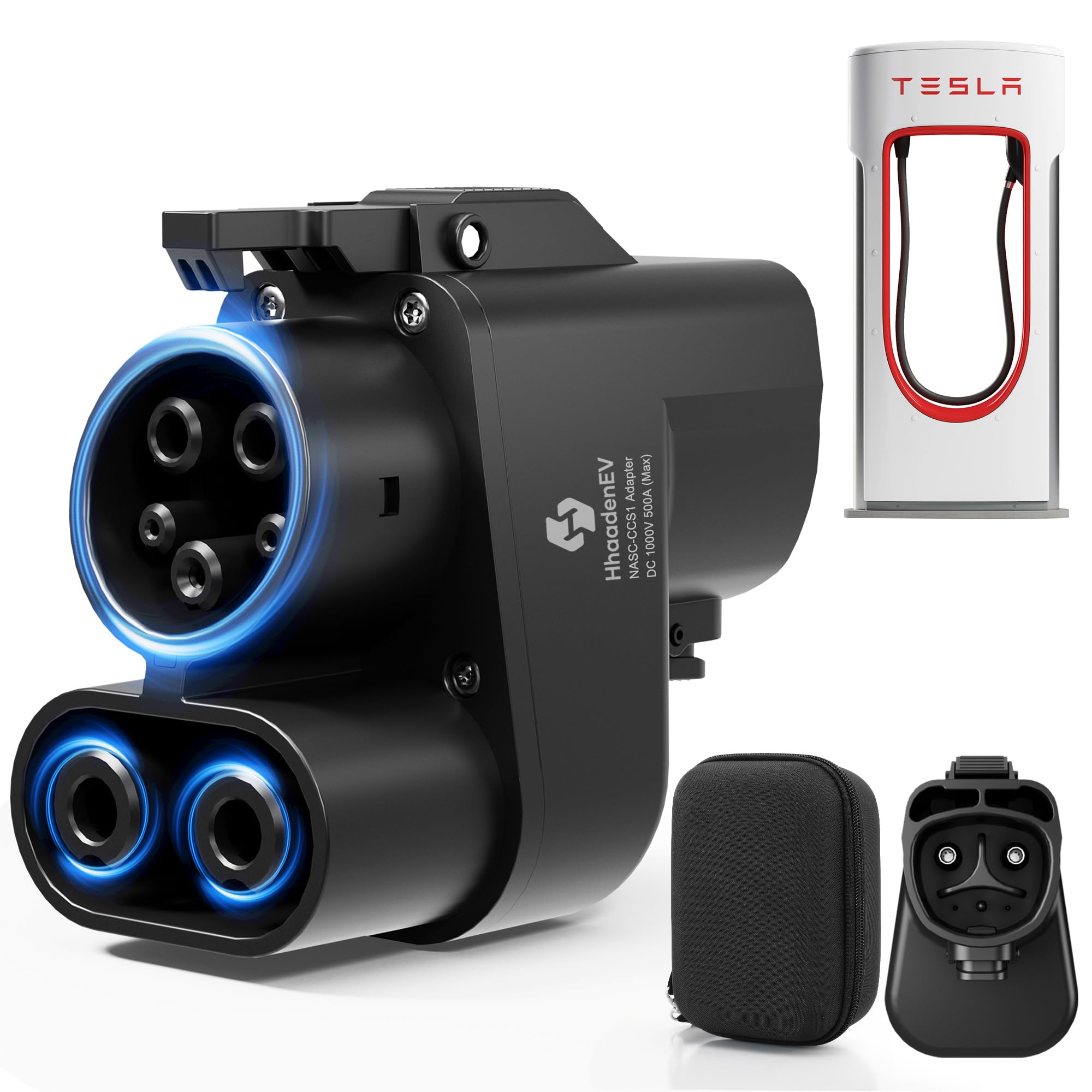
The HhaadenEV adapter stands out for its automatic temperature control system that uses dual internal sensors. When the connector temperature reaches 194°F, charging is halted entirely — not just derated — which provides a hard stop against thermal runaway. The improved connector design also increases physical tightness at the coupling point, reducing the micro-movement that can generate contact wear over time.
Rated for 1000V and 500A DC, this adapter covers the current and future power ceiling of V3 Superchargers. It is built with load-resistant, waterproof, and flame-retardant construction. The compact form factor and lightweight build make it glovebox-friendly, and the inclusion of a travel case adds protection during storage.
The critical limitation is that this adapter works exclusively on Tesla V3 Superchargers and compatible V4 posts. It will not function on V1/V2 stations or any AC home charger or wall connector. A VW ID.4 owner reported charging from 50% to 100% in 29 minutes, indicating consistent power delivery. The adapter is not compatible with plug-in hybrid EVs or model years before 2016.
Why it’s great
- Dual temperature sensors with hard shutdown at 194°F
- Improved connector tightness for stable coupling
- Compact and lightweight for glovebox storage
Good to know
- Compatible only with V3/V4 Superchargers
- Does not support V1/V2 or AC charging
- Not compatible with PHEVs or pre-2016 EVs
6. Hugener 2025 NACS to CCS1 EV Charging Adapter
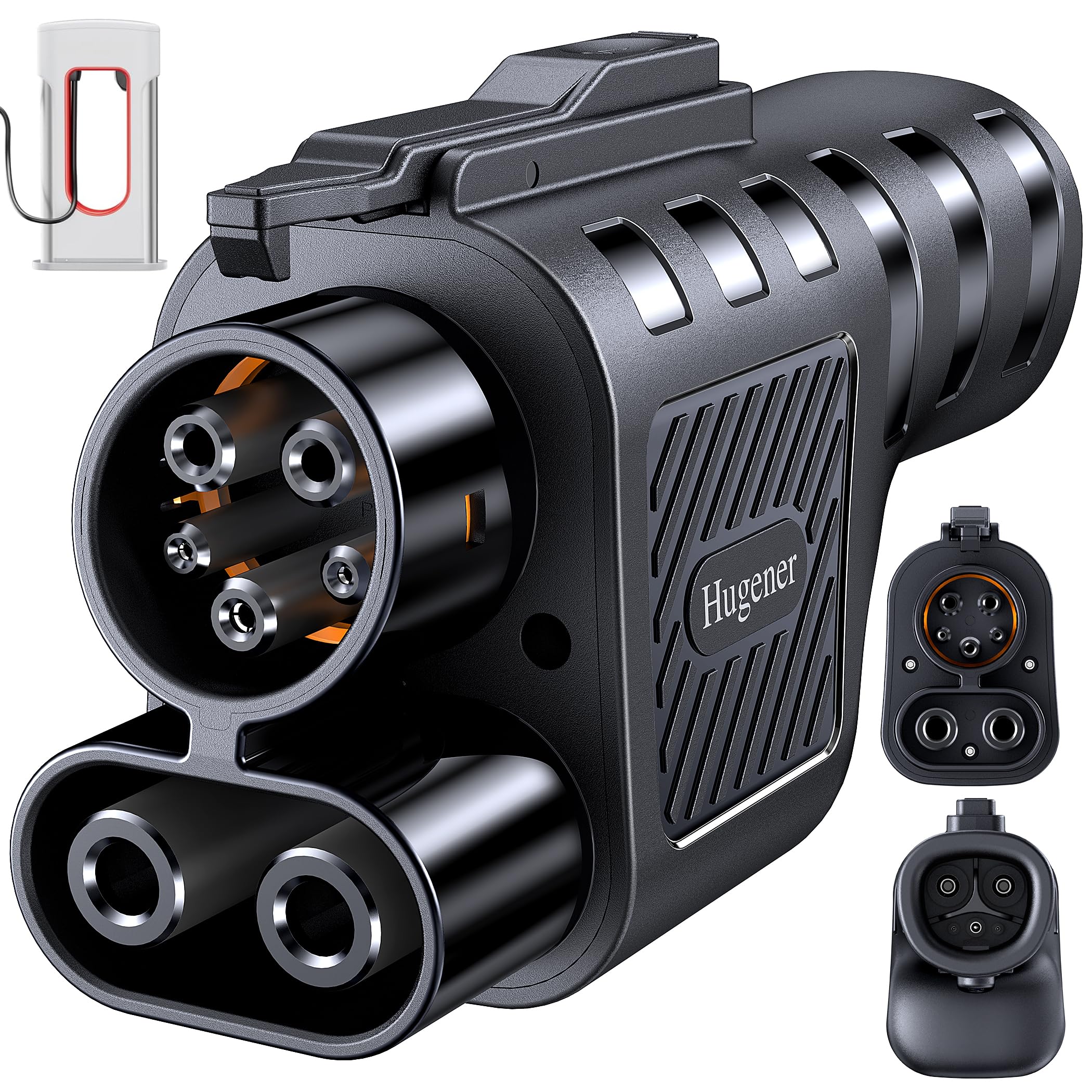
Hugener packs three temperature sensors into this adapter — one at the plug, one at the cable interface, and one at the internal chip — plus an auto-power adjustment system that reduces current before overheating can occur. The claimed IP67 waterproof rating when plugged means the adapter can survive immersion in shallow water, which is valuable for drivers who charge in heavy rain or snow. The operating temperature range spans -30°C to 50°C.
The auto-lock system secures both the NACS and CCS1 sides with independent locking mechanisms, preventing accidental disconnection during a high-amperage session. The connector design uses a vortex plug that fits securely into the Tesla handle. Compatibility extends to Ford, GM, Rivian, Hyundai Ioniq 5/6, Kia EV6/EV9, Volvo XC40/C40/EX30/EX90, Polestar 2/3/4, Lucid Air/Gravity, Nissan Ariya, and Honda Prologue.
One verified owner using a Cadillac Lyriq reported excellent charging speeds and solid build. However, a separate report from a GMC owner noted the adapter capped charging at 154kW at a Tesla Supercharger, below the 250kW capability of the station. This suggests the adapter’s thermal management may be conservative on certain vehicle-station combinations. It only works with Tesla V3 and V4 stalls — not V1/V2 or AC charging.
Why it’s great
- Three-sensor temperature monitoring system
- IP67 waterproof rating when plugged
- Dual auto-lock for NACS and CCS1 sides
Good to know
- Some users report speed capping below 250kW
- Compatible only with V3/V4 Superchargers
- Not compatible with Tesla EVs or AC charging
7. NACSTOCCS NC-01 NACS to CCS1 Adapter
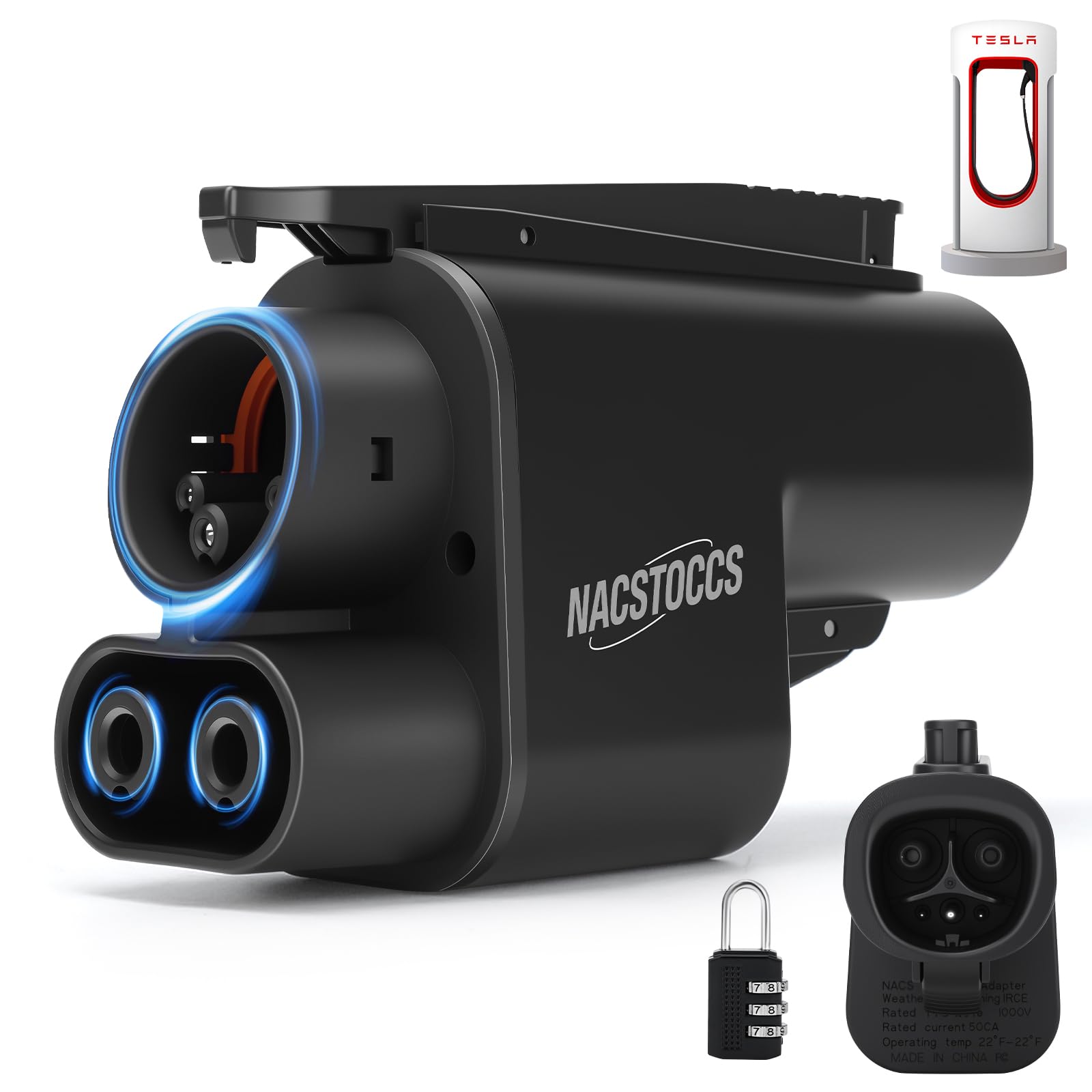
The NACSTOCCS NC-01 is the lightest adapter in this lineup at just 1.54 pounds, with dimensions of 7.48 x 5.51 x 3.94 inches that fit easily into a center console or under-seat storage. Despite the entry-level price point, it carries a full 500A/1000V rating, matching the specifications of adapters costing significantly more. It opens access to over 16,000 Tesla Supercharger stations for CCS1-compatible EVs.
Compatibility covers Ford models (Mustang Mach-E, F-150 Lightning, E-Transit), Rivian R1T/R1S/R2/R3, GM EVs, Volvo, and Polestar. The adapter uses a plug-and-play setup: connect the adapter to the vehicle port first, then engage with the Tesla Supercharger handle. Owners using a Rivian R1T and Ford Mach-E at V3 and V4 stations report peak charge rates of approximately 215kW and 150kW respectively, with stable current and no error flags.
The adapter is not compatible with Ford plug-in hybrid vehicles, the 2012-2016 Ford Focus Electric, or the 2013-2016 Chevy Spark EV. It also requires that the vehicle’s Tesla protocol update be installed for full functionality. Some owners note the adapter runs warm after extended 25-minute sessions, though within safe operating parameters. The lack of an external temperature readout or certified safety listing may be a concern for cautious buyers.
Why it’s great
- Very lightweight and compact at 1.54 pounds
- 500A/1000V rating at an entry-level price
- Real-world peak rates of 215kW with Rivian R1T
Good to know
- Not compatible with PHEVs or older model EVs
- No external safety certification listed
- Vehicle must have latest Tesla protocol update
8. DEWALT CCS1 to NACS Fast Charging Adapter (350A)
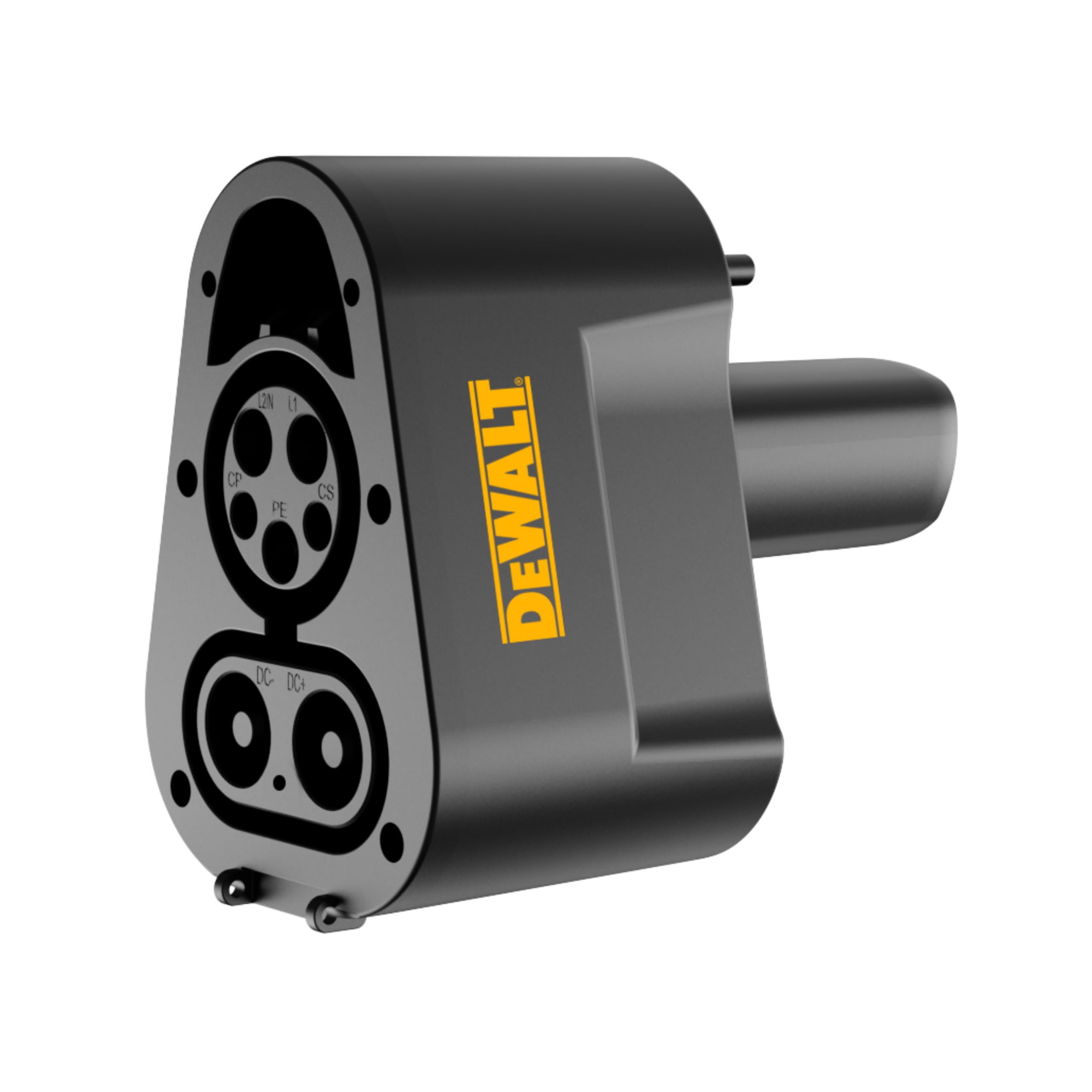
This DEWALT adapter reverses the usual current direction: it is designed for Tesla Models 3, S, X, and Y (2021 and newer, excluding Cybertruck) to charge at third-party Level 3 DC fast chargers with CCS1 connectors. The 350A/1000V rating aligns with what most non-Tesla DC fast chargers can deliver, and the IP54-rated exterior protects against rain, dust, and road spray during a charge session at an EVgo or Electrify America station.
The construction feels characteristically DEWALT — dense, solid, and over-engineered. The adapter operates from -22°F to 122°F, which covers the practical temperature range for all-season road trips. It includes a travel bag for protection and is backed by a 3-year limited warranty and 24/7 technical support. A 2024 Model 3 owner reported seamless integration with EVgo’s Autocharge feature, eliminating the need to use the app or touchscreen to start a session.
The primary drawback is the tight fit. Multiple owners report that the adapter is difficult to disconnect from the charging handle due to a very snug connection. The process requires pressing the handle button and wiggling the adapter free, which can be frustrating in a rush. One owner with a 2023 Nissan Ariya found the adapter did not work at all — the Tesla charging head got stuck and the session never initiated — and noted that Tesla provides no support for third-party adapters.
Why it’s great
- Built for Tesla owners accessing CCS DC fast chargers
- 3-year limited warranty from DEWALT
- Works with EVgo Autocharge for app-free sessions
Good to know
- Very tight connection makes disconnection difficult
- Reported incompatibility with some EV models
- 350A rating is lower than 500A alternatives
FAQ
Will a CCS to NACS adapter work with any Tesla Supercharger station?
Can I use a 500A adapter on a car that only charges at 150kW max?
Do I need to update my EV’s software before using one of these adapters?
Is there a difference between a NACS to CCS1 adapter and a CCS1 to NACS adapter?
Final Thoughts: The Verdict
For most users, the best ccs to nacs adapter winner is the A2Z EV Typhoon Pro because its dual-temperature-sensor safety architecture and silver-plated copper conductors provide the most thorough thermal management at this stage of the market. If you want a warranty-backed unit from a proven tool brand, grab the DEWALT NACS to CCS1 500A. And for verified third-party UL 2252 certification at a fair price, nothing beats the LENZ adapter.