
A dedicated CD player isn’t a relic—it’s a sonic upgrade. Streaming services compress audio to save bandwidth, robbing your favorite albums of their dynamic range and detail. A quality home CD player unlocks the full 16-bit/44.1kHz uncompressed sound that was always on the disc, transforming your listening room into a private concert hall where every instrument breathes.
I’m Min — the co-founder and writer behind Gadgets Feed. I spend hundreds of hours analyzing technical specifications, reading deep into service manuals, and cross-referencing real user reports to separate durable designs from components prone to early failure.
Whether you miss the ritual of a full album listen or want to hear your music as the artist intended, choosing the right best cd player for home demands a clear understanding of DAC quality, connectivity, and build reliability.
How To Choose The Best CD Player For Home
Not all CD players sound the same. The transport mechanism, digital-to-analog converter (DAC), and output stage each influence the final sound you hear. Understanding these layers helps you pick a model that matches your audio standards.
DAC Architecture: The Heart of the Sound
The DAC chip converts the digital 0s and 1s on the disc into an analog signal your amplifier can use. Entry-level players often use basic multibit converters that can introduce jitter. Mid-range and premium models from Yamaha, Denon, and Cambridge Audio incorporate high-performance DACs like the Burr-Brown PCM series or proprietary upsampling algorithms such as AL32, which reconstruct missing data points to smooth the waveform. If you plan to connect via optical to an external DAC, the player’s internal converter still matters for standard RCA output—always check the signal-to-noise ratio (SNR) and total harmonic distortion (THD) figures.
Mechanical Stability and Vibration Damping
A sturdy chassis does more than look premium. The laser pickup must read the spiral data track with micron-level precision. Vibrations from the motor spinning the disc or from nearby speakers can cause read errors, leading to skipping or “disc error” messages. Manufacturers like Denon use “Direct Mechanical Ground Construction,” bolting the power transformer to the chassis to redirect vibrations away from the transport. Cambridge Audio and Yamaha employ floating mechanisms and heavy steel base plates to isolate the optical pickup. A lighter plastic unit placed on a resonant shelf is far more likely to struggle with scratched or CD-R discs over time.
Connectivity and Format Support
Consider how the player fits into your existing system. RCA stereo outputs are standard, but digital outputs (optical Toslink and coaxial) are essential if you want to bypass the internal DAC and use a separate high-end DAC. Front-panel USB ports allow playback of FLAC, WAV, and MP3 files from flash drives. For standalone players, the ability to read CD-R/RW and MP3-encoded discs expands your library. If you prefer an all-in-one solution, a mini-system with built-in amplifier, speakers, Bluetooth, and FM radio eliminates the need for separate components, though the DAC and amplifier quality typically fall short of a dedicated component system at the same price.
Quick Comparison
On smaller screens, swipe sideways to see the full table.
| Model | Category | Best For | Key Spec | Amazon |
|---|---|---|---|---|
| Yamaha CD-S303 | Single Player | Dedicated hi-fi integration | Burr-Brown DAC + Pure Direct mode | Amazon |
| Denon DCD-600NE | Single Player | AL32 processing purist | Direct Mechanical Ground Construction | Amazon |
| Cambridge Audio AXC35 | Single Player | Near-analog warmth on a budget | THD < 0.01% @ 1kHz | Amazon |
| Panasonic SC-PM700PP-K | Mini System | Compact all-in-one with bass control | 80W RMS + Bass/Treble knobs | Amazon |
| Philips TAM8905/37 | Mini System | Wi-Fi streaming + CD flexibility | 100W + Spotify Connect & Internet Radio | Amazon |
| Denon D-M41 | Mini System | Amplifier + speakers + CD in one box | 30W/ch + silk dome tweeters | Amazon |
| Bose Wave Music System IV | Tabletop System | Room-filling single-box simplicity | Waveguide technology + dual alarms | Amazon |
| LONPOO LP-609BT | Mini System | Budget retro-style entry point | 100W Hi-Fi + DSP + Bluetooth 5.3 | Amazon |
| Tovlroy CDA-A6 | Portable/Utility | CD ripping + car stereo use | WAV ripping to USB + Bluetooth Tx/Rx | Amazon |
In‑Depth Reviews
1. Yamaha CD-S303 Single CD Player

The Yamaha CD-S303 is the gold standard for anyone who wants a dedicated, reliable transport that integrates seamlessly into an existing hi-fi system. Its Burr-Brown DAC delivers a natural, open soundstage with low noise floor, and the Pure Direct mode bypasses the digital display and output buffer to reduce interference—resulting in a cleaner analog signal through the RCA outputs. Front-panel USB port plays FLAC, WAV, AAC, and MP3 files, giving you flexibility beyond physical discs.
Owners consistently praise the solid aluminum front panel and the smooth, quiet disc tray mechanism—a stark contrast to the flimsy plastic trays found on cheaper units. The coaxial and optical digital outputs allow you to use an external DAC if you later upgrade your system, making this a future-proof hub for your digital audio chain. Firmware updates via USB can fix disc-reading quirks, which has resolved problems with commercial CD-Rs in some units.
Perhaps the most impressive detail is the load mechanism’s laser pickup floating design: it physically damps vertical vibrations from the spinning disc, reducing read errors on scratched media. This is the reason users report the S303 handling discs that skip in other players. If you want no-compromise Redbook playback at a mid-range price, this is the player to beat.
Why it’s great
- High-performance Burr-Brown DAC with Pure Direct mode
- Excellent vibration-damped transport mechanism
- USB front port for FLAC/WAV digital file playback
- Optical and coaxial digital outputs for external DACs
Good to know
- No 3.5mm headphone jack on front panel
- No resume playback after power loss
- Built-in DAC is adequate, not elite—external DAC unlocks full potential
2. Denon DCD-600NE Compact CD Player

Denon’s DCD-600NE brings proprietary AL32 Processing to the affordable hi-fi segment—a multi-bit digital filter that interpolates missing samples to reconstruct a waveform closer to the original analog master tape. The result is a texture and decay in cymbals, piano notes, and vocal reverb that sounds less “digital” than typical budget DACs. Pair this with Denon’s Direct Mechanical Ground Construction, where the power transformer is physically anchored to the chassis floor to direct micro-vibrations away from the pickup mechanism, and you have a player built for longevity and pristine tracking.
The unit reads CD, CD-R/RW, MP3, and WMA discs, and its display shows artist and song-title metadata when present on CD-TEXT discs. The remote control includes Pure Direct and Random Play buttons, though these functions are conspicuously absent from the front panel. Users switching from older Onkyo or Sony models frequently note that the DCD-600NE manages to play discs that previously exhibited “Can’t Read Disc” errors—a testament to its more forgiving laser assembly and error-correction firmware.
Optical and coaxial outputs are present for users who want to bypass the internal DAC with a higher-end processor, but the AL32 circuit is strong enough that most owners are satisfied using the standard RCA outputs into their integrated amplifier. The slim 4.2-inch chassis allows it to slide into tight shelving, and the weight (8.6 pounds) hints at the robust transformer and bracing inside. It’s the choice for the listener who values computational audio correction and mechanical isolation over flashy features.
Why it’s great
- Proprietary AL32 Processing for smoother digital-to-analog reconstruction
- Vibration-resistant chassis design improves disc reading reliability
- Plays skipping discs that fail in other players
- Optical and coaxial outputs provide digital flexibility
Good to know
- Remote is required for Random Play and Pure Direct toggles
- Remote not backlit for dark listening rooms
- Some reports of early laser failure; extended warranty recommended
3. Cambridge Audio AXC35 CD Player

Cambridge Audio’s AXC35 is a no-frills dedicated player that prioritizes sonic purity above all else. With a signal-to-noise ratio exceeding 93dB and total harmonic distortion below 0.01% at 1kHz, the analog output stage is exceptionally clean—free from the grain and hash that plagues entry-level transports. The transport mechanism itself is a top-loading tray that opens and closes with a damped, mechanical precision that feels expensive even at this price point.
The built-in DAC produces a warm, near-analog signature that owners consistently describe as “liquid” and “musical”—qualities that make long listening sessions less fatiguing. It reads CD, CD-R, CD-RW, and MP3 discs, though users report that heavily scratched CD-Rs can be finicky compared to the Denon or Yamaha units. The absence of USB playback and headphone jack keeps the signal path simple, which is exactly what purists want.
At 9.5 pounds, the AXC35 has substantial heft from its toroidal transformer and steel chassis, both of which help reject external vibration. The coaxial digital output lets you use an outboard DAC down the road, but most owners find the onboard conversion so satisfying that they never bother. If you value a simple, beautiful audio tool that makes CDs sound analog and rich, this is your player.
Why it’s great
- Exceptionally low THD (<0.01%) for pristine analog output
- Heavy steel chassis and toroidal transformer reduce vibration
- Warm, analog-like sound signature reduces fatigue
- Build quality that rivals far more expensive players
Good to know
- Fussy with scratched CD-R discs
- No USB port, headphone jack, or display metadata
- Remote feels cheap relative to the player’s build
4. Panasonic SC-PM700PP-K Compact Stereo System

The Panasonic SC-PM700PP-K squeezes serious performance into a small footprint. Rated at 80W RMS (40W per channel), the system drives large 10cm woofers and 6cm tweeters housed in bass-reflex cabinets, delivering a fullness that defies its dimensions. The CD mechanism loads quickly and reads CD, CD-R, and CD-RW discs without hesitation, while the FM tuner with 30 presets and Bluetooth connectivity round out a capable all-in-one package.
Physical bass and treble knobs let you dial in the perfect tone for your room without diving into menus—a tactile advantage over digital-only systems. Panasonic’s Sound Remastering Technology cleans up distortion in compressed digital files, but the real star is how cleanly the analog section handles Redbook CDs. Users coming from budget no-name brands immediately notice the absence of background hiss and the solid bass extension even at low volumes.
The front headphone jack is a welcome addition for late-night listening, and the included remote controls all major functions. It runs warm after extended use at high volumes, which is typical for compact class-AB amplifiers. If you want a single, tidy system with no separate amp or speakers to match, the PM700 delivers controlled, articulate sound that fills a living room without dominating it.
Why it’s great
- Clean 80W RMS output with dedicated bass/treble physical controls
- Fast-loading CD tray with reliable CD-R/RW playback
- Compact footprint with front headphone jack for private listening
- Seamless Bluetooth pairing and “My Sound” presets
Good to know
- Labels on controls are tiny and hard to read in low light
- Reports of CD playback failure after 2 days in a small number of units
- Not powerful enough to rattle windows in large open-plan rooms
5. Philips TAM8905/37 Bluetooth & WiFi Stereo System

The Philips TAM8905/37 is the most versatile all-in-one on this list, integrating CD playback with Wi-Fi streaming, Spotify Connect, Internet Radio, FM radio, USB playback, and Bluetooth. Its 100W of total power drives dual 5.25-inch woofers with bass-reflex ports and dome tweeters, producing sound that fills a large kitchen or open-plan living area with authority. The color display shows album art—a rare and welcome feature for a CD mini-system.
The CD transport reads all standard formats and loads silently. The real advantage here is the Wi-Fi radio: you can leave CDs aside for daily listening and stream lossy or high-res tracks from your network, then pull out a physical album for dedicated listening sessions. The matte aluminum central unit looks sophisticated next to bookcases or kitchen counters, and the included remote is logically laid out with dedicated source buttons.
Setup requires connecting the speakers to the receiver with spring-clip terminals, which some users found fiddly but is standard for this class. Bluetooth performance is solid up to 30 feet, though some users note that the Bluetooth input sounds slightly less dynamic than direct CD playback—a common compromise due to the codec compression. If you want a single system that does it all without sacrificing the CD experience, the TAM8905 is the one.
Why it’s great
- Wi-Fi streaming with Spotify Connect and Internet Radio alongside CD playback
- Color display shows album art and metadata
- Powerful 100W output with 5.25-inch woofers for room-filling sound
- Premium matte aluminum and wood cabinet aesthetic
Good to know
- Speaker-to-receiver cable connection is fiddly with spring clips
- Bluetooth input sounds less dynamic than CD or AUX
- Heavier unit (22 pounds) for wall-mount or shelf placement
6. Denon D-M41 Home Theater Mini Amplifier and Bookshelf Speaker Pair

The Denon D-M41 is the complete package: a CD player, AM/FM tuner, Bluetooth receiver, integrated amplifier, and a pair of SC-M41 bookshelf speakers. At 30 watts per channel, it won’t shatter windows, but the sound is clean, detailed, and surprisingly authoritative thanks to the 4.75-inch woofers and 1-inch silk dome tweeters. The triple noise reduction design isolates the power supply, digital processing, and analog output stages to prevent internal interference.
CD playback is Denon-refined: fast loading, stable tracking, and the same AL32 processing found in the DCD-600NE effectively stretches low-bitrate files into smoother waveforms. The headphone amplifier is a dedicated circuit (not just a resistor dropped on the speaker output), delivering a clean signal to sensitive headphones. Bluetooth streaming pairs easily with iOS and Android, and the FM antenna included in the box gives analog radio a solid presence.
Several users note that adding a small subwoofer (via the pre-out) completes the experience, especially for rock and electronic genres where sub-50Hz bass is needed. The D-M41 is the go-to for anyone who wants a single-brand, matched system that fits on a bookshelf and sounds dramatically better than a soundbar or Bluetooth speaker. It’s the most straightforward path to genuine hi-fi for CD lovers in a small or medium room.
Why it’s great
- True matched system: amplifier, speakers, and CD transport engineered together
- Dedicated headphone amplifier with clean output
- Triple noise reduction for low background hiss
- Subwoofer pre-out for future bass expansion
Good to know
- 30W/ch may be insufficient for large rooms at high volume
- No USB port for digital file playback from flash drives
- Distortion sets in near maximum volume on demanding tracks
7. Bose Wave Music System IV (Renewed)

The Bose Wave Music System IV is the single-box solution that changed how people think about tabletop audio. Its patented waveguide technology fires the rear wave from the speaker driver through a folded, tuned labyrinth, reinforcing bass response far deeper than the 4.5-inch tall cabinet should allow. The result is room-filling, lifelike sound without separate speakers—ideal for kitchens, bedrooms, or offices where clutter is unwelcome.
This renewed unit includes a CD/MP3 player, advanced AM/FM tuner with text display, and a dual-alarm clock function. The touch-top surface controls play, volume, and snooze with capacitive sensitivity. The slim remote stores 12 presets and offers full control over the entire system. An optional Bluetooth adapter can be added for wireless streaming, but the unit itself has a standard 3.5mm aux input for wired connections.
Note that Bose no longer manufactures the Wave System IV new; this renewed model has been inspected by a third party to function like new. Long-time owners resoundingly praise the sound as “exceptional” and “out of this world.” If you value a compact, stylish unit that sounds far bigger than it looks, and you don’t need multi-component separation, this is the definitive tabletop CD system.
Why it’s great
- Patented waveguide technology delivers deep bass from a single small cabinet
- Room-filling sound quality with wide soundstage
- Integrated dual alarm clock with touch-top snooze
- Refurbished units from Bose-certified vendors are reliable
Good to know
- No built-in Bluetooth—requires optional adapter for wireless streaming
- Renewed unit, not brand-new from factory
- Single-box design limits stereo separation compared to separate speakers
8. LONPOO LP-609BT Bookshelf System
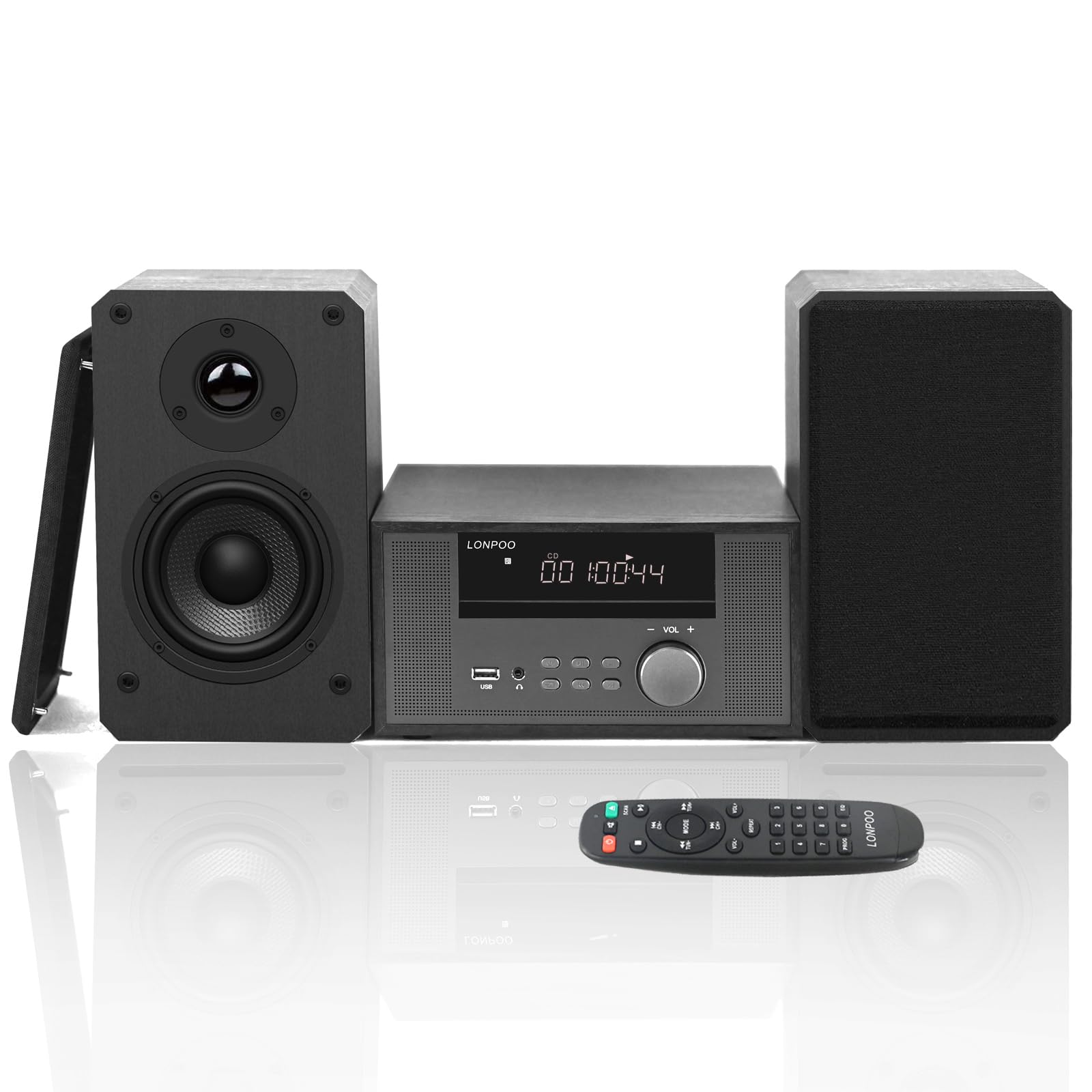
The LONPOO LP-609BT brings retro aesthetics and modern connectivity to the mid-range mini-system category. Its wood-textured cabinet and dark gray aluminum panel evoke classic 70s hi-fi, while the white LED display and large rotary knob keep operation intuitive. Rated at 100W total output, the 2-way speakers with 1-inch silk dome tweeters and 4-inch rubber woofers deliver a warm, forgiving sound that pairs well with spoken word, jazz, and pop.
Playback sources are abundant: CD, CD-R/RW, FM radio (non-AM), Bluetooth 5.3, USB MP3/WMA, and 3.5mm aux input and output. Digital Signal Processing (DSP) offers five EQ presets and three repeat modes. The remote control handles all functions, including the memory button for radio presets. Some users note that the system runs warm during long high-volume sessions, typical of compact class-AB amplifiers, but the sound remains composed.
Bass response is present but not thunderous—if you need sub-50Hz extension, a separate subwoofer would help, but the LP-609BT lacks a dedicated subwoofer output. The speakers connect to the amplifier via standard spring-clip terminals. For a buyer who wants a stylish, multi-format system that looks good on a credenza and sounds pleasant for casual listening, this is a solid entry-level choice.
Why it’s great
- Attractive retro wood/aluminum design with modern LED display
- 100W total power with silk dome tweeters for smooth highs
- Five EQ presets via DSP for quick sound tailoring
- Bluetooth 5.3 with stable connectivity and USB playback
Good to know
- No subwoofer output for bass extension
- Runs warm during extended high-volume listening
- Bass is polite rather than impactful for bass-heavy genres
9. Tovlroy CDA-A6 HiFi CD Player with Ripping
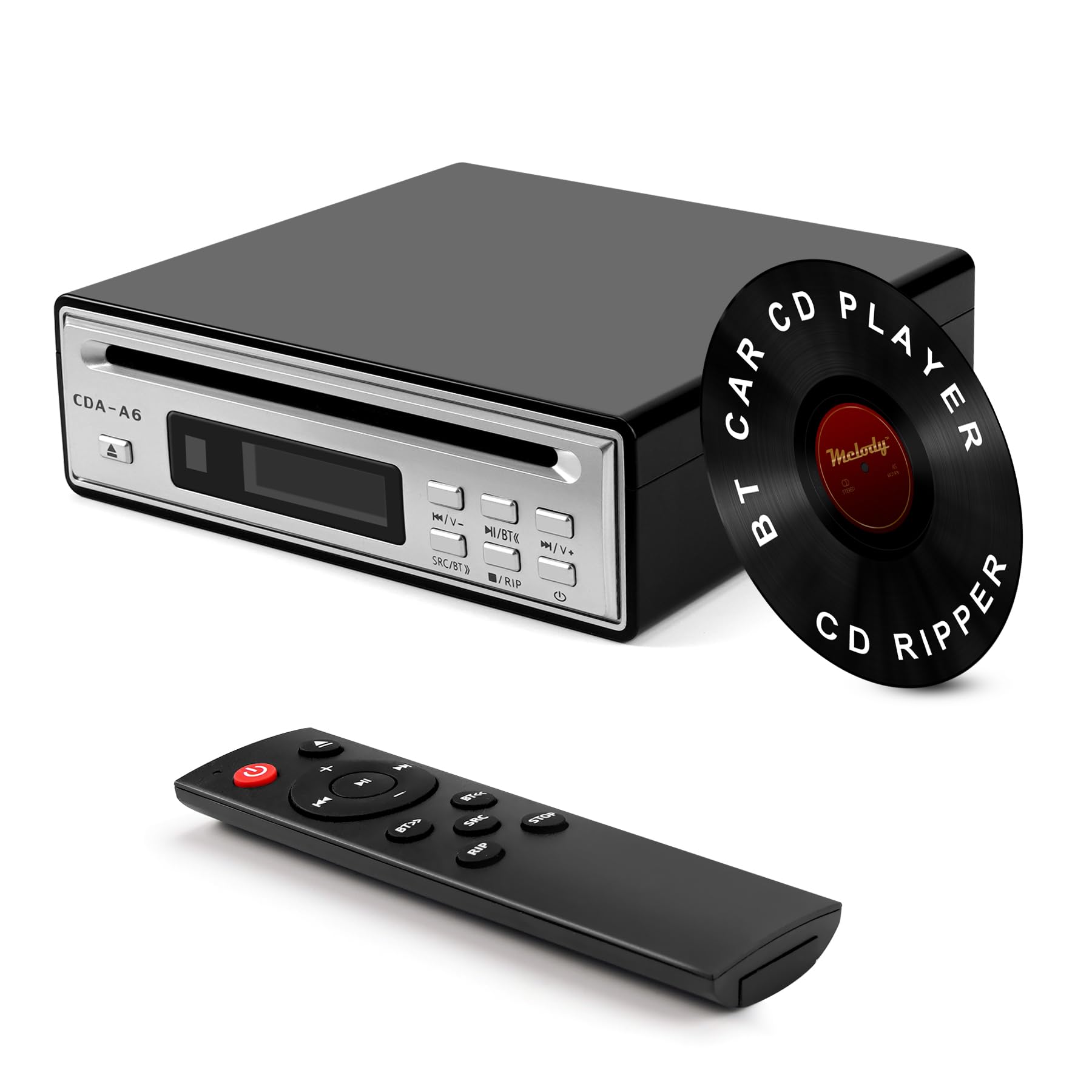
The Tovlroy CDA-A6 is a multifunctional CD player designed for owners who want to digitize their physical collection and also use the player in a car audio environment. Hold the RIP button for two seconds, and the unit converts CDs to lossless WAV files directly onto a USB flash drive—an extremely handy feature for backup or mobile listening. The 10-minute ripping speed is competitive with full-size computer drives.
Bluetooth 5.0 works in both transmitter and receiver modes: you can stream from your phone to the player (receiver mode) or send the CD audio to Bluetooth headphones or a car stereo (transmitter mode). The optical output connects to an external DAC or soundbar for improved fidelity, while the 3.5mm AUX/headphone jack accommodates wired headphones or car auxiliary inputs. The LED screen shows ripping progress, track number, and current mode.
Build quality is adequate for the price, but reliability reports are mixed: some units stop reading discs after a few months of light use, and several customers were unable to get the ripping function to work correctly. Position this as a secondary or budget-friendly unit for digitizing a small collection or for use in a vehicle where durability demands are lower. For a stationary primary home system, the more robust mid-range options above will serve you better over the long term.
Why it’s great
- Direct CD-to-USB WAV ripping without a computer
- Bluetooth transmitter sends CD audio to wireless headphones or car stereo
- Optical and AUX outputs offer flexible connectivity
- LED screen provides real-time ripping progress and track info
Good to know
- Reports of failed disc reading after 2 months of light use
- Ripping function may be finicky or non-functional in some units
- Best used as a utility ripper or car unit, not primary home hi-fi
FAQ
Is it worth buying a dedicated CD player if I already have a Blu‑ray player?
What does Pure Direct mode actually do?
Can I connect a CD player to a soundbar?
Do I need a separate amplifier, or can I use powered speakers?
How important is the remote control for a CD player?
Final Thoughts: The Verdict
For most users, the best cd player for home winner is the Yamaha CD-S303 because its Burr-Brown DAC, Pure Direct mode, and USB file playback offer the ideal balance of hi-fi performance and flexibility without exceeding a reasonable spend. If you value computational audio correction and sturdy vibration-resistant construction, grab the Denon DCD-600NE. And for a complete, integrated system that pairs CD fidelity with Wi-Fi streaming and a premium look, nothing beats the Philips TAM8905/37.