
Most in-ceiling speakers sound thin, bright, and completely forgettable — they deliver voices and treble just fine, but the moment a kick drum or an explosion hits, the sound collapses into a hollow, lifeless mess. The problem isn’t installation; it’s physics. Standard ceiling speakers lack the driver surface area, cabinet volume, and engineering to move enough air for real low-frequency impact. You are not asking for concert-level pressure; you are asking for a full, warm, punchy sound that fills a room without needing the subwoofer to do all the heavy lifting.
I’m Min — the co-founder and writer behind Gadgets Feed. I have spent countless hours studying the crossover topologies, driver materials, and measured frequency response curves that separate bass-capable ceiling speakers from the ones that leave you underwhelmed.
This guide cuts through the marketing noise to identify the models that genuinely reproduce low-end energy. After analyzing driver sizes from 5.25 to 8 inches, examining porting technologies, and synthesizing hundreds of verified owner experiences, I have compiled the definitive resource for the best ceiling speakers with bass that actually deliver on their promise.
How To Choose The Best Ceiling Speakers With Bass
Selecting a ceiling speaker that delivers genuine bass requires a sharp focus on a few non-negotiable physical and electrical specs. The marketing buzzwords about “deep bass” mean nothing if the woofer cone is small and the enclosure is unported. You need to anchor your decision on measurable data.
Woofer Size and Cone Material
Bass is about moving air. An 8-inch woofer has roughly 78% more surface area than a 5.25-inch driver, translating directly to deeper and louder low-frequency output. Look for polypropylene mica cones for a balanced, stiff response or Cerametallic (anodized aluminum) for superior rigidity and lower distortion at high SPL. A larger driver made from a stiff material is the single most important factor for ceiling bass.
Enclosure, Porting, and Power Handling
Unlike bookshelf speakers, in-ceiling models rely on the ceiling cavity as their enclosure. Models that include a sealed back box or feature a ported design (like Polk’s Power Port) produce tighter, more extended bass than open-back designs that let sound bleed into adjacent rooms. Check the RMS power rating — a speaker rated at 50W RMS continuous will sound anemic next to one rated at 100W RMS when paired with the same amplifier.
Frequency Response and Crossover Flexibility
Look for a published frequency response that reaches below 60 Hz (-3 dB point). Anything above 70 Hz will likely require a subwoofer for a satisfying home theater experience. Swivel tweeters and treble/bass attenuation switches allow you to fine-tune the sound after installation, which is critical for correcting for ceiling reflections and room acoustics.
Quick Comparison
On smaller screens, swipe sideways to see the full table.
| Model | Category | Best For | Key Spec | Amazon |
|---|---|---|---|---|
| Klipsch CDT-5800-C II | Premium In-Ceiling | Impactful home theater Atmos | 8″ Cerametallic woofer / 60 Hz | Amazon |
| Yamaha NS-IC800 | Premium In-Ceiling | Full-range music listening | 8″ poly cone / 140W peak | Amazon |
| Polk Audio 265-RT | High-Performance In-Wall | 3-way surround sound systems | Dual 6.5″ w/ Power Port | Amazon |
| Bose Virtually Invisible 791 | Premium In-Ceiling | Room-filling stereo without sub | 7″ woofer / Stereo Everywhere | Amazon |
| SVS Prime Elevation | Versatile Mount | Dedicated Dolby Atmos height | 4.5″ mid-woofer / sealed cabinet | Amazon |
| Polk Audio 255c-RT | Center Channel In-Wall | Center speaker for dialogue & bass | Dual 5.25″ w/ Power Port | Amazon |
| Sonos In-Ceiling by Sonance | Wireless-Ready Premium | Multi-room Sonos ecosystem | 6.5″ woofer / 36 Hz response | Amazon |
| Yamaha NS-IW280CWH | Mid-Range Wired | Value surround sound | 6.5″ woofer / 100W max | Amazon |
| Herdio 5.25″ Bluetooth | Budget Wireless System | Easy Bluetooth installation | 5.25″ woofer / 300W peak system | Amazon |
In‑Depth Reviews
1. Klipsch CDT-5800-C II In-Ceiling Speaker

The Klipsch CDT-5800-C II pairs an 8-inch Cerametallic woofer with a 1-inch titanium tweeter in a horn-loaded configuration. This is the largest woofer on this list, and it shows — the controlled dispersion design aims the bass directly into the listening area rather than letting it disperse into the ceiling cavity. The 60 Hz frequency response bottom end is genuinely felt, not just heard, making it ideal for Dolby Atmos height channels where impact matters.
The pivoting woofer and tweeter allow you to aim the sound toward the main listening position, a feature that compensates for the limitations of in-ceiling placement. The treble and mid-bass attenuation switches on the front baffle let you dial in the tonal balance without pulling the speaker out. Owners consistently note that these speakers punch above their price, especially when paired with a dedicated subwoofer for the deepest extension.
Installation is straightforward thanks to the included template and sturdy dogleg clamps. The white paintable grille blends into any ceiling. Keep in mind these are sold as single speakers, so a pair requires two units. For a premium yet accessible in-ceiling solution with genuine low-end authority, the CDT-5800-C II is the clear leader.
Why it’s great
- 8-inch woofer produces deeper, more powerful bass than any 6.5-inch competitor on this list.
- Horn-loaded tweeter delivers clear, efficient highs even at low amplifier power.
- Swivel drivers and attenuation switches allow fine-tuning after installation.
Good to know
- Sold individually — budget for two units for a stereo pair.
- Best low-end performance requires pairing with a powered subwoofer for sub-50 Hz content.
2. Yamaha NS-IC800 8-Inch In-Ceiling Speakers (Pair)

The Yamaha NS-IC800 delivers a rare combination: an 8-inch polypropylene mica cone woofer sold as a pair at a mid-range price point. The 140W peak power handling per speaker means these can play loud without strain, and the 2-way design with a swivel dome tweeter provides balanced, smooth sound that works well for both music and movie dialogue. The frequency response extends to 28 kHz at the top end, but the real story is the low end — the large cone moves enough air to produce a satisfying thump without needing a subwoofer for casual listening.
Build quality is noticeably higher than the price suggests. The magnetic grille attaches flush to the ceiling with no visible hardware, and the spring-loaded binding posts accept banana plugs and bare wire securely. The included mounting template is thick and reusable, making the cutout process simple. Owners frequently compare these favorably to higher-priced Polks, noting the Yamaha’s smoother sound and more solid construction.
One note: these speakers shine most with a proper receiver handling the crossover. Set your AVR to 80 Hz or 60 Hz and let the Yamaha handle the mid-bass. They are not designed to replace a subwoofer for home theater LFE, but as a pair of full-range music speakers, they deliver exceptional value.
Why it’s great
- 8-inch woofer in a pair package — rare at this price bracket.
- Full, smooth sound with sufficient low-end for music without a subwoofer.
- Magnetic grille and strong clamp system for easy, clean installation.
Good to know
- Some users report slightly recessed high frequencies compared to brighter speakers.
- A subwoofer is still recommended for dedicated home theater bass effects.
3. Polk Audio 265-RT 3-Way In-Wall Speaker

The Polk Audio 265-RT is a 3-way design that uses two 6.5-inch mid-woofers and a 1-inch silk dome tweeter. The dual driver configuration effectively doubles the cone area compared to a single 6.5-inch speaker, helping it produce deeper and more dynamic bass than most single-driver ceiling speakers. Polk’s patented Power Port technology extends the low-frequency response by channeling air from the woofer more efficiently, reducing turbulence and port noise.
This speaker is designed as left/right or rear surround channels in a high-performance home theater. The 3-way topology separates the midrange and bass duties, which means cleaner vocals and a more defined low-end. The swivel-mount tweeter allows you to direct the high frequencies toward the listening position. The rotating cam system ensures a vibration-free fit that stays secure over years of use.
Some users note that while the 265-RT produces excellent bass for an in-wall speaker, it still benefits from a dedicated subwoofer for the lowest octaves. The white grille is paintable, and the wafer-thin design allows it to virtually disappear into the ceiling. For a 3-way solution that balances clarity and bass authority, the 265-RT is a top-tier choice.
Why it’s great
- Dual 6.5-inch woofers plus Power Port for enhanced low-end output.
- 3-way design with separate midrange driver for cleaner, more detailed sound.
- Rotating cam system and template ensure secure, professional installation.
Good to know
- Sold as a single speaker — a pair requires purchasing two units.
- Deep sub-bass (below 50 Hz) still requires a powered subwoofer.
4. Bose Virtually Invisible 791 In-Ceiling Speaker II

The Bose Virtually Invisible 791 is engineered to be one of the few in-ceiling speakers that can serve as a primary audio source without a subwoofer. A 7-inch woofer combined with two strategically placed 1-inch tweeters delivers a frequency response that many users estimate reaches down to 40 Hz. The “Stereo Everywhere” design uses angled drivers to create a wide, immersive soundstage that fills the room evenly, eliminating the pinpoint hot spot typical of conventional ceiling speakers.
Bose’s engineering focuses on balanced, full-range performance rather than raw SPL. The bass is present, warm, and controlled — not boomy or overwhelming. This makes the 791 excellent for ambient music in living spaces, kitchens, or bedrooms where you want a rich sound without the clutter of a subwoofer. The near-bezel-less grille and paintable surface make the speaker virtually invisible once installed.
The trade-off is price. These are among the most expensive speakers on this list, and the value proposition depends on how much you prioritize a clean, subwoofer-free setup. Installation is straightforward with standard dogleg clamps and a magnetic grille. If your goal is a refined, full-range ceiling system that disappears into the room, the Bose 791 is the benchmark.
Why it’s great
- 7-inch woofer delivers satisfying bass without requiring a separate subwoofer.
- Stereo Everywhere design creates even sound coverage across the entire room.
- Low-profile, paintable grille blends completely into the ceiling.
Good to know
- Premium price point — not a budget-conscious option.
- Deep sub-bass still benefits from a dedicated subwoofer for movie LFE tracks.
5. SVS Prime Elevation Speaker (Pair)
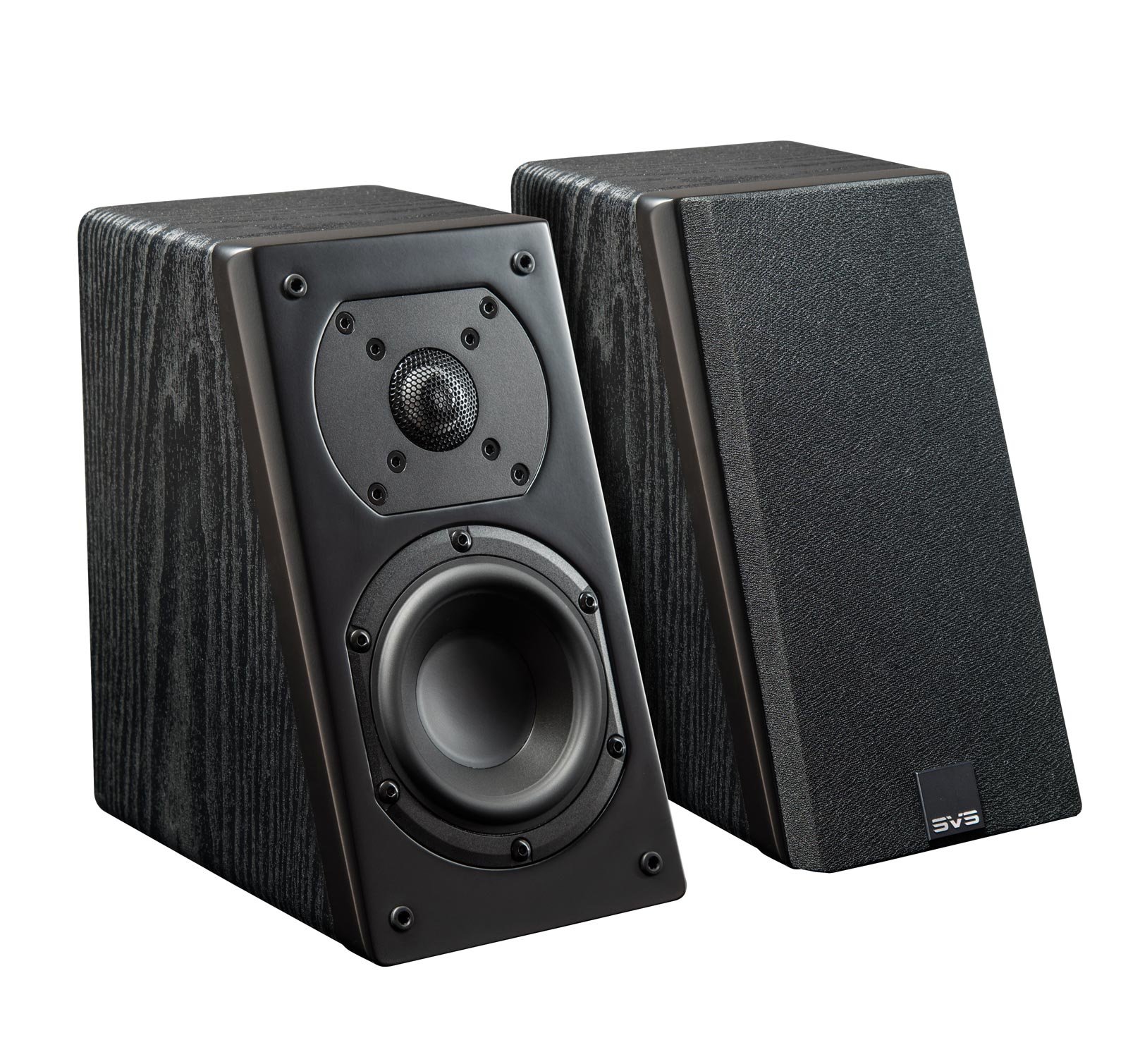
The SVS Prime Elevation is not a traditional in-ceiling speaker — it is a versatile enclosure designed for wall or ceiling mounting as a dedicated height channel. The sealed cabinet houses a 4.5-inch mid-woofer and a 1-inch aluminum dome tweeter, and the measured frequency response dips down to 50-60 Hz. This speaker is a purpose-built solution for Dolby Atmos and DTS:X, where direct-firing sound is preferred over reflective “ceiling bounce” designs.
The multi-angle wall bracket allows the speaker to be mounted in up-firing, down-firing, side-firing, or overhead orientations. This flexibility makes it ideal for rooms with sloped ceilings or where traditional in-ceiling cutouts are impractical. The build quality is exceptional — the Premium Black Ash finish matches high-end cabinetry, and the acoustically inert cabinet eliminates coloration. Owners consistently report dramatic improvements in the height layer of their Atmos system.
These speakers are sold as a pair, which simplifies purchasing. They work best when paired with a capable subwoofer for the lowest frequencies, but their ability to produce full-range height effects without the limitations of reflective designs makes them a standout for serious home theater enthusiasts.
Why it’s great
- Sealed cabinet delivers clean, full-range sound without ceiling cavity dependence.
- Multi-angle bracket allows flexible mounting for optimal height channel placement.
- 50-60 Hz frequency response provides genuine impact for Atmos effects.
Good to know
- Visible speaker enclosure — does not disappear into the ceiling like flush-mount designs.
- Designed primarily as a height/surround channel; not ideal as a main stereo speaker.
6. Polk Audio 255c-RT Center Channel In-Wall Speaker

The Polk Audio 255c-RT is a 2-way center channel speaker designed for in-wall or in-ceiling installation. It uses two 5.25-inch mid-woofers and a 1-inch silk dome tweeter, with Polk’s patented Power Port technology to extend bass response. The dual woofer configuration gives it more low-end authority than a single 5.25-inch driver, making it particularly effective at anchoring dialogue and mid-bass effects in a home theater system.
The Distance Toggle switch allows you to compensate for installations where the speaker must be placed closer to a wall or corner, reducing boomy low-end. The paint-able sheer grille and precision flange create a clean, flush finish. Many users choose this as a center channel paired with the 265-RT speakers for left and right, creating a timbre-matched Polk system.
It is important to note that this is a center channel speaker optimized for dialogue and front-stage sound, not a general-purpose music speaker. Audyssey and similar room correction systems often set the crossover around 40 Hz, confirming its ability to produce meaningful bass. For upgrading a traditional 5.1 or 7.1 system with a hidden center channel, the 255c-RT is a focused, effective solution.
Why it’s great
- Dual 5.25-inch woofers provide strong dialogue presence and mid-bass.
- Power Port technology extends low-frequency response for a center channel.
- Distance Toggle switch reduces bass bloat in tight installations.
Good to know
- Designed specifically as a center channel — not ideal for stereo music listening alone.
- Some owners report the sound benefits from a break-in period of 80-100 hours.
7. Sonos In-Ceiling by Sonance

The Sonos In-Ceiling by Sonance speaker is purpose-built for integration with the Sonos Amp ecosystem. It features a 6.5-inch woofer and a 25mm tweeter, with a specified frequency response of 36 Hz to 20 kHz (with DSP processing). The 36 Hz low-end extension is remarkable for a flush-mount in-ceiling speaker, achieved through the DSP correction that the Sonos Amp applies automatically using Trueplay room tuning.
The installation depth is only 120mm (4.7 inches), making it one of the shallowest options available, which is critical for ceilings with limited plenum space. The grille is paintable and designed to be nearly invisible. The speaker is capable of producing 110 dB max SPL at 1 meter, which is loud enough for most home environments. A single Sonos Amp can power up to three pairs of these speakers, making a whole-home system feasible.
The catch is that these speakers are optimized for the Sonos ecosystem. While they work with any standard amplifier, the Trueplay tuning and DSP processing that unlock their full potential require a Sonos Amp. For anyone already invested in the Sonos platform or building a multi-room audio system, these speakers represent the most seamless, great-sounding solution available.
Why it’s great
- 36 Hz frequency response with DSP processing provides real subwoofer-like extension.
- 120mm installation depth fits in tight ceiling spaces.
- Seamless integration with Sonos ecosystem for multi-room audio.
Good to know
- Full performance requires a Sonos Amp for Trueplay tuning and DSP.
- Premium price reflects the Sonos brand and ecosystem lock-in.
8. Yamaha NS-IW280CWH 6.5″ In-Ceiling Speaker Pair

The Yamaha NS-IW280CWH is a 3-way in-ceiling system that includes a 6.5-inch polypropylene mica cone woofer and dual 3/4-inch dome tweeters per speaker. Sold as a pair, it offers exceptional value for budget-conscious buyers who still want reasonable bass performance. The 100W maximum input capability is adequate for most mid-range receivers, and the swivel tweeters allow for some directional adjustment.
This model uses a slightly angled woofer baffle and aim-able tweeters to improve sound dispersion. The frame size is 10.2 inches with a cutout of about 10 inches, so measure your ceiling joist spacing before committing. The spring-loaded binding posts accept banana plugs and bare wire cleanly, and the magnetic grille snaps on without tools. Owners frequently praise its value as rear surround speakers in a 5.1 setup.
The bass is present but not room-shaking — it provides a solid foundation for movies and music, but a powered subwoofer is highly recommended for the low end. The plastic housing is water-resistant, making it usable in bathrooms or covered patios. For a budget-friendly wired system that delivers good sound without breaking the bank, the NS-IW280CWH pair is hard to beat.
Why it’s great
- 3-way design with 6.5-inch woofer provides better bass than typical 5.25-inch budget speakers.
- Sold as a pair — immediate stereo setup without buying two individual units.
- Water-resistant plastic housing suitable for humid environments.
Good to know
- Bass is adequate but not deep; a subwoofer is necessary for low-end impact.
- Large frame size (10.2″) may not fit between standard 16-inch on-center joists.
9. Herdio 5.25″ Bluetooth Ceiling Speaker System

The Herdio 5.25-inch system takes a completely different approach — it includes a dedicated Bluetooth amplifier box that powers the pair of speakers wirelessly. The amplifier delivers a total of 300 watts peak power (150W per speaker), which provides enough headroom for decent volume levels. The system is designed for easy installation without running speaker wire back to an AV receiver, ideal for kitchens, bathrooms, or covered patios where wiring is difficult.
The 5.25-inch woofers are smaller than the rest of the speakers on this list, which naturally limits bass extension. Owners report good highs and mids for the price, with bass that benefits from activating a graphic equalizer or bass booster on the source device. The system is capable of sounding pleasant, but it will not compete with larger wired speakers for low-end weight. The Bluetooth range is impressive — tested at over 30 feet even through walls.
This is an entry-level system best suited for casual background music in small to medium rooms. The separate amplifier box means one more component to place, but it also means you are not dependent on an AVR. For a simple, affordable wireless ceiling audio system that produces acceptable bass for its size, the Herdio offers a straightforward solution.
Why it’s great
- Complete Bluetooth system with amplifier box — no AV receiver needed.
- 300W peak power provides sufficient headroom for a small room.
- Good Bluetooth range with stable connection through walls and ceiling.
Good to know
- 5.25-inch woofer limits bass extension; requires EQ boost for satisfying low end.
- Setup instructions are minimal; some trial and error during installation is likely.
FAQ
Can ceiling speakers produce real bass without a subwoofer?
What is the ideal amplifier power for ceiling speakers with bass?
Does the ceiling cavity type affect bass performance?
Final Thoughts: The Verdict
For most users, the ceiling speakers with bass winner is the Klipsch CDT-5800-C II because its 8-inch Cerametallic woofer and horn-loaded tweeter deliver genuine, impactful low-end in a flush-mount design. If you want an 8-inch pair at a more accessible price, grab the Yamaha NS-IC800. And for a complete wireless system that trades raw bass for simplicity, nothing beats the Herdio Bluetooth system for its ease of installation.