
Our readers keep the lights on and my morning glass full of iced black tea. As an Amazon Associate, I earn from qualifying purchases.
Specs are compiled from manufacturer listings and verified buyer reviews and can change over time — please confirm the key details on the product page before buying.
Celery is the toughest green in the kitchen — fibrous, stringy, and full of water that ordinary juicers turn into a foamy mess. A dedicated masticating juicer squeezes every drop from those stalks without stripping the nutrients or leaving you with a clogged machine and a pile of wet pulp.
I’m Min — the founder and writer behind Gadgets Feed. This guide is built by comparing the manufacturers’ published specifications and the patterns across verified customer reviews, so you get each pick’s real strengths and trade-offs instead of marketing spin.
Whether you juice one stalk daily or a whole bunch for weekly prep, the right cold-press machine handles the stringy fibers without a fight — and this roundup of the very best celery juicer options lays out exactly which model earns its spot on your counter.
Quick Picks
- Omega Celery Juicer and Nutrition System — Best Overall
- Hurom H310 Easy Clean Slow Juicer — Premium Pick
- LUFVEBUT 2-in-1 Juicer Grinder — Versatile Choice
- LINKChef Cold Press Juicer — Best Value
- PSIIDAN LED Touch Screen Juicer — Feature Rich
- LUFVEBUT Cold Press Juicer (250W) — Budget Champion
- Whuto Cold Press Juicer — Multi-Function
How To Choose The Best Celery Juicer
Celery has a tough cellular structure that standard centrifugal juicers spin so fast they heat the juice and introduce oxygen, breaking down enzymes and creating foam. A slow masticating juicer, which chews the stalks at 45 to 80 RPM, squeezes the liquid out while keeping oxidation low and the pulp bone-dry.
Motor Power and Torque
The motor is what drives the auger (the spiral screw that crushes the produce). For celery, a motor rated around 200 to 250 watts is the balance — it gives enough torque to break down fibrous stalks without overheating. Higher wattage usually means you can process harder ingredients like beets and carrots alongside your celery.
Feed Chute Size
If you juice whole celery stalks often, a wide feed chute saves you the prep step of cutting each stalk into small pieces. Some models accept whole apples or whole long stalks, which cuts your chopping time by minutes per batch.
Dedicated Celery Features
A few juicers come with a specialized end cap or a modified auger designed to squeeze celery longer for maximum yield. These aren’t gimmicks — buyers report getting significantly more juice from the same amount of stalks when the machine is tuned for that specific vegetable.
Quick Comparison
| Model | Best For | Power | Feed Chute | Special Feature | Amazon |
|---|---|---|---|---|---|
| Omega Celery Juicer | Dedicated celery end cap | 200 Watts | Straight tube | Adjustable end caps | $198.99Amazon |
| Hurom H310 | Zero-scrub cleanup | 320 Watts | Self-feeding hopper | Strainer-free chamber | $449.00Amazon |
| LUFVEBUT 2-in-1 | Juicer + coffee grinder | 250 Watts | Small chute | 18-level grind adjust | $267.00Amazon |
| LINKChef Cold Press | Whole fruit feeding | 200 Watts | 130 mm | 1.8 L chamber | $134.98$179.99Amazon |
| PSIIDAN LED Touch | Fibrous greens heavy user | — | Standard | Soft/Hard speed modes | $99.99$349.98PrimeAmazon |
| LUFVEBUT Cold Press | High juice yield on budget | 250 Watts | Standard | 7-segment spiral auger | $156.00Amazon |
| Whuto Cold Press | Extra wide chute + ice cream | 200 Watts | Wide chute | Ice cream and nut milk | $312.99Amazon |
In‑Depth Reviews
1. Omega Celery Juicer and Nutrition System

The only juicer with a specialized end cap built exclusively for celery stalks.
You get a much higher juice yield from every stalk because Omega engineered this machine with two adjustable end caps — one designed purely for celery, not any other fruit or vegetable. That dedicated cap squeezes the stalks longer inside the chamber. At 80 RPM, it is slower than most competitors, which minimizes heat buildup and oxidation while the triple-stage masticating technology pulls nutrients from even tough fibrous greens.
The 200-watt motor handles whole celery stalks without pre-cutting, and the straight feed tube fits them easily. Owners mention using this machine daily for four years straight, averaging a quart of juice per day, with the only worn part being an occasional rubber gasket that tore from forced feeding. One reviewer noted the celery end cap yielded 16 ounces of juice from thin celery stalks — a number that outperforms most standard juicers on the same amount of produce.
The versatility extends beyond celery: this nutrition system also grinds coffee, makes nut butter, extrudes pasta, and minces herbs. At 14.3 pounds, it is heavier than the LINKChef, so plan a permanent spot on your counter rather than lifting it out of a cabinet daily.
Why celery lovers choose it
- Dedicated celery end cap boost juice yield per stalk
- 80 RPM triple-stage masticating keeps nutrients intact and oxidation low
- Versatile secondary uses — nut butter, pasta, coffee grinding
The real trade-off
- At 14.3 pounds, it is the heaviest single-purpose juicer here
- Straight feed tube fits whole celery and carrots but not whole apples or cucumbers without cutting
- One buyer mentioned juice leaks during food processing due to no close-off lever
Reach for this if: you juice celery daily and want the maximum yield per stalk with a machine proven to last years of heavy use.
Look elsewhere if: you need a lightweight machine you can store in a cabinet or you plan to juice very large whole fruits like apples without any cutting.
2. Hurom H310 Easy Clean Slow Juicer

A slow juicer that eliminates the scrub brush entirely with a strainer-free design.
You never scrub out a mesh strainer again because the Hurom H310 uses a patented Slow Squeeze technology with a two-part auger that meshes together to strain out juice without a traditional mesh strainer. The self-feeding hopper fits whole-sized fruits and vegetables, so you drop in full celery stalks and the machine pulls them down on its own.
At 320 watts, this is the most powerful motor among the seven picks here, giving it extra torque for tough celery and root vegetables — more grunt than the Omega’s 200-watt motor. The quiet motor operates at low speed, keeping noise minimal. The H310 is 100% BPA-free with no blades or sharp parts, and the compact footprint (8 x 14 x 16 inches) makes it small enough to leave on the counter. Note that the manufacturer rates the juice freshness at up to 72 hours — your morning batch stays good into the third day.
The catch: this machine is not dishwasher safe, unlike the LINKChef at a lower price point.
Why it stands out
- Strainer-free chamber — rinse clean with water, no scrubbing needed
- 320-watt motor is the most powerful of the picks here
- Self-feeding hopper handles whole fruits with zero manual pushing
Consider before buying
- Not dishwasher safe — hand-wash only
- Small internal capacity means frequent emptying for large batches
- Premium price point reaches into high-end appliance territory
Best fit for: anyone who hates scrubbing strainers and wants a powerful, quiet machine that fits whole produce without pre-cutting.
Pass on it if: you need dishwasher-safe parts or you juice more than a quart at a time without wanting to stop and empty the pulp bin.
3. LUFVEBUT 2-in-1 Juicer Grinder

A juicer that doubles as a coffee grinder with 18 precision levels.
You get two appliances in one: the same 250-watt copper motor drives both the cold-press auger for juicing and a flat-burr coffee grinder. You switch between the two components with a one-button disassembly. The flat burr has 18 precision grind levels, so you go from coarse French press to fine espresso without a separate machine. The juicing side features an extended auger and low-noise gears that separate juice from pulp quietly at under 60 dB.
The recommended uses cover orange, ginger, apple, celery, wheatgrass, beet, and carrots — the same range as dedicated juicers. The small feed chute and no-blade design protect children from injury, and the overheat protection system keeps the motor from burning out during longer sessions. Customers note the machine rinses clean easily and the dishwasher-safe parts simplify maintenance.
The trade-off: because it splits its design between two functions, the juicing component does not have a wide feed chute or a dedicated celery end cap like the Omega. You will need to cut celery stalks into smaller pieces before feeding them in.
What you gain
- Juicer and coffee grinder in one appliance with 18 grind levels
- 250-watt copper motor is quiet and powerful for tough ingredients
- Dishwasher-safe juicing parts and overheat protection
What you trade
- Standard feed chute requires pre-cutting celery stalks
- No dedicated celery optimization feature
- Grinder component adds bulk — not a space-saver for pure juicers
Reach for this if: you want one countertop machine for fresh celery juice and fresh-ground coffee, and you are comfortable cutting stalks into smaller pieces.
Look elsewhere if: juicing is your only need and you want the widest feed chute or a dedicated celery cap.
4. LINKChef Cold Press Juicer
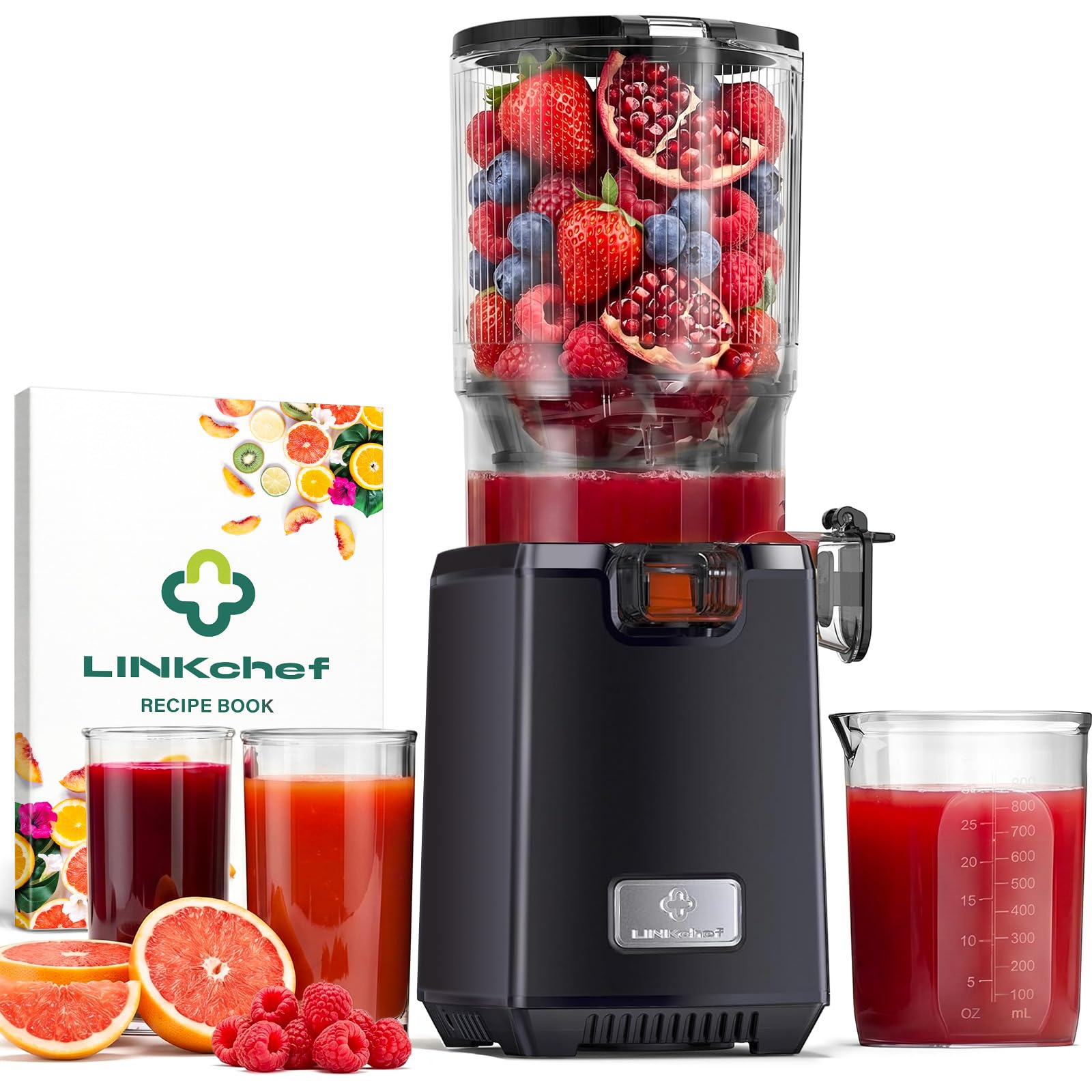
A 5.12-inch feed chute that swallows whole apples and whole celery stalks.
You skip the cutting board entirely because the LINKChef features a 130-millimeter (5.12-inch) feed chute. You drop in whole apples, whole carrots, and full celery stalks without any chopping. The 1.8-liter chamber lets you load a big batch and juice hands-free, ideal for weekly meal prep. The machine rotates at 50 to 65 RPM, a slow speed that keeps the juice fresh and reduces foam.
A three-layer filter works together inside to separate pomace from juice while reducing clogging and sediment. The one-knob operation handles start, stop, and reverse — when celery fibers jam, you flip to reverse for 2-3 seconds to clear the blockage. The body is BPA-free Tritan for the filling cup and juice cups, with a baby-grade silicone bumper. Assembly takes about five seconds with a one-piece design that has only three parts.
At 200 watts, this is on the lower end of power compared to the Hurom’s 320 watts. It handles celery well, but reviewers point out that very dense root vegetables like beets benefit from being cut into smaller pieces for smoother feeding.
Why shoppers love it
- 130 mm feed chute accepts whole apples and full celery stalks raw
- 1.8 L batch chamber allows hands-free juicing for weekly prep
- Three-layer filter drastically reduces clogging and sediment
Know before you buy
- 200-watt motor can struggle with larger batches of hard root vegetables
- One-knob design lacks separate speed modes for delicate vs. hard produce
- Some users report needing to cut beets into smaller pieces despite the wide chute
Best fit for: batch juicers who want to toss in whole produce without prep time and get clean, sediment-free juice.
Pass on it if: you juice mostly hard root vegetables like raw beets and turnips in large quantities.
5. PSIIDAN LED Touch Screen Juicer
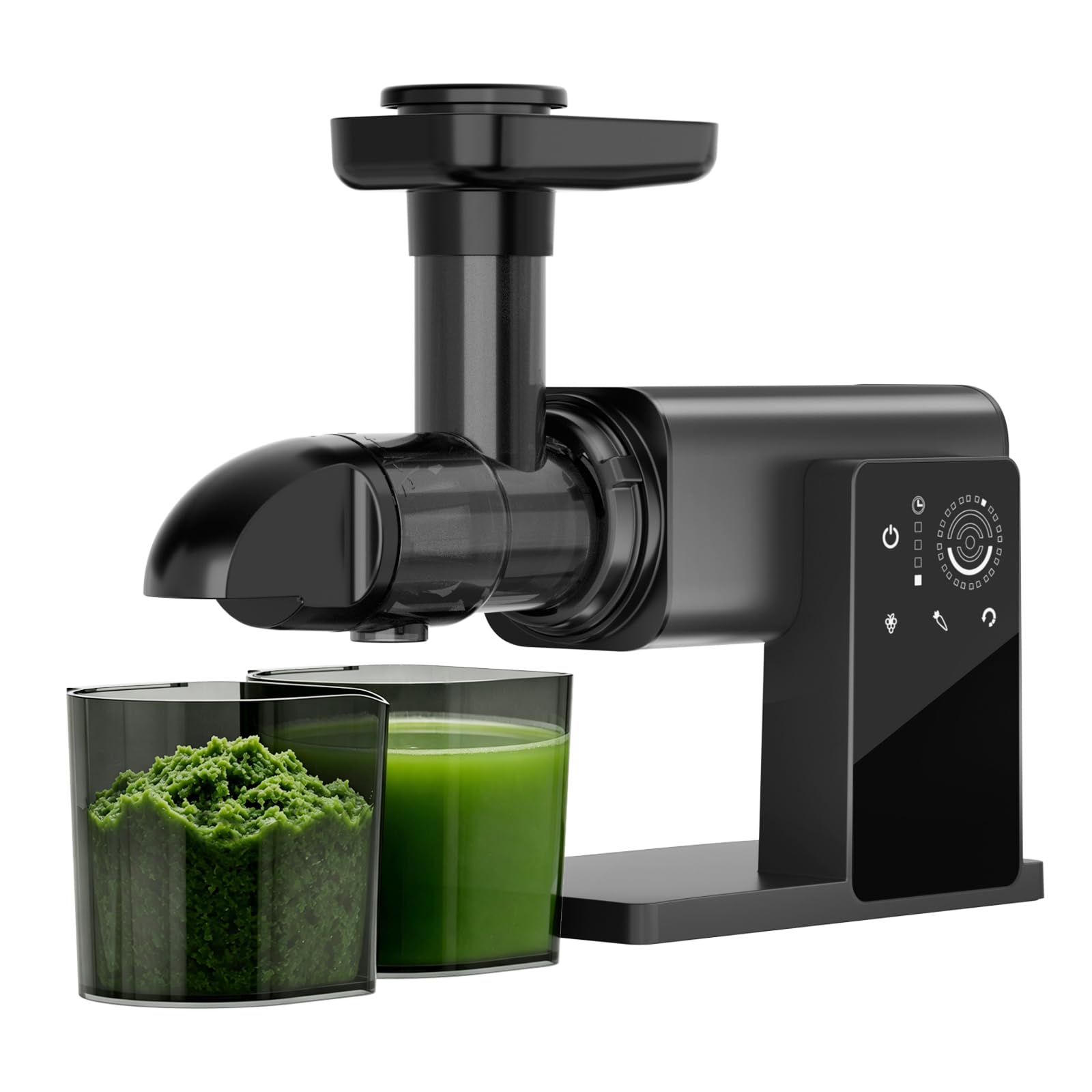
An intuitive LED touch screen with two speed modes for soft and hard ingredients.
You get exactly the right extraction for whatever you are juicing because the PSIIDAN features an LED smart touch panel — unusual at this price point — that lets you toggle between Soft mode for oranges and tomatoes, and Hard mode for celery, carrots, and beets. The aluminum alloy chassis reduces vibration during operation, and the machine runs under 60 dB, quiet enough for early morning use without waking a household.
Shoppers say the cold-press auger extracts plenty of juice from kale, celery, and apples, preserving the natural flavor. One owner reported the reverse function is helpful for clearing clogs when processing fibrous greens, and the pulp comes out relatively dry compared to standard vertical models. The accessories are BPA-free and top-rack dishwasher safe. The item dimensions at 17.56 x 6.22 x 13.82 inches are deeper than most — the body is long horizontally rather than tall vertically.
While the LED screen is a nice convenience, the plastic components include ABS (acrylonitrile butadiene styrene) rather than stainless steel, so the build feels less premium than the Hurom or Omega. The screen adds a modern look but does not improve juice yield.
Highlights
- Soft and Hard speed modes tune extraction for different produce
- Aluminum alloy chassis reduces vibration and noise under 60 dB
- Reverse function clears clogs from fibrous celery and kale
Keep in mind
- Plastic (ABS) body feels less durable than metal-bodied competitors
- Long horizontal footprint takes up more counter depth
- Touch screen adds a feature but does not increase juice output
Reach for this if: you want a modern touch-screen interface, a quiet machine for early juicing, and the flexibility of two speed modes for different produce.
Look elsewhere if: a metal body and maximum durability are your priorities over gadget features.
6. LUFVEBUT Cold Press Juicer (250W)

A 250-watt brushless motor with a 7-segment spiral for higher juice yield.
You get more torque than most budget juicers because the LUFVEBUT uses a 250-watt copper brushless motor and an upgraded 7-segment spiral auger that chews through produce at 45 to 65 RPM. The slow speed reduces heat and oxidation, producing juice with less foam and better preservation of flavor. The motor is powerful enough to handle soaked soybeans along with standard fruits and vegetables, which few juicers in this price range can do.
Soft Mode handles tomatoes, strawberries, kiwis, and citrus. Hard Mode handles cucumbers, apples, carrots, beets, and ginger. For green leafy vegetables like wheatgrass, celery, kale, and spinach — which have more fiber and less juice yield — the manufacturer recommends juicing them together with other fruits for better output. The reverse function prevents clogging when processing the tough stems. Noise is under 60 dB, and an automatic shut-off kicks in after 20 minutes of continuous use.
The downside: the housing uses high-end piano paint process plastic rather than stainless steel, so it can show scratches over time. The feed chute is standard size and will not accept whole celery stalks without cutting.
What works
- 250-watt brushless motor offers more torque than most budget juicers
- 7-segment spiral auger improves extraction efficiency
- Soft and Hard modes plus reverse function for different produce
What to consider
- Plastic housing with painted finish may show wear over time
- Standard feed chute requires pre-cutting celery and large produce
- 20-minute auto shut-off can interrupt extended batch juicing sessions
Best fit for: budget-conscious buyers who want a 250-watt motor and don’t mind cutting produce before feeding.
Pass on it if: you need a metal body, a wide feed chute, or you juice large batches that exceed 20 minutes continuously.
7. Whuto Cold Press Juicer
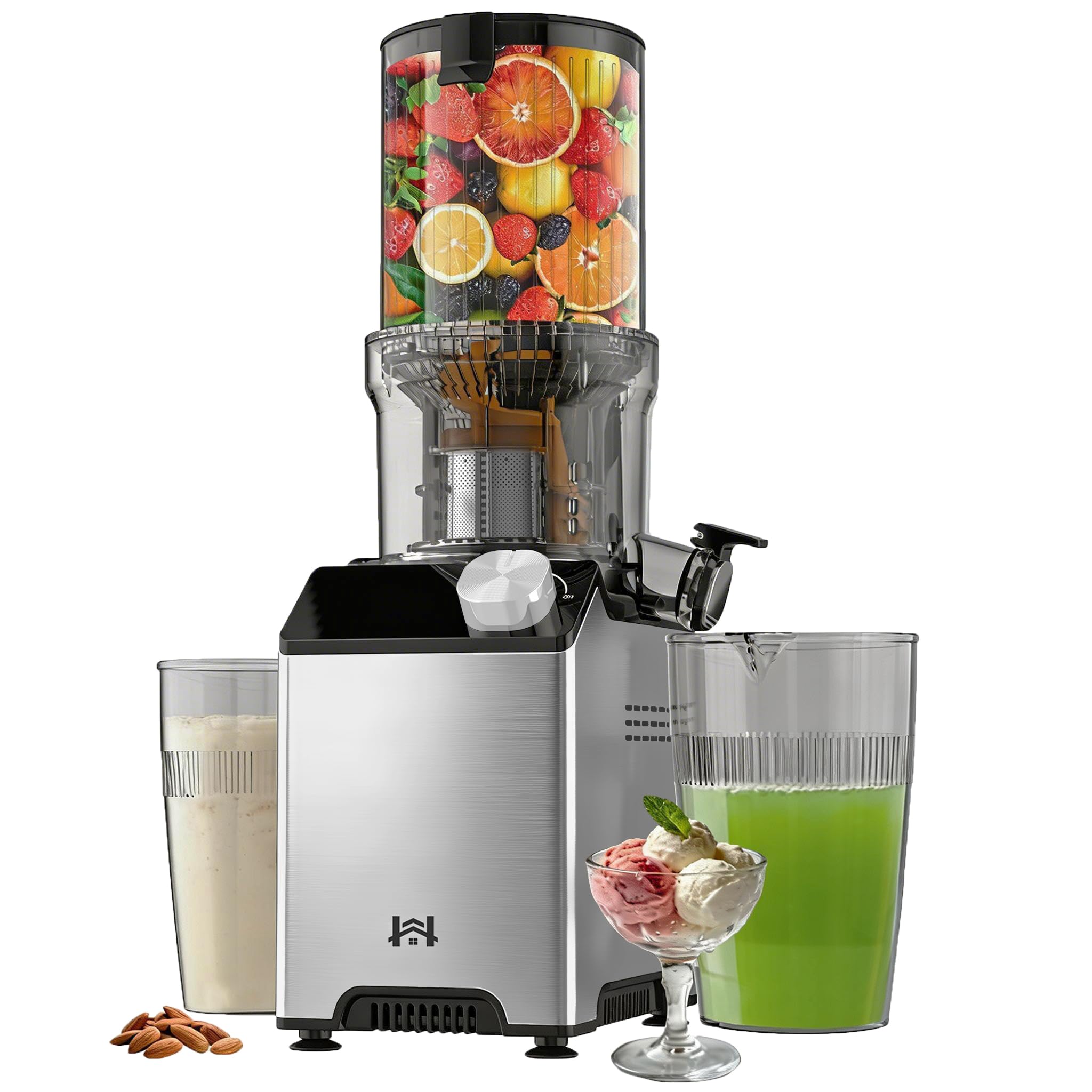
A compact stainless steel juicer that also makes ice cream and nut milk.
You get three kitchen functions from one appliance because the Whuto features an extra-wide feed chute that lets you process whole fruits and vegetables with less prep, and it also supports making ice cream and nut milk. The stainless steel body shell feels more premium than the plastic LUFVEBUT models at a similar tier. The upgraded cold press technology uses a new spiral auger that increases the cutting surface. Two different mesh sizes filter the juice for a pure, sediment-free glass.
The 45-degree angled control panel is comfortable to reach, and the non-slip, vibration-absorbing suction cups keep the machine steady during operation. Safety lock design pauses the machine when the feed chute lid is open and prevents disassembly while the lid is closed. Cleaning takes three simple steps — dismantle, rinse with water, and use the included brush for occasional stuck bits. All components are dishwasher safe.
At 5.95 pounds and measuring 7.08 x 4.8 x 16.53 inches, this is the lightest and most space-efficient pick here — much easier to store than the 14.3-pound Omega. The trade-off: with 200 watts of power, it is on the lower end of motor strength, so you may need to cut harder vegetables like beets into smaller pieces before juicing.
Why it wins on versatility
- Stainless steel body provides durable, scratch-resistant finish
- Extra wide chute reduces prep time for whole produce
- Makes ice cream and nut milk in addition to juicing
Where it falls short
- 200-watt motor is less powerful than the 250W LUFVEBUT
- No speed modes — single-speed operation for all produce
- Dedicated celery yield may be lower than the Omega with its specialized end cap
Reach for this if: you want a compact, stainless steel machine that handles multiple kitchen tasks and fits in a small countertop space.
Look elsewhere if: you need maximum power for hard root vegetables or a dedicated celery optimization feature.
Understanding the Specs
Motor Wattage and Torque
The motor’s wattage — typically 200 to 320 watts across these machines — tells you how much force the auger can apply. For celery, which is tough and stringy, a motor around 250 to 320 watts gives you the torque to crush stalks without slowing down or overheating. A 200-watt motor will still work, but you may notice it chugging through denser stalks and hard vegetables like beets.
RPM (Revolutions Per Minute)
The speed at which the auger spins determines how much heat and oxygen mix into the juice. Slow juicers operate between 40 and 80 RPM — compare that to a centrifugal juicer that spins at thousands of RPM. Lower RPM means less oxidation, which keeps the juice fresh longer (some models claim up to 72 hours), and less foam in your glass.
FAQ
Can I put whole celery stalks in a juicer without cutting them?
What is the difference between a masticating and a centrifugal juicer for celery?
How often do I need to clean a celery juicer?
Does a higher-wattage motor always mean better celery juice?
Why does my celery juice foam up with some juicers?
Can a celery juicer also handle wheatgrass and kale?
How long does fresh celery juice last in the refrigerator?
What does the reverse function do on a celery juicer?
Is a horizontal or vertical masticating juicer better for celery?
Does a dedicated celery end cap really make a difference in juice yield?
Final Thoughts: The Verdict
For most people, the best celery juicer winner is the Omega Celery Juicer because it comes with a dedicated celery end cap that boost yield, runs at 80 RPM for low oxidation, and has proven to last for years of daily heavy use. If you want zero-scrub cleanup and a self-feeding hopper, grab the Hurom H310. And for the best value with a wide 130mm chute that swallows whole apples and celery, the standout is the LINKChef Cold Press Juicer.
How We Picked
We do not accept paid placement. Every pick is matched to a real buyer and a real use-case; we do not hands-on test units.
Sources & Methodology
Specifications: manufacturer listings and product documentation. Review insights: verified customer reviews, as of July 2026. Pricing: not shown on this page (it changes often); check the current price via the retailer link.
As an Amazon Associate, Gadgets Feed earns from qualifying purchases. This does not affect which products we feature.
Related Guides
Product prices and availability are accurate as of the date/time indicated and are subject to change. Any price and availability information displayed on Amazon at the time of purchase will apply to the purchase of this product. As an Amazon Associate I earn from qualifying purchases.
CERTAIN CONTENT THAT APPEARS ON THIS SITE COMES FROM AMAZON. THIS CONTENT IS PROVIDED "AS IS" AND IS SUBJECT TO CHANGE OR REMOVAL AT ANY TIME.
Amazon and the Amazon logo are trademarks of Amazon.com, Inc. or its affiliates.