
Our readers keep the lights on and my morning glass full of iced black tea. As an Amazon Associate, I earn from qualifying purchases.
Specs are compiled from manufacturer listings and verified buyer reviews and can change over time — please confirm the key details on the product page before buying.
You want to turn your “no service” zone into a place where calls connect and bars stay full. The right booster grabs a weak outdoor signal, amplifies it, and broadcasts it indoors to every phone in the house—not just beside a window. Your choice depends on matching the booster’s coverage area, gain (how much it amplifies the signal), and frequency bands to your home’s size and your carrier’s network.
I’m Min — the founder and writer behind Gadgets Feed. This guide is built by comparing the manufacturers’ published specifications and the patterns across verified customer reviews, so you get each pick’s real strengths and trade-offs instead of marketing spin.
Whether you are stuck in a basement, a metal-roofed shop, or a rural cabin, the best cell phone booster for your situation is the one that matches your square footage and your carrier’s cellular bands.
Our Picks at a Glance


How To Choose The Best Cell Phone Booster
Before you buy, check your outdoor signal strength; if there’s no signal outside, no booster will help. Walk outside and check the signal on your phone; if there is no signal outside at all, no booster on the market will help because the device needs some outdoor signal to amplify.
Match Coverage to Your Space
Booster ratings in square feet are best-case estimates based on a strong outdoor signal. A unit rated for 5,000 sq ft might only cover a single room if your outdoor signal is a weak 1 bar. Always choose a model with a larger range than your actual home size to give yourself a buffer.
Check Your Carrier’s Frequency Bands
Every carrier broadcasts on specific frequency bands. Verizon uses Band 13 heavily, while AT&T and T-Mobile rely on Bands 12 and 17. A booster that does not support your carrier’s main band will simply do nothing for you. Confirm your phone’s bands against the booster’s supported list before you purchase.
Understand Gain and Antenna Type
Gain, measured in dB, tells you how much the booster amplifies the signal; higher numbers mean stronger amplification. A directional Yagi outdoor antenna focuses on one distant tower for maximum range, while an omnidirectional antenna picks up signal from all directions but with less power.
Quick Comparison
| Model | Best For | Coverage | Max Gain | Bands Supported | Amazon |
|---|---|---|---|---|---|
| HiBoost Home Office★ Best Overall | Whole large homes & basements | Up to 8,000 sq ft | 70 dB | 2, 4, 5, 12, 13, 17, 25 | Amazon |
| JACOOL Home OfficeBest Value | Verizon & AT&T users | 3,000–5,000 sq ft | — | 12, 13, 17 | Amazon |
| Metarepeater MG1Smart Display Pick | Tech users wanting live stats | Up to 5,000 sq ft | — | 12/17, 13, 5, 4/66, 2/25 | Amazon |
| SignalBrick K01 | Remote small homes | Up to 3,000 sq ft | 60 dB | 4, 12, 17, 13, 5, 25, 2 | Amazon |
| ZORIDA Ace 5S | Small homes & single rooms | Up to 2,000 sq ft | 72 dB | 12/17, 13, 5, 4, 2/25 | Amazon |
| GAGBK Car/RV | Vehicles & road trips | 5–8 miles distance | 65 dB | 2/4/5/12/13/17/25/66 | Amazon |
| SureCall Flare 3.0 | Small homes needing app help | Up to 3,500 sq ft | — | Multi-band | Amazon |
| weBoost Drive 4G-X OTR | Long-haul truckers | Inside vehicle | — | 12/17, 13, 5, 4, 25/2 | Amazon |
| weBoost Drive Reach OTR | Heavy-duty truck & RV users | Inside vehicle | 50 dB | 12/17, 13, 5, 4, 25/2 | Amazon |
In‑Depth Reviews
1. HiBoost Cell Phone Signal Booster for Home Office and Multi Room
Our pick — 4.5★ from 650+ verified ratings; the strongest balance of quality and price.
The whole-home powerhouse that turns a dead basement into five rooms of solid coverage.
For a large house or a sprawling office, this HiBoost is the unit to beat because it covers up to 8,000 sq ft. That range is the largest in this lineup, and it uses two indoor antennas to push signal into 5–6 rooms rather than just one corner. Buyers report jumping from zero bars to 3–4 bars of 5G throughout their homes.
What wins people over is the sheer effectiveness — it consistently lifts signal from 1 bar to 3–4 bars, eliminating dropped calls. You get a built-in app, so you can monitor real-time gain and performance from your phone, plus a manual LCD display on the unit itself. The AGC (Automatic Gain Control — a feature that self-adjusts the amplifier to avoid feedback) means you rarely touch settings after setup.
Setup is genuinely approachable thanks to clear instructions, and the support team earns praise for guiding owners through antenna realignment. Owners mention: “Improved basement signal from 1-2 to 4-5 bars after support-guided antenna realignment.” The one trade-off to plan for is that the indoor cable runs short, so placement needs a little thought, and data range is strongest near the antennas.
Why It Leads
- Massive 8,000 sq ft coverage for 5–6 rooms
- 70dB gain lifts 1 bar to 3–4 bars
- Smart app plus LCD for real-time monitoring
- Works on all major US carriers and 5G bands
The Fine Print
- Indoor cable length is a bit short
- Data speeds drop off further from the antennas
The pick for big homes: if you need reliable voice and data across a large or multi-story space, this is the one to reach for.
Reach for it if: you live in a basement, metal building, or rural property where a weak 1-bar signal needs to become a workable 4-bar one.
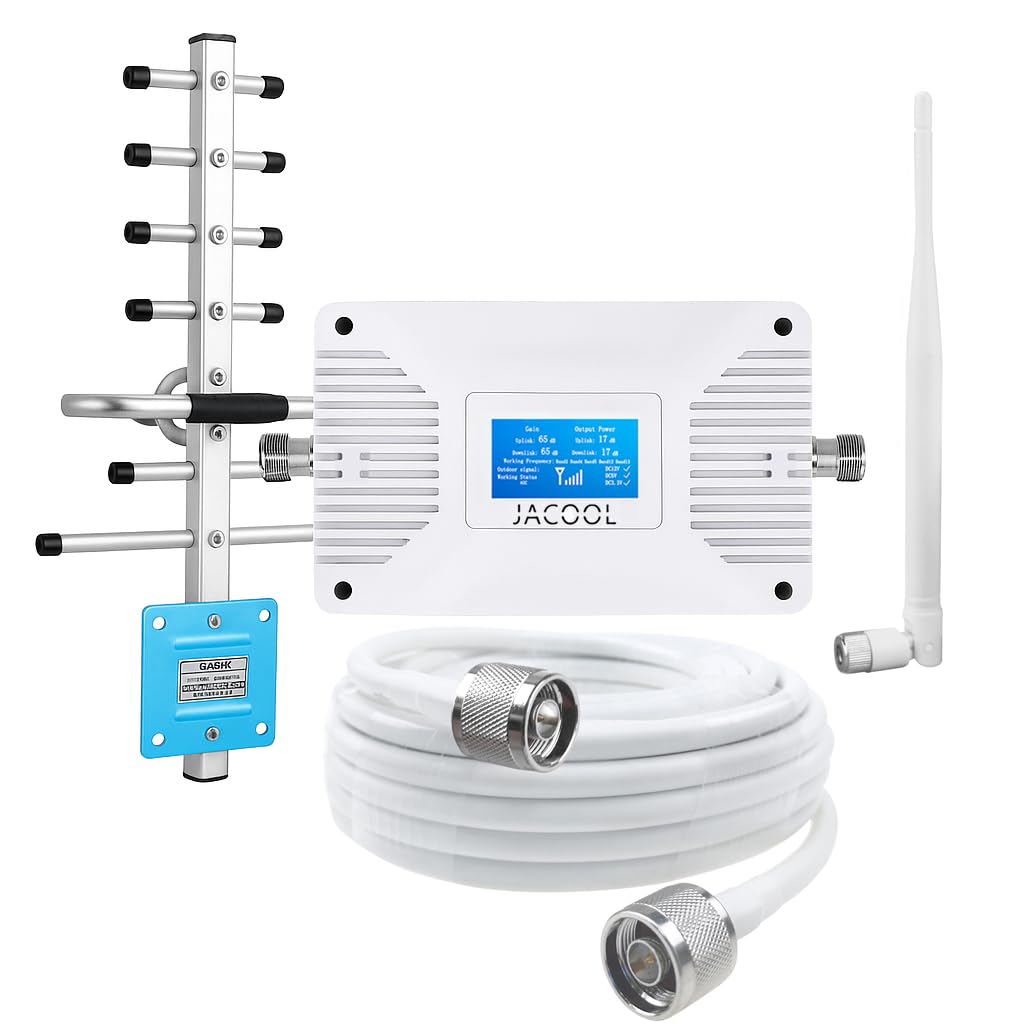
2. Cell Phone Signal Booster for Home Office – JACOOL
A budget-friendly booster that punches above its price for Verizon and AT&T homes.
If your household is on Verizon or AT&T, this JACOOL booster is the smart money pick because it targets the exact bands those carriers use — Band 12, 13, and 17. It covers a solid 3,000–5,000 sq ft, and a high-gain outdoor Yagi antenna does the heavy lifting of grabbing a weak tower signal.
The AGC system automatically adjusts to prevent the interference that ruins signal quality, which keeps performance stable without you fiddling with dials. It is also built for multiple users at once, so a whole family can be on calls and streaming simultaneously. The box includes everything needed for an install that should take under 30 minutes.
Real-world results are honest: customers note a modest “one bar signal” boost in tricky metal-roof buildings, while another confirms it “will work in a completely metal clad building with a metal roof.” The catch here is that it is a single-band device focused on Verizon and AT&T frequencies, so T-Mobile users should look elsewhere. It ranks as one of the higher-value options in this list for its price class.
Solid and simple: a straightforward, no-frills booster that does exactly what it promises for the two biggest US carriers.
Watch the limits: single-band design means it won’t help if your carrier uses different frequencies, and results vary with outdoor signal strength.
3. Metarepeater Home Cell Phone Signal Booster with Smart LCD Display
The five-band workhorse whose color display shows you exactly what your signal is doing.
This Metarepeater stands apart with a large color LCD that displays the gain of all five frequency bands in real time. That live readout means you can watch the numbers change as you move the outdoor antenna, which dramatically simplifies finding the perfect mounting spot.
It amplifies weak signals by up to 100x, with realistic coverage that depends on your outdoor signal: at 3–4 bars outside it reaches 1,300–2,500 sq ft, and with full outdoor signal it stretches to a maximum of 5,000 sq ft. The five-band design covers 5G, 4G LTE, and 3G across bands 12/17, 13, 5, 4/66, and 2/25, which means it works for all US carriers including AT&T, Verizon, T-Mobile, and US Cellular.
Owners talk about jumping from 1 bar to 4 or 5 bars instantly and getting “full service throughout the house.” Ensure your outdoor antenna point has at least -110 dBm of signal before buying, and keep in mind the roof install may need 1–2 people. One caveat: an occasional unit arrives with a power supply that fails within weeks, so test your unit early and use the warranty if needed.
The display sells it: no other booster this affordable gives you such a clear window into what the amplifier is doing.
Best for: tech-curious owners who want to dial in their antenna placement with hard data instead of guesswork.
4. SignalBrick Cell Phone Booster for Home
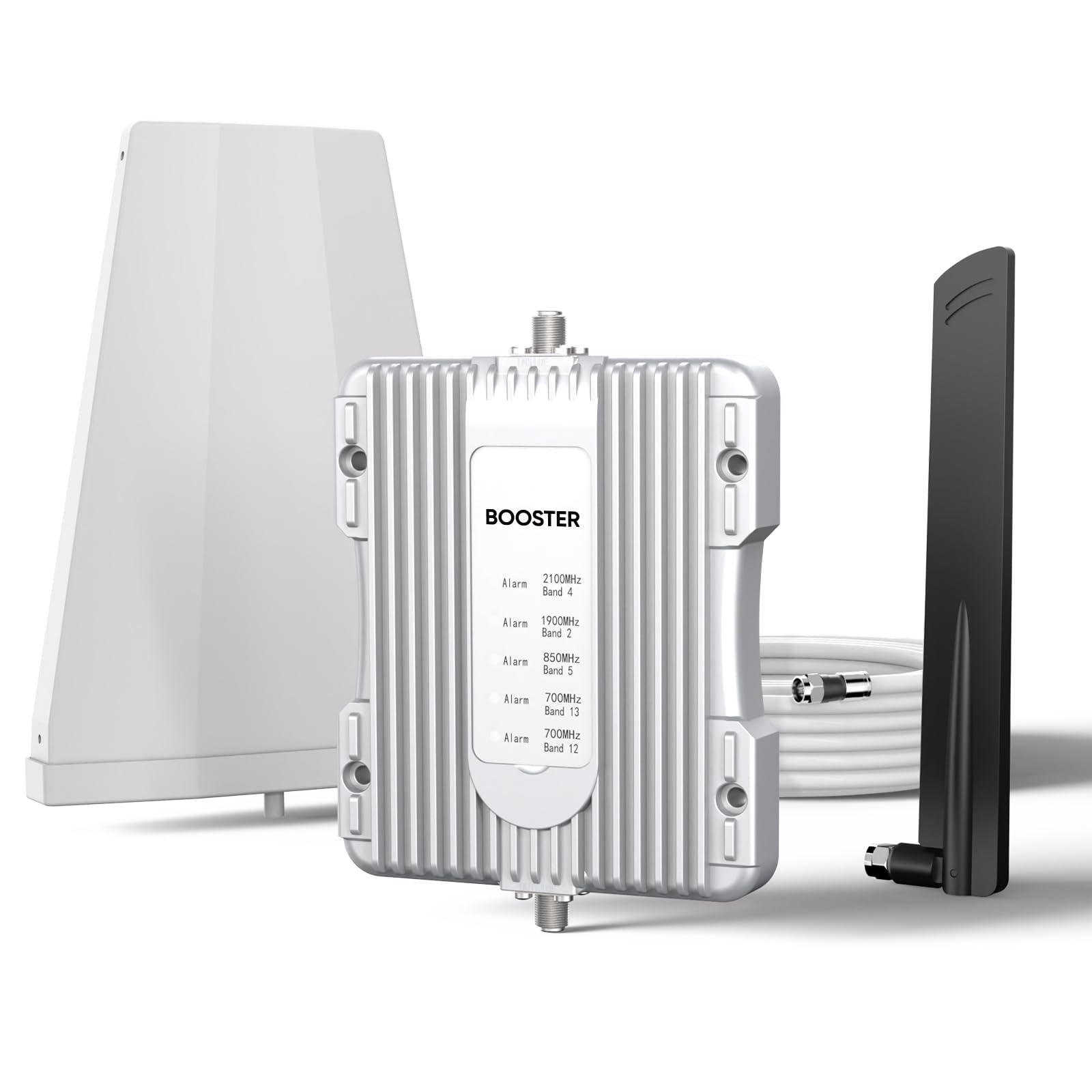
A 7-band repeater that brings 3,000 sq ft of coverage to stores, shops, and remote homes.
Wide carrier compatibility is the headline here: this SignalBrick supports Band 4, 12, 17, 13, 5, 25, and 2, so it boosts across AT&T, Verizon, T-Mobile, Sprint, Straight Talk, and US Cellular. With up to 60dB of gain and a directional outdoor antenna, it captures a distant tower and pushes signal through up to 3,000 sq ft.
The unit amplifies signal up to 100x, and owners verify real results: one saw signal climb from 1 bar of 4G to 3 bars of 5G in a home where construction was blocking the signal. Another reports solid improvement in a hilly, low-tower area after mounting the antenna above the roofline, reaching 3–4 bars on T-Mobile.
Setup is genuinely fast at under 30 minutes, with a tower-finding guide included and about 30 feet recommended between the outdoor and indoor antennas. The honesty check: results depend heavily on your location and tower direction, and a few buyers found no improvement after exhaustive antenna repositioning. If you are in a truly remote dead zone with no outdoor signal, this won’t be the fix.
What Stands Out
- 7-band coverage across all major US carriers
- 60dB gain lifts 1 bar to 3 bars of 5G
- 30-minute setup with tower-finding guidance
What to Expect
- Performance hinges on location and tower direction
- Won’t create signal where none exists outside
Grab it for: a shop, warehouse, or rural home with at least a weak outdoor signal that needs amplifying across a few rooms.
Think twice if: you have zero bars anywhere on your property — no booster can manufacture signal from nothing.
5. ZORIDA Cell Phone Signal Booster for All US Carriers

A compact 2,000 sq ft booster with app-guided installation that owners swear by for small spaces.
For a small home, studio, or single room, the ZORIDA Ace 5S is a crowd favorite because of its 72dB max gain — the highest ceiling in this lineup. That raw power translates into real results: owners regularly report going from 1–2 bars to 5 solid bars, with dropped calls stopping entirely.
The defining feature here is the companion app. It walks you through finding the best outdoor antenna spot with step-by-step videos, and shows your signal data before and after installation. Owners call the support team responsive and note the booster supports AT&T and Verizon simultaneously.
Installation is a genuine effort, though — mounting the outdoor antenna and running cable can take a while and often needs two people. The instructions could be clearer on tower types and frequency meanings, and signal can fluctuate with weather. It is FCC and IC certified, backed by a 3-year warranty, and one owner’s speed test showed 15.9 Mbps down and 12 Mbps up.
Great for small spaces: if you only need one room or a studio covered, this is an effective, app-guided choice.
Not for big homes: the 2,000 sq ft range and single-whip indoor antenna suit compact areas better than open floor plans.
6. GAGBK Cell Booster for Car and Truck
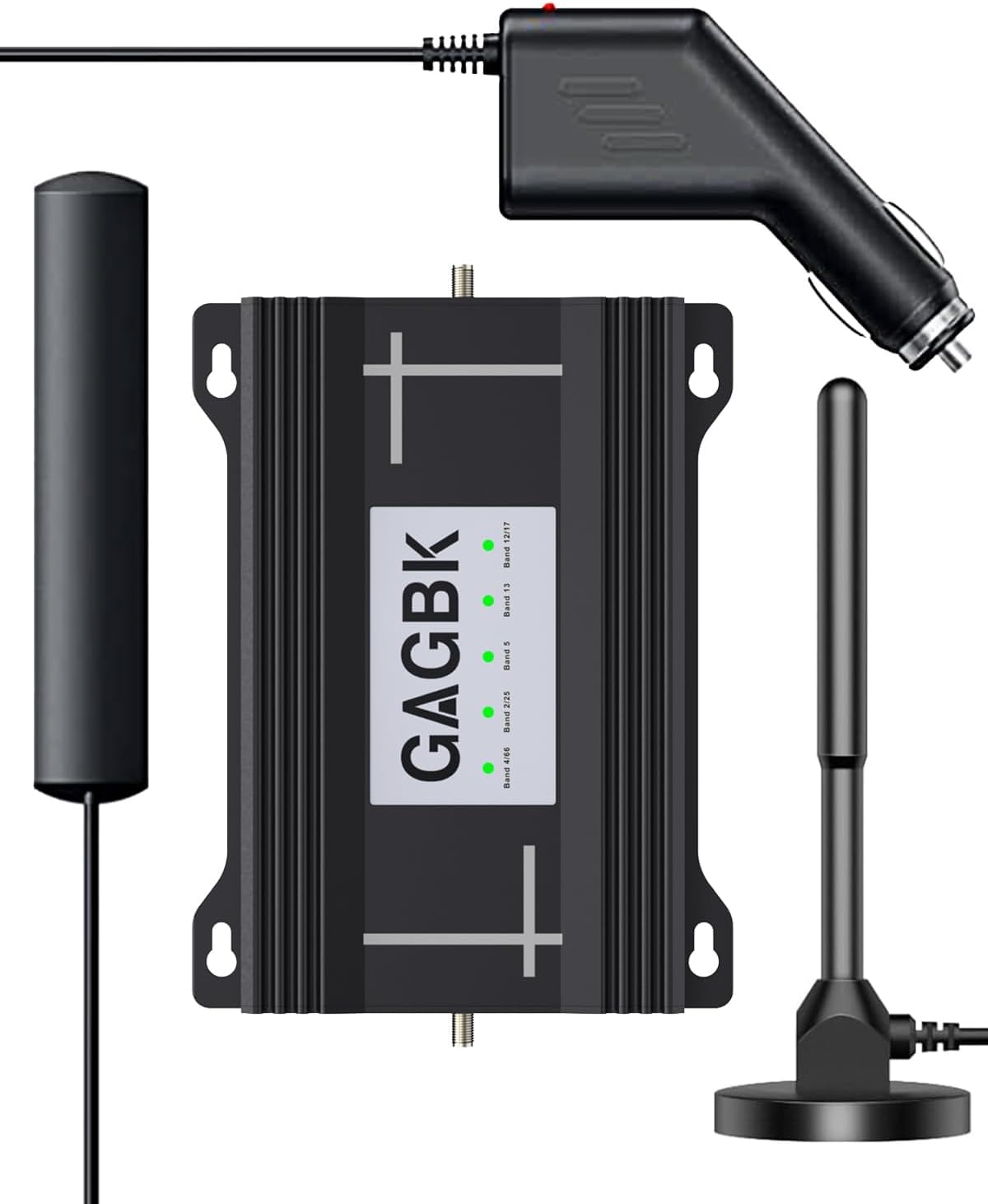
A plug-and-play vehicle booster that reaches towers 5–8 miles away to keep road trips connected.
This in-vehicle booster from GAGBK is built for life on the move, with a maximum communication distance reaching 5–8 miles to a cell tower. The 65dB high-gain design boosts 2G, 3G, 4G LTE, and 5G signal up to 100x stronger, which makes it a solid companion for RVs, trucks, vans, SUVs, and boats.
It supports a wide band range — 2/4/5/12/13/17/25/66 — so it works with all major US carriers and all phones. You get multiple smart features like AGC (automatic gain control that self-adjusts), an inactivity mode to save power, and oscillation elimination to keep the signal clean. The kit includes a 12V 3A power adapter, a 10ft indoor cable, and a 16ft outdoor magnet antenna cable.
Because it runs on your vehicle’s 12V power, it’s a true plug-and-play install that needs no technical experience. Owners note that for maximum power you have to position your phone near the indoor antenna. The warranty package is practical for travelers: 30-day money back, 90-day replacement for defects, and a 3-year manufacturer warranty.
Built for the road: a versatile booster for campers and commuters who need reliable signal across changing terrain.
Fair warning: phone placement matters — keep your device near the indoor antenna to get the full boost.
7. SureCall Flare 3.0 Cell Phone Signal Booster for Home and Office
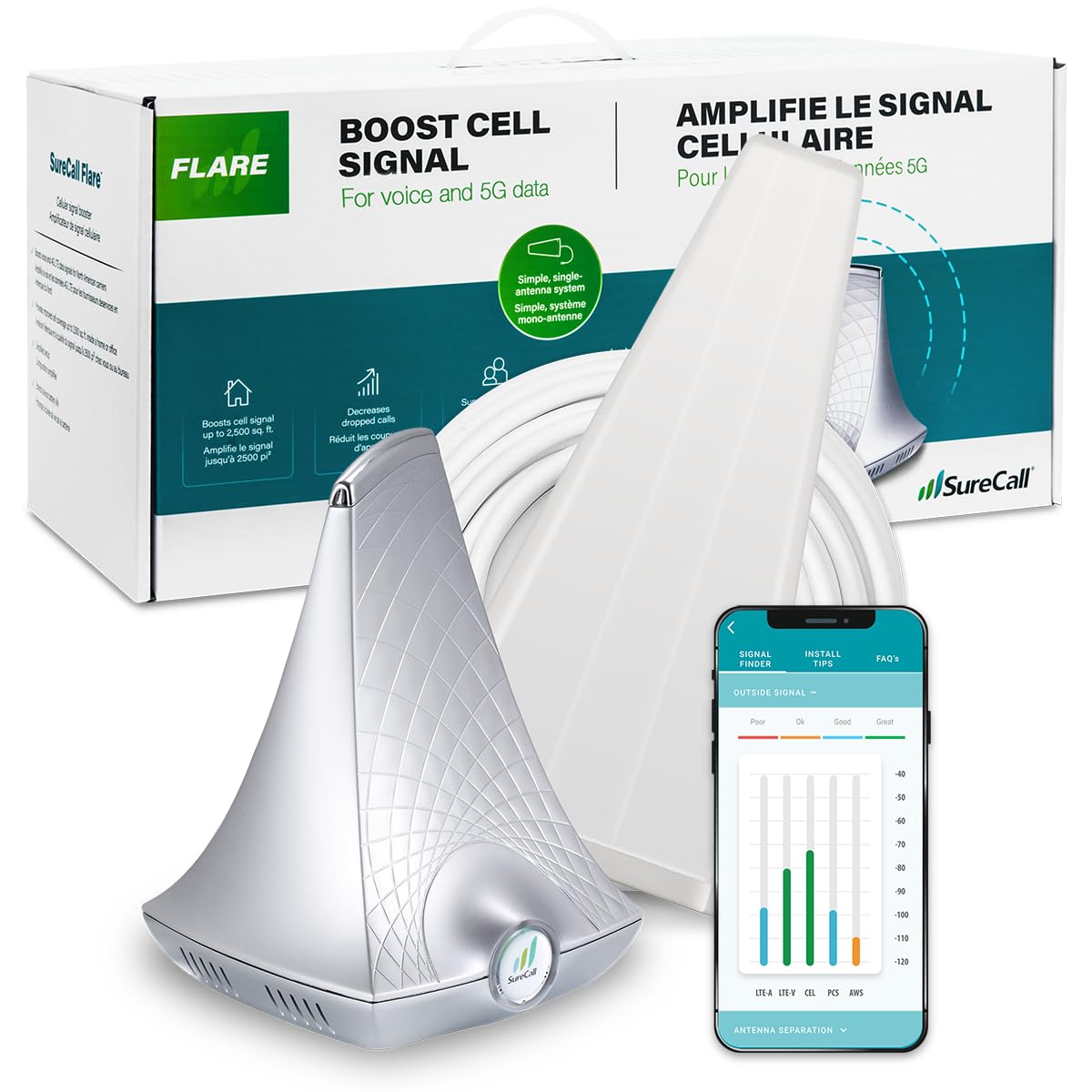
An American-made booster that pairs a Yagi antenna with an app to guide you through tricky installs.
SureCall is a US company that designs, assembles, and tests this unit stateside, which appeals to buyers who want domestic manufacturing. The Flare 3.0 uses a directional Yagi outdoor antenna to focus on a specific tower, and it covers up to 3,500 sq ft when the outdoor signal is strong.
Realistic expectations are built into the marketing here: with 1–2 bars outside you get about 500 sq ft inside, with 3–4 bars you reach 1,500 sq ft, and only with 5 bars outside do you hit the full 3,500 sq ft. This honesty is refreshing, and the free SureCall app helps you aim the antenna and tune placement in minutes.
The free app is the standout feature, guiding owners through antenna positioning. One owner in rural Alaska got full coverage after extensive tuning with the Yagi antenna and vertical separation between units. Signal results are genuinely mixed, though; some reviewers point out no improvement at all, and a few units died within weeks. It works best for a smaller home or a desk-area hotspot rather than whole-home coverage.
Good for small homes: if you’re willing to tune the Yagi antenna, this can deliver solid single-room or small-house coverage.
Reality check: results split evenly between impressive gains and no change — your outdoor signal and placement skill decide the outcome.
8. weBoost Drive 4G-X OTR Truck Cell Phone Signal Booster

The OTR workhorse that gives every passenger in the cab a stronger signal and up to 2 extra hours of talk time.
weBoost is the household name in vehicle boosters, and the Drive 4G-X OTR lives up to that reputation for long-haul truckers. It comes with an omnidirectional, weather-resistant 17-inch antenna that mounts via a 3-way CB antenna mount, so it’s built to survive highway life and grab signal from all directions.
Multi-user functionality means every passenger benefits — this isn’t a single-phone toy. It supports all US networks including Verizon, AT&T, Sprint, T-Mobile, and US Cellular. A smart benefit on the road: stronger cell service draws less battery power, which translates to up to 2 hours of additional talk time on your phone.
Shoppers say impressive real-world gains: one improved signal by 20dB and went from 4–5 bars in a poor-service area, enabling Netflix streaming via hotspot in an emergency. Another confirms it works even where the phone shows no signal at all, in places like Teton Canyon. Setup takes about 45 minutes, and the OTR antenna is notably more powerful than the smaller magnetic versions, though it is harder to mount. Expect to keep your phone near the internal antenna for best results.
Worth the Cab Space
- 20dB signal improvement in poor-service zones
- Omnidirectional 17″ antenna survives highway use
- Multi-user support for every passenger
- Adds up to 2 hours of phone talk time
Install Notes
- OTR antenna is harder to mount than magnetic versions
- Phone must stay near the internal antenna
For serious road warriors: if you log long miles and need reliable calls and hotspot data in remote stretches, this earns its place in your cab.
Not for: casual commuters who rarely leave strong-signal metro areas — the bigger OTR antenna is overkill for local driving.
9. weBoost Drive Reach OTR Cell Phone Signal Booster
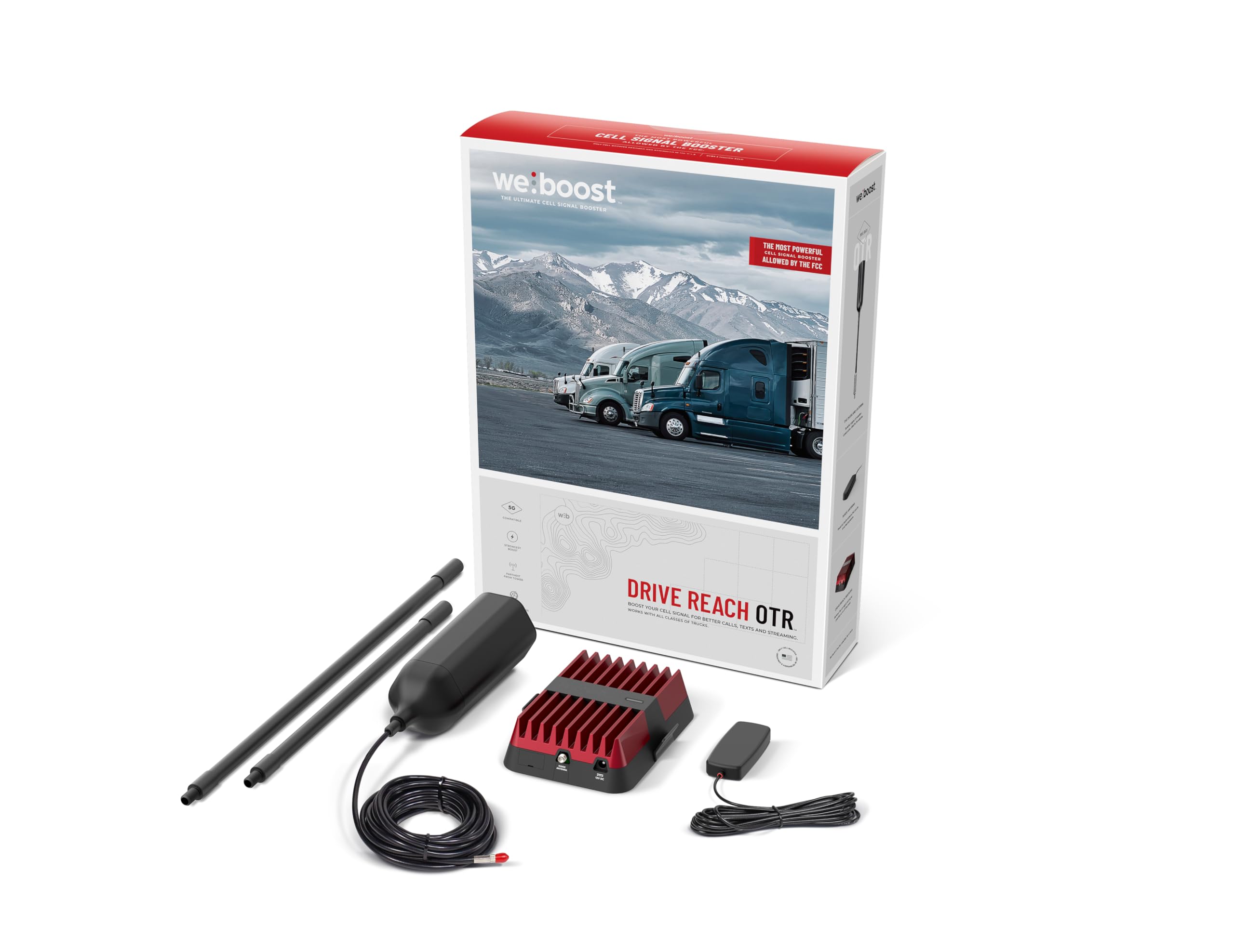
The top-shelf OTR system with 50dB gain that reaches the farthest towers for trucks and SUVs.
This is the premium end of the weBoost vehicle lineup, boasting 50dB of max gain to reach the most distant cell towers. It boosts both 5G and 4G LTE for all US carriers, and the kit is remarkably complete: it includes the Drive Reach booster, a Drive RV antenna, two mast extensions (one 13-inch and one 18-inch), an antenna spring, a side-exit adapter, and a slim low-profile indoor antenna.
For oil field workers and remote-site travelers, the 50dB gain reliably pulls in distant towers. One owner in the oil patch reports zero dropped calls since installing it in a big truck. Another saw massive gains in a rural Washington farm field, where an upload that took about an hour dropped to 7 minutes with the booster active. The push-up poles let you raise the antenna to rooftop level for maximum reach.
The catch is proper setup: the internal antenna needs to sit 18–36 inches from your device, and the external antenna should be 5–8 feet away. Owners stress that toggling airplane mode helps reset the connection after install. The antenna assembly drew some durability complaints over time, and a few buyers found the price steep for what they got. Backed by a two-year warranty and US-based support through app, chat, phone, or email.
The pro choice: for dedicated truckers and RVers who work or camp in true dead zones, the 50dB gain reliably pulls in far towers.
Setup is everything: respect the antenna spacing guidelines or you’ll leave performance on the table.
Understanding the Specs
Gain (dB)
This number tells you how much the booster amplifies the incoming signal. A higher dB means a stronger boost — think of it as the volume knob for your cellular signal. Units like the ZORIDA with 72dB max gain can turn a faint 1-bar outdoor signal into strong indoor coverage, while a lower-gain unit will give you a smaller nudge.
Coverage Area (Sq Ft)
Manufacturers rate boosters in square feet, but this is a best-case number that assumes a strong outdoor signal. The Metarepeater is a great example: it only hits its full 5,000 sq ft when you have 5 bars outside, and drops to 1,300–2,500 sq ft with a moderate signal. Always buy more coverage than you think you need.
Frequency Bands
Your carrier broadcasts on specific frequency bands, and the booster must support those exact bands to work. Verizon relies on Band 13, while AT&T and T-Mobile use Bands 12 and 17. The HiBoost covers bands 2, 4, 5, 12, 13, 17, and 25, making it a safe bet for nearly any US carrier.
Outdoor Antenna Type
A directional Yagi antenna focuses all its power on one distant tower, giving maximum range. An omnidirectional antenna like the weBoost’s 17-inch unit picks up signals from every direction but with less concentrated power. For static homes, a Yagi is usually the stronger choice; for moving vehicles, omnidirectional is practical.
FAQ
Will a cell phone booster work if I have no signal outside at all?
What does the dB gain number actually mean for my phone?
How do I know if a booster supports my carrier?
What is the difference between a home booster and a vehicle booster?
Is a cell phone booster legal to use?
Will a booster help with 5G signal or only 4G LTE?
How far apart should the outdoor and indoor antennas be?
What is AGC on a signal booster?
How long does installation actually take?
Final Thoughts: The Verdict
Across the board, the cell phone booster winner is the HiBoost Home Office because its 8,000 sq ft coverage and 70dB gain solve the biggest problem — whole-home dead zones — with app guidance and strong owner results. If you want a budget-friendly option for Verizon and AT&T, grab the JACOOL. And for life on the road, the weBoost Drive 4G-X OTR is the one to reach for, with its 17-inch omnidirectional antenna and multi-user support.
How We Picked
We do not accept paid placement. Every pick is matched to a real buyer and a real use-case; we do not hands-on test units.
Sources & Methodology
Specifications: manufacturer listings and product documentation. Review insights: verified customer reviews, as of August 2026. Pricing: not shown on this page (it changes often); check the current price via the retailer link.
As an Amazon Associate, Gadgets Feed earns from qualifying purchases. This does not affect which products we feature.