
A dead phone on a backcountry trail isn’t just an inconvenience—it’s a safety risk. A dedicated solar charger turns unlimited daylight into a reliable power source, keeping your device alive for navigation, communication, and photos without hunting for an outlet. The key is finding a panel that balances real-world wattage, portability, and durability for your specific outdoor routine.
I’m Min — the co-founder and writer behind Gadgets Feed. I’ve spent countless hours analyzing solar panel efficiency ratings, charging circuit designs, and real-user output data to build this guide around the specific trade-offs that matter when you’re relying on the sun.
Whether you’re through-hiking the Pacific Crest Trail or packing a bug-out bag for emergencies, this deep dive into the best cell phone solar charger options will help you pick the right panel for your next off-grid adventure.
How To Choose The Best Cell Phone Solar Charger
Not all solar panels are created equal, especially when your goal is juicing up a smartphone. You need to look past the marketing wattage and focus on the panel’s real-world behavior—how it performs in partial shade, the efficiency of its solar cells, and whether it can handle a bumpy ride in your pack.
Wattage vs. Real-World Output
Most portable phone solar chargers claim 10W to 30W, but that’s under perfect laboratory conditions—direct overhead sun, 25°C, no clouds. In real-world hiking or camping scenarios, expect 50-70% of that rated wattage. A 10W panel might deliver 5-7W on a partly cloudy afternoon, which is enough to trickle-charge an iPhone directly, but far too slow for a drained tablet. For consistent phone charging, aim for at least 15W of rated capacity.
Cell Type and Efficiency Matter
Monocrystalline silicon is the standard for portable chargers because it offers the highest efficiency (typically 22-25%) in a compact footprint. Cheaper panels use polycrystalline cells, which are less efficient and require more surface area for the same output. Some premium panels, like the ELECOM NESTOUT, use SunPower MAXEON cells, which boost efficiency further and perform better in low-light conditions like dawn or heavy overcast.
Portability and Build Quality
A solar charger you won’t carry is useless. Look for a folded size of roughly 7×8 inches or smaller and a weight under 1.5 pounds. The outer fabric matters—ripstop nylon and oxford cloth resist tears from sharp rocks and tree branches. ETFE (ethylene tetrafluoroethylene) film lamination protects the solar cells from scratches and weather, and a minimum IPX4 rating ensures the panel survives rain splashes without failing.
Output Ports and Smart Charging
At a minimum, your panel needs a USB-A port. USB-C is increasingly common and allows faster charging with modern phones. A smart IC chip that auto-detects your device and adjusts the current prevents overcharging and protects your phone’s battery. Some panels also include a small LED indicator so you know sunlight is actually generating power—a useful sanity check when you’re setting up camp in a clearing.
Quick Comparison
On smaller screens, swipe sideways to see the full table.
| Model | Category | Best For | Key Spec | Amazon |
|---|---|---|---|---|
| BigBlue 28W | Premium | Multi-device backpackers | 25.4% conversion, dual USB-C | Amazon |
| FlexSolar 20W | Mid-Range | Balanced power & size | 20W, USB-C + USB-A, 24% eff | Amazon |
| ENOFLO 30W | Mid-Range | Power station pairing | 30W, QC3.0, 10-in-1 DC adapter | Amazon |
| SOLUPUP 30W | Premium | Car camping & emergency kits | 30W, IPX5, kickstand included | Amazon |
| FlexSolar 15W | Mid-Range | Ultralight treks | 15W, 0.99 lbs, IP67 | Amazon |
| BLAVOR 10W | Budget | Day hikes & top-offs | 10W, 0.81 lbs, 24% eff | Amazon |
| ELECOM NESTOUT 28W | Premium | Integrated gear systems | SunPower cells, current checker | Amazon |
In‑Depth Reviews
1. BigBlue 28W Solar Panel Charger

The BigBlue 28W stands out because it uses N-type solar cells with a shadow-free surface design—no metal grid lines on the front panel, which means more active area captures light even when partially shaded. Its 25.4% conversion efficiency is among the highest in the portable class, and the dual USB-C plus single USB-A configuration lets you charge three devices at once. At 1.5 pounds, it’s light enough for a multi-day pack but still delivers enough real-world output (roughly 18-22W in full sun) to keep a phone and a power bank topped off simultaneously.
Users on extended trips have paired it with 10,000mAh to 36,000mAh battery banks, reporting that the panel fully charges a bank in a couple of hours under direct sunlight. The polymer surface resists rain and fog splashes (IP44), and the foldable design collapses to 11x6x1.4 inches—small enough to slide into a side pocket of a daypack. The blue LED glows solid when it’s getting solid sun, so you can angle the panel until you see the confirmation light.
One trade-off is the USB junction box, which isn’t fully sealed; you’ll want to keep it dry in a sustained downpour. Also, the fabric mounting loops are stitched into the panel’s edge, so rough handling or repeated flexing near the hinge points could eventually weaken them. For most hikers and campers, though, this is the gold standard of portable solar charging.
Why it’s great
- Industry-leading 25.4% cell efficiency
- Two USB-C ports for modern device charging
- Lightweight (1.5 lbs) and compact folded size
Good to know
- USB junction box is not waterproof
- Mounting loops can be a failure point over time
2. FlexSolar 20W Small Solar Panel Charger

This 20W FlexSolar panel hits a sweet spot between output and packability. Unfolded, it measures 18x12x0.6 inches, but it folds down to the size of a standard iPad, weighing just 0.99 pounds. The ETFE film lamination protects the monocrystalline cells from scratches and provides an IP67 rating, meaning it’s dust-tight and can survive submersion in shallow water (though the junction box itself isn’t fully sealed). It delivers up to 15W per port when used individually, or a balanced 10W per port when both USB-A and USB-C are occupied.
Real-world performance reports from thru-hikers show it can charge an iPhone 13 Pro Max from 70% to 100% in 2-3 hours under partly cloudy skies, and a 10,000mAh battery pack from 40% to full in 4-5 hours of bright sun. The auto-restart function is a standout—if a cloud passes or you move into shade, the panel automatically resumes charging without you having to unplug and replug. Four reinforced hanging holes plus two carabiners let you clip it to the back of your pack while you hike.
The main downside is that the overall power is still modest—20W is enough for phones and small power banks, but it will struggle with larger 20,000mAh+ batteries or any device that draws more than 15W consistently. Also, a few users report that charging time is slower than expected in heavy overcast, so this is best suited for sunny or partly cloudy climates.
Why it’s great
- Auto-restart function for consistent charging in variable sun
- ETFE film with IP67 protection
- Weighs under a pound and folds to tablet size
Good to know
- 20W output is insufficient for larger power banks or laptops
- Junction box is not fully waterproof despite IP67 panel rating
3. ENOFLO 30W Solar Panel Charger YT30
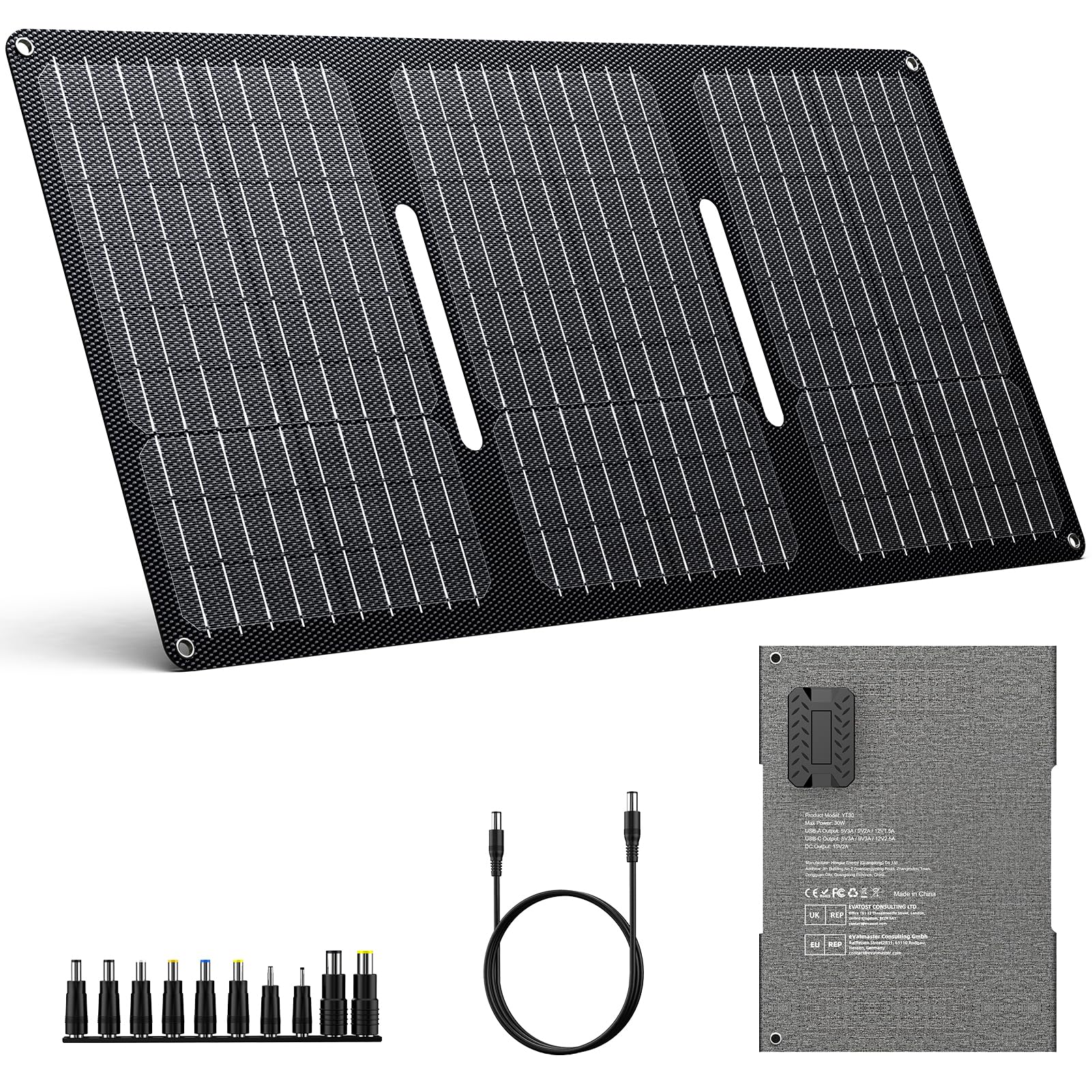
The ENOFLO YT30 delivers a genuine 30W of peak power with a smart chip that identifies your device and maximizes charging speed. In full sun, users have measured 27W through the DC port and about 19W over USB-C—enough to charge a 10,000mAh battery from 20% to 80% in roughly two hours. The three-panel foldable design collapses to 13×8.5×0.3 inches, roughly the size of a MacBook Air, and weighs 2.09 pounds, making it a bit heavier than ultralight options but still packable for car camping or basecamp setups.
What sets the YT30 apart is its 10-in-1 DC connector kit, which includes adapters for portable power stations and solar generators. This means you’re not limited to USB charging—you can plug directly into a Jackery, EcoFlow, or similar brand’s solar input for faster, more efficient charging. The built-in smart chip also handles overcharge and overload prevention, so you can leave devices connected without worry. In a snowstorm test, one user charged three phones, two radios, and a Fitbit over six hours of partial sun.
The main compromise is size and weight—at over two pounds, it’s not ideal for ultralight backpackers who count every gram. Also, the fabric can become stiffer after repeated sun exposure, making it a bit harder to fold neatly. The lack of a dedicated storage pouch is a minor annoyance for travel.
Why it’s great
- Genuine 30W peak output for faster charging
- 10-in-1 DC adapter kit for power stations
- Smart IC prevents overcharging and overloading
Good to know
- Heavier than competitors at 2.09 lbs
- No built-in storage pouch for cables
4. SOLUPUP 30W Foldable Solar Charger
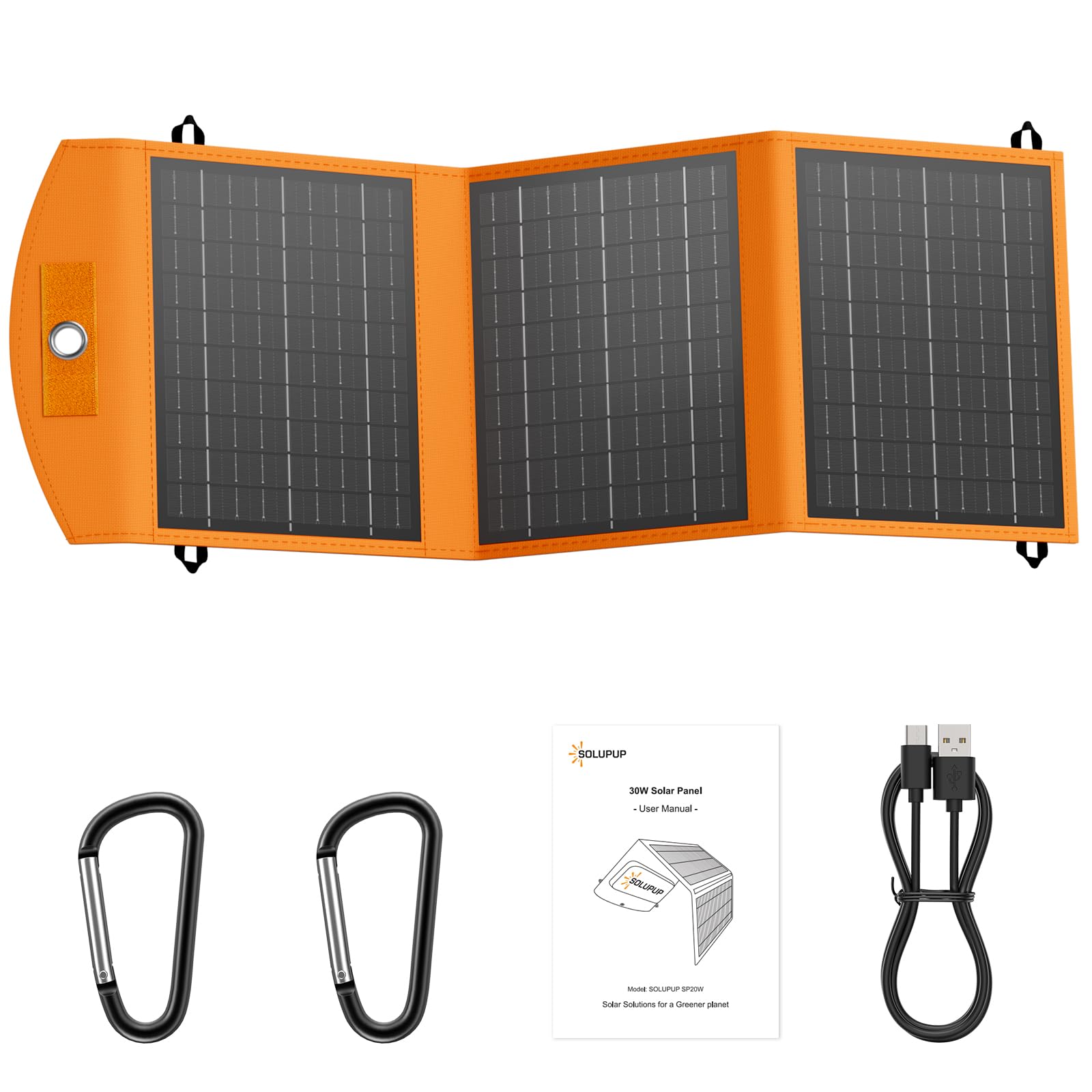
The SOLUPUP 30W is built for convenience: it includes a built-in adjustable kickstand that lets you angle the panel directly at the sun without propping it against a rock. Its monocrystalline cells deliver over 23% efficiency, and the dual USB-A and USB-C ports (5V/3A each, 15W max per port) handle simultaneous charging of a phone and a power bank. In direct sunlight, users report that an iPhone begins charging immediately upon connection—no finicky handshake issues.
The IPX5 rating means the panel can withstand rain from any direction, making it a solid choice for emergency kits and car camping where weather exposure is unpredictable. One user took it on a 5-day off-grid canoe trip and recharged a spare battery pack daily with just a few hours of sun. The panel folds to 10.63 inches and weighs 2.4 pounds—not the lightest, but the integrated stand and sturdy construction justify the heft for basecamp-style use.
A limitation is that the USB-C port tops out at 15W, so you won’t get the full 30W into a single USB-C device; you’ll need to use both ports or the DC output to reach peak performance. Also, some users note that the actual sustained output in less-than-perfect sun is closer to 10-15W, so set expectations accordingly for cloudy conditions.
Why it’s great
- Built-in kickstand for optimal sun angling
- IPX5 waterproof rating for rain exposure
- Fast device recognition with auto-reconnect after shading
Good to know
- USB-C limited to 15W per port
- Sustained real-world output drops significantly in clouds
5. FlexSolar 15W Small Solar Panel Charger

If every ounce counts, the FlexSolar 15W is the lightest fully-featured solar panel in this lineup at just 0.99 pounds. It folds to 7.8×8.8×0.7 inches—smaller than an iPad—and uses ETFE film lamination with an IP67 rating, meaning it’s dustproof and can handle rain submersion (junction box excluded). The single USB-A output (5V/3A max) is simple and direct; just unfold, plug in your device or power bank, and let the sun do the work.
Field testing from a 2.5-week trip shows it can fully charge a 36,000mAh battery pack daily, even under partially cloudy skies, when positioned correctly. The monocrystalline cells achieve up to 24% conversion, so you get solid performance for the size. The included carabiners let you attach it to your backpack, and the three-fold design spreads to 23.5×8.8 inches, giving you a large capture area relative to its folded bulk.
The biggest trade-off is the single USB-A port—you can only charge one device at a time, and there’s no USB-C for modern fast charging. Also, the hanging holes are made from the same fabric as the panel body, and repeated clipping/unclipping could wear the edges over time. This is strictly a trickle-charge or power-bank maintenance tool, not a high-speed refueling station.
Why it’s great
- Ultra-lightweight at under 1 lb
- IP67 rating for excellent weather protection
- ETFE film is scratch-resistant and durable
Good to know
- Single USB-A port only, no USB-C
- 15W output is slow for direct phone charging
6. BLAVOR 10W Portable Solar Charger
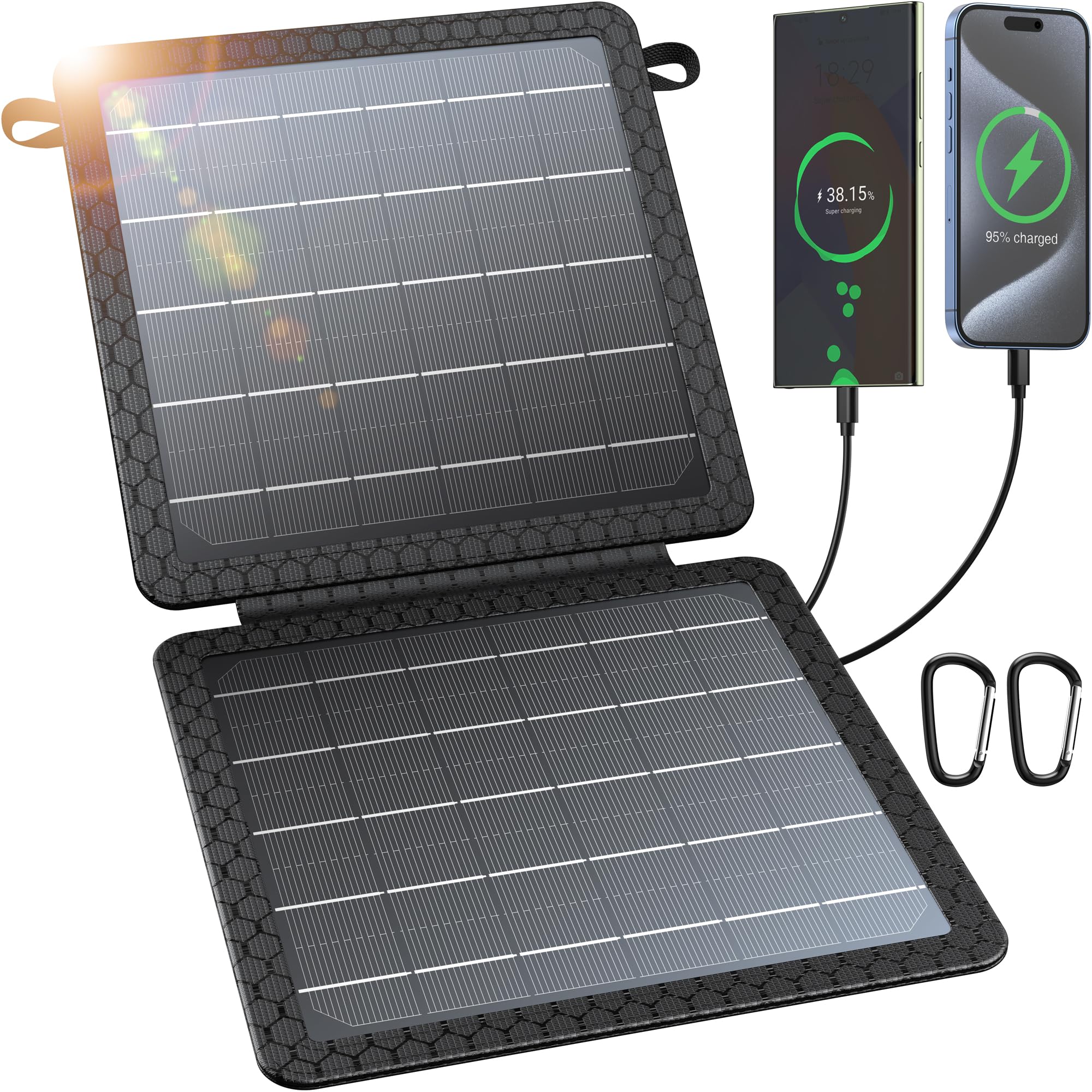
The BLAVOR 10W is the entry-level panel that proves you don’t need to spend a lot to keep your phone alive on a day hike. At just 0.81 pounds and folding to 7.4×7.5×1 inches, it’s light enough to clip to a hydration pack strap. The ETFE high-light-transmission film gives a 24% conversion rate—impressive for the price point—and the USB-A and USB-C outputs (5V/2A max) offer surprising versatility for such a small panel.
Users report that in full sun, the panel maintains a phone charge at 96-100% while streaming music all day, meaning it’s a solid top-off tool. On cloudy days, it can still keep a phone from dropping below 66% over a full day of moderate use. The oxford cloth exterior handles dust and light rain, and the included carabiners make attachment straightforward. It’s best used to charge a power bank during the day, then use the bank to charge your phone at night.
The main risk is reliability—there are isolated reports of the panel failing after just a few days of use, with the red charging LED ceasing to function. Also, at 10W, it won’t put meaningful charge into larger devices like tablets or 20,000mAh+ power banks. Treat it as a lightweight emergency companion, not a primary power source for extended trips.
Why it’s great
- Extremely lightweight and compact
- Both USB-A and USB-C outputs
- Affordable entry into solar charging
Good to know
- 10W output is slow for direct phone charging
- Some units report early failure of charging circuitry
7. ELECOM NESTOUT Portable Solar Panel 28W

It uses SunPower MAXEON cells, which deliver up to 24% higher efficiency than standard monocrystalline panels, and the integrated LED current checker display shows you exactly how much solar power is flowing into the USB ports. The panel itself is housed in water-resistant ripstop nylon with a zippered storage pouch that holds the NESTOUT battery pack, lantern, and cables, creating a self-contained power station.
In practice, the dual USB-A ports (5V/4.8A total, max 2.4A per port) charge a NESTOUT battery pack from flat to full in about 2.5-3 hours of direct sun. The panel’s adjustable stands allow you to tilt it toward the sun at multiple angles, and the three exterior loops let you hang it from trees, tent lines, or backpack straps. The entire folded package is 11×6.1×2.4 inches and weighs 1.7 pounds—a bit heavier than bare panels, but the integrated storage and build quality justify it.
The glaring omission is the lack of a USB-C port, which is surprising at this price point. You’ll need a USB-A to USB-C cable for modern phones. Also, the panel’s real-world output is best when both USB ports are in use; running a single device may not hit the full 28W rating. For those already invested in the NESTOUT ecosystem or who value a polished, integrated design, this is a top contender, but budget-conscious buyers can get similar performance for less.
Why it’s great
- High-efficiency SunPower MAXEON solar cells
- Built-in digital current checker display
- Water-resistant ripstop nylon with integrated storage
Good to know
- No USB-C port, only USB-A outputs
- Premium price for the integrated design
FAQ
Can I charge my phone directly from a small solar panel?
How much wattage do I need to charge an iPhone or Android quickly?
Do I need a solar charger with a built-in battery?
Can I use a solar charger to charge a laptop or tablet?
How do I maximize charging speed from my solar panel?
Final Thoughts: The Verdict
For most users, the best cell phone solar charger winner is the BigBlue 28W because it combines highest-in-class 25.4% cell efficiency with dual USB-C ports and a lightweight, compact fold that fits any pack. If you want a built-in kickstand and rugged IPX5 protection for car camping, grab the SOLUPUP 30W. And for ultralight backpackers who count every gram, the FlexSolar 15W delivers reliable trickle charging at under a pound.