
Our readers keep the lights on and my morning glass full of iced black tea. As an Amazon Associate, I earn from qualifying purchases.
Specs are compiled from manufacturer listings and verified buyer reviews and can change over time — please confirm the key details on the product page before buying.
Here is the short answer most shoppers want: the TECKNET VR Headset with Controller is the one to buy if you want your phone to actually feel like a VR rig, because it pairs a 90°-110° field of view with a Bluetooth controller and a genuinely light 268g build. Everything else on this list is a narrower bet — fine for a movie night or a curious kid, but a step behind in daily usability. The single number that matters most for any phone-dock headset is its FOV, the field of view, because that figure decides whether the picture wraps around your vision or stares back at you like a tiny TV. The second number is screen-size support, since a headset that tops out below your phone’s display simply will not hold it. Those two specs decide whether a headset works with your phone at all; comfort and controllers are secondary.
I’m Min — the founder and writer behind Gadgets Feed. This guide is built by comparing the manufacturers’ published specifications and the patterns across verified customer reviews, so you get each pick’s real strengths and trade-offs instead of marketing spin.
Below you will find the specs that decide what your phone can actually do inside these shells, plus the honest limits of each design. Whether you are chasing 360-degree sports clips or a five-minute novelty for the family room, this page lays out a cell phone vr headset shortlist you can check against your own phone before you buy anything.
Quick Picks
- TECKNET VR Headset for Phone with Controller — Best Overall
- VRG Pro 3D VR Glasses (Black Basic) — Widest View
- Mryzzsf 3D VR Headset with Controller — Clean Sweep
- VR EMPIRE B95 VR Headset — Big-Screen Ready
- VR EMPIRE BR95 VR Headset with Controller — Gamer’s Remote
- Google Daydream View (Slate) — Daydream Only
How To Choose The Best Cell Phone VR Headset
A phone-dock headset is a plastic shell with two lenses, a slot for your handset, and a strap. That is the whole machine. So the buying decision is really four small decisions: does my phone fit, does the lens bend light in a way my eyes tolerate, is the picture wide or narrow, and do I get a controller. Settle those four questions and the shortlist narrows to one or two models.
Start with your phone’s screen size, not its brand
Every listing here quotes a range like 4.7″ to 7.3″. That is the physical diagonal of the display your headset can clamp, and it is the first filter that eliminates a pick. A 4.7″ to 7.3″ dock swallows a big handset with room to spare. A 5.0″ to 7.0″ dock fits the same popular phones but has less slack for a chunky case. Measure your phone’s screen diagonal and match it to the dock’s stated range. Do not assume your brand is supported — check that your exact model is named or that your screen falls inside the range.
Your phone needs a gyro sensor for the 3D to work
A gyro sensor is the tiny motion chip that tells the headset which way you just turned your head. Without it, you get a flat split-screen picture that will not follow you, and the whole effect collapses. Most modern handsets carry one, but a budget phone may not. Check your handset’s spec sheet before you order, because no lens and no knob can fix a missing sensor.
Field of view: the difference between a window and a cinema
Field of view, or FOV, is measured in degrees and describes how much of the world the lenses fill. A 120° lens wraps the picture around your peripheral vision, which is what makes a concert clip feel like a front-row seat. A 90°-110° lens is a touch narrower, still convincing for movies, slightly more like looking through a large window. Both figures are usable for movies and clips; the 120° lens simply fills more of your peripheral vision. Neither projects a true 360 sphere on its own — that comes from the app you run.
Quick Comparison
| Model | Best For | Field of View | Phone Screen Fit | Controller | Amazon |
|---|---|---|---|---|---|
| Google Daydream View (Slate) | Daydream-ready handsets | — | Daydream-ready phones | Daydream View Controller | Amazon |
| VRG Pro 3D VR Glasses (Black Basic) | Glasses wearers and big phones | 120 degrees | Up to 7 inch | Remote control included | Amazon |
| Mryzzsf 3D VR Headset with Controller | Wide phone compatibility | 120 degrees | 5.0-7.0 inch | Button control remote | Amazon |
| VR EMPIRE B95 Headset | Big-screen handsets | 120 degrees | 4.7″ to 7.3″ | Touchpad control | Amazon |
| VR EMPIRE BR95 with Controller | Gaming with a motion remote | 120 degrees | 4.7″ to 7.3″ | Motion-sensing controller | Amazon |
| TECKNET VR Headset with Controller | All-round everyday use | 90°-110 degrees | 4.7-7.2 inch | Bluetooth controller | Amazon |
In‑Depth Reviews
1. TECKNET VR Headset for Phone with Controller
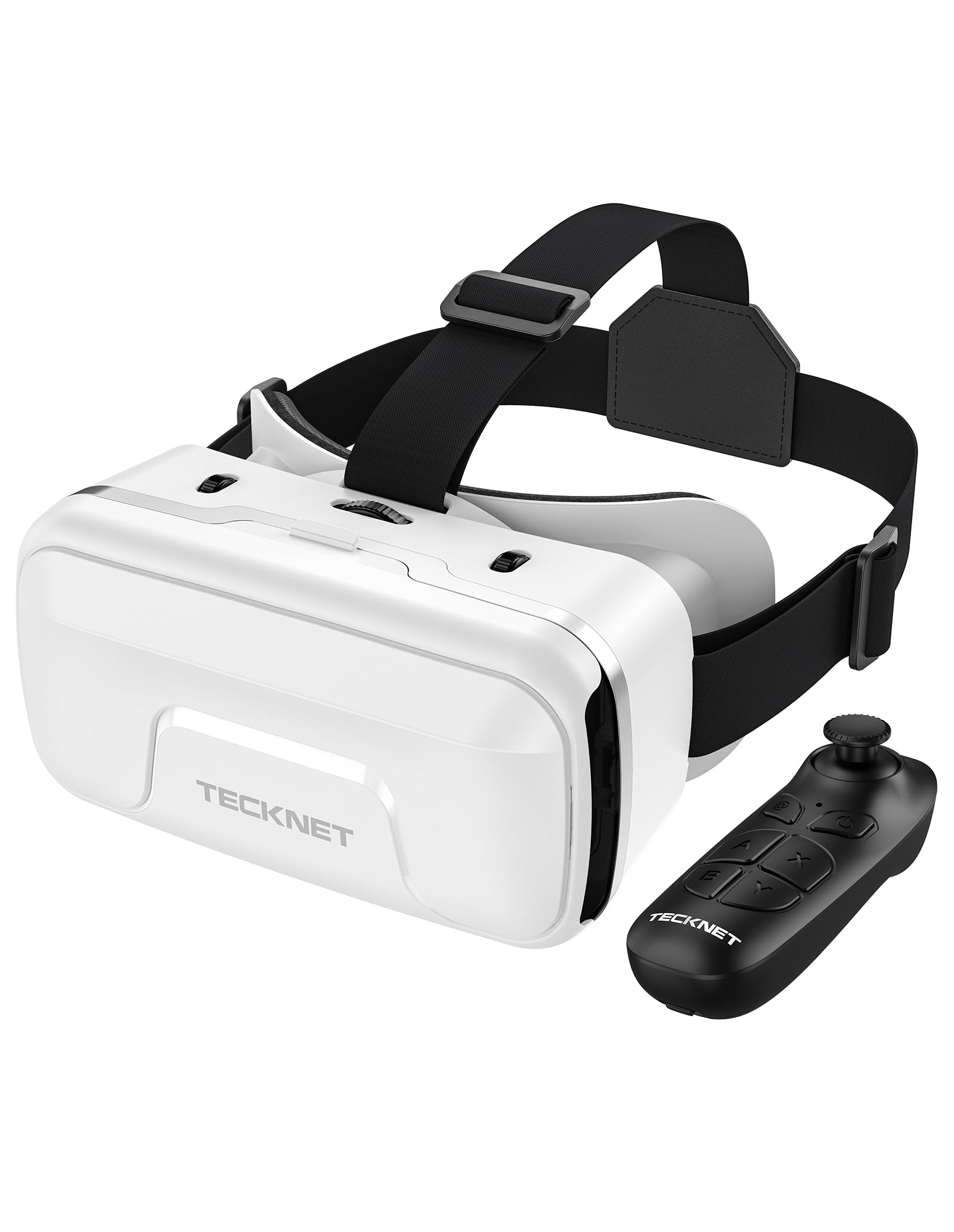
The one that behaves like real gear, not a novelty — light on the head and paired with a wireless remote.
Start with the 268g weight, because it is the spec you feel first. That is roughly the heft of a full water bottle strapped to your face, and it is why this headset can survive an extended movie session without the strap digging in. The adjustable headband and soft nose rest spread that load, and the breathable soft foam mask keeps air moving so the lenses do not fog the moment you settle in. It is the only pick on this list that names a weight at all, and the number is modest.
Then there is the Bluetooth controller — a wireless remote that connects to your phone rather than dangling a wire across your chest. That matters because it frees you to sit back on a couch instead of holding a rigid posture. Screen support runs 4.7 to 7.2 inches, which covers the modern iPhone and Samsung families the listing names outright. The 90°-110° field of view is narrower than the 120° lenses on the VRG Pro and the two VR EMPIRE units, so a panoramic sports clip will not wrap as far around your vision. In exchange you get a headset built for comfort first.
The listing is refreshingly blunt about one thing: this VR does not convert images into 3D by itself. You supply the depth by opening 3D-format apps or panoramic video, so the experience lives or dies on what you feed it. That is true of every headset in this category, but TECKNET is the one that says so out loud in the product copy. The 36-month warranty, for registered users, is also the longest window mentioned anywhere on this list. For a first-time buyer who wants one headset to learn on, that combination of light build, wireless remote and long coverage is the soundest bet here.
What it brings to your face
- A 268g build that keeps long sessions comfortable
- Bluetooth controller removes the dangling wire
- Soft foam mask and adjustable headband for a broad head fit
- 36-month warranty on registered units
What to keep in mind
- 90°-110° field of view is narrower than the 120° picks
- No built-in 3D conversion — you must supply the content
Reach for this if: you want one everyday headset that stays comfortable and pairs with a wireless remote for gaming and films.
Look elsewhere if: you specifically want the widest 120° picture available on this list.
2. VRG Pro 3D VR Glasses (Black Basic)

A 120-degree window that opens wider than the TECKNET, and knobs that let glasses wearers skip the contacts.
The headline here is the 120 degree lens, a full 120° field of view that spreads the picture further into your edges than the TECKNET’s 90°-110° window. For a panoramic concert clip or a sweeping landscape, that extra spread is the difference between watching and being placed inside. It is also the reason four separate picks on this page quote 120°, and this is the least expensive route to that figure.
The adjustment story is unusually complete for the money. Independent lens adjustment, a knob for pupil distance, and an object-distance adjustment all sit on the shell. In plain terms, pupil distance is the gap between your eyes, and the knob lets you dial the lenses to match yours so the two images merge cleanly instead of ghosting. The listing also flags it as myopic-friendly, so a glasses wearer can often leave the spectacles off. A detachable large-screen frame handles phones up to 7 inch, and the frame comes out for smaller handsets.
Comfort leans on a removable sponge eye mask — soft against the face, and simple to peel out and clean, which matters once a few family members have had a turn. The foldable body is genuinely carry-friendly, so it can ride in a bag for a trip. It comes with a remote control to pair with the phone. Weigh the trade-off honestly: a foldable shell and a wide lens often mean a headset you treat as a shared toy rather than a precision instrument, so handle the hinge with care and it will serve you well.
The fit-first read: if you wear glasses or share the headset across a household, the independent lens and pupil-distance controls are the reason to pick this over the simpler shells on the list.
One number to note: 120 degrees of FOV out of a foldable frame is a lot of picture for the footprint.
Best suited to: glasses wearers and families who want a wide 120° picture and a foldable body for travel.
Think twice if: you want a fixed, rigid frame you never worry about closing.
3. Mryzzsf 3D VR Headset with Controller

The highest-rated shell on this page, and the one that ships with the most complete little starter kit.
Pour the box out and you get the headset, a remote controller, a cleaning cloth and an English user manual — a small thing, but the manual is worth naming when other listings leave you to guess. The lens itself matches the VRG Pro at 120 degrees, so the picture wraps as wide as anything else here except the two VR EMPIRE units, which quote the same 120°. The difference is in the wearing: a fully adjustable head strap, an eyesight protection system, and a soft nose piece that takes pressure off the bridge.
The FD and OD adjustments, short for focal distance and object distance, do the same job as the knobs on a camera lens — they let you tune the picture until it is sharp instead of strained. The listing also ties them to unilateral myopic alignment, which is a formal way of saying one eye can be dialed differently from the other. Phone fit covers 5.0 to 7.0 inches, and the compatibility list reads like a phone-shop inventory: iPhone 15 Pro Max down to the 6s, plus Galaxy S22 through S8 and the Note line. A lower 5.0″ floor means a small handset that the 4.7″ picks would handle sits right at this one’s edge.
It comes with a button control remote that talks to your phone for play, pause and volume, so you are not reaching up to tap the headset. The listing pitches it as a gift for kids and adults, which tells you the makers expect it to be passed around. That is fine — but set expectations before the first session, because no headset in this category magically turns a normal video into 3D. Load a 3D app or a panoramic clip and this one performs well above its price point.
Why it earns a look: a 120° lens, dual focal and object-distance tuning, and a full accessory set make this the most complete budget-friendly kit in the group.
Your pick if: you want a wide picture plus a controller and a manual in one box, and your phone sits between 5.0 and 7.0 inches.
Skip the fit if: your handset is smaller than 5.0 inches, which falls below this dock’s stated range.
4. VR EMPIRE B95 VR Headset

Built for the largest phones on this list, with a 7.3-inch ceiling that swallows the biggest handsets going.
If your phone is a max-size slab, the fit range is what separates this from the Mryzzsf. The B95 accepts 4.7″ to 7.3″ screens, the widest upper limit here alongside its sibling BR95, so a 7.3-inch handset clips in without a fight. The lens is the familiar 120 degrees, matching the VRG Pro and Mryzzsf for wraparound width.
The glass is where it diverges — anti-blue lenses that cut the blue light coming off the screen, the same category of protection the TECKNET also carries. A screen touch button on the shell lets you interact without pulling the phone out, and an adjustable headband keeps it planted. The listing describes the visual result as a 360 experience, and it leans on the same gyro sensor requirement as every other pick: your phone needs that motion chip, or the head tracking will not respond. It handles the iPhone 15 range and Samsung’s recent Galaxy models by name. As a gift it covers kids and adults, and the anti-blue lens is a sensible touch if a younger viewer will be using it.
One design note worth flagging: this shell uses a touchpad control rather than a separate handheld remote. That is simpler to keep track of — nothing to lose — but it means your taps happen on the headset rather than in your hand. The list copy here is unusually repetitive and keyword-stuffed, so read the specs, not the prose, when you compare. Ignore the prose and the B95 is a solid wide-fit shell for a 7.3-inch phone.
Where it shines
- 4.7″ to 7.3″ fit handles the largest handsets
- 120 degree field of view for a wide picture
- Anti-blue lenses for longer viewing sessions
- Screen touch button keeps control on the headset
The honest caveats
- Touchpad control instead of a handheld remote
- Needs a phone with a gyro sensor for head tracking
Point it at: owners of max-size phones who want a 120° picture and anti-blue lenses in one shell.
Not the one for: anyone who prefers a separate controller in hand over tapping the headset.
5. VR EMPIRE BR95 VR Headset with Controller

Same wide shell as the B95, but this time you get a motion-sensing controller in your hand.
Where the B95 gives you a touchpad, the BR95 hands you a motion-sensing controller — a remote that reads the way you swing it, not just the buttons you press. That is the whole reason to step up to this model. For anything that involves aiming, swiping or swinging at a target, a controller that tracks movement beats tapping a panel bolted to your face.
Everything else carries over cleanly. The screen range is the same generous 4.7″ to 7.3″, covering the iPhone 15 family and the recent Galaxy line by name. The lens repeats the 120 degree field of view, so the picture spreads as wide as the B95. An adjustable headband and a light body round out the fit side — no weight figure is published here, but the listing calls it lightweight and the same shell design is shared across the pair.
The blue-light lenses return too, cutting screen glare if someone in the house is prone to longer sessions. The paperwork mirrors the B95 almost word for word, so the honest caveat is the same: the copy is stuffed with keywords and tells you little you cannot read off the spec sheet. It is the B95 shell with a motion controller instead of a touchpad, and nothing more. If motion control is the point of the purchase, this is the pick of the two VR EMPIRE models.
What tips it over the B95: motion-sensing control turns the same 120° picture into something you can actually aim inside, not just watch.
Made for: gamers who want to swing and aim with a remote instead of tapping a touchpad.
Only skip if: gaming is not the plan and you would rather not pay for a controller you will not swing.
6. Google Daydream View (Slate)

The one that feels like fabric on your face instead of plastic, but only talks to a short list of phones.
Google wrapped this one in soft, breathable fabric — a genuinely different material choice from every other shell here, and the reason it slips onto the head with less clamminess. It ships with the Daydream View controller and a wrist strap, and the platform behind it is a curated store of VR apps and games rather than a wild west of downloads. The pitched appeal is the front-row seat: concerts and sports in a 360-degree panoramic view, browsed from the Daydream app library.
Here is the catch, and it is a real one: this is a Daydream-ready headset. The compatibility line is narrow — it works with Daydream-ready phones, and that is a short roster, so check yours before anything else. Where the VRG Pro and the two VR EMPIRE units take phones from 4.7 or 5.0 inches up to 7 or 7.3, this one is tethered to a specific phone list and a specific app store. Buy it without a matching handset and you own a very comfortable paperweight.
For the right owner, though, the experience is warm and polished. The controller transforms with the app, letting you move from the sideline into the action. The existing owner base — a crowd large enough to place this among the more-reviewed picks here — comes back to the fun of the games and the low learning curve most often, and that reputation holds. If your phone is on the Daydream list and you want a fabric-soft headset with a curated app shelf, this remains a lovely object. Check your handset against the Daydream-ready list before you order.
The charming parts
- Soft, breathable fabric that stays comfortable
- Curated Daydream app store with games and 360 video
- Controller and wrist strap in the box
The hard limit
- Only works with Daydream-ready phones
- Narrow compatibility compared with the 4.7-7.3 inch docks
Buy it when: your phone appears on the Daydream-ready list and you want a fabric-soft headset tied to a curated app store.
Pass it over when: your handset is not Daydream-ready — this shell will not take a stranger phone.
Understanding the Specs
Field of View in degrees
Field of view is the slice of the world your lenses can fill, written in degrees. A 120° lens spreads the picture wider than a 90°-110° one, which typically means more wrap and less tunnel vision on a panoramic clip. Think of it as the width of a cinema screen versus a large window. A wider figure is not automatically better for everyone — some eyes prefer the calmer edge of a narrower lens. Match the number to what you plan to watch.
Pupil distance and focal adjustment
Pupil-distance control, sometimes called interpupillary distance, moves the two lenses to match the gap between your eyes so the left and right images merge without strain. Focal adjustment, listed on some headsets as FD and OD, changes where the virtual image sits so it comes into sharp focus. If a picture looks blurry or doubled through a headset, these two knobs are the fix. Headsets without them rely on your eyes doing the adjusting — fine for some, tiring for others, and the reason glasses wearers often favor adjustable units.
FAQ
Does my phone need a gyro sensor for a VR headset to work?
What is the difference between a 120 degree headset and a 90 to 110 degree one?
Will a 7.3 inch phone fit every headset on this list?
Can I use a phone VR headset if I wear glasses?
Do these headsets convert normal videos into 3D automatically?
Which headset is best for gaming rather than movies?
Is the Google Daydream View compatible with any phone?
How long does the TECKNET warranty last?
Does the field of view number cover the whole 360 sphere?
Can kids use these VR headsets safely for long sessions?
Final Thoughts: The Verdict
For most people, the winner is the TECKNET VR Headset with Controller because it balances a light 268g body, a Bluetooth remote and the longest stated warranty here, with a default rating from a large pool of owners that sits at 4.0+ stars. If a wide 120° picture and adjustable lenses for glasses wearers top your list, the VRG Pro 3D VR Glasses is the budget-friendly route to that field of view. And if you own a max-size handset and want motion control for gaming, the VR EMPIRE BR95 is the one to reach for. Before ordering, confirm your phone has a gyro sensor and its screen falls inside the headset’s stated range.
How We Picked
We do not accept paid placement. Every pick is matched to a real buyer and a real use-case; we do not hands-on test units.
Sources & Methodology
Specifications: manufacturer listings and product documentation. Review insights: verified customer reviews, as of November 2026. Pricing: not shown on this page (it changes often); check the current price via the retailer link.
As an Amazon Associate, Gadgets Feed earns from qualifying purchases. This does not affect which products we feature.