
That spinning wheel of death on your phone—the one that turns a quick email check into a five-minute stare at the ceiling—isn’t your carrier’s fault. It’s physics. Concrete, metal roofing, thick insulation, hilly terrain, and distance from the nearest tower all strip radio frequency energy away from your device until calls drop and your data feed turns into a trickle. A dedicated signal repeater is the only consumer-grade tool built to fix that, and the technology has matured fast.
I’m Min — the co-founder and writer behind Gadgets Feed. I’ve cross-referenced hundreds of verified customer experiences, FCC filings, and real-world decibel gain reports to separate the few amplifiers that actually deliver from the ones that do little more than light up their status LEDs.
If you’ve had enough of walking around the house holding your phone at ceiling level, it’s time to look at a best cellular repeater that matches the size of your space and your carrier’s specific frequency bands—not just the one with the highest number on the box.
How To Choose The Best Cellular Repeater
The most expensive booster in the world is worthless if it doesn’t amplify the exact cellular frequency bands your carrier uses at your location. Shopping by coverage area alone leads straight to disappointment. You need to match three variables: the signal quality outside your building, the square footage you need to cover, and the specific uplink/downlink frequencies your carrier broadcasts on.
Understand Your Outdoor Signal Floor
Every repeater requires a usable signal outside to amplify. If you have zero bars outdoors (no LTE or 5G at all), no booster will create signal where none exists. You need at least one measurable bar or a field-test dBm reading better than -120 dBm. Most mid-range boosters specify their realistic indoor coverage based on outdoor strength—a unit claiming 3,500 sq ft may only cover 500 sq ft if the outside signal is a bare single bar.
Know Your Carrier Frequency Bands
Verizon relies heavily on Band 13 (700 MHz) for LTE. T-Mobile uses Band 71 (600 MHz) in many rural areas and Band 2/4/66 in cities. AT&T mixes Band 12 (700 MHz), Band 5 (850 MHz), and Band 2 (1900 MHz). A repeater that skips Band 13 will be nearly invisible to a Verizon phone. Always verify the supported uplink/downlink pairs—2000-series frequencies for AWS and PCS bands matter just as much as 700 MHz.
Separate Antenna Isolation Is Everything
Oscillation—the repeater picking up its own amplified signal and entering a feedback loop—kills performance instantly. The fix is physical separation. You need at least 20 to 30 feet of vertical or horizontal distance between the outdoor donor antenna and the indoor rebroadcast antenna. Yagi directional antennas produce less back-lobe interference, making isolation easier. Omni antennas are simpler to install but demand greater separation discipline.
Quick Comparison
On smaller screens, swipe sideways to see the full table.
| Model | Category | Best For | Key Spec | Amazon |
|---|---|---|---|---|
| SureCall Flare 3.0 | Mid-Range | Small homes with directional accuracy | 72dB max gain | Amazon |
| HiBoost 10K SL | Premium | Large homes needing app-based tuning | 5500 sq ft coverage | Amazon |
| HiBoost 15K 2.0 | Premium | Multi-floor homes up to 12,000 sq ft | 72dB max gain, 2 indoor antennas | Amazon |
| weBoost Destination RV | Premium | Stationary RV and camper use | 25 ft collapsible pole | Amazon |
| weBoost Home Studio Omni | Mid-Range | Renters needing simple omni setup | 2000 sq ft coverage | Amazon |
| HiBoost 8000 | Premium | Multi-room coverage with 2 antennas | 8000 sq ft, 70dB gain | Amazon |
| CEL-FI GO G41 | Premium | Maximum coverage for challenging terrain | 100dB gain, 15,000 sq ft | Amazon |
| ZORIDA Ace 5S | Budget | First-time buyer for small spaces | 72dB gain, 2000 sq ft | Amazon |
| FREEQUEEN LOVE LIFE | Budget | Entry-level whole-home trial | 65dB gain, 5000 sq ft | Amazon |
In‑Depth Reviews
1. SureCall Flare 3.0
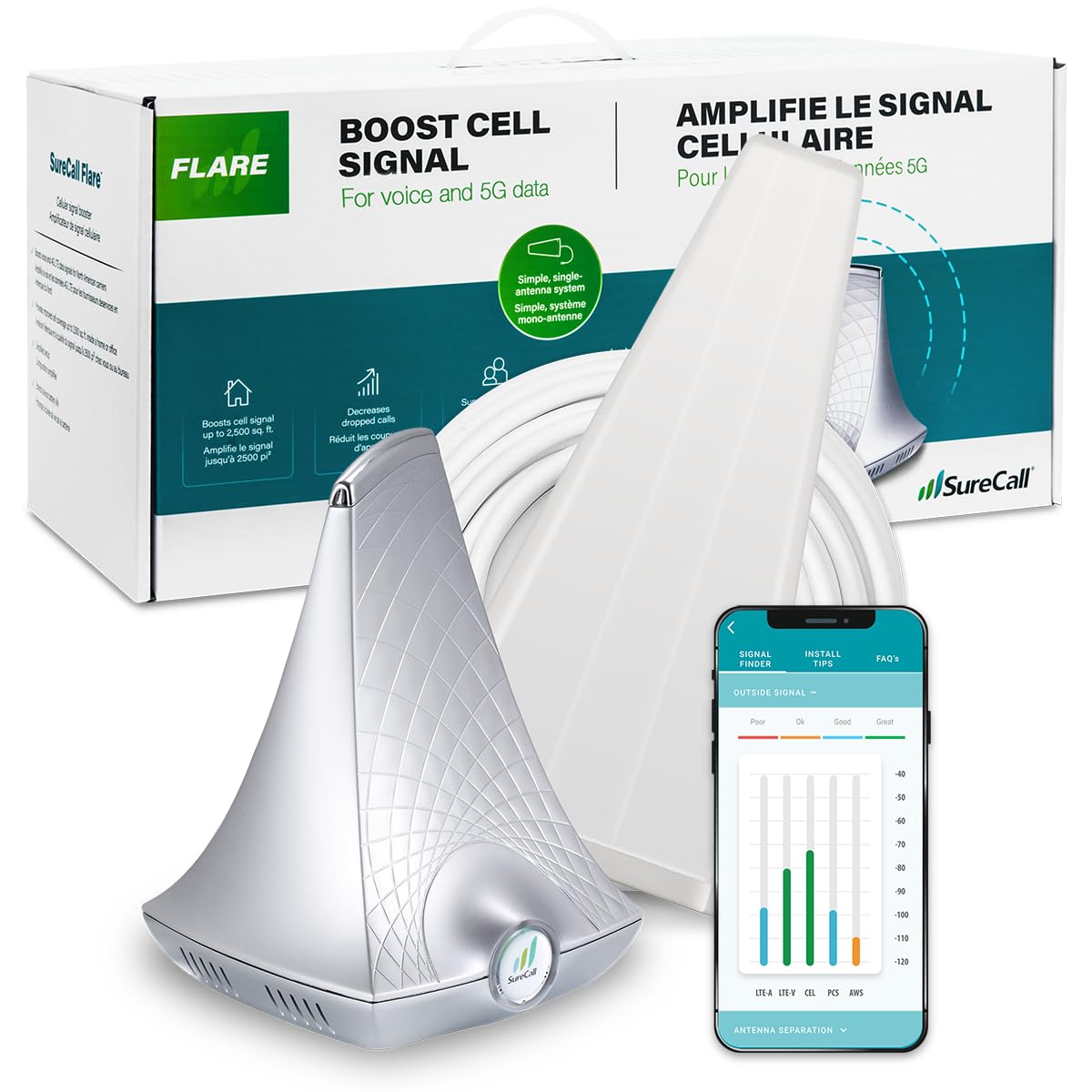
The SureCall Flare 3.0 is built around a Yagi directional antenna that pulls a targeted signal from a specific tower, making it far more effective than an omni in fringe areas. At 72dB max gain, it’s rated for up to 3,500 sq ft, but its real-world coverage scales honestly with outdoor signal—customers report 500 sq ft usable with one bar outside and around 1,500 sq ft with three bars. The kit includes a 50-foot coax cable, which is crucial for achieving the vertical separation needed to prevent oscillation. The SureCall app helps you aim the antenna by displaying live signal metrics, a feature that removes the guesswork from pointing the Yagi at the correct tower.
Assembled and tested in the USA, the Flare 3.0 covers all four major US carriers across bands 12/13/5/4/2/25. It supports 5G signals running on existing 4G bands through DSS, so you’ll see faster data once your carrier activates those frequencies. The unit connects via RJ45 or USB Type A, and the automatic gain control manages output levels to avoid network interference. Multiple users reported that using the OpenSignal or Cell Mapper app alongside the SureCall app dramatically improved installation success.
A small fraction of buyers experienced the yellow oscillation light despite careful antenna placement—this usually resolves by increasing vertical separation or adding a metal barrier between antennas. The Flare 3.0 won’t create coverage where no outdoor signal exists, so confirm your outdoor floor before purchasing. The 3-year warranty and lifetime US-based support are genuinely responsive, and the unit’s durable metal housing holds up well in garages and basements.
Why it’s great
- Yagi directional antenna outperforms omni designs in weak-signal areas
- Real-time app guidance for aiming eliminates trial-and-error installation
- Robust 72dB gain with honest coverage scaling tied to outdoor signal
Good to know
- Oscillation (yellow light) requires careful vertical separation of 15-20 feet
- Coverage drops sharply below outdoor signal of 2 bars
2. HiBoost 10K SL

The HiBoost 10K SL bridges the gap between mid-range affordability and enterprise-level monitoring. Its LCD screen displays real-time uplink and downlink gain, and the SignalSupervisor app provides a live dBm readout so you can adjust the outdoor directional antenna until you see a genuine improvement. The high-gain directional antenna (not omni) reaches distant towers efficiently, and the automatic gain control (AGC) continuously adjusts output to prevent over-amplification and oscillation. One buyer in a 2,700 sq ft home with almost no outside signal went from zero data to 50+ Mbps on Verizon 5G after fine-tuning the antenna alignment using the app.
Rated for coverage up to 5,500 sq ft, the 10K SL delivers usable signal across most large single-story homes and open office layouts. It supports all major US carriers on bands 12/13/5/25/2/4 and works with 5G DSS networks. The kit includes one outdoor directional antenna, one indoor panel antenna, and a through-window cable for installations where drilling isn’t an option. Customers frequently praised the inclusion of the 32.8-foot NM-to-SMA cable and the 16.4-foot SMA-to-NM cable, which provide flexibility when running the outdoor line around windows or doorframes.
HiBoost’s US-based tech support earns consistent praise for helping with antenna alignment and troubleshooting weak spots. The unit lacks Band 71 (600 MHz), which matters for T-Mobile users in rural zones—if that’s your carrier, verify that Band 2 or 12 provides adequate coverage first. The metal housing blocks external RF interference, but the booster runs warm during extended use, so ensure it sits in a well-ventilated area. The 3-year warranty and lifetime support are legitimately responsive.
Why it’s great
- LCD display plus app provides real-time dBm monitoring for precise antenna tuning
- High-gain directional antenna reaches distant towers better than omni alternatives
- Through-window cable enables drill-free installation
Good to know
- Does not support T-Mobile Band 71 (600 MHz)
- Coverage shrinks noticeably below 2 bars outdoor signal
3. HiBoost 15K 2.0

The HiBoost 15K 2.0 is purpose-built for multi-story homes and larger offices where a single indoor antenna can’t cover the entire footprint. It includes two indoor panel antennas—one built into the booster unit and a second wired panel—so you can place one on the first floor and the other on the second, or position them at opposite ends of a long space. The 72dB max gain plus industry-leading 400-type coax cable reduces transmission loss, which matters when running 50+ feet of cable from the outdoor antenna to the booster.
Users reported boosting initial 1-bar 4G/5G to 25 Mbps downloads and 9 Mbps uploads across a forested valley property where no line-of-sight to a tower existed. The SignalSupervisor app and LCD display work together to show real-time signal levels, allowing you to fine-tune the directional antenna angle while standing at the booster. It supports all major US carriers on bands 2/4/5/12/13/17/25 and works with 5G DSS. The kit includes two outdoor cables (NM to SMA), two indoor cables, and a through-window cable, giving you flexibility in routing.
At 2.2 kg, the metal-bodied booster is heavy but durable. Some customers noted that the 12,000 sq ft coverage rating depends heavily on outdoor signal quality—in a forested valley with one bar outside, expect closer to 4,000-5,000 sq ft of usable coverage. The unit lacks Band 71, so T-Mobile users in deep rural areas may not see full improvement. The 3-year warranty and US-based support are responsive, with multiple customers citing proactive follow-ups from the team.
Why it’s great
- Two indoor antennas provide genuine multi-room and multi-floor coverage
- 400-type coax cable minimizes signal loss over long cable runs
- Real-time app and LCD monitoring enable precise antenna alignment
Good to know
- Heavy metal housing (2.2 kg) requires sturdy mounting
- Lacks Band 71 support—check T-Mobile compatibility
4. weBoost Destination RV

The weBoost Destination RV is designed for stationary campsite use, not for driving. Its 25-foot collapsible pole mounts onto your RV’s ladder or a ground stand and lifts the directional antenna high enough to catch signal over trees and terrain. When you pack up, the whole assembly collapses in about 10 minutes. The kit includes a DC/DC power supply that runs directly from your RV’s 12V battery, plus an AC/DC adapter for times when shore power is available. It works on bands 12/13/5/4/2, covering Verizon, AT&T, T-Mobile, and Dish.
Real-world performance is strongest on Verizon—one user saw downloads jump from 0.5 Mbps to 4-9 Mbps after aiming the antenna properly. T-Mobile performance was weaker for the same user, likely due to missing Band 71 which T-Mobile relies on for rural reach. The directional antenna demands careful aiming using a tower-finding app like Cell Mapper; the included weBoost app provides basic guidance but doesn’t show tower direction. The inside panel antenna does a solid job covering a single living area but won’t penetrate RV walls into the bedroom without placement planning.
The biggest limitation is that the Destination RV requires a metal roof surface to prevent oscillation—RVs with fiberglass or wood roofs may trigger the red oscillation light because the booster picks up its own signal through the non-reflective roofing. This is a critical consideration if your RV’s roof isn’t metal. The 24-pound kit includes all mounting brackets, command strips, and 30 feet of coax cable. weBoost offers US-based support, and most installation issues resolve with a call to their tech team.
Why it’s great
- 25-foot collapsible pole dramatically improves signal capture in wooded campsites
- 10-minute setup and takedown fits RV travel pace
- Dual DC/AC power supplies work on battery or shore power
Good to know
- Requires metal RV roof to prevent oscillation—does not work with fiberglass or wood roofs
- T-Mobile performance limited by missing Band 71 support
5. weBoost Home Studio Omni
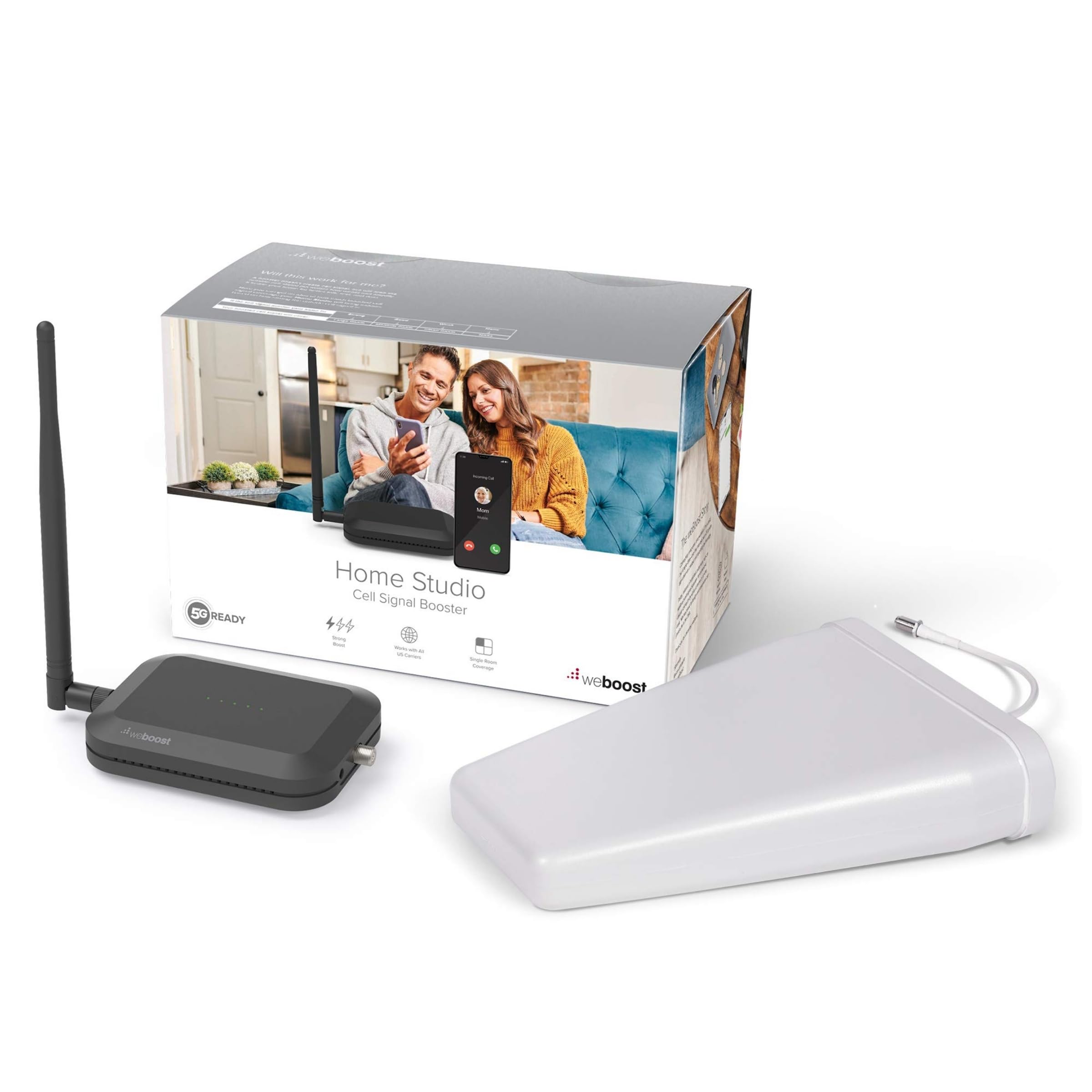
The weBoost Home Studio Omni uses an omnidirectional outdoor antenna rather than a directional Yagi, which simplifies installation—you don’t need to aim it at a specific tower. This makes it ideal for renters or users who want a turnkey setup without climbing on the roof with a compass. The booster provides 4G LTE and 5G coverage across all US and Canadian carriers, supporting bands 12/13/5/4/2. The kit includes two 30-foot low-loss cables, an inside booster antenna, the omni antenna, and the power supply.
Coverage is listed at 2,000 sq ft, but buyers consistently note that the effective range is closer to 7-10 feet from the indoor antenna—this is the trade-off for the omni’s simplicity. One user with Verizon home internet saw download speeds jump from under 1 Mbps to 122 Mbps after installing the antenna on their roof edge, but only devices within about 7 feet of the booster experienced this improvement. The omni antenna’s 360-degree pattern picks up less specific signal than a Yagi, so in areas with weak outdoor signal (1 bar or less), the booster struggles to amplify anything useful.
At 10.2 ounces, the booster unit itself is light and easily mounts on a wall or sits on a shelf. The grey casing blends into most interiors. Some users reported the coax connectors getting hot during extended use—this is normal for high-gain boosters but worth monitoring. weBoost provides US-based support and the unit is FCC approved. The Home Studio Omni is best suited for apartments or small homes where you just need a reliable signal bubble around your desk or living room couch.
Why it’s great
- Omni antenna eliminates need for precise aiming—truly plug-and-play
- Lightweight unit (10.2 oz) with simple wall-mount design
- Made in the USA with responsive support
Good to know
- Effective coverage limited to roughly 7-10 feet radius from indoor antenna
- Omni design struggles in areas with outdoor signal below 2 bars
6. HiBoost 8000

The HiBoost 8000 is designed for homes and offices up to 8,000 sq ft, but its secret weapon is the dual-antenna configuration. The booster has a built-in antenna and ships with a second wired indoor panel antenna, letting you place one on the main floor and the second in a basement or far room. The 70dB gain with Automatic Gain Control (AGC) intelligently adjusts the amplifier’s output so it never oscillates, even when you’re pushing signal to multiple rooms. Customers report boosting from 1 bar to 3-4 bars of stable 5G across 5-6 rooms in a single-story layout.
The kit includes two outdoor cables (one NM-SMAM and one SMAF-NM), a through-window cable, and all mounting accessories. The booster supports bands 2/4/5/12/13/17/25, covering all major carriers including Verizon, AT&T, and T-Mobile. The SignalSupervisor app provides the same real-time monitoring as the larger HiBoost models, with live dBm readouts and step-by-step installation guidance. The unit is FCC approved and comes with a 3-year warranty.
One limitation cited by buyers is that the built-in antenna reduces placement flexibility—you can’t separate it from the booster unit. For maximum coverage, the second wired panel antenna requires careful positioning at least 20 feet from the outdoor antenna. The booster runs on a USB 2.0 connector, which delivers consistent power but feels less robust than the barrel connectors on competing units. If you need to cover a sprawling single-story home or an open office with interior walls, the HiBoost 8000 delivers dependable multi-room performance.
Why it’s great
- Built-in plus wired indoor antenna covers multiple rooms without separate splitters
- AGC intelligently prevents oscillation across varying signal conditions
- App-based monitoring with live dBm values simplifies antenna tuning
Good to know
- Built-in antenna limits placement flexibility—booster must go where coverage is needed
- USB power connector feels less durable than standard coax power designs
7. CEL-FI GO G41
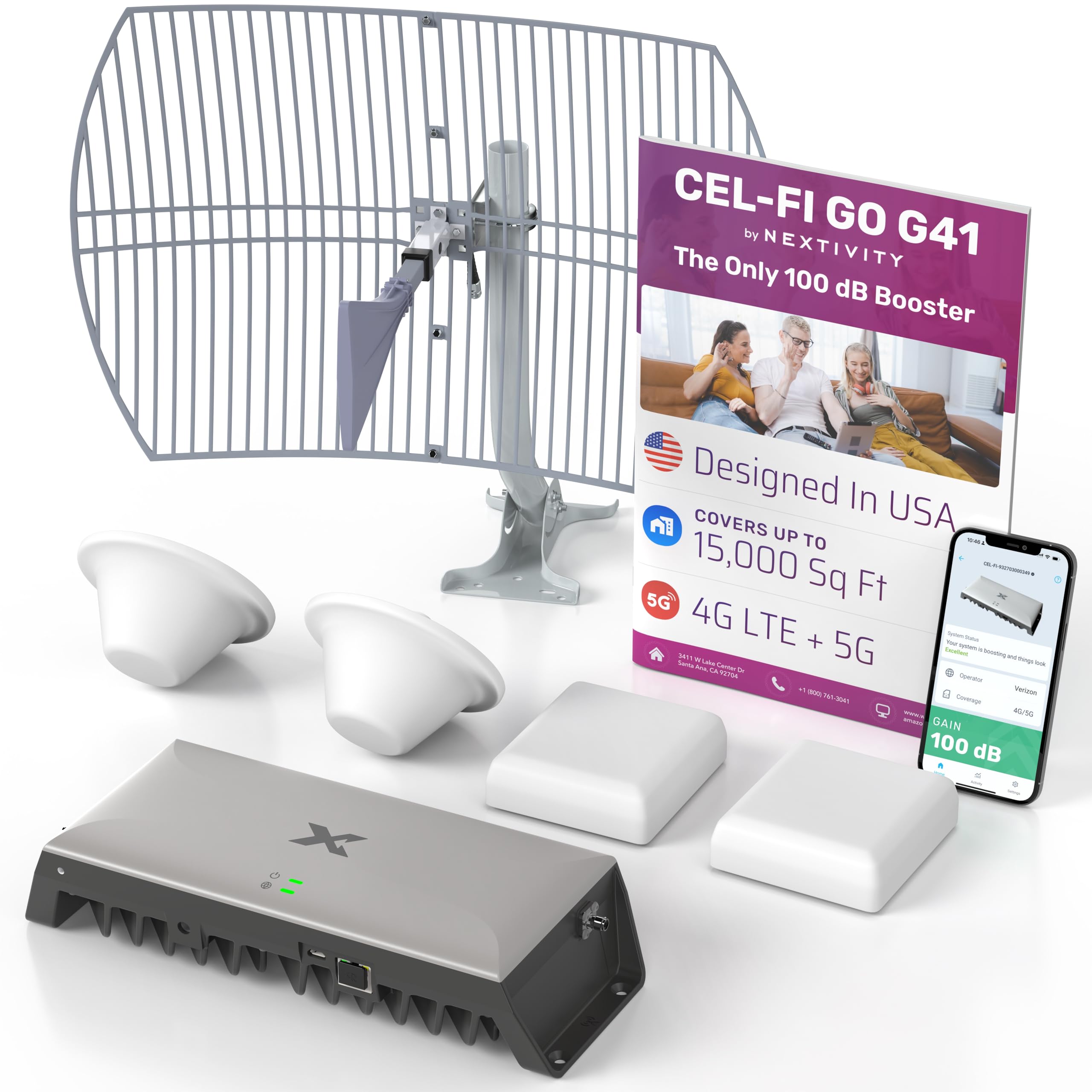
The CEL-FI GO G41 operates in a different tier from every other booster on this list. Its 100dB gain is 30dB more than competing boosters—that’s roughly 1,000 times more amplification power. This gain allows the G41 to pull usable signal from towers that other boosters can’t even detect, making it the only viable option for properties in deep valleys, behind mountain ridges, or miles from the nearest tower. The 4th-generation IntelliBoost chipset supports 4G LTE, 5G-DSS, and 5G NR, and the unit self-optimizes in real-time across bands 12/13/5/4/2.
The kit includes two dome antennas and two panel antennas—you choose which pair to deploy based on your space. Users in rural farmhouses with metal roofs and zero indoor signal reported turning -108 dBm outdoor readings into -75 dBm indoors, with full bars across a 2,000 sq ft home. The G41’s true strength is its ability to handle multiple base-station bands simultaneously, though one buyer noted that in areas with carrier aggregation across bands 2, 12, 30, and 66, the phone may prefer non-boosted bands if the booster only amplifies two bands at once—a nuanced issue that affects only very specific network configurations.
Installation is not a 30-minute job—most buyers spent a full day mounting the outdoor antenna, running cables, and positioning indoor antennas. The outdoor antenna requires a pole mount, and the 50-foot coaxial cables need careful routing to avoid kinks. CEL-FI (Nextivity) provides solid US-based support, and the 3-year warranty covers the high-end hardware. At roughly double the price of the next-most-expensive consumer booster, the G41 is for users who have tried everything else and still can’t get a signal.
Why it’s great
- 100dB gain is 30dB more than any competitor—pulls signal from miles away
- IntelliBoost 4th-gen chipset handles 5G NR and self-optimizes in real-time
- Includes both dome and panel antennas for maximum installation flexibility
Good to know
- Installation takes a full day and requires pole mounting for outdoor antenna
- May not fully support carrier aggregation in areas with 3+ active bands
8. ZORIDA Ace 5S

The ZORIDA Ace 5S is the most accessible entry point for someone who needs to test whether a signal booster can solve their connectivity problem without committing serious cash. It delivers 72dB max gain across bands 12/13/5/4/2/25, covering all major US carriers including Verizon, AT&T, and T-Mobile. The compact indoor whip antenna attaches directly to the booster, and the outdoor directional antenna includes a 49.2-foot cable, giving you plenty of length to reach a roof edge or balcony. Setup requires no drilling—just place the booster on a table or mount it on a wall, then aim the outdoor antenna toward the nearest tower using the ZORIDA app.
Real-world performance is genuinely impressive for the price tier. Customers in northern Michigan went from 2 bars of 4G with frequent dropped calls to full 5G bars with clear calls and faster data. Another user boosted Verizon signal from 2 spotty LTE bars to 3 consistent 5G bars indoors. The app provides step-by-step installation videos, live chat with support, and a signal reading before and after setup. The Ace 5S is FCC and IC certified and comes with a 3-year warranty and 30-day money-back guarantee.
The main limitation is coverage area—at 2,000 sq ft, it’s best suited for small homes, apartments, RVs, or single rooms. The indoor whip antenna has a shorter broadcast range than panel antennas, so don’t expect to cover a 3,000 sq ft house with one unit. Some users mentioned that the supplied cable connectors feel less robust than those on premium brands, though no widespread failure was reported. If you’re on the fence about signal boosters, the ZORIDA Ace 5S is a low-risk first step.
Why it’s great
- 72dB gain at a truly entry-level price—incredible value for small spaces
- App-based installation guidance with live signal readings
- FCC/IC certified with 3-year warranty and US-based support
Good to know
- Whip antenna limits broadcast range—best for single-room or small apartment use
- Cable connectors feel less durable than premium brands
9. FREEQUEEN LOVE LIFE
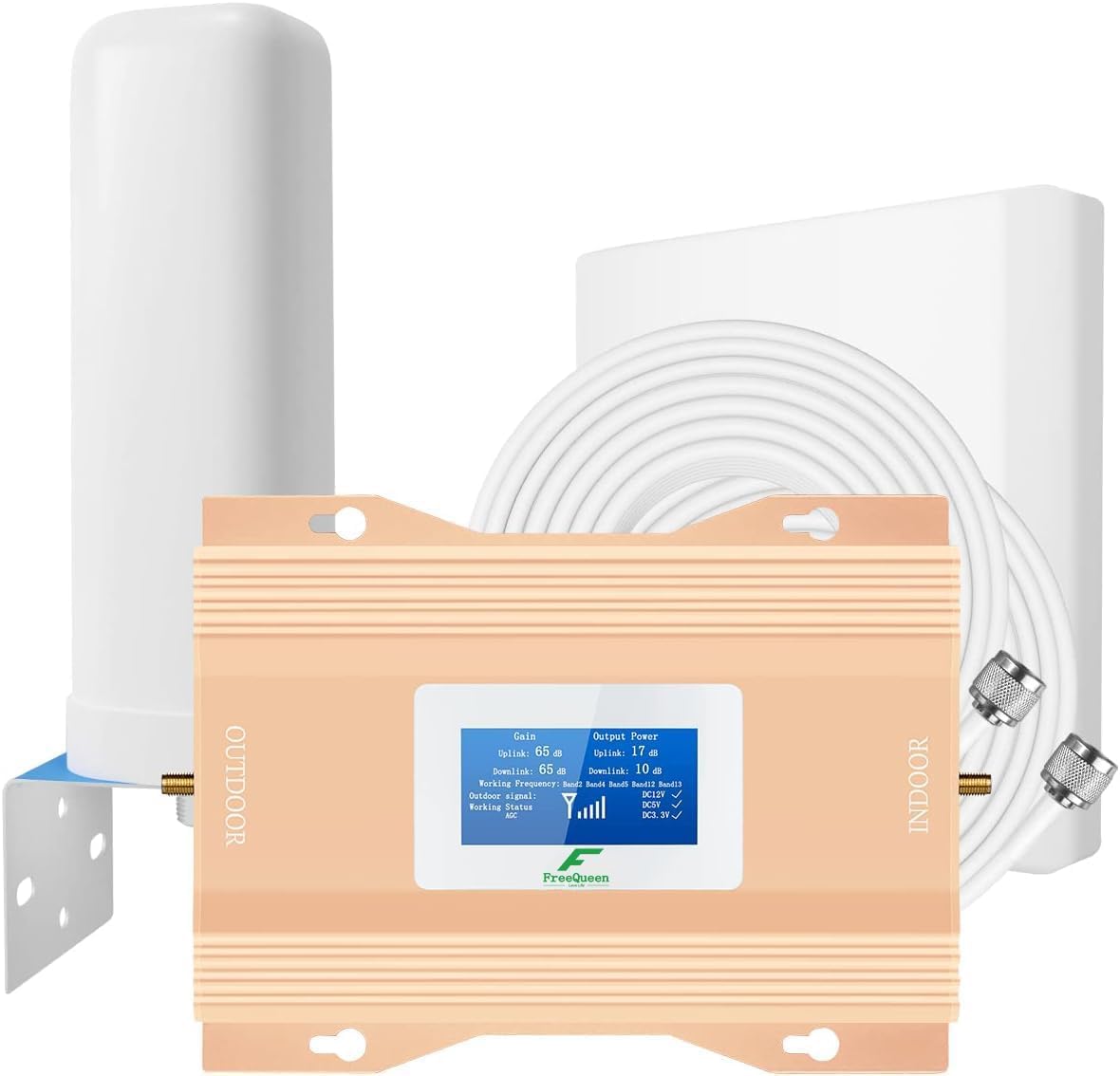
The FREEQUEEN LOVE LIFE booster targets buyers who want whole-home coverage at a budget-friendly price point. It claims support for up to 5,000 sq ft with 65dB gain across bands 12/17/13/5/25/66/2/4, covering all major US carriers including Metro PCS, Cricket, and US Cellular in addition to the big three. The built-in LCD display shows real-time signal strength and system status, which is a rare feature at this price level. The kit includes all necessary cables and antennas for a basic installation.
The orange-colored unit stands out from the usual black/grey boosters, and the LCD provides an immediate visual of whether the outdoor antenna is capturing usable signal—this helps with initial alignment. Users reported success improving call clarity and reducing dropped calls in metal buildings and basements. The booster supports multiple users simultaneously and works with iOS, Android, and Windows devices. It’s FCC approved and includes a 3-year manufacturer warranty with a 30-day money-back guarantee.
Customer reviews for this particular model are mixed, with some buyers reporting no improvement despite all green lights. The “65000dBi” gain listed on the product page appears to be a typo or specification error (65dB is the realistic figure). The unit lacks the app-based guidance and community support that brands like HiBoost and SureCall provide, so you’ll be troubleshooting installation with the printed manual alone. If you need a very basic booster for a small metal building or single-room workspace and the price fits your budget, it may serve—but don’t expect it to match the refinement of more established brands.
Why it’s great
- LCD display gives real-time signal status without needing a phone app
- Wide claimed coverage up to 5,000 sq ft at a budget-friendly entry point
- Supports Band 66 in addition to standard US bands
Good to know
- Mixed user reports—some buyers saw no improvement despite correct installation
- No app-based guidance or community support for troubleshooting
FAQ
Can a cellular repeater work with zero bars outside?
What is oscillation and how do I fix it?
Will a booster work with 5G?
Do I need to register my booster with my carrier?
Final Thoughts: The Verdict
For most users, the best cellular repeater winner is the SureCall Flare 3.0 because its Yagi directional antenna and app-guided installation system deliver reliable, repeatable signal improvement across all major carriers at a price that balances performance with practicality. If you need to cover a large multi-story home with two separate coverage zones, grab the HiBoost 15K 2.0. And for extreme rural dead zones where no other consumer booster can pull a signal, nothing beats the CEL-FI GO G41 and its 100dB gain.