
Our readers keep the lights on and my morning glass full of iced black tea. As an Amazon Associate, I earn from qualifying purchases.
Specs are compiled from manufacturer listings and verified buyer reviews and can change over time — please confirm the key details on the product page before buying.
Dead zones hit everyone eventually — a rental cabin, an RV park, a job site, or just a hotel with WiFi that gives up at 8 p.m. A cellular hotspot fixes that by turning the cell tower near you into your own private WiFi network. The trick is picking one that matches how you actually use it: a pocket gadget for travel, a router for your RV, or a 5G beast for whole-home backup.
I’m Min — the founder and writer behind Gadgets Feed. This guide is built by comparing the manufacturers’ published specifications and the patterns across verified customer reviews, so you get each pick’s real strengths and trade-offs instead of marketing spin.
Choosing a cellular wifi hotspot depends on your travel habits, the number of devices you need to connect, and whether you prefer a simple prepaid plan or full control over settings.
Our Picks at a Glance

How To Choose The Best Cellular WiFi Hotspot
First, decide if you need a pocket-sized travel companion or a stationary router for a home or RV. Both types do the same core job — turning cellular data into WiFi — but they differ completely in battery life, antenna strength, and flexibility. Your choice affects every other spec that matters.
Battery capacity is your real-world endurance number
A hotspot’s battery is measured in milliampere-hours (mAh) — the energy stored in its battery. A 3,000 mAh cell may get you through a travel day of light use, while a 5,000 mAh or 7,000 mAh unit can power hours of streaming. Check the claimed hours, not just the mAh number, because a bigger battery often runs a hungrier 5G modem.
Carrier compatibility decides if it works at all
Hotspots either come locked to a carrier like AT&T, or open up to accept any SIM. If you already have a data plan, an open up device is the flexible choice — but verify it supports your carrier’s bands (the radio frequencies your carrier uses). Some routers even support dual SIMs, so you can switch to whichever network has the stronger signal.
Quick Comparison
| Model | Best For | Battery | Max Speed | Devices | Amazon |
|---|---|---|---|---|---|
| MOFI6500-5GXeLTE★ Best Overall | Rural & RV whole-site coverage | — | 3.4 Gbps | Dual-SIM failover | Amazon |
| Franklin A50 5GBest Value | AT&T prepaid streaming | 5,000 mAh | 960 Mbps LAN | 20 | Amazon |
| GlocalMe UPPGlobal Pick | International travel, no SIM | 3,000 mAh / 13 hrs | 150 Mbps | 8 | Amazon |
| GL.iNet GL-E750V2 MUDI | Travelers who need VPN security | 7,000 mAh / 8 hrs | 433 Mbps | — | Amazon |
| TravlFi JourneyGo | RV & camper pay-as-you-go | 16-hr battery | — | 10 | Amazon |
| SIMO Solis 5G | Global travel, power bank backup | 1GB/mo lifetime data | 1 Gbps LAN | 16 | Amazon |
| NETGEAR Nighthawk M6 Pro | Power users on mmWave 5G | 5,040 mAh | 3.6 Gbps Wi-Fi | 32 | Amazon |
| GL.iNet GL-X3000 Spitz AX | RV & rural home 5G gateway | — | 3 Gbps | Dual-SIM failover | Amazon |
| Cudy P5 | Advanced users wanting band lock | — | 3.4 Gbps (NSA) | Dual-SIM failover | Amazon |
In-Depth Reviews
1. MOFINETWORK MOFI6500-5GXeLTE-RM520-HP
Our pick — over 4★ from 850+ verified ratings; the strongest balance of quality and price.
The amplified heavy-lifter that turns dead rural zones into a 4-bar office.
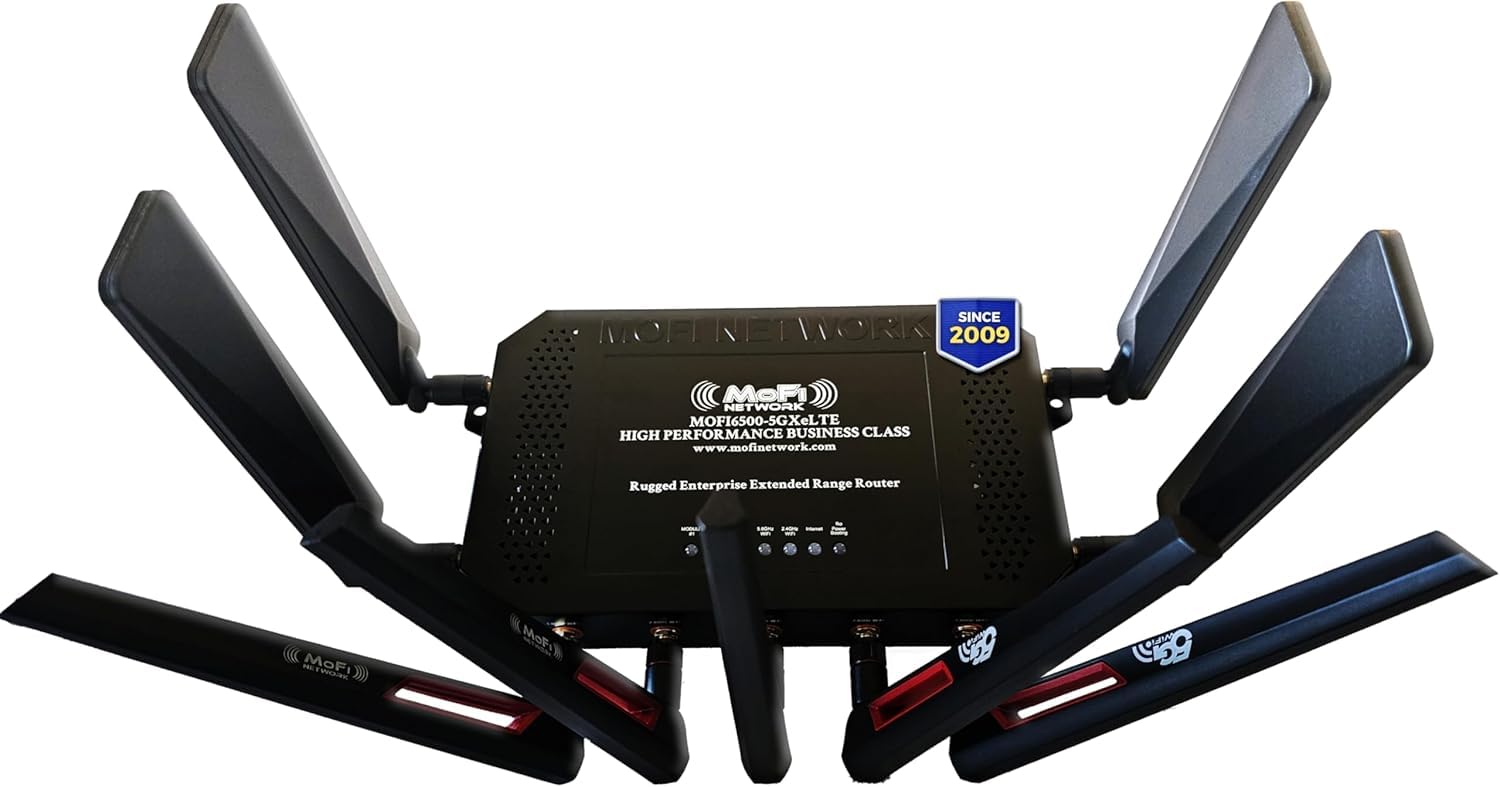
The standout here is the boosted signal story — buyers report a Yagi antenna pulling a weak 1-bar location up to 4 bars, with strong WiFi held steady over two weeks in a rural two-building setup. That is the real reason this router exists: not for a café, but for a farm, an RV, or a remote workshop where a phone hotspot gives up.
Under the hood it is a serious machine, not a pocket toy. The full metal case sheds heat well, the four 5G high-gain antennas and five WiFi antennas attach externally, and dual SIM slots auto-switch to keep you online if one network drops. Data transfer tops out at a claimed 3.4 Gbps, and it is built for business-class extras like IP pass-through, band lock, and Zerotier connectivity. That said, the dual SIM is failover only, not simultaneous — buyers warn you need the separate DUAL model if you want both lines running at once.
Setup is genuinely fast for a device this capable — one owner was live in two minutes — and T-Mobile users specifically report solid performance and strong signal. The honest trade-off: this is a bigger, wired, always-connected router, so it does not suit weekend travelers who want a pocket puck. It is for people who treat internet as infrastructure.
Why RVers and rural users love it
- Amplified WiFi 6 with detachable antennas reaches where phones fail
- Metal case runs cool and survives rough mounting
- Dual SIM slots keep a second network on standby
The fine print to know
- Dual SIM is failover, not simultaneous — check before you buy
- No battery, so it needs constant power
Reach for this if: you need reliable WiFi across a whole rural property or RV and want the option to bolt on a directional antenna for weak-signal areas.
Look elsewhere if: you want something to slip in a pocket — this is a stationary router, not a travel hotspot.
2. Franklin A50 5G WiFi 6 Hotspot
The AT&T prepaid puck that keeps a packed car streaming all day.
This is the entry point that proves a budget hotspot can carry real weight. The Franklin A50 runs on AT&T prepaid 5G with Wi-Fi 6 dual-band, and it handles up to 20 devices at once — enough for a family road trip where every phone, tablet, and car screen wants a slice. The battery is a removable 5,000 mAh cell, and it doubles as a power bank to top up a phone in a pinch.
The 5G band support is broad — n2, n5, n12, n14, n30, n66, n77 — so it locks onto the AT&T network across most of the country. That is the whole appeal: an AT&T user can pull the SIM from an old hotspot, slide it in, and be live. One mountain-to-beach road trip report has it grabbing 5G+ signal all the way from the mountains of North Carolina to Myrtle Beach while streaming satellite radio continuously.
Here is the honest catch, and it is a real one: the battery gets called weak and the signal strength poor in some setups. The rating sits at 3.9 stars, and while many owners praise easy streaming, others found the reception short of what they needed. This is a “you get what you pay for” moment — if your primary need is reliable weak-signal performance, a device with external antennas serves you better.
balance: AT&T prepaid customers who want the cheapest way to share one data plan across a whole car or camper, and do not need to chase distant towers.
Pick this for: streaming on the move with an existing AT&T SIM — the setup is genuinely five minutes.
Think twice if: your campsite sits in a known weak-signal valley, where the MOFI above beats it handily.
3. GlocalMe UPP 4G Mobile Hotspot
The no-SIM travel puck that works in 200-plus countries straight from the start.
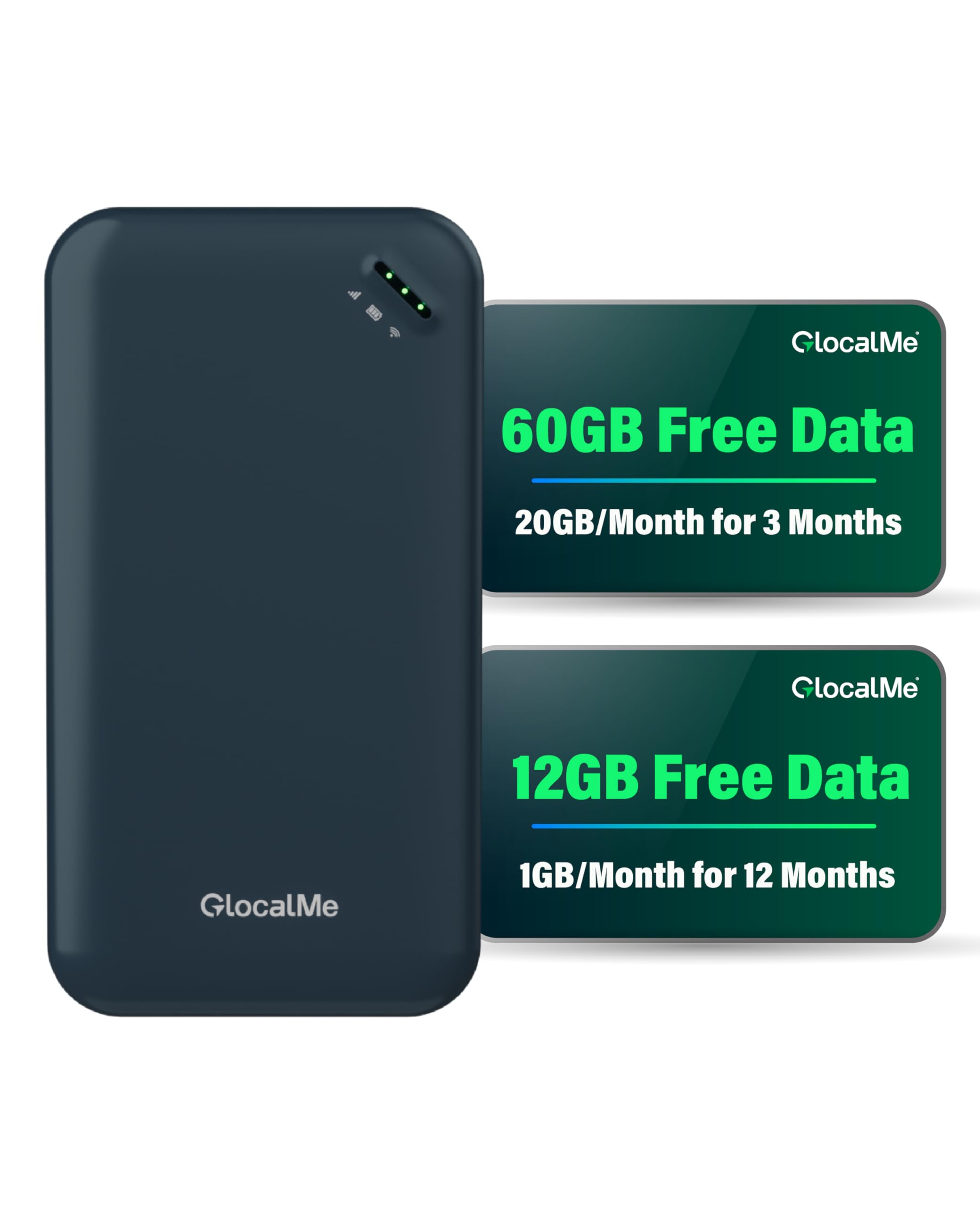
If you hate the airport SIM-card scavenger hunt, the GlocalMe UPP is for you. It ships with 72GB of data preloaded — 20GB a month for the first 3 months in the US, plus 1GB of global data monthly for 12 months — and needs no SIM card and no contract. Just power it on, download the GlocalMe app, and start browsing in any of 200+ countries across America, Europe, Asia, Africa, and Oceania.
The device automatically picks the strongest local carrier from 390+ options, which means it “just works” when you land somewhere new. The 3,000 mAh battery claims over 13 hours of continuous use, and it shares its connection with up to 8 devices at once. The ultra-slim body is built for a luggage pocket, and the included data makes it a genuinely strong match for a first-time international trip.
Buyers consistently call setup easy and the portability a highlight, with one owner using it reliably in Jamaica and finding the signal stronger indoors and outdoors than the house WiFi. The flip side is honestly a reliability question: a portion of users report dropped connections and slow downloads, especially with multiple devices. It is also single-band WiFi, so do not expect the fastest internal network speeds.
Best for: travelers who want a working connection in a foreign country without researching local SIMs or carrier bands first.
Choose it if: you want a truly plug-and-play global connection with zero carrier commitment.
Consider a different route if: you plan to stream heavily or connect many devices — 4G single-band limits both.
4. GL.iNet GL-E750V2 MUDI Travel Router

The pocket router that wraps your hotel WiFi in a private VPN tunnel.
Security is the defining feature: built-in OpenVPN and WireGuard support let you connect through 30+ VPN servers, with WireGuard speeds up to 50Mbps and OpenVPN up to 10Mbps — so your browsing stays private even on a sketchy public network.
Its 7,000 mAh battery delivers up to 8 hours of use, and it can even power other devices via USB. The whole unit is just 5.7 x 3.1 x 0.9 inches and 285g, genuinely pocket-sized for a remote-work kit. Since it runs on OpenWrt, power users can install plugins, set up failover between LTE and wired connections, and use it as a home backup — one owner runs it as a Verizon-powered LTE backup with Unifi, using failover and load-balancing features.
The honest catch is the learning curve. Buyers with networking experience call it “powerful value,” but the same owners note the app is complex and “not for beginners,” and there are reports of middling battery life and performance bottlenecks on the older chip. This is a tool for someone who wants control, not a casual traveler who wants a zero-config puck.
What makes it a power user’s pick
- Repeats hotel WiFi into a private, VPN-protected network
- Runs OpenWrt with plugins, failover, and load balancing
- 7,000 mAh battery doubles as a phone charger
Where it stumbles
- Complex interface that demands networking knowledge
- Cellular performance limited by the 433 Mbps WiFi ceiling
Designed for: the remote worker who lives in hotels and wants VPN-grade privacy on every connection.
Not for: the casual traveler — the learning curve is real, and beginners will find the GlocalMe easier.
5. TravlFi JourneyGo LTE RV WiFi Hotspot
The contract-free RV companion with a battery that outlasts a full camp day.
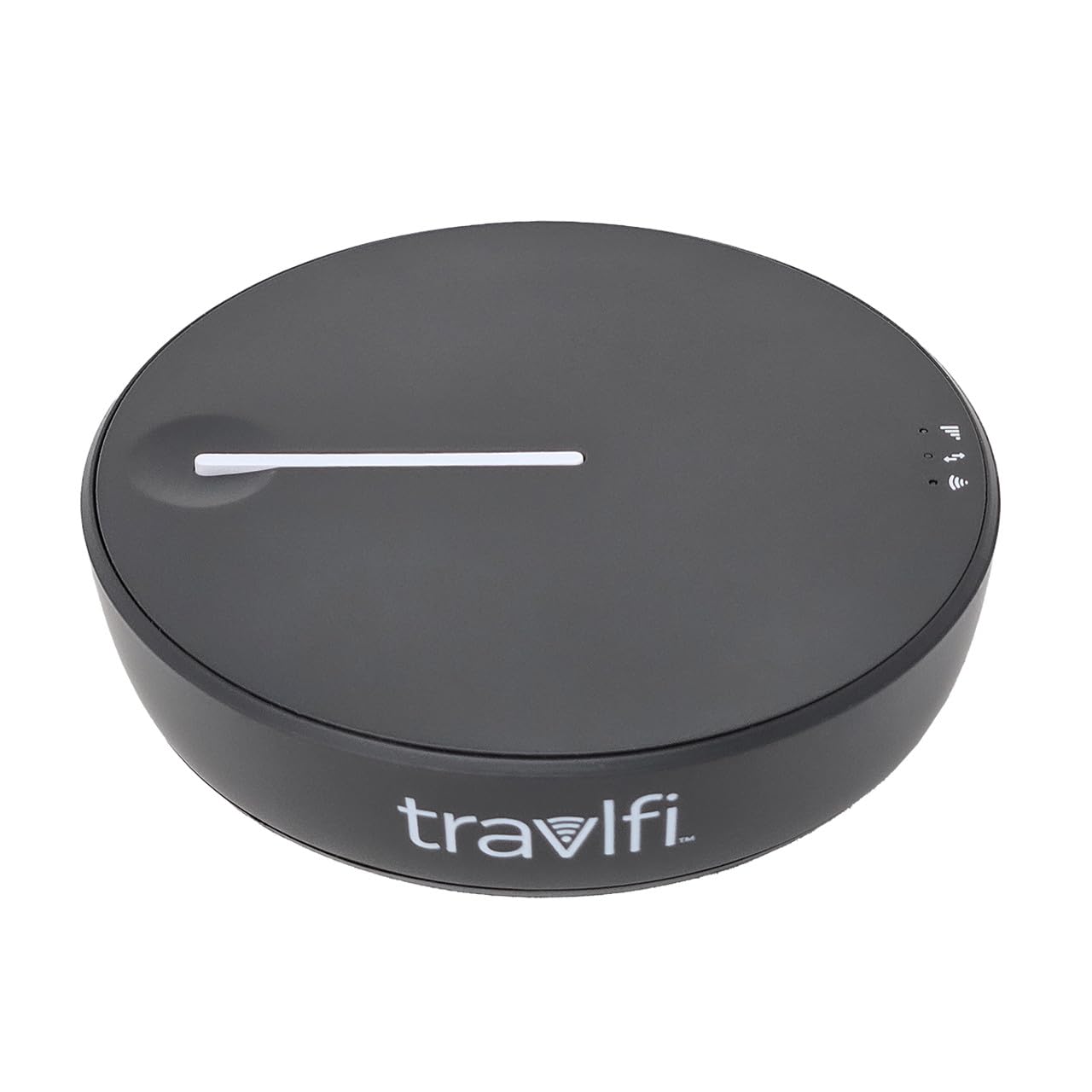
The TravlFi JourneyGo is built for the RV and camper crowd that wants internet without a long-term lock-in. It uses e-SIM technology, so there is no physical SIM to fiddle with — you just pick a prepaid plan from as little as 2GB all the way up to unlimited, pay for a month at a time, and pause it when you are parked at home. Coverage stretches virtually anywhere in the US across multiple national networks.
The battery is the headline: a 16-hour runtime that genuinely covers a full day of camp, and it supports 10 devices at once — enough for the whole family’s phones, plus TV streaming. Owners mention it keeps up with their devices smoothly, with one RV-resort buyer getting good phone service and “excellent TV reception” on all their streaming apps right after an easy setup. It is small enough to fit in a pocket and works with any cell carrier’s tower.
The catch is that signal strength is location-dependent — some owners in weak areas found it slower than a 5G phone and insufficient for TV streaming, with one returning it for Starlink. If you camp in strong-signal regions, this is a delight; if you chase remote boondocking spots miles from a tower, no portable LTE device will save you.
Standout trait: the pay-as-you-go flexibility and the 16-hour battery make it the least stressful way to get an RV online for a single season.
Grab it for: weekend RVers who want zero contracts, easy setup, and a battery that lasts the whole trip.
skip it if: you camp deep off-grid — that is exactly when you need an external-antenna setup like the MOFI instead.
6. SIMO Solis 5G WiFi Mobile Hotspot

The rugged travel brick that samples carriers until it finds the strongest one.
The Solis 5G is all about never settling for a weak signal. Its virtual multi-carrier network needs no SIM card — it automatically samples several different cell carriers and locks onto the strongest available signal, covering you across 135+ countries. If coverage dips, the SignalScan feature lets you manually switch to a more sturdy carrier at the tap of a finger. That is a lifeline for people whose work depends on staying connected in random places.
It is also built for the rough and tumble of travel: an IP54 ruggedized design stands up to drops, dust, and light water, and the 2.4-inch LCD touchscreen puts data usage and network settings right on the device. The unit supports 16 connected devices, and when your phone is dying, it doubles as a power bank. Every unit also comes with 1GB of global data every month for life — small, but a genuinely useful emergency reserve.
The catch is data economics. While owners praise it as a reliable emergency backup and find it easy to set up via QR code in under a minute, heavy users have found the pay-as-you-go data plans expensive — one frequent traveler called a local SIM far cheaper for daily heavy use. The renewed (refurbished) status also means condition varies, so inspect carefully on arrival.
Strongest feature: the auto-selecting multi-carrier engine that keeps you online in weak-coverage areas where a single-carrier hotspot would drop out.
Take it if: you need one device that roams the world without SIM cards and survives a rough bag.
pass on it if: you stream gigabytes daily — the data costs add up fast, and a local SIM wins on price.
7. NETGEAR Nighthawk M6 Pro (MR6500)

The 5G monster that pulls mmWave speeds only the fastest networks can deliver.
If speed is your religion, the Nighthawk M6 Pro is the pick. It supports both 5G mmWave and Sub-6 bands, with Wi-Fi 6E AXE3600 throughput that splits into 2.9Gbps on the 5GHz/6GHz band and 700Mbps on 2.4GHz. It handles up to 32 devices — enough for a whole house or a serious business trip — and its 2.5G Ethernet port lets you wire in a laptop or game console that needs rock-solid speed.
The 2.8-inch color touch LCD puts password, data, and signal info right on the screen, and the 5,040 mAh battery keeps it running away from a wall. The Qualcomm SD X65 chipset is the same class of silicon found in premium phones. Owners near a window report 100 Mbps down, and it is described as great for temporary setups, gaming, and downloads — just not a replacement for a wired cable connection.
Here is the reality check, and it is sharp: this is a renewed (refurbished) unit, and the reviews split hard. Value is praised, but customers note inconsistent battery drain, mixed signal strength, and a concerning number of units that stop working or ship with defects requiring hours of carrier troubleshooting. Treat this as a great-value speed machine if you get a good unit, and brace for the gamble that comes with refurbished gear.
The speed case
- mmWave 5G reaches speeds most hotspots cannot touch
- 2.5G Ethernet port wired directly into the router
- Tri-band WiFi 6E across 32 connected devices
The refurb reality
- Renewed condition varies — some units arrive defective
- Battery and signal performance reported as inconsistent
Buy it if: raw 5G speed for many devices matters most, and you are willing to vet a refurbished unit.
Choose a new device if: you need warranty-driven confidence — the lottery of used hardware is not for everyone.
8. GL.iNet GL-X3000 Spitz AX

The 5G gateway that keeps an RV or rural home on the fastest available network.
The Spitz AX is what you buy when a hotspot is not enough and you want a proper cellular gateway for a house, RV, or workshop. It runs Wi-Fi 6 at up to 574Mbps on 2.4GHz and 2402Mbps on 5GHz, with six detachable antennas that can be replaced or upgraded — including a wired dome antenna for extra stability in remote areas. It is certified for both AT&T and T-Mobile IoT, and its dual SIM slots support single-standby failover so you can pick the stronger network.
Because it runs OpenWrt v21.02, this is a tinkerer’s dream: over 5,000 ready-made plug-ins, multi-WAN support across Ethernet, repeater, cellular, and tethering, plus load balancing and failover priorities you can configure yourself. VPN support is built in with OpenVPN and WireGuard, hitting up to 300 Mbps on WireGuard. Owners with metal buildings report superlative results when pairing it with an external antenna, and one long-term user has run theirs flawlessly for three years on Google Fi/T-Mobile.
The honest trade-off: reliability is a mixed bag in the broader review pool. Some owners saw their unit slow down after days of use and require a reboot, and a few report units stopping after a few months. The 5G modem itself is called solid across the board, but the router functions are where opinions split. This is a powerful, customizable gateway that rewards owners willing to learn it.
The headline: six detachable antennas plus dual-SIM failover make it the most physically flexible gateway for a fixed installation hunting a weak signal.
Best for: RVers and rural homeowners who want a permanent, customizable 5G gateway with real antennas, not a pocket puck.
Not for: plug-and-play seekers or anyone avoiding network configuration — this one asks for a little effort.
9. Cudy P5 5G NR AX3000 Router

The dual-SIM router with band lock for people who like to steer their own connection.
The Cudy P5 is built on the Qualcomm Snapdragon SDX62 chipset and delivers 5G NR downlink speeds up to 3.4 Gbps in NSA mode and 2.4 Gbps in SA mode — numbers that put it at the top of the speed table alongside the MOFI. Its AX3000 Wi-Fi 6 output hits a combined 3000 Mbps across the 2.4GHz and 5GHz bands, so your internal network matches the fast cellular line feeding it.
For tinkerers, this is the rare router with band lock, TTL controls, and a clean interface — one owner highlights the band-lock and TTL options as genuinely useful, reporting it faster than a hotspot and stable for streaming. It works with dual SIMs plus WAN failover to stay online, and the four 5dBi cellular antennas and two 5dBi WiFi antennas strengthen both signals. Mobile workers in a van or boat will love the flexibility to prioritize whichever network is fastest.
The catch: T-Mobile SIMs are not compatible, and Verizon users have hit walls — one buyer spent days trying to connect a Verizon SIM with no luck and poor support, while others succeeded on U.S. Cellular and other carriers. The most-cited real-world wins are speed and easy setup, with owners reporting downloads in the 150 to 200 Mbps range. Check your carrier’s band support before committing.
Defining strength: the band-lock and TTL controls give advanced users a level of network control that the simpler travel pucks simply cannot match.
Go with it if: you want a fast, configurable dual-SIM 5G router and your carrier is not T-Mobile.
Steer clear if: you are on T-Mobile or want a set-and-forget device — this one rewards patience and technical comfort.
Understanding the Specs
Battery capacity (mAh) and real runtime
A hotspot’s battery is measured in milliampere-hours (mAh) — simply the energy stored in its battery. A 3,000 mAh unit like the GlocalMe UPP claims over 13 hours, while a 7,000 mAh unit like the GL.iNet MUDI claims 8 hours. The higher mAh does not always mean longer life, because a faster 5G modem drains more power. Look at the claimed hours, not just the battery number.
Carrier compatibility and band support
Hotspots either work with a specific carrier like AT&T, or accept any SIM if open up. Every carrier uses specific radio frequencies, called bands — for example, the Franklin A50 supports AT&T bands n2, n5, n12, n14, n30, n66, n77. An open up router still needs to support your carrier’s bands to connect, so check the band list before you buy.
FAQ
What is the difference between a cellular hotspot and a travel router?
Do I need a SIM card for these hotspots to work?
Will an open up hotspot work with AT&T, T-Mobile, and Verizon?
How long does a hotspot battery typically last?
What does dual-SIM failover actually do?
Can a hotspot replace my home cable or fiber internet?
How many devices can connect to a hotspot at once?
Why does my hotspot signal drop in rural areas?
Final Thoughts: The Verdict
For most people, the cellular wifi hotspot winner is the MOFINETWORK MOFI6500-5GXeLTE because its amplified external antennas and dual-SIM failover solve the single biggest problem buyers face — weak rural signal. If you want travel-friendly plug-and-play with data included, grab the GlocalMe UPP. And for a secure VPN-protected connection in hotels, the GL.iNet MUDI is the one to reach for.
How We Picked
We do not accept paid placement. Every pick is matched to a real buyer and a real use-case; we do not hands-on test units.
Sources & Methodology
Specifications: manufacturer listings and product documentation. Review insights: verified customer reviews, as of August 2026. Pricing: not shown on this page (it changes often); check the current price via the retailer link.
As an Amazon Associate, Gadgets Feed earns from qualifying purchases. This does not affect which products we feature.