
Our readers keep the lights on and my morning glass full of iced black tea. As an Amazon Associate, I earn from qualifying purchases.
Specs are compiled from manufacturer listings and verified buyer reviews and can change over time — please confirm the key details on the product page before buying.
That muffled, hard-to-hear dialogue is the most common home theater complaint — and the fix is almost always the same: a dedicated center channel speaker. It carries the vast majority of movie and TV dialogue, so you stop reaching for the remote to rewind. This guide ranks the best options by real-world strengths—dialogue clarity, off-axis coverage, and placement fit—so you can match one to your room and receiver.
I’m Min — the founder and writer behind Gadgets Feed. This guide is built by comparing the manufacturers’ published specifications and the patterns across verified customer reviews, so you get each pick’s real strengths and trade-offs instead of marketing spin.
You want a speaker that makes every word crisp without blasting the volume, and the right center channel speaker for home theater does exactly that by anchoring dialogue to the screen.
Our Picks at a Glance


How To Choose The Best Center Channel Speaker For Home Theater
Your center speaker handles almost all dialogue, so getting this one right makes the biggest difference in how much you enjoy movies and TV. Before you click buy, weigh these three decisions.
Size vs. Your TV and stand
Center speakers are long, low boxes, but they come in very different physical footprints. A wide, heavy model with big woofers delivers more authority — but it may block your TV’s IR sensor or force a new stand. Measure your space first, and check whether the speaker can sit on top of your TV’s base or must live on a shelf below.
Driver count and crossover design
A 2-way design has separate tweeters and woofers; a 3-way adds a dedicated midrange driver, which usually means clearer, more natural vocals. A concentric driver, where the tweeter sits in the middle of the midrange, widens the balance so off-center seats hear the same clear dialogue.
Quick Comparison
| Model | Best For | Design | Woofers | Tweeter | Amazon |
|---|---|---|---|---|---|
| Klipsch RP-504C★ Best Overall | Big rooms & reference setups | 2.5-way bass-reflex | Dual 5.25″ Cerametallic | 1″ Titanium LTS | Amazon |
| Micca MB42X-CBudget Champion | Budget-conscious listeners | 2-way ported | Dual 4″ Carbon-Fiber | 0.75″ Silk-Dome | Amazon |
| Polk Monitor XT35Slim Design Pick | Slim setups that need wall-mounting | 2-way slim | Four 3″ Dynamically Balanced | 1″ Terylene | Amazon |
| Klipsch RP-500C | Powerful dialogue in compact spaces | 2-way bass-reflex | Dual 5.25″ Cerametallic | 1″ Titanium LTS | Amazon |
| Polk ES35 | Design-conscious slim installs | 2-way slim | Six 3″ Woofers | 1″ Terylene | Amazon |
| ELAC Uni-Fi 2.0 UC52 | Off-axis listening & 3-way purists | 3-way concentric | Triple 5.25″ Aluminum | 1″ Wide-Roll Surround | Amazon |
| SVS Prime Center | Revealing clarity at high volumes | 3-way rear ported | Dual 5.25″ Woofers | 1″ Aluminum Dome | Amazon |
| Definitive CS-9060 | Systems without a separate subwoofer | 2-way with powered sub | Built-in 8″ 150W Powered | 1″ Aluminum Dome | Amazon |
| SVS Ultra Evolution | Reference-grade transparency | 3-way vertically aligned | Dual 6.5″ Aluminum | 1″ Diamond-Coated Dome | Amazon |
In‑Depth Reviews
1. Klipsch RP-504C Reference Premiere Center Channel Speaker
Our pick — over 4.5★ from 900+ verified ratings; the strongest balance of quality and price.
The wide, horn-loaded beast that makes dialogue land like a punch from the front row.
The compressed molded silicon face on the 90° x 90° Tractrix horn reduces resonance for smoother frequency response across the room. Buyers report the wide cabinet aids off-axis listening—side seats hear the same crisp center presence as the balance—and call it better than the smaller RP-500C.
The 2.5-way design with dual crossovers improves dialogue, while a vented titanium tweeter and Cerametallic woofers deliver efficient, room-filling output. The ebony finish feels furniture-grade, but the speaker is very large and heavy—owners routinely say it requires a new TV stand or wall-mounted TV, with one noting a TV up to 75 lbs can sit on top per Klipsch.
It needs substantial space, so smaller rooms will feel dominated by it. For those who can accommodate the footprint, it pairs perfectly with other Reference Premiere components and improves with break-in.
What wins the room over
- crisp dialogue even in intense action scenes
- Wide soundstage keeps side seats engaged
- High efficiency means less receiver strain
What to plan around
- Massive footprint needs a big stand or wall-mounted TV
- Heavy enough to make placement a two-person job
Reach for this if: you have the space and want a reference-grade center that outshines soundbars and smaller centers.
Look elsewhere if: your TV stand is tight or your room is compact — this one needs room to breathe.
2. Micca MB42X-C Advanced 2-Way Passive Center Channel Speaker
The compact budget star that punches far above its asking price.
This is the value pick that refuses to sound cheap: a balanced woven carbon-fiber woofer pair delivers effective bass for 4-inch drivers, and the 0.75-inch silk-dome tweeter produces smooth, natural vocals. The highly tune 18dB crossover creates an open, balanced sound that owners say approaches much pricier models.
Value for money is the second most-praised aspect here, and the consensus is clear: it sounds close to speakers many times its price. Owners mention it requires 30-40+ hours of break-in to remove a hollow sound — after which the bass “defies physics” for such a small cabinet. It’s a straight upgrade for anyone moving from a soundbar or tiny TV speakers.
The compact classic design disappears into any room, and the tight cabinet produces no rattles. Just remember it’s a passive speaker, so you’ll need an amplifier or receiver to drive it.
Best for: a budget home theater where you want genuine vocal clarity without spending big.
Worth noting: budget-tier drivers mean you’ll want a subwoofer for movie impact.
3. Polk Monitor XT35 Slim Center Channel Speaker
The low-profile center that slides under your TV without blocking the remote sensor.
If your TV sits low or you hate the look of a bulky box, the XT35 is built for you: a 4-inch low-profile design with a 1-inch Terylene tweeter and four 3-inch Dynamically Balanced woofers that delivers an open mid-range. You can place it on a stand or wall-mount it below the TV without blocking the IR sensor — a thoughtful detail for wall setups.
Dialogue clarity is the recurring theme in owner feedback, with crisp vocals that make closed captions feel optional. It’s excellent for movies and streaming, and it pairs smoothly with the Polk Monitor XT tower series for a timbre-matched home theater. The 25-watt to 200-watt recommended amplifier power range means it’s easy to drive.
Just note it’s larger than ultra-compact centers, so measure your stand. It works best as part of a matching Polk setup, though it holds its own with other fronts.
Who it’s for: slim, wall-mounted setups that still want rich, hi-res sound.
The honest limit: pairs best with matching L/R speakers for smooth blending.
4. Klipsch RP-500C Reference Premiere Center Channel Speaker
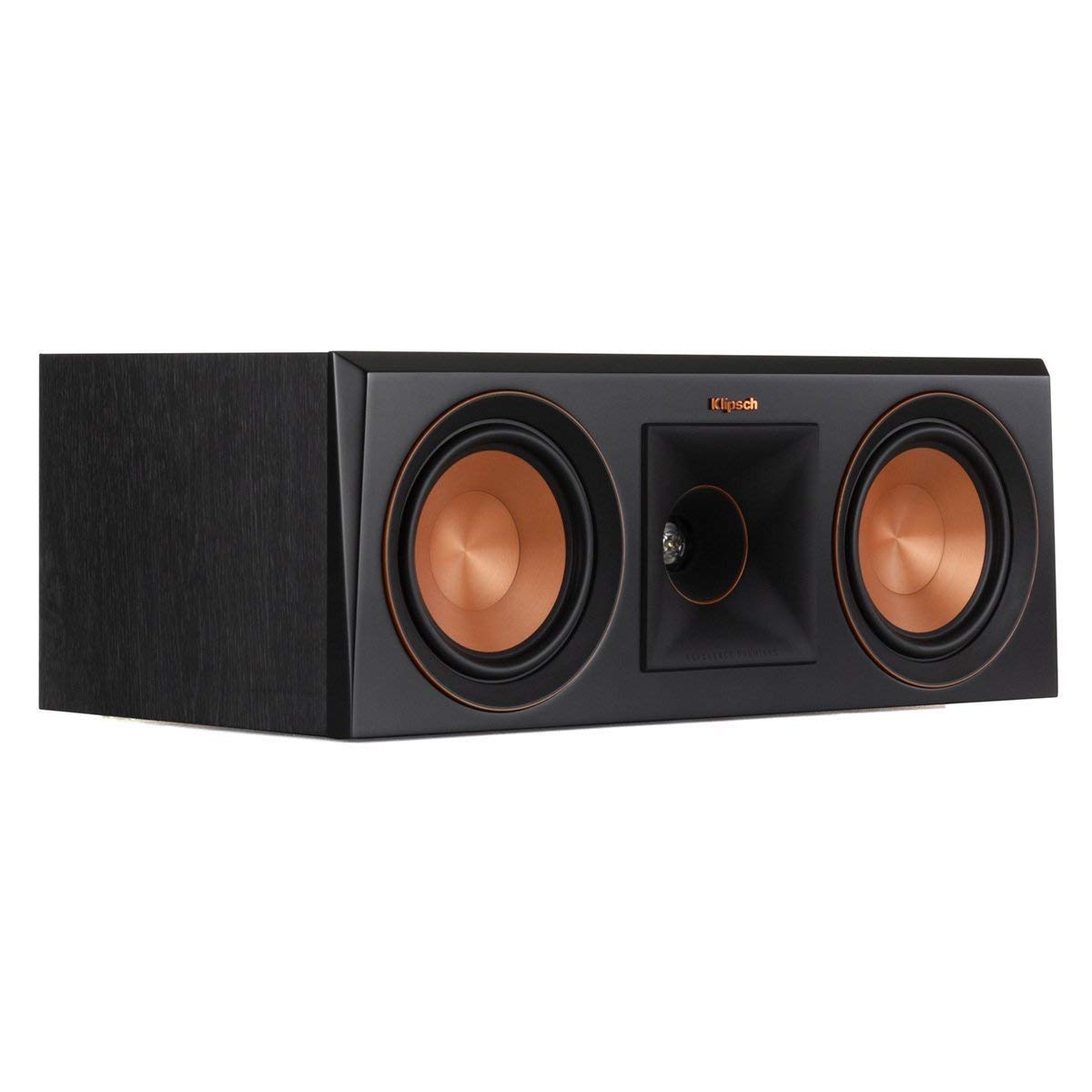
Twin 5.25-inch copper woofers in a package that keeps up with much bigger fronts.
This is the slightly more compact sibling of our top pick, and it shares the same DNA: dual 5.25-inch spun copper Cerametallic woofers and a 1-inch Titanium LTS Vented Tweeter with a Hybrid Tractrix Horn. Bass-reflex loading via a rear-firing Tractrix port gives it real low-end reach for its size.
Voice clarity is the headline here, with owners describing a massive clarity and depth boost over entry-level centers. It can keep up with pounding subs without losing dialogue — a key strength if you like action movies loud. The removable magnetic grille and scratch-resistant ebony finish add polish.
The size is the trade-off: it’s much larger and heavier than expected, with a footprint similar to bookshelf speakers like the RP-600M. Plan for stand reconfiguration before it arrives.
Standout: powerful dialogue that stays clear even with heavy bass.
Plan for: a bigger-than-expected footprint that may demand a new stand.
5. Polk Audio Signature Elite ES35 Center Channel Speaker
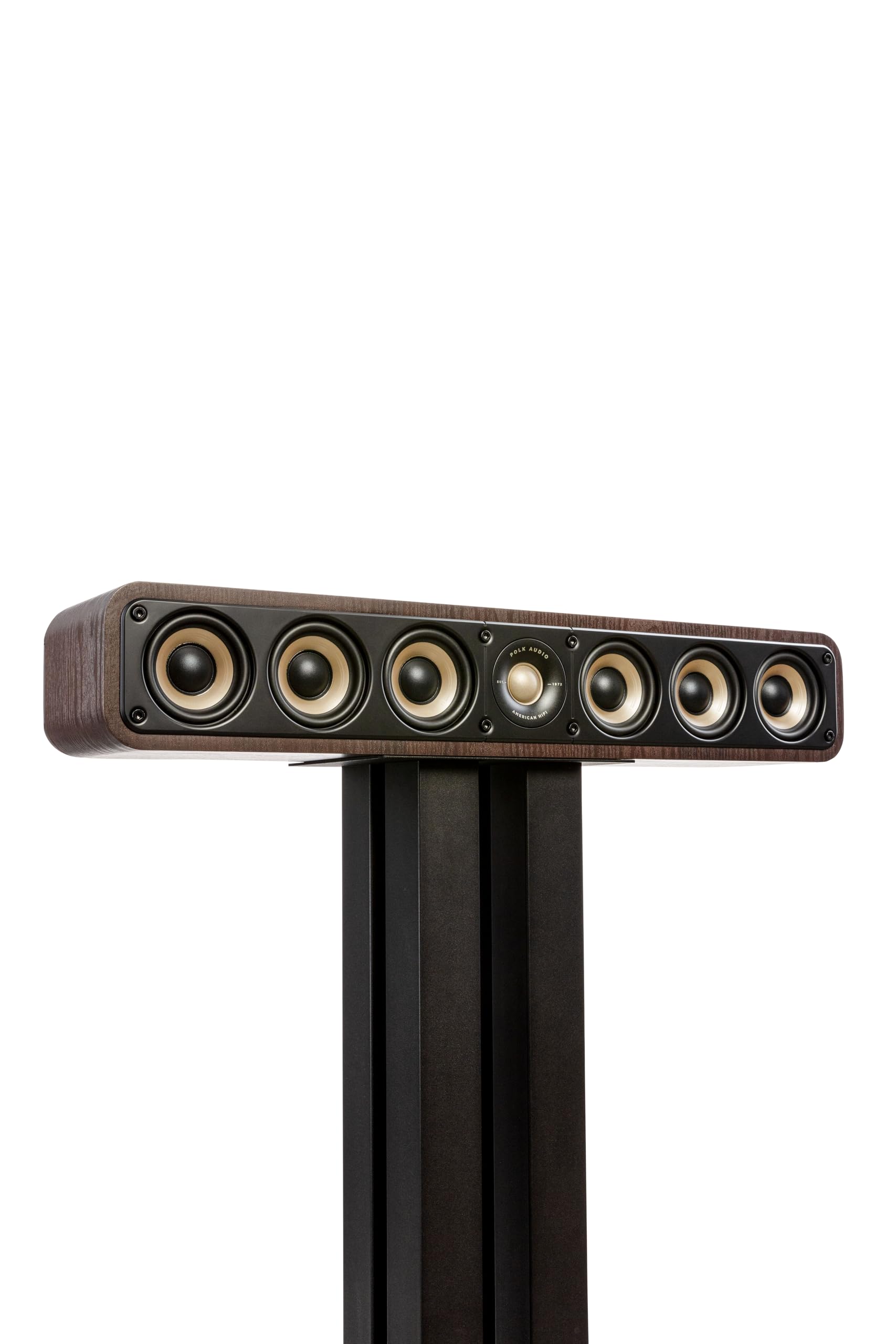
A slim, walnut-clad speaker that carries nearly three-quarters of your audio.
With Polk’s patented Power Port Technology, the ES35 delivers dramatic frontal impact and handles almost 75 percent of the audio in a scene, so the center channel is doing the heavy lifting. It pairs a 1-inch Terylene tweeter with six 3-inch woofers in a Dynamically Balanced Acoustic Array, producing room-filling, crisp sound from a compact silhouette.
Dialogue clarity is superb — owners highlight natural vocals and clear sound even at low volumes, with no dead spots across the range. The contemporary walnut finish and magnetic grille make it a centerpiece you’ll actually want visible. It wall-mounts below the TV without blocking the IR sensor, and the rear port cage allows flush mounting.
It needs a 20-30 hour break-in to sound its best, so don’t judge it on day one. It integrates beautifully with other Signature Elite speakers and Denon receivers.
Why it earns the spot
- Slim form fits under fireplace mantles and tight stands
- Clear vocals at any volume level
- True 4- & 8-ohm compatibility for easy pairing
Know before buying
- Break-in period of 20-30 hours before peak performance
- Plastic build despite the premium look
Grab it if: you want a design-forward, slim center that doesn’t sacrifice dialogue quality.
skip it if: you expect a hefty wood cabinet — this one is built light and plastic-based.
6. ELAC Uni-Fi 2.0 UC52 Center Speaker

The concentric 3-way design that widens the balance for everyone on the couch.
This is the pick for off-axis listening — its newly developed concentric driver places a 4-inch aluminum midrange around a 1-inch wide-roll surround tweeter, creating a wider balance so side seats hear the same clear dialogue as the center seat. The true 3-way design with a dedicated midrange is what makes vocals sound more natural than a typical 2-way center.
Triple single-piece aluminum cone 5.25-inch bass drivers handle low frequencies, while front-firing ports allow flexible room placement, even against a wall. Owners note that dialogue improves greatly, especially off-center, with clear, distortion-free highs. It’s a significant step up from ELAC’s Debut line.
The 6-ohm nominal impedance makes it compatible with virtually all receivers and amplifiers. For buyers coming from a 2-way design with an offset tweeter, the coaxial center tweeter here is the vastly superior approach for better sound.
Best for: wide seating areas where off-center dialogue clarity is the priority.
Consider: the concentric driver takes a moment to appreciate — give your ears a few sessions.
7. SVS Prime Center Speaker

The true 3-way center that anchors loud action scenes with revealing clarity.
The SVS Prime Center’s 1-inch aluminum dome tweeter plays crisp at high volumes, offering an ‘airy’ presentation and unveiled highs so vocals always sound crisp. The potent 5.25-inch woofers ride on a cast ABS-fiberglass composite basket, which keeps the frame inert without resonances or added harmonics — that precision translates to clean, natural dialogue.
Owners describe it as a substantial upgrade from budget centers, dramatically improving dialogue clarity — especially for hearing-impaired listeners. The rear ported cabinet enhances bass output, and the SVS SoundMatch 3-way crossover ensures smooth transitions between drivers. The Audioholics quote says it all: it anchors clear vocals with smooth transitions.
The midrange is very bright initially and needs a level reduction, warming up after roughly 15 movies of break-in. Build quality is excellent, heavy, and compact.
The strong points
- crisp dialogue at loud volumes
- Balanced voicing with solid bass from dual woofers
- Rear port for flexible placement
The honest caveats
- Bright midrange from the start — budget a level adjustment
- Break-in period of about 15 movies
Pick it for: a mid-to-high-end system that demands clarity at serious volume.
Expect: a bright start that settles into a balanced, revealing character.
8. Definitive Technology CS-9060 Center Channel Speaker
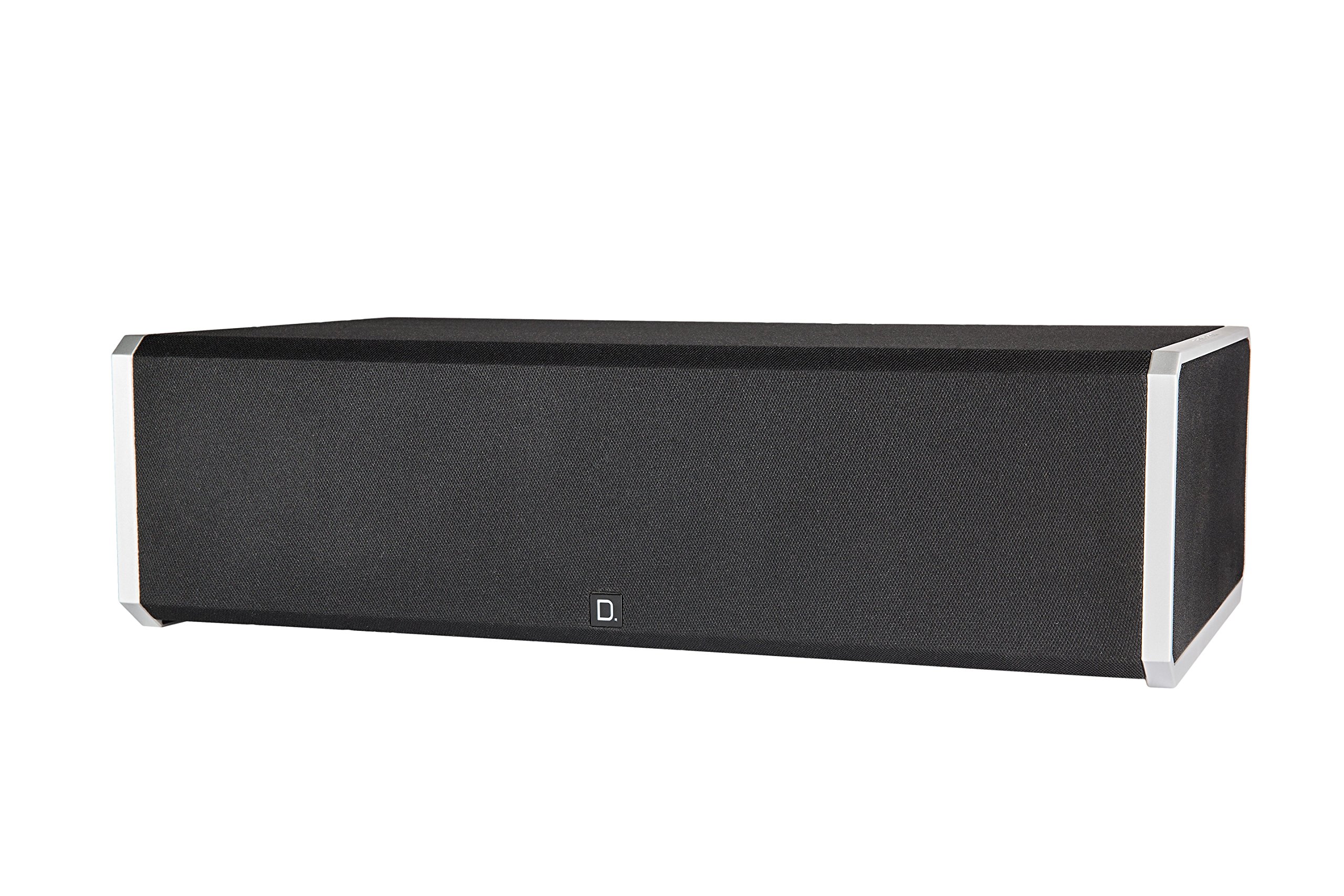
The rare center that brings its own powered subwoofer for deep bass without an extra box.
This is the problem-solver for rooms with no subwoofer: it packs a built-in 8-inch 150-watt powered subwoofer into the cabinet, delivering deeper, more effective bass and extraordinary detail even without a separate sub. The 1-inch aluminum dome tweeter and two 4.5-inch BDSS mid drivers produce pure sound for demanding audio content.
Customers note it rivals movie theater quality, with excellent dialogue clarity and no captions needed. Definitive’s Intelligent Bass Control maintains balance between lows and mids for crisp sound, and the totally inert resonance-free cabinet keeps things clean.
The catch: it needs AC power, so you’ll have a cable to manage. Set your receiver to “full size” or the built-in sub won’t activate — a small setup quirk worth knowing.
Who it’s for: 3.1 systems or setups that skip a dedicated subwoofer but still want movie bass.
Setup note: requires AC power and a receiver that sends a full-range signal to the center.
9. SVS Ultra Evolution 3-Way Center Channel Speaker

The reference-grade 3-way that makes you hear notes you never noticed before.
This is the pinnacle pick: a 3-way center with a vertically aligned tweeter-midrange array that creates perfect on- and off-axis frequency response for clear vocals across the entire seating area. The hyper-rigid diamond carbon coating on an aircraft-grade aluminum dome delivers what SVS calls top-tier fidelity, linearity, and transient response.
Owners describe it as nearly indistinguishable from ultra towers in 2-channel mode, with excellent dispersion and extreme clarity at any volume. It works well at both 80Hz and 60Hz crossovers, making it flexible for different subwoofer setups. The black oak veneer and piano gloss finish look stunning in any room.
This is a serious investment, but the performance justifies it: music notes become individual and clear at lower volumes, and high volumes stay powerful without fatigue. If you’ve been upgrading piece by piece, this is the center you finish with.
For the purist: the ultimate center for a high-end setup where dialogue and music clarity are non-negotiable.
The commitment: premium-tier pricing that pairs best with equally capable L/R speakers.
Understanding the Specs
2-Way vs. 3-Way Design
A 2-way speaker has tweeters for highs and woofers for mids and lows. A 3-way design adds a dedicated midrange driver, which handles the critical vocal frequencies — this is why 3-way centers like the ELAC UC52 and SVS models produce more natural dialogue. The trade-off is usually size and price.
Off-Axis Listening and the balance
the balance is the seating position where the soundstage is perfectly centered. If you have side seats, a concentric or vertically aligned driver design — like the ELAC’s coaxial tweeter — keeps dialogue clear from wider angles. A wide horn-loaded center like the Klipsch RP-504C also broadens that coverage.
Impedance and Amplifier Matching
Impedance, measured in ohms, tells you how much electrical resistance the speaker presents to your receiver. A 6-ohm or 8-ohm nominal rating works with virtually all home theater receivers. Lower-impedance speakers demand more current, so always check that your receiver can handle the load before cranking volume.
Placement and Cabinet Design
Rear-ported speakers need space behind them, while front-firing ports allow placement flush against a wall. Slim designs like the Polk XT35 and ES35 wall-mount below the TV without blocking the IR sensor. The Definitive CS-9060 needs AC power for its built-in subwoofer.
FAQ
Why is a center channel speaker so important for home theater?
What is the ideal size for a center channel speaker?
Do I need a 3-way center channel speaker?
Can I use a center channel speaker with any home theater receiver?
How long does a center channel speaker need to break in?
Should the center speaker match my left and right speakers?
What does off-axis listening mean for a center speaker?
Do I still need a subwoofer if I have a center channel speaker?
Final Thoughts: The Verdict
For the majority of shoppers, the best center channel speaker for home theater is the Klipsch RP-504C because its horn-loaded design and wide soundstage deliver reference-grade dialogue clarity in any seating position. If you want budget-friendly value that still sounds fantastic, grab the Micca MB42X-C. And for a design-conscious slim setup that wall-mounts cleanly, the Polk Monitor XT35 is the one to reach for.
How We Picked
We do not accept paid placement. Every pick is matched to a real buyer and a real use-case; we do not hands-on test units.
Sources & Methodology
Specifications: manufacturer listings and product documentation. Review insights: verified customer reviews, as of August 2026. Pricing: not shown on this page (it changes often); check the current price via the retailer link.
As an Amazon Associate, Gadgets Feed earns from qualifying purchases. This does not affect which products we feature.