
Our readers keep the lights on and my morning glass full of iced black tea. As an Amazon Associate, I earn from qualifying purchases.
Specs are compiled from manufacturer listings and verified buyer reviews and can change over time — please confirm the key details on the product page before buying.
Skimping on the center speaker is the most common home theater mistake. It carries most dialogue, so a weak one forces you to crank the volume and still miss lines. A great center channel instantly transforms TV, movies, and gaming, and this guide highlights affordable models that deliver clear vocals.
I’m Min — the founder and writer behind Gadgets Feed. This guide is built by comparing the manufacturers’ published specifications and the patterns across verified customer reviews, so you get each pick’s real strengths and trade-offs instead of marketing spin.
You’ll learn which specs matter, what size your room needs, and how to match a speaker to your receiver, so you can pick a center channel speaker that makes every word unmistakably clear.
Our Picks at a Glance


How To Choose The Best Center Channel Speaker
Your center speaker works harder than any other in your setup. It anchors voices, effects, and the front soundstage, prioritizing vocal clarity above all. Start by measuring the space under your TV, then match the speaker’s efficiency to your receiver.
Match the Driver Layout to Your Room
A 2-way design with two woofers flanks a tweeter, which is the most common layout. A 3-way design adds a dedicated midrange driver, which often makes voices sound more natural and smooth, especially at higher volumes. If you sit off to the side, look for a design with wide dispersion so the sound stays clear even when you are not dead center.
Check Sensitivity and Impedance
Sensitivity tells you how loud the speaker plays from a given amount of power, measured in decibels. A higher number, like 90dB, means efficient speakers that do not need a powerful amplifier. Impedance, measured in ohms, tells you how much resistance the speaker offers; many modern centers work with both 4- and 8-ohm receivers, which gives you flexibility.
Consider the Cabinet and Ports
A rear port fires air backward, so it needs some space behind it. A front-firing port is easier to place against a wall or inside a bookshelf. If your TV sits directly on the speaker, check the weight limit and the cabinet’s flat top. A large, heavy cabinet often means better bass but can force you to raise your TV.
Quick Comparison
| Model | Best For | Woofer Size | Tweeter Type | Design | Amazon |
|---|---|---|---|---|---|
| Klipsch RP-504C★ Best Overall | High-efficiency home theater | 5.25 inches | Titanium Horn | 2.5-way | Amazon |
| Micca MB42X-CBest Value | Budget-friendly value | 4 inches | Silk Dome | 2-way | Amazon |
| Micca RB42-CCompact Pick | Small rooms and near-field | 4 inches | Silk Dome | 2-way | Amazon |
| Polk XT30 | Compact hi-res setups | 5.25 inches | Dynamically Balanced | 2-way | Amazon |
| ELAC C5.2 | Balanced music and movies | 5.25 inches | Cloth Dome | 2-way Bass Reflex | Amazon |
| Polk ES35 | Slim designs and wall mounting | 3 inches (six) | Terylene | Array | Amazon |
| SVS Prime Center | Revealing clarity and 3-way design | 5.25 inches | Aluminum Dome | 3-way | Amazon |
| Definitive CS-9060 | Built-in powered subwoofer | 8 inches & dual 4.5 inch | Aluminum Dome | BDSS with Sub | Amazon |
| SVS Ultra Evolution | Reference-level transparency | 6.5 inches | Diamond-coated Aluminum | 3-way MTM | Amazon |
In-Depth Reviews
1. Klipsch RP-504C Reference Premiere Center Channel Speaker
Our pick — over 4.5★ from 950+ verified ratings; the strongest balance of quality and price.
The horn-loaded powerhouse that throws voices across the room with easy efficiency.
What wins people over here is the sound quality, and it starts with the signature horn. The 90° x 90° Tractrix horn pairs with a vented titanium tweeter to push dialogue out widely, so you hear clear voices even when you are sitting off to the side. Buyers report that the wide dispersion aids off-axis listening, which is the difference between catching every word and leaning forward to hear.
It uses a 2.5-way design with dual crossovers, which improves dialogue articulation over a simpler layout. Two 5.25-inch Cerametallic woofers handle mids and bass with light, rigid cones that stay efficient. Klipsch confirms TVs under 75 lbs can sit on top, so you can rest your screen directly on this speaker’s flat cabinet. Just measure first — the size draws mixed reactions, and many owners had to raise their TV or buy a new stand to make it fit.
The crowd favorite — 4.8 stars across 900+ owners — is efficient at roughly 90dB real-world sensitivity, playing loud without a massive amplifier. The rear Tractrix port needs some breathing room behind it to deliver clean bass. Owners mention it blends beautifully with the RP8000F towers, and the ebony finish looks furniture-grade. A rare unit arrives damaged in transit, so inspect the box carefully.
Dialogue machine: The horn design and dual crossovers make this the clearest-voiced pick in the mid-range tier, and the 75 lb TV weight limit lets it double as a stand.
Space check: It is genuinely huge, so make sure your TV stand and room can handle a speaker this size before you order.
Reach for this if: you want horn-loaded efficiency, wide off-axis sound, and the freedom to set your TV right on top.
Look elsewhere if: you are working with a shallow shelf or a small TV stand, since the footprint demands real estate.
2. Micca MB42X-C Advanced 2-Way Passive Center Channel Speaker
The compact workhorse that makes budget buyers feel like they spent three times as much.
Customers note solid dynamic range for its size, but check dimensions first — it is very compact. Two 4-inch balanced woven carbon fiber woofers deliver tight, effective bass, while a high-performance silk dome tweeter keeps treble smooth and imaging accurate. It fills a 20 x 15 room effectively, far more capable than its small frame suggests.
The things owners rave about are the sound quality and value for money. The tune 18dB crossover produces an open, balanced, and dynamic sound, and the ported enclosure extends bass response with low distortion. One buyer notes the twin 4-inch woofers deliver better bass than the MB42X bookshelf, nearly matching 6.5-inch units. It needs 30-40+ hours of break-in to shake a hollow tone, after which the bass becomes impressive.
This is the entry-level champion that also happens to be the most-discussed pick here for pure value, with hundreds of buyers praising its performance. The classic design disappears into any room, and the wooden finish makes it look more expensive than it is. A slight hiss on “s” sounds is the only recurring note from critical listeners, but at this level it is a minor quibble.
The value case
- Carbon fiber woofers look and sound pricier than they are
- Compact size fits easily in most entertainment centers
- Handles dialogue well even at lower volumes
The honest limits
- Needs 30-40+ hours of break-in before it sounds its best
- Sensitive listeners may notice a slight hiss on sibilant sounds
Best for: budget builders who want near-audiophile performance and a speaker that vanishes into the room.
Think twice if: you demand room-shaking bass without a subwoofer, since its 4-inch drivers are built for clarity, not depth.
3. Micca RB42-C Reference 2-Way Passive Center Channel Speaker
The small-room specialist with punchy bass and vocals that mesmerize up close.
This is the perfect center for the RB42 bookshelf speakers, and it delivers sturdy bass and midrange output in a tiny package. Two 4-inch long-throw woofers with coated paper cones and large rubber surrounds handle the low end, while a 0.75-inch silk dome tweeter on a neodymium magnet keeps the highs silky. It measures to 40Hz in-room, which is exceptional for a speaker this size.
The secret is the 10-element crossover with film capacitors and air-core coils, which gives both drivers an 18dB/octave slope for dramatically reduced lobing and superior off-axis performance. Reviewers point out clear, crisp vocals without listener fatigue, and the punchy bass is a constant compliment. It works great in small and medium rooms, but owners do flag severe port chuff at loud volumes in large spaces.
A symmetrical design means you can buy a pair and use them vertically as bookshelf speakers, which adds versatility. The dark walnut finish and clean modern lines are praised enough that owners say you won’t feel the urge to hide it. It is more efficient than the RB42 bookshelf, but it still wants an 80Hz crossover and a subwoofer to sound its best — a note that comes up repeatedly in the reviews.
Small-room star: The 86dB sensitivity and long-throw woofers make it ideal for near-field listening where space is tight.
Volume caution: Push it hard in a big open room and the port will chuff — this one wants a sub and modest levels.
Choose this when: you want a compact center that fills a small-to-medium room with clear, punchy sound and looks like a much pricier speaker.
skip it if: you have a large open-floor plan and love cranking the volume, since port noise becomes a factor.
4. Polk Audio Monitor XT30 Compact Center Channel Speaker

The compact all-rounder that brings hi-res clarity without demanding a huge cabinet.
This speaker is built for crisp dialogue and dynamic hi-res sound, and shoppers say it pairs exceptionally well with Polk bookshelf speakers and Yamaha Atmos receivers. A 1-inch Dynamically Balanced tweeter sits between two 5.25-inch Dynamically Balanced woofers, creating an rich soundstage that makes voices sound natural and integrated. The 4- and 8-ohm compatibility handles Dolby Atmos and DTS:X from streaming services with ease.
Buyers consistently describe the sound as incredible for the money, with clear dialogue that makes it a great deal for home theater. It is compact yet powerful enough to place in most AV consoles, and the timbre-matched Polk components ensure smooth blending with other Monitor XT speakers. One owner notes the speaker fabric cover only comes in gray, wishing for a black option to match their other speakers.
The recurring honest note is about measurements. Polk lists 5.25-inch woofers, but one critical buyer measured the actual frame at 5 inches with a driver under 4.5 inches. Performance still earns five stars, but it is a sizing discrepancy worth knowing. Buyers also mention it is bigger than expected, so some had to raise their TV to fit it under the screen.
Why it wins
- Hi-res compatible across Atmos and DTS:X sources
- Compact size suits most AV consoles and bookshelves
- Timbre-matched with the rest of the Monitor XT line
Watch out for
- Listed 5.25-inch woofers measure smaller in reality
- Grille comes in gray only, which some owners dislike
Pick this for: an affordable hi-res upgrade that blends smoothly with Polk Monitor XT towers and bookshelves.
Be aware that: the physical size is larger than the “compact” name suggests, so measure your space first.
5. ELAC Debut 2.0 C5.2 Center Channel Speaker
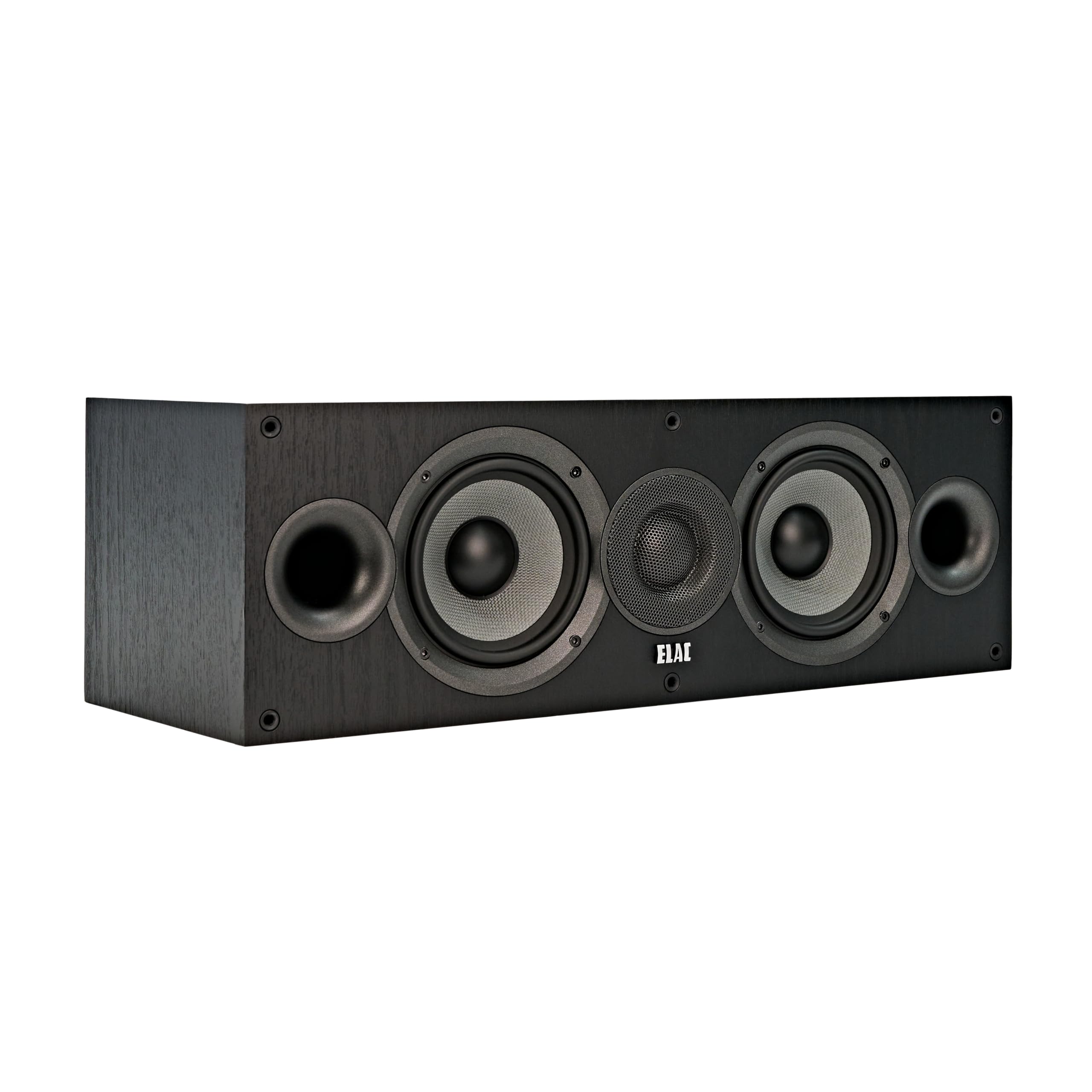
The music-loving center that makes both movie lines and concert vocals sound life-sized.
Buyers call this the sleeper center of the year, and the reason is its dual nature. The 1-inch cloth dome tweeter takes response up to 35,000 Hz with a wide-roll surround, producing life-like highs that make dialogue crisp and natural. Two 5.25-inch woven aramid-fiber woofers deliver smoother, extended low-frequency response, giving this speaker a musicality that few centers match.
The front-firing ports are a genuine placement win, letting you tuck this against a wall or inside a bookshelf without compromising performance. The thick, internally braced MDF cabinet reduces vibration, and buyers report it pairs brilliantly with the B6.2 bookshelf speakers. It beats the Klipsch RP-404C and several Polks on dialogue clarity, which is high praise in this category.
Owners do disagree on size and weight, with many finding it noticeably large and heavy. It also needs 30-40 hours of break-in before the sound opens up, and a 90W amplifier is sufficient to drive it. One buyer experienced listening fatigue with concert documentaries, though the same person called it the best center among Paradigm, Infinity, Polk, and Bose speakers they tried.
Music-first center: The 35,000 Hz cloth tweeter and aramid woofers make this the best pick here for people who watch concerts and listen to music, not just movies.
Placement perk: Front-firing ports mean you can use it near a wall, which is a real advantage over rear-ported rivals.
Choose it for: cinematic sound in a setup where the center pulls double duty for music and movies, with easy near-wall placement.
Consider the trade: it is big and heavy, and it wants a real break-in period before you judge it.
6. Polk Audio Signature Elite ES35 Slim Center Channel Speaker

The slim profile card that hides under your TV while carrying the soundstage.
This is the answer for anyone whose TV leaves little vertical room, because the slim design fits easily in entertainment centers and can wall-mount below the screen without blocking the IR sensor. It uses a Dynamically Balanced Acoustic Array with a 1-inch Terylene tweeter and six 3-inch woofers, and owners mention it delivers room-filling, crisp sound that is exceptional for its size. The 40 KHz frequency response gives it headroom most slim speakers lack.
Polk’s patented Power Port Technology adds dramatic frontal impact, and the speaker carries almost 75 percent of the audio in a home theater. That means louder, lower, cleaner bass without distortion, which buyers consistently praise alongside the dialogue clarity. The rear port has a cage that allows flush wall placement, a clever touch for tight installs. A magnetic cover is included, and the modern black finish looks classy.
Owners note it needs 20-30 hours of break-in, and while the build quality is solid, the enclosure is plastic rather than wood. Wall mount hardware is not included, so factor that into your install. One buyer described it as the best slim center channel speaker in its price range, and the vocal clarity at low volumes is a recurring highlight.
Slim but mighty: Six 3-inch woofers plus the Power Port deliver surprisingly full sound from a cabinet shallow enough to fit under most TVs.
Install note: You will need to buy wall-mount hardware separately, and the plastic cabinet is a compromise at this price.
Grab this for: a sleek, low-profile center that mounts under your TV and still fills a room with clear, clean audio.
Look past it if: you want a heavy wooden cabinet, since this one trades heft for a slim aesthetic.
7. SVS Prime Center Speaker

The revealing 3-way design that makes vocals crisp, smooth, and utterly transparent.
Customers note this speaker anchors the front soundstage with revealing clarity and crisp transitions, thanks to its true 3-way crossover design. A 1-inch aluminum dome tweeter plays crisp at high volumes with an airy presentation, while two 5.25-inch woofers on cast ABS-fiberglass composite baskets keep the cabinet free of resonances. The dedicated midrange driver is what separates this from cheaper 2-way designs, creating smooth transitions between drivers.
The proprietary SVS SoundMatch 3-way crossover is tuned for accurate frequency response and pinpoint imaging. Buyers consistently note the clear, crisp dialogue and solid bass, with one calling it a substantial upgrade from a Sony center and easily superior in all ways. It pairs beautifully with Cerwin-Vega L-9 floor-standing fronts, and the sound distribution extends beyond a 90° axis, so off-axis listeners stay in the balance.
It is rear ported for enhanced bass output, so it needs some space behind it. The midrange runs bright at first and needs level reduction initially, but owners say it warms up after roughly 15 movies. The build is solid and heavy, and SVS customer service earns repeated praise for its responsiveness.
Revealing transparency: The true 3-way design with a dedicated midrange gives this a level of vocal clarity and imaging that 2-way centers cannot match.
Patience required: The bright midrange at first needs a level trim and a break-in period of a couple weeks.
Reach for this if: you want a genuine 3-way center that reveals detail in music and dialogue with pinpoint imaging.
pass on it if: you cannot give a rear-ported speaker a few inches of breathing room behind the cabinet.
8. Definitive Technology CS-9060 Center Channel Speaker
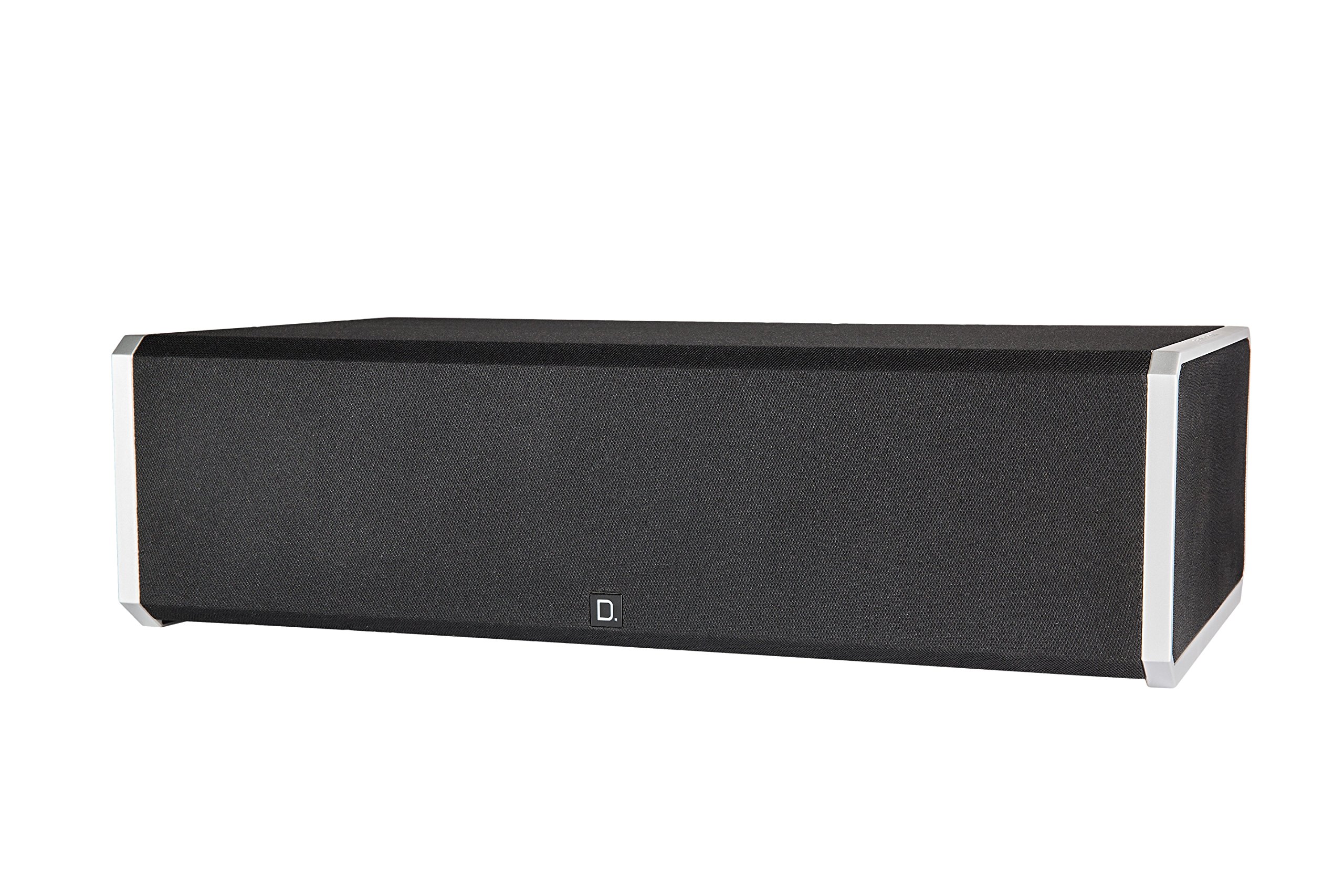
The one-box wonder with a built-in subwoofer that makes you forget it is only a center.
This is the only speaker here that brings its own bass, and reviewers point out the integrated 8-inch 150-watt powered subwoofer delivers deeper, more effective bass even without a separate sub. The BDSS technology pairs a 1-inch aluminum dome tweeter with two 4.5-inch mid drivers, creating crisp highs and mids. Definitive’s Intelligent Bass Control keeps the lows balanced, so dialogue stays crisp over action scenes.
Owners consistently report crisp dialogue at normal listening volumes, with one noting they no longer need captions. The built-in sub uses speaker wire to connect, and the tonal control is useful for fine-tuning. It pairs well with Dual 15-inch subs and Definitive mains, and shoppers say it rivals theater-quality sound. One buyer replaced a CS 2300 and was completely satisfied, noting the dull chrome finish is not distracting.
The honest trade-off is setup: you must set your receiver to “full size” center, or the bass cuts out. A minor popping sound can occur when the sub auto-powers on, and volume needs adjustment per source, which Denon presets help with. The 25 years of Definitive engineering is evident in the rigid, resonance-free cabinet that keeps sound natural and clear.
All-in-one bass: The built-in 150-watt powered sub means you do not need a separate subwoofer for a satisfying movie night.
Setup quirk: Your receiver must be configured to full-size center for the bass to work, and the sub can pop when it wakes up.
Pick this for: a complete center-channel solution that delivers theater-like bass and dialogue without extra components.
Think twice if: you dislike receiver configuration quirks, since the full-size center setting is mandatory.
9. SVS Ultra Evolution 3-Way Center Channel Speaker

The reference-grade center that makes mediocre streaming dialogue sound excellent.
Buyers report this speaker delivers pinpoint accuracy, absolute transparency, and easy bass, making dialog on mediocre streaming shows sound excellent. The Vertically Aligned Tweeter-Midrange array creates perfect on- and off-axis frequency response, so vocals stay clear and blended no matter where you sit. The hyper-rigid diamond carbon coating on an aircraft-grade aluminum dome delivers what owners call top-tier fidelity and transient response.
Precision-cast aluminum-alloy baskets keep critical components aligned and boost thermal dissipation, while the FEA-tune cabinet construction eliminates acoustic and structural resonances. The 6.5-inch drivers give it real low-end authority, and the 8-ohm impedance makes it easy to drive. Owners mention it is nearly indistinguishable from towers in 2-channel mode, and it works well at both 80Hz and 60Hz crossovers.
It is a huge upgrade from the Prime Center, with individual, clear, non-fatiguing notes that retain clarity at lower volumes. The Black Oak Veneer finish looks premium, and customers note it pairs perfectly with Prime L/R speakers. Newer to the market with fewer reviews than other picks, it is a recent flagship release that has impressed early owners with its powerful, easy output that stays clear even when pushed.
Reference performance: The diamond-coated dome and vertically aligned array make this the most transparent, engaging center here for critical listeners.
Early adopter note: With far fewer owner reports than the established picks, you are trusting the spec sheet and early impressions more.
Choose this for: a flagship 3-way center that lifts every source, including low-quality streams, to reference-level clarity.
it’s not for you if: you are happy with the Prime Center’s performance, since this is a premium step up in cost and size.
Understanding the Specs
2-Way vs 3-Way Design
A 2-way speaker splits the audio between a tweeter and a woofer (or two woofers flanking a tweeter). A 3-way design adds a dedicated midrange driver, which handles the critical vocal frequencies separately. This often results in more natural, smooth dialogue with less strain at higher volumes. If you watch a lot of dialogue-heavy content and have room in your budget, a 3-way center is usually the better investment.
Sensitivity and Impedance
Sensitivity, measured in decibels, tells you how loud a speaker plays from a single watt of power. A higher number like 90dB means the speaker is efficient and does not need a powerful amplifier. Impedance, measured in ohms, is the speaker’s resistance to the amplifier’s signal. Many modern centers are compatible with both 4- and 8-ohm receivers, giving you flexibility when matching to your AV receiver.
Port Placement and Cabinet Size
A rear port fires air backward and needs clearance behind it to produce clean bass. A front-firing port lets you place the speaker flush against a wall or inside a bookshelf without compromising performance. Cabinet size affects bass depth — larger, heavier cabinets generally produce fuller low-end but require more space under your TV. Always measure your TV stand and check the TV’s weight limit before placing it on top of a speaker.
Dispersion and Off-Axis Listening
Dispersion describes how wide the sound spreads from the speaker. A design with wide dispersion, like a horn-loaded tweeter or a vertically aligned array, keeps dialogue clear even when you are sitting off to the side. If you have a wide couch or multiple seating positions, prioritize a speaker with a wide balance so everyone hears crisp vocals, not just the person in the center seat.
FAQ
Can I place my TV directly on top of a center channel speaker?
What does a 3-way center channel speaker do better than a 2-way?
Do I need a subwoofer if my center speaker has one built in?
How much space does a rear-ported center speaker need behind it?
What is the ideal break-in period for a new center speaker?
Will any center speaker work with my existing bookshelf speakers?
What does sensitivity mean and why does it matter?
Is a compact center speaker as good as a full-size one?
What is the difference between a silk dome and a metal dome tweeter?
Final Thoughts: The Verdict
For most buyers, the center channel speaker winner is the Klipsch RP-504C because its horn-loaded efficiency and 2.5-way design deliver class-leading dialogue clarity and off-axis reach from a mid-range price. If you want a compact, budget-friendly speaker that still sounds premium, grab the Micca MB42X-C. And for a complete one-box solution with its own bass, the Definitive Technology CS-9060 is the one to reach for.
How We Picked
We do not accept paid placement. Every pick is matched to a real buyer and a real use-case; we do not hands-on test units.
Sources & Methodology
Specifications: manufacturer listings and product documentation. Review insights: verified customer reviews, as of August 2026. Pricing: not shown on this page (it changes often); check the current price via the retailer link.
As an Amazon Associate, Gadgets Feed earns from qualifying purchases. This does not affect which products we feature.