
Our readers keep the lights on and my morning glass full of iced black tea. As an Amazon Associate, I earn from qualifying purchases.
Specs are compiled from manufacturer listings and verified buyer reviews and can change over time — please confirm the key details on the product page before buying.
You need a centrifuge that gives you clean plasma fast, holds the tubes you actually use, and doesn’t rattle your counter. The key specs to compare are spin force (measured in xg or g-force), tube capacity, and noise level. This guide covers seven benchtop units, so you can match the rotor, speed, and timer to the exact tubes you run daily.
I’m Min — the founder and writer behind Gadgets Feed. This guide is built by comparing the manufacturers’ published specifications and the patterns across verified customer reviews, so you get each pick’s real strengths and trade-offs instead of marketing spin.
You will see how top-rated models like the ONiLAB compare on rotor capacity, maximum RCF, and noise levels to find the right centrifuge machine for plasma separation, blood work, or general lab use.
Our Picks at a Glance
How To Choose The Best Centrifuge Machine
Centrifuges spin samples to separate liquids by density — heavier cells sink to the bottom, and lighter plasma or serum collects on top. For PRP (platelet-rich plasma) work, the machine needs to spin fast enough to concentrate platelets without damaging them, and it needs a rotor that fits your blood collection tubes.
Match the rotor to your tubes
Every machine here uses a fixed-angle rotor with adapters. Count your daily tube sizes first: 2ml, 5ml, and 10ml vacutainer tubes are the most common for blood draws, while 15ml and 20ml centrifuge tubes suit larger volumes. A rotor that accepts 8 x 10ml tubes is not the same as one holding 8 x 20ml — check the adapter list carefully.
Read the RCF, not just the RPM
RPM (revolutions per minute) tells you how fast the rotor spins, but RCF (relative centrifugal force, shown as xg) tells you the actual separation force applied to your sample. A shorter rotor at the same RPM produces less force, so compare the maximum xg figure when judging real-world performance.
Safety features and noise
A lid interlock that prevents opening mid-spin is essential, as is an imbalance sensor that cuts power if the load is uneven. Noise levels around 56-65 dB are typical for benchtop units — quiet enough for a small office but noticeable in a silent room.
Quick Comparison
| Model | Best For | Max Speed | Max RCF | Rotor Capacity | Amazon |
|---|---|---|---|---|---|
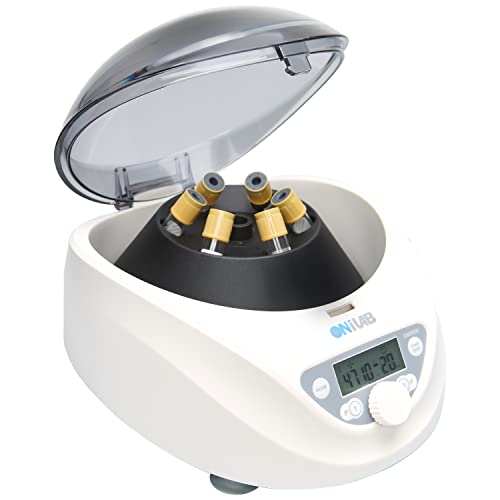
| ONiLAB PRP Centrifuge★ Best Overall | Rich plasma yield | 5000rpm | 2600xg | 6 x 15ml | Amazon |
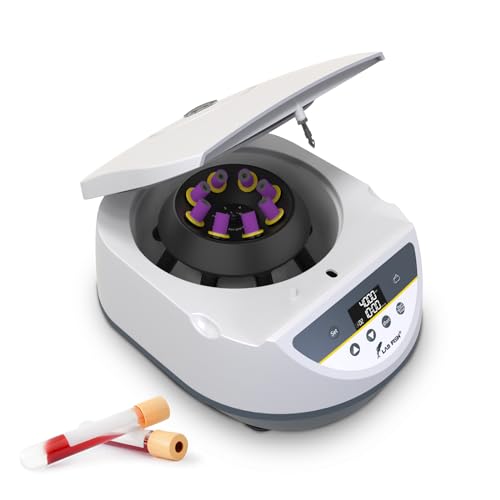
| LAB FISH LC-8STop Performer | High-force versatility | 5000rpm | 3074xg | 8 x 15ml | Amazon |
| CGOLDENWALL 100-4000RPM | Stable countertop runs | 4000rpm | 1880xg | 8 x 15ml | Amazon |
| LAB FISH LC-400PRO | Wide speed control | 5000rpm | 2683xg | 8 x 10ml | Amazon |
| JIAWANSHUN Benchtop | Long timed protocols | 4000rpm | 1920xg | 8 x 20ml | Amazon |
| LC-400 RP PRF | Light portable builds | 4000rpm | 1717xg | 4 x 15ml | Amazon |
| CGOLDENWALL 80-2 | Budget multi-tube runs | 4000rpm | 2325xg | 12 x 20ml | Amazon |
In‑Depth Reviews
1. ONiLAB Lab PRP Centrifuge
Our pick — over 4.5★ from 100+ verified ratings; the strongest balance of quality and price.
The crowd favorite that turns 5000rpm into visibly richer plasma.
Buyers report visibly richer plasma after just a few PRP treatments. That outcome traces back to the machine’s 2600xg maximum centrifugal force, which packs more separation power than the JIAWANSHUN’s 1920xg — a 35% gap that shows up in cleaner fractions.
The defining trait here is the noise floor. Owners consistently describe it as near-silent, and the ≤56dB rating backs that up — a welcome difference from older units that rattle through a room. The 11.4-pound frame with cast iron base and vacuum suction feet keeps it planted, so a full 6 x 15ml run stays steady without creeping across the bench.
Setup is genuinely one-key: the LCD lets you read speed in RPM or G-force, and two stored programs (P1/P2) fire off with a single button press. Safety is equally thought out — a lid interlock stops you opening the chamber mid-spin, an overspeed detector watches the rotor, and the machine self-tests on startup. The 30-second to 99-minute timer covers both quick spins and long protocols.
Why owners swear by it
- Quietest runs in this lineup at ≤56dB — near-silent in a small office
- Adaptors accept 15, 10, 7, and 1.5-5ml tubes for flexibility
- CE and cTUVus certified for international safety standards
Who should look elsewhere
- Six-tube capacity is lower than 8 or 12-tube rivals
- One power adapter issue appeared in feedback — check the input port
Best for: solo practitioners and small spas running PRP treatments who want the strongest plasma yield per spin in a quiet package.
Reach for this instead if: you need more than six tubes at once — the 12-tube CGOLDENWALL below fits that workflow better.
2. LAB FISH LC-8S Centrifuge
Highest g-force here at 3074xg, wrapped in an aluminum alloy rotor.
This is the power pick. The LC-8S pushes 5000rpm into a 3074xg maximum relative centrifugal force — the strongest separation force in this lineup — and it does it with an aluminum alloy fixed-angle rotor that handles 8 x 10ml or 8 x 15ml tubes, plus 2ml and 5ml vacutainers. For PRF work that needs a dense fibrin clot, that extra force shortens spin time.
Dental offices and pathology labs are the loudest fans here. The review pages sum it up: six months of daily PRP use in a dental practice with no issues, quiet enough for patient-facing rooms, and a suction base that keeps the 14.27-pound unit stable during travel demos. The wide electronic speed control from 500 to 5000 rpm gives you fine-grained dial-in that the fixed-speed rivals lack.
Two workflow touches stand out. The timer stretches to 99 minutes and 59 seconds, and a dedicated “shot” button starts the spin the instant you press it — release it to stop. The intelligent electronic lock opens the lid automatically when the run ends, and a malfunction alarm sounds if something goes wrong. One year of limited warranty backs it up.
The headline numbers
- Highest RCF in the list at 3074xg for denser PRF clots
- Aluminum rotor resists corrosion better than plastic
- Suction base adds stability for portable clinic use
Keep in mind
- Adapters are a known wish — some owners wanted more included
- Heavier than the ONiLAB at 14.27 pounds
Grab this if: your protocol demands maximum separation force and you run 8-tube batches of 15ml or smaller.
The trade-off: you give up the ONiLAB’s bigger review base for a higher ceiling on force.
3. CGOLDENWALL Lab PRP Benchtop Centrifuge
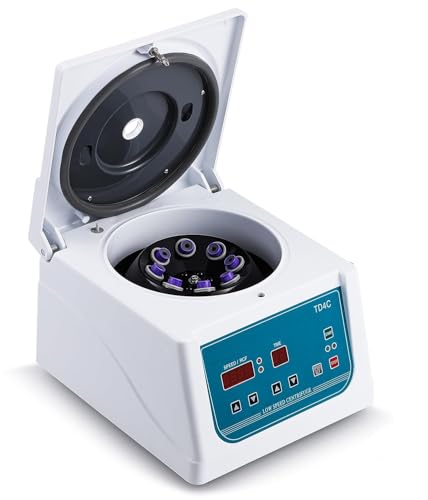
A stable 8-tube workhorse that holds its place on the counter.
Small medical offices are the natural home for this one. Owners note it processes blood efficiently and quietly without sample damage., and the 14.72-pound frame stays put — no drifting across the counter mid-run, which is exactly what you want when the machine is doing its job unattended. The 1880xg force handles routine PRP and serum separation without drama..
The speed range is the flex here: 100 to 4000 rpm, electronically controlled, with an LED display that shows time, speed, and RCF side by side. The 1-99 minute timer is straightforward, and a notable design choice — the timer only starts counting after the rotor reaches your set speed, so a full-speed PRP spin takes the full time you intended.
It is not the loudest or the quietest; the spec says noise stays at or under 65dB. The lid lock doubles as a noise reducer and a safety latch. Tube compatibility covers 5-10ml vacutainers and 10-15ml centrifuge tubes, which is the balance for most blood-draw workflows.
Counter-stable and capable: the leading praise is how steady it stays at speed, a real advantage for unattended runs.
Not a speed demon: at 1880xg it trails the ONiLAB and LC-8S, so heavy PRF protocols may want more force.
Choose it for: a budget-conscious clinic running routine 8-tube batches who values stability and simplicity.
Think twice if: you need maximum g-force for dense fibrin — step up to the LC-8S.
4. LAB FISH LC-400PRO Centrifuge

Wide voltage stability and a balanced spin at a feathery 10.38 pounds.
This is the lightest full-featured unit in the group, and that portability does not cost force — the LC-400PRO reaches 2683xg at 5000rpm, edging past the JIAWANSHUN’s 1920xg and the LC-400’s 1717xg. Owners call the spinning balanced, with good vibration isolation when the rotor is loaded evenly, and the noise stays impressively low for the class..
The wide-voltage technology is the sleeper feature: speed holds steady even if your wall power fluctuates, which matters in older buildings or clinics with heavy equipment on the same circuit. The LCD display makes time and speed adjustments intuitive, with a timing range from 30 seconds to 59 minutes and 50 seconds. It handles 8 x 2ml, 5ml, or 10ml vacuum tubes, plus 4 x 15ml tubes with the included adapters.
Safety is layered: a vibration sensor cuts power if the machine shakes beyond a safe amplitude, and a dual electronic lock keeps the lid sealed until the rotor stops. A special ventilation design reduces internal heat build-up during longer runs. The one-year limited warranty is the same coverage as the pricier LC-8S.
Balanced and light: the best portability-to-force ratio in this list, ideal for mobile phlebotomy or tight bench space.
Smaller rotor: 8 x 10ml max means 15ml runs drop to four tubes at a time.
Reach for it if: you travel with your machine or share bench space — 10.38 pounds is genuinely easy to move.
skip it if: you routinely spin 8 x 15ml in one batch; the LC-8S is your better fit.
5. JIAWANSHUN Lab Benchtop PRP Centrifuge

The repeat-buy favorite with a timer that stretches to 999 minutes.
Best proof of reliability is a second purchase, and that is exactly what this machine inspires — owners mention “Works great, had one for 3 years now and needed another.” It spins quietly and runs straightforwardly., and A 2-minute spin delivers “perfect PRP” per the reviews.. The 1920xg RCF at 4000rpm covers routine hospital, research, and beauty clinic separations..
The standout spec is the timer: up to 999 minutes, which is overkill for PRP but invaluable for long serum or fat-processing protocols where you want to walk away and come back. The 8 x 20ml rotor is the biggest in this comparison by tube volume, comfortably holding standard 15ml tubes and 5-10ml vacutainers via adapters. The LCD shows real-time speed, preset speed, and remaining time all at once.
Balance matters here — the manual is explicit that each tube should not exceed 80% of max capacity and single tubes need a water counterweight opposite. The 14.37-pound weight and compact 10.24 x 11.02 x 8.27-inch footprint fit a busy bench, though 130mm-long ACD gel tubes do not fit in this rotor, so check your tube length first.
What wins loyalists
- 8 x 20ml capacity — the largest tube volume in this lineup
- 999-minute timer for unattended long protocols
- Proven track record across repeat purchases
Before you buy
- Long ACD gel tubes (130mm) will not fit — measure your tubes
- Noise drew a lone complaint, so place it away from patient ears
Best for: labs running extended serum or fat separation where the 999-minute timer removes the need to babysit.
Not for: anyone using long gel tubes — verify your tube length against the rotor before ordering.
6. LC-400 RP PRF Centrifuge Machine
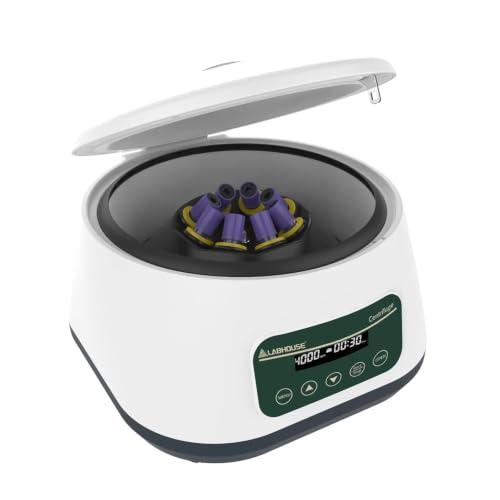
The lightest dedicated PRF spinner, built for small rescue operations.
This LABHOUSE machine weighs just 10.68 pounds, and that lightness is exactly why a cat rescue bought it — owners use it to spin serum from blood for treating eye ulcers in animals. The honest trade-off shows up in time: with only 1717xg of force, customers note it needs 30 to 35 minutes of spinning to produce a good serum yield from 3ml of blood, versus faster clinical machines.
What it lacks in force it makes up in gentle handling and safety. The corrosion-resistant ABS housing and maintenance-free brushless motor keep the 500-4000 rpm range smooth, with noise rated at or below 56dB. The rotor accepts 4 x 15ml tubes or 8 x 2ml, 5ml, and 10ml vacuum tubes via adapters — enough flexibility for small-batch blood work.
The safety suite is generous for the size: a vibration protection function cuts power if the amplitude exceeds a safe range, and the electronic lock releases automatically the moment the rotor stops. The timing range runs from 30 seconds to 59 minutes and 50 seconds, which suits its slower spin profile.
Gentle and portable: ideal for rescue groups, small clinics, or anyone who values a light machine that treats samples kindly.
The patience requirement: at 1717xg it is the slowest separator here — budget extra spin time for serum yield.
Choose this for: low-volume applications like animal rescue work or occasional PRP where light weight matters more than speed.
Look elsewhere if: you need fast serum yield from small samples — the ONiLAB or LC-8S will save you 20-plus minutes.
7. CGOLDENWALL 80-2 Electric Lab Centrifuge

Twelve-tube capacity at 2325xg makes this the high-volume budget king.
The 80-2 wins on raw throughput: 12 x 20ml tubes in a single run, the largest batch count in this comparison, at a maximum centrifugal force of 2325xg. Reviewers point out “Good value for the price” and note it is reasonably quiet and well balanced.. One owner uses it to identify contamination in hydraulic oil, and notes that runs longer than 10 minutes warm the machine up — not hot, just warm, around 20 degrees.
The transparent glass lid is the defining visual feature, reducing noise and air resistance compared to open-top designs. The 0-120 minute timer gives solid control, and the 0-4000 rpm speed regulation is simple — the note says to ramp from low to max rather than jumping straight to 4000rpm. It suits plasma and serum separation, urea manufacturing, and hospital or biochemical lab qualitative analysis.
The trade-offs are real but priced in. The metal construction feels industrial-grade and the slots accept standard hospital blood draw tubes, but a few owners hit turbulence during spins that affected separation, and the noise rose past comfortable on one unit. It is the oldest design in this lineup, and it shows in the rougher edges.
Where it leads
- 12-tube capacity — spin a full rack at once
- 2325xg force beats both the JIAWANSHUN and LC-400
- Glass lid keeps noise down and lets you watch the spin
Honest caveats
- Long runs warm the unit up — plan cooling time between batches
- A couple of owners reported vibration that affected separation
Reach for it if: batch size is your bottleneck — 12 tubes at once is class-leading here at this value tier.
Proceed with caution if: your samples are precious; the occasional vibration issue makes careful balancing essential.
Understanding the Specs
RPM vs. RCF (xg)
RPM (revolutions per minute) measures how fast the rotor spins, but RCF (relative centrifugal force, written as xg) tells you the actual force applied to your sample. The same RPM on different rotor sizes produces different forces, so always compare the maximum xg figure — it is the number that determines how cleanly plasma separates from cells.
Rotor Capacity and Tubes
Fixed-angle rotors hold tubes at a set angle, which creates a shorter path for particles to travel. Match the rotor’s tube sizes to what you actually draw — 2ml and 5ml vacutainers are standard for blood, while 10ml and 15ml tubes suit larger samples. A 12-tube rotor beats a 6-tube one for throughput, but only if your daily workflow runs that many samples.
FAQ
What is the difference between PRP and PRF centrifugation?
How do I know which tube sizes fit a centrifuge rotor?
Why does my centrifuge shake during operation?
How long does a centrifuge take to separate plasma?
Is a brushless motor worth paying extra for?
What does the lid lock safety feature do?
Can I use a centrifuge for non-blood samples?
How noisy are benchtop centrifuges?
Final Thoughts: The Verdict
For the majority of shoppers, the centrifuge machine winner is the ONiLAB because it pairs the best plasma yield with near-silent 56dB operation and the strongest safety suite at 2600xg. If you want maximum separation force for dense PRF clots, grab the LAB FISH LC-8S. And for high-volume batches on a budget, the CGOLDENWALL 80-2 is the one to reach for with its 12-tube capacity.
How We Picked
We do not accept paid placement. Every pick is matched to a real buyer and a real use-case; we do not hands-on test units.
Sources & Methodology
Specifications: manufacturer listings and product documentation. Review insights: verified customer reviews, as of August 2026. Pricing: not shown on this page (it changes often); check the current price via the retailer link.
As an Amazon Associate, Gadgets Feed earns from qualifying purchases. This does not affect which products we feature.