
Our readers keep the lights on and my morning glass full of iced black tea. As an Amazon Associate, I earn from qualifying purchases.
Specs are compiled from manufacturer listings and verified buyer reviews and can change over time — please confirm the key details on the product page before buying.
You want a skillet that sears like cast iron but cleans up like nonstick — and the difference between a great ceramic-coated pan and a frustrating one depends on three things: how smooth the cooking surface is, how heavy the pan really is, and how hot you can safely take it. Get those three right and you get a pan that browns steak beautifully, wipes clean in a minute, and never needs a seasoning ritual. Get them wrong and you get eggs welded to the pan and enamel that chips along the rim. This guide separates the pans that genuinely work from the ones that only look the part.
I’m Min — the founder and writer behind Gadgets Feed. This guide is built by comparing the manufacturers’ published specifications and the patterns across verified customer reviews, so you get each pick’s real strengths and trade-offs instead of marketing spin.
The picks below cover a wide spread of sizes and finishes, so the choice mostly depends on what you actually cook in a week. Whether you are replacing a worn-out nonstick pan or adding your first ceramic-coated pan, this breakdown of the Best Ceramic Cast Iron Skillet shows you exactly which surface, weight, and heat limit fits your stovetop.
Our Picks at a Glance


How To Choose The Best Ceramic Cast Iron Skillet
A ceramic cast iron skillet is a heavy iron pan coated in a fired enamel layer — sometimes called enamel or porcelain enamel — that seals the raw iron beneath a smooth, rust-resistant surface. That coating is the whole point: it gives you cast iron’s heat retention without the oiling and re-seasoning routine, and it lets you cook acidic foods like tomato sauce without a metallic taste. Here is what actually separates a keeper from a regret.
Interior texture: matte black versus smooth colored enamel
Look closely at the inside of the pan before anything else. A matte black interior — like the finish on the Staub skillets — is deliberately textured to grip food and build deep browning. A light, glossy colored interior is usually paired with a smoother casting, which helps food release but can brown a little less aggressively. Neither is better in the abstract; a rough interior browns and sticks more, a smooth one releases more and sears a touch lighter. Cuisinart’s own reviewers ended up on both sides of this, with some calling the surface stick-free and others reporting food adhering to it.
Weight and diameter: the spec that decides if you actually use it
Cast iron is heavy, and enameled cast iron is heavier than most people expect. A 12-inch pan that weighs about as much as a 6-quart Dutch oven is a two-hand lift for a lot of cooks — one buyer of the Tramontina put it plainly: “Very heavy. Partner handles it.” A 10-inch pan around 3.2 pounds, by contrast, moves around the kitchen one-handed. Match the size to your burners and your household: an 8-inch pan is a single-portion and egg pan, a 10-inch covers two to three people, and a 12-inch is the family-size sear. If your wrist or grip is a concern, a second helper handle matters more than an inch of cooking surface.
Oven-safe limits and stovetop compatibility
Every pan here is oven-safe, but the ceiling varies widely — from 450°F up to 900°F — and that ceiling decides whether you can finish a steak under a broiler or bake in the same pan. Induction compatibility is the other check: almost all of these pans work on gas, electric, and ceramic glass, and several explicitly support induction too. If your cooktop is flat induction, read the fine print, because at least one owner found a flat induction surface produced uneven burn rings while a concave coil heated the same pan evenly.
What “no seasoning required” does and does not mean
You will not need to oil and bake these pans the way you would bare cast iron, and you can wash them with soap. But “no seasoning” does not mean “nothing ever sticks.” These pans still need a preheat and a little fat, and several owners found that adding a light, wiped-on seasoned layer over time is what turns a good pan into a genuinely slippery one. A 2013 Cuisinart still in daily use shows the enamel coating itself holds up for a decade when you avoid metal utensils and thermal shock.
Quick Comparison
| Model | Best For | Size / Capacity | Weight | Max Oven Temp | Amazon |
|---|---|---|---|---|---|
| Staub 10-inch Fry Pan★ Best Overall | Smooth daily searing | 10 inches | 3.2 lb | 900 °F | Amazon |
| Crock Pot Artisan 12-InchBudget Champion | Budget family-size sear | 2 quarts | 8.5 lb | 500 °F | Amazon |
| Cuisinart Chef’s Classic 10-InchBest for Glass Cooktops | Glass-cooktop omelettes | 3 quarts | 16 oz | — | Amazon |
| Tramontina Bestow 12-Inch with Lid | Lidded braising and oven-to-table | 3.25 liters | 5.7 kg | 450 °F | Amazon |
| Hisencn 3-Piece Skillet Set | Stocking a kitchen from scratch | 8″, 9.5″, 11″ | — | 550 °F | Amazon |
| Caraway 8″ Cast Iron Skillet | One-person meals and small portions | 8 inches | 2.38 kg | 500 °F | Amazon |
| STAUB Traditional Deep Skillet 8.5-inch | Deep sides for splatter control | 1 liter | 4.5 lb | — | Amazon |
| Le Creuset Classic Skillet 9″ | Enamel that resists dulling and staining | 9 inches | 4.2 lb | 500 °F | Amazon |
In‑Depth Reviews
1. Staub Cast Iron 10-inch Fry Pan – Grenadine, Made in France
Our pick — over 4.5★ from 350+ verified ratings; the strongest balance of quality and price.
The pan that made a raw-cast-iron cook stop fighting sticky eggs for good.
If you have ever scraped a pan and hated it, this is the one to reach for first. The Staub wins on feel as much as on paper: at 3.2 pounds it is far lighter in the hand than the Crock Pot Artisan 12-inch at 8.5 pounds, so it is a one-hand pan for most cooks. And the ceiling is the highest in this group by a wide margin — 900 °F oven-safe against the Crock Pot’s 500 °F. That headroom is why it slides from a stovetop sear straight under a broiler without you worrying about the coating.
What owners rave about is the finish. The interior uses a matte textured enamel engineered to grip food for deep browning, and it does exactly that — the recurring theme is even heat, no hot spots, and a smooth-enough surface that pancakes and fried eggs release cleanly once the pan is properly preheated. The enamel also insulates the food from bare iron entirely: no rust, no metallic taste from acidic dishes, and none of the dietary iron you get from a raw skillet. It needs no seasoning, works on gas, electric, glass, ceramic, induction, and halogen, and has pouring spouts for tipping off fat.
The catch is technique, and it is worth being honest about. Eggs are the one thing that divides owners here — cook them cold in an under-heated pan and they stick, while a proper four-minute low preheat with a little oil gives you the slide-around release. Buyers report: “I love this pot!! I have used this pot to make a large variety of things! Great for everything, but eggs get really sticky.” It is also priced as a premium pan, and the dishwasher label is a bit misleading — the maker says dishwasher safe but hand wash recommended, so plan on hand washing to protect the finish.
Why It Earns The Top Slot
- 900 °F oven-safe — the highest rating in this lineup, so broiler finishes are never a question.
- 10-inch matte enamel interior browns food deeply and pours fat off through built-in spouts.
- No seasoning, no rust, and acidic sauces won’t pick up a metallic taste.
- Works on every surface named: gas, electric, glass, ceramic, induction, and halogen.
Where It Asks Something Back
- Eggs stick if you skip the preheat — give it four minutes on low before adding oil.
- Grit can collect where the handle meets the pan, so clean that seam on purpose.
- Hand wash to keep the finish; the dishwasher-safe claim comes with a “recommended not to” caveat.
Reach for this if: you want one 10-inch pan you can sear in, broil in, and slide onto the table, with heat you can trust across every burner you own.
Look elsewhere if: you expect a true nonstick egg pan with zero preheat — this pan rewards technique, not shortcuts.
2. Crock Pot Artisan 12 Inch Enameled Cast Iron Round Skillet, Scarlet Red
Big-pan cooking for a family, with a glossy red finish that looks twice its tier.
This is the pick for the cook who wants a wide, cheerful searing surface without stretching the budget. It is a 12-inch pan with a 2-quart capacity and a ceramic coating described simply as ceramic — a smooth glossy surface rather than the matte grit that builds browning. That smooth interior is exactly why cleanup tends to be easy and why food mostly slides off once the pan is hot. It runs on gas, electric, ceramic, and induction, and it is oven-safe to 500 °F, so a pan-finished chicken or a quick broil is fair game.
What wins people over is the value — a well-made, even-heating skillet that produces no hot or cold spots and looks far nicer than its place on the shelf suggests. Bacon and steak cook beautifully, and the two-handle design lets you lift a heavy-loaded pan with two hands instead of one wrist. The recurring honest note is weight: at 8.5 pounds it is the heaviest pan here, and that makes it a both-hands tool on a glass cooktop. That smooth surface is beginner-friendly rather than a pro-browning machine — a trade-off worth knowing going in.
The one genuine frustration owners hit is packaging, not the pan itself. Owners mention: “Skillet looks fine for the price, no complaints there. Packaging is horrific, a peice of paper with it in the box… box was destroyed, after all it is heavy cast iron. Because of this, the ceramic was chipped in a few places.” The pan arrives intact most of the time, but check the rim and exterior on unboxing before you cook. Chips, when they happen, land on the outside or handle shoulders from stacking — never on the cooking surface — so a little care with storage keeps this pan looking new.
The Value Read: A 12-inch enameled skillet that heats evenly, resists sticking when hot, and cleans up fast is exactly what most households need — and this one delivers it at the friendliest tier on the list.
The Weight Reality: 8.5 pounds is real; if you have a glass cooktop and won’t lift dead weight, an assistant handle and a two-hand lift are non-negotiable.
Best for: family-size searing on a modest budget — bacon, steaks, and one-pan dinners in a pan that looks the part.
Skip if: your wrist or cooktop makes an 8.5-pound pan a chore, or you need a broiler-grade oven ceiling.
3. Cuisinart Chef’s Classic Enameled Cast Iron 10-Inch Round Fry Pan, Cardinal Red
The flat-bottomed classic that has quietly survived a decade on glass cooktops.
For induction and glass-ceramic owners who need a dead-flat pan bottom, the Cuisinart is a compelling pick. It holds 3 quarts, making it the roomiest single-skillet option in this group, and its porcelain enameled interior is built not to hold flavors or odors from one meal to the next — so your frittata after last night’s fish tastes like frittata. The angled walls and flat base make it a strong omelette pan, and the wide cast iron handles give a full, secure grip. It is also dishwasher safe, which very few enamel pans in this lineup claim.
The popularity here is earned over the long haul. Owners mention appearance and cooking performance as the two things they praise most, and it shows — the rich Cardinal Red finish is the kind of pan you bring straight to the table. It also packs two handles that make a pan full of stewed tomatoes manageable. It sears and holds heat like cast iron should, with the enamel layer keeping the iron away from your food entirely.
The honest trade-off is the nonstick question. The surface is enameled, not coated in nonstick, so it needs oil and it builds its release over time — owners who expected true slick nonstick found eggs a challenge, while those who cooked with a little fat got the slide they wanted. Customers note: “Failed to be non-stick for eggs despite seasoning; not a solution for high non-stick demands.” Weight is genuinely manageable for cast iron, but it is still heavy enough that it must not slide across a glass cooktop — lift it, don’t drag it. The coating is the long game here, not a shortcut.
What Deserves Your Attention
- 3-quart capacity — the most room of any single skillet here, real family-sized cooking.
- Flat bottom sits dead-still on glass and induction cooktops.
- Enameled interior won’t keep flavors or odors from one dish to the next.
- Dishwasher safe, a rare bonus on an enameled cast iron pan.
Know Before You Buy
- Not a nonstick pan — it needs oil and patience to release eggs cleanly.
- Lift, don’t slide, to avoid scratching a glass cooktop.
- Heavy enough that a weak wrist or hand issue wants the helper handle engaged every time.
Your pan if: you cook on glass or induction, want 3 quarts of capacity, and are happy to use a little oil for the payoff of an enameled surface that lasts.
Not your pan if: you need true nonstick egg release straight from the start without any seasoning build-up.
4. Tramontina Bestow Enameled Cast Iron 12-Inch Skillet with Lid, Blue
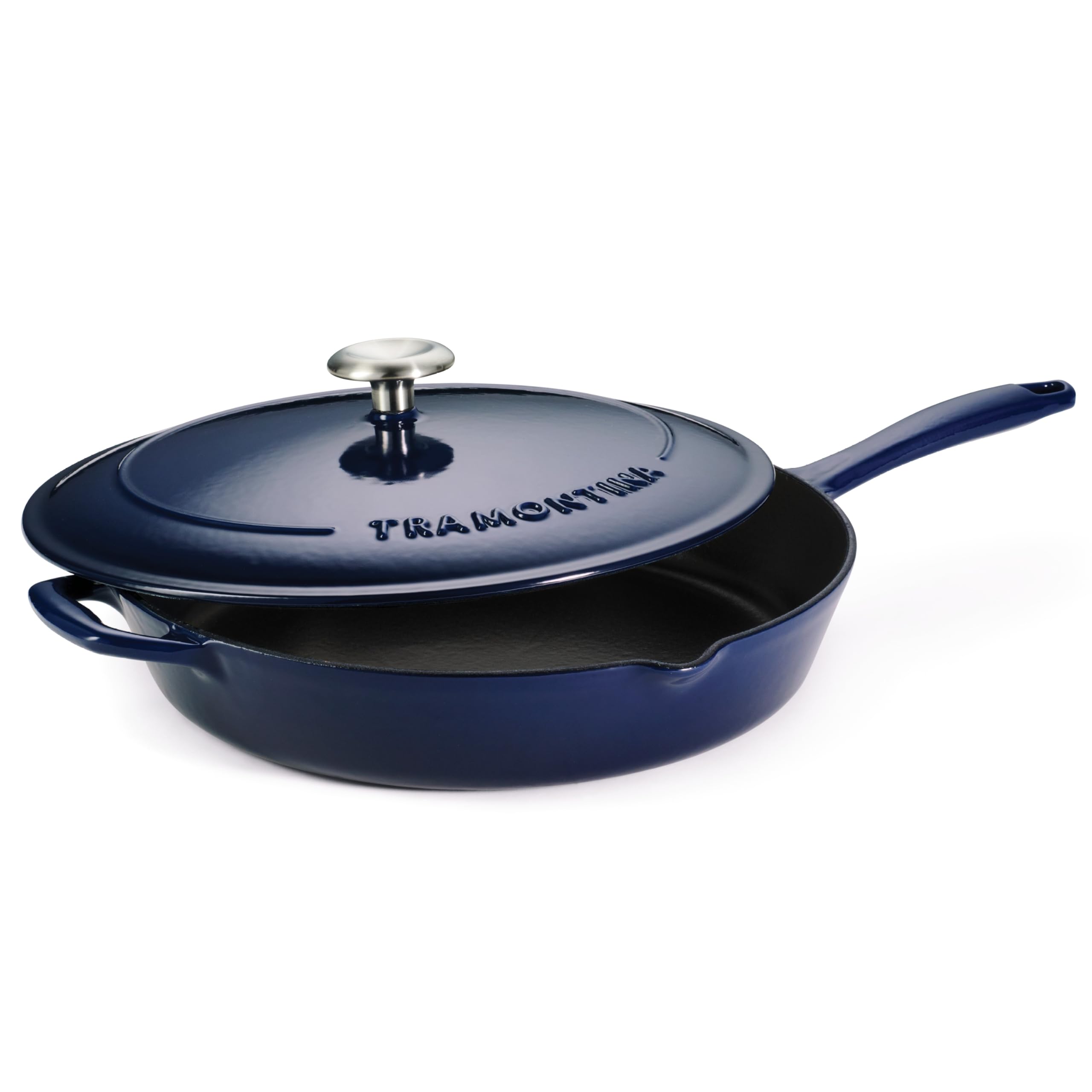
A lidded 12-inch braiser that traps steam so your braises come out juicy, not dry.
Most skillets on this list are pure searing tools. This one is the only pick with a lid, and it uses that lid smartly — the cast iron cover has self-basting condensation ridges that redirect moisture back onto the food, so a covered braise stays tender. It holds 3.25 liters, the largest capacity here, built on an HT150 cast iron core for even cooking. Its interior is a matte-black porcelain enamel, which is the darker, harder-working finish that handles acidic foods like tomato sauce without any metallic reaction. Oven-safe to 450 °F and compatible with gas, electric, ceramic glass, and induction, it’s a legitimately oven-to-table pan.
The appearance is what buyers point to most, and it earns it: the blue porcelain-enamel exterior is sprayed for durability and looks genuinely high-end on the table, especially with the stainless steel lid knob on top. Seared steaks and grilled cheese come out beautifully, and the black interior wipes down easily after acidic cooking. There is a large helper handle to balance the pan when you are moving it from oven to counter — a real plus on a 12-inch pan with a lid on it.
The catch is weight and, honestly, the nonstick surface. It is a heavy pan — owners compared it to a 6-quart iron Dutch oven, and one described it as a two-hand lift. And the nonstick performance is the weakest link: the smooth interior needs fat and patience, and a portion of owners found food clinging to it, especially over high heat. It’s not a defect so much as a fit issue — this pan rewards low-to-medium heat and a good preheat. It’s also note the bottom is 10 inches while the top rims out larger, so it does not give you a full 12 inches of cooking surface at the base. Treat the lid as the star, and this becomes a very useful braising and baking skillet.
The Case For It: If you want one pan that sears, braises, and bakes with the lid doing the moisture work, this delivers the most cooking range of anything here — and the blue finish is genuinely table-worthy.
The Recurring Gripes: Heavy enough that it’s a two-hand maneuver, and the nonstick surface is the pan’s soft spot — cook it slow and low or the interior gets grippy.
Pick this one for: one-pan braises and oven-to-table cooking where the self-basting lid earns its keep and the blue enamel looks the part.
Leave it if: you want a light, low-maintenance daily pan or expect a slick nonstick surface without preheating.
5. Hisencn Nonstick Enameled Cast Iron Cookware, 3-Enameled Cast Iron Skillet
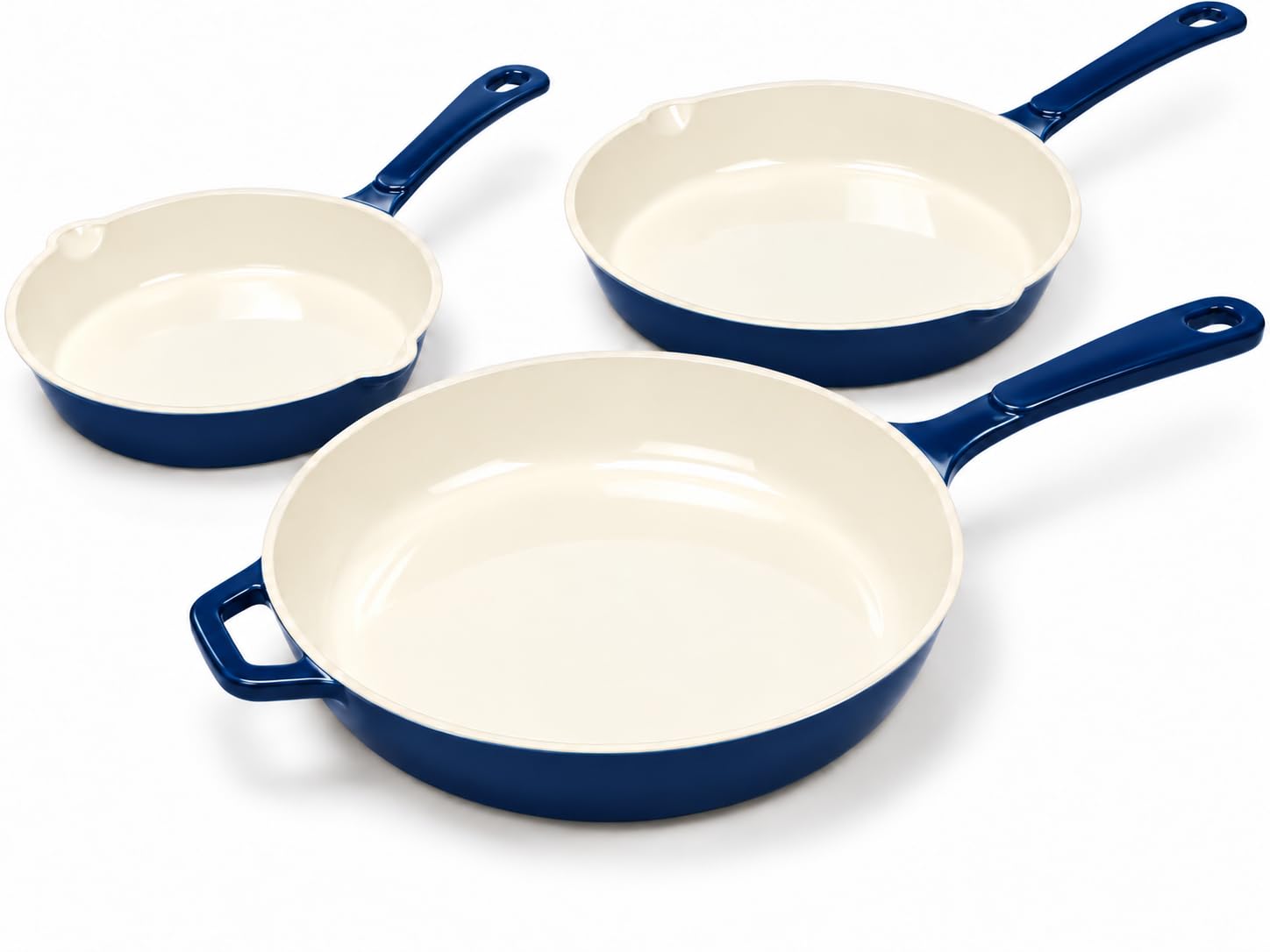
Three pans in navy enamel, sized small-to-large, so you can replace a whole drawer of nonstick at once.
If you are starting a kitchen or replacing worn nonstick cookware wholesale, this set is the smart way to do it. You get an 8-inch pan for eggs and small portions, a 9.5-inch for everyday frying and searing, and an 11-inch deep skillet for larger meals — all in a sturdy cast iron core with a multi-layer enamel finish. The coating is built to resist rust, stains, and wear, and the surface needs no traditional seasoning layer. It is also one of the more carefully labeled sets here: made without PFOA, PTFE, PFAS, lead, or cadmium, with dual pour spouts and hanging holes on each pan. Oven-safe to 550 °F and compatible with gas, electric, ceramic, and induction.
The reasons owners stick with this set show up clearly over time — quality first, then how easy it is to keep clean. Heat spreads evenly across each pan, the smooth enamel interior wipes down after most meals with just warm water and a soft sponge, and the cooling handles mean no scrambling for a towel mid-sear. The pour spouts actually work, which is not always true at this tier. For anyone coming off scratched nonstick pans, the jump in durability and even cooking is the real draw, and the three sizes mean you are rarely reaching for a pan that doesn’t fit the job.
Where it can go sideways is consistency. Some owners found the nonstick release less reliable than hoped — a portion reported food clinging regardless of oil, and a few felt the cooking performance didn’t match the promise. That’s the honest limitation on a multi-piece set: individual pans can vary. On the plus side, the manufacturer inspects each set before shipping and offers support if one arrives damaged. It is a heavier set overall, so if you want the lightest pan in the kitchen, a single premium skillet will feel friendlier. But as a value-packed full-kitchen set, it covers more ground than any single pan here.
Where This Set Shines
- Three pans — 8″, 9.5″, and 11″ — cover eggs, every day, and family-size meals in one purchase.
- Filter-free labeling: no PFOA, PTFE, PFAS, lead, or cadmium.
- Oven-safe to 550 °F and ready for gas, electric, ceramic, and induction cooktops.
- Dual pour spouts and cooling handles make everyday cooking easier, not fussier.
The Gotchas To Weigh
- Nonstick release can vary from pan to pan; overheat it and food will grip.
- The whole set runs heavy, so it’s not the light option if weight is a concern.
- Fine quality on a set can be inconsistent compared to a single carefully-made skillet.
Buy it for: stocking a kitchen from scratch or replacing every scratchy nonstick pan in one move, without giving up oven-safe cast iron cooking.
Think twice if: you only ever use one size, or you want one premium pan instead of three very good ones.
6. Caraway 8″ Cast Iron Skillet Pan
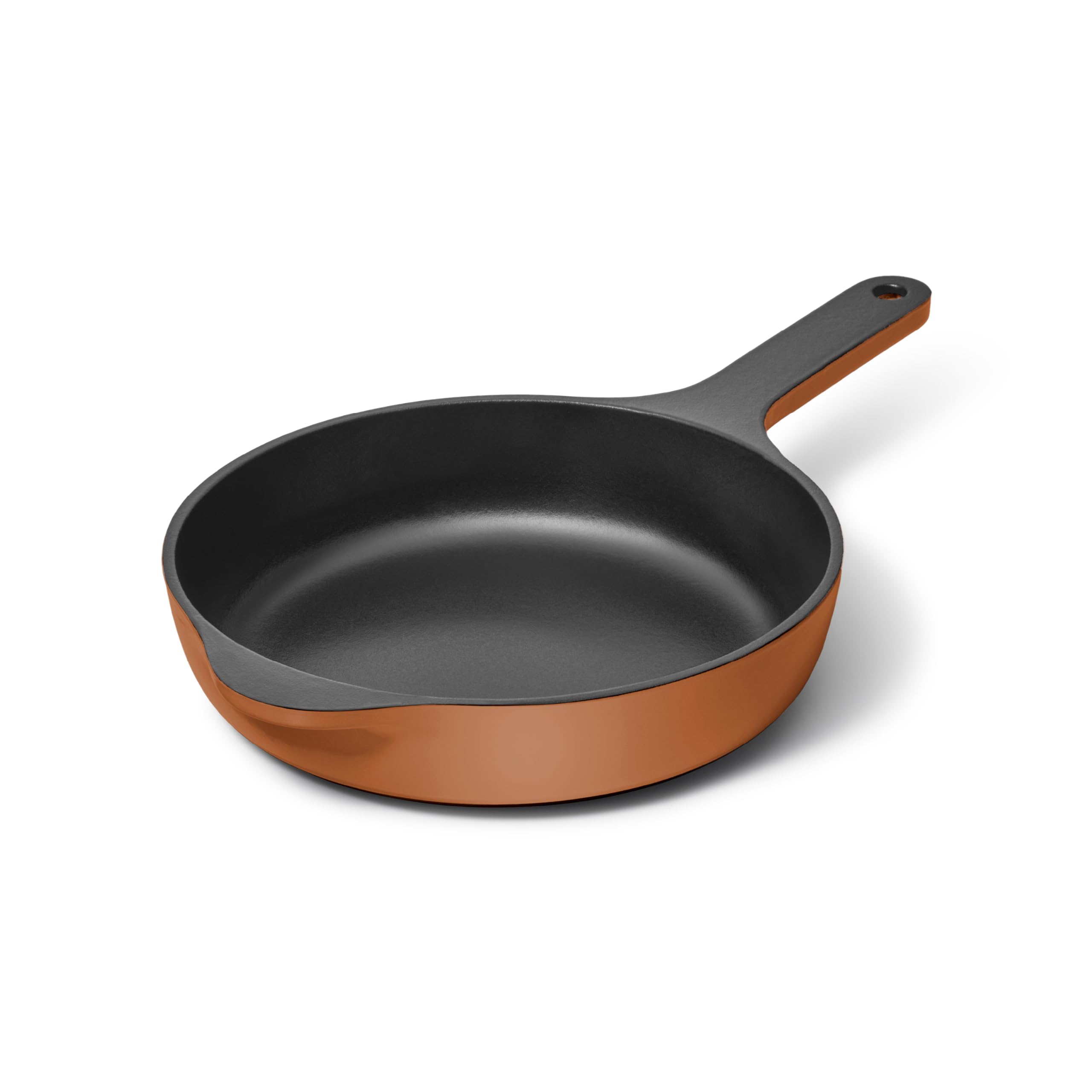
A small, clean-eating 8-inch pan for single servings, eggs, and quick cornbread.
Single cooks and small households get the most out of this one. It’s an 8-inch enameled skillet built for one-person portions — a fried egg, a quick steak, a skillet cornbread, a side of sautéed vegetables. The 3-layer enamel coating gives it strong heat retention and an even cook surface that needs no seasoning, and the naturally nonstick surface is designed to wipe clean with soap, water, and a non-abrasive sponge. It works on gas, electric, and induction, is oven-safe to 500 °F, and is made without PTFE, PFOA, or PFAS. It is also made from 50% recycled materials and backed by a lifetime warranty.
The size is the feature, and the people who use it right love it. It sears meat cleanly on the cooktop, goes straight into the oven, and returns to the table as a serving pan for one. Owners call the 3-layer enameled interior smoother and easier to care for than bare cast iron, and at 2.38 kg (about 5.2 pounds) it is one of the lightest pans in this lineup. It sits nicely on a glass cooktop without leaving marks, and a small, low-flame preheat is all it takes to get hot. If you eat mostly for one and hate dragging out a big pan, this fits the brief exactly.
Where it can disappoint is the nonstick promise against the premium tier. The value-for-money and nonstick aspects both drew criticism — some owners felt it wasn’t worth the price for the release they got, and a few had food sticking even with oil or butter. It is also hand-wash only despite the easy-clean surface, and being a small pan, it can’t cook a family meal. The thing to understand is that this is a well-made, nicely finished small skillet for the right buyer — someone cooking one or two portions who wants enamel that behaves — not a nonstick replacement for a big family pan.
The Size Story: 8 inches is the point — perfect for a fried egg or a single steak, too small for a family dinner.
The Honest Limit: Premium-tier pricing with occasional sticking reported, and it’s hand-wash only — buy it for the manageable size and quality, not because it’s a nonstick pan.
Ideal for: one- or two-person cooking where you want a small, handsome, oven-safe pan that sears meat and wipes clean without a seasoning routine.
Not for you if: you cook for a crowd, want a true nonstick surface, or expect the lowest-tier pricing on an 8-inch pan.
7. STAUB Cast Iron 8.5-inch Traditional Deep Skillet – Cherry

A deep-sided, single-portion pan that keeps splatter in and pours fat cleanly out.
For one or two servings and a lot of sauté work, this deep skillet earns its keep. At 8.5 inches with a 1-liter capacity and raised sides, it’s built to cook onions, sear meat, and finish saganaki without splattering all over the stovetop — that raised rim is the exact feature that keeps hot fat contained. The interior is a black matte enamel that browns exceptionally well and needs no seasoning. It sits on gas, electric, and induction, has pouring spouts for tipping off fat, and pairs a stainless steel handle with a textured enamel surface that cleans easily by hand.
The pan is heavy and durable because it’s genuine enameled cast iron, and the people who own it tend to keep it. It has become a small-batch mainstay in homes cooking for one or two — closer attention to the fit than with a big 12-inch, but incredibly easy to use once you learn to heat it slowly. Owners who used this deep skillet twice daily for years report the matte black enamel still looks new inside and out, with no sticking or cleaning issues. It browns onions deeply, sears meat well, and holds heat so steadily that butter browns without scorching when you preheat as instructed.
Two things to know before you commit. First, it’s small and priced at the premium end, and with only 1 liter of capacity it genuinely cannot cook a bigger meal — one buyer called it “Small & expensive but she loves it!” Second, there are isolated durability reports: a handful of owners noted a chip developing on the bottom despite careful handling. That’s rare, but it’s the honest edge on any enameled pan. If you want a deep, beautifully-finished single-portion skillet, this is a carefully-made pick — just size it to your household honestly.
Why Owners Keep It
- Deep, raised sides keep splatter inside the pan during hot searing and sautéing.
- Matte black enamel interior browns food exceptionally well with no seasoning.
- Stainless steel handle and pouring spouts make it easy to move and to tip off fat.
- Heavy, durable cast iron that reviewers point out still looking new after years of daily use.
Temper Your Expectations
- At 1 liter it’s genuinely small — best for one or two servings, not a family pan.
- Premium-tier pricing for a compact skillet.
- An occasional owner reports a bottom chip despite careful handling.
Choose it for: small-batch cooking for one or two where deep sides and clean pours matter more than cooking surface.
Pass if: you need to feed a family or want maximum surface area for the premium you’re spending.
8. Le Creuset Enameled Cast Iron Classic Skillet, 9″, Cerise

The 9-inch enamel classic built to resist dulling, staining, chipping, and cracking.
Heirloom buyers and anyone replacing a stack of dead nonstick pans should look here. This 9-inch skillet is enameled cast iron with a black satin interior enamel formulated for higher surface temperatures, and its exterior enamel is specifically built to resist dulling, staining, chipping, and cracking — the four things that usually kill a pan’s looks first. It needs no seasoning, is dishwasher safe, compatible with cooktops, and oven-safe to 500 °F. It also carries a lifetime warranty, the longest coverage of any pan in this lineup. It comes in Cerise, and it’s the classic look that made this brand an institution in home kitchens.
The heat behavior is what people fall for. Owners say food tastes better than it did in their old pans, and the black satin interior sears, sautés, and finishes in the oven the way cast iron should. It is friendlier for beginners than bare iron: a low, oiled preheat of about three minutes and almost nothing sticks. And the weight is called out as a plus rather than a complaint: owners note it’s light enough to move around easily for a cast iron pan, which matches the maker’s claim of the lightest weight cast iron by quart. Owners whose partners scorched previous nonstick pans on high heat report this enameled skillet survives the same abuse without blistering or peeling.
The nonstick expectation is where it gets honest. Some owners found it nonstick-better and some found food sticking — a split that usually traces back to preheat technique. Shoppers say: “This skillet is great. Nothing sticks to it, but it is very heavy.” The counterpoint in reviews goes the other direction entirely, with one long-time cook reporting eggs sticking badly right from the start. The truth lands in the middle, like most enamel skillets: preheat low with a little fat and it releases; cold-drop an egg into a cold pan and it clings. It’s a lifetime pan for people who cook with intention, not a throw-in-the-pan-anytime nonstick.
Worth it for: anyone who wants a pan they’ll still be cooking on in a decade — a lifetime warranty, a finish built to resist chipping and staining, and that classic enamel-cast-iron feel.
Look elsewhere if: you want true nonstick egg performance from the start or you cook in a hurry and skip the preheat.
Understanding the Specs
Capacity and Diameter
These two specs work together, and neither tells the whole story on its own. Capacity is how much food the pan holds — 1 liter for a single-portion deep skillet, 3.25 liters for a full braiser — while diameter is the width of the cooking surface. A wide pan with shallow walls sears a big steak; a narrower pan with deep sides holds onions and sauce without spilling. Match the pair to your household size, not the number on the box.
Oven-Safe Temperature
The oven ceiling is the highest temperature at which the pan is safe to use in the oven, and it decides what you can finish in it. A pan rated to 900 °F easily handles a broiler finish, while a 450 °F pan is better suited to lower oven work. Always preheat on the stovetop first and reach for pot holders when you move an enameled cast iron pan — the whole body gets hot, not just the base.
Coating and Texture
Ceramic and enamel coatings are the same family: a fired glass-like layer that seals the raw iron under a rust-resistant skin. A darker matte interior is deliberately textured to build deep browning, while a smoother glossy interior is designed for easier food release and quick cleanup. Remember that the word “nonstick” on an enameled pan is relative — even a well-made one usually wants a little oil and a proper preheat.
Stovetop Compatibility
The magnet test tells you a lot: if a magnet sticks to the base, the pan can usually work on induction. Most ceramic cast iron skillets here support gas, electric coil, ceramic glass, and induction, but a few list only standard cooktops, so read the fine print if induction is your main stovetop. On smooth surfaces, always lift the pan rather than sliding it, to avoid scratching the glass.
FAQ
What is a ceramic cast iron skillet, and how is it different from a regular cast iron pan?
Do ceramic cast iron skillets need to be seasoned?
Can I use a metal spatula on an enameled cast iron skillet?
Will an enameled cast iron skillet work on an induction cooktop?
Why does food stick to my new ceramic coated skillet?
Are these skillets dishwasher safe?
How hot can you safely cook in an enameled cast iron skillet?
How much heavier is an enameled cast iron skillet than a nonstick pan?
Is a smaller skillet better than a larger one for everyday cooking?
Can I use a ceramic cast iron skillet for acidic foods like tomato sauce?
What size skillet should I buy if I mostly cook for one or two people?
Final Thoughts: The Verdict
For most kitchens, the ceramic cast iron skillet worth starting with is the Staub Cast Iron 10-inch Fry Pan — it pairs a smooth matte enamel interior that browns deeply with the highest oven ceiling here at 900 °F, all in a 3.2-pound pan that stays manageable on the wrist. If your stove is glass and you want maximum cooking surface for the money, reach for the Cuisinart Chef’s Classic 10-Inch with its flat bottom and 3-quart capacity. And if you are outfitting a whole kitchen in one shot, the Hisencn 3-Piece Set covers eggs, everyday frying, and family-size meals without buying three pans separately. Whichever you choose, the pattern across thousands of owner experiences is the same: preheat slowly, use a little fat, and an enameled cast iron skillet rewards you for years — that is where the real value in this category lives.
How We Picked
We do not accept paid placement. Every pick is matched to a real buyer and a real use-case; we do not hands-on test units.
Sources & Methodology
Specifications: manufacturer listings and product documentation. Review insights: verified customer reviews, as of September 2026. Pricing: not shown on this page (it changes often); check the current price via the retailer link.
As an Amazon Associate, Gadgets Feed earns from qualifying purchases. This does not affect which products we feature.