
Our readers keep the lights on and my morning glass full of iced black tea. As an Amazon Associate, I earn from qualifying purchases.
Specs are compiled from manufacturer listings and verified buyer reviews and can change over time — please confirm the key details on the product page before buying.
A dull knife is the most dangerous tool in your kitchen — it slips, it crushes tomatoes, and it makes every prep session feel like a chore. A ceramic sharpener fixes that by using a surface harder than steel to realign the blade’s edge, bringing back that fresh-from-the-store feel in a matter of swipes. This guide breaks down the best ceramic knife sharpeners into whetstones, honing rods, and electric systems, so you can pick the one that fits how you actually cook.
I’m Min — the founder and writer behind Gadgets Feed. This guide is built by comparing the manufacturers’ published specifications and the patterns across verified customer reviews, so you get each pick’s real strengths and trade-offs instead of marketing spin.
Whether you own ultra-hard Japanese blades or everyday stainless steel, the best ceramic knife sharpener for you depends on your skill level and how much metal you want to remove. This guide pairs each tool type with the right owner.
Our Picks at a Glance


How To Choose The Best Ceramic Knife Sharpener
Ceramic sharpeners vary widely. Some handle quick daily touch-ups, while others grind a fresh edge onto a badly damaged blade. Your choice depends on three factors: your knife’s hardness, how often you sharpen, and how much effort you want to invest.
Know Your Blade’s Hardness
Japanese knives like Global or Shun are forged from very hard steel that holds an edge for a long time. A ceramic rod is ideal here because ceramic is harder than the steel, so it can realign that edge without stripping away much metal. Softer European stainless knives also work well, but they need more passes to get the same result.
Match the Grit to the Job
Lower grit numbers (around 1000) remove more material — they are for sharpening a dull or nicked edge. Higher numbers (3000 and up) polish and refine an already decent edge. A dual-grit whetstone gives you both jobs in one tool; a single fine-grit rod is strictly for maintenance between full sharpenings.
Decide on Your Skill Level
Using a bare whetstone demands a steady hand and a consistent angle. If that sounds intimidating, guided rods with built-in angle guides remove the guesswork—you set the rod, swipe the blade, and the angle stays locked. Electric sharpeners are the fastest and most simple to use, but they remove more metal, so they suit knives you don’t mind wearing down.
Quick Comparison
| Model | Best For | Type | Grit | Weight | Amazon |
|---|---|---|---|---|---|
| Suehiro Cerax 1010★ Best Overall | Purist sharpening | Whetstone | 1000 | 0.06 kg | Amazon |
| Sharpeak 3000-Grit RodPremium Pick | Japanese steel honing | Honing rod | 3000 | 229 g | Amazon |
| Shenzhen Knives RodBest Value | Full-length coverage | Honing rod | 1000 | 350 g | Amazon |
| SHARPAL 118H | Guided angle beginners | Honing rod | 3000 | 225 g | Amazon |
| Work Sharp Ceramic Rod | BBQ and countertop use | Honing rod | Fine | 16 oz | Amazon |
| Work Sharp Benchtop | Practice whetstone | Whetstone | 1000 / 6000 | 2.3 lbs | Amazon |
| Smith’s CCD4 | Camping and travel | 3-in-1 system | 750 diamond | 0.25 kg | Amazon |
| Global Stage 2 | Global knife owners | 2-stage pull-through | 3-stage wheels | 180 g | Amazon |
| VIDOME Electric 3-Stage | No-skill sharpening | Electric | Diamond abrasives | 2.7 lbs | Amazon |
In-Depth Reviews
1. Suehiro Cerax 1010 Grit #1000 Sharpening Stone
Our pick — over 4.5★ from 600+ verified ratings; the strongest balance of quality and price.
The purist’s pick — a water stone that turns steel into a razor
If you want a knife that can shave paper, this soak-in-water whetstone is the foundation of that outcome. The 1000-grit surface is the “sweet middle” — aggressive enough to grind down a dull edge, yet fine enough that most kitchen knives need nothing else. The larger 8.07-inch platform means you can run long chef’s knives through full, consistent strokes without the blade falling off the edge of the stone.
This is an immersion stone, so you soak it for 10-15 minutes before use—slower to prep than splash-and-go options, but the cutting speed and blade feedback are worth the wait for most owners. The stone is durable; some report it has held up for several months of steady use without wearing out. What wins people over is the feel: the surface is hard and cuts fast, outperforming many cheaper hardware-store alternatives.
One honest note: at 1000 grit, this is a sharpening stone, not a finishing stone. If you want an absolutely mirror-polished edge, you would follow this with a 3000-4000 grit finish, though most home cooks find that unnecessary. The stone’s hard surface cuts fast, giving you audible and tactile feedback that confirms you’re removing metal efficiently.
What the stone does well
- Fast cutting 1000-grit surface builds a burr in about 5-10 minutes even for beginners
- Large platform gives long knives a stable, consistent stroke path
- Produces edges that feel far finer than the 1000 rating suggests
- Hard, durable ceramic composition holds its flat surface through months of use
Where it asks something of you
- Requires a 10-15 minute water soak before every session
- Takes practice to hold a steady angle freehand — there are no guides
- Raising a slurry (the muddy cutting paste) without a separate Nagura stone takes effort
Reach for this if: you enjoy the ritual of sharpening and want the finest possible edge on your knives.
Look elsewhere if: you want something quick and simple to use—this rewards patience and technique.
2. Sharpeak 3000-Grit Ceramic Sharpening Rod
The daily-maintenance rod that keeps Japanese knives razor-ready
This rod is the ideal tool for keeping a good knife in constant rotation. Its fine 3000-grit ceramic surface is for honing, not heavy grinding — it polishes and refines the blade edge to a razor finish, and it excels on hardened Japanese steels that are harder than 61 HRC. The built-in 20-degree angle guides take the guesswork out of your stroke, giving you a consistent edge every pass.
At 12 inches of actual rod (17.5 inches total including the handle), it covers everything from small paring knives to large butchering blades in a single sweep. Buyers report it is 2.5 inches longer than comparable rods, which makes it more comfortable to use and means it still fits easily in a drawer. The hexagonal hand guard does double duty — it keeps your fingers safe and stops the rod from rolling off the counter. The rubber tip on the end plants it firmly on a cutting board for stable vertical honing.
The trade-off is that 3000 grit is for maintenance, not restoration. A badly dulled knife needs a coarser surface first. But the crowd favorite here is that a 5-10 minute monthly pass keeps edges in top shape between water-stone sessions, and the ceramic surface is less aggressive than a diamond rod while remaining harder than steel.
Why owners keep it in reach
- 20-degree angle guides make it nearly impossible to mess up the angle
- 3000-grit surface polishes to a razor finish on hard Japanese steel
- 12-inch rod length handles long chef’s knives in one heel-to-tip stroke
- Hexagonal guard prevents rolling and adds a safety barrier
Know before you buy
- Designed for honing not-very-dull knives — revive a dead edge elsewhere first
- Ceramic is brittle, so a hard drop could chip the rod
The standout: 3000-grit finesse plus simple to use angle guides—the best honing rod for premium steel.
The catch: it maintains a sharp edge, it does not create one from scratch.
3. Shenzhen Knives Ceramic Honing Rod – 12 Inch, HRC 68
A 12-inch rod with the hardness to tackle hard steels
What makes this rod special is that its ceramic alumina surface ranks just below diamond on the hardness scale. That HRC 68 rating means it is harder than the steel of most kitchen knives and even handles carbon steel blades that would shrug off a traditional steel honer. The 1000-grit surface gently realigns your blade edge with each stroke, restoring sharpness without stripping excessive metal so your knives stay sharp longer between full sharpening sessions.
The 12-inch length sweeps the full blade in one heel-to-tip pass, and the zinc-alloy-reinforced rectangular guard keeps your hand safely away from the rod — a confidence boost for first-time honers. The ergonomic 5-inch nylon handle provides a secure grip through the stroke. Owners mention this restores old santoku knives with just 5-10 gentle swipes per side, and weekly use is plenty for most home cooks. The 1000 grit doubles as both honing and light sharpening, matching what a 3000 JIS grit would do on the Japanese scale.
The honest trade-off is in the handle — the silver section is actually plastic, not metal, so the build feels less premium than the price implies. But the performance punches far above it, with the full-length coverage beating out rods that cost significantly more.
What you are paying for
- HRC 68 alumina is harder than steel and rust-resistant for lasting performance
- 1000-grit surface both hones and lightly sharpens — dual action in one rod
- 12-inch length covers the full blade of butcher, chef, and carving knives
- Non-rolling guard builds confidence for beginners
Fair warning
- Handle hardware is plastic despite the metal look
- 12 inches can be too long to store in some knife blocks
- Not for serrated blades — straight edges only
Grab it when: you want a full-length rod that sharpens and hones hard steels without spending premium money.
Pass if: you need a pocket-friendly or knife-block-sized rod.
4. SHARPAL 118H Ceramic Honing Rod

Beginner-proof angle guides on a rod that finishes like a strop
If the idea of holding a freehand angle makes you nervous, this rod is the answer — the built-in 20-degree angle guides do the thinking for you. The 3000-grit extra-fine ceramic surface is harder than most knife steel, so it polishes and refines the blade edge to a razor-sharp finish that works especially well as a final touch-up after regular sharpening.
The hexagonal hand guard prevents the rod from rolling on the counter, and the removable rubber cap protects your countertop while planting the rod firmly for vertical use. Owners who have never touched a honing rod before report it is startlingly easy — the handle angle is set, you hold that angle down the blade, and the edge comes back quickly. The light weight (225 g) makes it easy to maneuver, and the non-toxic, odorless, rust-free ceramic means it will never degrade on you.
The one mixed opinion among owners is cleaning — some find the ceramic surface easy to wipe down, while others wish it released metal residue more easily. But for the price, the guided angle system alone has converted plenty of steel-rod holdouts.
What the guides buy you
- 20-degree angle guides deliver consistent, accurate sharpening for total beginners
- 3000-grit extra-fine surface puts a shaving-sharp finish on final touch-ups
- Hexagonal guard adds safety and stops the rod from rolling
- Rubber end cap keeps the rod stable and scratch-free on the counter
Before you buy
- Cleaning is a point of debate — plan to wipe off metal residue after each use
- Honing does not fix a badly dulled or nicked edge
Perfect for: the cook who wants the convenience of a rod with the precision of a fixed angle.
Not for: knife collectors who prefer freehand control.
5. Work Sharp Kitchen Ceramic Honing Rod

The hone that lives on your BBQ grill, ready for a quick swipe
This ceramic rod’s coolest trick is the lanyard hole in the handle — hang it on your BBQ grill and it is always at arm’s reach for a quick fresh-up between cooks. The fine ceramic surface removes a small amount of material to refine the cutting edge back to razor sharpness, and the built-in angle guides ensure you get a consistent, repeatable angle on every stroke.
The rubber tip lets you brace it safely on a cutting board or workbench, making the honing motion steady and controlled. Owners describe it as feeling solid and hefty but not too heavy, and the guard makes the whole process a breeze. It is favored over steel rods by those who own both — it takes just a few swipes to freshen an edge, and the results are noticeably sharper. At 16 ounces, it has a reassuring heft that suggests durability.
The recurring request from owners is for a second set of angle guides for Japanese knives, and the 15.5-inch total length means it does not fit every knife block slot. But the hanging loop plus the BBQ-ready design makes it the easiest rod to keep within reach, and one buyer was so satisfied they bought several as gifts.
Reasons it earns a drawer spot
- Lanyard hole lets you hang it on the BBQ for instant access
- Built-in angle guides deliver repeatable, accurate honing
- Rubber tip braces safely on a cutting board or workbench
- Solid, hefty feel suggests it will last for years
Small caveats
- Only one angle set — Japanese knife owners wish for a finer option
- Too long to fit in many knife block slots, so plan to hang it
Best for: grill masters and anyone who wants a hone permanently parked where the knives are used.
Think twice if: you want a rod that fits neatly inside a knife block.
6. Work Sharp Benchtop Whetstone Knife Sharpener

The whetstone that brings a safety net to freehand sharpening
This is the whetstone for people who want the finest edge but are terrified of ruining a knife trying to get it. The built-in sharpening guides can be set to 15° or 17° — or removed entirely for freehand practice — giving you a training wheel while you learn the muscle memory. The premium 1000 / 6000 combo stone covers both jobs: the 1000-grit side sharpens, the 6000-grit side hones, and together they create a working edge that owners compare favorably to brand-new knives.
What makes this a genuinely clever system is the water control base. It gives you a stable sharpening surface, keeps the mess contained, and stores the stone when you are done. The non-slip mat keeps everything from sliding mid-stroke. Owners consistently report it works on carbon and stainless steel, handles 10-inch chef’s knives with ease, and produces “working-at-better-than-new” quality results. The simple water-soak method means no oil or special fluid needed.
The honest gripe from owners is that the angle guides feel like they should have been included in the base kit — they are magnetic and removable, which is great, but the instructions lean on them heavily. Some wish the stone bed was bigger for longer blades. Still, for a brand-new whetstone user, this is the smoothest on-ramp available.
What makes it beginner-friendly
- Magnetic 15°/17° angle guides remove the hardest part of freehand sharpening
- Dual-grit 1000/6000 stone sharpens and hones in one tool
- Water control base keeps the area clean and provides a stable surface
- Non-slip mat keeps the stone from sliding mid-stroke
Keep in mind
- Guides were expected to be included with the base kit by some owners
- Freehand still takes practice — the guides are a crutch, not a cure
Choose this if: you want a real whetstone’s results without the steep learning curve.
skip it if: you already sharpen freehand confidently and want a bare stone.
7. Smith’s CCD4 3-in-1 Sharpening System

The camping companion that packs three sharpeners into one base
This sharpener belongs in your camping bag, hunting pack, or workshop drawer. The 3-in-1 system offers three ways to sharpen: a pair of teardrop ceramic rods (set at a preset 20-degree angle), a fine 750-grit diamond stone for quick edge restoration, and a carbide sharpener for rescuing truly damaged blades. That variety covers every knife you own, from folding pocket knives to butcher blades.
Portability is the headline feature—when you finish, the rods flip down into the base for compact storage, and the whole unit measures just 8.5 inches long. The protective lid doubles as a hand guard while you work the rods, adding safety without extra components. Owners who have had this unit for over 15 years still rate it as a top pick, noting the old one kept working even after a plastic guard cracked and rubber feet unglued—proof of the core design’s longevity.
The trade-off is that the rods are short, which makes large chef’s knives (over 6 inches) awkward to sharpen — this is a tool- and camp-knife sharpener first, kitchen rod second. The carbide sharpener also removes a lot of metal, so it should be used sparingly just to set the edge angle. Check the unit on arrival, as some owners have received slightly chipped or bent rods.
The three tools in one
- Teardrop ceramic rods preset at a nice 20-degree angle for straight or serrated blades
- Fine 750-grit diamond stone restores quickly and works on hard steels
- Carbide sharpener rescues badly damaged edges in a few passes
- Rods store in the base for compact, portable storage
Real-world limits
- Short rods make cleaning a full 10-inch chef’s knife difficult
- Quality control varies — inspect ceramic rods for chips on arrival
- Carbide is aggressive; use it only to set the angle, not for normal touch-ups
Made for: hikers, hunters, and camp cooks who need one compact tool for every blade they own.
Not your pick if: you primarily sharpen large kitchen chef’s knives.
8. Global Stage 2 Sharpener
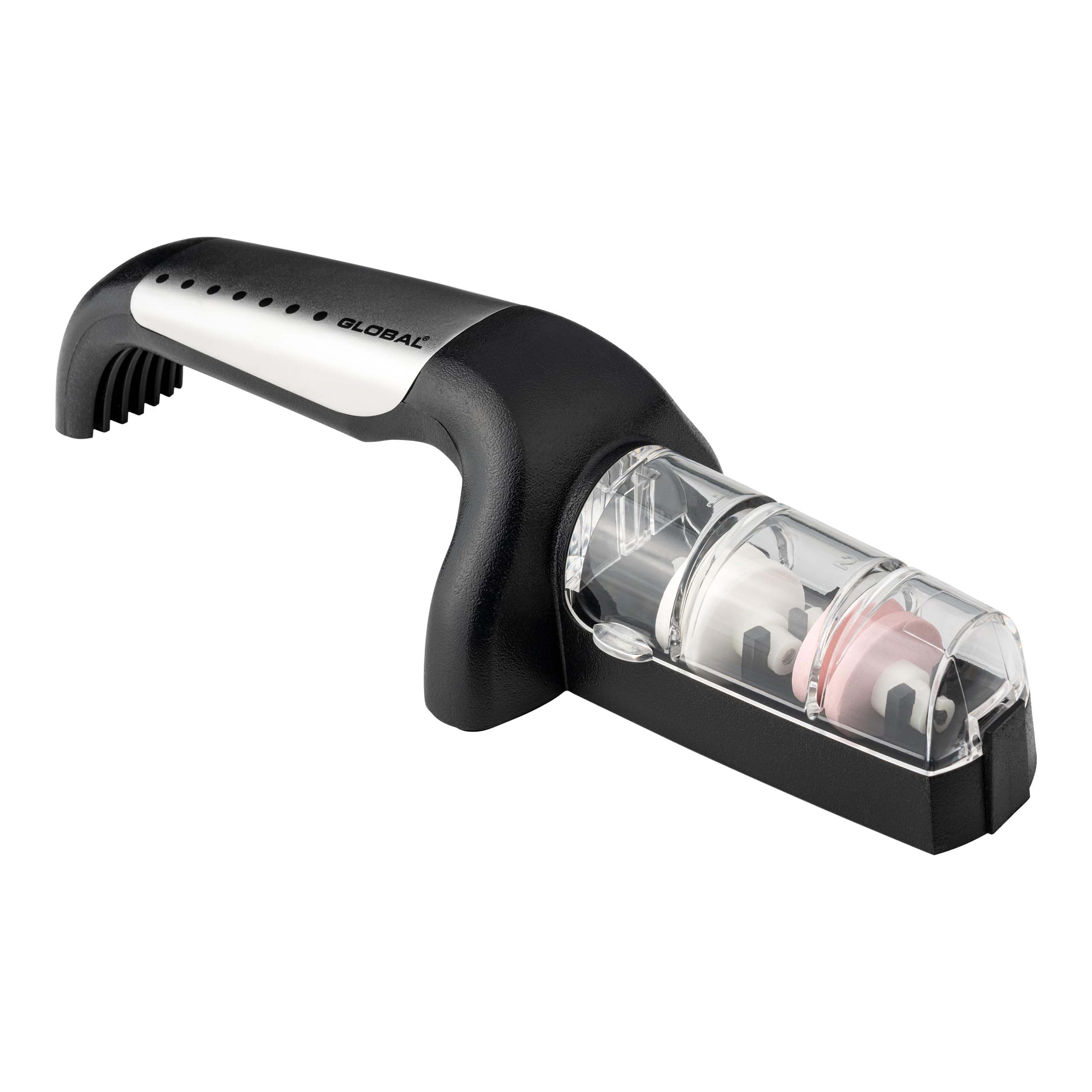
The only sharpener that truly understands Global’s unique edge
If you own Global knives, you already know they have a distinctive edge profile that generic sharpeners cannot replicate. This 2-stage sharpener is built for that exact geometry, which is why Global knife owners consistently call it a must-have — it returns their blades to original sharpness with just a few easy strokes and minimal pressure. The rubberized base grips the counter securely, so the unit stays steady while you pull the blade through.
The system uses a 2-stage design: a coarse stage and a fine stage, with a superfine polishing wheel at the final stage to finish the blade. It is designed for Global knives specifically, but the manufacturer states it also sharpens most other cutlery brands. The manual design is safe and simple — no electricity, no skill required, just a few strokes and the blade is back to razor sharp. Owners describe it as “simplicity in action” and note the unit is steady and easily stored at just 9.65 inches long.
The honest limitation is that it shines brightest specifically on Global’s unique edge geometry — non-Global knives work, but not as dramatically. If your knife drawer is all Global, this is a no-brainer; if you have a mixed set, it is a solid but less spectacular option.
Why Global owners swear by it
- Matches Global’s unique edge profile that generic sharpeners miss
- Three-wheel system (coarse, fine, superfine polish) delivers a finished edge in one pass
- Rubberized base keeps the unit planted and stable
- Manual design with no skill required — just a few easy strokes
Know the limits
- tune for Global blades — other knives see less dramatic results
- Pull-through sharpeners remove more metal than a honing rod over time
Non-negotiable for: Global knife owners who want their blades back to factory sharpness with zero effort.
Only if: your set is mostly Global — mixed-brand drawers should look at the guided rods above.
9. VIDOME Professional Electric Knife Sharpener 3-Stage
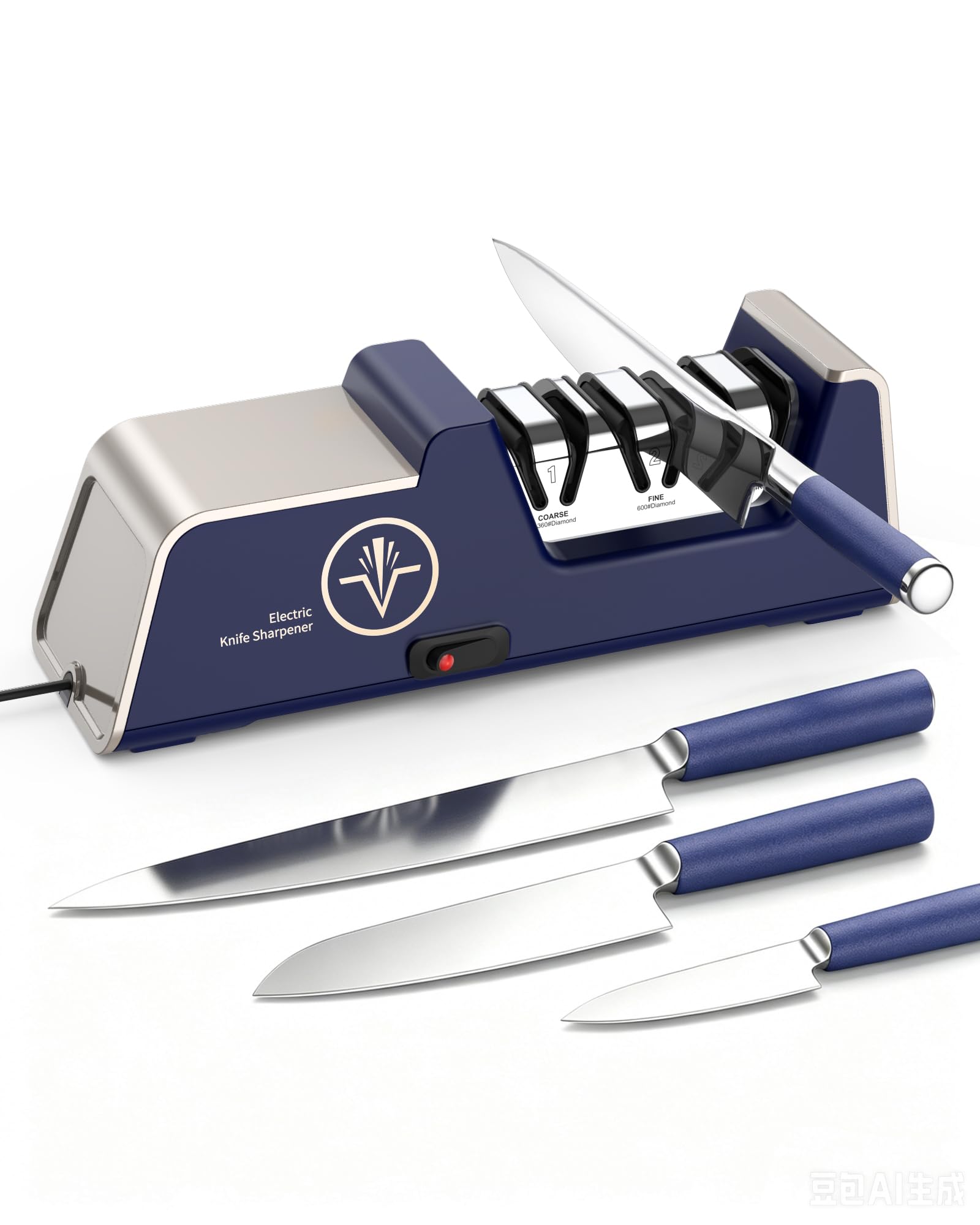
The no-skill sharpener that makes dull blades razor-sharp in 30 seconds
If you have arthritis, zero patience, or just want the fastest possible route from dull to sharp, this electric sharpener is the answer. The 3-stage system uses 100% diamond abrasives — the hardest natural substance — in stages 1 and 2 to sharpen and hone, then safe stropping disks in stage 3 to polish the blade to a like-new finish. It sharpens straight-edge, ceramic, and serrated knives, making it the most versatile tool on this list.
It sharpens a dull knife in about 30 seconds and re-sharpens in 10, making it the fastest option here. It sharpens 15-degree blades and converts 20-degree kitchen knives to a finer 15-degree edge for easier cutting. A magnetic tray collects metal shavings, and flexible spring guides hold the blade at the correct angle without scratching it.
It removes more metal than a honing rod, so avoid it on your fanciest blades. Owners note the handle can bump the frame on large chef’s knives, and the motor feels modest. For sheer convenience, it revives a 4-year-old dull knife to “cuts like butter” status in minutes.
Where the motor earns its keep
- 30-second first sharpening, 10-second re-sharpening — faster than any manual tool
- 3-stage system with diamond abrasives plus stropping polish for a like-new finish
- Handles straight, ceramic, AND serrated knives — total kitchen coverage
- Magnetic chip tray keeps metal shavings off the counter
Before you plug it in
- Removes more metal than honing — avoid on your fanciest Japanese blades
- Chef’s knife handles can bump the frame mid-pass
- It operates at 60–80dB, so it’s not silent.
Grab this if: you want professional-grade sharpness with literally zero technique required.
Steer clear if: you own premium Japanese knives you want to protect from heavy metal removal.
Understanding the Specs
Grit Rating
Grit tells you how coarse or fine the sharpening surface is. Lower numbers (around 1000) are coarser — they remove more metal, which is what you need for a dull or nicked blade. Higher numbers (3000 and up) are finer — they polish an already-sharp edge. A dual-grit stone gives you both in one tool: use the coarse side to grind, the fine side to finish.
Honing vs. Sharpening
Honing realigns the edge of a slightly dull knife — it does not remove much metal. Sharpening physically grinds away metal to create a new edge. A 3000-grit ceramic rod is mostly a honing tool: it keeps an already-good edge fresh. A 1000-grit whetstone is a sharpening tool: it can rescue a badly dulled blade. Most kitchens need both, but the right blend depends on how dull your knives get between uses.
FAQ
What is the difference between a ceramic honing rod and a steel honing rod?
Will a ceramic sharpener damage my knife?
Can a ceramic sharpener be used on serrated knives?
What is the best grit for a ceramic knife sharpener?
How often should I sharpen my knives with a ceramic rod?
What is the difference between 1000 grit and 3000 grit ceramic?
Are electric ceramic sharpeners better than manual ones?
Do ceramic sharpeners need any preparation before use?
How do I clean a ceramic honing rod?
Final Thoughts: The Verdict
For most buyers, the ceramic knife sharpener winner is the Suehiro Cerax because it delivers the finest possible edge with a durable 1000-grit stone that outperforms cheaper hardware-store alternatives. If you want simple to use daily maintenance for hard Japanese steel, the Sharpeak rod gives you simple to use 3000-grit honing with built-in angle guides. And for anyone who wants professional sharpness with zero technique, the VIDOME electric puts a razor edge on any knife in about 30 seconds.
How We Picked
We do not accept paid placement. Every pick is matched to a real buyer and a real use-case; we do not hands-on test units.
Sources & Methodology
Specifications: manufacturer listings and product documentation. Review insights: verified customer reviews, as of August 2026. Pricing: not shown on this page (it changes often); check the current price via the retailer link.
As an Amazon Associate, Gadgets Feed earns from qualifying purchases. This does not affect which products we feature.