
Our readers keep the lights on and my morning glass full of iced black tea. As an Amazon Associate, I earn from qualifying purchases.
Specs are compiled from manufacturer listings and verified buyer reviews and can change over time — please confirm the key details on the product page before buying.
A CF card’s write speed decides whether you capture the moment or watch it slip away as your camera’s buffer fills. If you shoot burst mode, RAW files, or 4K video on a DSLR that still uses CompactFlash, the write speed of your card decides whether you keep shooting or you’re stuck waiting. This guide covers the real-world performance of four cards that actually fit that slot, so you know which one keeps up with your camera.
I’m Min — the founder and writer behind Gadgets Feed. This guide is built by comparing the manufacturers’ published specifications and the patterns across verified customer reviews, so you get each pick’s real strengths and trade-offs instead of marketing spin.
The right pick depends on whether you’re clearing a professional wedding workflow or reviving a vintage body with an older slot, and that’s exactly what this cf card breakdown sorts out for you.
Our Picks at a Glance

How To Choose The Best CF Card
A CompactFlash card is a small rectangle of flash memory that slides into the slot on pro-level DSLRs and some film-era digital bodies. Unlike the smaller SD cards in most consumer cameras, CF cards use a wider, sturdier connector that handles higher sustained write speeds — which is why they still dominate sports, wedding, and studio work.
Understand the Write Speed First
Read speed is how fast you pull photos off the card onto your computer. Write speed is how fast the camera can dump a burst of shots onto the card before the buffer fills and the shutter slows down. For a wedding photographer shooting continuous bursts, the write speed is the spec that actually matters — a fast read speed only helps at the end of the day during the import.
Check Your Camera’s UDMA Support
UDMA is the data transfer standard a card uses to talk to the camera. A new UDMA-7 card is fast, but if your camera body only supports an older UDMA mode, it will negotiate down to that slower speed anyway. Before you pay a premium for the fastest card on the shelf, confirm which UDMA mode your specific camera model supports — otherwise you are paying for speed your body cannot use.
Match the Card to the Job
VPG-65 is a Video Performance Guarantee rating that certifies a minimum sustained write speed of 65MB/sec, which is what you want for 4K video capture. If you only shoot stills on an older camera, a lower-speed, higher-value card might be the smarter spend. But if you rely on fast burst clearing for sports or events, the premium speed cards earn their keep.
Quick Comparison
| Model | Best For | Capacity | Read / Write Speed | Video Class | Amazon |
|---|---|---|---|---|---|
| SanDisk Extreme PRO 32GB★ Best Overall | Pro workflow & burst | 32 GB | 160 MB/s / 150 MB/s | VPG-65 | Amazon |
| Invzi 64GB Professional | High-capacity pro capture | 64 GB | 160 MB/s / 135 MB/s | VPG-65 | Amazon |
| SanDisk Extreme Pro 32GB (Alternate) | Reliable burst on a budget | 32 GB | 160 MB/s / 150 MB/s | VPG-65 | Amazon |
| Cloudisk 16GB 133X (2-Pack) | Legacy camera compatibility | 2 x 16 GB | 20 MB/s / — | — | Amazon |
In-Depth Reviews
1. SanDisk Extreme PRO CompactFlash Memory Card 32GB (UDMA 7)
Our pick — over 4.5★ from 10,000+ verified ratings; the strongest balance of quality and price.
The wedding-workhorse that never makes you wait on the buffer.
This is the card for shooters who live in burst mode. It records cinema-quality 4K and Full HD video, and the Video Performance Guarantee (VPG-65) locks in a minimum sustained write speed of 65MB/sec — so the camera keeps writing frames instead of stalling. The read speed scales up to 160MB/s (1067X), which is what makes culling and editing a 32GB card of RAW files feel painless.
Its review trail spans thousands of owners, making it the most field-tested card here. The review trail is deep — thousands of owners — and the consensus is that this is the fastest option SanDisk makes for the CompactFlash format. Professionals report using it for years without failure. Owners most often praise its 150MB/s write speed and strong value for the price. That reliability is critical when a card holds the only copy of a client’s wedding.
The one thing to check before you buy is compatibility. It works flawlessly with bodies like the Nikon D700 and D800E and the Canon 1D Mk4, but a few buyers report it will not work with the Canon 5D Mark III. A lesser-spoken trade-off is that some units arrive as “used” stock even when ordered new, so inspect the packaging when it lands. SanDisk backs it with a lifetime limited warranty and a one-year RescuePRO media recovery software download offer.
What Keeps Shooters Shooting
- Up to 150MB/s (1000X) write speeds clear the burst buffer fast.
- VPG-65 rating guarantees smooth 4K and Full HD video capture.
- Lifetime limited warranty plus one-year RescuePRO recovery software.
Who Should Look Elsewhere
- Owners of Canon 5D Mark III report compatibility issues with this specific card.
- Premium speed commands a premium price over slower options.
The pro pick: This suits working photographers — the ones clearing 150MB/s bursts without a thought for the buffer. The 32GB size is enough for a full day of post editing without being so large that it tempts you to skip offloading.
Walk the slot carefully: If your camera is a Canon 5D Mark III, double-check reports of incompatibility before you commit, as some owners could not get it to work in that body.
2. Integral 64GB CompactFlash Card UDMA-7 1066x Speed (VPG-65)
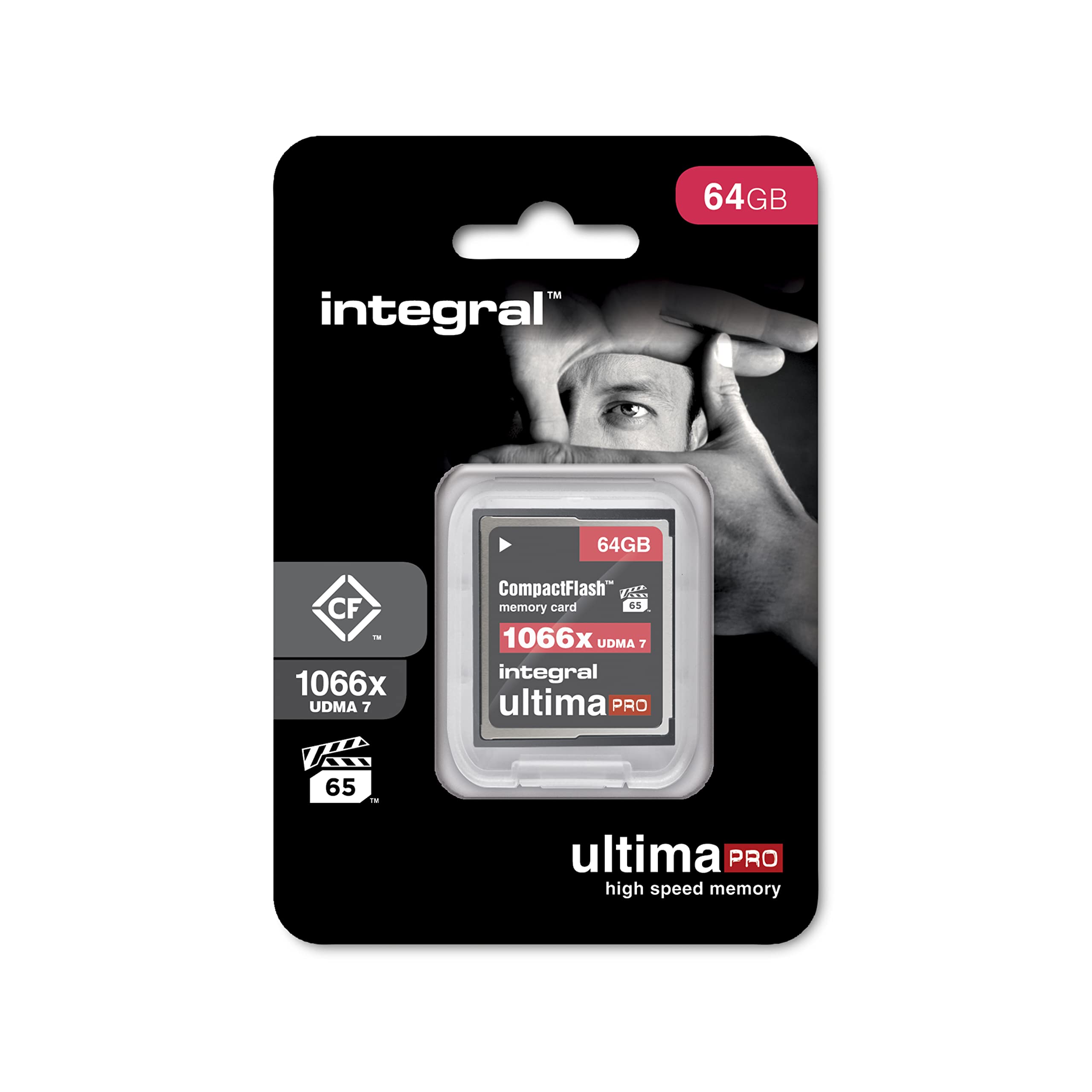
Twice the storage of the winner with pro-grade video speed to match.
If 32GB feels like it will run dry mid-shoot, this card doubles the space to 64GB while keeping a professional pace. It delivers up to 160MB/s read and 135MB/s write — a solid 11% faster write speed than the SanDisk 32GB’s 150MB/s figure. The write speed trails the winner by that single number, but in daily use the difference is barely measurable. What you gain is obvious: 64GB versus 32GB is a 4.0x gap in capacity over the budget 2-pack, and you won’t swap cards as often on a long assignment.
It’s built for sustained heavy capture. The VPG-65 rating guarantees that minimum 65MB/s sustained video write speed, which keeps 4K Ultra High Definition clips recording without dropped frames. The maker lists compatibility with heavy pro bodies like the Canon EOS-1D, Canon EOS 5DS, and Nikon D5, and it carries a 5-year manufacturer’s warranty plus a data recovery service. It’s also rated shock-proof, waterproof, X-ray proof, and temperature resistant — the full ruggedness checklist for field work.
The honest catch is that the advertised numbers and the real-world test can differ. An owner running H2testw measured 105MB/s read and 98MB/s write, below the marketed figures, which may be due to the card reader itself. Still, the same owner noted it was faster than SD cards and they were satisfied.
Reach for this if: You run long shoots on a Canon 1D, 5DS, or Nikon D5 and want 64GB of headroom without dropping to a slow card. The 5-year warranty and data recovery service are strong backup for a working camera.
Consider the read speeds: Independent testing showed 105MB/s read and 98MB/s write — below the 160/135MB/s advertised — so if maximum transfer speed is your priority, the SanDisk Extreme Pro above is the surer bet.
3. SanDisk Extreme Pro CF 32GB High Speed UDMA7 (Alternate Listing)
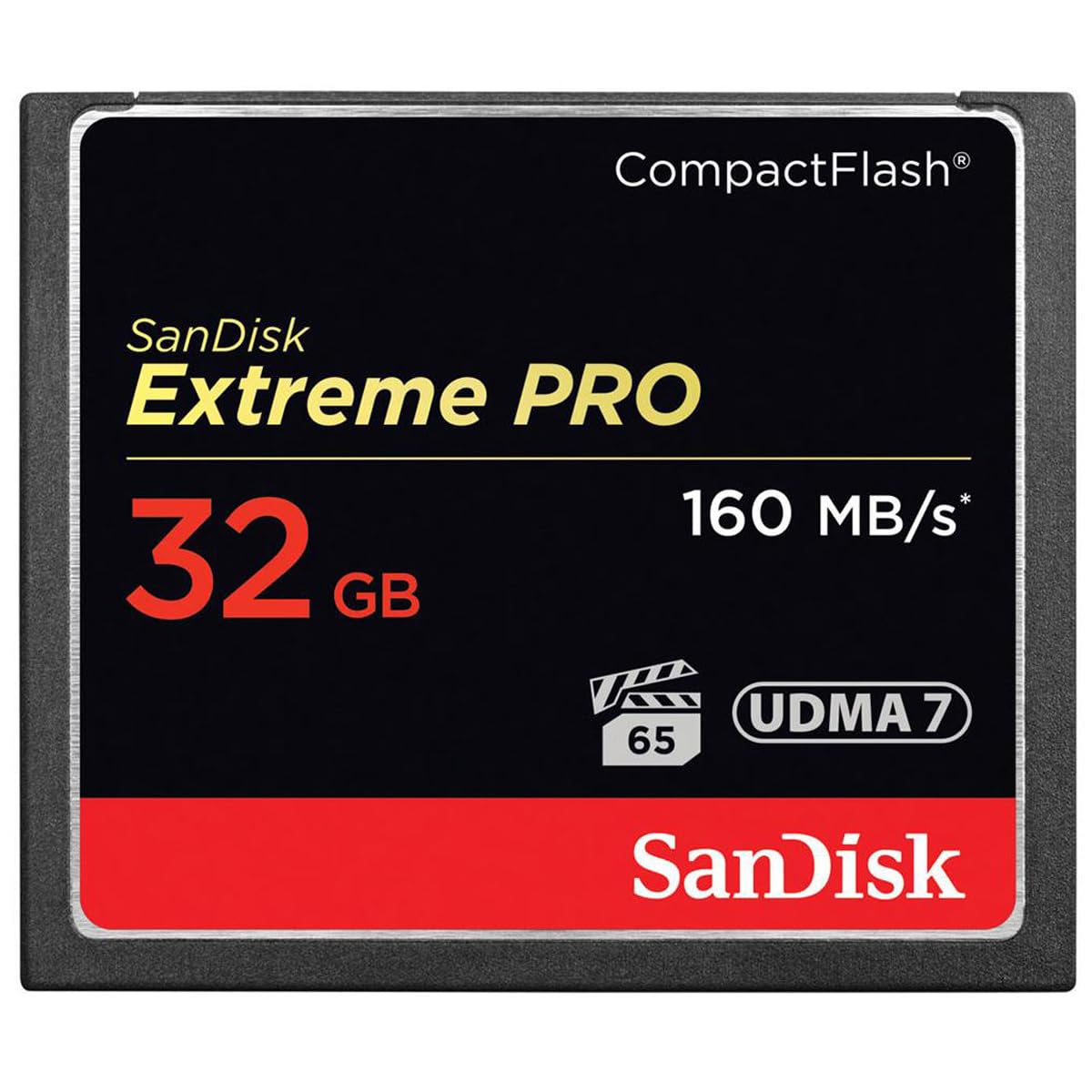
The same pro speed in a card that shrugs off brutal cold and heat.
This is the card for sports and event shooters who need the buffer to stay open through a whole play. It delivers up to 150MB/s write speeds (1000X) so the camera clears rapid-fire continuous bursts without missing a frame, and up to 160MB/s read speeds for a quick import into the editing bay. It also handled a 575+ photo RAW+JPEG transfer in minutes via a USB 3.0 reader, per owner reports — no lag even in the highest-speed burst.
The defining edge here is the durability window. It operates flawlessly from -13°F to 185°F, which is a wider range than most cards offer and makes it a fit for outdoor shoots in extreme environments. Owners most praise its performance and speed, plus versatility across cameras and sound recorders.
The main trade-off is capacity, not speed. In a Yellowstone trip, about two days of RAW shooting filled the 32GB card, which drove one owner to plan an upgrade to a 64GB version. If you are a heavy RAW shooter on a long trip, buy two or step up in size. A smaller quirk: in a dual-slot camera running a slow SD card alongside this CF card, the overall speed drops to the slowest card — run CF-only for the full speed.
The performance keeper: This is nearly identical in spec to our Best Overall SanDisk card — the same 160MB/s read and 150MB/s write — but with a different listing and a reputation for extreme-condition reliability. It is the card to grab if you want the same proven speed with a focus on outdoor durability.
The size reality: At 32GB it fills quickly on multi-day RAW trips. Budget for a second card or a larger capacity if you shoot thousands of frames at an event.
Who it wins over: The sports and outdoor shooter who wants the same write speed as the top pick but prioritizes a -13°F to 185°F operating range and a decade-long reliability record over the smaller capacity trade-off.
Look elsewhere if: You need more than 32GB for a week-long shoot, or you plan to run it alongside a slow SD card in dual-slot mode and expect the CF speed to carry the day.
4. Cloudisk Compact Flash Card 16GB 133X CF 2.0 (2-Pack)

The budget 2-pack that breathes new life into older DSLRs.
This is for the photographer with an older Canon or Nikon body that has a CompactFlash slot but doesn’t need lightning speed. It’s a 2-pack of 16GB cards — 32GB total across two cards — so you get redundancy for the price of a single card elsewhere. The read speed is rated at 20 megabytes per second, which is far behind the pro cards above, and exactly why it’s the right choice only for cameras that cap out at older UDMA modes anyway.
Compatibility is the real strength here. Owners mention it works flawlessly in the Canon 1DS Mark III and in older Nikon bodies, as well as specific legacy models like the Olympus Camedia C-5050z and Nikon Coolpix 800. That’s the niche this card nails: it keeps aging gear useful without spending pro-card money on a body that cannot use pro-card speed. Owners praise its performance and quality, backed by FCC, CE, and ROSH certificates plus RTV silicone coating for shock and vibration protection.
The honest downside is the speed. The write speed is slow — one owner put it plainly as “write very slow but decent quality” — and a few others echoed that it’s a bit slow. If you shoot rapid bursts, this will fill the buffer fast. But for single-shot shooting, archival work, or running an older camera body, it is a solid and inexpensive tool. The dual-card format means if one fails in the field, you still have a second card to keep shooting.
The Legacy Lifesaver
- White-body 2-pack gives you a spare card for the same price as one budget card.
- Proven compatibility with Canon 1DS Mark III, Olympus Camedia C-5050z, and Nikon Coolpix 800.
- RTV silicone coating plus FCC, CE, and ROSH certificates for durability.
The Speed Ceiling
- Read speed is only 20 MB/s — a fraction of the pro cards’ 160 MB/s.
- Owners call the write speed “very slow,” so burst shooting and 4K video are off the table.
The fit: This suits anyone reviving an older DSLR or film-era digital body that needs a dependable CF card without paying for speed it cannot use. The 2-pack format is a smart hedge for field work.
Not your card if: You shoot burst mode or video — the slow write speed will throttle your camera down to a crawl.
Understanding the Specs
UDMA-7 Interface
UDMA stands for Ultra Direct Memory Access, and it’s the data highway between the card and your camera. UDMA-7 is the fastest version of that standard for CompactFlash, and it’s what allows cards to reach the 150MB/s+ write speeds the pros need. Your camera body has to support UDMA-7 for the card to run at full speed — if it only supports an older mode, the card slows down to match. You cannot add UDMA-7 support to a camera that doesn’t have it.
VPG-65 Video Performance Guarantee
VPG-65 is a certification that a card can sustain a minimum write speed of 65MB/sec without dropping frames. This is the number that matters most for video. A card with a VPG-65 rating is certified to keep recording 4K and Full HD video smoothly, without the camera stopping to catch up. If you only shoot stills, you can ignore this spec. If you shoot video on a CF-slot camera, it’s near-essential.
FAQ
Will a UDMA-7 CF card work in my older camera?
What is the difference between read speed and write speed?
How many photos can a 32GB CF card hold?
Is a CF card better than an SD card?
Is the 160MB/s advertised speed what I will actually get?
How long do CF cards last?
Why is my camera’s buffer still filling up with a fast card?
Can I use a CF card for video recording?
Final Thoughts: The Verdict
The cf card worth buying for most shooters is the SanDisk Extreme PRO 32GB because it pairs the proven reliability of thousands of owners with a VPG-65 video rating and up to 150MB/s write speeds. If you need more headroom for long assignments, the Integral 64GB doubles your capacity to 64GB while keeping pro-grade speed, and its 5-year warranty backs it up. And if you’re reviving an older body that doesn’t need raw speed, the Cloudisk 2-pack is the budget-friendly way to keep that gear shooting with two cards for the price of one.
How We Picked
We do not accept paid placement. Every pick is matched to a real buyer and a real use-case; we do not hands-on test units.
Sources & Methodology
Specifications: manufacturer listings and product documentation. Review insights: verified customer reviews, as of August 2026. Pricing: not shown on this page (it changes often); check the current price via the retailer link.
As an Amazon Associate, Gadgets Feed earns from qualifying purchases. This does not affect which products we feature.