
Balancing HVAC ductwork, verifying dust collection performance, or checking fume hood safety all rely on one critical measurement: cubic feet per minute (CFM). A quality CFM air flow meter cuts through guesswork, delivering precise air velocity and volume data that lets you balance systems and diagnose issues with confidence. Without a reliable meter, you are flying blind — adjusting dampers and hoping for the best.
I’m Min — the co-founder and writer behind Gadgets Feed. I spend hours breaking down the technical specifications and real-world performance data of measurement instruments to separate marketing fluff from genuine utility, so you know exactly which features matter for your HVAC or field work.
Whether you are commissioning a new air handler or simply curious about your home’s ventilation efficiency, finding the best cfm air flow meter means choosing between vane anemometers, hot-wire probes, and Bluetooth-enabled models that each excel in different scenarios.
How To Choose The Best CFM Air Flow Meter
Picking the right airflow meter comes down to matching the sensor technology to your specific environment — a vane anemometer works well for general duct traversing, while a hot-wire probe excels in tight spaces and low-velocity scenarios.
Sensor Type: Vane vs. Hot-Wire
Vane anemometers use a rotating impeller to measure air speed. They are durable, require no warm-up, and handle moderate dust loads reasonably well. Hot-wire anemometers use a heated element — they are more sensitive at low velocities (under 50 FPM) and have a smaller form factor for cramped ductwork, but their sensor is more delicate and susceptible to contamination.
Data Logging and Connectivity
If you need to document airflow across multiple supply registers or track performance over time, look for a meter with either Bluetooth app support for real-time remote viewing, or USB data export for PC analysis. Some models store hundreds of data points internally, which saves you from manually recording readings on a clipboard.
Key Specs to Compare
Pay attention to the meter’s wind speed range (most cover 0.001–100 mph), accuracy rating (typically ±3% to ±5%), and the maximum CFM resolution (models that handle up to 999,900 ft³/min give you headroom for larger systems). A backlit display, data hold, and a tripod mount are practical features that improve usability on ladders or in dim mechanical rooms.
Quick Comparison
On smaller screens, swipe sideways to see the full table.
| Model | Category | Best For | Key Spec | Amazon |
|---|---|---|---|---|
| BTMETER BT-846A | Pro Vane | HVAC duct traversing | 0.001–100 mph, 600 data logs | Amazon |
| testo 405i | Hot-Wire Probe | Tight ducts & confined spaces | 15″ telescopic shaft, Bluetooth 4.0 | Amazon |
| AOPUTTRIVER AP-856A | Pro Vane | USB data export to PC | 0.001–100 mph, USB + disc | Amazon |
| AOPUTTRIVER AP-846A | Pro Vane | Max/Avg/Min functions | 0.001–100 mph, 2-year support | Amazon |
| HoldPeak 866B-APP | Bluetooth Vane | Remote monitoring on phone | Bluetooth APP, includes tripod | Amazon |
| BTMETER BT-100APP | Bluetooth Vane | Wireless data logging export | Bluetooth APP, rechargeable USB | Amazon |
| Aicevoos H12 | Value Vane | Budget-friendly HVAC checks | Includes humidity, carry pouch | Amazon |
In‑Depth Reviews
1. BTMETER BT-846A Pro HVAC Anemometer
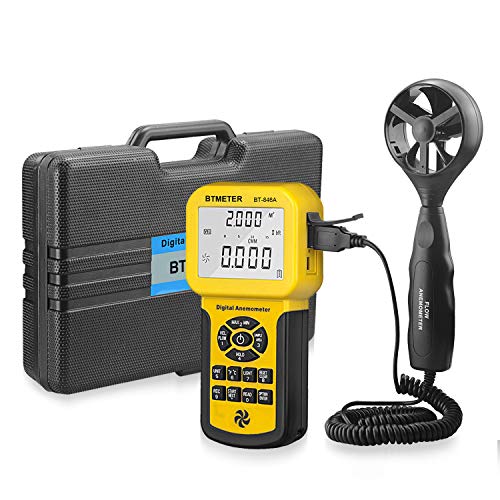
The BT-846A delivers a potent combination of high-range sensitivity and integrated data logging that serious HVAC techs need. Its separated extendable vane sensor lets you hold the display at eye level while positioning the impeller deep inside a duct register — a real asset when balancing on a ladder. The 0.001–100 mph range with ±3% accuracy covers everything from low-flow supply vents to high-volume exhaust fans.
Built with a well-sealed battery compartment (O-ring and screws) and a protective carrying case, this meter is designed for daily work-site abuse. The 600-group data storage means you can log readings across an entire building before transferring them to a spreadsheet. Users consistently report readings that align closely with professional-grade airflow hoods.
On the downside, the included manual is sparse and the CFM display can reset to CMM if you are not careful with the area settings. The backlight also times out automatically, which can be annoying when working in dim mechanical rooms for extended periods. Despite these quirks, the BT-846A remains the most balanced pro-grade vane meter at its tier.
Why it’s great
- Separated sensor simplifies one-handed duct traversing
- 600 data log capacity for multi-point system analysis
- Rugged battery seal resists moisture and dust ingress
Good to know
- Manual lacks setup guidance for beginners
- Auto backlight timeout can be inconvenient
- CFM units occasionally reset to CMM
2. testo 405i Hot-Wire Anemometer

When you need to measure airflow inside a cramped duct or VAV box, the testo 405i’s hot-wire sensor and telescoping shaft (extending to 15 inches) are unmatched. The hot-wire technology gives you stable readings down to very low velocities where vane meters stall, making it the go-to choice for commissioning energy recovery ventilators and checking fume hood face velocities.
Bluetooth 4.0 pairs effortlessly with the Smart Probe App, which displays real-time velocity, temperature, and volumetric flow (CFM) on your phone once you enter duct dimensions. The app stores data as graphs or tables and lets you generate reports on-site — ideal for certified technicians who need documentation. Users report accuracy within 4% of professional-grade pitot tube measurements.
The trade-offs are real. The hot-wire bulb is delicate and can drift if contaminated with dust or oil, so it requires careful handling and regular cleaning. It maxes out at 6,000 FPM, making it unsuitable for high-velocity industrial exhaust. Batteries last well, but the unit is strictly app-dependent — there is no onboard display, so your phone must stay paired throughout the job.
Why it’s great
- Hot-wire sensor excels at low-velocity accuracy in tight spaces
- 15-inch telescoping shaft reaches deep into duct runs
- Bluetooth app provides graphing, logging, and report generation
Good to know
- Sensor bulb is fragile and sensitive to dust buildup
- Maximum velocity limited to 6,000 FPM
- No onboard screen — requires a smartphone for readings
3. AOPUTTRIVER AP-856A Pro HVAC Anemometer

The AP-856A stands out for its USB data transmission capability — connect it to a PC to transfer logged measurements for detailed analysis. This makes it a strong contender for technicians who need to produce written reports or trend airflow data over time. The meter covers the same 0.001–100 mph range as its sibling the AP-846A, with the same ±3% accuracy rating.
Physical build is solid, with a stretchable vane probe and a large backlit display that is easy to read in dim settings. The CFM calculation function lets you input duct area directly and read volumetric flow without manual math. Users testing it against a flow hood found readings within about 4% — solid correlation for a vane-style meter at this level.
Documentation is the weakest link here — the manual is poorly translated and the USB software may not install cleanly on newer Windows versions (some users report it fails on Windows 10 and XP). The data recording feature requires careful setup to function. If you are comfortable figuring out the quirks, the hardware itself performs reliably for HVAC balancing and blower testing.
Why it’s great
- USB export enables PC-based data analysis and reporting
- Stretchable vane probe adapts to different duct depths
- Direct CFM readout after area input
Good to know
- USB software may not work on older Windows versions
- Poorly translated manual with confusing setup steps
- Data recording function is finicky to activate
4. AOPUTTRIVER AP-846A Pro HVAC Anemometer

The AP-846A shares the same core sensor and specs as the AP-856A but omits the USB port, focusing purely on onboard measurements with Max/Avg/Min functions. This simplifies operation — you get reliable velocity and CFM readings without wrestling with PC software. The 0.001–100 mph range with 0.001 resolution picks up even the faintest drafts in a balanced system.
Its 1.69 x 2.3-inch backlit display is larger than many competitors at this tier, making it easy to scan readings while positioned awkwardly on a ladder. The extendable vane probe stores compactly but slides out to reach registers that are set back in the ceiling. Backed by a 2-year manufacturer warranty, it offers peace of mind for regular professional use.
Like its sibling, the manual is a weak point — confusing illustrations and poor translations frustrate first-time users. The 9V battery is included but has no low-battery warning until the display starts dimming perceptibly. Some users note that the backlight auto-off behavior cannot be disabled, which interrupts long-duration monitoring sessions.
Why it’s great
- Large, bright backlit display for dim mechanical rooms
- Extendable vane probe simplifies reaching deep registers
- 2-year warranty provides confidence for daily use
Good to know
- Manual is poorly translated with unclear diagrams
- 9V battery lacks clear low-battery indicator
- Backlight times out and cannot be locked on
5. HoldPeak 866B-APP Handheld Anemometer

The HoldPeak 866B-APP brings Bluetooth connectivity to the vane anemometer format, letting you monitor wind speed and temperature remotely on your phone from up to 30 feet away. The included tripod and 1/4-inch mounting thread free your hands for ductwork adjustments while the meter sits in the airstream — a huge convenience for single-person balancing jobs.
Its dual temperature sensors and 8-vane impeller deliver responsive readings down to very low airflows, making it suitable for both outdoor wind monitoring and indoor HVAC diagnostics. The app displays real-time data and allows you to save logs, though some users note the app interface feels dated and data occasionally fails to sync. The tripod is lightweight and adequate for indoor use but may struggle in gusty outdoor conditions.
The main trade-off is that the unit logs data primarily through the app — if you do not connect to your phone, you lose the recording capability. The included instruction manual is sparse, and the app’s setup requires granting storage permissions manually. For tech-savvy users who want wireless convenience, this is a solid mid-range entry, but novices may struggle with initial configuration.
Why it’s great
- Bluetooth app provides remote data viewing up to 30 feet
- Included tripod and hand strap improve hands-free operation
- Sensitive 8-vane impeller measures low flows accurately
Good to know
- App setup requires manual storage permission granting
- Tripod is too light for outdoor use in strong wind
- Historical data may not sync reliably to app
6. BTMETER BT-100APP Anemometer

The BT-100APP delivers Bluetooth wireless logging and a rechargeable USB battery — two features rarely seen together at this tier. It auto-pairs with the mobile app on iPhone and Android, logging wind speed, temperature, and wind chill data that you can export as Excel or TXT files. The 8-vane impeller and dual temp sensors make it sensitive enough for HVAC duct traversing and outdoor shooting applications alike.
Physical design is compact and tripod-ready via the 1/4-inch metal insert, so you can mount it for continuous monitoring. Users consistently praise its responsiveness and accuracy, with one reviewer confirming it was the best among four anemometers they tested side-by-side. The rechargeable battery eliminates the ongoing cost and hassle of replacing 9V or AAA cells.
App reliability is a recurring complaint — some users report the app is slow to connect, fails to save data, or shows flaky behavior on certain Android versions. The temperature sensor can also read up to 3°F off from reference instruments. For the price, the hardware is excellent, but the software experience lags behind more polished competitors like the testo 405i.
Why it’s great
- Rechargeable USB battery saves on disposable cells
- Bluetooth app logs and exports data as .xls / .txt files
- Compact, tripod-mountable design for continuous monitoring
Good to know
- Bluetooth app can be slow and occasionally fails to sync data
- Temperature reading may be off by up to 3°F
- Incomplete manual does not explain all functions
7. Aicevoos H12 Digital Anemometer

The H12 packs surprising versatility into a budget-friendly package with its separated extendable wind sensor and integrated relative humidity measurement. You get wind speed in five units, direct CFM display (no manual calculation required), and ambient humidity readings — all for a price that undercuts most competitors. The extendable probe reaches 2.3 meters, making it useful for high-ceiling supply diffusers.
Homeowners and DIY HVAC enthusiasts have found the H12 accurate enough to verify professional technician readings — one user reported their measurements matched a pro-grade gauge within tolerance. The big backlit screen is legible outdoors, and the included carry pouch and AAA batteries mean it is ready to use out of the box. Build quality feels solid for the price point.
The manual again falls short — the clock icon function is undocumented, and navigating between units requires some trial and error. The humidity sensor adds value but is not calibrated for precision lab work. For occasional HVAC checks, shooting range wind calls, or general curiosity about home ventilation, the H12 delivers reliable readings without the investment of a pro-tier meter.
Why it’s great
- Extendable 2.3m probe reaches high and deep ducts
- Built-in humidity sensor adds diagnostic value
- Direct CFM readout removes manual calculation
Good to know
- Manual fails to explain all button functions
- Humidity sensor is not lab-grade accurate
- Unit switching requires experimentation to master
FAQ
Can I use a vane anemometer in a round duct vs. square duct?
How do I clean and maintain my hot-wire anemometer sensor?
What does a CFM reading of 0.001 actually mean for my HVAC system?
Final Thoughts: The Verdict
For most users, the best cfm air flow meter winner is the BTMETER BT-846A because it combines a separated extendable probe, 600-data-log memory, and a dust-sealed build that suits professional HVAC balancing. If you work in confined spaces with low velocities, grab the testo 405i for its hot-wire precision and telescoping shaft. And for budget-friendly DIY checks, nothing beats the Aicevoos H12.