
A chainsaw that refuses to start after sitting in the shed for three months isn’t a tool — it’s an anchor. For homeowners, the real test isn’t peak horsepower on a spec sheet. It’s whether the saw fires up on the first few pulls when a storm branch is blocking the driveway or a dead oak needs to come down before it hits the fence. Gas, corded electric, and battery-powered options each demand different compromises in weight, maintenance, noise, and runtime. The right choice depends entirely on the size of your property and the frequency of your cutting tasks.
I’m Min — the co-founder and writer behind Gadgets Feed. I’ve spent countless hours analyzing technical specifications, cross-referencing real-world user data, and dissecting the build quality of dozens of chainsaws to identify which models deliver reliable, consistent performance for the suburban and rural property owner who needs a saw that works when called upon, not one that requires a mechanic’s toolkit to operate.
Whether you’re clearing fallen limbs after a thunderstorm or processing firewood for the winter, selecting the right machine is critical. This guide cuts through the marketing noise to deliver a focused, data-backed selection of the best chainsaw for home use across every power platform and price tier.
How To Choose The Best Chainsaw For Home Use
Home-use chainsaws live in a different performance envelope than professional logging equipment. The priority shifts from raw cutting speed to reliability, ease of starting, low maintenance, and safe handling for intermittent use. Three power platforms dominate this category, and each solves a different set of homeowner problems.
Power Source: Corded, Battery, or Gas
Corded electric saws deliver instant, consistent power without the hassle of fuel mixing or battery degradation. They are the lightest and quietest option, ideal for properties with accessible outlets and cutting sessions under an hour. The trade-off is range — you are tethered to a cord, which limits mobility around large lots or remote areas. Battery-powered saws offer cord-free convenience with increasingly impressive runtime, especially with brushless motors and high-capacity packs in the 40V to 80V range. They are heavier than corded models but lighter than most gas saws, and they excel at mid-range tasks like pruning and storm cleanup. Gas-powered saws remain the go-to for heavy bucking, felling, and extended cutting sessions where refueling in seconds beats waiting for battery recharges. They are louder, heavier, and require more maintenance — but they also deliver the highest power-to-weight ratio for sustained work.
Bar Length and Chain Pitch
Bar length determines the maximum diameter of wood you can cut in a single pass. A 16-inch bar handles logs up to roughly 14 inches thick — sufficient for most home firewood and storm cleanup tasks. An 18-inch bar extends capability to 16-inch logs, adding weight and reach. Bars shorter than 12 inches are purpose-built for pruning and limbing, offering superior maneuverability in tight spaces. The chain pitch (typically 0.325, 3/8, or .404 inches) and gauge (0.043, 0.050, or 0.058 inches) must match the bar and sprocket. For home use, standard 0.325-inch pitch chains offer a good balance of cut speed and smoothness.
Essential Safety and Convenience Features
An inertia-activated chain brake is non-negotiable — it stops the chain in milliseconds during a kickback event. Tool-free chain tensioning allows quick field adjustments without fumbling for wrenches, a feature that pays for itself every time the chain loosens mid-cut. Automatic oilers keep the bar and chain lubricated during operation; look for adjustable flow-rate models if you cut varying wood densities. Self-sharpening systems, like Oregon’s PowerSharp, eliminate the most tedious maintenance task by letting you restore a dull edge in seconds with a built-in stone. Low-vibration handles (often marketed as LowVib or similar) reduce hand fatigue during extended cuts, a critical feature for users who don’t run a saw daily.
Quick Comparison
On smaller screens, swipe sideways to see the full table.
| Model | Category | Best For | Key Spec | Amazon |
|---|---|---|---|---|
| Husqvarna Power Axe 350i | Battery | Premium cordless power | 40V / 7.5 Ah / Boost Mode | Amazon |
| Husqvarna 130 | Gas | Reliable gas performance | 38-cc / 2.2 HP / X-Torq | Amazon |
| CRAFTSMAN V20 RP | Battery | Lightweight trimming | 12″ bar / 105 cuts per charge | Amazon |
| Greenworks 40V 12″ | Battery | Compact storm cleanup | 6 lbs / 12″ bar / 50 cuts | Amazon |
| RYOBI RY3716 | Gas | Gas with storage case | 37-cc / 16″ bar | Amazon |
| Oregon CS1500 | Corded | Self-sharpening convenience | 15A / 18″ bar / PowerSharp | Amazon |
| NEO-TEC 62cc | Gas | Budget gas power | 62-cc / 3.5 HP / 20″ bar | Amazon |
| DongCheng 40V 16″ | Battery | Dual battery ecosystem | 40V / 2×4.0 Ah / 120 cuts | Amazon |
| Dewalt DCCS623B | Battery | Compact pruning | 20V / 8″ bar / Tool-only | Amazon |
In‑Depth Reviews
1. Husqvarna Power Axe 350i

The Husqvarna Power Axe 350i represents the apex of cordless chainsaw engineering for the home user who demands gas-level cutting performance without the fumes, pull-start frustration, or carburetor maintenance. Its brushless motor paired with a 40V 7.5 Ah lithium-ion battery delivers an impressive runtime of 30 to 45 minutes under heavy load, and the Boost Mode injects 25% more power into the chain when you hit a tough knot or need to finish a cut quickly. The X-Cut chain maintains its edge noticeably longer than standard chains, reducing the frequency of sharpening sessions.
At 7.7 pounds, the 350i is lighter than any comparable gas saw, though the battery placement makes the balance feel slightly top-heavy compared to a traditional gas chassis. The tool-less chain tensioning system is genuinely convenient, but some users report the plastic tensioning mechanism can deform under extreme torque from a pinched chain, requiring disassembly to reset. The included 1-amp charger is slow — expect six to seven hours for a full recharge, so a second battery is almost mandatory for extended workdays.
Noise levels are significantly lower than any gas saw, making it a strong candidate for suburban neighborhoods with noise restrictions. The inertia-activated chain brake works reliably, and the overall build quality reflects Husqvarna’s decades of professional saw experience. Battery compatibility across the Husqvarna 40V handheld tool line adds value if you already own other tools in the ecosystem.
Why it’s great
- Boost Mode delivers gas-level power on demand
- Quieter operation ideal for suburban use
- Tool-less chain tensioning for quick field adjustments
Good to know
- Plastic chain tension housing can deform under pinched-chain torque
- Batteries are expensive ( each)
- Slow 1-amp charger requires 6-7 hours for full recharge
2. Husqvarna 130

The Husqvarna 130 is the entry point into a brand known for professional forestry equipment, and it brings genuine engineering pedigree to the home-use category. Its 38-cc X-Torq engine produces 2.2 HP while reducing fuel consumption and exhaust emissions compared to older two-stroke designs. The fuel pump and combined choke/stop control work together to minimize the risk of flooding during cold starts, and most users report reliable ignition within three to five pulls when using the recommended starting procedure with six primer shots.
LowVib technology uses dampeners strategically placed in the handle assembly to reduce vibration-induced fatigue, allowing longer cutting sessions without your hands going numb. The automatic oiler provides continuous bar and chain lubrication, and the centrifugal air cleaning system, called Air Injection, expels larger debris particles before they reach the air filter, extending service intervals significantly. The inertia-activated chain brake adds a critical safety layer against kickback, and the Safe-T-tip protects against rotational kickback at the bar nose.
Some units have reported quality control issues — specifically a bent bar adjustment screw or a carburetor that arrives out of tune from the factory. These appear to be batch-specific rather than endemic, and Husqvarna’s two-year warranty covers defects. The saw is light for its class at just over 10 pounds fully fueled, and the 16-inch bar is ideal for the homeowner who needs to process firewood and clear fallen trees without the weight of a pro-grade 20-inch saw.
Why it’s great
- X-Torq engine is fuel-efficient and low-emission
- LowVib dampeners reduce hand fatigue
- Air Injection extends air filter life
Good to know
- Occasional quality control issues with carburetion or adjustment screws
- Replacement parts can be expensive
- Not designed for heavy professional use
3. CRAFTSMAN V20 RP 12-Inch

The 12-inch bar is purpose-built for pruning, small branch removal, and light storm cleanup, and the compact chassis allows one-handed operation in tight spaces between shrubs or against fence lines. CRAFTSMAN rates it for up to 105 cuts per charge on the included 5.0 Ah battery, and real-world testing on 6-inch pine and oak logs confirms the rating holds up under moderate cutting conditions.
Auto-oiling keeps the bar and chain lubricated without user intervention, and the bolt-lock chain tensioning system maintains adjustment reliably even as the chain heats and expands. The onboard tool storage and bar sheath are thoughtful touches for a saw in this tier. The included charger is a standard 1.25-amp unit, so a full charge from empty takes roughly two hours on the 5.0 Ah pack — acceptable for one-battery workflows but slow for heavy production cutting.
The V20 battery platform is shared across CRAFTSMAN’s entire cordless outdoor power equipment line, including trimmers, blowers, and hedge clippers. If you already own CRAFTSMAN 20V tools, buying this as a bare tool saves money. The build quality feels robust for a consumer-grade saw, with no creaking plastic or loose fasteners out of the box.
Why it’s great
- Brushless motor delivers 80% more peak power than prior model
- 40% lighter than comparable gas saws
- Tool-free chain tensioning with positive lock
Good to know
- 12-inch bar limits maximum cut diameter to about 10 inches
- Charger is slow (1.25A) for the included 5.0 Ah battery
- Not suitable for heavy bucking or felling
4. Greenworks 40V 12-Inch

The Greenworks 40V 12-inch chainsaw trades maximum cutting capability for extreme portability and ease of use, weighing only 6 pounds with the battery installed. This makes it the go-to choice for ladder work, pruning high branches, or keeping a saw in the trunk for emergency storm response. The 2.0 Ah battery delivers a claimed 50 cuts through 4×4 treated lumber, which aligns closely with real-world testing on dry pine. Cutting speed is noticeably slower than a gas saw or larger cordless model, but the saw never bogs down on limbs up to 8 inches in diameter as long as the chain is sharp and properly tensioned.
The auto-oiler provides continuous bar lubrication, and the tool-free chain tensioning knob is a genuine convenience — you can adjust slack in seconds without removing gloves. The dual safety start system requires pressing a lock button and squeezing the trigger, preventing accidental startups. The battery’s USB port allows charging phones or other small devices, a niche feature that adds practicality for camping or remote work sites.
Some users note that the chain loosens more frequently than on premium saws, requiring retensioning after 15 to 20 minutes of cutting. The 12-inch bar and 0.73 HP motor mean this saw is strictly for light-duty tasks — it will struggle with dense, knotty hardwoods or logs over 10 inches in diameter. The included hard case is compact and secure for storage.
Why it’s great
- Ultra-light at 6 pounds for ladder and overhead use
- Battery doubles as a USB power bank
- Tool-free chain tensioning is simple and effective
Good to know
- Chain loosens more frequently than premium cordless models
- Power is limited for hardwood and logs over 10 inches
- Included 2.0 Ah battery provides limited runtime
5. RYOBI RY3716 16-Inch Gas

The RYOBI RY3716 fills the gap between lightweight battery saws and premium gas models, offering a 37-cc two-stroke engine with a 16-inch bar tuned specifically for suburban property maintenance. The anti-vibration handle system reduces hand fatigue noticeably compared to entry-level gas saws, and the adjustable automatic oiler lets you dial in lubrication volume based on wood hardness and cutting speed. The side-access chain tensioner is simple to use and keeps the bar clean during adjustments, while the tool-free air filter cover makes air filter cleaning a genuinely quick task.
The included heavy-duty case provides secure storage and transport, which is a meaningful value-add for homeowners who store their saw seasonally. The inertia-activated chain brake and Safe-T-tip protect against kickback, making this a safe choice for less experienced operators. Starting reliability is generally good when using the correct fuel mix, though a small number of units have arrived with stiff recoil starters that require significant pull force.
The snap-on air filter cover design on newer versions is less secure than the older screw-retained design, and some units have dislodged during operation, allowing debris into the carburetor. The 1.5 HP output is adequate for limbing, bucking small to medium logs, and firewood processing, but the saw lacks the torque for sustained cutting on hardwoods like oak or hickory without frequent sharpening. It is a solid mid-range option for the RYOBI ecosystem owner who needs a gas saw for occasional heavy work.
Why it’s great
- Anti-vibe handle reduces fatigue during extended cuts
- Adjustable automatic oiler for customized lubrication
- Heavy-duty storage case included
Good to know
- Snap-on air filter cover can dislodge during use
- Recoil starter can be stiff on some units
- Limited torque for dense hardwoods
6. Oregon CS1500 Self-Sharpening

The Oregon CS1500 solves the single biggest annoyance of chainsaw ownership — dull chains — with its integrated PowerSharp self-sharpening system. When cutting performance drops, you simply press a button while the chain is running, and a built-in stone restores a sharp edge in three to five seconds. This feature alone transforms the saw into a low-maintenance workhorse for homeowners who would rather cut wood than sharpen chains. The 15-amp motor drives an 18-inch bar with enough torque to handle logs up to 30 inches in diameter with proper technique, and the tool-free chain tensioning knob allows quick slack adjustments without a wrench.
The automatic oiler provides continuous bar and chain lubrication from a translucent oil tank with a visible level window. The chain brake stops the chain in milliseconds during kickback, and the lightweight construction at 12.6 pounds makes it easy to maneuver for overhead limbing. The corded design means zero startup delay and consistent power delivery throughout the cut — no voltage sag, no battery swap, no fuel mixing. Noise levels are significantly lower than any gas saw, which matters in noise-sensitive neighborhoods.
The self-sharpening system wears the chain faster than manual filing, and replacement chains for the proprietary PowerSharp system are more expensive than standard chains. The motor brushes are user-replaceable — Oregon sells OEM brushes for around , and several owners report five years of heavy use before needing brush replacement. The housing can get warm during extended cutting sessions, and the cord management loop is basic but functional.
Why it’s great
- Integrated PowerSharp sharpens chain in seconds
- 15A motor provides consistent, unlimited runtime
- Tool-free chain tensioning and auto oiler
Good to know
- Self-sharpening system wears chains faster than manual filing
- Proprietary PowerSharp chains cost more than standard
- Cord tether limits range near outlets
7. NEO-TEC 62cc 20-Inch Gas

The NEO-TEC 62cc gas chainsaw punches well above its price tier, delivering a 3.5 HP engine with a 20-inch bar that can chew through large hardwoods and storm-fallen trees without breaking a sweat. The power-to-weight ratio is outstanding at 14 pounds fully equipped, and the wrap-around handle provides excellent control during angled cuts and limbing. The eight-inch bar and chain setup uses a standard 0.325-inch pitch with 0.058-inch gauge, and the two-nut bar retention system holds alignment more securely than single-nut designs common on budget saws.
Starting reliability is generally good after breaking in the engine. The manufacturer specifies a 25:1 gas-to-oil ratio during break-in, which is richer than the standard 50:1 for most modern two-strokes. Using the correct mix is critical — several owners who used 50:1 reported hard starting and poor idling until they corrected the ratio. The carburetor has accessible adjustment screws for fine-tuning idle and fuel mixture, though the manual’s English translation is minimal. The chain brake and trigger lockout provide standard safety functionality.
Customer service ships replacement parts from China, and warranty claims require photo documentation. The saw runs strongly after break-in, with owners reporting reliable cold starts in two to three pulls and excellent cutting performance on trees up to 12 inches in diameter. Some units exhibit rough idling that requires carburetor adjustment, but this is common in economy gas saws. The included zippered tool pouch contains basic assembly tools and a scrench.
Why it’s great
- 3.5 HP engine with 20-inch bar handles large logs
- Excellent power-to-weight ratio at 14 pounds
- Two-nut bar retention system holds alignment securely
Good to know
- Requires 25:1 gas-oil mix during break-in
- Some units need carburetor adjustment for smooth idle
- Customer service ships parts from China
8. DongCheng 40V 16-Inch Brushless
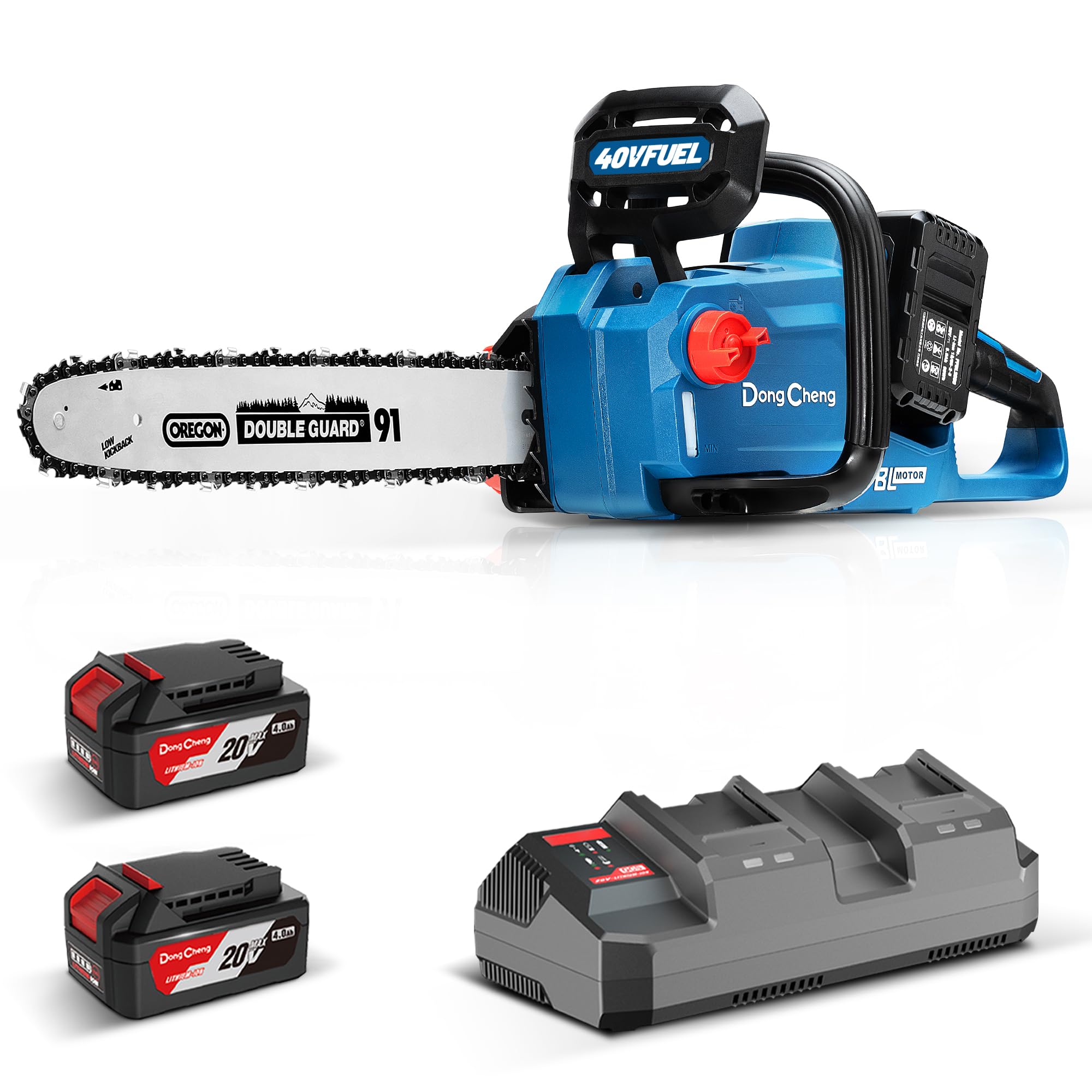
The DongCheng 40V 16-inch brushless chainsaw brings serious value to the cordless category by pairing a high-torque brushless motor with dual 4.0 Ah batteries that produce 40V total. The manufacturer claims up to 120 cuts through 4×4 lumber on a single charge, and real-world testing on dry pine and cedar confirms the saw maintains power through 80 to 100 cuts before noticeable slowdown. The 16-inch bar is versatile enough for limbing, bucking medium logs, and firewood processing, and the tool-free chain tensioning knob allows quick adjustments without tools.
The automatic oiler provides continuous bar and chain lubrication, and the inertia-activated chain brake engages in under 0.1 seconds during kickback. The included dual bay charger replenishes both 4.0 Ah batteries in about 20 minutes each — genuinely fast for this capacity class. The batteries are compatible with DongCheng’s 20V and 40V tool platforms, allowing shared use across drills, impact drivers, and other outdoor power equipment.
Build quality is solid for the price point, though some units have arrived with a faulty chain oiler that required replacement. The saw is well-balanced and quiet enough for suburban use, and the brushless motor eliminates brush replacements entirely. The plastic housing feels durable but not premium, and the chain speed of 14 m/s is slightly slower than premium cordless models like the Husqvarna 350i. Long-term durability beyond two years of regular use is unproven, but early adopters report excellent performance for the price.
Why it’s great
- Dual 4.0 Ah batteries provide extended runtime
- Fast charging in under 20 minutes per battery
- Brushless motor eliminates maintenance
Good to know
- Occasional quality issues with chain oiler
- Chain speed is slower than premium cordless models
- Long-term durability unproven
9. Dewalt DCCS623B 20V 8-Inch

The Dewalt DCCS623B is a purpose-built pruning chainsaw designed for one-handed operation in tight spaces, featuring an 8-inch bar that handles branches up to 7 inches in diameter with surprising ease. At 4.6 pounds without the battery, it weighs less than most gas-powered pole pruners and can be used comfortably for extended overhead trimming sessions. The 2.8 HP brushless motor draws power from Dewalt’s 20V Max battery platform, and the tool-only configuration (battery and charger sold separately) makes it an affordable addition for existing Dewalt owners.
The oil fill port is conveniently located and accepts standard bar and chain oil, and the included wrench stores neatly in the scabbard for quick access. The chain tensioning system is simple and secure, staying tight through multiple cuts without requiring adjustment. Battery life is excellent — owners report a full weekend of trimming on a single 5.0 Ah charge, and the saw handles 3.5-inch oak logs without bogging down. The safety switch is intentionally stiff to prevent accidental startups, which some users find annoying but adds genuine safety during transport.
The 8-inch bar is the limiting factor — this saw cannot cut logs larger than 7 inches in diameter, and it is not suitable for bucking firewood or felling trees. The lack of an automatic oiler means you must manually lubricate the bar and chain, though the Oregon R34 replacement chain is widely available and affordable. For the homeowner who needs a lightweight saw for clearing saplings, pruning low limbs, and storm debris cleanup, the DCCS623B is hard to beat.
Why it’s great
- Ultra-compact and lightweight for one-handed use
- Excellent battery life on Dewalt 20V platform
- Handles branches up to 7 inches with ease
Good to know
- Battery and charger sold separately (tool-only)
- 8-inch bar limits maximum cut diameter to 7 inches
- No automatic oiler — requires manual lubrication
FAQ
Why do some gas chainsaws specify 25:1 instead of 50:1 fuel mix?
How often should I replace the chain on a home-use chainsaw?
Can I use a gas chainsaw in a residential neighborhood without causing complaints?
What does the chain brake do and should I test it regularly?
Final Thoughts: The Verdict
For most users, the best chainsaw for home use winner is the Oregon CS1500 because the self-sharpening PowerSharp system eliminates the most tedious maintenance task, and the 15-amp motor paired with an 18-inch bar handles the vast majority of home cutting tasks without the weight or maintenance of gas. If you want cordless convenience with gas-like power, grab the Husqvarna Power Axe 350i. And for compact trimming and pruning where weight matters most, nothing beats the Dewalt DCCS623B for maneuverability and ease of use.