
Lower back pain from sitting is not a badge of honor for a hard day’s work—it is a biomechanical failure of your chair. A proper lumbar support bridge that gap between your spine’s natural inward curve and a flat, unsupportive backrest is the single most important feature to prevent slouching, disc compression, and the shooting ache that sets in after hour three of a shift. Ignoring it means your body pays the price every single day.
I’m Min — the co-founder and writer behind Gadgets Feed. I’ve spent hundreds of hours parsing the engineering specs, mesh densities, adjustability ranges, and foam compression rates of dozens of ergonomic chairs to find which ones truly deliver targeted lumbar relief.
Whether you suffer from chronic back stiffness or simply want to avoid developing it, understanding the difference between a fixed curve and a fully adjustable system is critical. This guide breaks down the engineering, the materials, and the real-world performance of the chair for lumbar support that actually works.
How To Choose The Best Chair For Lumbar Support
Lumbar support is not a single feature—it exists on a spectrum from a fixed curve molded into the backrest to a fully independent, multi-axis mechanism that moves with your spine. Choosing incorrectly means you either never feel the support or you feel a hard plastic nub exactly where it should not be.
Adjustability Range
The best lumbar supports allow you to shift the pad vertically (up/down) to align with the natural inward curve of your lower back, and horizontally (in/out) to dial in the depth of pressure. A fixed lumbar bump is better than nothing, but a system with at least 2 inches of vertical travel and 1 inch of depth travel will fit a far wider range of body types and sitting postures.
Backrest Material and Tension
Mesh backs breathe and flex, but their tension must be high enough to hold your spine in correct alignment without sagging over time. Leather or padded backs feel plush but trap heat and may lack the firm, targeted push that a true lumbar support needs. Look for a taut, high-elasticity mesh or a firm foam that maintains its shape after hours of compression.
Seat Depth and Cushioning
If the seat pan is too deep, you will be forced to slouch, rendering any lumbar support useless by flattening your curve. An adjustable seat depth (also called seat slide) lets you set the distance from back to knees. Pair that with supportive foam or mesh that does not compress to the frame, and you have a baseline for real ergonomic success.
Quick Comparison
On smaller screens, swipe sideways to see the full table.
| Model | Category | Best For | Key Spec | Amazon |
|---|---|---|---|---|
| Steelcase Leap | Premium | All-day office work | Lower back firmness dial + 3D LiveBack | Amazon |
| Hbada X7 Smart | Premium | Smart auto-adjusting lumbar | 3D auto-tracking lumbar + 8D massage | Amazon |
| ProtoArc EC200 | Mid-Range | Precise vertical/horizontal lumbar tuning | 2.36″ vertical + 0.8″ depth lumbar | Amazon |
| ELABEST T96 | Mid-Range | Bionic curve back relief | Bionic-curve backrest + synchro-tilt | Amazon |
| MOLENTS ML230 | Mid-Range | Tall users needing solid mesh | Up/down + forward/back lumbar | Amazon |
| GABRYLLY GYMAX-T | Mid-Range | Big & tall with deep recline | 2-mode lumbar height/depth | Amazon |
| GABRYLLY GYMN01 | Mid-Range | Napping with footrest | 3″ vertical + 1.6″ horizontal lumbar | Amazon |
| COLAMY Executive | Mid-Range | Plush leather with pop-out lumbar | Push-button pop-out lumbar | Amazon |
| YFO Home Office | Budget | Budget-friendly leather option | Sponge-reinforced back | Amazon |
In‑Depth Reviews
1. Steelcase Leap Office Chair

The Steelcase Leap has earned its reputation through a lower back firmness dial that lets you fine-tune the pressure of the lumbar support—not just its position. The Natural Glide System moves the seat pan forward and backward as you recline, preventing your shirt from riding up and keeping your lumbar curve engaged at every tilt angle. With seven points of adjustment, this chair accommodates body shapes and work styles that most chairs cannot.
Its 3D LiveBack technology mimics the spine’s natural movement, widening and narrowing the backrest as you shift from leaning forward to reclining. This dynamic contouring means the lumbar support never disappears—it adjusts with you rather than staying fixed in one spot. The seat depth adjustment is also critical for ensuring your lower back contacts the support rather than the edge of the chair.
Some users report a break-in period where the foam seat padding feels firm initially, and used or refurbished units may have minor creaks. At this price point, the investment is justified by the longevity and the depth of ergonomic engineering, but budget-conscious buyers should consider whether they need this level of full-array customization.
Why it’s great
- Independent lumbar firmness dial for precise pressure tuning
- Natural Glide System keeps lumbar engaged during recline
- 3D LiveBack mirrors actual spine movement
Good to know
- Significant investment compared to mid-range options
- Seat padding may feel firm; some users add a cushion
- Some used units reported minor fit and finish issues
2. Hbada X7 Smart Ergonomic Chair
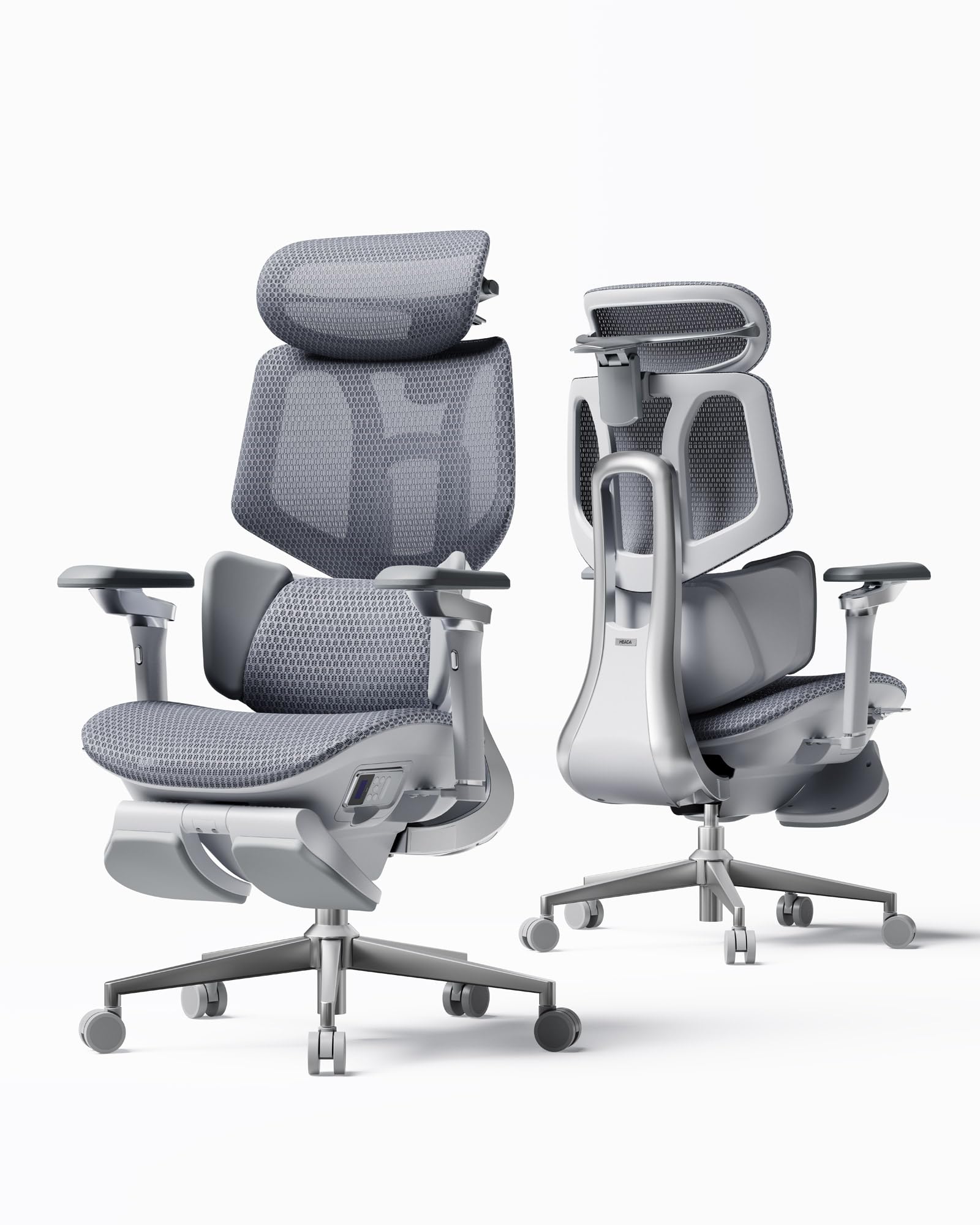
Where the Hbada X7 diverges from every other chair is its gravity-sensing base that auto-adjusts lumbar support intensity in real time. A 6D adjustable waist pillow aligns with your spine’s curve while 8D massage rollers with three levels of heating (40–50°C) work out muscle knots during long sessions. This is the only chair on this list that actively treats back fatigue rather than just holding your posture.
The ventilated seat cushion integrates a dual-fan cooling system with three airflow speeds—Silent, Balanced, and Turbo—claiming 65% improved breathability over standard mesh. The 720° omnidirectional armrests and 140° recline make this chair feel like a command center, though it remains firm and supportive rather than soft. The aluminum frame and 5-star nylon base support up to 330 lbs.
Tall users above 6 feet may find that the standard gas cylinder does not provide enough height to achieve an ideal 90-degree angle at the hips, requiring a replacement cylinder. The fans and massage motors also introduce complexity without an off-switch for the electronics, and a few users report that the lumbar tracking gimmick takes time to calibrate properly.
Why it’s great
- Active smart lumbar tracking adapts pressure dynamically
- Built-in massage and heating for real muscle relief
- Dual-fan ventilated seat for long, cool sessions
Good to know
- Electronics add potential failure points over the long term
- Not ideal for users over 6 ft without a taller gas cylinder
- Smart features have a learning curve and calibration needed
3. ProtoArc EC200 Ergonomic Office Chair
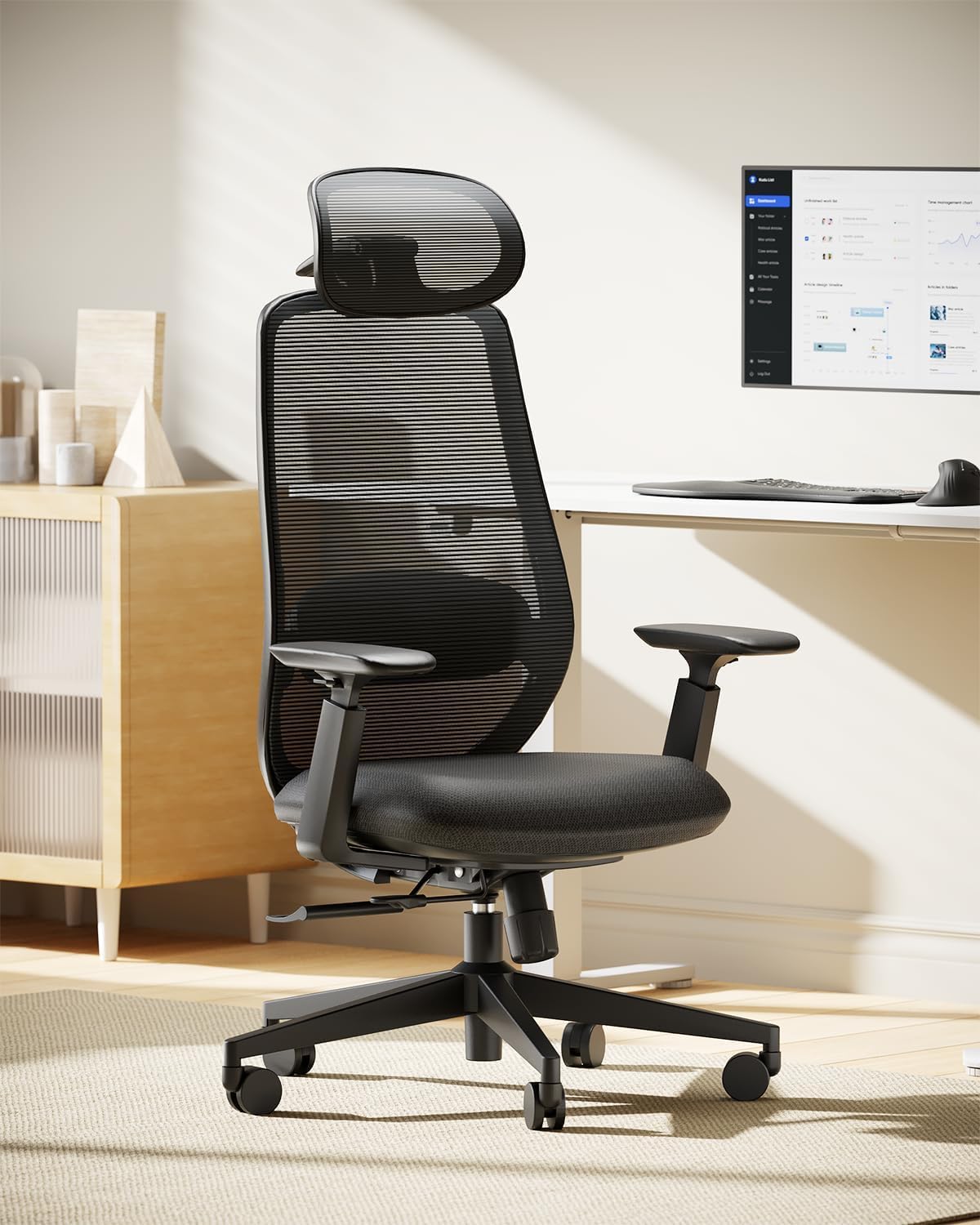
The ProtoArc EC200 targets users between 5’4″ and 6’0″ with a lumbar support system that adjusts 2.36 inches vertically and 0.8 inches in depth independently. This dual-axis movement is rare at its price level and makes the critical difference between a support pad that hits your belt line versus one that actually fills the hollow of your lower back. The pad itself is padded foam rather than hard plastic, so it provides comfort along with structure.
Beyond lumbar support, the EC200 offers a 5-position sliding seat depth with 1.97 inches of travel and an instant lock mechanism. This ensures that shorter users can rest their full thighs on the cushion without dangling knees, a feature that most chairs in this bracket ignore. The 55D high-density foam seat, 3D wider headrest, and 4-stage recline (90° to 130°) round out a package designed for 8+ hour coding and remote work sessions.
At 5’3″, the lowest seat height may still be slightly tall for petite users who prefer to plant their feet flat. The mesh is breathable but firm, which some may find less cushioned than padded alternatives. Assembly is straightforward at around 20 minutes, but the heavy 45-pound build requires patience during unboxing.
Why it’s great
- Independent vertical and depth lumbar adjustment for precise fit
- 5-position sliding seat adapts to different leg lengths
- 55D high-density foam seat resists sagging
Good to know
- Lowest seat height may be too tall for very short users
- Firm mesh seat takes adjustment time for some users
- Heavy chair at 45 pounds
4. ELABEST Ergonomic Mesh Office Chair T96

The ELABEST T96 uses a bionic-curve backrest that is molded to follow the natural S-shape of the spine, paired with an adjustable lumbar pad that moves independently within that curve. Unlike standard single-layer mesh that loses tension, this chair’s mesh is high-grade and stretch-resistant, and the synchro-tilt mechanism has three lockable positions with adjustable tension, giving you precise lower back relief that does not fade over 8-hour stretches.
The “Golden Triangle” back structure specifically supports the shoulders and upper back, distributing load away from the lumbar area during intense focus tasks such as typing and coding. The 3D adjustable armrests allow customization of height, width, and angle, further reducing upper body strain that can indirectly affect lower back posture. The full-mesh seat prevents heat buildup, and the waterfall front edge promotes leg circulation.
Some users find the armrests too wide for narrow desk setups, though the manufacturer offers rotating replacements upon request. The chair performs best for individuals 5’5″ to 5’10” and under 200 lbs; taller or heavier users may find the mesh tension insufficient for long-term support. Assembly is manageable in 20–30 minutes, and BIFMA 5.1 certification ensures commercial-grade durability.
Why it’s great
- Bionic-curve backrest mimics natural spine alignment
- Golden Triangle shoulder support reduces upper back fatigue
- BIFMA 5.1 certified for long-term commercial use
Good to know
- Armrests may be too wide for narrow builds; rotating replacements available
- Best fit for 5’5″–5’10” users under 200 lbs
- Mesh feels firm initially; no plush padding
5. MOLENTS Ergonomic Office Chair ML230

The MOLENTS ML230 offers lumbar support that adjusts both up/down and forward/back, providing targeted pressure for the lower back curve. This dual-axis adjustability is comparable to chairs costing more, and the mesh back is taut enough to resist deformation over time. Users report that it helps eliminate lower back pain within days when dialed in correctly, making it a strong contender for anyone with existing lumbar issues.
The 3D armrests allow width, height, and angle customization, and the backrest reclines from 90° to 120° with three lockable positions. The seat depth, width, and cushioning are generous, accommodating taller users up to 6’2″ and heavier builds without the frame creaking. Breathable mesh construction keeps the back cool during extended use, and the seat mesh tension holds up well under sustained weight.
Some taller users find the headrest positioning limited, and the armrest panels—designed to slide forward/back and rotate—may feel loose to those who prefer a fixed platform. The wheels are smooth on hard floors but may struggle on plush carpets without a mat. Assembly is well-documented with labeled parts, typically taking around 15–20 minutes.
Why it’s great
- Dual-axis lumbar adjustability for precise targeting
- Exceptional build handling tall and heavier users
- High-tension breathable mesh resists sagging
Good to know
- Headrest may not reach ideal support for very tall users
- Sliding armrest panels may feel wobbly for some
- Wheels underperform on thick carpet without a mat
6. GABRYLLY Ergonomic Office Chair GYMAX-T

The GABRYLLY GYMAX-T features a 2-mode lumbar system: adjust up/down 2 inches to match the curve of your lower back, or slide it forward/back 1.6 inches to control pressure intensity—from a gentle cradle for light tasks to a firm push for deep focus sessions. Designed for users 5’6″ to 6’3″ and supporting up to 400 lbs, its high-back frame and 20-inch wide foam seat provide full-body ergonomic cradling that does not compromise on lumbar specificity.
The 5D flip-up armrests adjust for height, slide, rotation, and a lift-up function that saves space and allows cross-legged sitting. The 135° recline with three preset angles works in tandem with the lumbar adjustment so you maintain support even when leaning back. The seat cushion features 5-inch thick high-density foam with built-in springs, offering sofa-like bounce without the sinking feeling that causes lower back strain. Breathable mesh construction keeps you cool, and the 3D headrest reduces neck tension.
Some users report that the flip-up armrests shift unintentionally under movement, and the mesh on the backrest may feel taut to the point of being less comfortable for users with sensitive skin. The 45-pound weight makes it a permanent fixture in your space rather than a chair to frequently move. Assembly is straightforward with included tools, and the 3-year parts warranty provides long-term peace of mind.
Why it’s great
- 2-mode lumbar adjusts height and depth independently
- Supports up to 400 lbs with a wide, stable seat
- 5D flip-up armrests save space and allow varied postures
Good to know
- Armrests may shift unintentionally under pressure
- Mesh back can feel taut for sensitive skin
- Heavy at 45 lbs; not portable
7. GABRYLLY Ergonomic Office Chair GYMN01
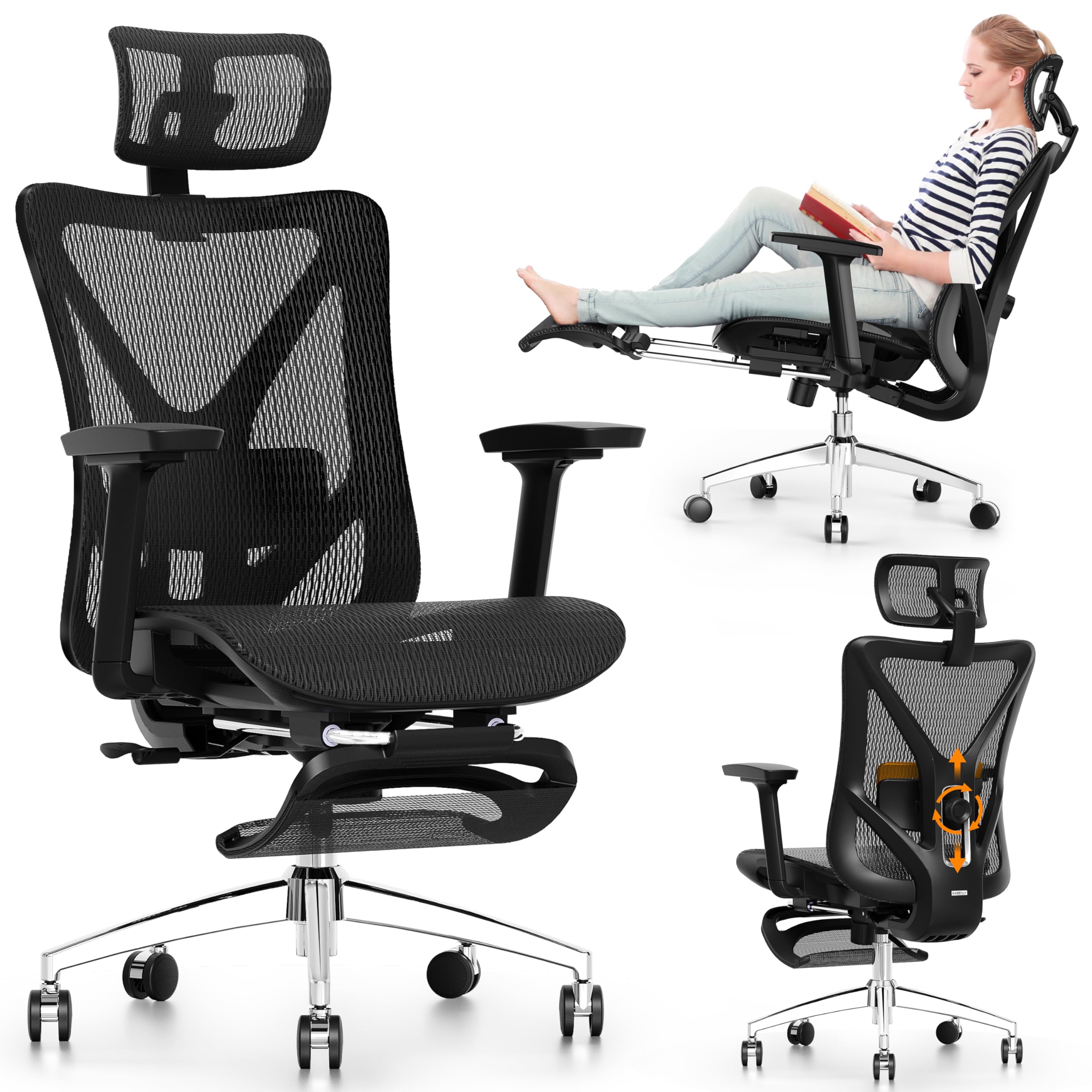
The GABRYLLY GYMN01 pairs a 2-way adjustable lumbar support—3 inches of vertical travel and 1.6 inches of depth travel—with a retractable steel footrest that extends up to 18.1 inches. This makes it unique among lumbar-focused chairs: you can dial in the exact curve of your lower back and then recline 135° with your legs elevated, reducing disc pressure in a way that a standard upright chair cannot. The lumbar support is independently adjustable from the recline, so you feel the same targeted push whether sitting up or leaning back.
The 3D armrests allow height, front/back, and in/out adjustments, and the large mesh headrest offers three degrees of regulation. The steel base has a 27.5-inch diameter for stability during reclining, and the silent caster wheels roll smoothly across various floors. SGS and BIFMA testing certify the chair for up to 300 lbs, and the mesh construction promotes airflow to prevent heat buildup during long sessions.
Some reviews note that the mesh material feels lower in quality and more taut than expected, which can become uncomfortable for users with sensitive skin after several hours. The armrests may shift under pressure and produce a clicking sound, and the lumbar adjustment mechanism itself requires some force to reposition, which can be a minor inconvenience when fine-tuning your setup.
Why it’s great
- Extensive lumbar adjustment range (3″ vertical, 1.6″ depth)
- Retractable steel footrest allows reclining leg elevation
- 3D armrests and headrest for full-body ergonomics
Good to know
- Mesh material may feel stiff and taut for some users
- Armrests can shift and click under movement
- Lumbar adjustment requires moderate manual force
8. COLAMY Office Ergonomic Desk High Back Executive Chair

The COLAMY Executive Chair takes a different approach to lumbar support with a pop-out mechanism that activates with a push of a button, extending a built-in support pad outward from the backrest. This provides an adjustable lower back bulge that can be manually deployed when needed and retracted when not. While not as finely tunable as a sliding mechanism, it offers a clear tactile feedback that works well for users who want a simple on/off lumbar presence.
Its defining feature is a 6.7-inch thick high-density foam seat cushion with a waterfall front edge that reduces thigh pressure and improves circulation. The selected leather upholstery adds a glossy, textured finish that is easy to clean, and the flip-up armrests let you slide the chair completely under a desk to save space. Upgraded casters roll silently and protect hard floors, and the heavy-duty metal base supports up to 300 lbs.
Some users report that the pop-out lumbar support feels flat and insufficiently pronounced, and the headrest button may be defective on certain units, causing it to sink to the lowest position. The seat height range is limited to under 3 inches of lift, which can be restrictive for taller users. Assembly takes 20–30 minutes, and the leather upholstery may trap heat during long summer workdays.
Why it’s great
- Simple pop-out lumbar activation for easy adjustment
- Massive 6.7″ thick foam cushion for extended comfort
- Flip-up arms save space under desks
Good to know
- Lumbar support may be too flat for users needing deep curve fill
- Seat height range is limited under 3 inches
- Leather upholstery can trap heat; less breathable than mesh
9. YFO Home Office Desk Chair

The YFO Home Office Desk Chair takes a straightforward approach to lumbar relief: it increases the sponge padding on the backrest to create a supportive curve that is more pronounced than a standard flat-back chair. While not independently adjustable, this built-in lumbar shape is bolstered by a seat cushion that uses sturdy wooden boards, soft sponge, and highly elastic spring packs to maintain a comfortable sitting surface that reduces the feeling of lower back fatigue over long periods.
Its mid-back design offers a generous 22-inch seat width and 20-inch depth, accommodating a variety of body types. The rubber casters are designed for smooth, quiet rolling on wood floors, carpet, and marble. A unique 2-in-1 feature allows you to install or remove the armrests, converting the chair into a cross-legged sitting option—useful for those who prefer to sit in non-standard positions to relieve back pressure. Assembly is simple with included tools.
The mid-back version lacks the adjustable armrests and recline features of its high-back sibling, which limits ergonomic customization. Some users report that the lumbar support, while present, does not project far enough forward to fill a deep lower back curve for taller individuals. The brown leather faux finish is attractive but may not breathe as well as mesh, and the overall build quality, while good for the price, is not designed for the 10-hour daily grind.
Why it’s great
- Built-in sponge lumbar curve provides noticeable back relief
- Wide seat (22″) and rubber casters work on multiple floors
- Removable armrests allow cross-legged sitting posture
Good to know
- Lumbar support is fixed and non-adjustable
- Mid-back version lacks adjustable arms and recline
- Leather finish is less breathable than mesh
FAQ
How much lumbar support travel do I actually need?
Is mesh or leather better for lower back support?
Final Thoughts: The Verdict
For most users, the chair for lumbar support winner is the ProtoArc EC200 because it offers independent vertical and depth lumbar adjustment, a sliding seat depth, and high-density foam at a mid-range price that balances features and value. If you want active, technology-driven lumbar relief, grab the Hbada X7 Smart. And for uncompromised, commercial-grade lower back support with a firmness dial, nothing beats the Steelcase Leap.