
Chronic neck and shoulder pain often begins with a single culprit: a chair that forces your head forward and rounds your upper back. When your workspace seat lacks proper head and lumbar support, your trapezius and cervical spine muscles work overtime just to hold your head upright, eventually leading to stiffness, tension headaches, and reduced mobility. A correctly engineered chair actively supports your cervical curve and scapular alignment, allowing those overworked muscles to finally relax.
I’m Min — the co-founder and writer behind Gadgets Feed. This guide distills hundreds of hours spent analyzing ergonomic backrest geometries, lumbar tracking mechanisms, and headrest adjustability ranges across nine competing models to find the seats that genuinely reduce upper body strain.
Whether you work from home, spend long hours gaming, or need relief from chronic desk-related discomfort, picking the right chair for neck and shoulder pain can transform how your body feels after a full day of sitting.
How To Choose The Best Chair For Neck And Shoulder Pain
Neck and shoulder pain from sitting is rarely about the chair alone — it is about how the chair’s geometry interacts with your spine. A seat that supports your lower back correctly prevents your shoulders from rolling forward, which in turn keeps your neck from jutting out. You must evaluate four key elements to break this chain of compensation.
Headrest Adjustability: Not Just a Pillow
A fixed headrest that pushes your head forward is worse than none. Look for a headrest with independent height, angle, and depth (forward/backward) adjustment. The ideal headrest supports the base of your skull — the suboccipital region — without forcing your chin toward your chest. Models with a 4D or multi-directional headrest allow you to dial in this exact contact point regardless of your height.
Lumbar Support That Prevents Upper Back Hunch
When your lumbar curve collapses, your pelvis tilts backward, your upper back rounds, and your neck extends forward to keep your eyes level. The best chairs for neck and shoulder pain use either adjustable-height lumbar pads or self-tracking mechanisms that follow your spine as you recline. Height-adjustable lumbar support (vertical range of at least 3 inches) lets you target the exact curve of your lower back, reducing the upstream stress on your shoulders and neck.
Armrest Customization and Shoulder Tension
Armrests that are too high force your shoulders to elevate and your trapezius muscles to contract statically. Look for 3D or 4D armrests that adjust in height, width, and angle (and ideally depth). Flip-up or fixed armrests can work if the height range matches your desk, but 3D/4D units provide the fine tuning needed to keep your arms at a 90-degree angle with relaxed shoulders.
Quick Comparison
On smaller screens, swipe sideways to see the full table.
| Model | Category | Best For | Key Spec | Amazon |
|---|---|---|---|---|
| Steelcase Leap | Premium | Gold-standard ergonomic adjustability | Natural Glide System + LiveBack spine mimicry | Amazon |
| Hbada X7 Smart | Premium | Auto-adapting lumbar with massage/heat | Auto lumbar tracking + 8D massage rollers | Amazon |
| Secretlab Titan Evo | Premium | Tall/heavy users needing firm support | Cold-cure foam + 4D armrests + 4-way lumbar | Amazon |
| Ergohuman ME7ERG GEN2 | Premium | Long-term durability with full mesh | Synchro tilt + seat depth + back height adjustment | Amazon |
| Newtral Ergonomic Chair | Mid-Range | Innovative auto-following lumbar tracking | Auto-follow lumbar + seat depth + 3D arms | Amazon |
| TRALT Ergonomic Chair | Mid-Range | High-density foam seat with flip-up arms | 3.5-inch high-density sponge + 330 lb capacity | Amazon |
| ELABEST T96 | Mid-Range | Golden Triangle shoulder support mesh | Bionic-curve backrest + 3D armrests | Amazon |
| MOLENTS Ergonomic Chair | Value | Budget-friendly full-mesh with wide seat | 90-120° recline + 3D arms + adjustable lumbar | Amazon |
| GABRYLLY Ergonomic Chair | Value | 135° recline with integrated footrest | 3-position recline + retractable steel footrest | Amazon |
In‑Depth Reviews
1. Steelcase Leap Office Chair

The Steelcase Leap is the benchmark for upper-body ergonomics. Its 3D LiveBack technology uses a flexible backrest that mimics the natural curvature of your spine as you move, preventing the mid-back rounding that forces your neck into forward-head posture. The lower back firmness dial lets you dial in exactly the lumbar push needed to keep your shoulders from rolling inward.
The Natural Glide System allows the seat to slide forward as you recline, maintaining a consistent distance to your desk so you don’t hunch to reach your keyboard. With 4D adjustable arms and a waterfall-edge seat cushion that relieves pressure behind your knees, this chair offers seven distinct points of adjustment — more than enough to tune out the specific stiffness points in your cervical and trapezius muscles.
The seat depth adjustment and “label-free” control layout make it intuitive, and the polyester fabric breathes better than leather alternatives.
Why it’s great
- Active lumbar support prevents upper back compensation
- Seat glide keeps you from hunching while reclining
- Exceptional build quality with long-term durability
Good to know
- Premium price places it out of budget for some
- Initial break-in period required for best comfort
2. Hbada X7 Smart Ergonomic Chair
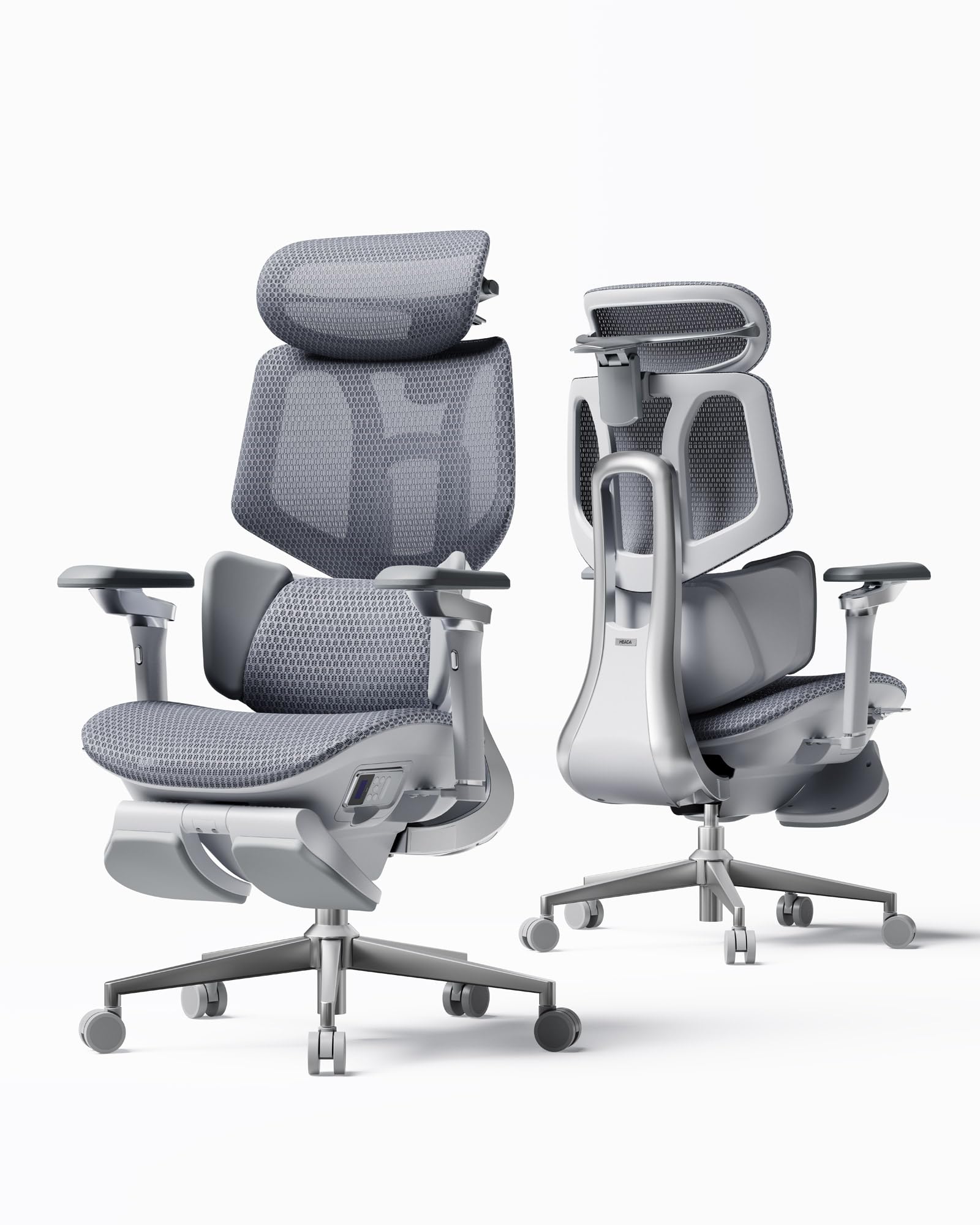
The Hbada X7 takes a radically different approach to neck and shoulder relief: a gravity-sensing base that automatically adjusts lumbar support intensity as you shift position. This dynamic response keeps your spine aligned without requiring manual knob-twiddling, reducing the likelihood of forgot-to-adjust slouching that strains your upper back and neck.
The chair also integrates 8D massage rollers with three-level heating (104-122°F or 40-50°C), which can directly target the knots that form in your rhomboids and trapezius during long sessions. The 4D headrest offers 70° rotation, 55 mm of slide, and 45 mm of height adjustment, giving you precise suboccipital contact that keeps your cervical spine neutral rather than flexed.
With a dual-fan ventilated seat and an aircraft-grade aluminum frame rated for 330 lbs, the X7 delivers advanced features without compromising on structural integrity. The 720° omnidirectional armrests (360° rotation plus 110 mm extension) let you position your arms exactly where your shoulders sit relaxed.
Why it’s great
- Auto-adjusting lumbar removes guesswork
- Massage and heat directly target upper back tension
- Highly adjustable headrest supports cervical neutral zone
Good to know
- Seat depth may feel short for users over 6’2″
- Advanced features may not appeal to minimalists
3. Secretlab Titan Evo Arctic White Gaming Chair

The Secretlab Titan Evo is engineered for users who require broad back coverage and high weight capacity without sacrificing ergonomic precision. Its 4-way built-in adjustable lumbar support — not a separate pillow — lets you fine-tune both the height and the depth of the curve, which directly affects how your upper back and neck align when you sit upright.
The magnetic memory foam head pillow attaches to the backrest and can be repositioned across a wide range, providing targeted neck support for users from 5’7″ to 6’9″ depending on the size variant. The cold-cure foam seat is initially firm but molds over time to your body, maintaining consistent support that prevents the pelvic tilt that leads to shoulder rounding.
Full-metal 4D armrests with replaceable tops allow precise width and height adjustment to keep your shoulders from hiking up. The 165° recline and multi-tilt mechanism mean you can find a posture that offloads your cervical spine completely during breaks.
Why it’s great
- 4-way lumbar targets the curve that controls shoulder position
- Magnetic head pillow provides customizable suboccipital support
- Firm foam prevents sacral sitting and spinal slump
Good to know
- Seat can feel firm for lighter users
- Lumbar may not reach low enough for some body types
4. Ergohuman Eurotech ME7ERG GEN2

The Ergohuman ME7ERG GEN2 has earned a cult following among office workers who suffer from chronic neck and shoulder tension. Its synchro-tilt mechanism keeps your feet flat on the floor while the backrest reclines, maintaining the open hip angle that prevents your lumbar spine from flattening — a common cause of upper back compensation.
The chair offers back height adjustment (27-30 inches), seat depth adjustment, and an adjustable lumbar support that moves with you. The full-mesh back provides constant airflow, preventing the heat buildup that can discourage movement. The headrest is adjustable in height and angle, allowing you to find the exact position that supports your cervical lordosis without pushing your head forward.
Owners commonly report that the GEN2 holds up for 10-15 years with minimal wear. The limited lifetime warranty covers the frame and mechanism, making it a durable investment for those who rely on their chair for daily pain management.
Why it’s great
- Synchro-tilt preserves lumbar curve through recline
- Full mesh prevents heat and moisture accumulation
- Back height adjustment suits different torso lengths
Good to know
- Casters on the standard version may feel cheap
- Armrest foam can deteriorate over time
5. Newtral Ergonomic Home Office Chair

The Newtral chair sets itself apart with an auto-following lumbar support that uses a spring-loaded mechanism to track your spine’s movement as you shift. Instead of a fixed pad that only works in one position, this system provides continuous lower back contact that keeps your pelvis neutral and your upper back from rounding forward to compensate.
The 4D headrest provides adjustable height, angle, and depth, allowing you to dial in the exact point where your neck transitions from tension to relaxation. The seat depth adjustment (2 inches of forward/backward slide) ensures your thighs are fully supported without compressing your calves, which prevents the slumped posture that stresses your cervical spine.
Endorsed by ergonomist Iris Sokol, the Newtral uses a KGS Class 4 gas lift made in Korea and a 7 cm high-density foam cushion wrapped in waterproof, flame-retardant fabric. The 3D armrests adjust in height, width, and angle to keep your shoulders from hiking up during typing.
Why it’s great
- Auto-follow lumbar adapts to your movement
- Seat depth adjustment prevents thigh restriction
- High-quality Korean gas lift ensures long-term reliability
Good to know
- Armrests can move unintentionally with light contact
- Backrest spring mechanism can be noisy on some units
6. TRALT Ergonomic Office Chair
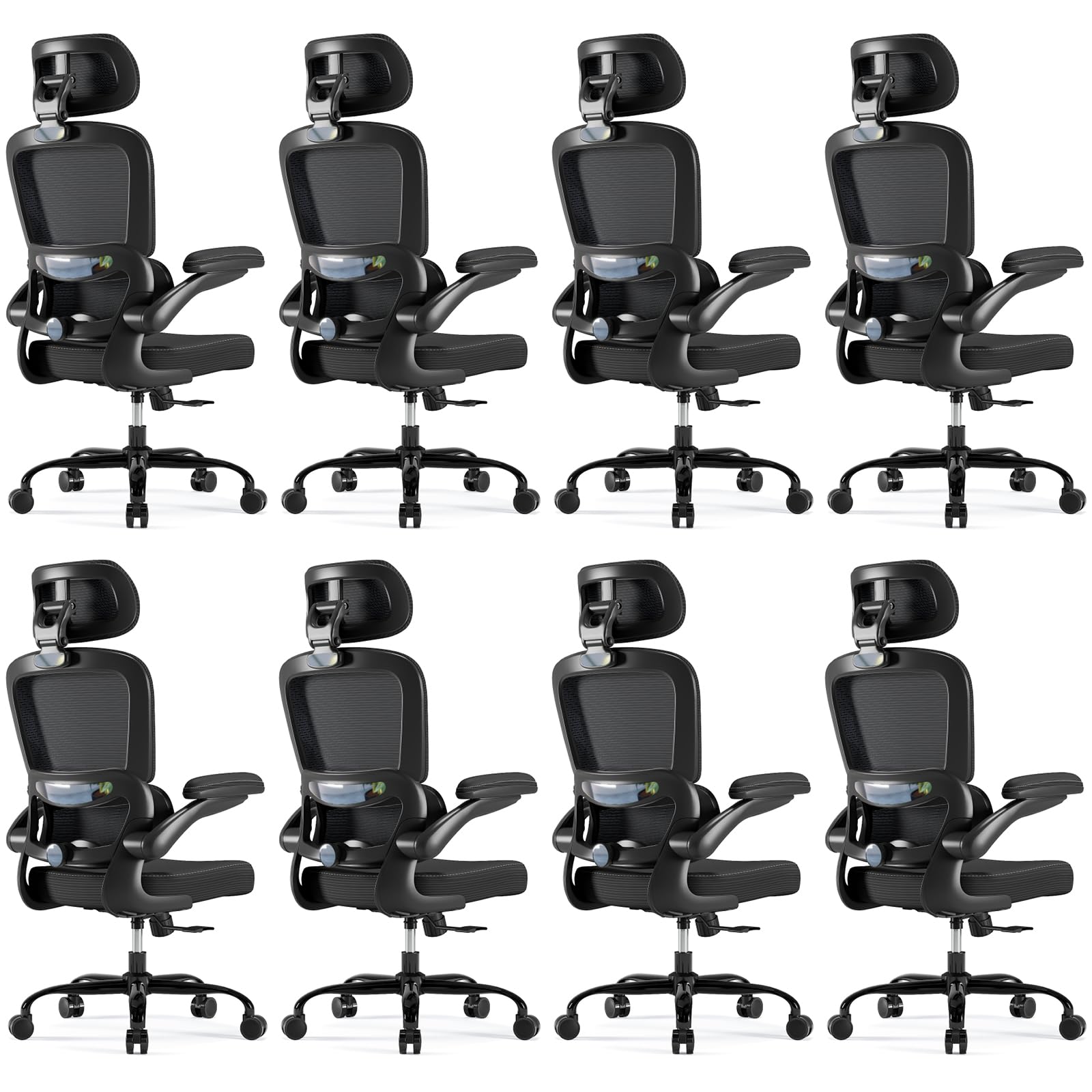
The TRALT chair delivers a generous 20-inch wide seat and a 3.5-inch high-density sponge cushion that resists sagging, providing a stable base that keeps your pelvis level. A level pelvis prevents the posterior tilt that triggers upper back rounding and forward-neck posture. The chair supports up to 330 lbs, accommodating a wide range of body types.
The adjustable lumbar support and headrest allow basic but effective customization for neck and shoulder alignment. The flip-up armrests free up space when you need to slide closer to your desk, and the leather seat cover is easy to clean while the mesh back keeps your upper body ventilated.
Assembly takes 25-30 minutes with clear instructions, and the metal frame and Class 3 gas lift provide reliable stability for daily use.
Why it’s great
- High-density foam resists sagging and maintains posture
- Wide seat distributes weight evenly
- Flip-up armrests are space-efficient
Good to know
- Flip-up armrests lack stability for heavy leaning
- Headrest may feel too far back for shorter users
7. ELABEST Ergonomic Mesh Office Chair T96

The ELABEST T96 is specifically designed with a “Golden Triangle” back structure that provides targeted support for the shoulders and upper back. This is a critical differentiator for neck and shoulder pain sufferers because the chair actively resists the rounded-shoulder posture that pulls on the cervical spine. The bionic-curve backrest mimics your spine’s natural shape rather than a flat grid.
The 3D adjustable armrests (height, width, angle) help keep your arms at a neutral 90-degree position, reducing trapezius tension. The adjustable lumbar support moves vertically and forward/backward to fill the curve of your lower back, which prevents the upstream compensation that tightens your neck muscles. The synchro-tilt mechanism offers three lockable positions.
BIFMA 5.1 certified and constructed with a metal frame, the T96 is built for commercial-grade durability. The full-mesh seat eliminates heat buildup, and the waterfall-edge seat design promotes healthy blood flow to your legs.
Why it’s great
- Golden Triangle back reinforces shoulder position
- Bionic-curve backrest matches spinal curvature
- 3D armrests allow fine shoulder angle adjustment
Good to know
- Armrests may be too wide for narrow-shouldered users
- Best suited for heights 5’5″ to 5’10”
8. MOLENTS Ergonomic Office Chair

The MOLENTS chair proves you can address neck and shoulder pain without spending a fortune. Its adjustable lumbar support moves up/down and forward/backward, giving you the ability to fill the curve of your lower back and prevent the upper back rounding that strains your neck. The 3D armrests adjust in height and angle to keep your shoulders relaxed.
The full-mesh seat and back provide exceptional breathability, reducing sweat accumulation that can cause fidgeting and poor posture. The three-position recline (90-120°) allows you to shift between work and rest positions, preventing the static loading that stiffens your trapezius muscles.
BIFMA quality-tested and with a 19.8-inch wide seat, the MOLENTS accommodates users from 5′ to 6′ with its 19.5 to 23.3 inch seat height range. Assembly is straightforward with labeled parts.
Why it’s great
- Dual-axis adjustable lumbar supports lower back curve
- Full mesh keeps you cool for long sessions
- Wide seat accommodates different body types
Good to know
- Armrests may feel short for some users
- Wheels may struggle on thick carpet
9. GABRYLLY Ergonomic Office Chair with Footrest
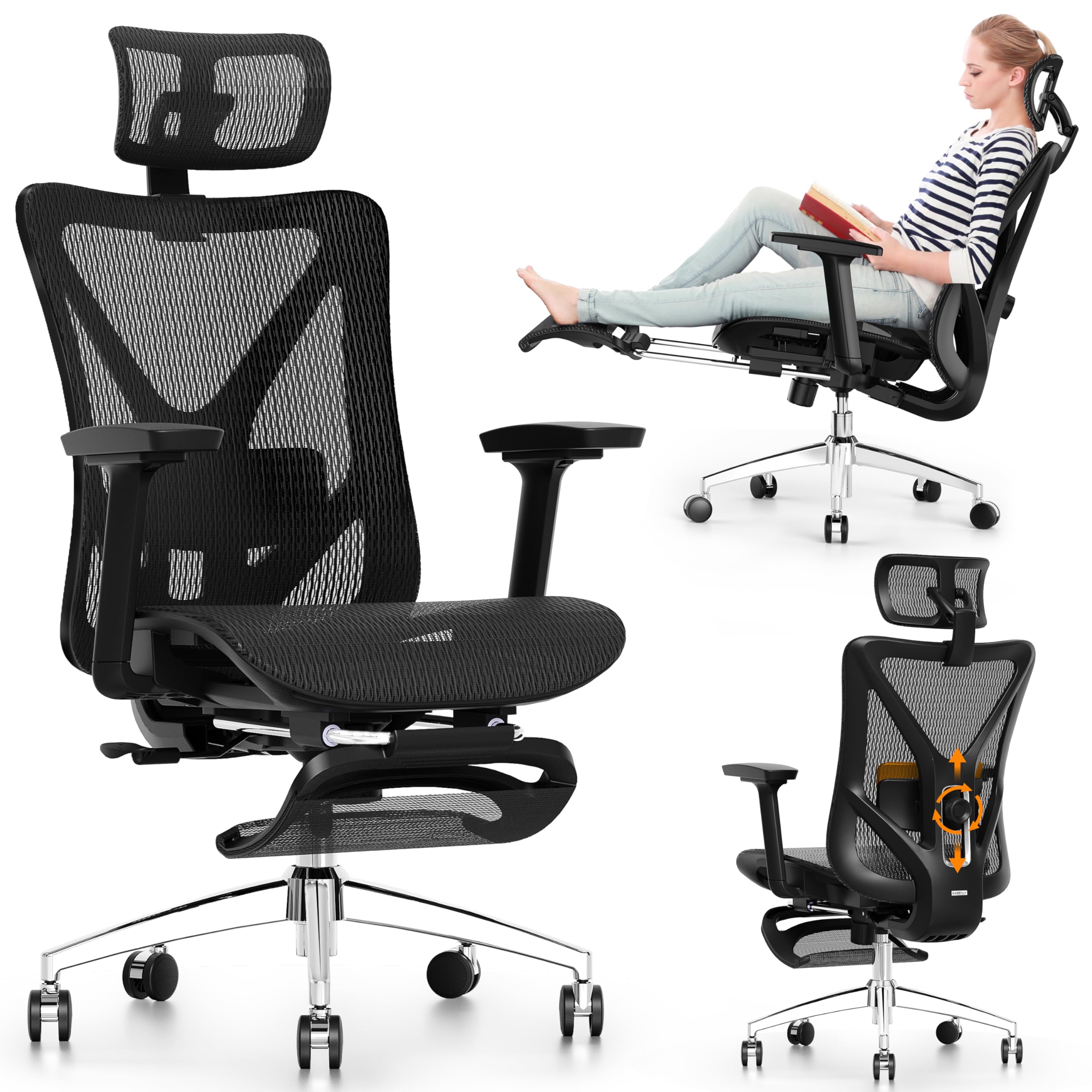
The GABRYLLY chair offers a 135° recline with a retractable steel footrest, allowing you to offload your spine completely during breaks. This full-back support is valuable for neck and shoulder relief because it lets you decompress your cervical vertebrae by shifting into a semi-supine position — something fixed-back chairs cannot provide.
The 2-way adjustable lumbar support moves 3 inches vertically and 1.6 inches horizontally, giving you the range to target your specific lumbar curve. The large mesh headrest adjusts in height, angle, and bracket position, providing personalized neck support that keeps your cervical spine in neutral alignment. The 3D armrests adjust up/down, front/back, and in/out to accommodate different desk heights and shoulder widths.
With a 300 lb weight capacity and a 27.5-inch steel base, the GABRYLLY is stable enough for big and tall users. The all-mesh design ensures airflow, and the silent wheels roll smoothly on hard floors.
Why it’s great
- 135° recline with footrest enables spinal decompression
- 2-way lumbar support targets lower back curve
- 3D armrests allow precise shoulder alignment
Good to know
- Armrests shift easily under pressure
- Mesh can feel taut for very long sessions
FAQ
How does lumbar support affect neck and shoulder pain?
Are mesh chairs better than foam for neck and shoulder pain?
What armrest features matter most for shoulder tension?
Can a headrest worsen my neck pain?
Final Thoughts: The Verdict
For most users, the chair for neck and shoulder pain winner is the Steelcase Leap because its LiveBack technology actively prevents the spinal rounding that causes upper body tension. If you want auto-adapting lumbar support with massage and heat, grab the Hbada X7 Smart. And for the best value that still addresses shoulder and neck mechanics, nothing beats the ELABEST T96 and its Golden Triangle back support.