
You lean forward to guide the fabric, your hips press unevenly into a cushion that’s too high or too low, and after thirty minutes your lower back sends a clear signal. For sewists, quilters, and crafters who spend hours at the machine, an ordinary office chair creates chronic hip tilt and a forward slump that ruins posture and drains the joy out of your project. A dedicated chair with the right seat height, stable base, and lumbar alignment is the single most effective upgrade for your body while you work.
I’m Min — the co-founder and writer behind Gadgets Feed. I’ve spent hundreds of hours analyzing the ergonomic specs, adjustability ranges, and material quality of sewing chairs to separate the temporary fixes from the long-term solutions so you can buy with confidence.
After evaluating cushion density, height adjustability, weight capacity, and real-world durability across dozens of models, I’ve narrowed the field to the seven best contenders for the best chair for sewing available today.
How To Choose The Best Chair For Sewing
Choosing a chair for sewing means evaluating mechanics that support your body through repetitive forward motion. The right chair keeps your hips level, your lower back engaged, and your feet stable on your sewing machine pedal. Focus on four factors to find the model that eliminates strain.
Seat Height Range
Standard desk chairs bottom out at 17 or 18 inches, but a sewing machine desk often sits lower. Look for a chair that drops to at least 17 inches from the floor — models that adjust down to 18 or 17.3 inches give you the clearance to work with your knees at a 90-degree angle. Too tall a seat forces your hips to tilt and your back to round, which compounds discomfort over a two-hour project.
Base Stability and Mobility
A five-star metal base provides the widest footprint and prevents tipping when you shift your weight to reach the fabric feed. Wheels with silicone or rollerblade-style casters roll smoothly over carpet and hard flooring without scratching. Glides work well if you want the chair to stay planted under the machine, but sewing requires frequent movement between the machine and an ironing board or cutting table, so smooth wheels reduce wasted effort.
Cushion Firmness and Lumbar Support
High-density foam or molded foam retains its shape after hours of seated pressure — soft cushions compress and transfer load to your sit bones. An adjustable lumbar rest or a contoured backrest that aligns with your lower spine prevents the forward slump that causes backache. Removable backrests offer flexibility for crafters who alternate between sewing and tasks requiring full torso rotation.
Footring Versus Glides
A sewing machine pedal sits on the floor, not on a chair footring. Chairs with a footrest ring can interfere with pedal placement, so armless models with a simple base and no ring give your feet the full range of motion to operate the pedal naturally. Some dedicated sewing chairs include glides instead of wheels specifically to stop the chair from rolling backward while you press the pedal — a small detail that matters more than most buyers realize.
Quick Comparison
On smaller screens, swipe sideways to see the full table.
| Model | Category | Best For | Key Spec | Amazon |
|---|---|---|---|---|
| Arrow Sewing H8160 | Premium | Dedicated sewists with lumbar needs | Height 18–22 in | Amazon |
| Pink Power Sewing Chair | Premium | Storage and lumbar support | Backrest 9–13 in | Amazon |
| SewErgo 200SE | Premium | Stable pedal control | Non-slip glides | Amazon |
| YOUTASTE Coffee Brown | Mid-Range | Multi-use home studio | 16° rocking motion | Amazon |
| Antlu Saddle Stool | Mid-Range | Posture correction | Molded foam saddle | Amazon |
| DUMOS Drafting Chair | Value | Budget-friendly ergonomics | Height 17.3–21.3 in | Amazon |
| Brick Attic Drafting Chair | Value | Customizable back support | Backrest removable | Amazon |
In‑Depth Reviews
1. Arrow Sewing H8160 Adjustable Height Hydraulic Sewing and Craft Chair

The Arrow H8160 is built specifically for sewists, with a seat depth and lumbar angle designed for hours at the machine. The seat height adjusts from 18 to 22 inches, which lets you match the height of most sewing tables and keeps your knees at a steady 90-degree angle. The contoured backrest provides targeted lumbar support that encourages you to sit upright without forcing your shoulders forward.
The under-seat storage compartment is large enough for bobbins, seam rippers, and small project accessories, cutting down on trips to the supply shelf. Heavy-duty casters roll smoothly on vinyl and hardwood floors without leaving marks, and the five-star metal base supports up to 250 pounds. Crafters who sew for four or more hours report significant reductions in hip and lower back tightness after switching to this model.
One practical note: the backrest is not adjustable in angle, so if you prefer a more reclined position while drafting patterns, the fixed angle may feel restrictive. The durable upholstery fabric is easy to clean with a lint roller, which matters when thread and fabric dust accumulate during long sessions.
Why it’s great
- Purpose-built lumbar geometry for sewing posture
- Integrated hidden storage keeps supplies at hand
- Quiet, floor-safe casters glide between stations
Good to know
- Backrest angle is not adjustable
- Weight capacity of 250 lbs may limit larger users
2. Pink Power Sewing Chair with Wheels and Adjustable Back Support

The Pink Power chair combines a full-sized sewing chair frame with an adjustable lumbar support that moves vertically between 9 and 13 inches, so you can position the pad exactly where your lower back needs it. The hydraulic lift ranges from 19 to 23 inches, which suits taller sewing tables or cutting counters where standard desk chairs feel too short.
The high-resilience padded cushion is firm enough to prevent the sinking feeling that leads to hip rotation, and the under-seat storage compartment hides thread, scissors, and patterns. The five-star swivel base and heavy-duty casters support up to 300 pounds, giving larger sewists the same stability and range of motion. Multiple users report that the lumbar pad makes a noticeable difference for sciatica and chronic lower back pain during extended projects.
Assembly requires some muscle to seat the wheels into the base — a rubber mallet helps. The surface is a painted powder-coat finish that resists scratches but can chip if the chair bumps against a metal table leg. Replacement casters are widely available if the stock wheels wear out on rougher flooring.
Why it’s great
- Vertical lumbar adjustment targets exact back pain zones
- High weight capacity (300 lbs) accommodates a range of body types
- Seat storage keeps sewing tools organized
Good to know
- Wheel installation requires significant force
- Powder-coat finish may chip on hard impacts
3. Reliable SewErgo 200SE Ergonomic Task Chair

The SewErgo 200SE is built with non-slip glides instead of wheels, which solves a problem unique to sewing: accidental backward rolling when you press the foot pedal. The glides keep the chair planted, letting you apply consistent pressure to the pedal without the chair shifting. Three adjustable features — seat height, backrest tilt, and backrest angle — give you fine-grained control over your sitting posture.
The full cloth-covered backrest provides breathable lumbar support, and the contoured cushion is filled with high-density polyester foam that resists flattening over time. Users who sew for six to eight hours at a stretch note that the firm cushion and adjustable back tilt eliminate the lower back fatigue that plagues many crafting chairs. The frame is made from recycled materials and assembled in Canada, which adds a craftsmanship edge over mass-produced imports.
The most common modification buyers make is swapping the glides for aftermarket casters — the base accepts standard caster stems, and many sewists prefer wheels for moving between a machine and a cutting table. The back adjustment knob is located beneath the seat rear, so reaching it while seated requires a bit of contortion. This chair does not include wheels or casters in the box, so budget for that upgrade if you want mobility.
Why it’s great
- Glides prevent pedal drift during sewing
- Three-way adjustability tailors fit precisely
- Dense foam cushion holds shape for all-day use
Good to know
- No casters included — requires aftermarket wheels for mobility
- Back adjustment knob is awkward to reach while seated
4. YOUTASTE Coffee Brown Office Chair Modern Armless Desk Chair

The YOUTASTE chair uses a taller height range of 31.8 to 36.6 inches, which positions it as a mid-back drafting stool for standing‑desk setups and higher sewing tables. The armless design gives you unrestricted arm movement for guiding fabric, and the seat is wide enough at 18.1 inches to provide stable support without feeling bulky. The 16-degree rocking function lets you tilt back during pattern drafting or seam pressing breaks.
The premium faux leather upholstery and high-density foam fill deliver a comfortable seat that doesn’t compress after a full workday. The SGS Class 3 gas lift and five-star metal base feel solid under shifting weight, and the smooth rolling wheels move quietly on hardwood and tile. Assembly takes around ten minutes with a clear sequence of four screws.
The rocking function is not lockable, so if you prefer a fixed upright seat for precise machine work, the chair will always have a slight give in the tilt mechanism. The curved seat encourages a slight posterior tilt that some sewists find relaxing but others report causes their hips to roll forward during long sewing sessions — try the firmness before committing to all-day use.
Why it’s great
- Tall height range suits standing desks and high sewing tables
- Quick assembly with clear instructions
- Sturdy metal base and smooth caster movement
Good to know
- Rocking function cannot be locked upright
- Curved seat may cause forward hip roll for some users
5. Antlu Saddle Stool Dental Hygienist Chair with Back Support

The Antlu saddle stool borrows its design from dental hygienist seating, which forces your pelvis into a neutral forward tilt that naturally aligns your spine. This posture pattern is ideal for sewists who lean forward toward the machine — it reduces the pressure on your lower back compared to a conventional flat seat. The molded foam seat is contoured to support the sit bones without creating hotspots, and the adjustable backrest adds lumbar support for longer sessions.
The adjustable height range of 20 to 28 inches is significantly taller than typical sewing chairs, so it pairs best with high sewing tables or standing‑height work surfaces. Rollerblade-style wheels glide silently across tile, hardwood, and low-pile carpet without jamming or scratching. Tool-free assembly takes under four minutes — a genuine advantage if you want to start sewing immediately.
The saddle shape takes about a week to get used to, especially if you’re accustomed to a flat padded cushion. The backrest is relatively small and may not provide enough support for users above 5-foot-8 who need taller lumbar coverage. One reviewer reported a wheel breaking after six months, though the other four chairs in the same household held up without issue.
Why it’s great
- Saddle design promotes neutral spine and reduces back strain
- Rollerblade wheels provide exceptional glide and noise control
- Tool-free assembly in under four minutes
Good to know
- Saddle seat requires an adjustment period of several days
- Backrest may be too short for taller users
6. DUMOS Armless Drafting Chair with Adjustable Footrest Ring
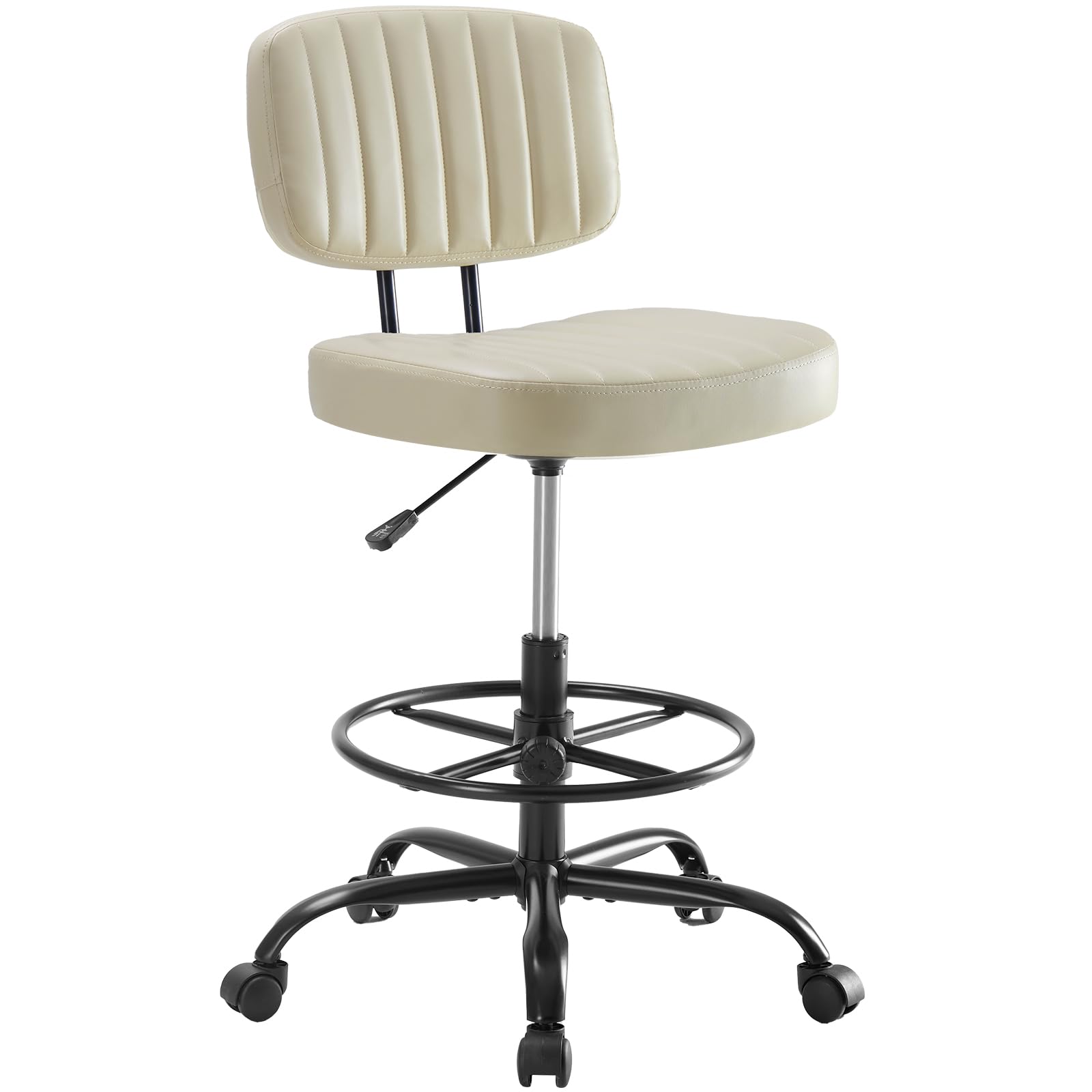
The DUMOS drafting chair delivers a 17.3 to 21.3 inch height range, which covers the low end needed for standard sewing tables without requiring a separate footrest. The curved PU leather backrest provides basic lumbar alignment, and the high-density sponge cushion strikes a balance between comfort and support — firm enough to prevent sinking but soft enough for shorter projects. The five-star metal base supports up to 350 pounds, making it the highest weight capacity in this list.
The armless form factor gives full arm clearance for sewing, and the adjustable foot ring doubles as a convenient leg rest. Silent nylon casters move without scratching floors, and the beige upholstery blends into a home studio aesthetic. Assembly requires a single Allen wrench — a decent-quality set of hex keys makes the process faster than the included tool.
The foot ring, while useful for resting, may get in the way if you need to place your sewing machine pedal directly on the floor. Some users report that the seat cushion is too firm for extended sessions beyond two hours. The chair is not designed for heavy reclining, so if you want to tilt back during breaks, the DUMOS feels rigid in that position.
Why it’s great
- Excellent weight capacity for larger sewists
- Low height range fits standard sewing tables
- Smooth casters and affordable price point
Good to know
- Foot ring may interfere with pedal placement
- Cushion is too firm for marathon sewing projects
7. Brick Attic Drafting Chair with Backrest

The Brick Attic drafting chair stands out for its removable backrest, which lets you convert between a full-support chair and a simple stool depending on your task. With the backrest attached, the ergonomic curved design supports your lower spine during sewing; with it removed, the chair frees up torso rotation for tasks like reaching for fabric rolls or ironing. The height adjusts from 33.86 to 41.75 inches, so it works best with higher sewing and cutting tables.
The 15.8-inch wide cushion is large enough for comfortable seated posture without being bulky, and the PU leather cover cleans easily with a damp cloth. The high-density memory foam fill provides a plush feel that still offers firm support under sustained pressure. The five-star base with a 2mm-thick steel frame supports up to 300 pounds, and the wheels roll smoothly on concrete, tile, and laminate.
The foot ring is adjustable up and down by 7.87 inches, which helps shorter users maintain a 90-degree knee bend. However, the foot ring occasionally slides down during use, requiring periodic readjustment. The backrest is shorter and may not provide adequate support for users taller than 5-foot-6 when using it for long sewing sessions.
Why it’s great
- Removable backrest adapts to sewing or task stool use
- Highly adjustable foot ring accommodates different leg lengths
- Sturdy metal frame with 300 lb weight limit
Good to know
- Foot ring may slide down during active use
- Backrest is short for taller users
FAQ
What seat height do I need for my sewing table?
Should I get a chair with or without armrests for sewing?
Why do some sewing chairs use glides instead of wheels?
Final Thoughts: The Verdict
For most sewists, the best chair for sewing winner is the Arrow Sewing H8160 because its purpose-built lumbar geometry and seat height range align directly with common sewing table dimensions, and the under-seat storage eliminates a major friction point during long projects. If you need adjustable lumbar support and a higher weight capacity, grab the Pink Power Sewing Chair. And for pedal control without the risk of chair drift, nothing beats the Reliable SewErgo 200SE.