
Our readers keep the lights on and my morning glass full of iced black tea. As an Amazon Associate, I earn from qualifying purchases.
Specs are compiled from manufacturer listings and verified buyer reviews and can change over time — please confirm the key details on the product page before buying.
You want a telescope that shows you Jupiter’s moons and Saturn’s rings without making you fight a wobbly setup. That is the biggest challenge with a cheap telescope — you need an aperture (the main lens that gathers light) big enough to reveal detail, and a tripod that actually stays still. This guide compares seven refractors to find the ones that give you real views and skip the frustration.
I’m Min — the founder and writer behind Gadgets Feed. This guide is built by comparing the manufacturers’ published specifications and the patterns across verified customer reviews, so you get each pick’s real strengths and trade-offs instead of marketing spin.
These picks represent the best options in today’s market for a cheap telescope that actually performs, if you want to spot Jupiter’s moons from the backyard or just get a sharp look at the Moon’s surface without a headache.
Our Picks at a Glance

How To Choose The Best Cheap Telescope
Picking a cheap telescope is about knowing which corners you can safely cut and which ones will ruin your night. You want the biggest aperture you can afford on a mount that doesn’t vibrate for five seconds after you touch it. Here are the specs that separate a keeper from a regret.
Aperture — The Light-Gathering King
Aperture is the diameter of the main lens (objective lens) in a refractor telescope. A bigger aperture grabs more light, which makes faint stars brighter and reveals more detail on the Moon and planets. For a cheap telescope, an 80mm aperture is the baseline for a satisfying view — 90mm is a noticeable step up that pulls in about 12% more light and gives you a richer image without a huge price jump.
Focal Length and What You Can See
Focal length (measured in millimeters) determines how much magnification you get with each eyepiece. A longer focal length, like 800mm or 900mm, gives you higher native magnification, which helps when you want to zoom in on Saturn’s rings or Jupiter’s cloud bands. Shorter focal lengths (500mm–600mm) give you wider, brighter views of star fields and the full Moon, but magnify less without a Barlow lens (an accessory that multiplies magnification, typically by 3X).
Tripod Stability — The Silent Dealbreaker
A telescope is only as good as its tripod. A shaky, lightweight tripod blurs the image every time you breathe or bump the tube, which is incredibly frustrating at higher magnifications. For a cheap telescope, look for a stainless steel or aluminum tripod with adjustable legs and a decent spread — the best picks in this list use stainless steel tripods that reach around 46 inches and stay planted. Avoid any model where reviews consistently mention wobble.
Quick Comparison
| Model | Best For | Aperture | Focal Length | Magnification Range | Amazon |
|---|---|---|---|---|---|
| Hawkko 80mm 500mm★ Best Overall | Entry-level & travel | 80 mm | 500 mm | 20X–150X | Amazon |
| Celticbird 80mm 900mmAlso Great | Lunar & planetary detail | 80 mm | 900 mm | — | Amazon |
| Dianfan 90mm 800mm | All-around beginner value | 90 mm | 800 mm | 32X–240X | $169.99$199.99Amazon |
| HUGERSTAR 90mm 800mm | Mid-range performance | 90 mm | 800 mm | 32X–240X | $149.98$199.99Limited time dealAmazon |
| MEEZAA 90mm 800mm (B0CP3RDV25) | Serious starter kit | 90 mm | 800 mm | 32X–240X | $169.99$199.99Amazon |
| MEEZAA 90mm 550mm | Portable family scope | 90 mm | 550 mm | 22X–165X | Amazon |
| HUGERSTAR 80mm 600mm | Budget starter with extras | 80 mm | 600 mm | 24X–180X | Amazon |
In‑Depth Reviews
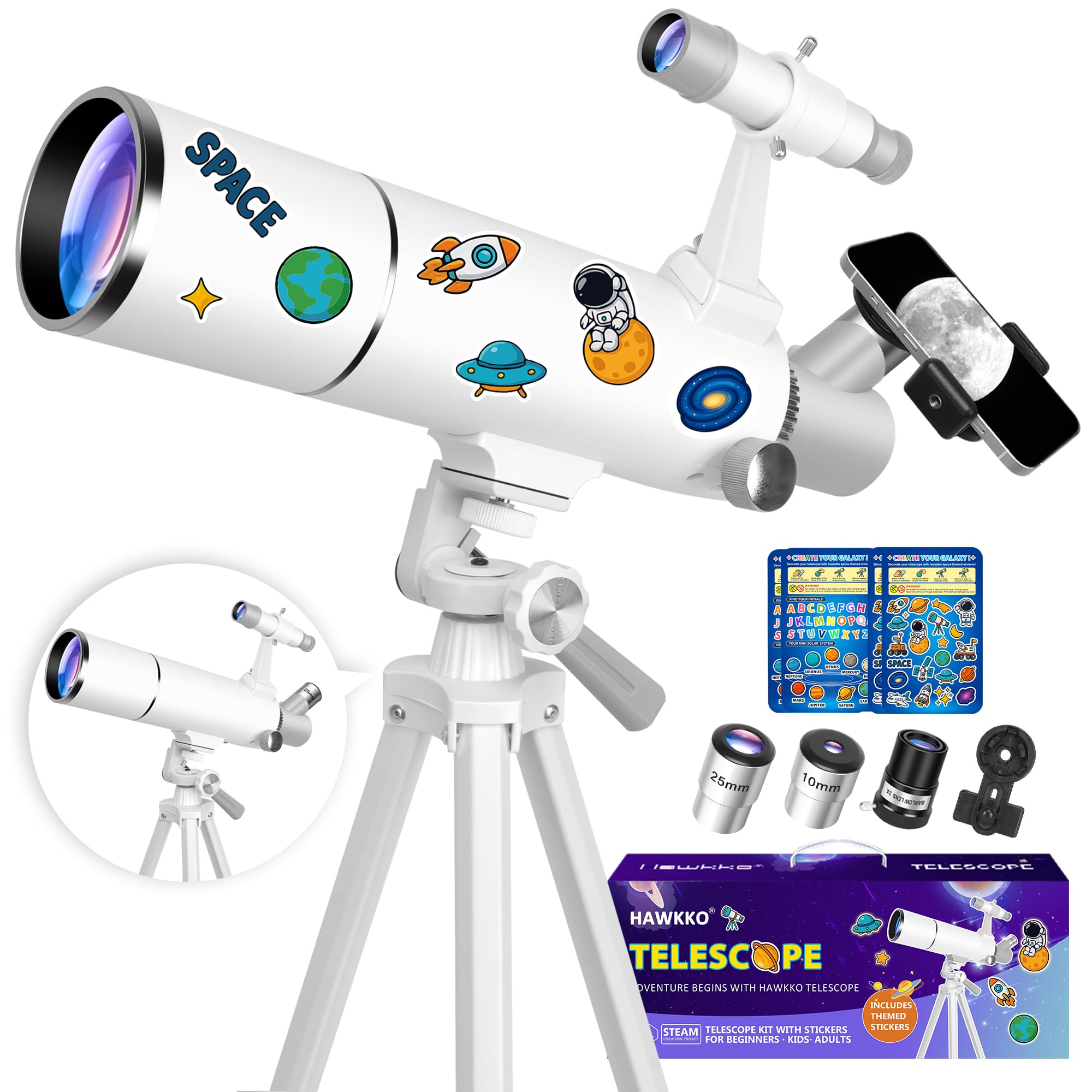
1. Hawkko Telescope for Adults & Kids, 80mm Aperture 500mm
The cheapest ticket to a Moon crater that comes with stickers to make it yours.
For the lowest cost on the list, the Hawkko cuts some corners but keeps the essentials. The 80mm aperture and 500mm focal length produce a 20X–150X magnification range, which is enough to see the Moon’s major craters and maybe Jupiter’s moons on a clear night. Reviewers point out that the image is “clear” and “crisp” at lower magnifications, but one 1-star review notes it gets blurry and the tripod feels flimsy at higher zooms — a common problem at this price floor. The included space-themed stickers are a unique touch for a child’s first scope, and the smartphone adapter works well for sharing a photo of the Moon.
The Hawkko’s 500mm focal length means it is 80% shorter than the Celticbird’s 900mm, so you get a wider field of view but less planetary reach. That makes it better for scanning star fields or using as a daytime spotting scope. Setup is quick — the tripod is adjustable for kids and adults, and the kit includes a finder scope, two eyepieces (10mm and 25mm), and a 3X Barlow lens.
If the budget is absolute and you are buying for a young child who might lose interest, this is the least painful entry point. But the jump to the HUGERSTAR 80mm is worth it for the longer focal length and moon filter.
Why It’s Here
- Lowest-cost way to see the Moon’s surface with an 80mm aperture.
- Includes fun space stickers for personalization.
- Quick, tool-free setup suitable for small children.
Where It Falls Short
- 500mm focal length limits high-magnification planetary detail.
- Several reviews mention a flimsy tripod that shakes at higher zoom.
Perfect for: a family on the tightest budget, or as a first telescope for a young child who wants to see the Moon up close and decorate their gear.
Upgrade if: you are a teen or adult serious about seeing more than just the Moon — the extra -20 for a longer focal length scope pays off quickly.
2. Celticbird Telescope for Adults High Powered (80mm Aperture 900mm)
The long-focal-length star that puts Jupiter’s moons within reach for under.
You buy a cheap telescope for the views, and this one delivers the most focal length in the lineup — 900 mm on an 80 mm aperture — which means you get stronger native magnification before you even touch a Barlow lens. That 900 mm focal length gives it an 80% more gap vs shorter 500 mm models, so planets look bigger in the eyepiece without cranking the zoom to blurry levels. Buyers report clear views of Jupiter’s moons and even Saturn’s rings, which is a lot to ask from a scope at this level. The tripod adjusts from 20 to 45 inches and is stable enough for backyard use, though one owner mentioned the tube can flip if you loosen the screw while moving it.
The included 20mm and 10mm upgraded wide-angle eyepieces are surprisingly decent for the price, and the phone adapter works well for snapping the Moon. The 5×24 finder scope is a reflex type (you look through a small window instead of a tube), which some beginners find easier. A couple of owners spotted dust inside the lens on arrival, so give it a quick check from the start, but the overall 4.6 rating across 453 reviews says most units are clean.
If you want the most magnification potential from a cheap telescope and you are patient enough to learn the manual focus, this is the sharpest path to seeing planetary detail without spending premium money.
Why It Leads the Pack
- 900mm focal length beats every other pick here for planetary magnification.
- 80mm aperture with fully coated lens captures enough light for crisp moon craters.
- Carry bag and upgraded phone mount add real travel value.
Trade-Offs to Know
- Occasional dust inside lens reported — inspect on arrival.
- Tripod screw can loosen, causing the tube to rotate unexpectedly.
Reach for this if: your main goal is seeing the Moon’s craters, Jupiter’s cloud bands, and maybe Saturn’s rings — the 900mm focal length gives you the reach.
Look elsewhere if: you want a grab-and-go scope that stays in the car, since the longer tube is less compact.
3. Dianfan Telescope, 90mm Aperture 800mm

A 90mm beast that brings premium light-gathering to the budget aisle.
The Dianfan pulls ahead of the Celticbird in one crucial way: its 90 mm aperture vs the Celticbird’s 80 mm. That extra 10 mm of glass (a 12% more gap in aperture vs 80mm models) pulls in noticeably more light, making star clusters and lunar detail a little richer at the same focal length. With an 800 mm focal length and a magnification range of 32X–240X (thanks to two eyepieces and a 3X Barlow lens), you get the same planetary reach as the HUGERSTAR 90mm models but at a slightly sharper price point given the 4.5 rating across 794 reviews.
Buyers consistently mention that this scope delivers clear views of the Moon’s craters and even Saturn’s rings in the same sentence as “easy setup” — most users report a 10- to 15-minute assembly. The stainless steel tripod is sturdy enough that you aren’t fighting wobble at 150X, and the included phone adapter and carry bag make it practical for taking to a dark-sky spot. One honest owner noted that the best views come at lower magnifications, so don’t expect perfect sharpness at 240X, but that’s true of nearly every cheap telescope.
If the Celticbird is the king of focal length, the Dianfan is the king of aperture-per-dollar — you get more light, a stable mount, and a complete kit that rewards a beginner who wants to see more than just the Moon.
Aperture Champion: The 90mm objective gathers more light than any 80mm scope here — only the HUGERSTAR and MEEZAA 90mm models match it, and the Dianfan’s 4.5 rating suggests fewer lemons.
Grab this if: you want the biggest aperture you can get for the money, paired with a stable stainless tripod and a phone adapter that works.
skip it if: you need ultra-wide field views of star clusters, where the shorter 500mm-600mm scopes give a brighter sweep.
4. HUGERSTAR Telescope, 90mm Aperture 800mm

The 90mm overachiever that reviewers call “crisp” and “3D-like” on the Moon.
Another 90mm aperture, 800mm focal length contender, but this HUGERSTAR brings a stainless steel tripod that adjusts from 28.7 to 46.4 inches — noticeably taller than the cheaper aluminum tripods on the 80mm models. That extra height and heft (heavy enough that owners mention it “eliminates wobble”) makes a real difference when you are trying to hold Saturn’s rings steady at 240X. The fully multi-coated lenses deliver bright, contrast-rich views, and one reviewer described the lunar images as “crisp, 3D-like.”
The kit includes 10mm and 25mm eyepieces, a 3X Barlow lens, and a moon filter that cuts glare so you can see smaller craters. A few owners noted the included phone adapter is fiddly — the short eyepiece neck can cause the side button on your phone to press — so you might want a third-party adapter for serious smartphone photography. Setup is tool-free, and HUGERSTAR claims 90% of users are ready in under 10 minutes.
Compared to the Celticbird, this one trades an extra 100mm of focal length for a wider 90mm aperture and a much taller tripod, so it is better suited for adults who don’t want to hunch over and want brighter images on deep-sky objects.
Why It Shines
- 90mm aperture + 800mm focal length combo offers a great balance of brightness and magnification.
- Tall stainless steel tripod (28.7 to 46.4 inches) suits adults and stays steady.
- Moon filter reduces glare for more detailed lunar observation.
Where It Stumbles
- The phone adapter can interfere with phone buttons — some buyers swap it out.
- Setup is tool-free but involves more parts than simpler 80mm scopes.
Best for: an adult beginner who wants a tall, stable tripod and bright 90mm views of the Moon and planets without stepping into premium pricing.
Not for: someone who wants the absolute longest focal length — the Celticbird (900mm) has more reach.
5. MEEZAA Telescope, 90mm Aperture 800mm Professional Refractor

The 90mm that comes with everything but the star chart.
MEEZAA’s 90mm 800mm telescope is the most complete kit on this list. You get the same 90mm aperture and 800mm focal length (f/8.88) as the Dianfan and HUGERSTAR, but the built-in media list reads like a full checklist: 10mm and 25mm eyepieces, 3X Barlow lens, phone adapter, carry bag, stainless steel tripod, accessory tray, zenith mirror, and a finder scope with a base. Buyers praise the build quality — one called it a “solid beginner telescope” with a sturdy stainless tripod that withstands wind, and several noted the low chromatic aberration (the purple fringing you see on cheap optics) is well controlled.
The 32X–240X magnification range is identical to the other 90mm 800mm scopes, but the included zenith mirror makes viewing comfortable when the telescope is pointed high overhead — you don’t have to crouch or twist your neck. Some users mentioned the inverted viewfinder (the image is flipped) takes getting used to, and the phone adapter can cause misalignment when focusing, but those are common traits at this level.
With over 854 ratings and a 4.4 average, this is the most-vetted 90mm cheap telescope on the list, which gives some confidence that the quality control is consistent across units.
Most Complete Kit: The included zenith mirror for overhead viewing and the sturdy carry bag make this a true grab-and-go setup that few competitors match at this price.
Pick this if: you want the assurance of a well-reviewed, complete kit with a stable stainless tripod and all the accessories to start tonight.
Consider the other 90mm scopes if: you are on a tighter budget — the Dianfan delivers a very similar experience for less.
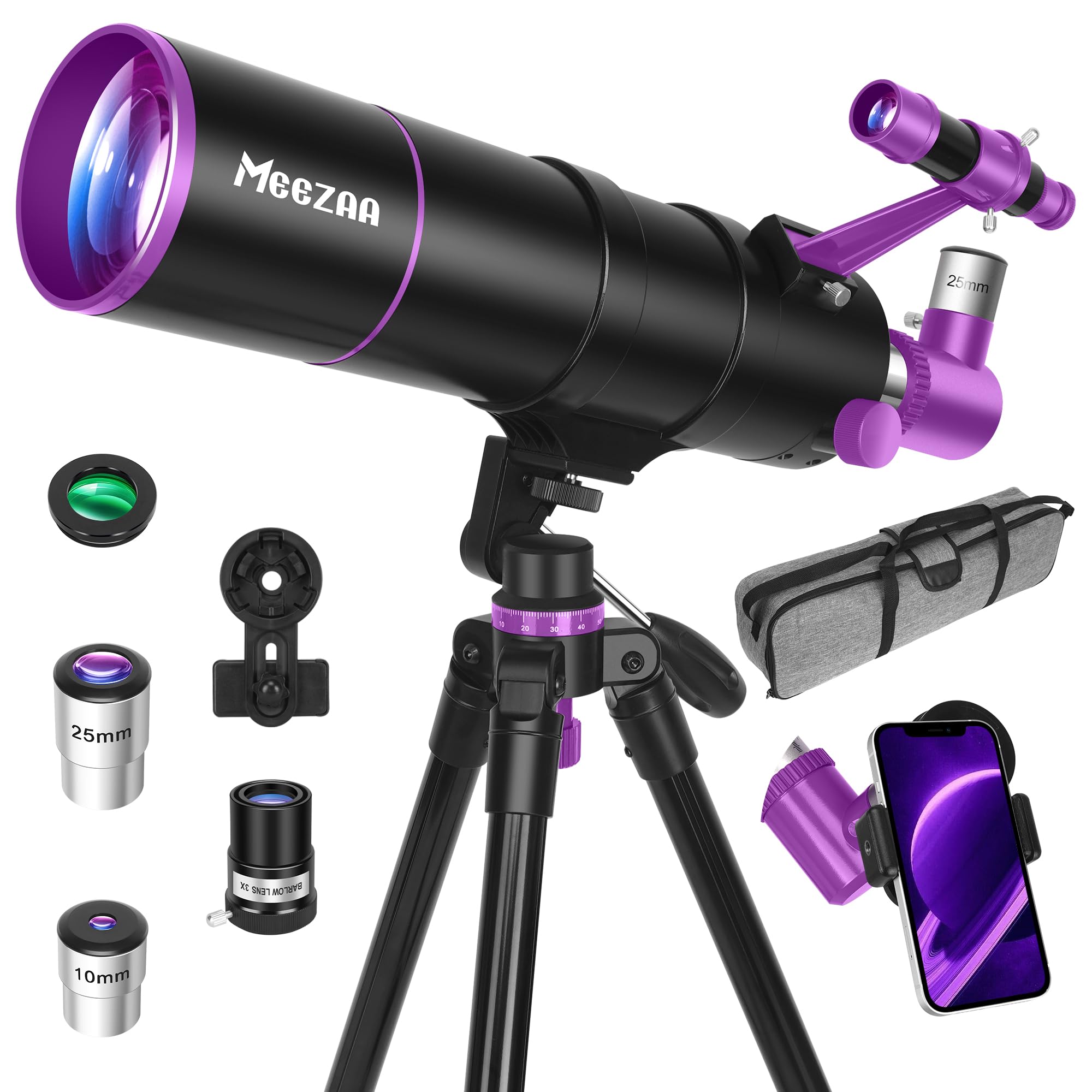
6. MEEZAA Telescope, 90mm Aperture 550mm Portable Refractor
The stubby 550mm tube that packs big light-gathering into a travel-friendly body.
This MEEZAA is the oddball in the lineup — it pairs a large 90mm aperture with a short 550mm focal length, giving you bright, wide-field views that are perfect for sweeping the Milky Way or watching the Moon rise, but not for zooming in on planets. The 22X–165X magnification range (using the 25mm and 10mm eyepieces plus the 3X Barlow lens) tops out lower than the 800mm models, which is the trade-off for a compact tube that fits easily into the included carry bag. The tripod adjusts from 22.04 to 47.63 inches — a 4% more gap in height than some 80mm scopes — so taller users get a comfortable stance.
Customers note that the 90mm aperture delivers “clear views of the moon and all its features” and that the 3X Barlow works well for stars. Some noted that calibrating the finder scope is a hassle and that focusing on the Moon when it’s directly overhead can be tricky (likely user error, as one owner admitted). The three built-in accessory holes on the mount are a nice touch — you can keep spare eyepieces within reach instead of fumbling in the bag.
If you want the brightness of a 90mm objective but don’t care as much about extreme planetary magnification, this shorter tube is lighter, easier to pack, and gives you stunning lunar panoramas on a steady tripod.
What Works
- 90mm aperture in a short 550mm tube — great light-gathering for its size.
- Tall tripod (up to 47.63 inches) suits adults.
- Three built-in accessory holes keep eyepieces handy.
What Doesn’t
- 550mm focal length limits high-magnification planetary views.
- Finder scope calibration can be frustrating for beginners.
Great for: families who want to throw a telescope in the car for camping and enjoy bright, wide views of the Moon and star fields.
Not for: planet chasers who need to see Saturn’s rings clearly — the 800mm/900mm scopes are better for that.
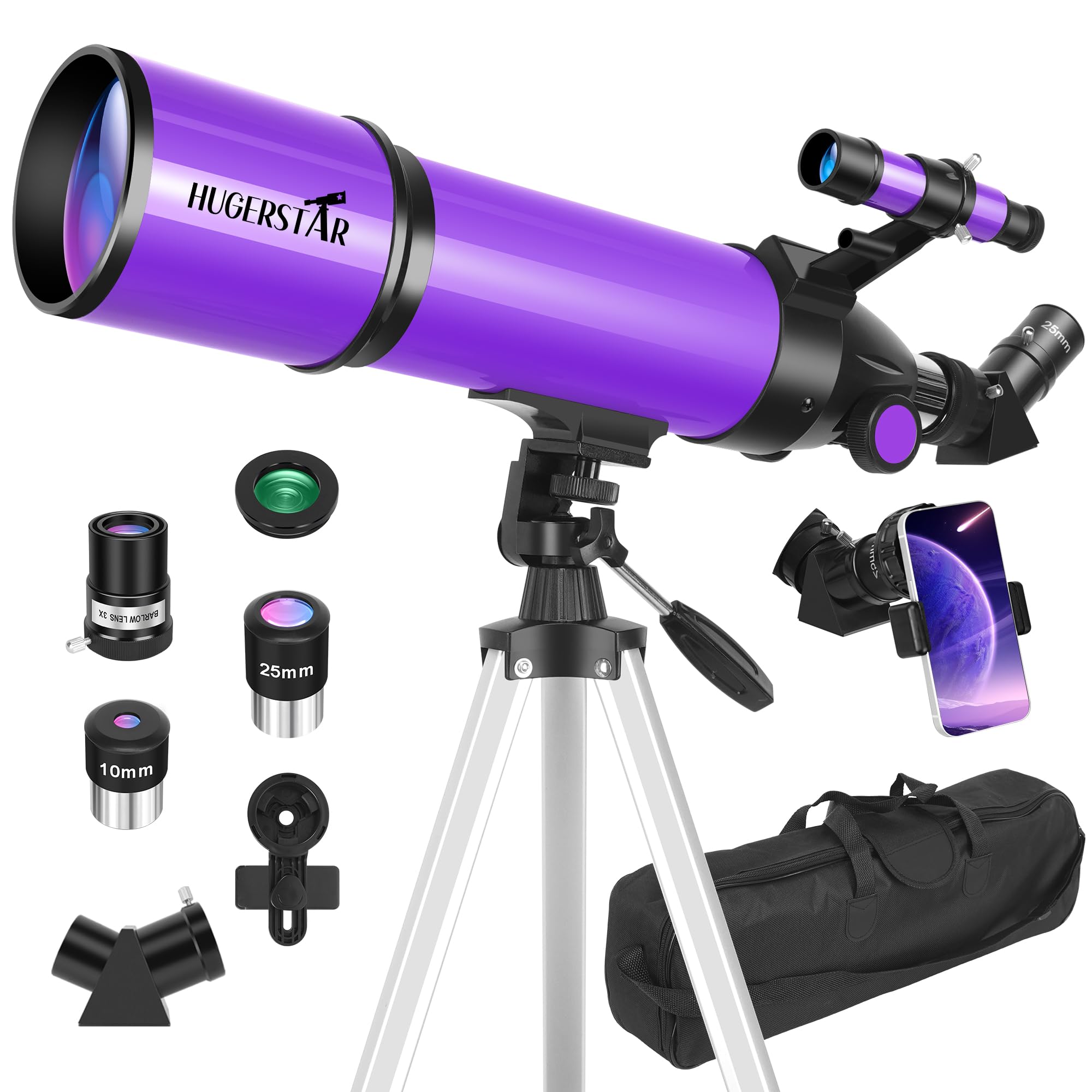
7. HUGERSTAR Telescope, 80mm Aperture 600mm
An 80mm starter that proves you don’t need to spend for clear views.
If your budget is tight but you still want a telescope that actually shows you detail, this HUGERSTAR is the balance. The 80mm aperture captures enough light for sharp Moon craters and Jupiter’s moons, and the 600mm focal length gives you a 24X–180X magnification range — punchier than the Hawkko’s 500mm scope, which tops out at 150X. The fully multi-coated lenses reduce glare so daytime birdwatching is viable, and the included moon filter improves contrast for nighttime lunar observation. The tripod adjusts from 21.2 to 44 inches, so kids and shorter adults can use it comfortably.
Reviewers with over 165 ratings gave this a 4.4 average, with many praising the sturdy build, stable AZ mount, and simple no-tools setup — 90% of users are ready in 10 minutes. The main downsides are that some buyers wanted better instructions, and like most entry-level scopes, the manual tracking (moving the tube by hand to follow objects) takes practice.
Compared to the Hawkko below, this HUGERSTAR has a longer focal length (600mm vs 500mm) and includes a moon filter — two upgrades that make a real difference for the extra cost.
Solid Starter: The fully multi-coated optics, moon filter, and stable aluminum tripod make this the most beginner-friendly cheap telescope under the premium tier.
Buy this if: you want a reliable, feature-packed 80mm telescope that includes a moon filter and a carry bag without hitting the mark.
pass on it if: you have the extra cash for a 90mm scope — the Dianfan or MEEZAA 90mm will show you more.
Understanding the Specs
Aperture Size (mm)
Aperture is the diameter of the main lens that collects light. In a cheap telescope, this is the single biggest predictor of what you will see. An 80mm aperture is the minimum for decent views of the Moon and bright planets. A 90mm aperture captures about 27% more light area than 80mm, making stars brighter and revealing fainter objects like star clusters. If you can, always push your budget to a 90mm scope — it makes a bigger difference than any other spec at this price point.
Focal Length (mm)
Focal length controls how much magnification you get with a given eyepiece. A longer focal length (like 900mm) makes planets appear larger in the eyepiece, which is great for spotting Jupiter’s cloud bands or Saturn’s rings. A shorter focal length (500mm–600mm) gives you a wider, brighter field of view, better for sweeping the Milky Way or watching a lunar eclipse. The trade-off is that you need stronger eyepieces or a Barlow lens to get high magnification from a short focal length scope.
FAQ
Is a 90mm telescope significantly better than an 80mm for a beginner?
What can I actually see with a cheap telescope under?
How important is the tripod for a cheap telescope?
What does a Barlow lens do and do I need one?
Why do some telescopes show images upside down?
Can I take photos with a cheap telescope?
What is the difference between an Altazimuth (AZ) mount and an Equatorial (EQ) mount?
How long does a cheap telescope typically last?
Final Thoughts: The Verdict
For most buyers, the cheap telescope winner is the Celticbird 80mm 900mm because its long focal length gives you the best planetary views at the lowest cost. If you want the most aperture per dollar and a broader view of the night sky, grab the Dianfan 90mm 800mm. And for the absolute tightest budget that still shows you the Moon’s craters clearly, the standout is the HUGERSTAR 80mm 600mm for its value and included accessories.
How We Picked
We do not accept paid placement. Every pick is matched to a real buyer and a real use-case; we do not hands-on test units.
Sources & Methodology
Specifications: manufacturer listings and product documentation. Review insights: verified customer reviews, as of July 2026. Pricing: not shown on this page (it changes often); check the current price via the retailer link.
As an Amazon Associate, Gadgets Feed earns from qualifying purchases. This does not affect which products we feature.
Related Guides
Product prices and availability are accurate as of the date/time indicated and are subject to change. Any price and availability information displayed on Amazon at the time of purchase will apply to the purchase of this product. As an Amazon Associate I earn from qualifying purchases.
CERTAIN CONTENT THAT APPEARS ON THIS SITE COMES FROM AMAZON. THIS CONTENT IS PROVIDED "AS IS" AND IS SUBJECT TO CHANGE OR REMOVAL AT ANY TIME.
Amazon and the Amazon logo are trademarks of Amazon.com, Inc. or its affiliates.