
Our readers keep the lights on and my morning glass full of iced black tea. As an Amazon Associate, I earn from qualifying purchases.
Specs are compiled from manufacturer listings and verified buyer reviews and can change over time — please confirm the key details on the product page before buying.
That mid-afternoon brain fog, the headache that appears in meetings, the grogginess that lingers after a nap — the culprit is often the air you are breathing, not your sleep or your workload. A CO2 monitor puts a number on that invisible problem, telling you exactly when your room has gone stale and a window needs to open. A reliable CO2 monitor pays for itself by flagging stale air before it triggers headaches or saps your focus.
I’m Min — the founder and writer behind Gadgets Feed. This guide is built by comparing the manufacturers’ published specifications and the patterns across verified customer reviews, so you get each pick’s real strengths and trade-offs instead of marketing spin.
We have sorted through the sensors, battery claims, and alert systems to find the co2 air monitor that fits your room, your routine, and your need for accuracy.
Our Picks at a Glance


How To Choose The Best CO2 Air Monitor
Before you pick a monitor, understand the single biggest difference between them: how they sense the air. This choice determines whether your readings are trustworthy or just a flashing number that looks scientific.
Sensor Tech: NDIR vs. Everything Else
Look for NDIR (a nondispersive infrared sensor, which beams light through an air sample and measures how much CO2 absorbs it). It is the most precise and reliable way to measure carbon dioxide. Sensors that use other chemical or electrochemical methods drift out of calibration faster and give you readings that wander away from the truth over weeks of use.
Power Source Shapes Placement
Ask yourself where the monitor will live. A plug-in AC unit never sleeps, runs 24/7, and is perfect for a bedroom or office you are always in — but it cannot travel. A unit powered by AA batteries can sit on a shelf for a year or more without attention. A rechargeable model lasts days, not months, but you can carry it from room to room or pack it for travel. Match the battery to the job.
Alerts: When to Ventilate
The whole point is knowing when to act. Some monitors flash a color-coded screen, others beep, and the smart ones push an alert to your phone. Pay attention to how many parameters you can set thresholds for. If you want to be told the instant CO2 crosses 1000 ppm (the level, in parts per million, where focus and air quality start to dip), make sure the monitor lets you set that limit rather than forcing a factory default.
Quick Comparison
| Model | Best For | Sensor & Display | Power Source | Weight | Amazon |
|---|---|---|---|---|---|
| Aranet4★ Best Overall | class-leading accuracy & portability | NDIR, E-ink | 2x AA (up to 4 yrs) | 3.67 oz | Amazon |
| Autopilot APCEM2Grow Room Pro | Grow rooms & greenhouses | NDIR, LED screen | USB-C adapter | 15.84 oz | Amazon |
| Sainlogic 16-in-1Room-Sized Upgrade | Beginner-friendly multi-check | High-precision, 7.2″ LCD | 2500mAh (8 hrs) | 1.5 lbs | Amazon |
| YNAK 16-in-1 | Family & pet friendly | External sensors, 7″ LED | AC + battery backup | 10.56 oz | Amazon |
| Temtop M10+ | Bedroom sleep monitoring | e-ink display | Rechargeable (60 days) | 9.6 oz | Amazon |
| GoveeLife H5140 | Smart home integration | SCD4x, LED display | AC power only | 5.28 oz | Amazon |
| SwitchBot Meter Pro | Smart displays & app alerts | Swiss NDIR, 92mm screen | Built-in battery (12 mo) | 4.8 oz | Amazon |
| LifeBasis 11-in-1 | Budget-friendly multipurpose | NDIR, LCD | 2500mAh (11-12 hrs) | 6.1 oz | Amazon |
| Pulse Pro | Serious grow operations | Swiss sensors, app-based | Li-Ion (12 hrs) | 9.25 oz | Amazon |
In-Depth Reviews
1. Aranet4 Indoor Air Quality Monitor
Our pick — over 4.5★ from 1,500+ verified ratings; the strongest balance of quality and price.
The pocket-sized gold standard that turns stale air into a readable number.
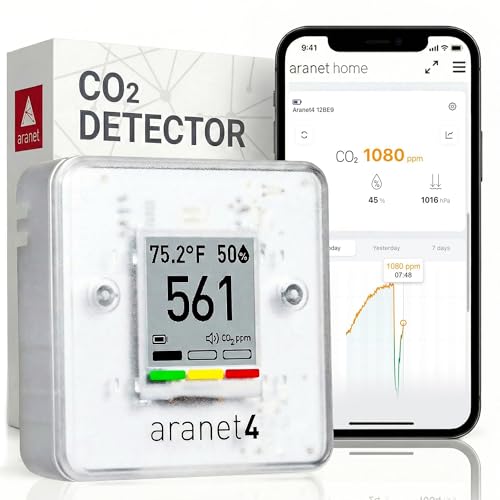
The Aranet4 is the unit other monitors get compared to, and the reason is simple: it measures CO2, temperature, relative humidity, and atmospheric pressure in real time using NDIR technology (the infrared light method that stays accurate for years). The payoff is readings you can actually trust to tell you when your room has gone bad — buyers report catching 1000+ ppm levels that caused real sluggishness and cognitive dip during the workday.
What makes it special is the power-efficient e-ink display (the same paper-like screen tech as an e-reader), which sips so little energy that two AA batteries can run the device for up to 4 years. That is the headline claim, and real-world use backs it up — as owners mention: “AA batteries last 18 months” of continuous daily monitoring. No cables, no charging anxiety, just a sleek 3.67-ounce puck you can toss in a bag for plane rides and hotel rooms, which several travelers specifically do. It is dramatically lighter than the 6.1-ounce LifeBasis, so it disappears into a carry-on.
The color-coded display and optional buzzer tell you the instant CO2 climbs too high, and the companion app stores up to 90 days of history in clean graphs. The main trade-offs: it is a pure CO2-and-climate device, so it skips particulate (PM2.5) and VOC readings, and the e-ink screen refreshes with a flash and has no backlight, which a few night-time users find slightly annoying. Calibration from the start is worth doing — one long-term owner found it read about +75 ppm high until a manual calibration brought it to within 15 ppm of a reference meter.
What wins people over
- NDIR precision with a reputation for dependable, repeatable CO2 numbers
- Up to 4 years on 2 AA batteries, with real owners seeing 18 months easily
- Crisp e-ink screen readable from across a room
Know before you buy
- No particulate or VOC sensing — CO2 and climate only
- No WiFi and no backlight, so it is not a smart-home hub device
Reach for it when: you want the most trusted portable CO2 reading money can buy, with battery life measured in years rather than days.
Look elsewhere if: your priority is tracking dust or chemical fumes — this one focuses purely on CO2 and climate.
2. Autopilot Desktop CO2 Monitor & Data Logger
A workhorse data logger built for growers who need trends, not just a number.
While most home monitors show you a single reading, the Autopilot APCEM2 is engineered to show you the story. It tracks CO2, relative humidity, and temperature on a clear LED screen, but its superpower is the digital memory chart that records stats over an adjustable 24-hour or 7-day period, with trend graphs for Min/Hr/Day/Wk readings. That makes it a genuinely different tool — designed for a grow room or greenhouse where you need to see how CO2 levels swing across the day, not just catch a spike in the moment.
The 2-channel low-drift NDIR sensor and audible alarm for high or low CO2 are exactly what a grower needs to keep an environment in its optimal band. It operates in temperatures from 32 to 122 degrees F, and its built-in altitude compensation mattered to one reviewer who found it landed within 40-50 ppm of a far more expensive reference unit — solid agreement for a sensor at this level. It is noticeably heavier than the Aranet4 at 15.84 ounces, and it is a plug-in device powered by a micro-USB adapter, so it is a fixed installation rather than a travel companion. The hook-and-loop fastener on the back lets you hang it where you need it, and it will even run off a standard smartphone charger.
One owner running a kerosene space heater found it invaluable for keeping that environment safe, and another praised its usefulness for measuring ventilation effectiveness. The loudest gripes are minor: all the LEDs glow green which can be hard to distinguish at a glance, and the chart axes take a moment to learn. But for someone whose whole operation depends on stable CO2, this is the reliable, feature-rich choice.
The grower’s edge: a built-in trend history over 24 hours or 7 days means you spot slow CO2 leaks and ventilation failures that a single-number display would never reveal.
Its limitation: it needs wall power and it is heavy enough that it stays put — this is not a monitor you carry from room to room.
3. Sainlogic 16-in-1 Air Quality Monitor
A big-screen, no-app monitor that tells the whole room to open a window.
The Sainlogic 16-in-1 takes the opposite approach from the pocket Aranet4: instead of a minimalist sensor you check up close, it is a 7.2-inch display with generously sized text you can read from across the living room. It tracks 9 environmental indicators — CO2, PM2.5, PM10, PM1.0, AQI, HCHO (formaldehyde), TVOC (total volatile organic compounds), temperature, and humidity — making it a far broader air-quality watchdog than a CO2-only device. For a family with young kids, allergy sufferers, or anyone who runs a 3D printer for hours, that breadth is the whole point; as owners put it, it is a device you do not realize you need until it proves your air was the problem all along.
The real-time sensor samples every 1.5 seconds and refreshes every 1 to 2 seconds, so when you burn toast or spray cleaner, you see the number move immediately. The smart alert system watches 7 user-defined thresholds, and once any reading hits Level 4, the screen flashes an “Open Windows for Ventilation” prompt while a tri-color LED shifts to grab your attention. You can mute the audible alarm with one press while keeping the visual warnings active — handy for a nursery. Setup is refreshingly simple: no app, no WiFi, just power it on and it starts working. Temperature reads from 14°F to 122°F with ±1°F to ±3°F accuracy, and humidity from 0% to 99% RH with ±2% to ±3% RH accuracy.
Its 2500mAh battery delivers up to 8 hours of wireless use per charge, which is enough to move it from the living room to the kitchen to the car, and recharging goes through a standard USB-C port. The catch is that those 8 hours are far shorter than the Aranet4’s year-plus on AA cells, so this is a monitor you will want to keep plugged in most of the time and unplug for short checks elsewhere. It is also the heaviest unit here at 1.5 pounds, so “portable” means room-to-room rather than travel-friendly. For a single screen that watches the whole health of your home’s air, it is hard to find a clearer, more approachable package.
Whole-house view: nine parameters on one giant screen with a plain-language ventilation warning makes it the easiest pick for families who do not want to fiddle with an app.
Fair warning: the 8-hour battery means you will treat it as a mostly-plugged-in device, and at 1.5 pounds it is built to sit, not to travel.
4. YNAK 16-in-1 Air Quality Monitor
A wall-powered 7-inch sentinel that keeps the whole house honest about its air.
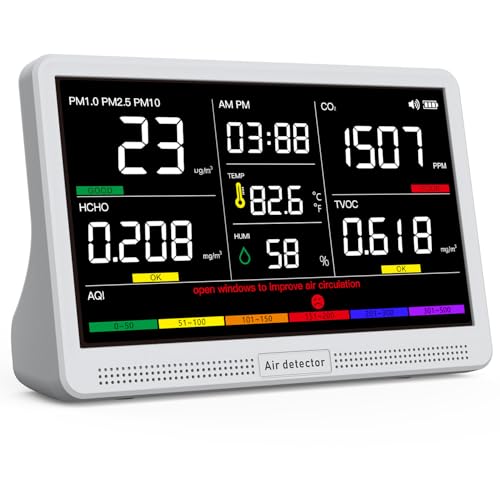
The YNAK AK22A is built around the idea that air quality is a household concern, not a personal gadget. Its 7-inch LED display shows CO2, PM2.5, PM1.0, PM10, HCHO, TVOC, temperature, humidity, AQI, and time all at once, in text large enough that you can glance at it from across the room and know the situation instantly. Owners have described it as a device the whole family can check without pulling out a phone, and several note it doubles as a useful clock. The external high-precision sensors with 0.001-level detection sample the air directly, avoiding the stale-air pocket that can form inside a sealed case, and the response to cooking, candles, or an open window is fast enough to watch the numbers fall in real time.
Because it runs on wall power with a D-battery backup, it monitors 24/7 without ever needing a recharge — a meaningful difference from the battery-only Sainlogic above, which tops out at 8 hours. The trade-off is that it is not a travel device; it is a fixture. The real-time alert system covers 7 distinct AQI buzzers for pollutants like CO2 and PM2.5, with color-coded warnings and a mute button for when the beeping gets to be too much. Homeowners with large dogs found its readings stayed consistent against other brands over months, and it reliably flagged cooking fumes as a negative air-quality event, which is exactly the kind of sensitivity you want.
The clearest limitation is the lack of data history — there is no app and no charting, so you are getting live numbers only, and one owner noted false TVOC/CO2 alarms in the first 24 hours that a power cycle cleared. If you want to track trends over weeks or check readings from your phone, this is not the monitor for you. But if you want a bright, always-on screen that keeps an entire living space visibly honest about its air, the YNAK is a straightforward, reliable pick.
Best when: you want a permanent, always-on display for a shared family space and you do not care about smartphone apps or history charts.
Think twice if: trend data and remote checking matter to you — this is live readings only.
5. Temtop M10+ 6-in-1 CO2 Meter
The bedroom-quiet monitor that runs two months on a charge and stays out of sight.
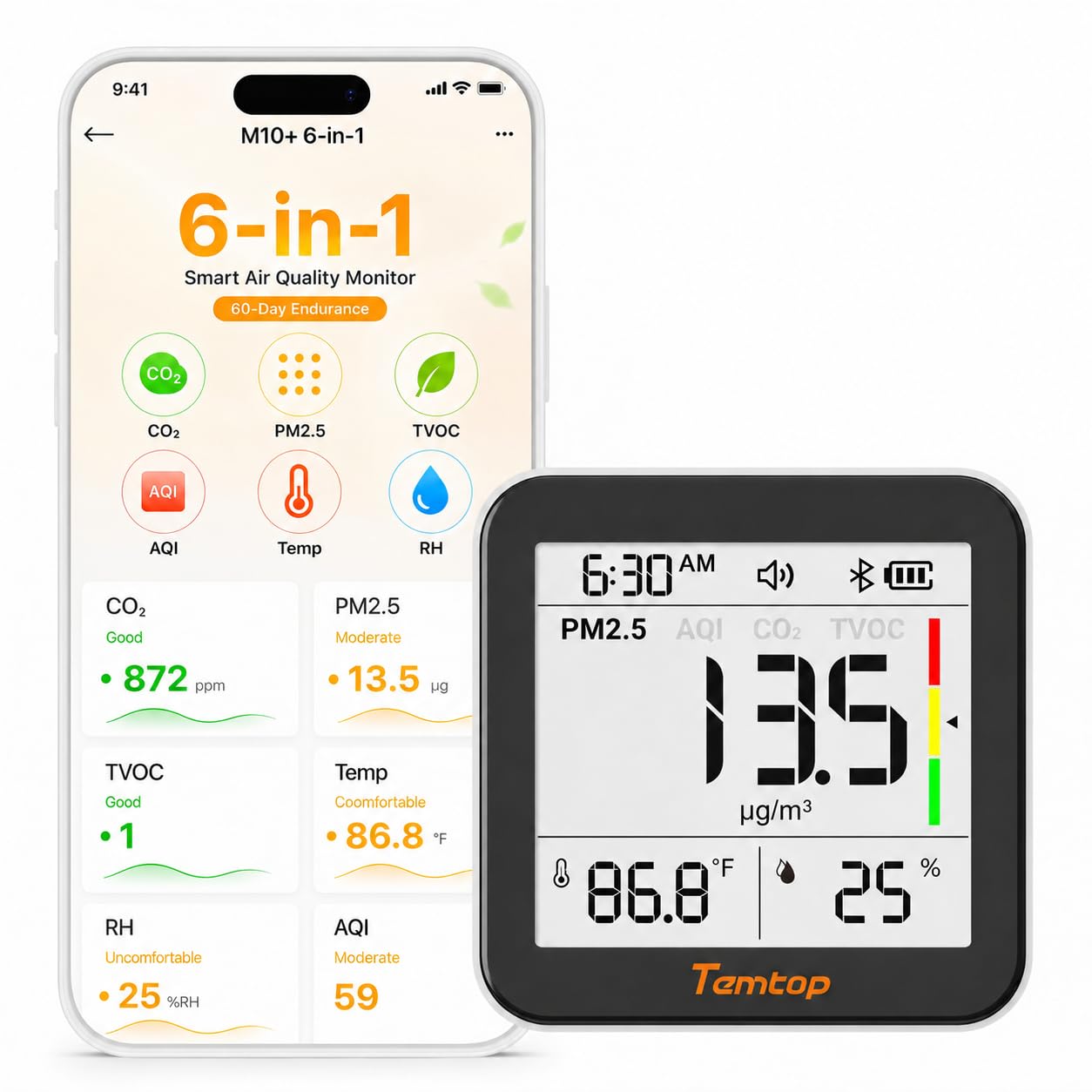
The Temtop M10+ is aimed squarely at one job: keeping your sleeping space healthy without disturbing you. Its e-ink display (the same low-glare screen tech as an e-reader) is easy to read at a glance yet produces no bright light pollution, and the adjustable alarm can be muted completely. Owners call the display exceptional and the battery life fantastic — the energy-efficient algorithm plus e-ink stretches a single charge to up to 60 days, which is remarkable for a rechargeable device. That puts it in a middle zone: far longer between charges than the 8-hour Sainlogic, though not the multi-year freedom of the AA-powered Aranet4.
It tracks CO2, PM2.5, TVOC, temperature, and humidity from high-quality sensors, and the compact 3.2-inch square metal-and-plastic body sits quietly on a nightstand. Its Bluetooth model pairs with the Temtop app for real-time display when you are nearby, with data logged and exported automatically once every hour — a clean, no-WiFi setup that gives you a consistent record without network dependence. One purchaser bought it to check a new barn and instead discovered an air problem in their own house, crediting the M10+ with flagging a hidden CO2 hazard in their home.
The honest caveat is speed. A few users found the response sluggish — one measured roughly an hour of lag before readings caught up to a real change in the room — which makes this a poor fit if you want instant feedback on whether opening a window is working. It also missed short-lived events, and the alarm only has a simple on/off toggle rather than customizable thresholds. For steady overnight monitoring and trend awareness in a bedroom or nursery, it is excellent; for reactive, minute-by-minute testing, it frustrates.
The sleep-first design: a glare-free e-ink screen and fully muteable alarm make it the most bedroom-friendly monitor in this lineup.
Its honest flaw: the sensor reacts slowly, so it suits long-term tracking far better than live experimentation.
6. GoveeLife Smart Air Quality Monitor H5140
A voice-controlled sentry that turns CO2 data into automated home action.
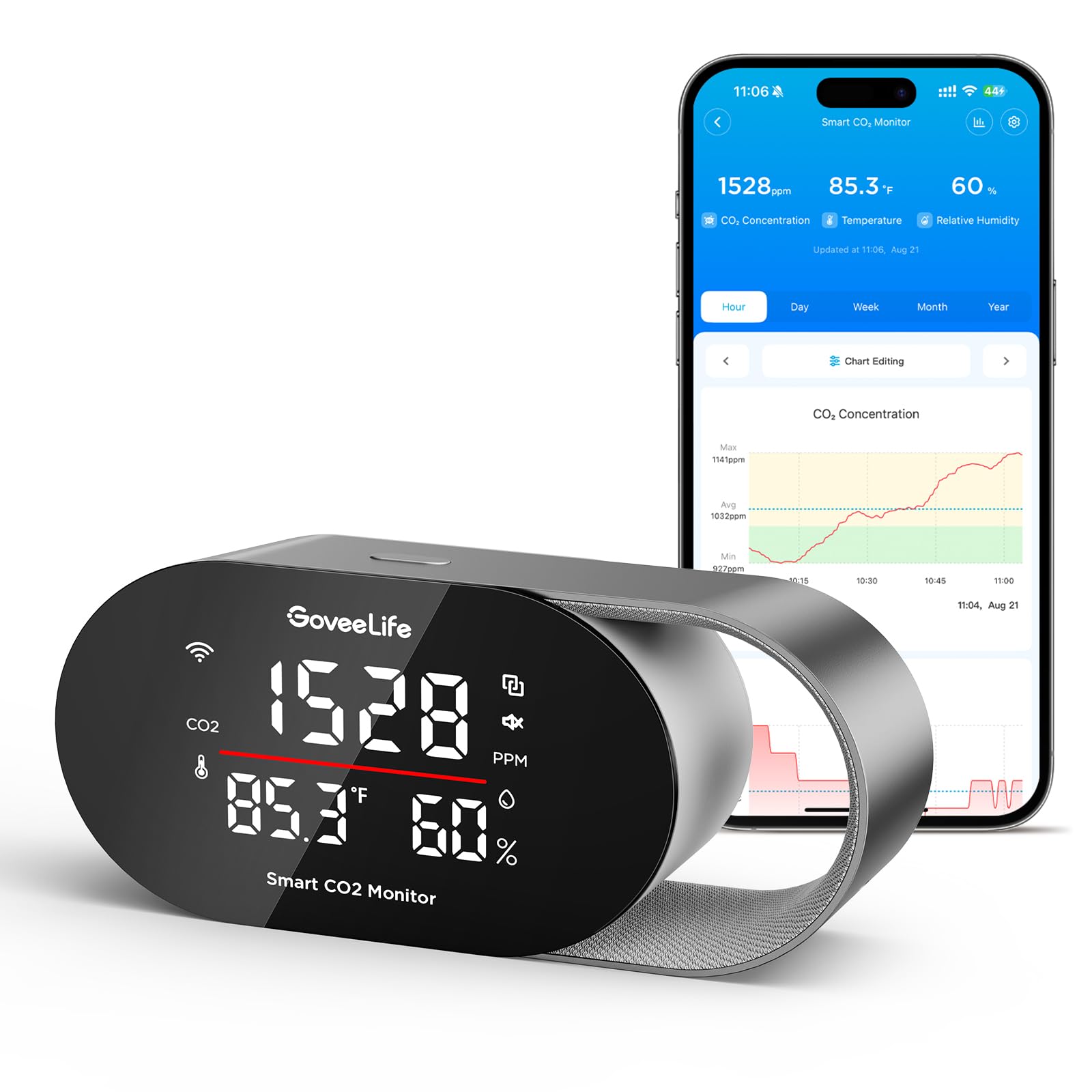
The GoveeLife H5140 is for the person who already lives in a smart-home ecosystem and wants air quality to join it. Its SCD4x CO2 sensor delivers accuracy of ±(40ppm + 5%) with a fast 5-second refresh rate, and built-in pressure compensation keeps readings honest at any altitude — no manual adjustment needed when you move between floors or cities. It measures CO2, temperature (°F/°C), and humidity (%RH) on a clear 4.82-inch display, and you can query the CO2 level by voice through Alexa or Google Assistant. The real differentiator is intelligent linkage: it can trigger a connected humidifier or tower fan to respond to your air quality automatically, turning passive monitoring into active environmental management.
Work-from-home users have found it genuinely useful — one saw CO2 hit 1500 ppm in a closed office, connected the resulting headaches to high CO2, and used the alerts to know exactly when to crack a window. The triple-alert system covers a built-in buzzer, instant app notifications, and detailed email reports, so you will not miss a threshold breach even if you are in another room. The app stores up to two years of historical data in interactive charts, and you can export CSV reports for your own records. The display brightness also auto-adjusts on a custom day/night schedule, cutting light pollution at night for light-sensitive sleepers.
The catch is power: this is an AC-powered device only, with no battery at all, so it must stay plugged in to a standard outlet. That guarantees uninterrupted 24/7 monitoring, but it kills portability — you cannot carry it to another room on a whim. It is also CO2-and-climate focused, so it will not sense particulate matter, and it deliberately cannot link to Govee’s air purifiers, since purifiers cannot actually reduce CO2. For a permanent desk or nightstand monitor inside the Govee ecosystem, it is a polished, alert-rich pick.
Choose it for: voice queries, two-year data history, and the ability to auto-trigger humidifiers and fans when your air goes stale.
Pass if: you need a portable monitor — with no battery, it lives where its outlet is.
7. SwitchBot Meter Pro CO2 Detector

A 92mm screen and Swiss sensor pack accuracy and style into one compact unit.
The SwitchBot Meter Pro CO2 takes the accuracy of a premium sensor and wraps it in a display that is genuinely pleasant to look at. Its 92-millimeter (about 3.6-inch) screen simultaneously shows CO2, temperature and humidity, time, date, and a comfort level, so one glance tells you everything about the room. Inside is a Swiss-made NDIR sensor that measures every 1 second with an accuracy of ±50 ppm across a 400 to 9000 ppm range — a wide span that covers normal home air all the way up to extreme greenhouse levels. Van-lifers praise it as an ideal wall-mount size for tight spaces, with a clear display readable from anywhere in the cabin and an alarm that tells them exactly when to open a window.
At just 4.8 ounces and 3.62 x 3.62 x 0.98 inches, it is barely heavier than the Aranet4 yet adds a clock and a larger, more colorful screen. The built-in battery runs up to 12 months between charges, and a low-battery warning keeps you from being caught off guard. It wall-mounts via holes or sits on an adjustable bracket, and its minimalist look blends into a living room, bedroom, or even a greenhouse. The three-alert system covers sound, a visual screen warning, and app notifications, though the app alerts require a separate SwitchBot Hub.
Accuracy gets strong real-world support — customers note outdoor readings around 400-450 ppm, which is the correct baseline for fresh air, and several consider it a smart-value alternative to the pricier Aranet4 at roughly half the cost. There is an honest quirk, though: in battery mode it checks CO2 every 5 minutes, while some users found readings froze for hours when the device was plugged in, with the app charts occasionally lagging behind. It runs fine on battery, which is how most people use it, but if you plan to keep it tethered to power, expect some quirks. It is also happiest when paired with a SwitchBot hub for full alerting.
The design win: a large, bright, minimalist screen with a full clock and comfort readout makes it the most informative display in this size class.
Worth knowing: full app alerts need a separate SwitchBot Hub, and plugged-in use can cause the readings to stall — battery mode is its happiest state.
8. LifeBasis 11-in-1 Air Quality Detector

An 11-in-1 sensor array that delivers broad air data on a budget.
If you want to sample everything — CO2, PM1.0, PM2.5, PM10, HCHO, TVOC, temperature, humidity, and AQI — without spending premium money, the LifeBasis 11-in-1 is the entry point that gets you there. It pairs an NDIR infrared CO2 sensor with a laser particle sensor, semiconductor sensor, photoelectric sensor, and a temperature/humidity sensor, all feeding a clear LCD screen with color-coded icons that shift from Good (green) through Moderate (yellow) and Poor (orange) to Abnormal (red). When a level is exceeded, the device ticks audibly and the interface color changes, so you know at a glance — no app required.
Its standout trait for the price is portability. At 6.1 ounces and roughly the size of a tall TV remote, it is noticeably heavier than the 3.67-ounce Aranet4 but still easy to carry from bedroom to living room, and the 2500mAh battery delivers up to 11-12 hours of continuous use on a full charge with a Type-C port for refills. Owners who tracked their sleep found real value: as reviewers point out, “CO2 works well: morning ~950, drops to 450-500 after ventilation,” which is exactly the feedback loop you want for deciding when to air out a bedroom. Several also found its PM2.5 readings correlated with their local EPA air-quality results during wildfire smoke, which built real trust.
Here is the honest caveat that shapes this pick: the accuracy opinions are genuinely split. The manufacturer asks for a 30-minute outdoor calibration before trusting it, and a handful of owners found early units glitchy — one saw the temperature read 76°F against a real 70°F, and another found CO2 stuck at nonsensical levels. In most of those cases, the company proactively replaced the unit and the replacement worked correctly, but the variance means you should treat early readings skeptically and calibrate outdoors first. It is the budget choice for breadth, not the precision choice — the Aranet4 above is the one to pick if CO2 accuracy alone is your priority.
The value pitch: no other monitor in this lineup touches this many air-quality parameters at this accessible level, with a battery that lasts a full day.
The fair warning: expect to calibrate outdoors for 30 minutes first, and know that sample-to-sample accuracy varies more here than on pricier NDIR units.
9. Pulse Pro Smart Grow Room Monitor
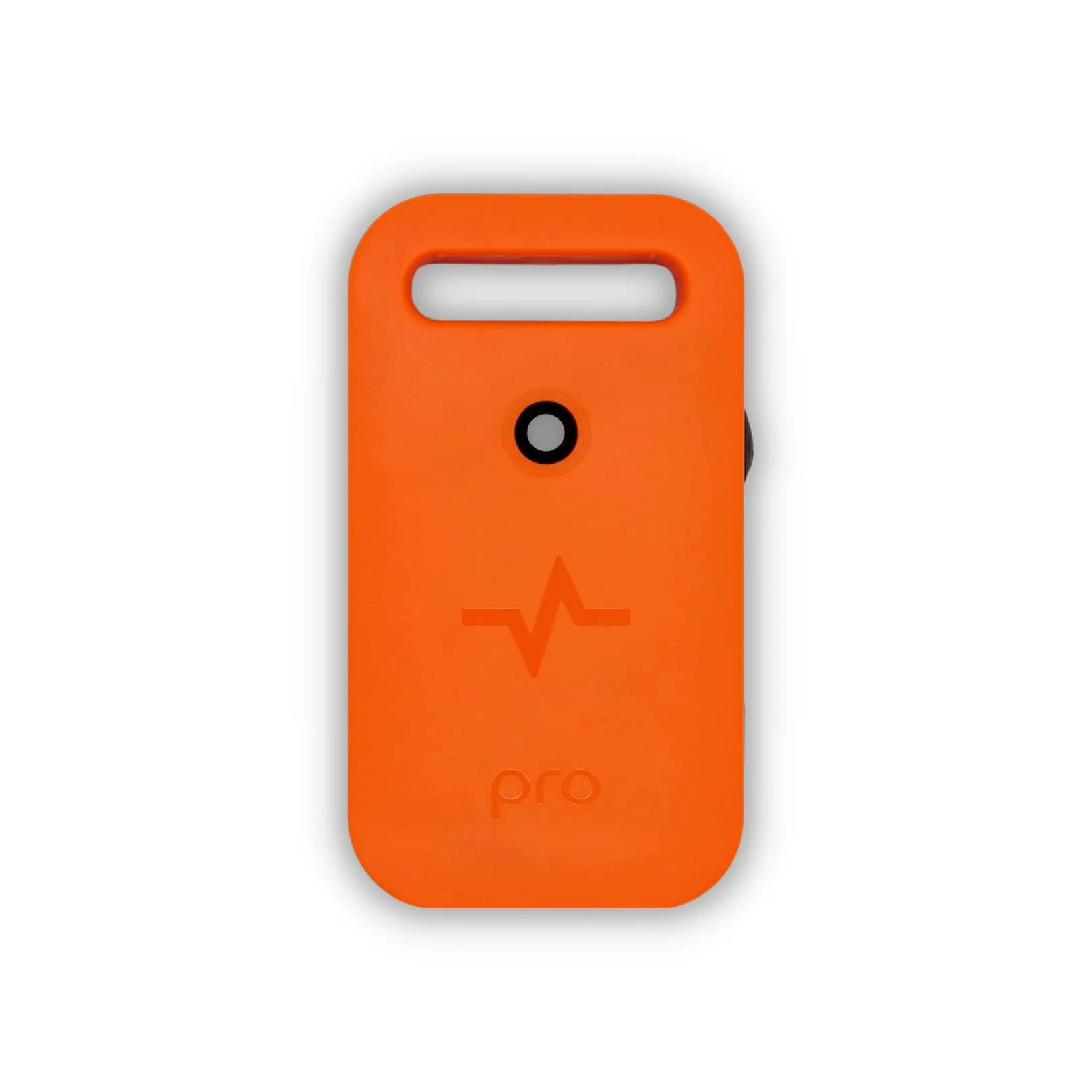
The professional-grade grow command center that tracks every environmental variable remotely.
The Pulse Pro is a different species from the rest of this list. It is not a home air-quality gadget; it is a precision grow-room instrument that measures CO2, PAR (photosynthetically active radiation, the light your plants can actually use), VPD (vapor pressure deficit, the key driver of plant transpiration), temperature, humidity, dew point, light intensity, and more. Designed and manufactured in the USA with Swiss-made sensors, it pairs over WiFi with iOS, Android, PC, or Mac, so you can watch your grow environment from anywhere. Owners describe it as an integral part of their grow lab, with email and SMS alerts keeping them aware of conditions around their plants even when they are not physically there.
The depth of data is what justifies its place at the top of the price range. The cloud dashboard tracks day and night averages for selected periods, stores data offline when connectivity drops, and alerts you to power outages. One owner found it revealed they were wasting CO2 — the monitor showed them exactly when their enrichment was overshooting — and noted the sensors were the most accurate they had owned. Another was impressed it could track even small temperature fluctuations, which matters when a few degrees can shift VPD and stress a crop. It is splash-resistant and runs on a lithium-ion battery that lasts 12 hours, backed by a one-year warranty and US-based support.
The trade-offs are clear and worth naming. This is a specialized tool, not a home monitor — it does not have a big always-on screen for a living room, and its 4.5 x 2.5 x 1.0-inch body is built to hang inside a grow tent, not decorate a desk. Its feature set is overwhelming for someone who just wants to know when to open a bedroom window. And while the core hardware earned strong praise from serious growers, the small owner sample includes at least one unit that would not connect, so the WiFi setup is not universally flawless. If you grow seriously and want CO2, PAR, and VPD data streaming to your phone, nothing else here touches it.
Built for: serious growers who need CO2, PAR, and VPD streamed remotely with cloud history and instant alerts — a true command center, not a room display.
Overkill for: anyone who merely wants to know when a home office feels stuffy; a simpler, cheaper monitor does that job with far less complexity.
Understanding the Specs
Parts Per Million (ppm)
This is the unit every CO2 reading is expressed in. Fresh outdoor air typically sits around 400-450 ppm. Indoors, levels climb as people exhale, and most people start noticing drowsiness or fuzzy thinking once a room passes roughly 1000 ppm. The number on your monitor tells you how far your room has drifted from fresh air, so you know when ventilation is genuinely needed.
NDIR vs. Photoacoustic Sensors
NDIR (nondispersive infrared) sensors shine infrared light through an air sample and measure how much CO2 absorbs it; they are the industry standard for stable, long-term accuracy. Photoacoustic sensors, like the SCD4x used in the Govee, measure the tiny sound wave created when CO2 absorbs pulsed light — a newer method that is compact and accurate, with built-in pressure compensation. Both beat cheaper chemical sensors, which drift out of calibration over time.
Refresh Rate
This is how often the sensor takes a new reading. Some units sample every 1 to 1.5 seconds, others every 5 minutes in battery-saving mode. A fast refresh matters if you want to watch CO2 fall in real time as you open a window; a slow refresh extends battery life dramatically. Decide which matters more for your use case before you buy.
Calibration
CO2 sensors drift slowly and need a reference point to stay accurate. Many monitors self-calibrate by assuming the lowest reading over a week or two is fresh outdoor air. Others ask you to take them outdoors for a set period — the LifeBasis recommends 30 minutes — to establish a baseline. If a reading looks wrong, a manual calibration outdoors usually fixes it.
FAQ
What is a safe CO2 level in a bedroom?
Should I get an NDIR or a cheaper chemical CO2 sensor?
How long does a CO2 monitor battery actually last?
Can a CO2 monitor work without WiFi or an app?
Does a higher price always mean a more accurate CO2 reading?
Why does my monitor read high when I first set it up?
What is the difference between CO2, TVOC, and PM2.5?
Can I use a CO2 monitor to check my car or greenhouse?
How many monitors do I need for my house?
Will an air purifier lower my CO2 readings?
Final Thoughts: The Verdict
Across the board, the co2 air monitor winner is the Aranet4 because its NDIR accuracy, up to 4-year AA battery life, and pocketable 3.67-ounce body make it the most trusted and easy way to know when your air has gone stale. If you live in a smart-home ecosystem and want voice control with two years of data history, grab the GoveeLife H5140. And for a family that wants one big screen watching every air-quality parameter without an app, the Sainlogic 16-in-1 is the one to reach for.
How We Picked
We do not accept paid placement. Every pick is matched to a real buyer and a real use-case; we do not hands-on test units.
Sources & Methodology
Specifications: manufacturer listings and product documentation. Review insights: verified customer reviews, as of September 2026. Pricing: not shown on this page (it changes often); check the current price via the retailer link.
As an Amazon Associate, Gadgets Feed earns from qualifying purchases. This does not affect which products we feature.