
Our readers keep the lights on and my morning glass full of iced black tea. As an Amazon Associate, I earn from qualifying purchases.
Specs are compiled from manufacturer listings and verified buyer reviews and can change over time — please confirm the key details on the product page before buying.
When the mercury drops below zero, a standard heat pump gives up and hands your heating bill over to the furnace. A cold climate air heat pump is built to keep pulling heat out of frigid air, so your home stays warm without the expensive backup kicking in.
I’m Min — the founder and writer behind Gadgets Feed. This guide is built by comparing the manufacturers’ published specifications and the patterns across verified customer reviews, so you get each pick’s real strengths and trade-offs instead of marketing spin.
The key is the low-ambient rating, and the picks below shrug off temperatures as low as -22°F while still cooling your whole home in summer.
Our Picks at a Glance

How To Choose The Best Cold Climate Air Heat Pump
Not every heat pump can handle a deep freeze. Standard models lose heating capacity as the outdoor temperature drops, which is why cold climate units are engineered with inverter compressors and rated to keep working at extreme lows.
Check the Low-Ambient Rating First
The single most important number is the minimum operating temperature. Look for a unit rated to at least -13°F, with the premium models going down to -22°F. This spec tells you exactly how cold it can get outside before the heat pump stops being your primary heat source.
Match BTU Output to Your Square Footage
Heating power is measured in British thermal units (BTU). A 9,000 BTU unit handles a single room, while an 18,000 to 24,000 BTU system covers a whole floor or small home. The manufacturer pairs each unit with a rated floor area — match that to your space or you will either waste energy or freeze.
Understand SEER2 and Efficiency
The Seasonal Energy Efficiency Ratio (SEER2) measures cooling efficiency; a higher number means lower running costs. Energy Star certification is your shortcut to knowing the unit qualifies for many utility rebates, which can offset the significant upfront cost of a professionally installed system.
Quick Comparison
| Model | Best For | Cooling Power | Floor Area | Capacity | Amazon |
|---|---|---|---|---|---|
| Senville AURA 18K★ Best Overall | Whole-home value and proven reliability | 17,000 BTU | 1,000 sq ft | 1.5 tons | Amazon |
| DELLA 18K 2-Zone | Heating two separate rooms at once | 18,000 BTU | 700 sq ft | 1.5 tons | Amazon |
| Senville Ducted 24K | Whole-home heating through existing ducts | 24,000 BTU | — | 2 tons | Amazon |
In‑Depth Reviews
1. Senville AURA Mini Split Air Conditioner, Heat Pump, White, 18000 BTU
Our pick — 4.5★ from 500+ verified ratings; the strongest balance of quality and price.
The proven workhorse that keeps a thousand square feet comfortable when the thermometer reads -22°F.
This is the cold climate pick with the longest track record, and the reason is the spec sheet. It delivers 17,000 BTU of cooling across a 1,000 square foot floor area, which beats the DELLA 2-zone by a 43% larger coverage gap — meaning it heats and cools roughly 300 more square feet of living space. The 1.5-ton capacity pairs with a 208-230V DC inverter to keep efficiency high even as the outdoor compressor works harder in a deep freeze.
The defining feature for cold climates is the operating range. Senville rates this system to deliver dependable heating and cooling down to -22°F (-30°C), which is about 9 degrees colder than the DELLA model below can manage. Buyers report heating a well-insulated 800 square foot home for about per day in 30°F weather. The same owners mention it “cools 15°F in 5 min, silent, accurate temp,” so the speed is not just a marketing claim.
You will need a pro to install this unit — it ships with the indoor air handler, outdoor condenser, and a 16ft. line set, but professional installation is mandatory. Some owners did partial DIY, mounting the units themselves and hiring an HVAC tech only for the refrigerant work, and they praised the seller support throughout. The 7-year warranty and Toshiba-made compressor add confidence for a machine meant to run for years. The WiFi connectivity gets mixed feedback from owners, so if Alexa control is your priority, expect to spend some time troubleshooting the app.
Owners Rave About
- Performance is the most-praised trait — over 70 buyers single it out, with heat performance a close second
- Quiet operation is a consistent theme, perfect for bedrooms and home offices
- Energy Star certified with HSPF 9.5 and SEER 22, qualifying for utility rebates
Know Before You Buy
- WiFi and Alexa connectivity earns mixed reviews — the app can be finicky
- Professional installation required; the included instructions are poorly organized
- The outdoor unit vibrates audibly if mounted on a wall instead of a pad
Reach for this if: you want the best-documented balance of power, efficiency, and sub-zero cold climate performance for a whole home.
Look elsewhere if: you need to heat two separate rooms independently — a single-zone system only serves one space.
2. DELLA 18K BTU 2 Zone 7000 9000 BTU Mini Split AC & Heat Pump, Energy Star 22 SEER2 Inverter 230V Ductless AC System for Rooms up to 700 Sq.Ft, WiFi & Voice Control, Pre-Charged,16.4ft Install Kit
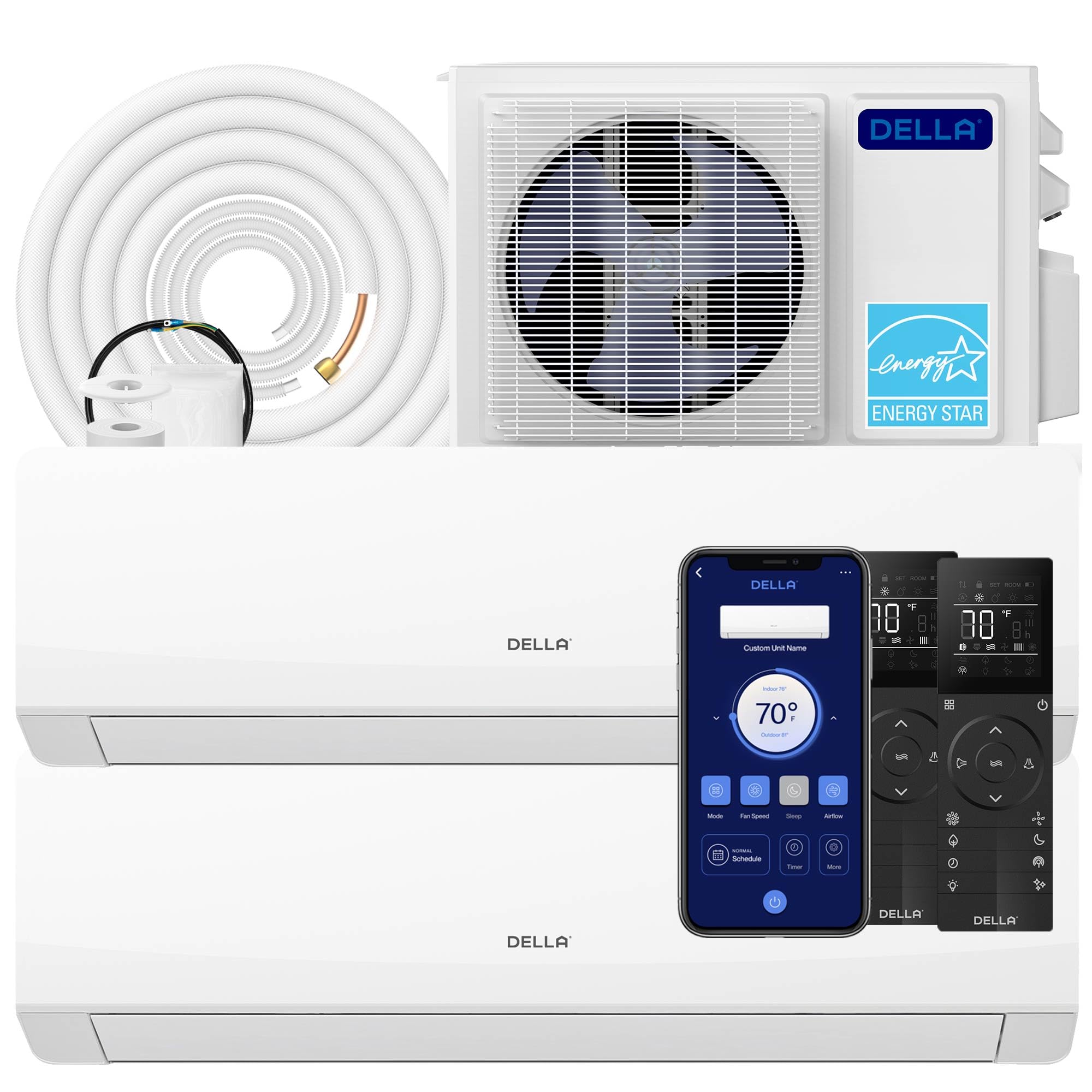
One outdoor condenser feeds two indoor units, so you can warm the bedroom and living room on separate schedules.
This is the pick for homes where a single wall unit is not enough. The 1.5-ton system pairs a 7,000 BTU indoor unit with a 9,000 BTU indoor unit, both connected to one outdoor condenser, covering up to 700 square feet total. That is a smaller footprint than the Senville AURA above, which handles 1,000 square feet, but the trade-off is zone control — you can heat only the room you are using and save energy.
Cold climate performance comes via the bottom heating element in the outdoor unit, which prevents ice buildup during winter operation and keeps it reliable at -13°F (-25°C). The 22 SEER2 efficiency rating is the headline number here, and owners confirm it is cheap to operate, with one DIY installer monitoring power usage and confirming it is efficient. The 16.4ft install kit includes standard 1/4″ and 3/8″ copper pipes, and the unit is pre-charged with R32 refrigerant, so a vacuum pump is the main extra tool you need.
The honest caveat is the reliability spread. Most customers note a smooth experience, but a small number hit a real problem — one buyer reports it “worked 1 day cold, then blew air; needs Freon but no service offered.” That is a rare but serious failure, so confirm your installer handles the line-set vacuuming properly, since any alteration of line-set length requires adjusting freon levels. The airflow also draws mixed reviews, so position the indoor units thoughtfully to avoid dead spots in the room.
Two-Room Winner: the standout feature is the dual-zone flexibility — one outdoor unit, two indoor heads, each controlled independently.
Efficiency Story: owners confirm the 22 SEER2 rating translates to genuinely low running costs, with several noting how cheap it is to operate.
Best for: a home office plus a bedroom, or any layout where you want independent temperature control in two rooms from a single outdoor unit.
Not for: buyers who need maximum cold climate depth — the -13°F rating trails the Senville AURA’s -22°F.
3. Senville Ducted Mini Split AC/Heating System, Concealed Duct, 24000 BTU

The concealed-duct powerhouse that hides in your ceiling and delivers 24,000 BTU of whole-home climate control.
This is the heavy hitter for larger homes that already have ductwork. At 24,000 BTU of cooling power, it outputs a 41% larger capacity than the Senville AURA’s 17,000 BTU, and the 2-ton rating gives it the muscle to condition a full floor rather than a single room. The concealed duct design means the indoor unit tucks away in your ceiling cavity, so you get central-style airflow without the visible wall cassette of the other picks.
Cold climate credentials are strong — the 4-in-1 system is rated for heating down to -22°F (-30°C), matching the AURA as the deepest cold climate performer here. It is a true 4-in-1 machine, combining air conditioning, heating, dehumidifying, and a fan, plus turbo function for rapid temperature changes. The built-in drain pump is a practical bonus for attic or crawlspace installations where gravity drainage is not possible, and the 16 ft. installation kit comes with pre-flared copper lines to simplify the pro install.
The reliability picture is genuinely mixed, and it is worth knowing before you commit. Owners love the performance and several praise the factory tech support, but the thermostat draws complaints — it can be inaccurate, causing the unit to run constantly, and the stock controller does not play nicely with a Nest smart thermostat. One owner solved it by wiring in a Cielo smart thermostat via signal replication, but that is a project, not a plug-and-play fix. Plan on a 35A breaker and follow the refrigerant filling sequence carefully.
Whole-Home Strengths
- Highest output of the three — 24,000 BTU and 2-ton capacity for large open layouts
- Rated to -22°F, matching the top cold climate performance available
- Whisper-quiet operation with a built-in drain pump for flexible placement
The Honest Trade-Offs
- The stock thermostat is inaccurate and can trigger constant running
- Nest smart thermostats are incompatible — you will need a Cielo or similar workaround
- Reliability feedback is split between “works great” and rare early failures
Choose it if: you need the most raw heating and cooling output for a large home with ducts, and you are comfortable managing a finicky thermostat.
Think twice if: you want smart-home simplicity — the thermostat quirks make this the most hands-on pick of the three.
Understanding the Specs
Low-Ambient Temperature Rating
This is the number that decides whether a heat pump is truly “cold climate.” It tells you the lowest outdoor temperature at which the unit still delivers rated heating capacity. The picks here are rated to -13°F and -22°F, which is the difference between a heat pump that stops working in a deep freeze and one that keeps your home warm all winter.
BTU and Ton Capacity
British thermal units (BTU) measure heating and cooling power — the higher the number, the more air it can condition. A “ton” is a shorthand for 12,000 BTU per hour. Matching the unit’s rated floor area to your home is the most common mistake; an undersized unit runs constantly, and an oversized one short-cycles and wastes energy.
FAQ
How cold can a cold climate heat pump operate?
What is the difference between a single-zone and a multi-zone mini split?
Can I install a mini split heat pump myself to save money?
Will a heat pump actually save me money compared to a furnace?
What does the SEER2 rating mean for my electricity bill?
Can I control these heat pumps with Alexa or Google Home?
What is a ducted mini split versus a wall-mounted ductless unit?
How long does a mini split heat pump last?
Final Thoughts: The Verdict
The clear winner for most homes is the cold climate air heat pump — the Senville AURA 18K — because it pairs a 17,000 BTU output with a 1,000 square foot coverage area and a -22°F rating, backed by hundreds of owners reporting quiet, efficient, reliable performance. If you need to heat two separate rooms, the DELLA 18K 2-Zone gives you independent control from one condenser. And for a larger home with existing ducts, the Senville Ducted 24K delivers the most raw power at 24,000 BTU — just budget time for its thermostat quirks.
How We Picked
We do not accept paid placement. Every pick is matched to a real buyer and a real use-case; we do not hands-on test units.
Sources & Methodology
Specifications: manufacturer listings and product documentation. Review insights: verified customer reviews, as of September 2026. Pricing: not shown on this page (it changes often); check the current price via the retailer link.
As an Amazon Associate, Gadgets Feed earns from qualifying purchases. This does not affect which products we feature.