
Our readers keep the lights on and my morning glass full of iced black tea. As an Amazon Associate, I earn from qualifying purchases.
Specs are compiled from manufacturer listings and verified buyer reviews and can change over time — please confirm the key details on the product page before buying.
If you are shopping for a cordless backpack vacuum, the one thing you actually need to know is this: runtime decides whether you keep it or return it. A cordless backpack vacuum puts the motor and the dust bag on your back and runs on a rechargeable battery instead of a wall cable. That means no cord to drag across a floor or trip over, but it also means every minute of cleaning is borrowed from a battery you will have to charge. Match runtime to your cleaning session, not to the biggest spec sheet.
I’m Min — the founder and writer behind Gadgets Feed. This guide is built by comparing the manufacturers’ published specifications and the patterns across verified customer reviews, so you get each pick’s real strengths and trade-offs instead of marketing spin.
Every model here is battery-powered and backpack-mounted, so the deciding factors are runtime, capacity, and filter setup. Weigh those three against your space before you commit to any of these, because this cordless backpack vacuum guide sorts the workhorses from the lightweights.
Quick Picks
- Milwaukee Electric – M18 Fuel 3-in-1 BACKPK — Best Overall
- Makita XCV09Z 18V X2 LXT Lithium-Ion — Best for LXT Owners
- Sanitaire Transport Commercial Cordless — Best Dual-Battery Design
- Makita XCV10PTX 18V X2 LXT Lithium-Ion — Best for Dust Control
- Makita XCV09PT 18V X2 LXT Lithium-Ion — Best Runtime Value
- ProTeam GoFit 3 Cordless 4Ah — Lightest Carry
How To Choose The Best Cordless Backpack Vacuum
A cordless backpack vacuum moves the weight from your wrist to your shoulders. The trade-off is the battery, and runtime is where most buyers end up disappointed. Three specs decide which one you should strap on.
Runtime vs. your real cleaning session
Every cordless backpack vacuum lists a runtime in minutes, and that number is measured either on a low or “normal” setting — not the boost or turbo mode you will reach for on a dirty floor. A vacuum quoted at a long runtime on normal can drop to a fraction of that on high. Count your rooms, carpet square footage, and tile square footage before you buy. If one charge will not cover the job, you want a unit with swappable batteries or a fast recharge so the work does not stop.
Battery voltage, amp-hours, and what they actually mean
Amp-hours (Ah) measure how much energy a battery stores — a 5.0Ah pack holds more charge than a smaller one. Voltage sets how hard that energy pushes the motor. A higher-voltage system with a brushless motor (a motor with no carbon brushes to wear out, so it runs cooler) can deliver strong suction while drawing less from the pack. More amp-hours and higher voltage usually mean more runtime, but they also add weight to the harness.
Filtration and bag vs. bagless
HEPA filtration is a filter grade that captures very fine particles, and it matters if you clean around pets, dust, or anyone with breathing sensitivity. Some units use disposable bags that seal the dust away when you swap them; others use a bagless cyclonic design with a canister you empty by hand. Bags cost money over time but keep the dust contained. Bagless saves on bags but means you handle the debris and clean the filter more often.
Quick Comparison
| Model | Best For | Carry Weight | Capacity | Runtime / Battery | Amazon |
|---|---|---|---|---|---|
| Milwaukee M18 Fuel 3-in-1 | Contractors and job sites | 15.3 lb | Bagless canister | Approx. 20 min per 5Ah | Amazon |
| Makita XCV09Z (Tool Only) | Buyers already on the LXT battery platform | 12.4 lb | 1/2 gallon | 116 min normal / 33 min max | Amazon |
| Sanitaire Transport SC580A | Commercial cleaning crews | 15 lb | 4 quarts | Up to 70 min / Dual 24V | Amazon |
| Makita XCV10PTX | Dust management on job sites | — | 0.5 gallons | 62 min normal / 33 min high | Amazon |
| Makita XCV09PT (Kit) | Stairs and outlet-free areas | — | 0.5 gallons | 116 min normal / 33 min max | Amazon |
| ProTeam GoFit 3 Cordless | Smaller-framed, light-duty users | 12.8 lb | 3 quarts | 51 min low / 39 min high | Amazon |
In‑Depth Reviews
1. Milwaukee Electric – M18 Fuel 3-in-1 BACKPK Vacuum
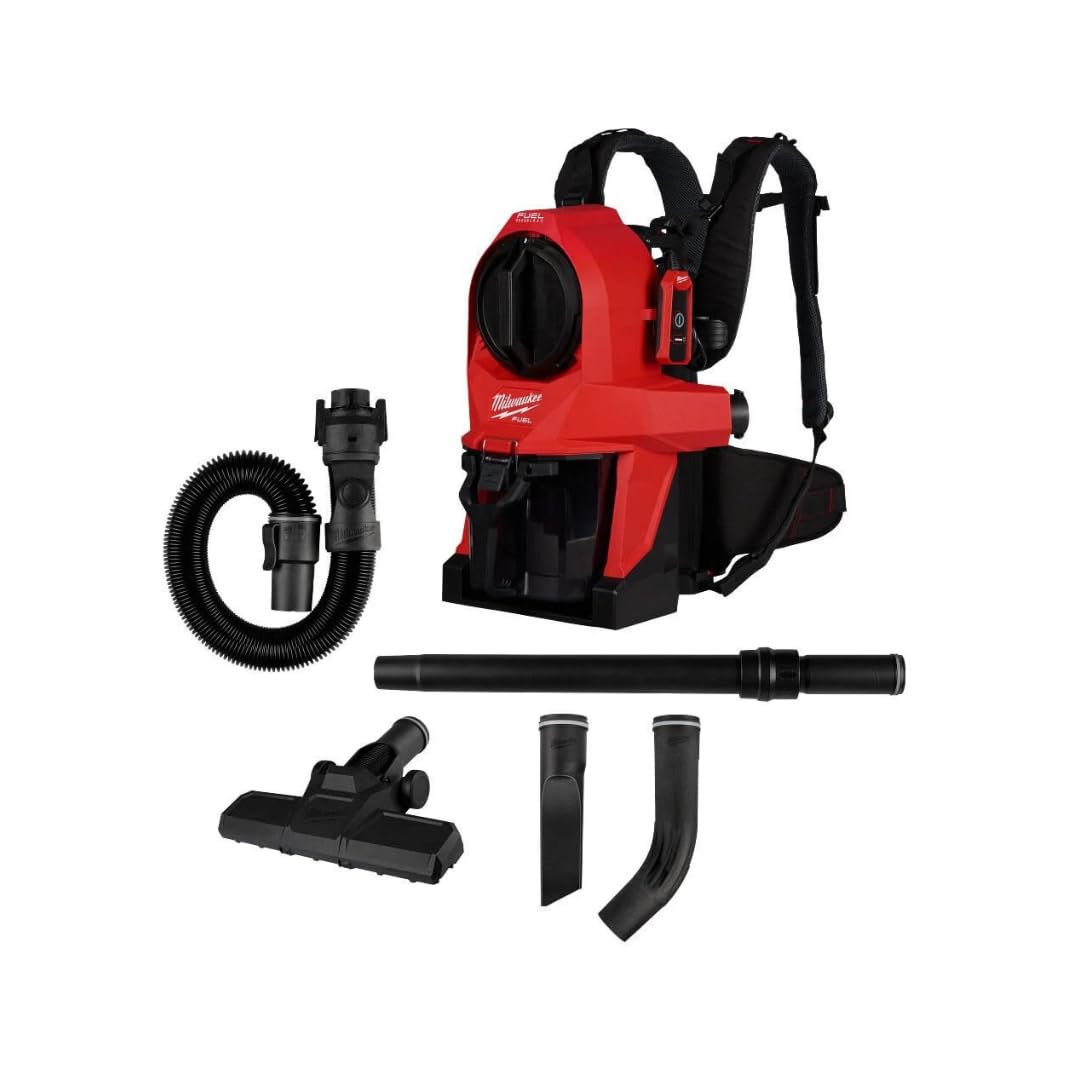
The job-site workhorse that trades runtime for raw, quiet suction and bag-less convenience.
If you clean job sites, cars, or garages on a hard floor rather than a carpeted home, this is the one to start with. The Milwaukee M18 Fuel 3-in-1 is a cyclonic bagless backpack vacuum — meaning it spins the dust out of the airflow instead of trapping it in a bag, so there is no bag to buy. Suction here is genuinely strong: the nozzle has enough pull to lift rugs off the floor, and two suction settings let you dial it back. You get on-board storage for the flexible hose, telescoping extension wand, floor tool, and crevice tool, plus a HEPA filter and dust extraction adapter in the box.
What wins people over is convenience. Strap it on and there is no cable to drag between rooms or trip over, and the removable harness plus integrated canister hook let you convert it from a backpack into a canister you pull along. It is noticeably quieter than a wheeled Shop-Vac, which matters when you are working near other people. One thing to plan around before you buy: runtime. One 5Ah battery runs roughly 20 minutes of continuous use, so buyers report bringing a spare pack or two for anything beyond a quick job. That short window is the honest cost of the power this motor pulls.
The 26.85″ x 9.96″ x 14.29″ body is built for durability on hard surfaces, and there is no roller brush, so hair never wraps around a beater bar. The recurring gripes are batteries draining fast on high draw and the need to clean the filter regularly to keep suction up. For light around-the-house cleaning, this is more machine than you need; for a pro or a serious DIYer, it earns its place as the overall pick.
Where It Pulls Ahead
- Cyclonic bagless design — no bags to buy, just empty the canister.
- Strong suction that will lift rugs; two power settings.
- Quieter than a wheeled Shop-Vac; HEPA filter included.
- Removable harness converts it from backpack to canister.
What To Plan Around
- Roughly 20 minutes per 5Ah battery on continuous use — bring spares.
- 15.3 pounds is the heaviest carry here.
- Filter needs regular cleaning to hold suction.
- Limited attachments in the box.
Reach for this if: you clean hard floors, garages, cars, or job sites and want bagless convenience with strong suction.
Look elsewhere if: you need long uninterrupted runtime or you are doing light around-the-house work on a carpeted floor.
2. Makita XCV09Z 18V X2 LXT Lithium-Ion (36V) Brushless Cordless 1/2 Gallon HEPA Filter Backpack Dry Vacuum, Tool Only

A featherweight pack with marathon runtime — if you already own the Makita batteries it needs.
The headline number here is 116 minutes. That is the runtime on the normal setting using two 18V LXT 5.0Ah batteries, which is far beyond what the Milwaukee above manages on a single pack. Drop it to the Max setting and you get 33 minutes at 70 CFM of suction and 44 inches of water lift — a measure of how hard the vacuum pulls air upward. The two-stage HEPA filter captures 99.97% of particulates 0.3 microns and larger, so fine dust and allergens stay sealed in the bag rather than blowing back into the room.
The catch is in the name: this is a “tool only” listing. No batteries, no charger. If you are already inside the Makita 18V LXT system, that is a genuine advantage — you reuse packs you own and skip paying for more. If you are starting from scratch, budget for the batteries too. At 12.4 pounds it is the lightest of the three Makita-family units here, 2.9 pounds lighter than the Milwaukee, which makes it easier to carry through a long session. The included aluminum telescoping wand, bent pipe, crevice nozzle, floor nozzle, and filter dust bag cover most jobs from the start.
Owners praise the suction on dog hair and drywall dust, and the low-profile pivoting head gets under furniture. The honest trade-off is the small 1/2-gallon bag: it fills quickly, and suction drops as it does, so you will be swapping bags often on big jobs. The reusable cloth bag clogs fast and kills airflow — paper bags keep pull stronger. If you run big jobs, the Makita XCV09PT kit at position 5 gives you the same body with two batteries and a charger included.
Runtime you can count on: 116 minutes on normal is the standout spec, and the brushless motor runs cooler because it has no carbon brushes to wear out.
Size the bag to the job: a 1/2-gallon capacity means frequent swaps and a suction dip as it fills, so this suits detailed work over whole-floor marathon cleans.
The smart buy if: you already own Makita 18V LXT batteries and want long runtime in the lightest possible pack.
The wrong pick if: you need batteries included or you are vacuuming large spaces where a bigger bag matters more than runtime.
3. Sanitaire Transport Commercial Cordless Backpack Vacuum with Adjustable Wand, Dual 24V Batteries, Handheld Controls, SC580A. Gray

Built for crews who clean whole buildings and cannot afford to stop for a recharge.
This is the pick for anyone cleaning commercially — offices, schools, clinics — where stopping to charge mid-shift is not an option. The Sanitaire Transport runs a dual 24V battery system, meaning you get two removable packs you can charge and swap for continuous work. Sanitaire puts the runtime at up to 70 minutes, or 40 minutes on continuous Boost speed, and the handheld controls let you check each battery’s charge and toggle power without taking the pack off. There is even a clippable remote controller for hands-free use.
The design goal is speed and reach. The body is 17.25″ x 21.25″ x 8.5″ — the widest footprint in this roundup, 21.25 inches wide versus the Milwaukee’s 9.96 inches — so it covers large floor areas fast but takes up more room to store. Filtration is a sealed HEPA system rated to capture at least 99.97% of 0.3 micron particles and smaller, and the whole thing weighs under 15 pounds on adjustable padded straps.
What buyers like most is the build quality and quiet operation — it is well made, easy to set up, and the batteries run one at a time so you can recharge the first while using the second. The gripes are real but manageable: the batteries run roughly 25 to 30 minutes on high and take over an hour to charge, and the included floor attachments are only okay on large debris, so some owners swap in a motorhead. One recurring annoyance is that the charger fan is loud. There is a 2-year commercial warranty behind it.
Where it wins the day: the dual-battery swap-and-charge system is the feature that keeps a cleaning crew moving all shift without a cord.
The honest stretch: recharge takes over an hour and the screw-on attachments are dated — if you mostly handle big debris, plan on adding a better head.
Made for this: commercial cleaners doing whole-building work who need continuous runtime and fast floor coverage.
Overkill if: you just want a lightweight household vacuum for a few rooms — the wide body and attachment quirks are more than that job needs.
4. Makita XCV10PTX 18V X2 LXT Lithium-Ion (36V) Brushless Cordless 1/2 Gallon HEPA Filter Backpack Dry Dust Extractor Kit, AWS Capable (5.0Ah)

A dust extractor that pairs with your Makita power tools and switches on when they do.
Here is a cordless backpack vacuum with a genuinely different job: catching dust at the source while you cut. The XCV10PTX is an AWS-capable dust extractor, meaning its Auto-start Wireless System uses Bluetooth to power the vacuum on and off in sync with a paired Makita tool — so you are not reaching for a switch with a saw in your hand. The brushless motor pushes 64 CFM of suction and 44 inches of water lift, with 62 minutes of continuous runtime on normal and 33 minutes on high using two 18V LXT 5.0Ah batteries.
This kit comes ready to work: two 5.0Ah batteries and a dual-port charger are included, along with a 1-inch by 59-inch flexible hose, HEPA filter, filter dust bag, harness, and three tool-cuff adapters at 22mm, 24mm, and 38mm for fitting the hose to different tools. Drywall professionals have leaned on exactly this jigsaw-plus-backpack combo for dust-sensitive work, and it is rated for outdoor use as well as indoor. The two-stage HEPA filter captures 99.97% of particulates 0.3 microns and larger. There is a 3-year limited warranty.
Two things to know before you buy. First, the AWS transmitter that pairs the vacuum to your tool is sold separately. Second, the bent-pipe suction tube is not in the box — you need it to attach the wand, so add it to your order or the vacuum cannot be used as a wand vacuum. Owners who bought it for that specific pairing love the results; a few found the suction weaker than hoped for general cleaning, so go in clear on what you are buying it for.
The system play: buy this because it turns your Makita tool into a dust-trapping machine, not because you want a general-purpose backpack vacuum.
Best fit: tradespeople who cut or sand inside occupied buildings and use Makita tools that support the AWS pairing.
Not for you if: you expect a wand vacuum straight from the start — the bent pipe and AWS transmitter are separate purchases.
5. Makita XCV09PT 18V X2 LXT Lithium-Ion (36V) Brushless Cordless 1/2 Gallon HEPA Filter Backpack Dry Vacuum Kit (5.0Ah)

The same 116-minute body as the tool-only Makita, now with batteries and charger in the box.
Think of this as the answer to a common headache. If you liked the Makita XCV09Z above but did not want to buy batteries separately, this kit ships with two 18V LXT 5.0Ah batteries and a dual-port charger, so it works the moment it arrives. The motor and runtime are identical: 70 CFM of suction, 44 inches of water lift, up to 116 minutes on normal and 33 minutes on Max. It runs on 36V from the two 18V packs combined, and the brushless motor runs cooler because there are no carbon brushes to wear out.
The package is generous for wand work — telescoping extension wand, bent pipe, crevice nozzle, floor nozzle, harness, and filter dust bag, plus the HEPA filter that captures 99.97% of particulates 0.3 microns and larger. Owners use it exactly where cords cannot reach: stairs, lofts, and rooms with no socket nearby. It works well on low carpet and bare tile, and the three-speed control with a memory setting lets you return to your preferred power level. The included batteries also fit other Makita LXT tools you may own.
Where it falls short is suction on deeper carpet. There is no beater bar, so the vacuum relies on airflow alone, and several owners find the pull only moderate on carpeted floors. The hose-to-floor attachment can pop off, and replacement bags fill quickly. If your home is mostly thick carpet, this is not the tool; if it is stairs, tile, and hard floors, the runtime and bagged HEPA filtration make it a strong kit buy.
Why The Kit Makes Sense
- Two 5.0Ah batteries and a dual-port charger included.
- Up to 116 minutes on normal from the 36V setup.
- Three speeds with a memory setting.
- Batteries also run other Makita LXT tools.
Where It Hits A Wall
- No beater bar, so deep-carpet suction is limited.
- Bags fill quickly on big jobs.
- Hose-to-floor attachment can pop off.
Pick this if: you want a ready-to-run kit for stairs, tile, and hard floors without buying batteries separately.
Pass it over if: thick wall-to-wall carpet is most of your cleaning — you want a powered head instead.
6. ProTeam GoFit 3 Cordless 4Ah, 3 qt. Commercial Backpack Vacuum w/Xover Multi-Surface Telescoping Wand Tool Kit, 107774
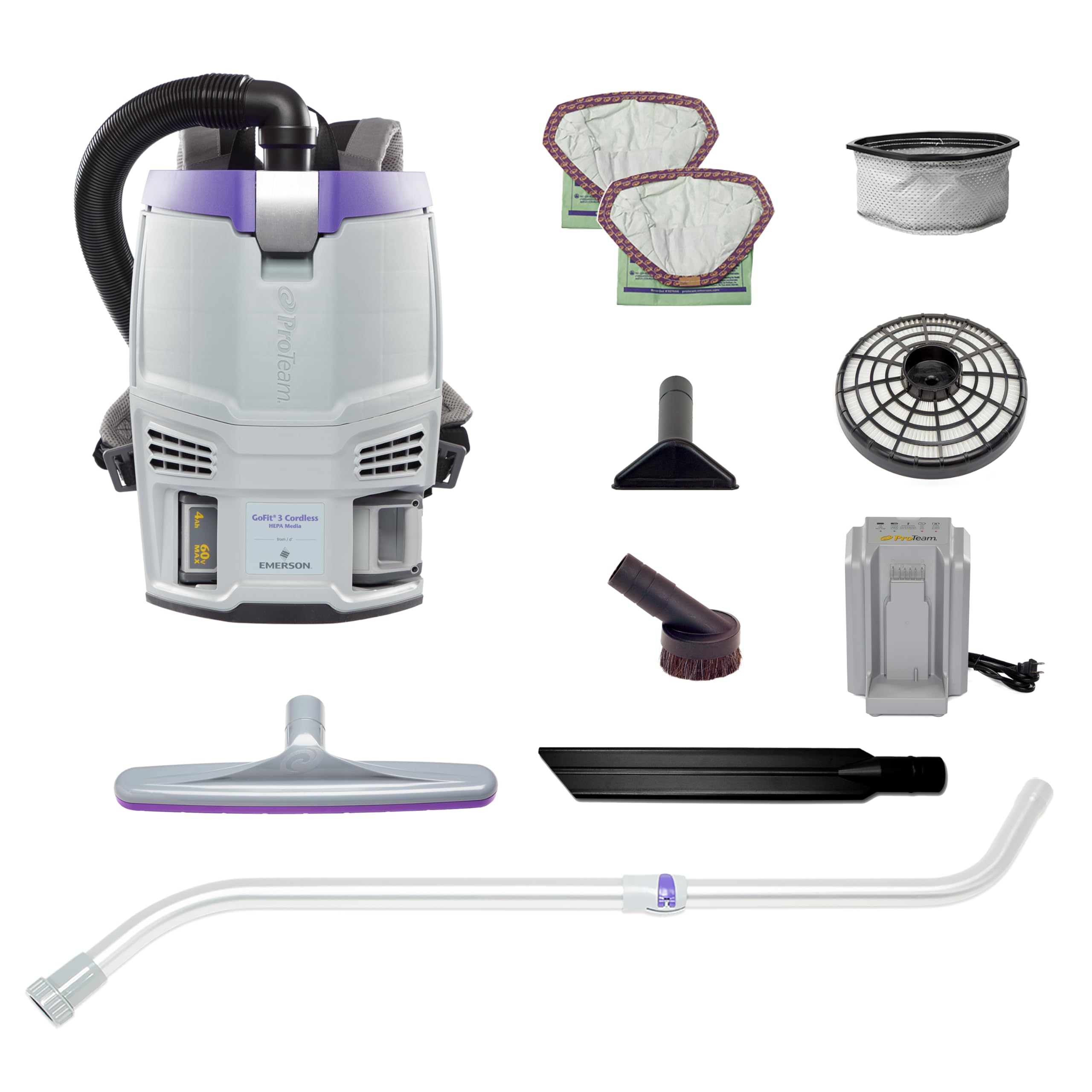
The lightest pack here, built for smaller frames and bare-floor cleanup.
ProTeam designed this one specifically for people with smaller frames. With the battery installed it weighs just 12.8 pounds, a touch under the 15.3-pound Milwaukee and about level with the lighter Makita packs, and the interchangeable quick-adjust 4-step harness sets your fit without tools. Runtime is roughly 51 minutes on low and 39 minutes on high from the 4Ah battery, and a rapid recharge brings it back to full in about 61 minutes. The 3-quart capacity is the largest bag here, which means fewer empties than the 1/2-gallon Makitas.
In daily use it shines on hard floors. The swivel hose and low-profile pivoting head reach under furniture and into vents, and the onboard attachment storage keeps tools with you. The battery design carries its weight low, so the load feels balanced despite tipping past 10 pounds. ProTeam pairs a ProLevel filtration system with HEPA-grade filtering, and the company is an American Lung Association partner — though the ALA notes it does not endorse products. The high/low switch lets you save runtime on detail work and step up to high for traffic lanes.
The honest limit is suction on carpet. There is no rotary brush, so lint and embedded dirt resist a single pass, and buyers rate the pull below comparable corded models — one noted the corded same-brand unit pulls noticeably harder. The battery has also been reported to work loose during use, and the charger runs loud. For large jobs on bare floors it holds its own; for deep carpet or heavy debris, a corded model or a unit with a powered head is the better call.
The strong suit: lightweight build and a 3-quart bag make long bare-floor sessions comfortable for smaller users.
Size up the job first: weaker-than-expected suction on carpet and a battery that can shift mean this one is best suited to hard floors and lighter cleaning.
Right for you if: you want the lightest carry, a bigger bag, and mostly hard-floor cleanup such as tile and vents.
Think twice if: your cleaning is carpet-heavy or you handle lots of debris — you will get more pull from a corded model.
Understanding the Specs
CFM and Water Lift
CFM (cubic feet per minute) measures how much air the vacuum moves, which affects how fast it sweeps a floor. Water lift measures how hard it pulls that air upward, which affects how much weight it can lift from carpet. A cordless backpack vacuum with high CFM and high water lift does both — but pushing both hard drains the battery faster, which is why runtime and suction always trade against each other.
HEPA Filtration
HEPA is a filter grade that traps very fine particles instead of passing them back into the air. A unit rated to capture 99.97% of 0.3-micron particles is holding onto fine dust, pollen, and pet dander. If you clean around allergies or on dusty job sites, that capture rate is worth more than raw suction, because the point is to remove the dust, not just move it around.
Battery Amp-Hours and Voltage
Amp-hours (Ah) tell you how much charge the pack stores, and voltage tells you how hard that charge drives the motor. Most cordless backpack vacuums here run on 18V packs, some paired into 36V systems for more power. A brushless motor — one with no carbon brushes to wear out — turns that power more efficiently and runs cooler, so you get more runtime per charge than a brushed motor of the same size.
Bag vs. Bagless and Capacity
Bagged models seal dust into a disposable bag you throw away, keeping your hands and the air clean but adding a recurring cost. Bagless cyclonic models spin dust into a canister you empty by hand, so no bags to buy but more cleanup. Capacity — measured in quarts or gallons — decides how often you stop; a 1/2-gallon bag needs far more swapping than a 3-quart or 4-quart one on a big job.
FAQ
How long does a cordless backpack vacuum actually run?
Is a cordless backpack vacuum as strong as a corded one?
Will a cordless backpack vacuum work on carpet?
What is the difference between HEPA and standard filtration?
Do I need to buy batteries separately for a cordless backpack vacuum?
How much weight will I carry on my back?
How often will I need to empty the bag or canister?
Can a backpack vacuum reach stairs and tight spaces?
Are cordless backpack vacuums quiet enough for offices?
What is AWS and do I need it?
Final Thoughts: The Verdict
The cordless backpack vacuum that earns the top spot is the Milwaukee M18 Fuel 3-in-1, because it pairs genuine bagless suction with a convertible backpack-to-canister design that handles hard floors and job-site mess. If runtime is what you are chasing, reach for the Makita XCV09PT — its 116-minute normal-setting run and included batteries make it a ready-to-work kit. And for a whole-building crew that cannot stop to charge, the dual-battery Sanitaire Transport SC580A lets you swap and keep going.
How We Picked
We do not accept paid placement. Every pick is matched to a real buyer and a real use-case; we do not hands-on test units.
Sources & Methodology
Specifications: manufacturer listings and product documentation. Review insights: verified customer reviews, as of September 2026. Pricing: not shown on this page (it changes often); check the current price via the retailer link.
As an Amazon Associate, Gadgets Feed earns from qualifying purchases. This does not affect which products we feature.