
Our readers keep the lights on and my morning glass full of iced black tea. As an Amazon Associate, I earn from qualifying purchases.
Specs are compiled from manufacturer listings and verified buyer reviews and can change over time — please confirm the key details on the product page before buying.
To avoid a dead fuse or a device that won’t start, you need to match the adapter’s wattage to what you plug in and know whether you’ll run it from the cigarette lighter or straight off the battery. This guide covers real-world power limits, key safety protections, and which models hold up on the road.
I’m Min — the founder and writer behind Gadgets Feed. This guide is built by comparing the manufacturers’ published specifications and the patterns across verified customer reviews, so you get each pick’s real strengths and trade-offs instead of marketing spin.
To run a laptop, power a TV, or fast-charge your devices while driving, the right dc to ac adapter keeps your gear alive without draining your vehicle’s battery or tripping its safety systems.
Our Picks at a Glance
How To Choose The Best DC to AC Adapter
Wattage is the primary decision, as it determines socket compatibility, cost, and which devices you can power. Match continuous wattage to your most power-hungry device, then add a small buffer to avoid constant strain.
Know the difference between continuous and peak power
Continuous watts is what the inverter can deliver steadily, while peak (surge) watts is the brief burst needed to start motors in things like mini-fridges or compressors. If a device’s startup draw exceeds the inverter’s peak rating, it will simply shut down or blow a fuse, so always compare both numbers against the appliance label.
Match the inverter to the power source, not just the device
Most car cigarette lighter sockets are designed for roughly 150W to 200W of continuous draw, which is why higher-wattage inverters come with battery clamp cables instead. If you need more than that, you have to connect directly to the 12V battery — trying to pull 400W through a lighter plug will melt fuses and wiring.
Check the output waveform for sensitive gear
Cheaper units output a modified sine wave (a stepped power signal), which is fine for laptops, phone chargers, and simple tools. But audio equipment, certain medical devices, and some appliances with motors can hum, run hot, or even fail on that signal — those demand a pure sine wave output (a smooth power signal) that mirrors the clean power from your wall outlet.
Quick Comparison
| Model | Best For | Output Power | AC Outlets | USB Fast Charging | Amazon |
|---|---|---|---|---|---|
| BESTEK 400W★ Best Overall | All-around daily car use | 400 watts | Dual 110V | USB-C PD 30W / USB-A QC 3.0 | Amazon |
| ALLWEI 200WBest Value | Everyday lighter-socket use | 200 watts | 2 US standard | USB-C PD 18W / USB-A | Amazon |
| DrimMek 300WMost Versatile | Multi-device road trips | 300W (110V) | Dual AC | USB-C 65W & 24W / USB-A 24W | Amazon |
| FSATBTNE 400W | Camping & portable batteries | 400 watts (800W peak) | 2 AC | USB-C 65W / USB-A 18W | Amazon |
| Pro Chaser 400W | Charging laptops on the go | 400 watts (800W peak) | Dual 110V | USB-C PD 65W / USB-A QC 18W | Amazon |
| OLTEANP 500W | Mobile office & power tools | 500 watts | 2 AC | USB-C 36W / USB-A | Amazon |
| YSOLX 1000W | RV & heavy multi-device | 1000 watts (2000W surge) | 3 AC + dual 12V sockets | USB-C PD 30W / 2x USB-A | Amazon |
| TOPBULL 3000W | Heavy-duty home backup | 3000 watts (6000W peak) | 2x 20A/120V | USB-C 30W / USB-A 3.4A | Amazon |
| BELTTT 2000W Pure Sine | Sensitive electronics & off-grid | 2000 watts (4000W surge) | Dual AC + 20A outlet | USB-A 5V2.1A | Amazon |
In‑Depth Reviews
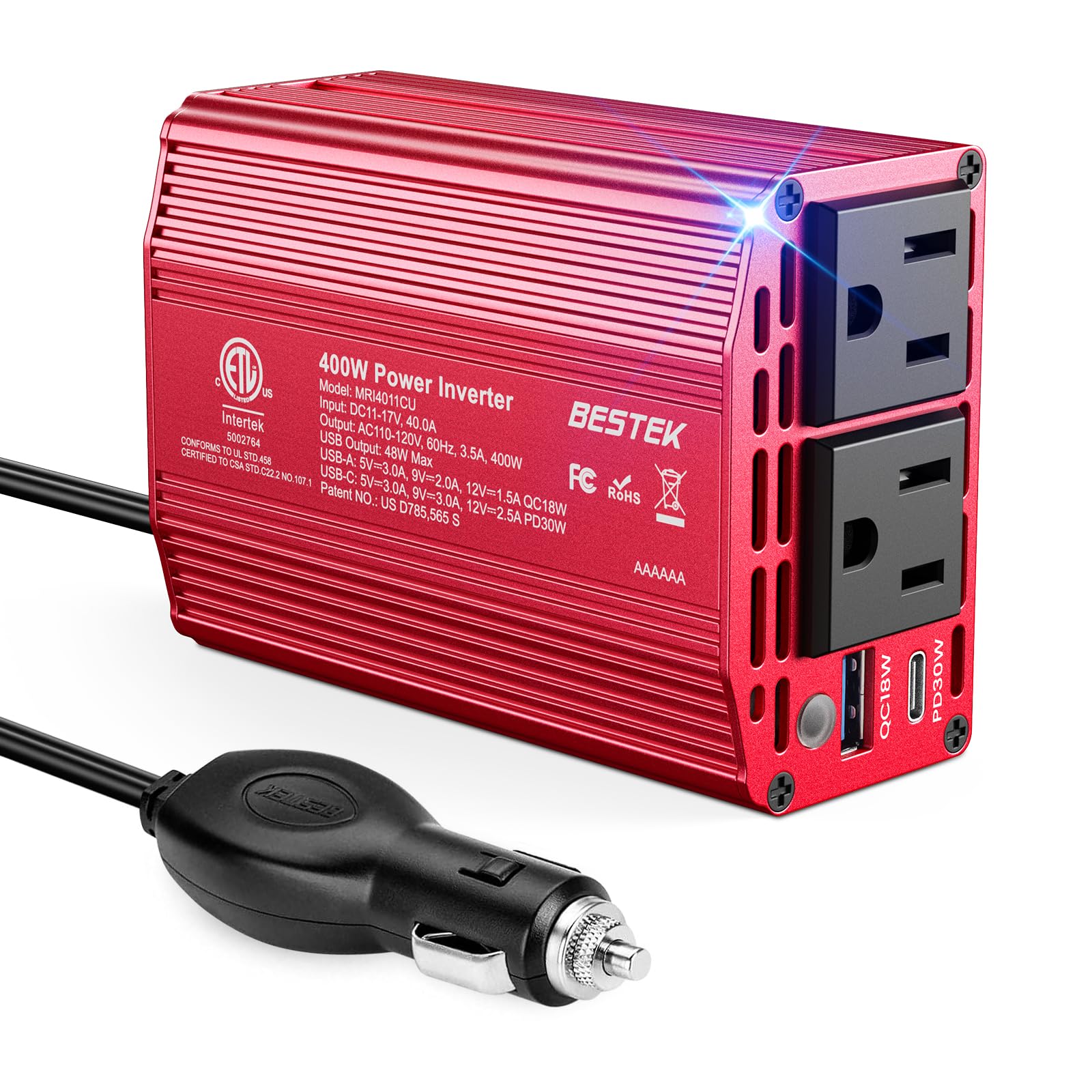
1. BESTEK 400W Car Power Inverter
Our pick — over 4.5★ from 300+ verified ratings; the strongest balance of quality and price.
The patrol-vehicle workhorse that packs 400 watts into an iPhone-sized body.
This pick earns its spot for its 400-watt steady output through dual 110V outlets, so you can run a laptop, a breast pump, or a DVD player without lugging a brick around. It also has a USB-C PD 30W port (a fast-charging USB-C port) and a USB-A QC 3.0 port (a quick-charge USB-A port), so your phone tops up at fast-charging speed on the side.
What wins people over is the sheer dependability of the 12V plug — buyers report the connector “stays tight in the outlet,” a rare compliment for a category where cheap plugs loosen and fail. It also runs without the noisy fan whine you get from cheaper inverters, and the ETL certification plus the built-in 40-amp fuse give you real protection against overheating, overvoltage, and short circuits.
The one honest trade-off shows up when you try to fit two chunky plugs side-by-side in the AC outlets — they’re close together, so some adapters block the second socket. That’s a minor squeeze for a unit that otherwise handles everything from air compressors to fast charging without complaint, backed by a 12-month replacement warranty.
What Owners Rave About
- Compact, iPhone-sized design that hides in a glovebox
- USB-C and USB-A fast charging in addition to dual AC outlets
- Tight, secure 12V plug that survives daily use
What to Watch For
- AC outlets sit close together, so bulky plugs may block each other
- A few units run hot under sustained load
Reach for it if: you want a proven, tidy 400-watt inverter for road trips, camping, and everyday device charging in one box.
Look elsewhere if: you regularly need two oversized wall-wart adapters plugged in at the same time.
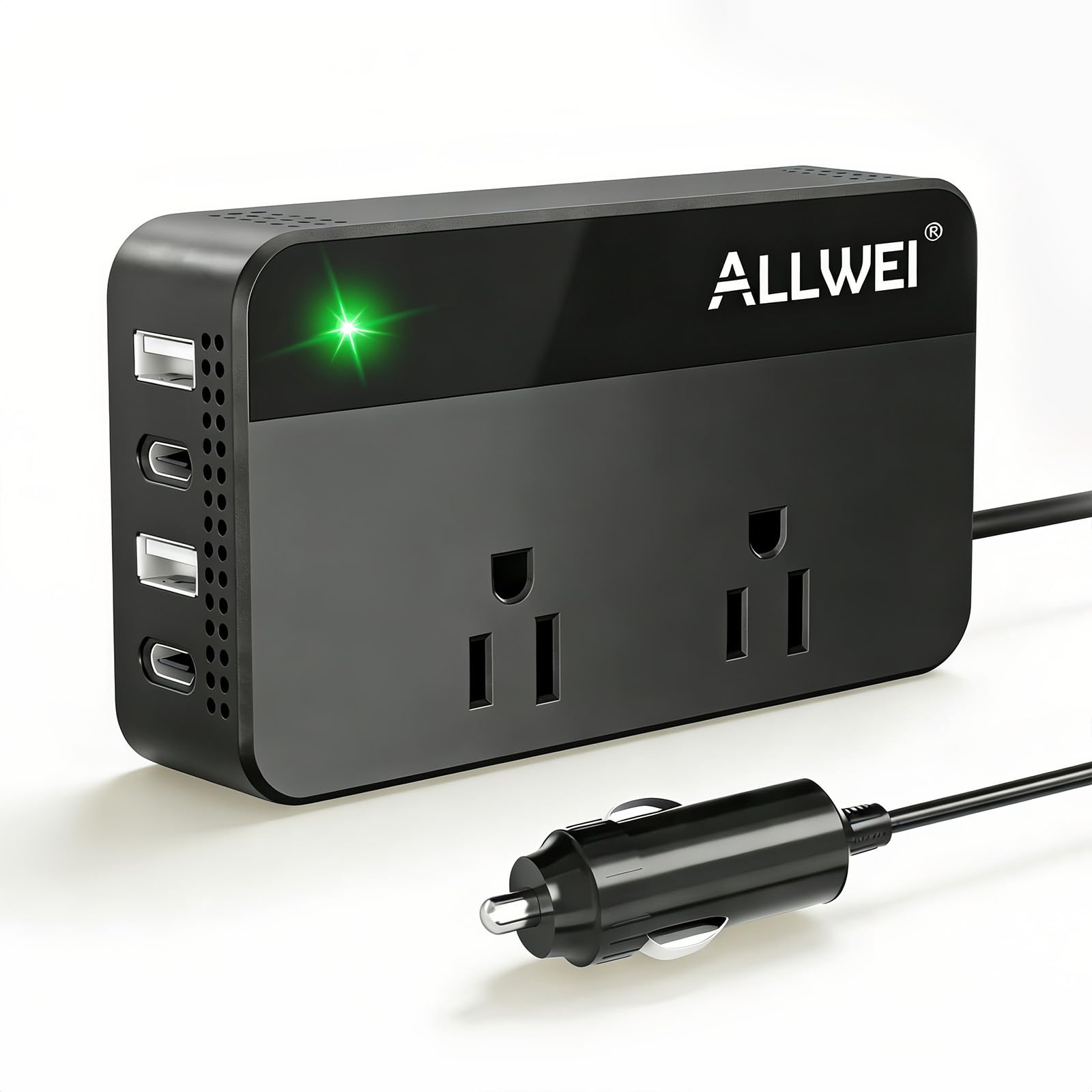
2. ALLWEI 200W Car Power Inverter
The smarter everyday pick that openly matches your car socket’s real 180W limit.
Most car cigarette lighter sockets only support up to 180W–200W of continuous power, so this 200-watt unit is the honest, cost-effective match for daily driving. It powers the same laptops, tablets, phones, and small TVs as many 300W inverters, but it won’t push your vehicle’s wiring past its design limit.
The 6-in-1 layout gives you 2 US AC outlets and 4 USB fast-charging ports, with USB-C PD 18W (a fast-charging USB-C port) that auto-tune speed for your devices. Owners mention running two USB devices and one 110V higher-amp device at once “without blowing my 12 volt automotive fuse” — the unit steps in and protects before the car’s fuse gives out.
It stays quiet thanks to a temperature-sensing fan that only speeds up past 107°F, and the phone-sized 5.9 x 3 x 1.3-inch body weighs just 10.4 ounces. The main thing to respect is the wattage ceiling: this is not for high-draw appliances, and it’s strictly for 12V vehicles — not 24V systems.
Why It’s the Value Pick
- Six ports means phones, tablets, and small gear all charge at once
- Automatic circuit protection saves your car’s fuse
- Ultra-quiet fan that only spins up when needed
Keep in Mind
- 200W ceiling rules out high-power appliances
- 12V only, not compatible with 24V vehicles
Best for: daily commuters who want one compact hub for laptop, phone, and tablet charging without stressing the car’s electrical system.
Not for: anyone planning to run a mini-fridge or power tools — step up in wattage.
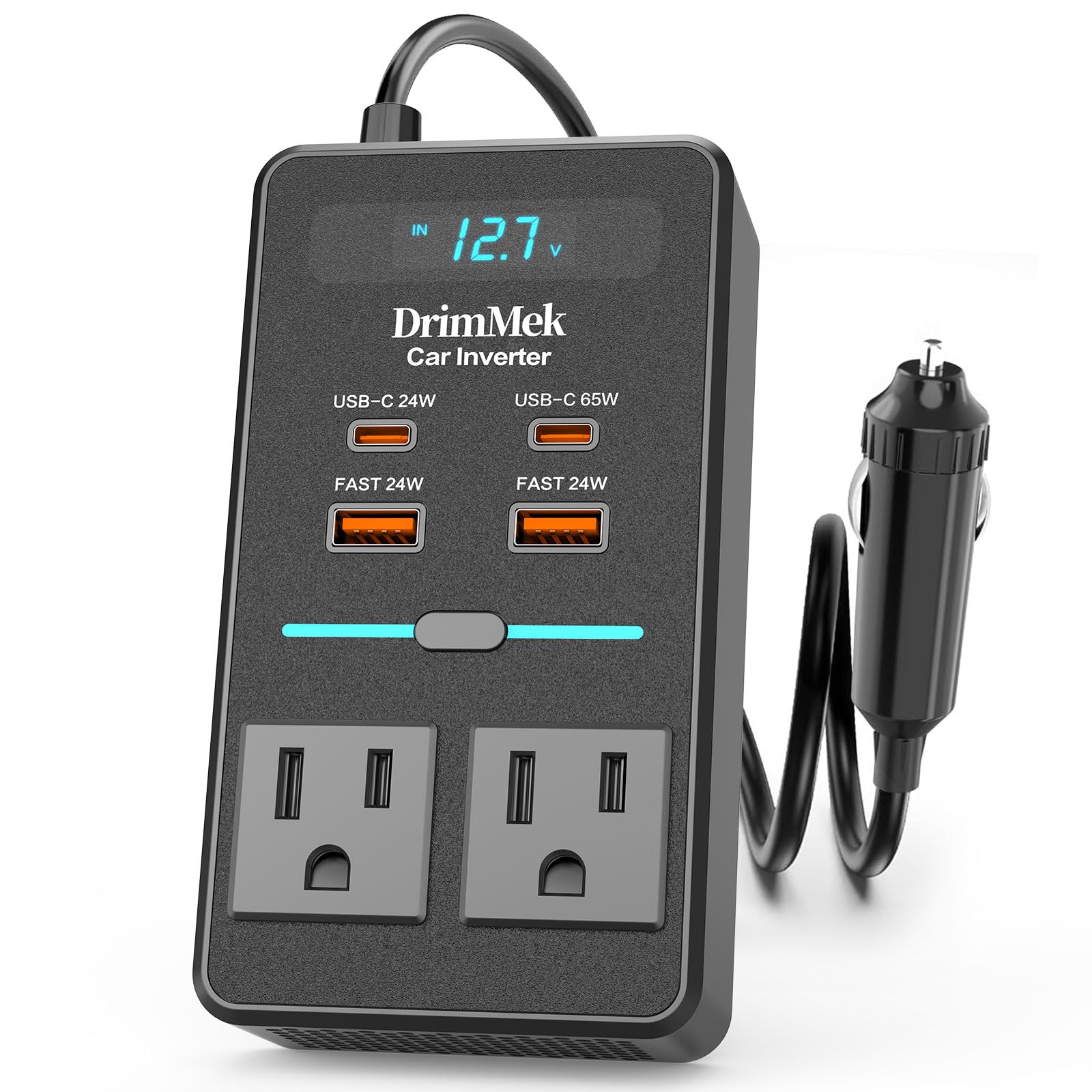
3. DrimMek 300W Car Power Inverter
A 65W USB-C port turns this 300W inverter into a genuine laptop charger, not just a phone top-up.
What sets this compact unit apart is the charging muscle packed into its USB ports — a 65W USB-C and a 24W USB-C alongside two 24W USB-A ports. That 65W output is enough to charge a modern laptop directly, which owners confirm worked flawlessly for phones, laptops, and even game systems on road trips, all without the unit overheating.
The dual AC outlets handle high-power devices like laptops and small appliances, while a built-in quiet fan keeps things cool during extended use. A small LED voltage display on the front shows power status at a glance, a feature buyers genuinely appreciate for confidence on long journeys.
One quirk owners mention is the manual button press required to activate the unit — that’s actually a battery-drain safeguard, so it’s a feature dressed as a minor inconvenience. It also checks your vehicle’s output voltage first, since it’s designed for standard 12V systems only, and the 300W total means you shouldn’t stack too many high-draw devices simultaneously.
What Stands Out
- 65W USB-C fast-charges laptops directly
- LED display shows live power status
- Quiet fan with overload, short-circuit, and heat protection
Minor Quirks
- Requires a manual button press to power on
- Second AC outlet has limits under heavy load
Choose this if: you want one device that charges your laptop at full speed and still offers AC outlets for travel gear.
Think twice if: you need to run two high-wattage appliances at once — the 300W budget splits fast.
4. FSATBTNE 400W Power Inverter

The clever rescue unit that turns a portable battery’s DC port into a working AC outlet.
Buyers found an ingenious use for this one: after blowing the AC port on a camping power station, they discovered this inverter could tap the battery’s DC port and restore full AC power to their gear. That flexibility — 400 watts continuous and 800 watts peak through 2 AC outlets, a 65W USB-C port, and an 18W USB-A port — makes it a genuinely versatile travel companion.
The aluminum alloy housing is the standout engineering choice here, doubling as a heat sink to keep things cool during long operation. Behind that sits an intelligent MCU chip that identifies the voltage and current each device needs, protecting against overheating, under/overvoltage, overcurrent, and short circuits.
Its 65W USB-C port charges a MacBook Pro 14″ to 50% in about 37 minutes. The honest caveat is heat: while some customers note it stays cool, others find it gets very hot during sustained operation, so give it breathing room on longer runs.
What Impresses
- Works from a portable battery’s DC port, not just a car
- Aluminum housing aids heat dissipation
- 800W peak handles startup surges
The Catch
- Heat management is mixed under heavy, sustained loads
- 24-inch cord is shorter than some rivals
Grab it for: campers with portable power stations who want to open up AC output from a DC port.
skip it if: you plan long, high-wattage hauls — give the thermal limits respect.
5. Pro Chaser 400W Power Inverter
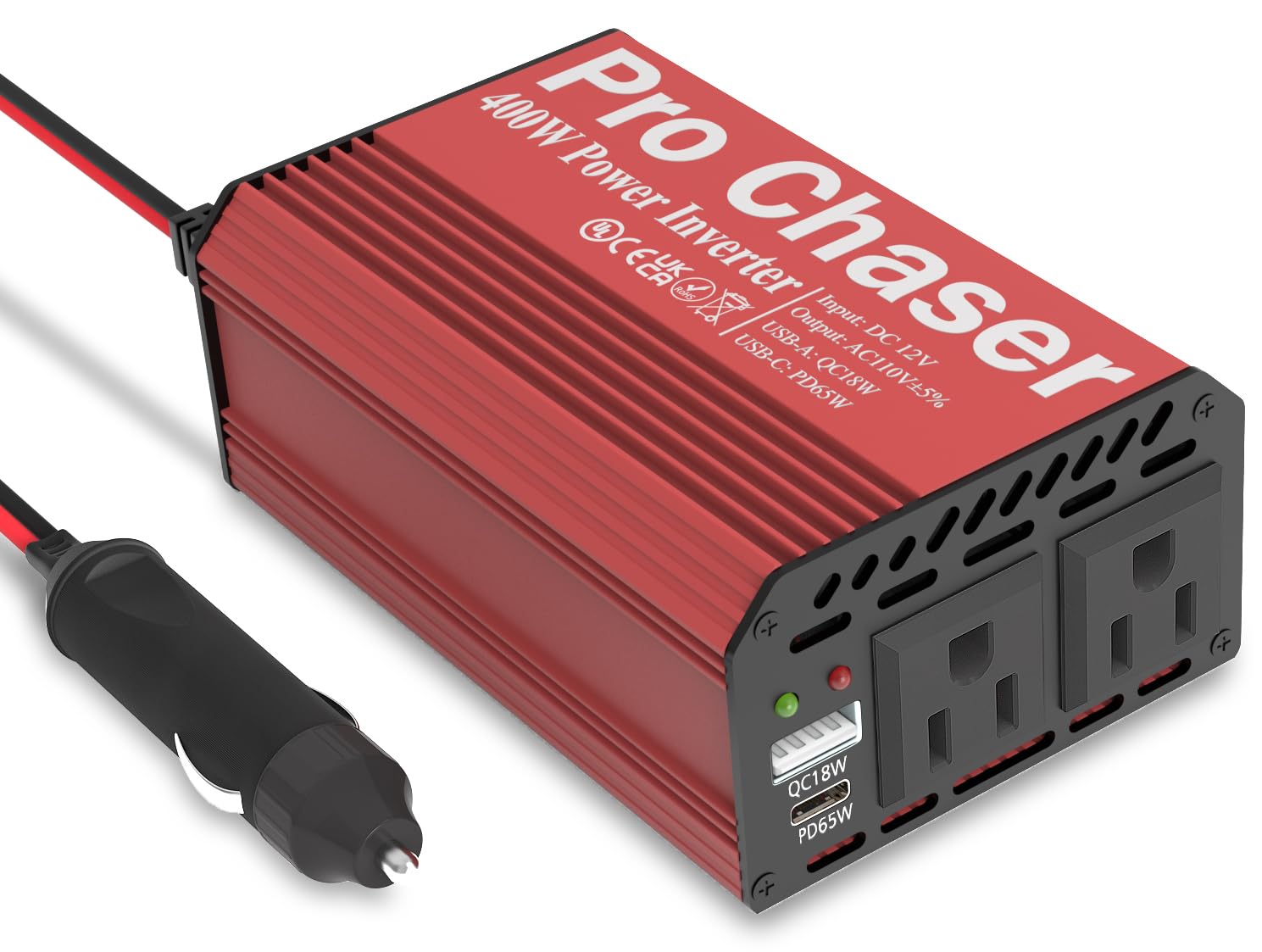
The one-hand-size inverter with a 30-inch cord that reaches your back seat or glovebox with ease.
The defining feature here is the 30-inch (75 cm) cord, which gives you real reach to run power from the front console to the back seat — a huge convenience for passengers charging laptops or tablets on long drives. It delivers 400 watts continuous and up to 800 watts peak through dual 110V outlets, plus a USB-C PD 65W port (a fast-charging USB-C port) and a USB-A QC 18W port (a quick-charge USB-A port).
Owners consistently describe it as quiet and compact, with the fan staying cool when charging a single device. The built-in fuse protects against short circuits, overloads, and over/undervoltage, and the cooling fan only kicks in when internal temperature climbs to 113°F — a smart threshold that keeps noise down during normal use.
There’s an honest warning printed in the specs: run only one high-power device at a time, because combining the PD 65W port with an AC socket can exceed the vehicle socket’s limit. Some owners also note the USB ports stay active even with the switch off, which is a minor quirk to remember if you want zero standby drain.
Why It Earns Its Place
- 30-inch cord reaches rear-seat passengers
- Quiet fan that stays off until 113°F
- 65W PD USB-C charges laptops fast
Respect the Limits
- Run one high-power device at a time
- USB ports draw power even when switched off
Best suited to: drivers who need power reaching the back seat and value a compact unit that disappears into a glovebox.
Not ideal for: powering multiple high-draw devices at once from a single lighter socket.
6. OLTEANP 500W Power Inverter

A 500W unit that shows you input and output voltage live, with battery clamps for real power.
This is the first genuine step-up in power class, delivering 500 watts continuous with a smart LCD screen that tracks input voltage, output voltage, and battery status in real time. When something’s wrong, the display shows protection codes — OL for overload, HI for high voltage, LO for low voltage, OH for overheat — so you can diagnose issues instead of guessing.
It ships with both a cigarette lighter plug and alligator clips (metal clamps for battery terminals), which matters because the manual is blunt about a real-world limit: the vehicle lighter socket supports only up to 150W, so anything from 150W to 500W should connect directly to the battery with the included clamps. Owners confirm it handles high-power tools like drills and grinders when wired properly, and it’s a favorite for truck sleepers and mobile office setups.
Buyers praise the dual AC outlets plus USB ports and the convenience for road trips. The honest expectation to set: this is a modified sine wave inverter, so it suits most small electronics but isn’t recommended for refrigerators, microwaves, or sensitive medical devices — check your gear before relying on it.
What Makes It Stand Out
- LCD shows live voltage and battery status
- Includes battery clips for full 500W use
- Handles power tools like drills and grinders
Know Before You Buy
- Lighter socket tops out at 150W — clamps needed above that
- Modified sine wave isn’t for sensitive medical gear
Pick this up for: truck drivers, campers, and mobile workers who need live power readouts and the option to pull full wattage from the battery.
Pass it by if: you need clean sine wave power for audio or medical equipment.
7. YSOLX 1000W Power Inverter
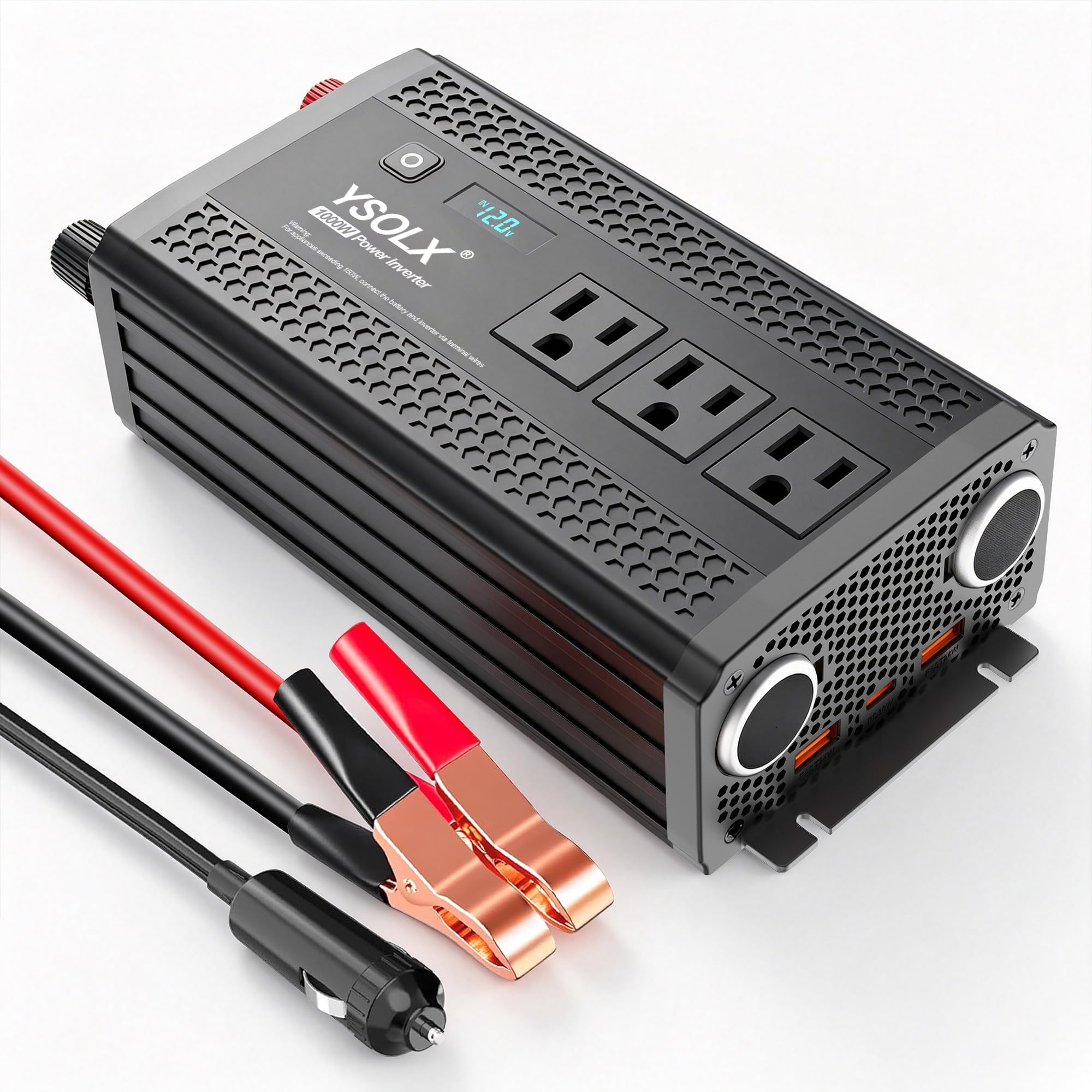
A 1000W RV-ready unit with three AC outlets and an LED display that feels like a mini power station.
This is the bridge between small car inverters and full home-backup systems, delivering 1000 watts continuous with a 2000-watt peak surge for startup demands. The port layout is generous — 3 AC outlets, 2 USB-A ports, a 30W USB-C PD port (a fast-charging USB-C port), and dual 12V cigarette lighter sockets — so a whole family can charge phones, run fans, and power laptops simultaneously on a camping trip.
Owners in off-grid situations, including some in Cuba running it off a 200-amp battery, report it running fans and charging three phones for over 24 hours straight — proof of its real-world endurance. The silent cooling fan kicks in at 42°C and shuts down at 38°C to manage heat, and the flame-retardant casing adds confidence for RV use.
The built-in LED display shows real-time battery voltage, and E1-E6 error codes cover undervoltage, overvoltage, overload, short-circuit, and overheat for instant fault alerts. The honest caveat from the review data: reliability is a mixed bag, with a portion of owners reporting units that failed within 6 months or after fewer than 10 uses, so keep the 1-year warranty in mind.
Why It Impresses
- 3 AC outlets plus USB and 12V ports charge everything at once
- 2000W surge handles motor startups
- LED display with E1-E6 fault codes for easy troubleshooting
Honest Fit Note
- Reliability reports are mixed on long-term durability
- Modified sine wave limits sensitive electronics
Reach for it if: you’re outfitting an RV or truck and need multi-device power with a clear display.
Proceed with care if: you need a unit for daily heavy use — consider the warranty your safety net.
8. TOPBULL 3000W Power Inverter
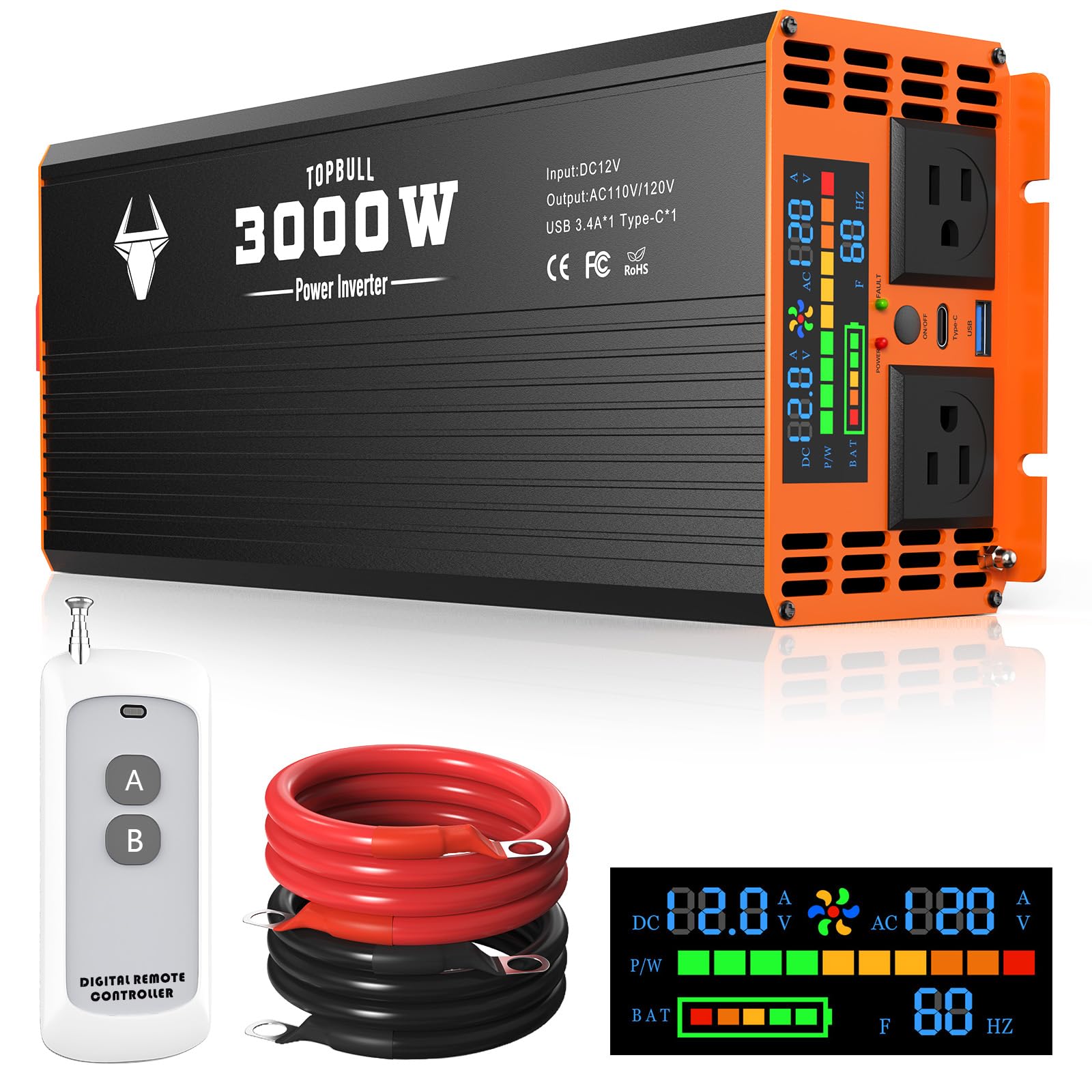
Professional-grade 3000W muscle with a 200-foot wireless remote to kill power from across the campsite.
This is the serious unit for construction sites, RVs, and whole-home emergency backup, converting 12V DC to 110/120V AC with a 3000W continuous output and 6000W peak. The headline feature is the 200-foot wireless remote control with one-button shutdown/restart, letting you manage the entire power supply system from a distance without walking back to the unit.
The engineering underneath is impressive: Pure copper components and an IPM power management system push conversion efficiency above 93%., and A ten-layer safety suite guards against voltage extremes, overloads, shorts, overheating, reverse polarity, ground faults, and leakage.. Two 20A/120V AC outlets handle high-current devices and industrial tools, joined by a 3.4A USB port and a 30W Type-C port.
Owners running off-grid setups report it powers two laptops, a Starlink, and a fan easily, and it fits neatly under truck seats. The aluminum alloy housing with dual silent smart fans keeps noise low even under load. The recurring note is customer service — when displays occasionally failed, the company sent replacements without requiring returns, which owners call exceptional.
Why It’s the Heavy-Duty King
- 6000W peak handles big tools and appliances
- 10-layer safety protection with full fault coverage
- Dual silent fans keep noise low under load
Consider This
- Requires proper battery connection — not a lighter-plug device
- Reliability has mixed reports on long-term durability
Choose this for: serious off-grid setups, camper living, or home backup where you need industrial power and remote control.
Not for: casual phone charging — this is a commitment to real power infrastructure.
9. BELTTT 2000W Pure Sine Wave Inverter
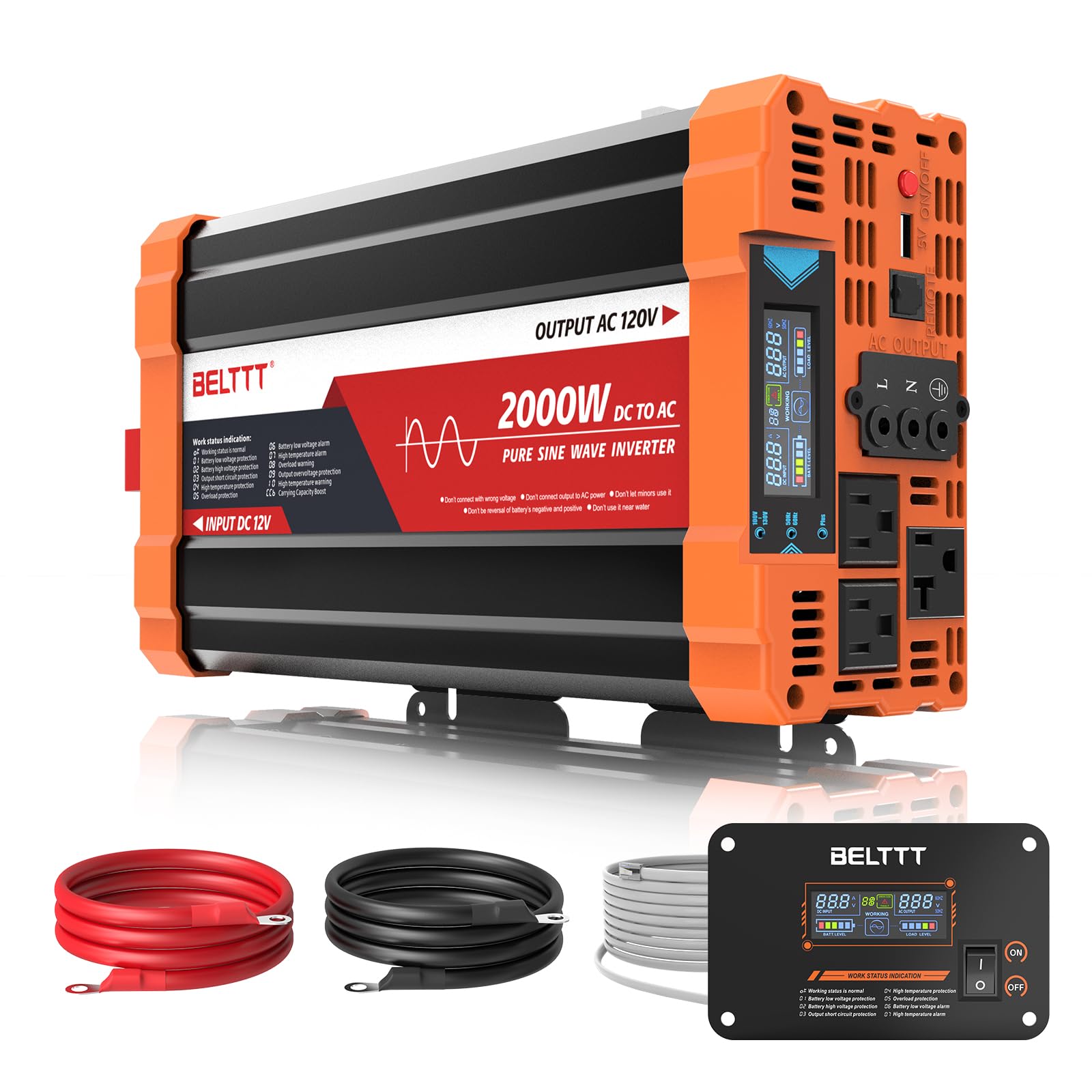
The clean-power specialist that runs TVs and home theaters without the hum or risk of modified sine wave units.
This is the inverter for anyone with sensitive electronics, because its pure sine wave output matches the AC waveform of the utility grid. That means televisions, home theater systems, and other sensitive loads run longer and safer — This clean waveform extends equipment service life and reduces fault rates versus modified sine wave units..
It delivers 2000 watts continuous with a 4000-watt peak surge, plus It maintains conversion efficiency above 93% during normal operation.. The smart LCD display simultaneously shows input and output voltages, battery status, and load conditions, with the output voltage adjustable in a small range. Owners who tested it verified steady 119-120V output on a meter, and it held up under a 2100-watt load.
The build quality earns consistent praise, with buyers noting soldered board tabs that prevent fire risk from loose lugs and zero current draw when off. The package includes a remote controller with a 23-foot cable, 2x 2AWG battery cables, and six 45A fuses. The honest note: power output gets mixed feedback, with some owners finding it handles only up to 1000 watts reliably on certain loads, and fan noise varies by unit.
Why Pure Sine Wins
- Grid-quality waveform protects TVs, audio gear, and sensitive loads
- 4000W surge handles motor startups
- Adjustable output voltage with smart LCD display
What to Weigh
- Some reviewers point out lower real-world power capacity than rated
- Fan noise feedback is mixed across units
Best for: off-grid setups and RV owners running televisions, home theater gear, or any electronics that need clean, stable power.
Consider alternatives if: your loads are all simple resistive devices where modified sine wave would work fine for less money.
Understanding the Specs
Continuous vs Peak Wattage
Continuous watts is the power an inverter can deliver steadily for long periods — this is the number to match against your device’s running draw. Peak (or surge) watts is the short burst needed to start motors in things like mini-fridges, compressors, or power tools, which can briefly draw two to three times their running wattage. If the startup surge exceeds the inverter’s peak rating, it will shut down or trip a fuse, so always check both numbers against your appliances.
Modified Sine Wave vs Pure Sine Wave
The output waveform determines what kind of electronics the inverter can safely power. Modified sine wave inverters are cheaper and fine for laptops, phone chargers, LEDs, and simple tools, but they can cause hum in audio gear, heat in motors, and erratic behavior in some appliances. Pure sine wave inverters produce clean power matching your wall outlet, making them the right choice for televisions, home theaters, medical devices, and any sensitive electronics you don’t want to risk.
FAQ
How many watts can I safely pull from my car’s cigarette lighter socket?
What is the difference between continuous watts and peak surge watts?
Will a DC to AC inverter drain my car battery when the engine is off?
Can I use a car power inverter to run a mini-fridge or microwave?
What does pure sine wave output mean for my electronics?
Is a 400W inverter better than a 200W inverter for a typical car?
What safety protections should I look for in a power inverter?
Can I plug the inverter into a portable battery power station instead of a car?
Final Thoughts: The Verdict
Across the board, the dc to ac adapter winner is the BESTEK 400W because it balances real 400-watt output, dual USB fast-charging, and a compact size that owners consistently praise for daily dependability. If you want the cleanest power for sensitive electronics like TVs and home theater gear, grab the BELTTT 2000W Pure Sine Wave. And for serious RV living or whole-home backup with remote control, the TOPBULL 3000W is the one to reach for.
How We Picked
We do not accept paid placement. Every pick is matched to a real buyer and a real use-case; we do not hands-on test units.
Sources & Methodology
Specifications: manufacturer listings and product documentation. Review insights: verified customer reviews, as of September 2026. Pricing: not shown on this page (it changes often); check the current price via the retailer link.
As an Amazon Associate, Gadgets Feed earns from qualifying purchases. This does not affect which products we feature.