
Our readers keep the lights on and my morning glass full of iced black tea. As an Amazon Associate, I earn from qualifying purchases.
Specs are compiled from manufacturer listings and verified buyer reviews and can change over time — please confirm the key details on the product page before buying.
You add a second battery to run a fridge, lights, or a winch while camping, and the first question hits: how do you keep your starter battery from going dead when you are parked? That is the job of a dual battery isolator — a smart switch that lets your alternator charge both batteries while you drive, then separates them so your accessories never drain the battery you need to start the engine. The right pick depends on how much current your gear draws, where you mount it, and if you want a simple voltage-sensing relay or a feature-packed unit with a manual jump-start override.
This guide is built from the manufacturers’ published specs and patterns across verified customer reviews. You get each pick’s real strengths and trade-offs instead of marketing spin.
The best dual battery isolator for most builds balances high continuous amperage with reliable voltage sensing that protects your starter battery first, and a compact size that fits under the hood without hassle.
Our Picks at a Glance

How To Choose The Best Dual Battery Isolator
Picking the right isolator depends on three decisions: how much current your second battery needs, how tough the environment is around the mounting spot, and if you want manual control or a set-and-forget voltage-sensitive relay. Here is what to weigh before you buy.
Amperage Rating
The continuous amp rating tells you how much current the isolator can pass without overheating. A 140-amp unit handles most truck and RV setups, while a 500-amp unit is overkill unless you are running a massive audio system or a heavy-duty winch. Match the isolator’s rating to your alternator’s output and the total load of your accessories — oversized protection is fine, but undersized means a melted unit.
Voltage Sensing vs. Manual
A voltage sensitive relay (VSR) automatically connects the batteries when it senses charging voltage (usually around 13.3V) and disconnects when voltage drops (around 12.8V). This is the simplest, most simple to use approach for most people. An electronic isolator may include a manual override button for jump-starting yourself, which is handy if you ever drain the starter battery by accident.
Water and Dust Protection (IP Rating)
The IP (Ingress Protection) rating uses two digits: the first for dust (6 means dust-tight), the second for water (2 means dripping water, 5 means water jets, 7 means temporary submersion — enough to survive a stream crossing). An IP62 rating is fine for a cab or a covered engine bay. An IP65 or IP67 rating matters if you mount it in an open engine bay, on a boat, or on an ATV that crosses streams.
Battery Chemistry Compatibility
Most isolators work with lead-acid, AGM, and gel batteries. If you plan to use lithium (LiFePO4) batteries, you need an isolator that specifically supports them — some voltage-sensitive relays are not compatible with lithium cells because of different charge profiles. Always check the manufacturer’s compatibility list before wiring a lithium auxiliary battery.
Quick Comparison
| Model | Best For | Continuous Amps | IP Rating | Voltage Sensing | Amazon |
|---|---|---|---|---|---|
| WirthCo Battery Isolator★ Best Overall | Overall reliability and manual jump-start | 125A continuous / 150A peak | IP62 | Electronic (13.4V cut-in) | Amazon |
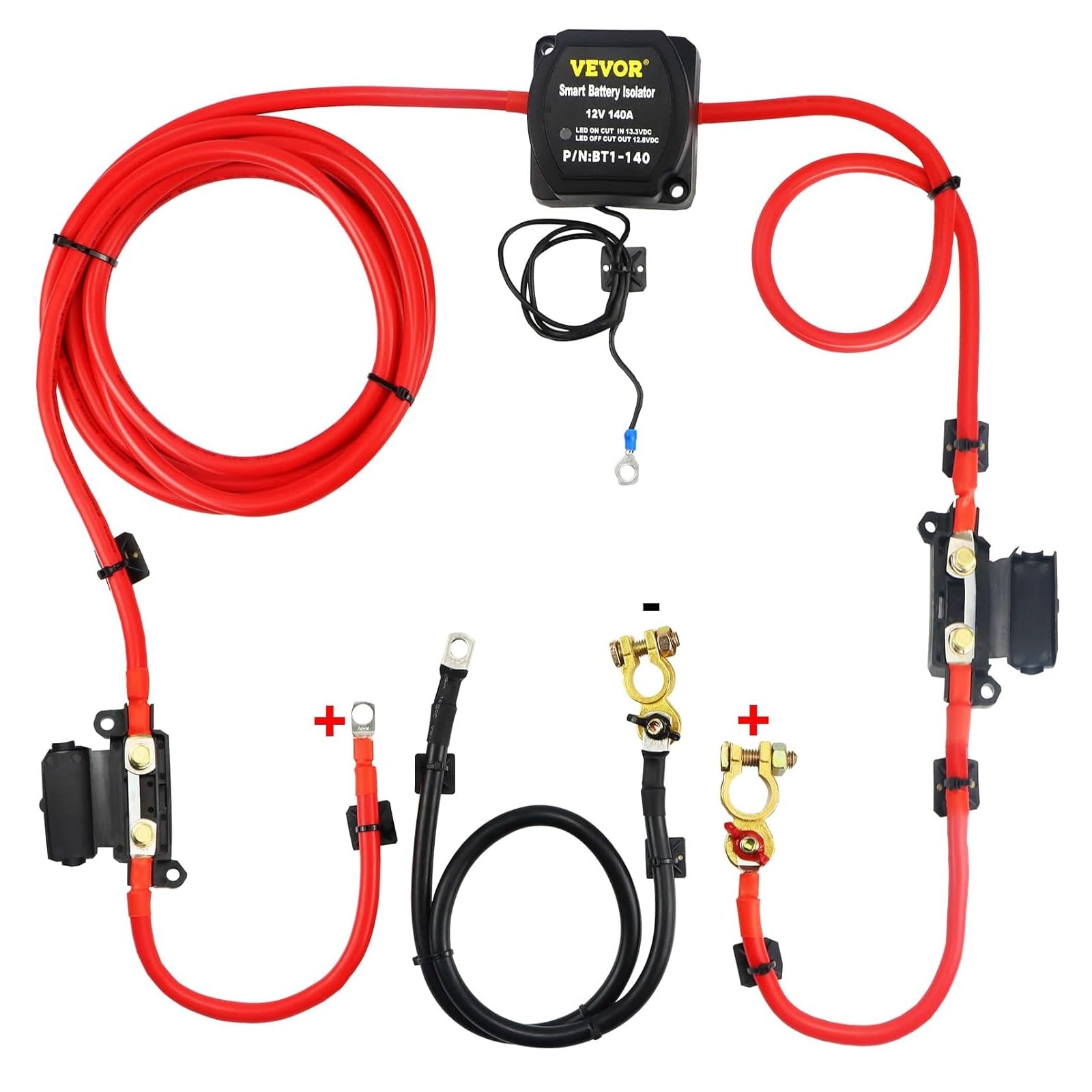
| VEVOR Split Charge Relay KitPremium Build | Complete kit for DIY installs | 140A | IP65 | VSR (13.3V cut-in) | Amazon |
| KeyLine Chargers Dual Battery Isolator Kit | Compact under-hood fitment | 140A | — | VSR (13.3V cut-in) | Amazon |
| Mata1 Dual Battery Isolator Kit | Extreme weather durability | 140A | IP67 | VSR (13.3V cut-in) | Amazon |
| RECOIL 500 Amp Isolator | High-current audio and winch setups | 500A continuous / 700A surge | — | Automatic relay | Amazon |
| Nilight Dual Battery Isolator Kit | All-in-one kit with cables and terminals | 140A | IP67 | VSR (13.3V cut-in) | Amazon |
| MaySpare 12V 140Amp VSR | Budget-friendly basic VSR | 140A | Waterproof silicone seal | VSR (13.3V cut-in) | Amazon |
In‑Depth Reviews
1. WirthCo Battery Isolator
Our pick — 4.5★ from 650+ verified ratings; the strongest balance of quality and price.
The one isolator that can jump-start you with a button press and still fit in tight engine bays.
What sets the WirthCo apart from simpler VSRs is the manual override jump-start feature — a single push parallels both batteries so a charged auxiliary battery can crank the engine when your starter battery is low. The electronic switching control technology lives in a compact 4 by 4 by 2 inch housing. The IP62 rated construction (protected against dripping water and some dust) makes it suitable for marine installations. Priority charging keeps your starting battery topped up before current is shared with the second battery — so the truck always starts before the fridge charges.
The thing owners praise most is functionality. One buyer who uses it with solar panels reports the blue indicator light stays on after the engine is off only when the AGM battery is fully charged, which they say is normal behavior. The main recurring critique is that the blue charging light can confuse first-time users; a few owners initially thought the unit was defective until they understood the voltage threshold. At 150 peak amps versus the MaySpare’s 140 amps, it handles more current, making it the stronger choice for builds with extra electrical load. It works with lead acid, AGM, and gel batteries, but not lithium (LiFePO4).
Why It Wins
- Manual jump-start override parallels both batteries in an emergency
- Compact 4x4x2 inch housing fits tight engine bays
- Built-in surge and overcurrent protection for electronic ignition systems
- Compatible with lead acid, AGM, and gel batteries
The Trade-Offs
- Blue indicator light behavior can confuse first-time users
- Requires starter battery voltage above 13.4V to begin charging — you may need to check your alternator
- IP62 rating is splash-resistant, not fully waterproof for submerged mounting
The crowd favorite: This is the pick for anyone who wants the security of a jump-start button built into a compact, proven electronic design. It beats simpler VSRs on features without sacrificing reliability.
Who should pass: If you need full IP67 waterproofing for an open-exposure mount, or if you prefer a purely passive VSR with no electronics to wonder about, a simpler relay might suit you better.
2. VEVOR Split Charge Relay Kit
The complete kit that has everything you need for a clean install, including the 6-meter cable.
Most isolators arrive as a bare unit, forcing you to buy cables, terminals, and wire separately. The VEVOR Split Charge Relay Kit removes that hassle — it comes with a 6-meter cable and all the accessories required to start installing immediately, which owners consistently highlight as the top reason to choose it. The voltage sensitive relay cuts in at 13.3 volts and cuts out at 12.8 volts, so your primary battery stays ready to start the vehicle while the secondary battery charges automatically. This means your fridge keeps running while your truck always starts.
The IP65 waterproof rating means the unit is secure even in dusty, wet, and unexpected extreme weather — great for ATVs, boat engine compartments, or camper vans that see rain and mud. Many owners note it took about 1.5 hours to wire it neatly. The VEVOR also keeps chassis batteries charged when paired with solar systems, as one owner discovered. At 140 amps continuous, it matches the current rating of most competitors in this guide, but the included wiring kit makes it the simplest path to a finished dual battery system.
The Advantage
- Complete kit with 6-meter cable and all accessories included
- IP65 waterproof rating handles dust and wet environments
- Compact 2.66 x 2.11 x 2.66 inch size fits almost anywhere
- Shockproof and dustproof plastic housing for long-term durability
The Note
- Wire length is fixed at 6 meters — may be more or less than your run needs
- Plastic housing feels less sturdy than metal-clad units in heavy vibration
The complete-package pick: Reach for this if you want a single box that includes everything to wire up a dual battery system without sourcing cables and terminals separately.
Not ideal for: If you need a unit rated beyond 140 amps for a high-current audio or winch system, or if you prefer a metal housing for extreme off-road vibration.
3. KeyLine Chargers Dual Battery Isolator Kit

The tiny 2.6-inch cube that hides under the hood and delivers full charging voltage without diode drop.
Space in the engine bay is often the deciding factor, and the KeyLine Chargers isolator is among the most compact you can buy — a 2.6 x 2.6 x 2 inch unit that fits into spots where larger boxes cannot go. Unlike traditional diode-based isolators that create a voltage drop (wasting power as heat), this VSR sends the full alternator voltage to your auxiliary battery. Owners praise its functionality. It is a common choice for UTVs, trucks, and RVs where space is tight.
One owner who mounted it in an RV reports the isolator keeps the generator battery isolated from the chassis battery during storage, with no dead battery after six months. Another who replaced a faulty WirthCo unit found the KeyLine charged the auxiliary battery on the first trip. The catch that comes up most is the ground wire — a few owners mention it can break off if handled roughly during installation, so you want to secure it gently. The unit does not include installation wires, so you will need to source your own 6 AWG cable and fuse.
Smart and small: The KeyLine delivers the full alternator voltage without diode loss in a package small enough to mount almost anywhere — ideal for tight engine bays and battery relocation kits.
One caution: The ground wire solder joint is delicate; seat the mounting carefully and consider a dab of adhesive to reinforce it if you are in a high-vibration setup.
4. Mata1 Dual Battery Isolator Kit

The IP67-rated isolator that survived one year and 25,000 miles through freezing winters and 110°F desert heat.
Most isolators carry a splash-resistant rating, but the Mata1 is built for the worst conditions you can throw at it — an IP67 waterproof rating means it is fully protected against dust and can survive immersion in up to a meter of water, so it will keep working even if you ford a deep stream. The unit is manufactured using premium-grade polyamide 66 and copper PVC. One reviewer noted it worked perfectly for a year covering 25,000 miles in temperatures ranging from freezing to 110°F, reliably completing the circuit at charge voltage and breaking at or below 12.8V.
Battery life is what owners praise most — the VSR ensures the auxiliary battery stays charged while driving, and one owner noted their fridge ran continuously for six days off the setup. Mounting is a breeze, and the complete kit includes cables, lugs, terminals, and instructions. The compact 2.7 x 2.7 x 2 inch footprint makes it barely noticeable under the hood. A few owners mention the relay LED is not clearly visible and the instructions can be confusing, so a wiring diagram would help a first-timer.
Built for the Elements
- IP67 waterproof rating handles immersion and dust ingress
- Polyamide 66 and copper PVC construction for long-term durability
- Complete kit includes cables, lugs, terminals, and instructions
- Proven through one year and 25,000 miles in extreme temps
The Minor Gripes
- Relay LED is not easily visible once installed
- Instructions are confusing — a wiring diagram would help first-timers
- Warranty is 1-year limited, not lifetime
For the adventurer: This is the isolator to pick if you mount it in an open engine bay, on a boat, or on an ATV that sees mud, water crossings, and extreme temperature swings. The IP67 rating is real confidence.
skip it if: You need a jump-start override feature or a unit that works with lithium batteries — this is a pure voltage-sensitive relay for lead-acid and AGM setups only.
5. RECOIL 500 Amp Mobile Audio Battery Isolator

The 500-amp beast that handles massive audio systems and winches without breaking a sweat.
While most isolators in this guide top out at 140 or 150 amps, the RECOIL BRL is in a different league — it handles 500 amps continuously and can surge up to 700 amps. That makes it the obvious choice for mobile audio competitions, heavy winching, or any setup where the second battery is feeding high-draw equipment. The silver contact material and panel-mount design eliminate the voltage drop that traditional isolators create, so your second battery gets the full charging voltage.
Owners consistently praise the build quality. One buyer uses it to isolate power between dual H6 batteries and reports stable voltage even under loud music in Texas summer engine heat. Another uses it to control power to a winch and confirms it worked right from the start. The isolator is waterproof. Note that the unit is a high-current relay with two terminals — you will need to wire it yourself with appropriate gauge cable and a fuse, and the automatic operation mode means it activates when it senses charging voltage.
Heavy duty specialist: If your dual battery system powers a big amplifier, a winch, or a high-output inverter, this is the only isolator on the list rated for the task — at 500 amps continuous versus the VEVOR or Nilight at 140 amps.
The caveat: Overkill for a basic fridge and light setup. You also need solid electrical knowledge to install it safely at these current levels, and the unit does not include wiring or a fuse.
6. Nilight Dual Battery Isolator Kit

The grab-and-go kit that bundles the isolator with 6 AWG cables, terminals, and a mounting plate.
Nilight brings the same convenience philosophy as VEVOR — a 140-amp voltage sensitive relay paired with everything you need for a complete install, including 6 AWG red and black battery cables, marine-grade terminals, heat shrink, and cable ties. The VSR cuts in at 13.3 volts and cuts out at 12.8 volts, charging two batteries from one alternator while keeping the starter battery isolated when the engine is off. The unit carries an IP67 waterproof rating, so it handles rain and washdowns without issue.
Owners praise the quality and the completeness of the kit — one buyer called it “very strong, easy to install” and noted it had everything needed to hook up a second battery. Another who had it installed for a couple of days confirmed it seemed to work fine. The Nilight is also clearly labeled as not compatible with lithium batteries, so stick to lead-acid, AGM, or gel chemistry auxiliary batteries. The package includes two positive marine battery terminals and one negative terminal, plus a full set of mounting hardware.
The Convenience Factor
- Complete kit: 6 AWG cables, marine terminals, heat shrink, and cable ties included
- IP67 waterproof rating for tough environments
- 140A VSR with 13.3V cut-in / 12.8V cut-out
- Everything needed for a clean, professional install in one box
Know Before You Buy
- Not compatible with lithium (LiFePO4) batteries — lead-acid and AGM only
- Limited number of owners have long-term feedback; few reviews past a few months
One-box convenience: If you want a waterproof, complete dual battery kit that includes every cable and terminal so you do not have to make a second trip to the auto parts store, the Nilight is a tidy solution.
Not for lithium users: If your auxiliary battery is lithium, you need a different isolator — this unit explicitly does not support lithium chemistry.
7. MaySpare 12V 140Amp Voltage Sensitive Relay

The affordable VSR that delivers the core function without the extra features or the premium price.
If your budget is tight and you just need a basic voltage sensitive relay to split charge two 12V batteries, the MaySpare does the job at a fraction of the cost of the WirthCo or the KeyLine. It is a small plastic-housed VSR with a 13.3V cut-in and 12.8V cut-out, a waterproof silicone seal, and a 100-amp rated fuse. The yellow wire, when grounded, connects both batteries for a jump-start or parallel operation — an audible click tells you it has engaged.
Installation is the aspect owners praise most — several note it was easy to set up in a Jeep or truck camper, and one reported no issues after six months of use in a truck with solar. The catch is that reliability is a mixed bag; while many have zero problems, a few buyers report units that did not work from day one or that failed after first use. The instructions are minimal, and the unit is not compatible with lithium batteries directly — one owner reports it slowly drains a lithium battery if connected to lead-acid. For the price, it is a functional entry point, but you take a bit of a gamble on long-term consistency.
The economy choice: The MaySpare is the cheapest path to a working dual battery setup, and many owners get years of trouble-free service. If you are on a tight budget and comfortable with a little DIY troubleshooting, it works.
The honest trade-off: The mixed reliability feedback is real — a small but noticeable number of buyers get duds. Spend a little more for a VEVOR or Nilight kit if you want more consistent quality assurance from the start.
Understanding the Specs
Continuous Amperage vs. Peak/Surge Amperage
Continuous amperage is the amount of current the isolator can pass steadily without overheating — match this to your alternator’s rated output and the total draw of your accessories. Peak or surge amperage is the short burst the unit can handle for a few seconds, like when a winch or compressor kicks in. A 140A continuous unit with a 150A peak is plenty for most truck and RV builds. A 500A continuous unit like the RECOIL is only needed for audio competition systems or heavy industrial winching.
IP Rating for Water and Dust Protection
The IP (Ingress Protection) rating uses two digits: the first for dust (6 means dust-tight), the second for water (2 means dripping water, 5 means water jets, 7 means temporary immersion). For an engine bay that sees rain and mud, look for IP65 or higher. For a dry cab or covered trunk, IP62 is sufficient. An IP67 rating means the unit can survive being splashed or briefly submerged, which is a big plus for marine use or off-road vehicles that ford water.
Cut-In and Cut-Out Voltage
These numbers define when the VSR connects or disconnects your batteries. A cut-in of 13.3V means the relay only closes when the alternator is producing charging voltage — so your starter battery gets charged first. A cut-out of 12.8V means it opens once charging stops, preventing the auxiliary battery from draining back into the starter battery when parked. These thresholds are standard for most 12V systems and work well with lead-acid, AGM, and gel batteries.
Manual Override vs. Passive VSR
A passive voltage sensitive relay (VSR) automatically connects and disconnects based on voltage — no buttons, no electronics, very reliable. An electronic isolator adds a manual override button that lets you combine both batteries for a jump-start if your starter battery dies. The trade-off is complexity: a passive VSR has fewer parts that can fail, but an electronic unit gives you an emergency starting option without jumper cables.
FAQ
Can I use a dual battery isolator with lithium batteries?
What size fuse do I need for my dual battery isolator?
How do I know if my alternator can handle a dual battery isolator?
What is the difference between a battery isolator and a DC-to-DC charger?
Can I mount a dual battery isolator in the engine bay?
How do I wire a voltage sensitive relay (VSR)?
Will a dual battery isolator drain my batteries when the vehicle is off?
How long does a dual battery isolator last?
Can I charge two batteries of different types with one isolator?
What size wire should I use for a 140-amp isolator?
Final Thoughts: The Verdict
For most buyers, the dual battery isolator winner is the WirthCo Battery Isolator because it combines a compact electronic design with a manual jump-start override and surge protection — features that justify its position as the crowd favorite among thousands of owners. If you want a complete kit with cables and terminals so you can install it in one afternoon without sourcing parts, grab the VEVOR Split Charge Relay Kit. And for extreme weather adventure where IP67 waterproofing is non-negotiable, the Mata1 Dual Battery Isolator is the one to reach for.
How We Picked
We do not accept paid placement. Every pick is matched to a real buyer and a real use-case; we do not hands-on test units.
Sources & Methodology
Specifications: manufacturer listings and product documentation. Review insights: verified customer reviews, as of July 2026. Pricing: not shown on this page (it changes often); check the current price via the retailer link.
As an Amazon Associate, Gadgets Feed earns from qualifying purchases. This does not affect which products we feature.