
Our readers keep the lights on and my morning glass full of iced black tea. As an Amazon Associate, I earn from qualifying purchases.
Specs are compiled from manufacturer listings and verified buyer reviews and can change over time — please confirm the key details on the product page before buying.
If you want a real espresso machine for your kitchen, the short answer is this: buy one with a 20-bar Italian pump, a steam wand for milk, and a water tank big enough that you are not refilling it every morning. Everything else — the LCD screens, the grind settings, the cup warmers — is just a tool for making that first shot taste better. This guide walks you through eleven machines that real owners keep on their counters, from compact apartment-friendly units to full bean-to-cup setups with built-in grinders.
I’m Min — the founder and writer behind Gadgets Feed. This guide is built by comparing the manufacturers’ published specifications and the patterns across verified customer reviews, so you get each pick’s real strengths and trade-offs instead of marketing spin.
Some machines here suit a beginner who just wants a latte before work, while others reward the home barista willing to dial in a grind. Below, you will find the espresso machines that actually earn counter space, ranked by how well they pour. best espresso machines here means machines that pull a real shot and steam real milk.
Our Picks at a Glance
How To Choose The Best Espresso Machines
An espresso machine is not like a drip coffee maker where you just pour water in and walk away. It is a small pump-driven device that forces hot water through a packed puck of finely ground coffee at pressure, and every choice you make about the machine changes how that process goes in the morning. The good news is that a few specs actually do the heavy lifting. Here is what to look at first.
Pressure and the Pump Behind It
You will see “20 bar” or “15 bar” written on almost every box. That is the maximum force the pump can push water at, measured in bars. What really matters is that the machine holds a steady pressure through the whole shot — that is what gives you the thick golden layer on top called crema. A 20-bar Italian pump is the most common spec on modern home machines, and it is a solid baseline. The pump brand matters too: units that advertise an “Italian pump” are telling you the heart of the machine is a proven component.
Temperature Control and Warm-Up Speed
Espresso brews best when water hits the grounds at a consistent temperature, and this is where cheaper machines cut corners. Two things to look for: a heating system that reaches brewing temperature fast (so you are not standing around waiting), and a control system that holds that temperature steady shot after shot. You will see “PID temperature control” in the specs — that is a small chip that reads the water temperature and adjusts the heater in real time, often holding it to within a couple of degrees. Machines with both a powerful heating element (you will see wattage like 1350W or 1600W) and temperature control tend to pull more forgiving, more consistent shots.
Built-In Grinder or Standalone?
An espresso machine with a built-in grinder grinds beans fresh right into the portafilter — the handle with the little basket that holds your coffee. That saves counter space and a step, and it is often the single feature that makes a beginner actually stick with home espresso. The trade-off is that when the grinder is integrated, a clog or failure means the whole machine is affected, so grind setting and fresh beans matter a lot. If you already own a good grinder, you can skip the combined units and spend your money on a machine with a better steam wand or a larger tank.
Steam Wand and Milk Frothing
If you drink lattes or cappuccinos, the steam wand is half the machine. A wand that produces a powerful, steady jet of steam is what spins cold milk into that dense, silky texture called microfoam — the stuff you can pour into latte art. Automatic or one-touch milk frothers take the skill out of it by steaming and whisking for you. Manual wands give you more control but come with a learning curve. Neither is wrong; it just depends on if you want to learn the pour or just want the drink.
Water Tank Size and Counter Footprint
Water tank capacity decides how often you refill, and on a machine you use daily that adds up fast. A 40-fluid-ounce tank on a compact unit is fine for one or two drinks a day; a 60-to-73-fluid-ounce tank on a larger machine can go a week between refills for a small household. Footprint matters just as much — measure your counter and your upper cabinets first. Many slim machines are just 5.5 inches wide, which is narrow enough to slide into an apartment kitchen corner, while full bean-to-cup units run much wider and taller.
Quick Comparison
| Model | Best For | Pressure | Water Tank | Built-In Grinder | Amazon |
|---|---|---|---|---|---|
| AMZCHEF Compact Espresso Machine (EM3131)★ Best Overall | Best first machine for small kitchens | 20 Bar | 50 oz | No | Amazon |
| CHULUX Slim Espresso MachineBest for Small Counters | Best for tight apartment counters | 20 Bar | 40 oz | No | Amazon |
| AMZCHEF Espresso Machine with Auto Milk FrotherMost Feature-Rich | Best for one-touch lattes without skill | 20 Bar | 61 oz | No | Amazon |
| CUSIMAX Espresso Machine with Grinder (CMEM-5510B-N) | Best all-in-one budget bean-to-cup | 20 Bar | 1.8 L | Yes (20 settings) | Amazon |
| CASABREWS Ultra Espresso Machine | Best mid-range value for latte fans | 20 Bar | 73 oz | No | Amazon |
| De’Longhi Classic Signature Espresso Machine | Best beginner-friendly branded machine | 15 Bar | — | No | Amazon |
| Electactic Espresso Machine with Grinder (2026 Upgrade) | Best premium bean-to-cup value | 15 Bar | 2.8 L | Yes (built-in) | Amazon |
| De’Longhi La Specialista Arte Evo | Best for cold brew plus espresso | 15 Bar | — | Yes (8 settings) | Amazon |
| Breville Barista Express (BES870XL) | Best proven long-term home barista machine | Pre-infusion + PID | 67 oz | Yes (conical burr) | Amazon |
| Ninja Luxe Café Pro Series (ES701) | Best 4-in-1 for espresso, drip, and cold brew | Barista Assist Technology | 68 oz | Yes (25 settings) | Amazon |
| Breville Barista Touch Impress (BES881BSS) | Best guided hands-free experience | ThermoJet heating | 67.6 oz | Yes (30 settings) | Amazon |
In‑Depth Reviews
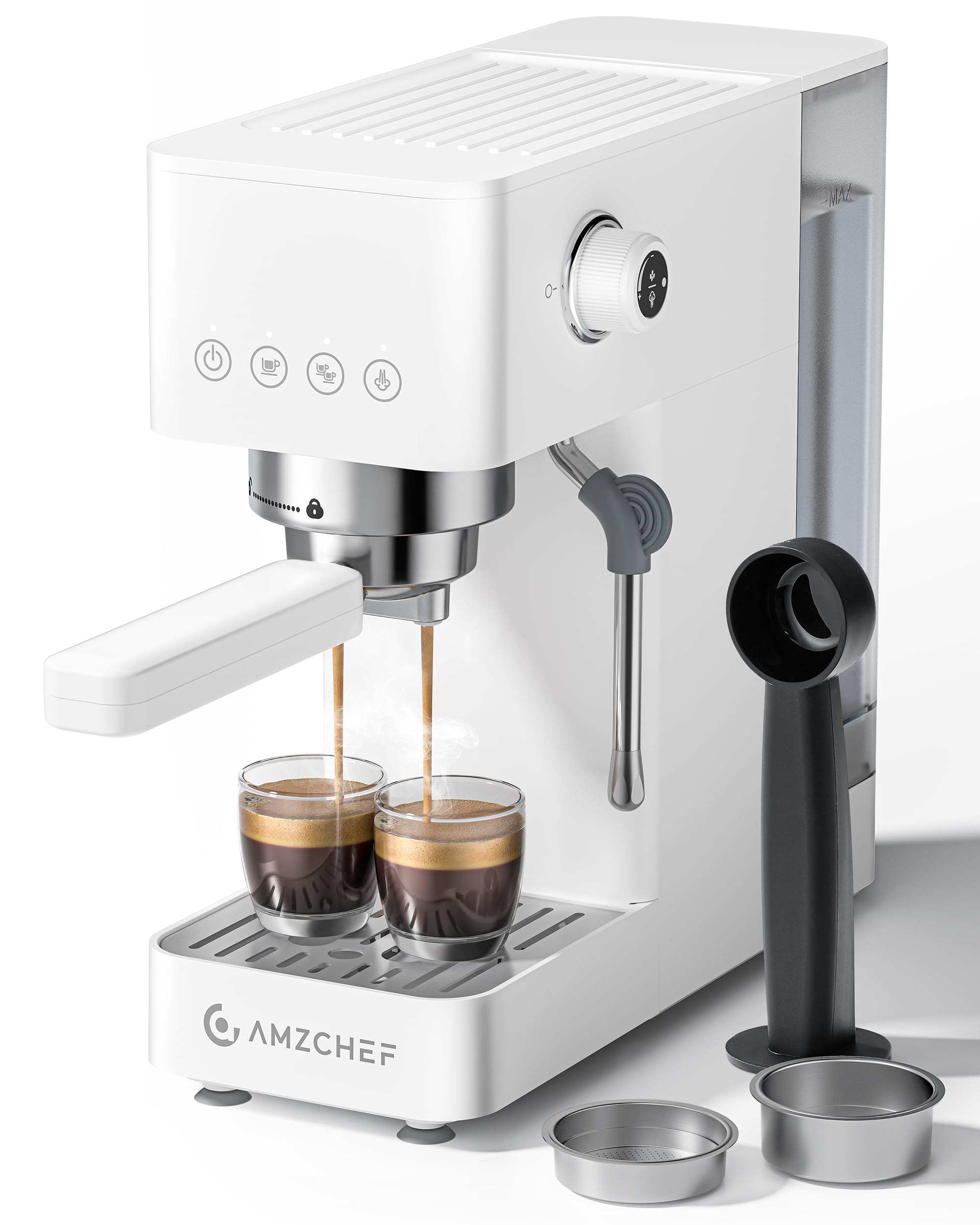
1. AMZCHEF Compact Espresso Machine 20 Bar, Americano, Latte & Cappuccino (EM3131)
Our pick — over 4.5★ from 350+ verified ratings; the strongest balance of quality and price.
The white compact that heats in 30 seconds and holds a 50 oz tank without eating your whole counter.
If you want one machine that does a real espresso shot, a latte, and an americano without a barista course first, this is the one to start with. The AMZCHEF EM3131 pairs a 20-bar Italian pump (the pressure engine that pushes water through the coffee) with a 1350W heating element that reaches brewing temperature in about 30 seconds. That number matters in the morning — you press a button and coffee is happening before your kettle would even be warm.
The temperature control is the quiet win here. A PID controller (a chip that reads water temperature and adjusts the heater constantly) holds brewing water to within roughly +/- 2°C, so your second shot tastes like your first. Owners describe the result as rich coffee with nice crema and foam that works well for cappuccinos, and the four-button layout lets you pick single or double shots or set a custom extraction time. At 12.5″D x 7″W x 14.4″H and 8.2 pounds, it is noticeably smaller and lighter than the CUSIMAX CMEM-5510B-N at 12.6 pounds — a real difference if you keep it on a camper counter or in a small apartment. The 50 oz removable water tank means fewer refill trips than a typical 40 oz tank.
What buyers keep coming back to is the combination of build quality and value — the machine earns its top spot by doing the fundamentals of espresso very well for its tier. Foam quality is the one area where opinions divide: some love the steam wand’s 360° rotation for frothing, others find it takes practice to get dense microfoam. The steam wand is manual, so it rewards a little patience. Noise is also mentioned as slightly loud during extraction, though owners call it normal for the class. One reviewer noted the delivery took just over a month, so factor in shipping timing if you need it fast.
Where It Wins
- 20-bar Italian pump with PID temperature control holding water to about +/- 2°C
- 1350W heating reaches brew temperature in roughly 30 seconds
- Compact 12.5″D x 7″W at 8.2 lbs — the lightest pick on this list by a wide margin
- 50 oz removable tank cuts down on refills and cleaning time
- One-touch single/double shots make it genuinely beginner-friendly
What To Know Before Buying
- The steam wand is manual, so frothing takes practice before microfoam is clean
- Extraction noise is noticeable, though owners describe it as normal for the class
- Uses ground coffee only — no built-in grinder
Reach for this if: you want a compact, fast-heating machine that pulls a real espresso shot without a steep learning curve, and counter space is tight.
Look elsewhere if: you brew for more than two people daily, or you need a built-in grinder so you never touch a separate one.
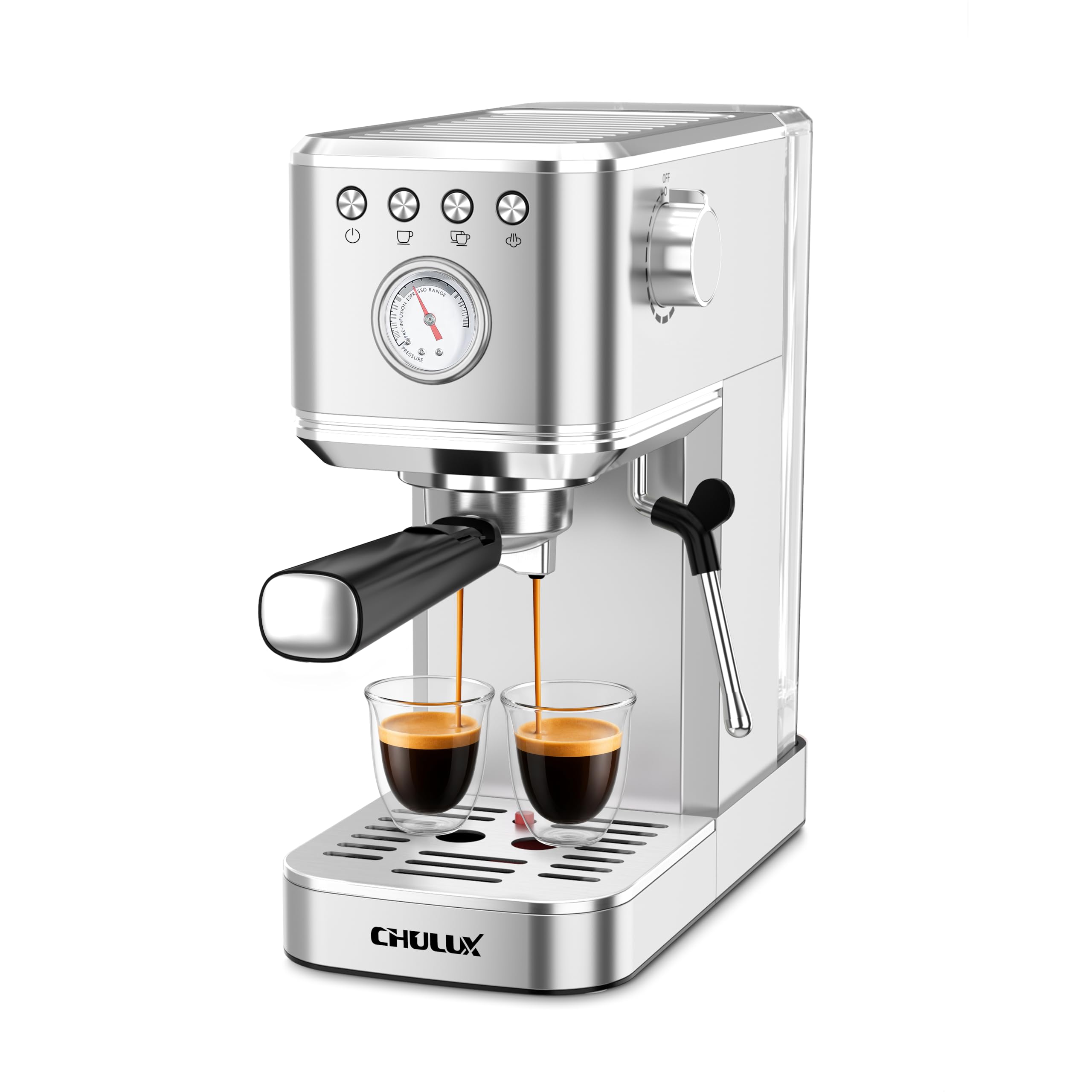
2. CHULUX Slim Espresso Machine with Milk Frother for Home Cappuccino & Latte
A 5.5-inch-wide espresso machine that slips into the sliver of counter beside your sink and still pulls a 20-bar shot.
When your counter measures tighter than your patience, this is the machine that actually fits. The CHULUX is just 5.5 inches wide and 11.7″D x 5.5″W x 12.5″H overall — 5% narrower and 7% shorter than the AMZCHEF EM3131, and at 7.8 pounds it is lighter too. In a studio apartment or a kitchen with one usable corner, that difference decides whether you own an espresso machine at all.
It does not cut corners on the brew side. The 20-bar Italian pump and a 1350W boiler reach preheat in about 30 seconds, then pull a shot in roughly one to three minutes on the fast end. A built-in pressure gauge shows the live pressure as you brew, and a pre-infusion function wets the grounds gently before full pressure hits for a more even extraction. The steam wand produces the microfoam you need for lattes and cappuccinos, and the 40 oz tank with a 25-minute inactivity auto shut-off keeps a daily routine simple. Buyers describe it as easy to operate without complicated buttons, and the direct report here is telling: “Ive had it a few months now and its amazing!”
The catch is the steam wand and the drip tray both demand a small learning curve — a couple of owners mention the frother drips and that pulling enough espresso for a larger drink sometimes takes two runs. The water lid can rattle a little during brewing, and the machine requires a fairly stable surface since vibration can drift your cup. These are small gripes on an otherwise well-loved machine that owners say cleans easily and looks good on the counter.
The tight-space champion: an ideal pickup if 5.5 inches of width is the only room you have and you want a pressure gauge for real-time feedback.
Consider a bigger machine if: you brew multiple back-to-back drinks and do not want to run the shot cycle twice.
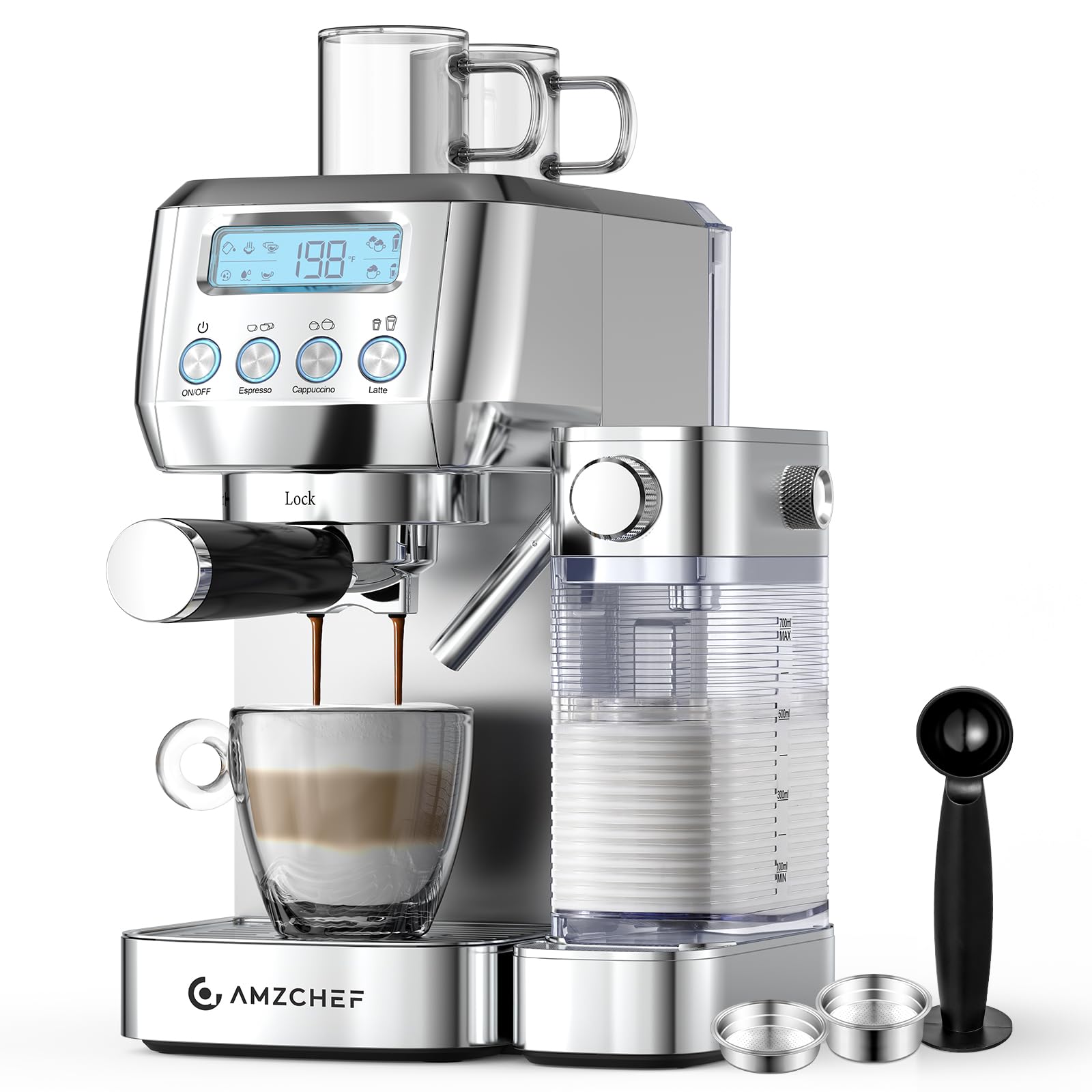
3. AMZCHEF Espresso Machine, Auto Milk Frother, 20 Bar Pressure, Silver
The laptop-sized AMZCHEF that pulls espresso and foams your milk without you holding a pitcher.
If you drink flat whites or macchiatos and do not want to learn how to steam milk, this machine was designed for you. The AMZCHEF with Auto Milk Frother uses a 20-bar Italian pump and an NTC temperature control system to pull a shot, then switches to a built-in automatic frother that creates microfoam in under 60 seconds. That is the whole point — it removes the skill barrier that trips up most new espresso owners, and it handles latte, cappuccino, flat white, and macchiato without you touching the wand.
Its 61 oz removable tank is the largest in its class here, brewing up to 24 cups before a refill — a full family’s morning without a trip to the sink. An LCD screen shows brewing temperature, a shot timer, and milk-frothing progress in real time. There is also a self-cleaning function for the milk system and an auto-rinse cycle after each use. Owners describe it as delivering high-quality, rich creamy coffee that tastes great, and the compact footprint means it fits neatly under standard cabinets at 12.5″D x 8″W x 14″H. Its 3-year warranty beats the 1-to-2 year standard in this range.
What you should know before buying: this one has the lowest star rating of the AMZCHEF trio in this list, and the value-for-money aspect drew mixed opinions from owners — some consider it worth the money, others feel you get what you pay for. A 7 oz cup-size limitation was called out by one reviewer who wanted a 12 oz pour, and there are legitimate reports of unit-specific defects where the frother and coffee only dribbled. If you get a perfect unit, it is one of the easiest ways to get a latte; if you get a bad one, AMZCHEF’s support was quick to respond in every documented case.
What buyers love most: the automatic frother — silky microfoam in under 60 seconds without a pitcher or a learning curve, plus the LCD screen walking you through each step.
Best for the no-skill latte drinker: if your morning drink has milk in it and you want it done automatically, this is the machine on this list built exactly for that.
Not the one for: buyers chasing a quick single espresso shot who do not need the auto frother at all.
4. CUSIMAX Espresso Machine with Grinder, 20 Bar (CMEM-5510B-N)
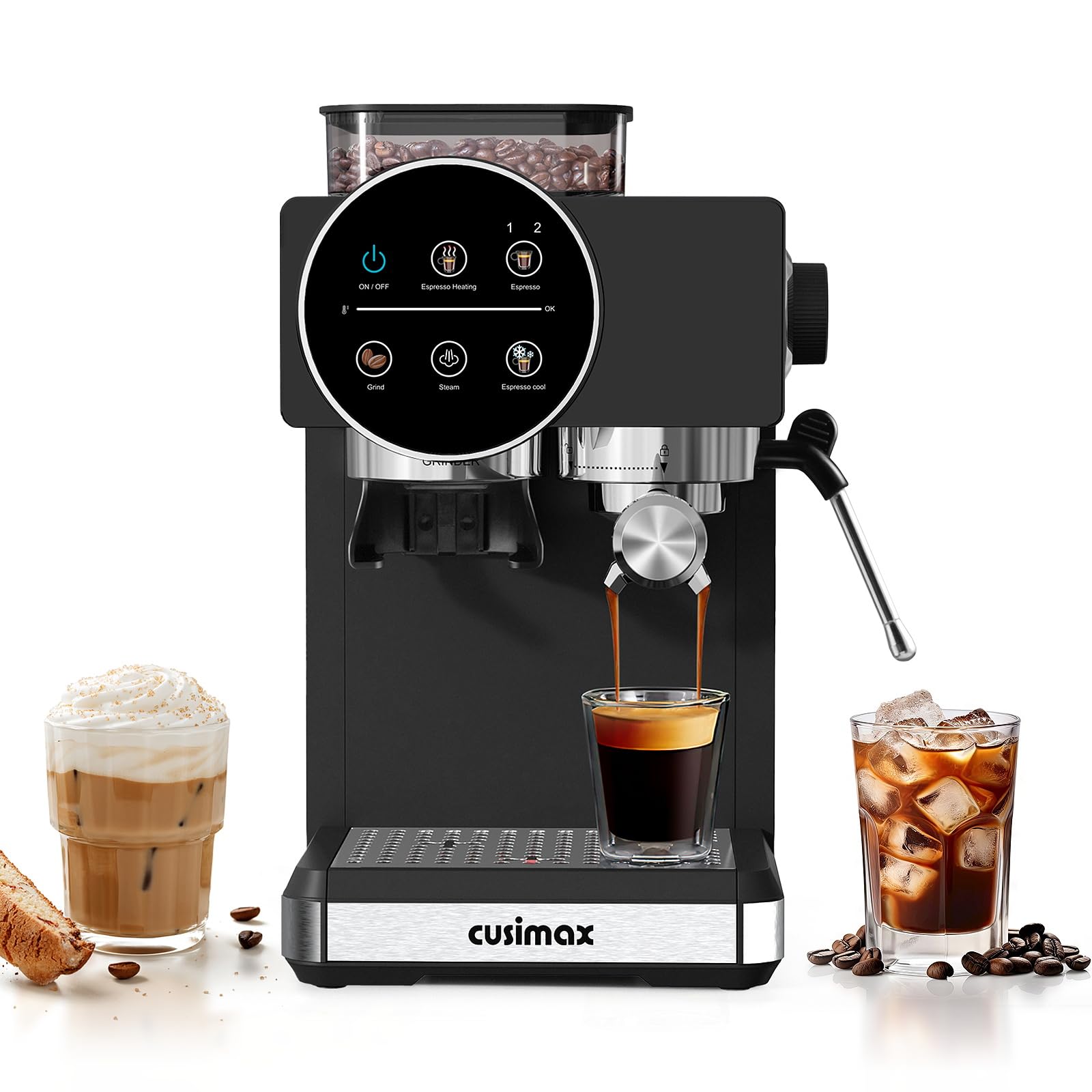
The grind-on-demand CUSIMAX that pairs a burr grinder with a 20-bar pump for fresh cups start to finish.
Want to walk the full bean-to-cup path without spending premium-tier money? This is the most affordable machine here with a built-in grinder. The CUSIMAX CMEM-5510B-N packs a stainless steel conical burr grinder (a pair of steel cone-shaped wheels that crush beans at a consistent size) with 20 pre-set grind settings, so you can go fine for espresso or coarser for a latte without swapping equipment. A dosing ring keeps grounds falling precisely into the portafilter, which saves counter cleanup — a detail owners genuinely appreciate.
The brewing side holds its own too. A 20-bar pressure system with a 1350W heating element keeps extraction stable, pre-infusion technology fully wets the grounds before full pressure hits, and a 360° steam wand delivers high-pressure steam for dense microfoam or hot water for tea and americanos. The 1.8-litre removable water tank minimizes refills compared to the smaller 40 oz tanks on some compact machines. Taste leads the feedback from owners by a wide margin — they describe it as producing rich espresso with good crema, and the all-in-one convenience earns frequent mention.
Here is the honest downside: this is a four-star machine, and the durability track record is mixed. A few owners have reported the grinder stopping and the espresso function failing after use, plus the 12-month warranty not always resulting in a replacement. Those reports are a minority against the many pleased buyers, but they are worth weighing if you plan to lean on this machine daily for years. There is also sometimes a learning period — the grinder plus brew system can need a few tries before it settles into a rhythm.
Pick it if: you want fresh-ground espresso at home on a tighter budget and are happy to save counter space by combining grinder and machine.
Choose a different machine if: you want a longer-proven reliability record and prize brand track record over the low entry cost.
5. CASABREWS Ultra Espresso Machine, Barista Espresso Maker with Steam Wand
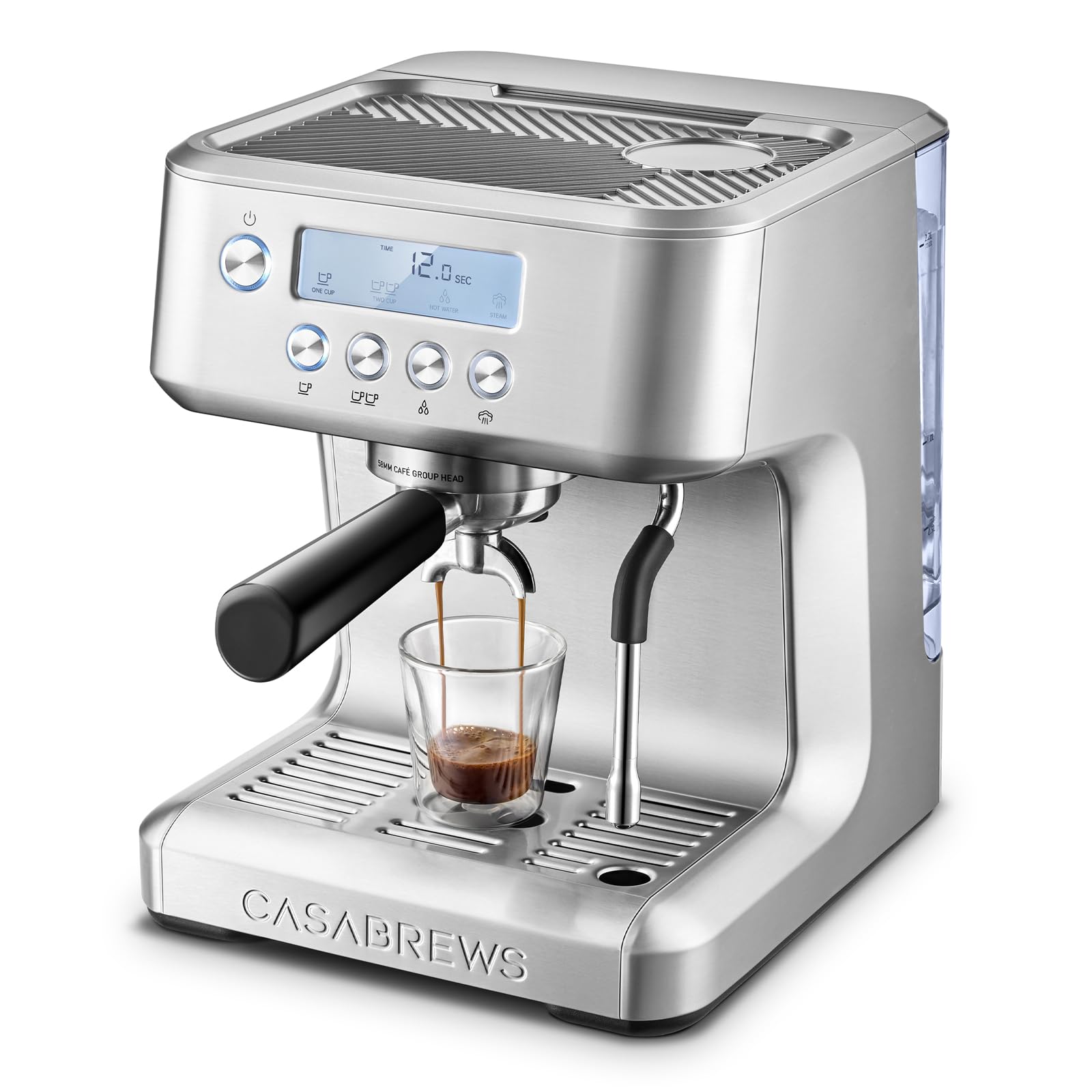
The CASABREWS Ultra earns its spot with a 73 oz tank and four temperature settings for the price of a shorter-name machine.
Here is the value math: a 20-bar Italian pump, a 1350W heating system, and a 73 oz water tank — the largest on any machine here without going to the bean-to-cup tier. That tank covers roughly a week of daily brews per refill. Four brewing temperature settings let you shift coffee temperature to suit a bean or a family member’s preference, and there is a dedicated hot water button so you can top off an americano or make tea without touching a kettle.
What makes owners stick with it is the whole package — smooth lattes, solid crema with a 58mm all-metal portafilter, a cup warmer that keeps your mug hot while the shot pulls, and a footprint small enough to live on a normal kitchen counter. The 58mm portafilter is the same diameter as the ones on machines several hundred dollars up the ladder, and it feels appropriately heavy in the hand. Buyers describe it as making fantastic shots and excellent lattes, with one noting it is far superior to a Nespresso for flavor. Fast cleanup — around two to three minutes for a daily routine — is another repeated point.
The catch reported by a few owners is crema quality straight from the start. The portafilter’s aluminum basket can give weaker crema than the machine’s pump is capable of, and swapping to a better replacement basket greatly improves the pour. There is also a small internal rattle on some units, and the stock tamper is a plastic piece owners often replace. These are minor setup tweaks, not machine faults, and they are worth knowing going in. Give yourself roughly a week of tuning to dial in the settings and it settles into a reliable daily machine.
Best-In-Show Features
- 73 oz removable water tank — a week of daily brewing between refills
- 20-bar Italian pump with a 1350W heating system
- Four adjustable brewing temperature settings
- 58mm all-metal portafilter and cup warmer, unusual at this tier
- Dedicated hot water button for americanos and tea
Setup Tweaks To Expect
- Stock aluminum basket gives weaker crema than an upgraded basket
- Slight internal rattle reported on some units
- Stock tamper is plastic and often swapped
Reach for this if: you want a full 20-bar machine that pulls shots reliably and rarely needs refilling, without venturing into the premium tier.
skip it if: you want microfoam latte art from the start and would rather not source an upgraded portafilter basket.
6. De’Longhi Classic Signature Espresso Machine, Adjustable Milk Frother
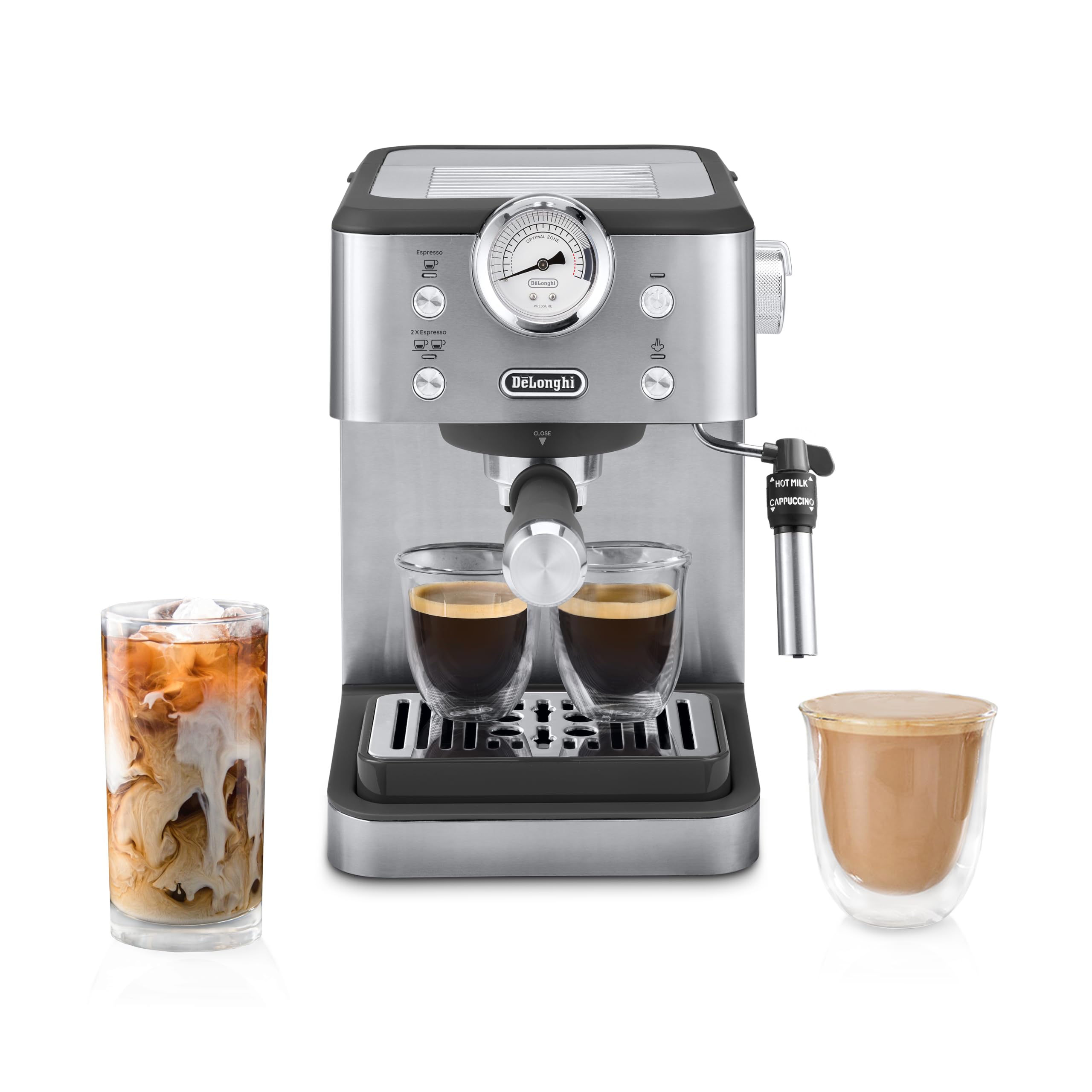
The De’Longhi Classic with a 15-bar pump and adjustable frother — the comforting, familiar brand name many first-time buyers trust.
If the brand name on the machine matters to you as much as the specs, De’Longhi’s Classic Signature is the natural starting point. Its 15-bar Italian professional pump is the pressure engine at the heart of it, and the adjustable 2-setting steam wand lets you choose between silky steamed milk and the lighter texture you need for cappuccinos and lattes. The Thermoblock heating system is designed to reach temperature fast and steadily, and there is a customizable single or double shot preset so beginners can get going without fiddling.
What lands with owners is the coffee. The machine turns out flavorful espresso with a good crema layer, and the compact stainless steel body fits a small kitchen while still looking polished. Beginner-friendly controls are the recurring theme — owners describe it as intuitive and easy to clean on daily use, with simple single and double shot buttons. It is also lighter and smaller than several of the mid-range machines here, which matters if counter space or lifting it to clean underneath is a consideration.
The honest caveats are real here: this is the second-lowest rated machine on this list, and the areas buyers flag are warm-up time and frother performance. Some owners found the machine runs cooler than expected on certain units — one buyer mentioned a 164-to-178°F water temperature reading that under-extracted espresso compared to the industry-optimal brewing range. Others felt the frother works perfectly and praised the value. A few also noted the internal portafilter is partly plastic. If you want the De’Longhi name and do not need a powerhouse steam wand, it remains a solid entry point — just go in with eyes open on the temperature consistency.
Suited to: first-time espresso buyers who want a trusted brand, a compact footprint, and an easy-to-learn routine.
Not the pick for: buyers who need the machine to brew at a specific, consistent temperature for delicate light roasts every single shot.
7. Electactic Espresso Machine with Grinder, Expresso Coffee Machines with Built-in Anti-Clog Grinder (2026 Upgrade)
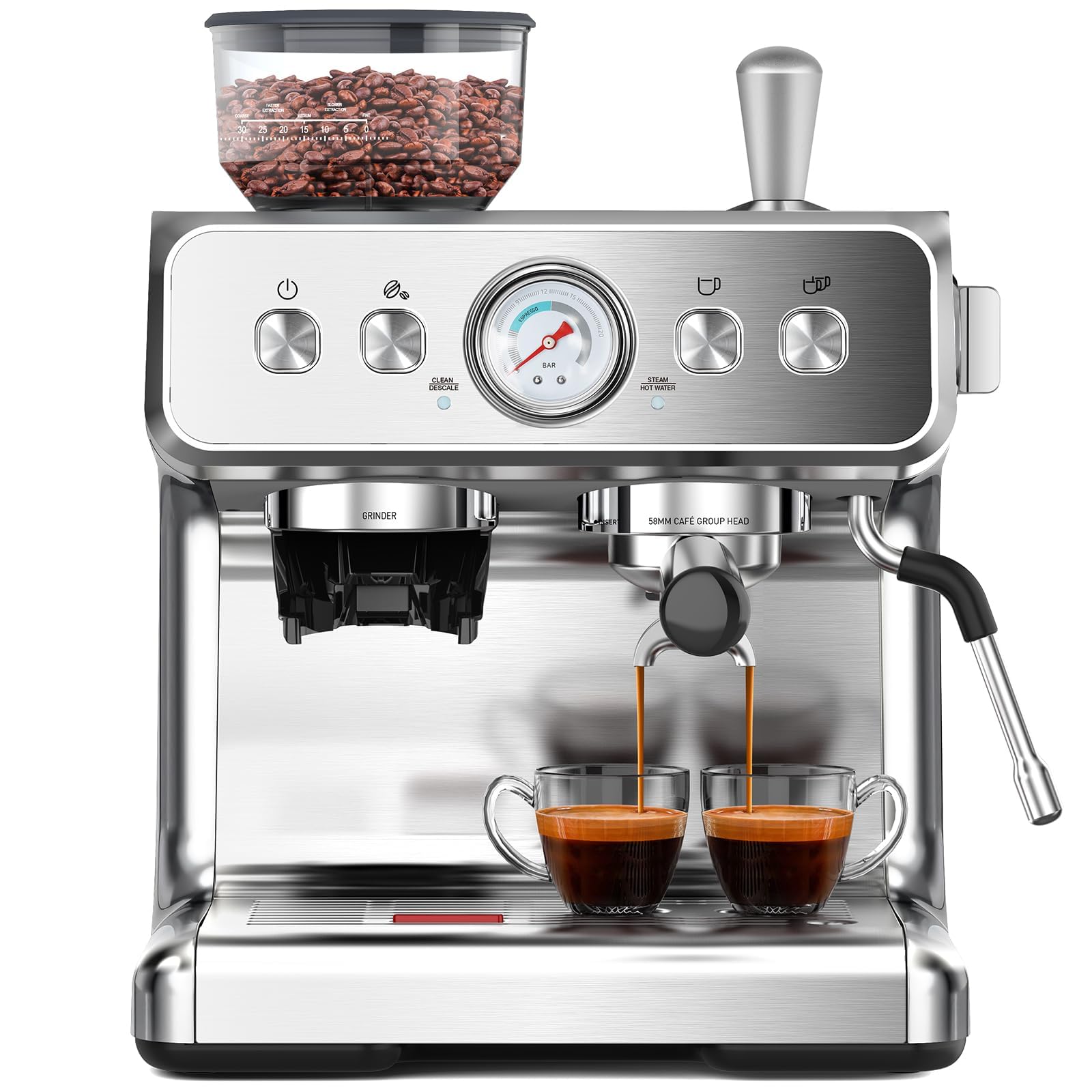
The big-tank Electactic with a clog-resistant grind path — a bean-to-cup machine that shipped with a 2.8-litre reservoir.
This is the machine for someone who is done with cleaning grinder jams. The Electactic’s upgraded grind path uses a 20% wider polished chute and a reinforced helical auger (a screw-shaped blade that pushes ground coffee out) designed to eject grounds instantly, even with oily dark roasts. It also carries a 2.8-litre water tank, the largest capacity of any machine in this guide, so refilling is a weekly chore rather than a daily one. At 15 bar it applies the ideal extraction pressure to pull maximum flavor and crema from each grind.
The steam wand is the standout secondary feature — owners who upgraded from Breville machines say the pump maintains pressure longer and the steamer works faster and better on their prior machine. One 58mm portafilter also won converts: for buyers coming from smaller 52mm setups, the wider basket makes a meaningful difference in the shot. After over a month of daily use, users report coffee quality and performance that stands up to side-by-side testing. The 2.8-litre tank and 15.75″D x 13.39″W body make it a big machine built for a full kitchen.
The honest trade-off: this one really does require setup time. Several buyers describe needing a few hours to dial in the grind setting and get the first great shot, and the process uses a fair amount of beans in the process. The workflow also runs in three steps — grind, select shot, then place your mug — and one owner wanted the water added during the shot instead of after. Those are the small friction points. Once dialed in, the machine is described as delivering cafe-grade depth and crema and handling plant or dairy milk with a firm, steady steam wand.
Why owners talk about the steamer: the steam output is powerful enough that owners who compared it directly against the Breville Barista Express felt it maintained pressure longer — a rare claim at this price point.
Clean routine note: wipe the steam nozzle immediately after each froth and the machine stays tidy — bean oils and milk residue are what age grinders and wands.
Built for you if: you want fresh-ground espresso daily, a 2.8-litre tank you forget about for a week, and a steamer you do not have to fight.
Give it a pass if: you want to press a single button on day one and drink — this machine has a dialing-in period before it sings.
8. De’Longhi La Specialista Arte Evo Espresso Machine with Coffee Grinder
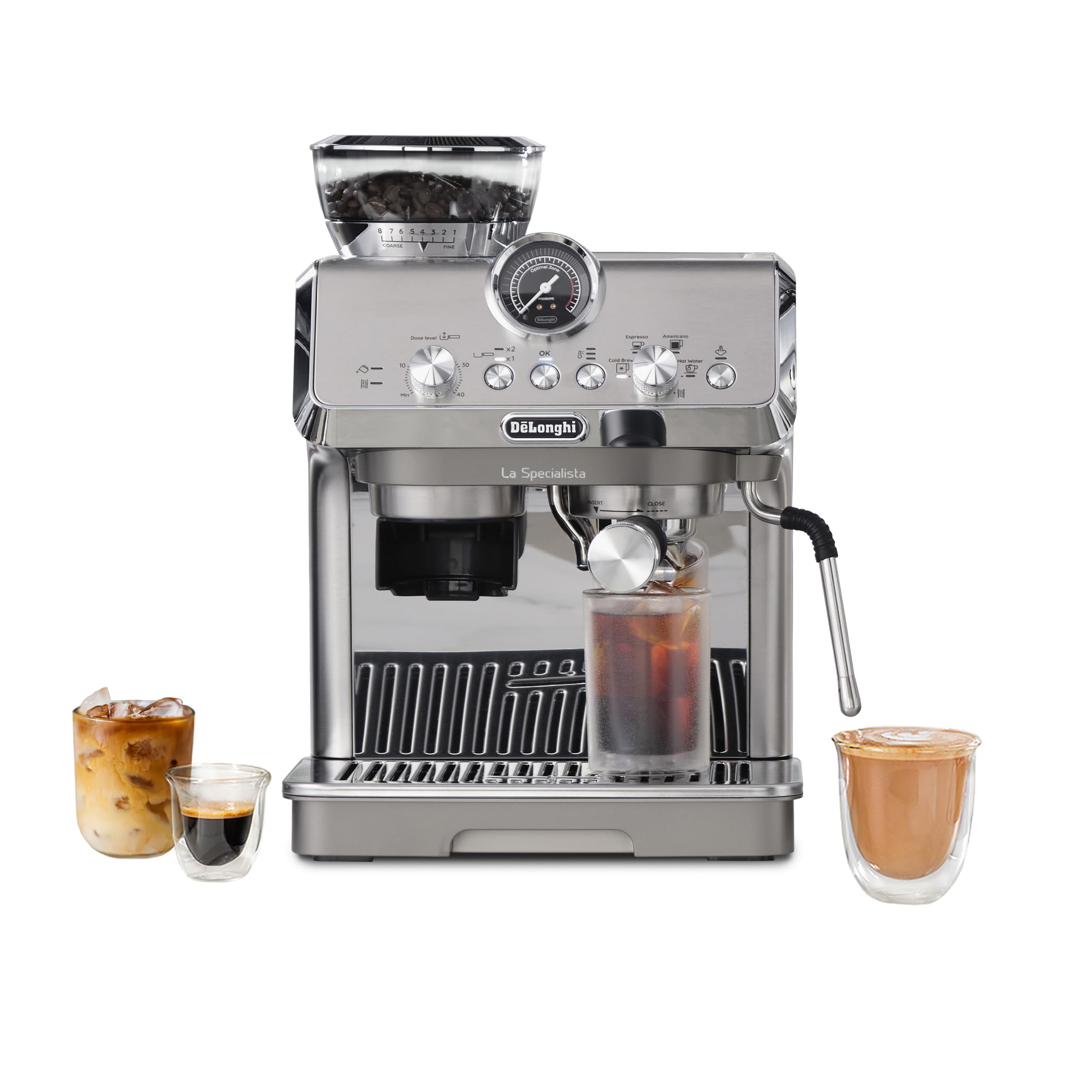
Espresso, Americano, and Cold Brew from one built-in grinder — La Specialista Arte Evo is the all-season machine.
If you want the same machine to pull a hot shot in January and a cold brew in July, this is where the list points you. The De’Longhi La Specialista Arte Evo runs a conical burr grinder with 8 grind settings, a 15-bar Italian pump that adjusts pressure from low during pre-infusion up to the optimal 9 bar during extraction, and De’Longhi’s proprietary Cold Extraction Technology, which brews cold brew in under five minutes using measured water flow and pressure. The machine has 4 presets — Espresso, Americano, Cold Brew, and Hot Water — right on the front panel. Active Temperature Control with 3 infusion temperatures lets you match the setting to a light or dark roast.
The barista kit included in the box is generous — a dosing and tamping guide, a tamping mat, a stainless steel milk frothing jug, a cleaning needle, and filters — which removes a surprising amount of the learning curve for a first machine. Owners describe easy setup, cafe-quality espresso with rich crema, and consistent smooth shots over a month of use. The compact stainless body, at 14.37″D x 11.22″W x 15.87″H and 21.5 pounds, fits where a drip coffee maker used to sit. The commercial-style steam wand heats quickly and produces the steady steam pressure needed for latte art.
The mixed news is the grinder. Grinder reliability and value for money both drew mixed feedback from owners, and there are reports of the integrated grinder clogging with bean oils over longer use — one long-term owner fixed their own by a partial disassembly following an online guide, and a less lucky one ended up in a warranty maze. The machine is also heavier than most picks here at 21.5 pounds, so it is not a move-around unit. Go in expecting to keep the grinder clean and this is a versatile machine; pass on it if you would rather grind with a separate tool you can replace independently.
Why It Stands Out
- Cold Extraction Technology brews cold brew in under five minutes
- 8-setting conical burr grinder plus 4 presets cover the whole drink list
- Active Temperature Control with 3 infusion temperatures for varying roasts
- Full barista kit included: dosing guide, tamping mat, milk jug, cleaning tools
- Compact stainless design that slots into a drip maker’s old spot
Where It Demands Attention
- Built-in grinder is the part most likely to clog with oily beans
- Heavier at 21.5 pounds — not a machine you shift around
- Grinder reliability drew mixed owner feedback, so clean it on schedule
The right call if: you want one machine for both hot espresso drinks and cold brew, with the grinder and barista tools already in the box.
Choose differently if: you plan to grind very oily dark roasts daily and would rather replace a standalone grinder than take apart an integrated one.
9. Breville BES870XL Barista Express Espresso Machine, Brushed Stainless Steel
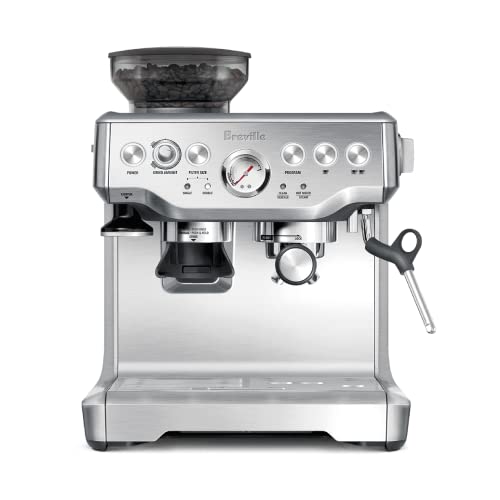
The ten-year-ownable Breville that grinds straight into the portafilter and goes beans-to-espresso in under a minute.
No other machine here has ownership stories this long. Buyers report running the BES870XL daily for nearly a decade with regular cleaning and descaling, and one has two units — one over ten years old and still going. That longevity is why it holds the top of the premium tier here. It combines a precision conical burr grinder (grinds on demand straight into the portafilter) with a PID temperature controller for precise extraction and a 1600W system.
The workflow is what owners describe as the real payoff: grind size dials from fine to coarse, the integrated tamper lets you compress the puck in place, and the machine goes from whole beans to a pulled shot in under a minute. A 67 oz water tank and a 1/2 lb bean hopper mean one person can go a while before refilling either. The steam wand produces the silky microfoam you want for latte art, and there is a hot water dispenser on the side for teas and americanos. The included Razor Dose Trimming Tool, 54mm portafilter, and single and dual wall filter baskets round out a package that ships ready to brew.
The real costs of ownership are maintenance and price. This is the pricier machine on the list, and it asks for a genuine ritual: daily wipe and purge of the steam wand, weekly cleaning of parts, water filter changes — one owner recommends changing the filter every 60 uses — and regular descaling. Wear items do come up, with the solenoid valve and o-rings reported as the parts that need attention over the machine’s life. That maintenance is exactly what keeps them running for years, so if you want a neglected machine, this is not it. If you want one that pays off in home cups over the long haul, it does.
Longevity is the headline: ten-plus years of daily service is what owners actually document, which is a durability story almost nothing else here matches.
The real trade-off: the top of the market price plus a maintenance calendar. it’s not for you if you will not descale on schedule.
Right for the long game: you want one machine that lasts years, grinds for you, and pulls café-grade shots at the press of a portafilter.
Look elsewhere if: you will not commit to a maintenance routine, or you want a machine you can ignore for months at a time.
10. Ninja Luxe Café Pro Series, Espresso, Cold Brew, Hot Water, ES701

Four machines in one countertop body — espresso, drip coffee, cold brew, and hot water, all from the Ninja ES701.
This is for the household that cannot agree on a drink. The Ninja Luxe Café Pro ES701 brews espresso (single, double, quad, ristretto, and lungo), drip coffee (classic, rich, or over ice), two cold brew styles (cold-pressed espresso or cold brew coffee), and has its own independent hot water system — all in one machine. If you want the same unit to make a lungo for you and a drip coffee for a partner who does not drink espresso, that flexibility alone justifies considering it.
The Barista Assist Technology is where the machine earns its name. It recommends grind size based on your last brew, weighs your dose for you with an integrated scale, then actively adjusts brewing temperature and pressure for a balanced shot. A 25-setting conical burr grinder feeds it, and an integrated lever tamper compresses grounds without any counter mess. A Dual Froth System Pro handles dairy or plant-based milk, with five preset froth functions including steamed milk, thin froth, thick froth, extra-thick froth, and cold foam, plus an insulated steam wand and an XL milk jug. Owners describe it as easy to use, particularly the simplified espresso setup, and say the coffee quality exceeded their expectations — one even noted their non-techy husband shot video of his first cup.
The one knock across owner feedback is durability mixed with froth performance — this is a highly capable machine for its tier, but long-term reliability is a genuine “wait and see” compared to the multi-year track record of the Breville and De’Longhi machines here. The footprint is also substantial at 27.1 pounds, so it owns its countertop space. That is the honest trade-off for getting four brew methods from one plug.
Where it leads: flexibility. No other machine here brews espresso, drip coffee, cold brew, and hot water in the same body, which makes the premium price easier to justify for a multi-drink household.
Ideal for: a busy household that needs espresso, drip coffee, cold brew, and hot water all from one machine — this is the only pick here that does all four.
Think twice if: you only ever drink espresso shots and would rather spend the money on a machine with a longer proven reliability record.
11. Breville BES881BSS Barista Touch Impress, Brushed Stainless Steel
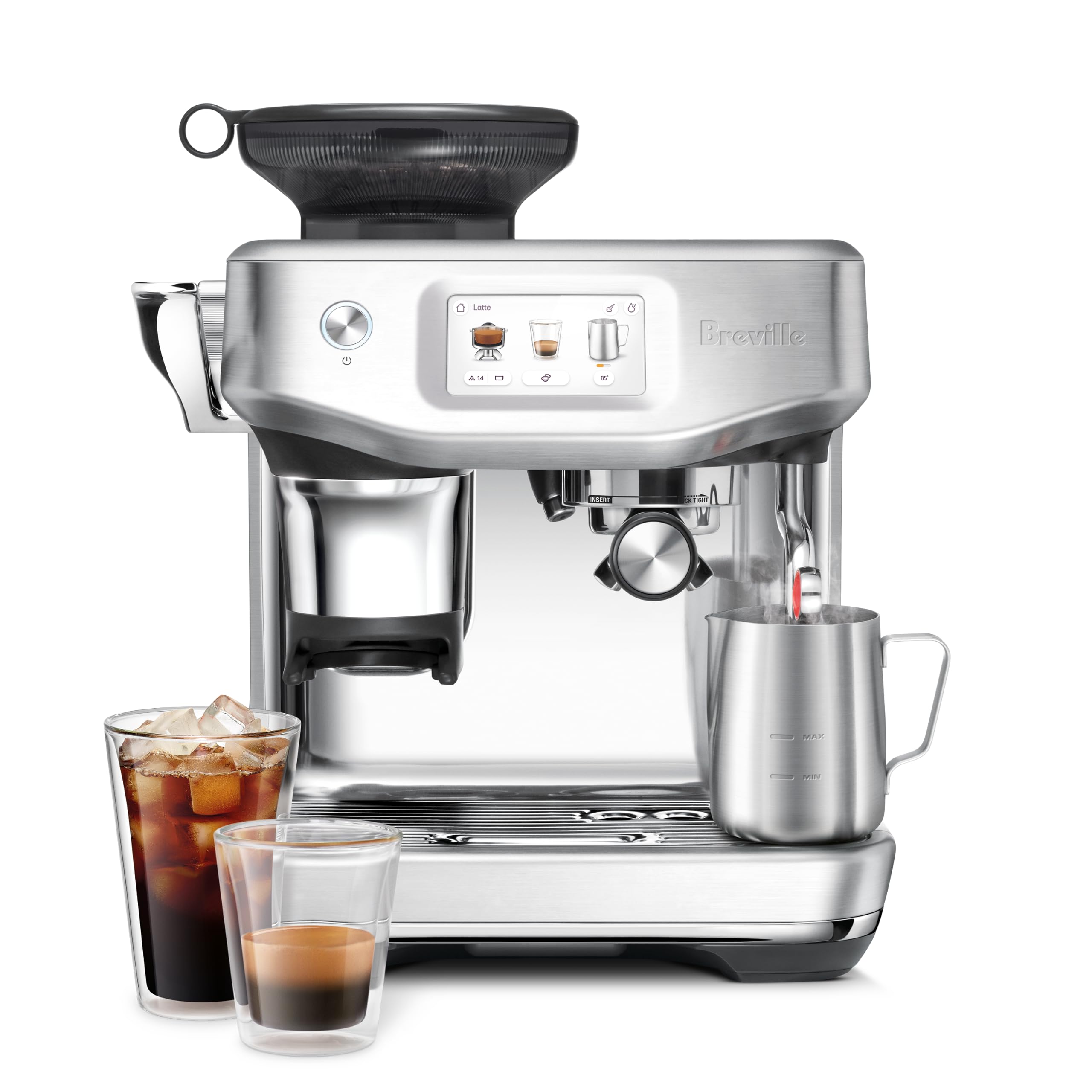
The Breville Touch Impress tamps, doses, froths, and pulls the shot for you — the closest thing here to pressing one button.
This is the machine for someone who wants the café ritual without any of the manual skill. The Barista Touch Impress uses the Impress Puck System to dose, tamp with 22 pounds of assisted force, and auto-correct the next dose — all while its Auto MilQ steam wand adjusts milk temperature and texture on its own. Three alternative milk settings calibrate air injection time and temperature specifically for different milk types, so an oat milk latte gets a foam profile tuned to oat milk. The 4-inch touchscreen (13 café presets) walks you through each drink step by step, and a ThermoJet heating system reaches extraction temperature in three seconds. A 30-setting Baratza European precision conical burr grinder delivers ground coffee on demand.
What owners rave about is the workflow. Set your milk temperature and froth level once, and the machine reproduces it shot after shot — one buyer who upgraded from a previous Breville said it was the no-thinking-required espresso machine they had been waiting for. Grind size auto-learns, the tamper is hands-free, and the enclosed grind path keeps the counter mess-free. Owners describe it as matching boutique coffee shops and delivering café-quality shots within a couple of sessions of dialing in. Fits a full kitchen at 13.4″D x 14.2″W x 16.3″H.
The honest part: this is the lowest-rated machine on this list, and the aspects owners flag are reliability and consistency. The most repeated frustration is that the machine sometimes needs its grind and dose recalibrated each time it powers on — a pattern that wastes beans during the reset. Others describe inconsistent shot times when switching between beans. It also carries the highest price tag of any pick here. For buyers who want auto-performance and do not mind the price, it is remarkable when it works; for buyers who want predictable repeatability with no calibration, the alternatives above may fit better.
Why It Earns The Top Tier
- Auto MilQ steam wand with 3 alternative-milk settings for hands-free microfoam
- Assisted 22 lb tamping with auto-correction of the next dose
- ThermoJet heating reaches extraction temperature in 3 seconds
- Baratza European precision conical burr grinder with 30 grind settings
- Touchscreen with 13 café presets and step-by-step guidance
What To Budget For
- Some owners mention needing to recalibrate grind and dose each time it powers on, wasting beans
- The highest price tier in this list
- Reliability drew mixed owner feedback, so extend the warranty if you can
The hands-free dream: pick this if you want auto-tamping, auto-frothing, and step-by-step guidance from a touchscreen, and you will not miss the money.
Not for you if: you want the same shot every day with zero calibration fuss — the required re-dialing is the trade-off here.
Understanding the Specs
Bar Pressure (the Pump’s Force)
The “20 bar” or “15 bar” on the box is the maximum water pressure the pump can push, measured in bars. Espresso needs a forceful, steady push to compress water through a tightly packed puck of fine grounds and pull out the oils that become crema. Most home machines here run 20-bar Italian pumps, which comfortably cover the 9-bar pressure espresso actually extracts at. What matters more than the headline number is that the pump holds steady pressure through the whole shot — an inconsistent pump gives you sour or bitter swings.
PID Temperature Control
A PID controller (Proportional-Integral-Derivative, a chip that reads temperature and continuously adjusts the heater) is what separates a machine that holds water temperature to within about two degrees from one that swings between too cool and too hot. Brew espresso below the ideal range and it tastes sour and thin; above it and it tastes bitter and burnt. If the box lists PID, NTC temperature control, or “active temperature control,” that is your sign the machine is managing this for you.
Water Tank Capacity
Measured in fluid ounces or liters, tank size decides how often you refill. A 40 oz tank on a compact machine suits one or two drinks a day. A 60-to-73 oz tank on a mid-range machine can stretch a week for a small household. The largest pick here, the Electactic, carries a 2.8-litre tank — enough that refilling becomes a weekend chore instead of a daily one. Removable tanks also make cleaning easier because you can take the whole thing to the sink.
Built-In Grinder and Grind Settings
An integrated grinder grinds whole beans fresh into the portafilter, so you get maximum aroma with no separate appliance. The number of grind settings (8, 20, 25, or 30, depending on the machine) sets how finely you can tune the grind — more settings give more control for matching different beans. Fresh-ground coffee is the single biggest flavor upgrade you can make, which is why built-in grinders push a machine into a higher tier.
Steam Wand and Milk Frothing
A steam wand injects high-pressure steam into cold milk, which heats it and whips in air to create the dense texture called microfoam — the stuff that pours into latte art. A manual wand lets you control the texture but takes practice. An automatic or auto-milk frother (like De’Longhi’s Auto MilQ or the AMZCHEF auto-frother system) does the steaming and the swirling for you, which is why they are the preferred choice for anyone who does not want to learn the pour.
Power Wattage and Heat-Up Time
Heating wattage (1350W, 1600W, and similar) is what determines how fast the machine reaches brewing temperature. A 1350W element reaches temperature in roughly 30 seconds on the compact machines here; a 1600W system with ThermoJet technology can be ready in as little as three seconds. If you brew before work and every second counts, heat-up speed is worth checking closely. Thermoblock heating systems are the technology that makes this fast warm-up possible without a long boiler wait.
FAQ
Do I really need a 20-bar pump, or is 15 bar enough?
How big a water tank do I need for daily espresso?
Is a built-in grinder worth the extra money, or should I grind separately?
Can I use pre-ground coffee in a machine that has a grinder?
How often do I need to descale an espresso machine?
Will a compact espresso machine fit under standard kitchen cabinets?
How much does a steam wand really matter for lattes?
Does heat-up speed matter if I brew every morning?
Should I get a semi-automatic or a fully hands-free machine?
Do these machines work with alternative milks like oat or almond?
Final Thoughts: The Verdict
For most people, the best espresso machines pick here is the AMZCHEF Compact Espresso Machine 20 Bar (EM3131) — it packs a 20-bar Italian pump, PID temperature control holding water to about +/- 2°C, and a 30-second heat-up into a body you can actually fit on a small counter. It is the one pick here that beats the CHULUX on both counter width and water capacity while staying the lightest machine on the list. If your drinks are milk-based and you want silky foam without a pitcher, the AMZCHEF with Auto Milk Frother handles the whole latte workflow for you. And if you want a machine that lasts ten years with a built-in grinder, the Breville Barista Express is the long-term investment that homeowners keep coming back to.
One last thing before you decide: think about your counter, not just the specs. The compact AMZCHEF and slim CHULUX fit apartments; the mid-range CASABREWS Ultra and its 73 oz tank suit a family kitchen; the bean-to-cup machines and the 4-in-1 Ninja want a bigger footprint in exchange for more drink options. Match the machine to the space you have and the drinks you actually drink, and espresso at home goes from a nice idea to a daily habit.
How We Picked
We do not accept paid placement. Every pick is matched to a real buyer and a real use-case; we do not hands-on test units.
Sources & Methodology
Specifications: manufacturer listings and product documentation. Review insights: verified customer reviews, as of September 2026. Pricing: not shown on this page (it changes often); check the current price via the retailer link.
As an Amazon Associate, Gadgets Feed earns from qualifying purchases. This does not affect which products we feature.