
The shrill beep at 3 a.m. from a burnt piece of toast or a dying battery isn’t just annoying — it’s a failure mode that erodes your trust in the one device meant to save your life. A modern fire alarm system does more than scream at smoke; it distinguishes between cooking vapors and real danger, it talks to every other unit in the house, and it runs for a decade without asking you to swap a battery. The right system turns a chaotic evacuation into a coordinated, whole-home warning.
I’m Min — the co-founder and writer behind Gadgets Feed. I’ve spent hundreds of hours cross-referencing UL certification standards, battery chemistries, interconnect protocols, and false-alarm reduction claims to build this guide around the specific specs that separate a nuisance device from a life-safety appliance.
This guide evaluates seven top-rated systems across hardwired and battery-powered configurations, analyzing sensor accuracy, backup power, and whole-home interconnectivity to help you choose the best fire alarm systems for your home.
How To Choose The Best Fire Alarm Systems
The first mistake buyers make is treating all alarms as interchangeable. A fire alarm system is defined by three factors: sensor technology (photoelectric vs. ionization vs. dual-sensor), power architecture (hardwired with battery backup vs. sealed battery), and interconnect method (hardwired line vs. wireless RF). Each decision shifts the trade-off between installation complexity, long-term maintenance, and false-alarm immunity.
Sensor Technology and UL 217 9th Edition
The UL 217 9th Edition standard, effective in 2024, forces manufacturers to reduce nuisance alarms from cooking fumes and steam. Alarms that meet this spec use enhanced photoelectric sensors that can distinguish between smoke particles and water vapor. If you install an alarm that does not meet this standard, expect false triggers from your kitchen or bathroom. All seven products in this guide meet or exceed the latest UL standards.
Power and Interconnect Options
Hardwired systems with battery backup (like the Kidde 30CUAR or First Alert SC-9120B) interconnect through existing 120V AC wiring, which means every alarm on the same circuit sounds together. Wireless RF systems (like the X-Sense SC01-W and SC06-W) interconnect by radio signal, letting you retrofit whole-home coverage without running new wires. Battery-only units with sealed 10-year lithium cells eliminate the need for annual battery swaps entirely.
Battery Backup and End-of-Life Planning
An alarm that can’t survive a power outage is a liability. Hardwired units use 9V or AA alkaline backup — you must change these every year. Sealed lithium battery alarms last exactly the sensor’s lifespan: 10 years. When the unit reaches end-of-life (EOL), it chirps persistently, and you replace the entire device. Check the manufacturer date on the underside of every alarm and set a calendar reminder to replace all units at year 10.
Quick Comparison
On smaller screens, swipe sideways to see the full table.
| Model | Category | Best For | Key Spec | Amazon |
|---|---|---|---|---|
| Kidde 30CUAR | Hardwired / 2-in-1 | Hardwired replacement with CO detection | 120V AC + 2 AA backup, 85 dB | Amazon |
| Kidde 30CUD10-V | Battery / 2-in-1 | Quick install with voice alerts | 10-year sealed battery, voice alerts | Amazon |
| First Alert SMI105-AC | Hardwired / Smoke Only | 3-pack value with Precision Detection | 120V AC + 10-year battery backup | Amazon |
| Siterlink GS562A | Hardwired / Smoke Only | Budget-friendly hardwired retrofit | 120V AC + 9V backup, photoelectric | Amazon |
| First Alert SC-9120B | Hardwired / 2-in-1 | Reliable CO + smoke on existing circuits | 120V AC + 9V backup, electrochemical CO | Amazon |
| X-Sense SC01-W | Battery / 2-in-1 | Wireless interconnect, 6-pack whole-home | 10-year lithium, RF interconnect, 85 dB | Amazon |
| X-Sense SC06-W | Battery / 2-in-1 | Sealed battery, no-wire upgrade | 10-year lithium, ionization sensor | Amazon |
In‑Depth Reviews
1. Kidde Hardwired Smoke & Carbon Monoxide Detector 30CUAR

The Kidde 30CUAR hits the sweet spot for most homes: it detects both smoke and carbon monoxide from a single 5-inch housing that runs on 120V AC wiring with two AA alkaline batteries as backup. The enhanced sensing technology complies with UL 217 9th Edition, meaning it actively filters out false triggers from cooking grease and steam while still catching real smoke at 85 decibels. The three-LED notification system communicates status at a glance — green for normal, amber for error, red for detected danger — without needing to climb a ladder to check.
Interconnect capability is the headline feature here. When you link multiple units on the same circuit, one alarm triggering will set off the entire chain, giving you critical seconds to evacuate before smoke spreads to a distant bedroom. The self-testing internal components verify the alarm’s circuitry daily, though Kidde still recommends a manual push-button test weekly.
The 2-pack configuration covers two floors or both ends of a hallway, and the 10-year limited warranty aligns with the industry-standard replacement cadence. The only catch is that older homes may need a wiring adapter (sold separately) if the existing connector doesn’t match the 30CUAR’s pigtail, so check your current mounting plate before purchasing.
Why it’s great
- Dual smoke and CO detection in a single, compact unit
- AA battery backup ensures operation during power outages
- Interconnectable so all alarms sound simultaneously
Good to know
- May require a wiring adapter for older mounting bases
- Not compatible with wireless interconnect — only hardwired
2. Kidde Smoke & Carbon Monoxide Detector 30CUD10-V

The 30CUD10-V eliminates the most common source of alarm fatigue: the chirping low-battery indicator. Its 10-year sealed lithium battery powers the unit for its entire lifespan, so you never swap a cell. What sets this model apart is the voice alert system — instead of a generic tone, it clearly says “Fire!” when smoke is detected and “Warning! Carbon Monoxide!” when CO reaches dangerous levels. This immediate verbal cue helps you determine the threat type without guessing, which is especially valuable for families with children or elderly residents.
Like its hardwired sibling, this unit uses enhanced sensing technology compliant with UL 217 9th Edition and UL 2034 4th Edition to reject false alarms from cooking fumes. The self-testing function checks internal components daily, and the test/silence button lets you quickly hush a nuisance trigger. At 0.8 pounds per unit, installation is straightforward using two screws into drywall or a junction box — no wiring required.
The trade-off is that this is a battery-only device with no hardwired interconnect. Each unit operates independently unless you pair multiple units via RF, which this model doesn’t support. You get voice clarity and zero battery maintenance, but you lose the whole-home simultaneous alert unless you buy additional units and manually coordinate them. This is a strong choice for renters or rooms where running wire is impractical.
Why it’s great
- Voice alerts identify the specific danger (fire vs. CO)
- 10-year sealed battery eliminates annual battery changes
- UL 217 9th Edition compliant for reduced false alarms
Good to know
- No hardwired interconnect — each unit operates solo
- Bracket design differs from older Kidde models
3. First Alert BRK Smoke Alarm SMI105-AC

The First Alert SMI105-AC is a smoke-only alarm that leans into the Precision Detection platform, First Alert’s implementation of UL 217 9th Edition sensor tuning. This means it discriminates between real smoke particles and the water vapor from a shower or a boiling pot, drastically reducing the annoyance of false triggers. The 10-year battery backup is built in — not a user-replaceable cell — so you get continuous protection during power outages without ever hearing a low-battery chirp across the decade.
Interconnect capability lets you link compatible alarms on the same hardwired circuit. When one unit detects smoke, all connected alarms sound simultaneously. The alarm indicator light on the triggering unit blinks red, so you can walk the house and identify which room started the event. The end-of-life warning chirps when the sensor reaches its 10th year, signaling it’s time to replace the entire unit.
The 3-pack gives you enough coverage for a two-bedroom home or a single floor with a basement. Installation is straightforward if you have existing hardwired smoke alarm wiring, though some users note that the mounting plate uses a different screw pattern than older models — you may need to drill new pilot holes. The subtle green LED backlight is a nice touch for nighttime visibility without being obtrusive in a bedroom.
Why it’s great
- 10-year sealed battery backup eliminates chirping forever
- Precision Detection reduces false alarms from cooking
- 3-pack provides whole-floor coverage at a budget-friendly price
Good to know
- Smoke only — does not detect carbon monoxide
- Mounting screws not included in the package
4. Siterlink Hardwired Interconnected Smoke Detector GS562A

Siterlink’s GS562A is a hardwired photoelectric smoke detector that complies with UL 217 9th Edition and connects up to 12 units on a single circuit for whole-home simultaneous alarming. The photoelectric sensor excels at detecting slow, smoldering fires (like a cigarette on upholstery) before they burst into flames, and the 9V battery backup keeps the alarm running through a power failure. The hidden LED indicator is a thoughtful design choice — it glows softly to confirm power status without casting harsh light into a child’s bedroom at night.
The 10-hour hush feature is particularly useful: a single press of the silence button mutes a false alarm for up to 10 hours, then automatically re-arms. This prevents the common workaround of removing batteries to stop a nuisance alarm, which leaves the home unprotected. The unit ships with a wiring harness, dust cap, and screw package, making it a turn-key upgrade for existing hardwired systems.
At 12.8 ounces and 1.5 inches deep, the GS562A is one of the slimmest hardwired detectors on the market, sitting nearly flush against the ceiling. The built-in alarm indicator is integrated rather than protruding, which some users find more aesthetically pleasing than the standard beehive-shaped units. The only notable downside is that it detects smoke only — if you need CO protection, you’ll need a separate companion unit, and Siterlink does not offer a 2-in-1 hardwired option in this form factor.
Why it’s great
- Slim, low-profile design with hidden LED indicators
- 10-hour hush button suppresses false alarms without disabling protection
- Interconnects up to 12 units for whole-home coverage
Good to know
- Smoke detection only — no carbon monoxide sensor
- 9V battery backup requires annual replacement
5. First Alert SC-9120B Hardwired Smoke and Carbon Monoxide Alarm

The First Alert SC-9120B is a hardwired combination alarm that pairs an ionization smoke sensor with an electrochemical carbon monoxide sensor, giving you dual-threat coverage from a single unit. Ionization sensors respond fastest to flaming, fast-moving fires, while the electrochemical CO sensor is the gold standard for carbon monoxide detection — it measures CO concentration accurately and triggers only when levels become dangerous, not from random fluctuations. This dual-sensor architecture means you get faster response to open flames than photoelectric alone, but you may experience more false alarms from kitchen smoke, so mounting location matters.
The 2-pack configuration lets you cover two zones — typically the hallway near bedrooms and the kitchen area — with both smoke and CO protection on the same hardwired circuit. The side-load battery compartment accepts a standard 9V alkaline backup, which is easy to replace annually. A single test/silence button handles both sensor checks and nuisance muting, and the LED indicator lights clearly differentiate between a smoke event and a CO event.
Installation takes about 30 seconds per unit if you’re replacing an existing First Alert or BRK alarm with the same mounting plate. The unit weighs only 0.57 pounds, so it won’t sag from the ceiling. The main consideration is that the ionization sensor will be more sensitive to cooking particulates — you may want to place this unit 10 feet away from the stove rather than directly over it. The sensor lifespan of 8–10 years aligns with the industry standard, and First Alert recommends writing the installation date on the underside with a Sharpie.
Why it’s great
- Dual-sensor coverage: ionization smoke + electrochemical CO
- Hardwired interconnect for whole-home simultaneous alarming
- Lightweight, quick-swap installation in under a minute
Good to know
- Ionization sensor may false-alert near kitchen cooking
- 9V backup battery must be changed every 12 months
6. X-Sense Interconnected Smoke and CO Detector Combo SC01-W
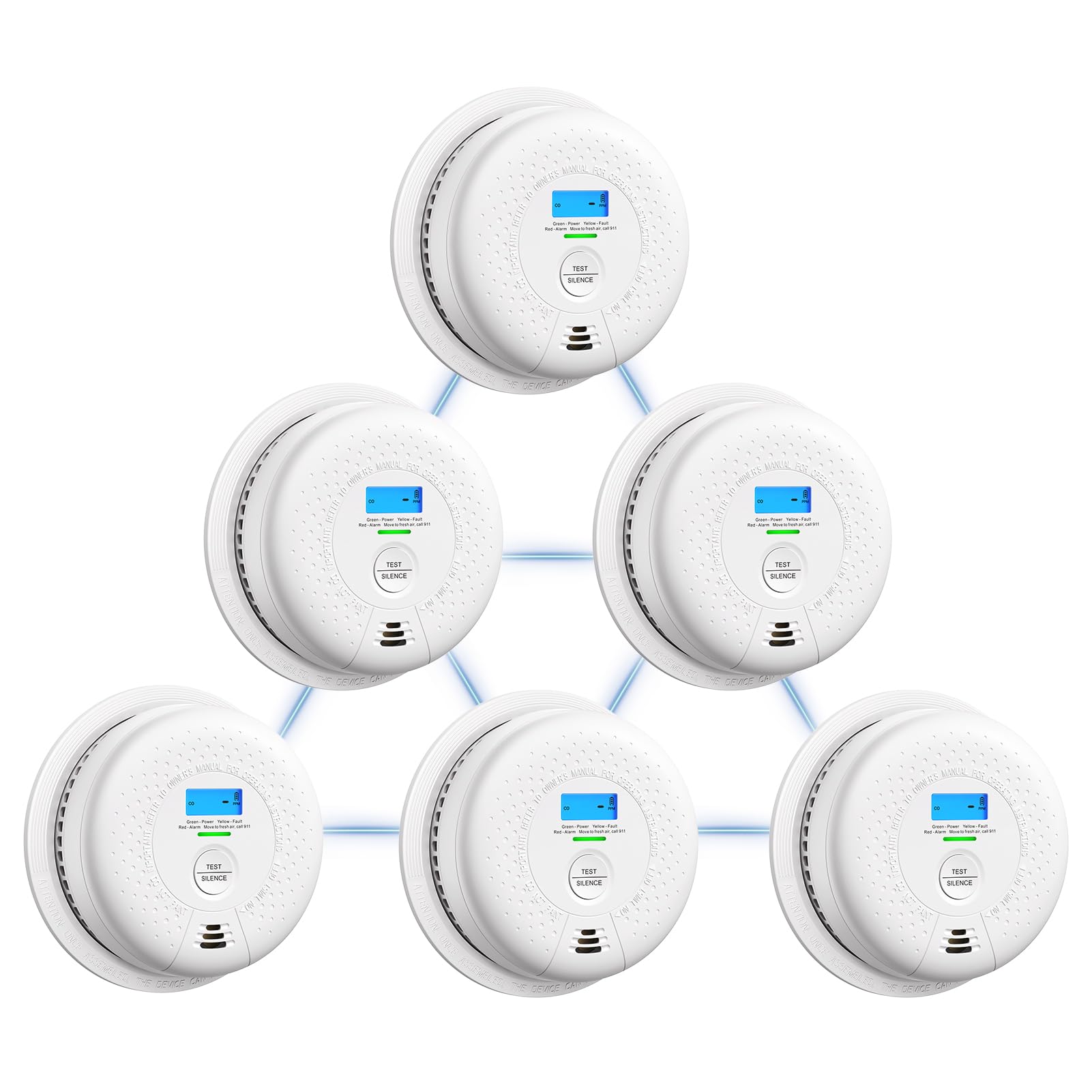
The X-Sense SC01-W is a wireless interconnected 2-in-1 detector that offers the whole-home simultaneous alert of a hardwired system without requiring any electrical wiring. The secret is RF interconnect: each of the six units communicates by radio signal, so when any one alarm detects smoke or CO, all six sound the 85 dB siren simultaneously. This makes it an ideal retrofit solution for homes without hardwired alarm circuits, for additions like a finished basement, or for apartments where you can’t alter the existing wiring.
Each unit houses a 10-year sealed lithium battery that powers the sensor and the RF transmitter for the unit’s entire lifespan. There are no user-replaceable batteries, no low-battery chirps, and no annual maintenance beyond a weekly push-button test. The extra-large 5.7-inch mounting bracket covers old screw holes and ceiling stains from previous alarms, so you don’t need to patch drywall when upgrading from an older system. The SC01-W carries UL 217 and UL 2034 certification, confirming its smoke and CO detection accuracy.
The 6-pack is enough to cover a typical three-bedroom home with detectors in each bedroom, hallway, basement, and living area. Pairing the units is a one-time synchronization process that takes about 10 minutes. The remote test button (sold separately) lets you test all units at once without climbing a ladder. The main limitation is that the RF interconnect range can be affected by thick walls or large metal appliances, so test the sync before permanently mounting all units.
Why it’s great
- Wireless RF interconnect — no wiring needed for whole-home alarming
- 10-year sealed battery eliminates all battery maintenance
- Large bracket covers old holes and stains from previous alarms
Good to know
- RF range can be reduced by thick walls or metal obstacles
- Mounting plate may not fit round electrical boxes without an adapter
7. X-Sense 6-Pack Interconnected Smoke and CO Detector SC06-W
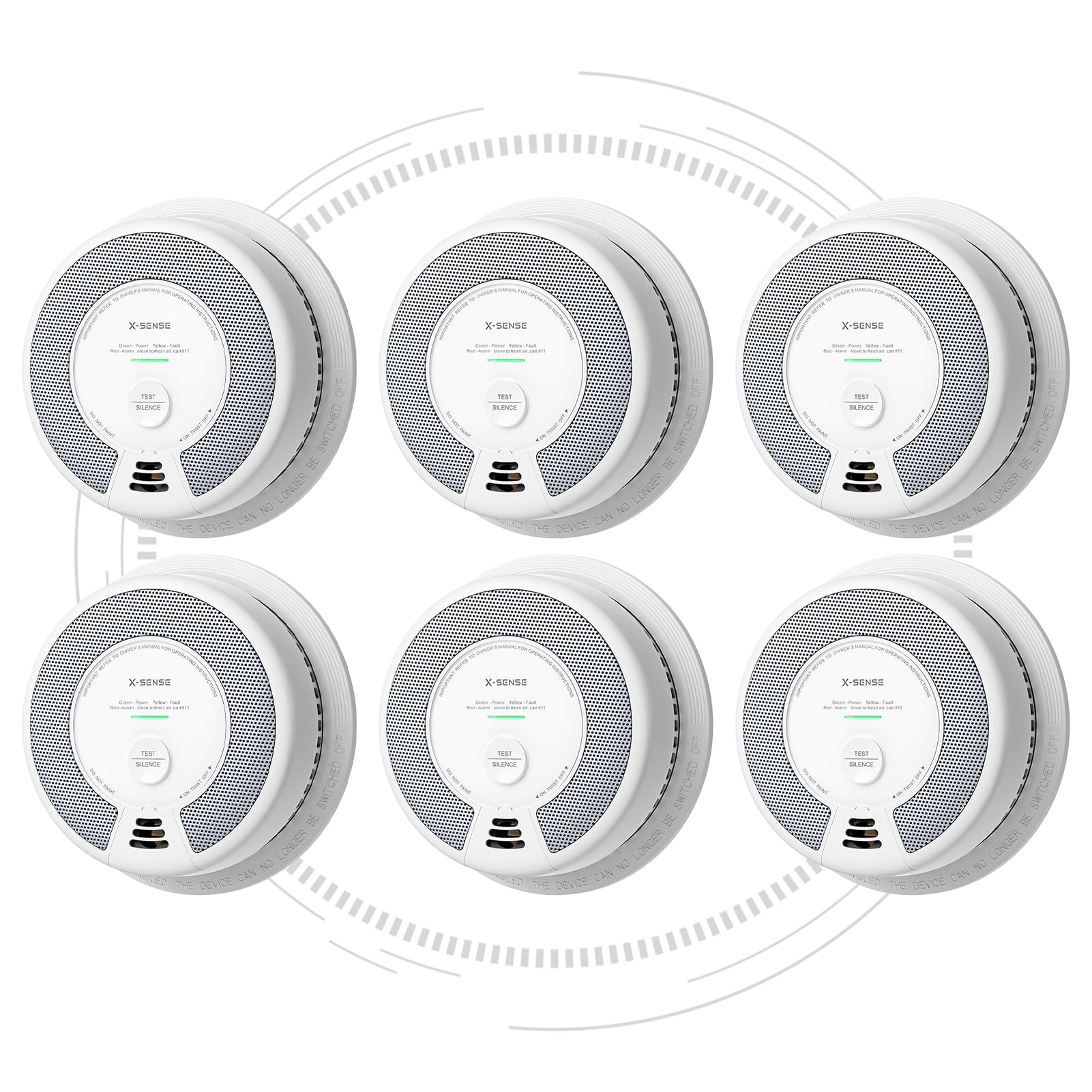
The X-Sense SC06-W is the more affordable sibling in the X-Sense line, offering the same 10-year sealed lithium battery and wireless RF interconnect as the SC01-W but using an ionization smoke sensor instead of a photoelectric one. Ionization sensors react faster to fast-flaming fires (paper, grease, electrical) but are historically more prone to nuisance alarms from cooking vapors. X-Sense claims UL 217 and UL 2034 certification for this unit, meaning the sensor tuning meets the same standard as the more expensive models, but the underlying technology still favors flaming-fire response over smoldering-fire detection.
The 6-pack covers a whole home at a per-unit cost that undercuts most competitors. Installation is identical to the SC01-W: mount the bracket, screw in the base, and pair the units via RF synchronization. The test/silence button on any unit triggers the entire network, so you can validate all alarms from one location. There is no Wi-Fi or smart-home integration — these are purely RF-interconnected detectors with no cloud connection, which also means no privacy concerns or subscription fees.
The SC06-W lacks the larger bracket that the SC01-W uses to cover old holes, so upgrading from an older unit may leave some wall imperfections visible. The factory pairing sometimes fails on bundled units, requiring manual re-pairing by holding the test button for 5 seconds on each unit. These are minor inconveniences for the value — at this price point for a 6-pack of interconnected 2-in-1 detectors with sealed 10-year batteries, the SC06-W is the most economical way to achieve whole-home coverage without wires.
Why it’s great
- Lowest per-unit cost for wireless interconnected 2-in-1 coverage
- 10-year sealed battery — no changes for the sensor’s lifespan
- Simple RF pairing creates whole-home alert without hardwiring
Good to know
- Ionization sensor may false-alert near kitchens more than photoelectric
- No adapter bracket for covering old junction box holes
FAQ
How many fire alarm units do I need for my home?
What does UL 217 9th Edition change about false alarms?
Can I mix different brands in a hardwired interconnect system?
How often should I replace my fire alarm system?
Final Thoughts: The Verdict
For most users, the fire alarm systems winner is the Kidde Hardwired Smoke & Carbon Monoxide Detector 30CUAR because it combines dual-threat detection, UL 217 9th Edition false-alarm immunity, hardwired interconnect, and affordable 2-pack pricing — the complete package for a wired home. If you want retrofit-friendly wireless whole-home coverage, grab the X-Sense SC01-W 6-Pack for its sealed lithium batteries and RF interconnect that requires zero wiring. And for the tightest budget to cover an entire house, the First Alert SMI105-AC 3-Pack gives you hardwired smoke coverage with a 10-year battery backup at the lowest cost per protected room.