
Our readers keep the lights on and my morning glass full of iced black tea. As an Amazon Associate, I earn from qualifying purchases.
Specs are compiled from manufacturer listings and verified buyer reviews and can change over time — please confirm the key details on the product page before buying.
If your favorite station fades in and out with every step you take, the fix is usually a better aerial, not a better radio. The right aerial turns static into clear, steady audio. We rank top FM aerials by real-world reception, cable reach, and setup ease.
I’m Min — the founder and writer behind Gadgets Feed. This guide is built by comparing the manufacturers’ published specifications and the patterns across verified customer reviews, so you get each pick’s real strengths and trade-offs instead of marketing spin.
This guide helps you pick an FM aerial that clears up your signal without guesswork.
Our Picks at a Glance


How To Choose The Best FM Radio Aerial
To get better FM reception, you swap a short, hidden wire for a longer, better-placed one. Most radios use a 75 ohm connection (a standard impedance for FM), so that is your safest bet for a direct hookup. Before buying, check your stereo’s back panel to see if it needs a screw-on F connector, a push-on PAL, or a 3.5mm jack.
Where you will mount it matters
A magnetic base model sticks to a metal shelf or filing cabinet, which is great for a quick desk setup. A dipole needs to be stretched out flat on a wall or behind a cabinet to work its best. If you are serious about distant stations, an outdoor or attic-mounted loop will beat any indoor wire, since walls and metal roofs block signals.
Cable reach changes your options
Longer coaxial cable means more freedom to position the antenna for a better signal. A short 10-foot cord means the antenna must sit near the receiver. A longer 16-foot cable lets you run it up to a window or another room, which often open up stations you could not get before.
Quick Comparison
| Model | Best For | Design | Cable Length | Impedance | Amazon |
|---|---|---|---|---|---|
| Bingfu Magnetic Base★ Best Overall | Versatile indoor tuning | Telescopic + magnetic | 10 ft | 75 ohm | Amazon |
| Fancasee Magnetic BaseMost Versatile | Compatibility with any port | Magnetic + 5 adapters | 10 ft | 75 ohm | Amazon |
| Universal Dipole | Vintage stereo upgrades | Twin-lead dipole | 16 ft | 75 ohm | Amazon |
| CHHLIUT Retractable Magnetic | Quick, mobile setups | Retractable + magnetic | 16 ft | 75 ohm | Amazon |
| Jensen Amplified | Vehicles and headliners | Amplified stick-on | 7 ft | 50 ohm | Amazon |
| Britta FM Loop | Serious attic coverage | Outdoor loop | — | 75 ohm | Amazon |
| Channel Master Dipole | Maximum long-range power | Outdoor dipole | — | 75 ohm | Amazon |
In‑Depth Reviews
1. Bingfu Strong Magnetic Base FM Radio Antenna
Our pick — over 4★ from 450+ verified ratings; the strongest balance of quality and price.
The magnetic-base swivel that adapts to any indoor spot you try.
This telescopic aerial solves the common problem of a radio tucked away where the signal cannot reach. Its 10-foot F-type cable (a standard coaxial connector) lets you move the antenna away from the receiver and onto a metal surface, and the strong magnetic base keeps it anchored through wind and rain if you mount it outside. The bottom swivels every which way, and the package includes three adapters, so you can connect a 3.5mm jack, a TV female socket, or a TV male plug.
Reception is the thing that wins people over here. The crowd reports that it doubles the number of clear stations they can pull in, and buyers in San Francisco say it gets 50+ channels including PBS. A shop owner who could only get static mounted it on the roof, and the magnet held through bad weather while pulling in a lot of stations. It works with Pioneer, Onkyo, Yamaha, Marantz, and Sherwood receivers, plus converter boxes and Samsung TVs, and it noticeably improves Tivoli radio tuning.
The 10-foot cord is shorter than the 16-foot dipole below, so you lose a bit of freedom to run the wire far from the receiver. That is a fair trade for a unit that stands on its own heavy base instead of needing a wall to stick to. If you want one antenna that works in a living room, a garage, or on a metal pole, this is the safest bet.
What stands out
- Swiveling magnetic base stays put on any metal surface
- Three adapters cover most radio and TV inputs
- Build quality earns consistent praise in reviews
Know the limit
- 10-foot cable is shorter than some competitors
- Best results need a metal surface to stick to
Reach for this if: you want one flexible indoor aerial that handles multiple receivers and spots.
The trade-off: you may need to keep it near the stereo since the cord stops at 10 feet.
2. Fancasee Universal FM Antenna with Magnetic Base
The adapter-packed aerial that mates with almost any vintage input.
If your receiver has an unusual socket, this is the aerial that gets you out of parity. It is a 75-ohm magnetic-base unit with a 10-foot coax cable and five different connectors: PAL male, PAL female, 3.5mm male, BNC male, and a 75-to-300 ohm adapter. That spread lets it plug into older gear like a 1976 Rotel receiver without hunting for a separate converter.
Buyers report this is the best of five antennas they tried, picking up Dallas stations from 12 miles away. It finds distant stations with ease, and it performs well in a basement with an older receiver, which is a tough environment for most indoor aerials. The pack includes two items, so you get the antenna plus the full set of connectors.
The honest caveat is the magnetic base, which draws the most mixed feedback. It is about the size of a quarter, so it holds best on a clean horizontal metal surface, and some owners ended up mounting it outside the garage instead. If your setup has a strong steel shelf, this is a bargain; if you need a heavy stand-alone base, the Bingfu above holds firmer.
Worth it for: the rare receiver with an odd port, and long-distance pulls like those Dallas stations from 12 miles out.
The catch: the magnet is small, so skip it if you only have painted or wooden surfaces nearby.
3. Universal FM Radio Dipole Antenna

The long twin-lead wire that revives a 1970s stereo’s lower band.
This dipole is built for the classic receiver that came with a flimsy wire antenna. It uses a 16-foot coaxial extension with a sticky mount, so you can run it up to a window and hide it behind a curtain. The 16-foot cord beats the 10-foot Bingfu and Fancasee models by 60%, giving you far more freedom to chase a clean signal. It includes a 75-to-300 ohm matching transformer, so it also fits radios with the older twin-screw terminals.
The brand is CHHLIUT, and owners adore it on vintage gear. A buyer with a 1970s Pioneer stereo improved lower FM reception from 40 miles away and got crisp sound, with the small antenna hidden by a curtain. Another replaced a silver telescoping rod and pulled in a favorite station clearly before even mounting it to the wall.
Performance gets mixed reviews overall, and one owner could not bring in a specific local station from Pismo Beach. This is the pick for classic receivers where the screw-on arms fit neatly; it just is not a guaranteed fix for every weak-signal corner of the map.
Best for: anyone upgrading an older Yamaha, Marantz, Onkyo, or Pioneer stereo with a 16-foot reach to a window.
Who may skip: listeners chasing a single stubborn distant station that needs a powered or outdoor aerial.
4. CHHLIUT Retractable Magnetic FM Antenna
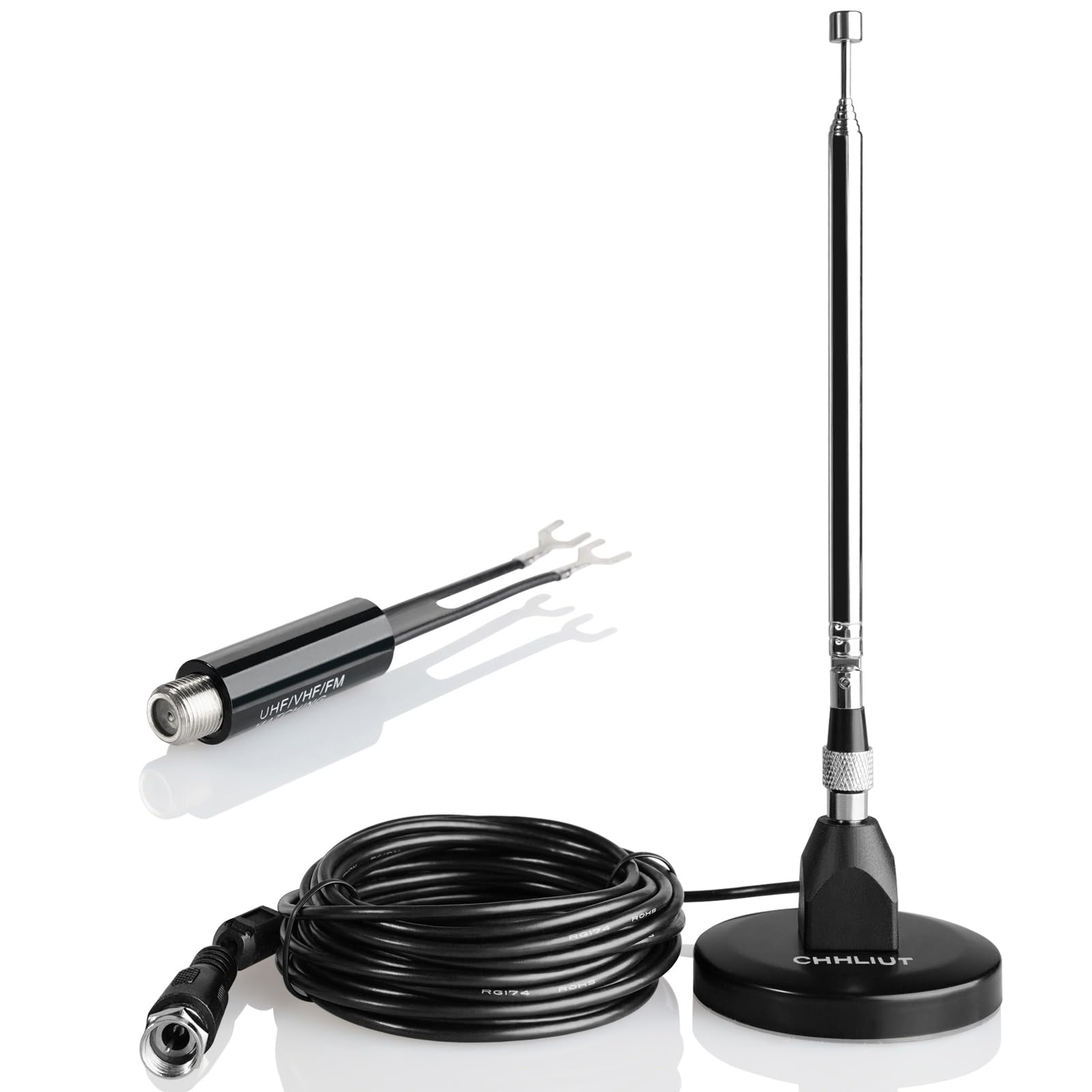
A light retractable aerial that stashes small and extends long.
This 75-ohm unit pairs a retractable telescopic element with a 16-foot coaxial cable, giving you both a compact footprint and serious reach. At 3.75 ounces, it is the lightest option here, and the retractable design means you can collapse it when not in use or extend it to find the balance. A strong magnetic base keeps it steady on metal surfaces without slipping.
It works smoothly with Pioneer, Onkyo, Yamaha, Marantz, and Sherwood receivers. The stand-out real story is a classical music fan on the wrong side of a hill who could not pull in the local station; this aerial did the trick after some repositioning. Another owner reports good reception even in a basement, and it works well in metal garages.
Reception is genuinely position-dependent, and one buyer in a warehouse could not get it to work well. Build quality draws mixed notes, with a complaint that the cable feels thin. It is a value pick for listeners who like to experiment with placement, not a set-and-forget solution.
Why it earns a spot
- 16-foot cable rivals the dipole for placement freedom
- Very light at 3.75 oz, easy to move and angle
- Strong magnet holds firm on metal
Where it stumbles
- Reception depends heavily on finding the right spot
- Some owners call the build quality cheap
Choose it for: a cheap, mobile experiment where you will move the antenna until the station locks in.
Think twice if: you want a rugged unit you can mount once and forget.
5. Jensen Amplified AM/FM Antenna
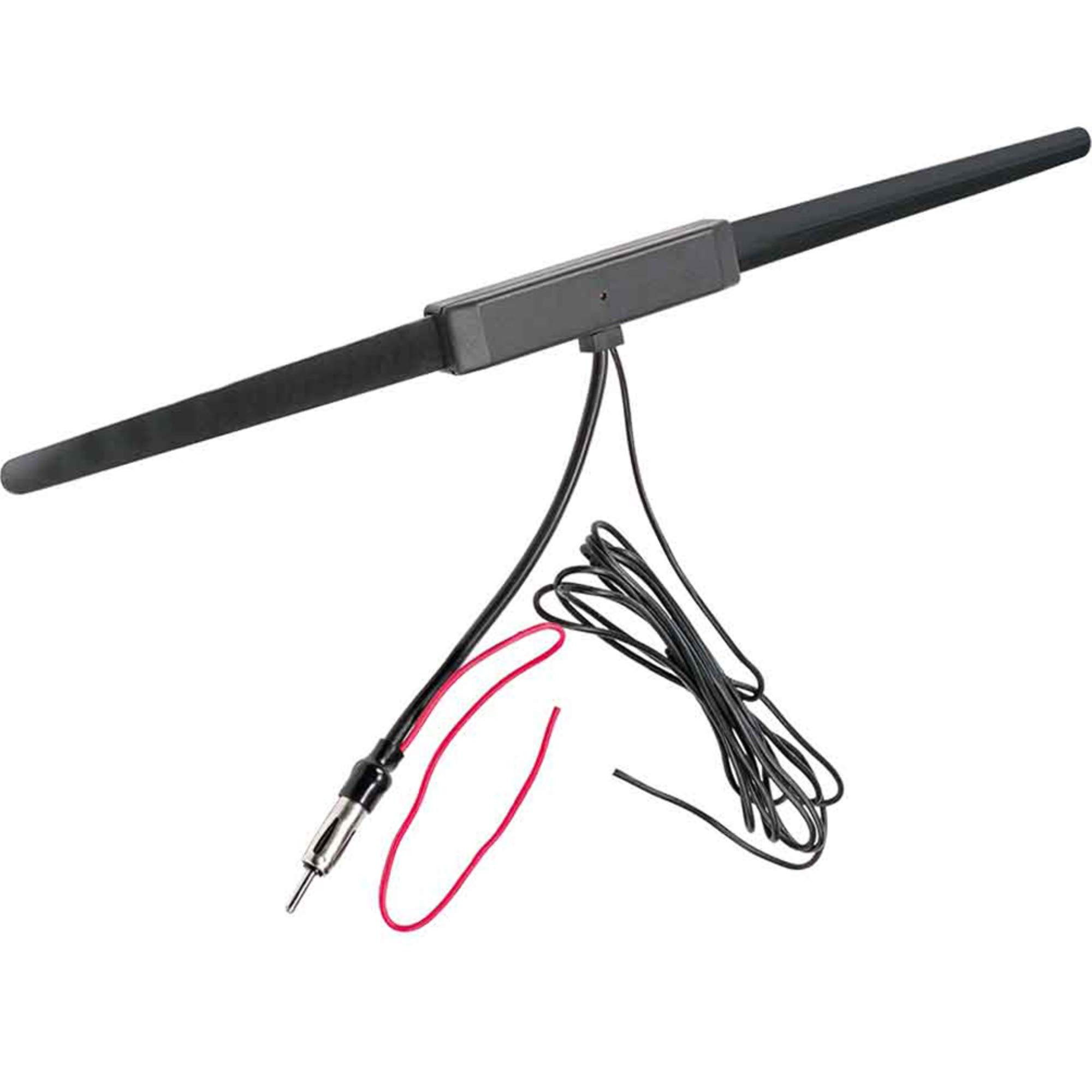
The amplified stick-on that disappears under a vehicle headliner.
This is a different breed: an amplified long-range antenna designed for demanding AM/FM listeners, most often in cars, boats, and side-by-sides. It mounts with adhesive foam strips and hides well under a headliner, so it is a favorite for replacing a bulky whip antenna. It draws 6 milliamps at 12V DC and includes a 7-foot cable. It is also rated for marine applications.
Installation is the thing everyone praises — the self-adhesive tape makes it a snap, and the antenna hides out of sight. A Polaris SXS owner who could previously get only the local station now pulls in any station available. Another installer in a Streetglide fairing reports reception better than the original whip while still in the garage.
Functionality gets mixed marks overall, and the biggest gap is AM: it does not work well on AM radio, and some users saw no real signal boost on FM. The 50-ohm impedance also means it is not a drop-in for a typical 75-ohm home stereo — this is a vehicle or marine aerial, full stop.
Perfect for: motorcycle fairings, boats, and UTVs where a short hidden powered antenna beats a whip.
Not for: home stereos with 75-ohm inputs, or anyone hoping to boost AM reception.
6. Britta FM Loop Antenna

The omni-directional loop that doubles your channel count without aiming.
This is a 75-ohm FM loop built for a home, office, attic, or an RV, and it is noticeably larger than most competitors at a 21.5-inch diameter. The heavy-duty aluminum construction with stand-offs and an integrated balun assembles in under 3 minutes. It outperforms indoor dipoles and whips on both analog and digital FM.
Buyers are emphatic: one replaced an indoor 300-ohm dipole and doubled the FM channels on a Pioneer TX-9500. An attic install improved reception 110%, and another owner picks up stations 70 to 80 miles away with up to 48 channels coming in clearly. It is essentially non-directional, so it picks up all but the weakest signals from every direction at once.
The trade-off is hardware, not reception. A few owners mention a missing assembly screw or loose washers in the box, and it needs a separate mast or mount to hold it. If you can live with a little assembly and want genuine long-range pull, this is the balance between indoor wires and a full outdoor beam.
Reach for it if: you want attic-grade coverage that grabs stations from all directions at once.
Plan for: buying a mounting pole, and checking the small parts bag before assembly.
7. Channel Master FM Antenna

The American-made dipole that pulls crisp stations from 55 miles out.
This is the heavy hitter for anyone who wants real range. It is a multi-directional outdoor dipole built from premium 6061 and 6063 aluminum, extruded and drilled locally in Chandler, Arizona. It comes with a heavy-duty matching transformer for a direct 75-ohm coaxial hookup to any receiver or FM radio with an external antenna jack. It supports both FM and HD Radio.
The build quality is the thing everyone raves about, and the reception backs it up. One owner mounted it on a rooftop mast and pulls in crisp stations from roughly 50 to 55 miles away. A garage setup that expected a few clear channels found at least ten. It assembles in less than five minutes and stands up to Kansas winds.
The honest catches: it is the priciest pick here, it needs a mast or wall mount (not included), and some receivers need a separate adapter to convert coaxial to their specific port. This is a permanent, weather-resistant install for the listener who wants the absolute maximum signal.
The case for it
- Premium 6061/6063 aluminum built to take weather
- Clear reception at 50 to 55 miles on a rooftop
- Assembles intuitively in under five minutes
What it asks of you
- Needs a separate mast or wall mount
- May require an adapter for your receiver’s port
Choose it if: distant stations matter more than convenience and you can commit to a permanent outdoor mount.
Look elsewhere if: you need a quick indoor fix or anything budget-friendly.
Understanding the Specs
75 Ohm vs 300 Ohm Impedance
Think of impedance as the shape of the plug your radio expects. Most modern and vintage stereo receivers use a 75-ohm coaxial connection, either a screw-on F-type or a push-on PAL. Older gear sometimes uses a 300-ohm twin-screw terminal, which needs a matching transformer. If you buy a 75-ohm aerial, check whether it ships with a 75-to-300 ohm adapter so you are not stuck at install time.
Cable Length and Placement Freedom
Cable length determines where you can place the antenna, not the wire’s quality. A 10-foot cord keeps the aerial near the receiver, which works if the receiver sits by a window. A 16-foot cord lets you run the antenna across a room or up to a better spot. For stubborn signals, the extra reach often matters more than the antenna design itself.
FAQ
Will a 75 ohm FM aerial work with my vintage stereo receiver?
What is the difference between a magnetic base and a dipole antenna?
How long does a 16 foot cable actually help my reception?
Can an indoor FM antenna pick up stations 40 miles away?
Do I need an amplified antenna for my car or boat?
Will an outdoor FM loop work in my attic?
What is the maximum range of the Channel Master FM antenna?
Why does my FM reception change when I move the antenna?
Final Thoughts: The Verdict
The clear winner in the fm radio aerial category is the Bingfu Magnetic Base, because its strong swiveling magnet, 10-foot cable, and three adapters solve indoor reception problems for the widest range of receivers. If you want maximum long-range power and are willing to mount outdoors, the Channel Master Dipole delivers crisp stations from over 50 miles away. And for a quick attic upgrade that pulls from every direction, the Britta FM Loop is the middle ground that likely doubles your channel count.
How We Picked
We do not accept paid placement. Every pick is matched to a real buyer and a real use-case; we do not hands-on test units.
Sources & Methodology
Specifications: manufacturer listings and product documentation. Review insights: verified customer reviews, as of August 2026. Pricing: not shown on this page (it changes often); check the current price via the retailer link.
As an Amazon Associate, Gadgets Feed earns from qualifying purchases. This does not affect which products we feature.